Proceedings of the 55th Annual Meeting of the Association for Computational Linguistics, pages 345–354 Vancouver, Canada, July 30 - August 4, 2017. c2017 Association for Computational Linguistics Proceedings of the 55th Annual Meeting of the Association for Computational Linguistics, pages 345–354
Vancouver, Canada, July 30 - August 4, 2017. c2017 Association for Computational Linguistics
Deep Learning in Semantic Kernel Spaces
Danilo Croce Simone Filice Giuseppe Castellucci Roberto Basili Department of Enterprise Engineering
University of Roma Tor Vergata, Via del Politecnico 1, 00133, Rome, Italy
{croce,filice,basili}@info.uniroma2.it [email protected]
Abstract
Kernel methods enable the direct usage of structured representations of textual data during language learning and inference tasks. Expressive kernels, such as Tree Kernels, achieve excellent performance in NLP. On the other side, deep neural net-works have been demonstrated effective in automatically learning feature representa-tions during training. However, their in-put is tensor data, i.e., they cannot man-age rich structured information. In this pa-per, we show that expressive kernels and deep neural networks can be combined in a common framework in order to (i) ex-plicitly model structured information and (ii) learn non-linear decision functions. We show that the input layer of a deep ar-chitecture can be pre-trained through the application of the Nystr¨om low-rank ap-proximation of kernel spaces. The result-ing “kernelized” neural network achieves state-of-the-art accuracy in three different tasks.
1 Introduction
Learning for Natural Language Processing (NLP) requires to more or less explicitly account for trees or graphs to express syntactic and semantic in-formation. A straightforward modeling of such information has been obtained in statistical lan-guage learning with Tree Kernels (TKs) (Collins and Duffy,2001), or by means of structured neu-ral models (Hochreiter and Schmidhuber, 1997;
Socher et al., 2013). In particular, kernel-based methods (Shawe-Taylor and Cristianini, 2004) have been largely applied in language processing for alleviating the need of complex activities of manual feature engineering (e.g., (Moschitti et al.,
2008)). Althoughad-hocfeatures are adopted by many successful approaches to language learning (e.g., (Gildea and Jurafsky, 2002)), kernels pro-vide a natural way to capture textual generaliza-tions directly operating over (possibly complex) linguistic structures. Sequence (Cancedda et al.,
2003) or tree kernels (Collins and Duffy,2001) are of particular interest as the feature space they im-plicitly generate reflects linguistic patterns. On the other hand, Recursive Neural Networks (Socher et al., 2013) have been shown to learn dense feature representations of the nodes in a struc-ture, thus exploiting similarities between nodes and sub-trees. Also, Long-Short Term Mem-ory (Hochreiter and Schmidhuber,1997) networks build intermediate representations of sequences, resulting in similarity estimates over sequences and their inner sub-sequences.
While such methods are highly effective and reach state-of-the-art results in many tasks, their adoption can be problematic. In kernel-based Support Vector Machine (SVM) the classification model corresponds to the set of support vectors (SVs) and weights justifying the maximal margin hyperplane: the classification cost crucially de-pends on their number, as classifying a new in-stance requires a kernel computation against all SVs, making their adoption in large data settings prohibitive. This scalability issue is evident in many NLP and Information Retrieval applications, such as in answer re-ranking in question answer-ing (Severyn et al., 2013; Filice et al., 2016), where the number of SVs is typically very large. Improving the efficiency of kernel-based methods is a largely studied topic. The reduction of com-putational costs has been early designed by impos-ing a budget (Dekel and Singer,2006;Wang and Vucetic,2010), that is limiting the maximum num-ber of SVs in a model. However, in complex tasks, such methods still require large budgets to reach
adequate accuracies. On the other hand, train-ing complex neural networks is also difficult as no common design practice is established against complex data structures. In Levy et al.(2015), a careful analysis of neural word embedding models is carried out and the role of the hyper-parameter estimation is outlined. Different neural architec-tures result in the same performances, whenever optimal hyper-parameter tuning is applied. In this latter case, no significant difference is observed across different architectures, making the choice between different neural architectures a complex and empirical task.
A general approach to the large scale modeling of complex structures is a critical and open prob-lem. A viable and general solution to this scal-ability issue is provided by the Nystr¨om method (Williams and Seeger, 2001); it allows to ap-proximate the Gram matrix of a kernel function and support the embedding of future input exam-ples into a low-dimensional space. For example, if used over TKs, the Nystr¨om projection corre-sponds to the embedding of any tree into a low-dimensional vector.
In this paper, we show that the Nystr¨om based low-rank embedding of input examples can be used as the early layer of a deep feed-forward neural network. A standard NN back-propagation training can thus be applied to induce non-linear functions in the kernel space. The resulting deep architecture, called Kernel-based Deep Architec-ture(KDA), is a mathematically justified integra-tion of expressive kernel funcintegra-tions and deep neu-ral architectures, with seveneu-ral advantages: it (i) di-rectly operates over complex non-tensor struc-tures, e.g., trees, without any manual feature or architectural engineering, (ii) achieves a drastic re-duction of the computational cost w.r.t. pure ker-nel methods, and (iii) exploits the non-linearity of NNs to produce accurate models. The experimen-tal evaluation shows that the proposed approach achieves state-of-the-art results in three semantic inference tasks: Semantic Parsing, Question Clas-sification and Community Question Answering.
In the rest of the paper, Section2surveys some of the investigated kernels. In Section 3 the Nystr¨om methodology and KDA are presented. Experimental evaluations are described in Section
4. Finally, Section5derives the conclusions.
2 Kernel-based Semantic Inference
In almost all NLP tasks, explicit models of com-plex syntactic and semantic structures are re-quired, such as in Paraphrase Detection: deciding whether two sentences are valid paraphrases in-volves learning grammatical rewriting rules, such as semantics preserving mappings among sub-trees. Also in Question Answering, the syntac-tic information about input questions is crucial. While manual feature engineering is always possi-ble, kernel methods on structured representations of data objects, e.g., sentences, have been largely applied. Since Collins and Duffy (2001), sen-tences can be modeled through their correspond-ing parse tree, and Tree Kernels (TKs) result in similarity metrics directly operating over tree frag-ments. Such kernels corresponds to dot products in the (implicit) feature space made of all possi-ble tree fragments (Haussler, 1999). Notice that the number of tree fragments in a tree bank is combinatorial with the number of tree nodes and gives rise to billions of features, i.e., dimensions. In this high-dimensional space, kernel-based algo-rithms, such as SVMs, can implicitly learn robust prediction models (Shawe-Taylor and Cristianini,
ROOT
P . ?::. PRD
NMOD PMOD
NN field::n NMOD
NN football::n NMOD
DT a::d IN of::i NN width::n NMOD
[image:3.595.86.271.65.155.2]DT the::d VBZ be::v SBJ WP what::w
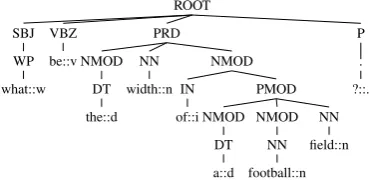
Figure 1: Grammatical Relation Centered Tree (GRCT) of“What is the width of a football field?”
word embedding methods (e.g., (Mikolov et al.,
2013;Sahlgren,2006). In particular, we adopt the Smoothed Partial Tree Kernel (SPTK) described inCroce et al. (2011): it extends the PTK formu-lation with a similarity function between lexical nodes in a GRCT, i.e., the cosine similarity be-tween word vector representations based on word embeddings. We also use a further extension of the SPTK, called Compositionally Smoothed Partial Tree Kernel(CSPTK) (as inAnnesi et al.(2014)). In CSPTK, the lexical information provided by the sentence words is propagated along the non-terminal nodes representing head-modifier depen-dencies. Figure2shows a compositionally-labeled tree, where the similarity function at the nodes can model lexical composition, i.e., capturing contex-tual information. For example, in the sentence, “What instrument does Hendrix play?”, the role of the wordinstrumentcan be fully captured only if its composition with the verb play is consid-ered. The CSPTK applies a composition tion between nodes: while several algebraic func-tions can be adopted to compose two word vectors representing a head/modifier pair, here we refer to a simple additive function that assigns to each (h, m)pair the linear combination of the involved vectors, i.e.,(h,m) =Ah+Bm: although
sim-ple and efficient, it actually produces very effec-tive CSPTK functions.
Complexity. The training phase of an optimal maximum margin algorithm (such as SVM) re-quires a number of kernel operations that is more than linear (almost O(n2)) with respect to the number of training examples n, as discussed in Chang and Lin (2011). Also the classification phase depends on the size of the input dataset and the intrinsic complexity of the targeted task: clas-sifying a new instance requires to evaluate the ker-nel function with respect to each support vector. For complex tasks, the number of selected sup-port vectors tends to be very large, and using the
resulting model can be impractical. This cost is also problematic as single kernel operations can be very expensive: the cost of evaluating the PTK on a single tree pair is almost linear in the number of nodes in the input trees, as shown inMoschitti
(2006). When lexical semantics is considered, as in SPTKs and CSPTKs, it is more than linear in the number of nodes (Croce et al.,2011).
3 Deep Learning in Kernel Spaces 3.1 The Nystr¨om method
Given an input training dataset D, a kernel K(oi, oj) is a similarity function over D2 that
corresponds to a dot product in the implicit ker-nel space, i.e., K(oi, oj) = Φ(oi) ·Φ(oj). The
advantage of kernels is that the projection func-tion Φ(o) = x ∈ Rn is never explicitly
com-puted (Shawe-Taylor and Cristianini, 2004). In fact, this operation may be prohibitive when the dimensionalitynof the underlying kernel space is extremely large, as for Tree Kernels (Collins and Duffy,2001). Kernel functions are used by learn-ing algorithms, such as SVM, to operate only im-plicitly on instances in the kernel space, by never accessing their explicit definition. Let us apply the projection function Φ over all examples from D
to derive representations, xdenoting the rows of
the matrix X. The Gram matrix can always be
computed asG=XX>, with each single element corresponding toGij = Φ(oi)Φ(oj) =K(oi, oj).
The aim of the Nystr¨om method is to derive a new low-dimensional embeddingx˜ in al-dimensional space, withlnso thatG˜= ˜XX˜>andG˜ ≈G.
This is obtained by generating an approximation ˜
GofGusing a subset oflcolumns of the matrix,
i.e., a selection of a subset L ⊂ D of the avail-able examples, calledlandmarks. Suppose we ran-domly samplelcolumns ofG, and letC ∈R|D|×l
be the matrix of these sampled columns. Then, we can rearrange the columns and rows ofGand
de-fineX= [X1 X2]such that:
G=XX>=
W X1>X2
X2>X1 X2>X2
and C=
W X2>X1
(1)
whereW =X1>X1, i.e., the subset ofGthat
con-tains only landmarks. The Nystr¨om approxima-tion can be defined as:
roothplay::v,*::*i
VB
play::v
nsubjhplay::v,Hendrix::ni
NNP
Hendrix::n
auxhplay::v,do::vi
VBZ
do::v
dobjhplay::v,instrument::ni
NN
instrument::n
dethinstrument::n,what::wi
WDT
[image:4.595.150.449.75.129.2]what::w
Figure 2:Compositional Grammatical Relation Centered Tree (CGRCT) of “What instrument does Hendrix play?” whereW† denotes the Moore-Penrose inverse of
W. The Singular Value Decomposition (SVD) is
used to obtainW† as it follows. First, W is
de-composed so that W = U SV>, where U and V are both orthogonal matrices, and S is a
di-agonal matrix containing the (non-zero) singular values of W on its diagonal. Since W is
sym-metric and positive definite W = U SU>. Then W†=U S−1U>=U S−12S−12U>and the
Equa-tion2can be rewritten as
G≈G˜ =CU S−12S− 1 2U>C>
= (CU S−12)(CU S−21)>= ˜XX˜> (3)
Given an input example o ∈ D, a new
low-dimensional representation ˜x can be thus
deter-mined by considering the corresponding item of
Cas
˜
x=cU S−12 (4)
where c is the vector whose dimensions contain
the evaluations of the kernel function between o
and each landmarkoj ∈L. Therefore, the method
producesl-dimensional vectors. Ifkis the average
number of basic operations required during a gle kernel computation, the overall cost of a sin-gle projection isO(kl+l2), where the first term corresponds to the cost of generating the vector
c, while the second term is needed for the ma-trix multiplications in Equation4. Typically, the number of landmarks l ranges from hundreds to
few thousands and, for complex kernels (such as Tree Kernels), the projection cost can be reduced to O(kl). Several policies have been defined to determine the best selection of landmarks to re-duce the Gram Matrix approximation error. In this work the uniform sampling without replacement is adopted, as suggested by Kumar et al. (2012), where this policy has been theoretically and em-pirically shown to achieve results comparable with other (more complex) selection policies.
3.2 A Kernel-based Deep Architecture The above introduced Nystr¨om representation˜xof
any input exampleois linear and can be adopted
to feed a neural network architecture. We assume a labeled datasetL = {(o, y) |o ∈ D, y ∈ Y}
being available, where o refers to a generic
in-stance and y is its associated class. In this
Sec-tion, we define a Multi-Layer Perceptron (MLP) architecture, with a specific Nystr¨om layer based on the Nystr¨om embeddings of Eq. 4. We will refer to this architecture as Kernel-based Deep Architecture (KDA). KDA has an input layer, a Nystr¨om layer, a possibly empty sequence of non-linearhidden layersand a finalclassification layer, which produces the output.
Theinputlayer corresponds to the input vector
c, i.e., the row of the C matrix associated to an
example o. Notice that, for adopting the KDA,
the values of the matrix C should be all avail-able. In the training stage, these values are in gen-eral cached. During the classification stage, thec
vector corresponding to an example o is directly computed bylkernel computations betweenoand
each one of thellandmarks.
The input layer is mapped to the Nystr¨om layer, through the projection in Equation 4. No-tice that the embedding provides also the proper weights, defined by U S−12, so that the mapping
can be expressed through the Nystr¨om matrix
HN y=U S−
1
2: it corresponds to a pre-trained
stage derived through SVD, as discussed in Sec-tion 3.1. Equation 4 provides a static definition forHN y whose weights can be left invariant
dur-ing the neural network traindur-ing. However, the val-ues ofHN ycan be made available for the standard
back-propagation adjustments applied for train-ing1. Formally, the low-dimensional embedding of an input exampleo, isx˜ =cHN y=cU S−
1 2.
The resulting outcomex˜ is the input to one or more non-linear hiddenlayers. Each t-th hidden
layer is realized through a matrixHt∈Rht−1×ht
and a bias vectorbt∈R1×ht, whereashtdenotes
1In our preliminary experiments, adjustments to theH
the desired hidden layer dimensionality. Clearly, given that HN y ∈ Rl×l, h0 = l. The first
hid-den layer in fact receives in input ˜x = cHN y,
that corresponds to t = 0 layer input x0= ˜x
and its computation is formally expressed by
x1 =f(x0H1+b1), wheref is a non-linear
acti-vation function. In general, the generict-th layer
is modeled as:
xt=f(xt−1Ht+bt) (5)
The final layer of KDA is the classification layer, realized through the output matrixHO and
the output bias vector bO. Their dimensionality
depends on the dimensionality of the last hidden layer (calledO−1) and the number|Y|of different
classes, i.e.,HO ∈ RhO−1×|Y|andbO∈R1×|Y|,
respectively. In particular, this layer computes a linear classification function with a softmax oper-ator so thatyˆ=sof tmax(xO−1HO+bO).
In order to avoid over-fitting, two different reg-ularization schemes are applied. First, the dropout is applied to the input xt of each hidden layer
(t ≥ 1)and to the input xO−1 of the final
clas-sifier. Second, aL2regularization is applied to the
norm of each layer2H
tandHO.
Finally, the KDA is trained by optimizing a loss function made of the sum of two factors: first, the cross-entropy function between the gold classes and the predicted ones; second theL2
regulariza-tion, whose importance is regulated by a meta-parameterλ. The final loss function is thus
L(y,yˆ) = X
(o,y)∈L
y log(ˆy)+λ X
H∈{Ht}∪{HO} ||H||2
whereyˆare the softmax values computed by the network andy are the true one-hot encoding
val-ues associated with the example from the labeled training datasetL.
4 Empirical Investigation
The proposed KDA has been applied adopting the same architecture but with different kernels to three NLP tasks, i.e., Question Classification, Community Question Answering, and Automatic Boundary Detection in Semantic Role Labeling. The Nystr¨om projector has been implemented in the KeLP framework3. The neural network has
2The input layer and the Nystr¨om layer are not modified
during the learning process, and they are not regularized.
3http://www.kelp-ml.org
been implemented in Tensorflow4, with2 hidden layers whose dimensionality corresponds to the number of involved Nystr¨om landmarks. The rec-tified linear unitis the non-linear activation func-tion in each layer. The dropout has been applied in each hidden layer and in the final classification layer. The values of the dropout parameter and the
λparameter of the L2-regularization have been
se-lected from a set of values via grid-search. The Adam optimizer with a learning rate of0.001has been applied to minimize the loss function, with a multi-epoch (500) training, each fed with batches of size 256. We adopted an early stop strategy, where the best model was selected according to the performance over the development set. Every performance measure is obtained against a specific sampling of the Nystr¨om landmarks. Results aver-aged against5such samplings are always hereafter reported.
4.1 Question Classification
Question Classification (QC) is the task of map-ping a question into a closed set of answer types in a Question Answering system. We used the UIUC dataset (Li and Roth, 2006), including a training and test set of 5,452and500questions, respectively, organized in 6 classes (likeENTITY
orHUMAN). TKs resulted very effective, as shown in Croce et al. (2011); Annesi et al. (2014). In
Annesi et al.(2014), QC is mapped into a One-vs-All multi-classification schema, where the CSPTK achieves state-of-the-art results of 95%: it acts di-rectly over compositionally labeled trees without relying on any manually designed feature.
In order to proof the benefits of the KDA ar-chitecture, we generated Nystr¨om representation of the CSPTK kernel function5 with default pa-rameters (i.e., µ = λ = 0.4). The SVM for-mulation by Chang and Lin (2011), fed with the CSPTK (hereafter KSVM), is here adopted to de-termine the reachable upper bound in classifica-tion quality, i.e., a 95% of accuracy, at higher com-putational costs. It establishes the state-of-the-art over the UIUC dataset. The resulting model in-cludes 3,873 support vectors: this corresponds to the number of kernel operations required to clas-sify any input test question. The Nystr¨om method based on a number of landmarks ranging from 100 to 1,000 is adopted for modeling input vectors in
4https://www.tensorflow.org/
5The lexical vectors used in the CSPTK are generated
the CSPTK kernel space. Results are reported in Table 1: computational saving refers to the per-centage of avoided kernel computations with re-spect to the application of the KSVM to each test instance. To justify the need of the Neural Net-work, we compared the proposed KDA to an effi-cient linear SVM that is directly trained over the Nystr¨om embeddings. This SVM implements the Dual Coordinate Descent method (Hsieh et al.,
2008) and will be referred as SVMDCD. We also
measured the state-of-the-art Convolutional Neu-ral Network6(CNN) ofKim(2014), achieving the remarkable accuracy of 93.6%. Notice that the linear classifier SVMDCD operating over the
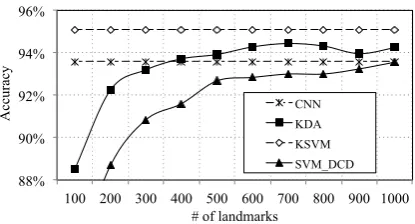
ap-proximated kernel space achieves the same classi-fication quality of the CNN when just 1,000 land-marks are considered. KDA improves this results, achieving 94.3% accuracy even with fewer land-marks (only 600), showing the effectiveness of non-linear learning over the Nystr¨om input. Al-though KSVM improves to 95%, KDA provides a saving of more than 84% kernel computations at classification time. This result is straightfor-ward as it confirms that linguistic information encoded in a tree is important in the analysis of questionsand can be used as a pre-training strat-egy. Figure3shows the accuracy curves accord-ing to various approximations of the kernel space, i.e., number of landmarks.
Table 1: Results in terms of Accuracy and saving in the Question Classification task
Model #Land. Accuracy Saving
CNN - 93.6%
-KSVM - 95.0% 0.0%
100 88.5% (84.1%) 97.4% 200 92.2% (88.7%) 94.8%
KDA 400 93.7% (91.6%) 89.7%
(SVMDCD) 600 94.3%(92.8%) 84.5%
800 94.3% (93.0%) 79.3% 1,000 94.2% (93.6%) 74.2%
4.2 Community Question-Answering
In the SemEval-2016 task 3, participants were asked to automatically provide good answers in a community question answering setting (Nakov et al., 2016). We focused on the subtask A: given a question and a large collection of question-comment threads created by a user community,
6The deep architecture presented inKim(2014)
outper-forms several NN models, including the Recursive Neural Tensor Network or Tree-LSTM presented in (Socher et al.,
2013;Tai et al.,2015) which presents a semantic composi-tionality model that exploits parse trees.
88% 90% 92% 94% 96%
100 200 300 400 500 600 700 800 900 1000
A
cc
ura
cy
# of landmarks
CNN KDA KSVM SVM_DCD
Figure 3: QC task - accuracy curves w.r.t. the number of landmarks.
the task consists in (re-)ranking the comments w.r.t. their utility in answering the question. Sub-task A can be modeled as a binary classification problem, where instances are (question, comment) pairs. Each pair generates an example for a bi-nary SVM, where the positive label is associated to a goodcomment and the negative label refers topotentially usefulandbadcomments. The clas-sification score achieved over different (question, comment) pairs is used to sort instances and pro-duce the final ranking over comments. The above setting results in a train and test dataset made of 20,340 and 3,270 examples, respectively. In
[image:6.595.312.520.65.177.2]Filice et al. (2016), a Kernel-based SVM clas-sifier (KSVM) achieved state-of-the-art results by adopting a kernel combination that exploited (i) feature vectors containing linguistic similarities between the texts in a pair; (ii) shallow syntactic trees that encode the lexical and morpho-syntactic information shared between text pairs; (iii) feature vectors capturing task-specific information.
Table 2: Results in terms of F1 and savings in the
Community Question Answering task
Model #Land. F1 Saving
KSVM - 0.644 0.0%
ConvKN - 0.662
-100 0.638 (0.596) 99.1% 200 0.635 (0.627) 98.2% KDA 400 0.657 (0.637) 96.5% (SVMDCD) 600 0.669 (0.645) 94.7%
800 0.680(0.653) 92.9% 1,000 0.674 (0.644) 91.2% Such model includes 11,322 support vectors. We investigated the KDA architecture, trained by maximizing the F1 measure, based on a Nystr¨om
layer initialized using the same kernel functions as KSVM. We varied the Nystr¨om dimensions from 100 to 1,000 landmarks, i.e., a much lower number than the support vectors of KSVM.
[image:6.595.320.511.557.650.2]are observed with impressive savings in terms of kernel computations (between 91.2% and 99%). Also on the cQA task, the F1 obtained by the
SVMDCDis significantly lower than the KDA one.
Moreover, with 800 landmarks KDA achieves the remarkable results of 0.68 of F1, that is the
state-of-the-art against other convolutional sys-tems, e.g., ConvKN (Barr´on-Cede˜no et al.,2016): this latter combines convolutional tree kernels with kernels operating on sentence embeddings generated by a convolutional neural network.
4.3 Argument Boundary Detection
Semantic Role Labeling (SRL) consists of the detection of the semantic arguments associated with the predicate of a sentence (called Lexi-cal Unit) and their classification into their spe-cific roles (Fillmore, 1985). For example, given the sentence “Bootleggers then copy the film onto hundreds of tapes” the task would be to recog-nize the verbcopyas representing the DUPLICA -TIONframe with roles, CREATORforBootleggers, ORIGINALforthe filmand GOALforhundreds of
tapes.
Argument Boundary Detection (ABD) corre-sponds to the SRL subtask of detecting the sen-tence fragments spanning individual roles. In the previous example the phrase “the film” represents a role (i.e., ORIGINAL), while “of tapes” or “film
onto hundreds” do not, as they just partially cover one or multiple roles, respectively. The ABD task has been successfully tackled using TKs since
Moschitti et al.(2008). It can be modeled as a bi-nary classification task over each parse tree node
n, where the argument span reflects words covered
by the sub-tree rooted at n. In our experiments,
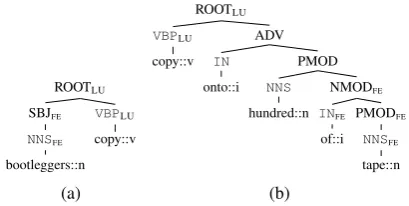
Grammatical Relation Centered Tree (GRCT) de-rived from dependency grammar (Fig. 4) are em-ployed, as shown in Fig. 5. Each node is consid-ered as a candidate in covering a possible argu-ment. In particular, the structure in Fig. 5a is a positive example. On the contrary, in Fig. 5bthe NMOD node only covers the phrase “of tapes”, i.e., a subset of the correct role, and it represents a negative example7.
We selected all the sentences whose predi-cate word (lexical unit) is a verb (they are about
7The nodes of the subtree covering the words to be
veri-fied as possible argument are marked with a FE tag. The word evoking the frame and its ancestor nodes are also marked with the LU tag. The other nodes are pruned out, except the ones connecting the LU nodes to the FE ones.
Bootleggers then copy the film onto hundreds of tapes NNS RB VBP DT NN IN NNS IN NNS
ROOT
SUBJ TMP
OBJ NMOD
NMOD
[image:7.595.314.518.65.120.2]PMOD NMOD PMOD
Figure 4: Example of dependency parse tree
ROOTLU
VBPLU
copy::v SBJFE
NNSFE
bootleggers::n
(a)
ROOTLU
ADV PMOD
NMODFE PMODFE
NNSFE
tape::n INFE
of::i NNS hundred::n IN
onto::i VBPLU
copy::v
(b)
Figure 5: Conversion from dependency graph to GRCT. Tree in Fig.5ais a positive example, while in Fig.5ba negative one.
60,000), from the 1.3 version of the Framenet dataset (Baker et al., 1998). This gives rise to about 1,400,000 sub-trees, i.e., the positive and negative instances. The dataset is split in train and test according to the 90/10 proportion (as in (Johansson and Nugues, 2008)). This size makes the application of a traditional kernel-based method unfeasible, unless a significant instance sub-sampling is performed.
We firstly experimented standard SVM learning over a sampled training set of 10,000 examples, a typical size for annotated datasets in computa-tional linguistics tasks. We adopted the Smoothed Partial Tree Kernel (Croce et al.,2011) with stan-dard parameters (i.e.,µ = λ = 0.4) and lexical nodes expressed through250-dimensional vectors obtained by applying Word2Vec (Mikolov et al.,
2013) to the entire Wikipedia. When trained over this 10k instances dataset, the kernel-based SVM (KSVM) achieves an F1 of 70.2%, over the same
test set used in Croce and Basili (2016) that in-cludes 146,399 examples. The KSVM learning produces a model including 2,994 support vec-tors, i.e., the number of kernel operations required to classify each new test instance. We then ap-ply the Nystr¨om linearization to a larger dataset made of 100k examples, and trained a classifier using both the Dual Coordinate Descent method (Hsieh et al.,2008), SVMDCD, and the KDA
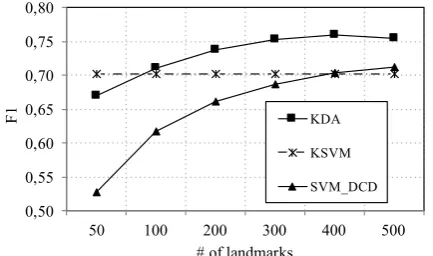
pro-posed in this work. Table3presents the results in terms of F1and saved kernel operation. Although
SVMDCD with 500 landmarks already achieves
[image:7.595.313.518.155.258.2]signif-0,50 0,55 0,60 0,65 0,70 0,75 0,80
50 100 200 300 400 500
F1
# of landmarks
KDA
KSVM
SVM_DCD
Figure 6: ABD task: F1 measure curves w.r.t. the
number of landmarks.
icantly improved by the KDA. KDA achieves up to 0.76 F1 with only 400 landmarks, resulting in
[image:8.595.74.291.64.192.2]a huge step forward w.r.t. the KSVM. This result is straightforward considering (i) the reduction of required kernel operations, i.e., more than 86% are saved and (ii) the quality achieved since 100 land-marks (i.e., 0.711, higher than the KSVM).
Table 3: Results in terms of F1 and saving in the
Argument Boundary Detection task.
Model Land. Tr.Size F1 Saving
KSVM - 10k 0.702 0.0%
100 100k 0.711 (0.618) 96.7% KDA 200 100k 0.737 (0.661) 93.3% (SVMDCD) 300 100k 0.753 (0.686) 90.0%
400 100k 0.760(0.704) 86.6% 500 100k 0.754 (0.713) 83.3%
5 Discussion and Conclusions
In this work, we promoted a methodology to em-bed structured linguistic information within NNs, according to mathematically rich semantic simi-larity models, based on kernel functions. Struc-tured data, such as trees, are transformed into dense vectors according to the Nystr¨om method-ology, and the NN is effective in capturing non-linearities in these representations, but still im-proving generalization at a reasonable complexity. At the best our knowledge, this work is one of the few attempts to systematically integrate lin-guistic kernels within a deep neural network archi-tecture. The problem of combining such method-ologies has been studied in specific works, such as (Baldi et al., 2011; Cho and Saul, 2009; Yu et al.,2009). InBaldi et al.(2011) the authors pro-pose a hybrid classifier, for bridging kernel meth-ods and neural networks. In particular, they use the output of a kernelized k-nearest neighbors al-gorithm as input to a neural network.Cho and Saul
(2009) introduced a family of kernel functions that
mimic the computation of large multilayer neu-ral networks. However, such kernels can be ap-plied only on vector inputs. In Yu et al. (2009), deep neural networks for rapid visual recognition are trained with a novel regularization method tak-ing advantage of kernels as an oracle represent-ing prior knowledge. The authors transform the kernel regularizer into a loss function and carry out the neural network training by gradient de-scent. In Zhuang et al. (2011) a different ap-proach has been promoted: a multiple (two) layer architecture of kernel functions, inspired by neural networks, is studied to find the best kernel com-bination in a Multiple Kernel Learning setting. In Mairal et al. (2014) the invariance properties of convolutional neural networks (LeCun et al.,
1998) are modeled through kernel functions, re-sulting in a Convolutional Kernel Network. Other effort for combining NNs and kernel methods is described in Tymoshenko et al. (2016), where a SVM adopts a tree kernels combinations with em-beddings learned through a CNN.
The approach here discussed departs from pre-vious approaches in different aspects. First, a gen-eral framework is promoted: it is largely applica-ble to any complex kernel, e.g., structural kernels or combinations of them. The efficiency of the Nystr¨om methodology encourages its adoption, especially when complex kernel computations are required. Notice that other low-dimensional ap-proximations of kernel functions have been stud-ied, as for example the randomized feature map-pings proposed inRahimi and Recht(2008). How-ever, these assume that (i) instances have vectorial form and (ii) shift-invariant kernels are adopted. The Nystr¨om method adopted here does not suffer of such limitations: as our target is the application to structured (linguistic) data, more general ker-nels, i.e., non-shift-invariant convolution kernels are needed.
so-lutions to complex tasks. Last, the suggested KDA framework isfully scalable, as (i) the network can be parallelized on multiple machines, and (ii) the computation of the Nystr¨om reconstruction vector
ccan be easily parallelized on multiple processing
units, ideally l, as each unit can compute oneci
value. Future work will address experimentations with larger scale datasets; moreover, it is interest-ing to experiment with more landmarks in order to better understand the trade-off between the repre-sentation capacity of the Nystr¨om approximation of the kernel functions and the over-fitting that can be introduced in a neural network architecture. Fi-nally, the optimization of the KDA methodology through the suitable parallelization on multicore architectures, as well as the exploration of mech-anisms for the dynamic reconstruction of kernel spaces (e.g., operating overHN y) also constitute
interesting future research directions on this topic.
References
Paolo Annesi, Danilo Croce, and Roberto Basili. 2014. Semantic compositionality in tree kernels. In Pro-ceedings of CIKM 2014. ACM.
Collin F. Baker, Charles J. Fillmore, and John B. Lowe. 1998. The Berkeley FrameNet project. InProc. of COLING-ACL. Montreal, Canada.
Pierre Baldi, Chloe Azencott, and S. Joshua Swamidass. 2011. Bridging the gap between neural network and kernel methods: Appli-cations to drug discovery. In Proceedings of the 20th Italian Workshop on Neural Nets.
http://dl.acm.org/citation.cfm?id=1940632.1940635.
Alberto Barr´on-Cede˜no, Giovanni Da San Martino, Shafiq Joty, Alessandro Moschitti, Fahad Al-Obaidli, Salvatore Romeo, Kateryna Tymoshenko, and Antonio Uva. 2016. ConvKN at SemEval-2016 task 3: Answer and question selection for question answering on arabic and english fora. In Proceed-ings of SemEval-2016.
Nicola Cancedda, ´Eric Gaussier, Cyril Goutte, and Jean-Michel Renders. 2003. Word-sequence ker-nels. Journal of Machine Learning Research
3:1059–1082.
Chih-Chung Chang and Chih-Jen Lin. 2011. Lib-svm: A library for support vector machines.
ACM Trans. Intell. Syst. Technol. 2(3):27:1–27:27.
https://doi.org/10.1145/1961189.1961199.
Youngmin Cho and Lawrence K. Saul. 2009. Kernel methods for deep learning. In Y. Bengio, D. Schu-urmans, J. D. Lafferty, C. K. I. Williams, and A. Cu-lotta, editors,Advances in Neural Information Pro-cessing Systems 22, Curran Associates, Inc., pages
342–350. http://papers.nips.cc/paper/3628-kernel-methods-for-deep-learning.pdf.
Michael Collins and Nigel Duffy. 2001. Convolution kernels for natural language. InProceedings of Neu-ral Information Processing Systems (NIPS’2001). pages 625–632.
Danilo Croce and Roberto Basili. 2016. Large-scale kernel-based language learning through the ensem-ble nystrom methods. InProceedings of ECIR 2016.
Danilo Croce, Alessandro Moschitti, and Roberto Basili. 2011. Structured lexical similarity via convo-lution kernels on dependency trees. InProceedings of EMNLP ’11. pages 1034–1046.
Ofer Dekel and Yoram Singer. 2006. Support vector machines on a budget. InNIPS. MIT Press, pages 345–352.
Simone Filice, Danilo Croce, Alessandro Moschitti, and Roberto Basili. 2016. KeLP at SemEval-2016 task 3: Learning semantic relations between ques-tions and comments. In Proceedings of SemEval ’16.
Simone Filice, Giovanni Da San Martino, and Alessan-dro Moschitti. 2015. Structural representations for learning relations between pairs of texts. In Pro-ceedings of ACL 2015. Beijing, China, pages 1003– 1013.http://www.aclweb.org/anthology/P15-1097.
Charles J. Fillmore. 1985. Frames and the semantics of understanding.Quaderni di Semantica6(2):222– 254.
Daniel Gildea and Daniel Jurafsky. 2002. Automatic Labeling of Semantic Roles. Computational Lin-guistics28(3):245–288.
David Haussler. 1999. Convolution kernels on discrete structures. In Technical Report UCS-CRL-99-10. University of California, Santa Cruz.
Sepp Hochreiter and J¨urgen Schmidhuber. 1997. Long short-term memory. Neural Comput. 9(8):1735– 1780.
Cho-Jui Hsieh, Kai-Wei Chang, Chih-Jen Lin, S. Sathiya Keerthi, and S. Sundararajan. 2008. A dual coordinate descent method for large-scale lin-ear svm. InProceedings of the ICML 2008. ACM, pages 408–415.
Richard Johansson and Pierre Nugues. 2008. The ef-fect of syntactic representation on semantic role la-beling. InProceedings of COLING.
Yoon Kim. 2014. Convolutional neural networks for sentence classification. In Proceedings EMNLP 2014. Doha, Qatar, pages 1746–1751.
Sanjiv Kumar, Mehryar Mohri, and Ameet Talwalkar. 2012. Sampling methods for the nystr¨om method.
Y. LeCun, L. Bottou, Y. Bengio, and P. Haffner. 1998. Gradient-based learning applied to document recog-nition.Proc. of the IEEE86(11).
Omer Levy, Yoav Goldberg, and Ido Dagan. 2015. Im-proving distributional similarity with lessons learned from word embeddings. Transactions of the Asso-ciation for Computational Linguistics 3:211–225.
https://transacl.org/ojs/index.php/tacl/article/view/570.
Xin Li and Dan Roth. 2006. Learning question clas-sifiers: the role of semantic information. Natural Language Engineering12(3):229–249.
Julien Mairal, Piotr Koniusz, Zaid Harchaoui, and Cordelia Schmid. 2014. Convolutional kernel net-works. InAdvances in Neural Information Process-ing Systems.
Tomas Mikolov, Kai Chen, Greg Corrado, and Jef-frey Dean. 2013. Efficient estimation of word rep-resentations in vector space. CoRRabs/1301.3781.
http://arxiv.org/abs/1301.3781.
Alessandro Moschitti. 2006. Efficient convolution ker-nels for dependency and constituent syntactic trees. InECML. Berlin, Germany.
Alessandro Moschitti, Daniele Pighin, and Robert Basili. 2008. Tree kernels for semantic role label-ing. Computational Linguistics34.
Preslav Nakov, Llu´ıs M`arquez, Alessandro Moschitti, Walid Magdy, Hamdy Mubarak, Abed Alhakim Freihat, Jim Glass, and Bilal Randeree. 2016. SemEval-2016 task 3: Community question answer-ing. InProceedings of SemEval-2016.
Ali Rahimi and Benjamin Recht. 2008. Random fea-tures for large-scale kernel machines. In J. C. Platt, D. Koller, Y. Singer, and S. T. Roweis, ed-itors, Advances in Neural Information Processing Systems 20, Curran Associates, Inc., pages 1177– 1184. http://papers.nips.cc/paper/3182-random-features-for-large-scale-kernel-machines.pdf.
Magnus Sahlgren. 2006. The Word-Space Model. Ph.D. thesis, Stockholm University.
Aliaksei Severyn, Massimo Nicosia, and Alessandro Moschitti. 2013. Building structures from classifiers for passage reranking. ACM, New York, NY, USA, CIKM ’13, pages 969–978.
John Shawe-Taylor and Nello Cristianini. 2004. Ker-nel Methods for Pattern Analysis. Cambridge Uni-versity Press, New York, NY, USA.
Richard Socher, Alex Perelygin, Jean Wu, Jason Chuang, Christopher D. Manning, Andrew Ng, and Christopher Potts. 2013. Recursive deep models for semantic compositionality over a sentiment tree-bank. InProceedings of EMNLP ’13.
Kai Sheng Tai, Richard Socher, and Christopher D. Manning. 2015. Improved semantic representa-tions from tree-structured long short-term mem-ory networks. In Proceedings of the 53rd An-nual Meeting of the Association for Computa-tional Linguistics and the 7th InternaComputa-tional Joint Conference on Natural Language Processing of the Asian Federation of Natural Language Pro-cessing, ACL 2015, July 26-31, 2015, Beijing, China, Volume 1: Long Papers. pages 1556–1566.
http://aclweb.org/anthology/P/P15/P15-1150.pdf.
Kateryna Tymoshenko, Daniele Bonadiman, and Alessandro Moschitti. 2016. Convolu-tional neural networks vs. convolution ker-nels: Feature engineering for answer sentence reranking. In Proceedings of NAACL 2016.
http://www.aclweb.org/anthology/N16-1152.
Zhuang Wang and Slobodan Vucetic. 2010. Online passive-aggressive algorithms on a budget. Journal of Machine Learning Research - Proceedings Track
9:908–915.
Christopher K. I. Williams and Matthias Seeger. 2001. Using the nystr¨om method to speed up kernel ma-chines. InProceedings of NIPS 2000.
Kai Yu, Wei Xu, and Yihong Gong. 2009. Deep learn-ing with kernel regularization for visual recognition. InAdvances in Neural Information Processing Sys-tems 21, Curran Associates, Inc., pages 1889–1896.