Proceedings of the 13th Linguistic Annotation Workshop, pages 108–112 108
Annotating formulaic sequences in spoken Slovenian:
structure, function and relevance
Kaja Dobrovoljc
Jozef Stefan Institute, Ljubljana, Slovenia University of Ljubljana, Slovenia
Abstract
This paper presents the identification of for-mulaic sequences in the reference corpus of spoken Slovenian and their annotation in terms of syntactic structure, pragmatic function and lexicographic relevance. The annotation cam-paign, specific in terms of setting, subjec-tivity and the multifunctionality of items un-der investigation, resulted in a preliminary lexicon of formulaic sequences in spoken Slovenian with immediate potential for future explorations in formulaic language research. This is especially relevant for the notable number of identified multi-word expressions with discourse-structuring and stance-marking functions, which have often been overlooked by traditional phraseology research.
1 Introduction
There has been an extensive body of research on the formulaic nature of language in the last three decades (Wray,2013) exposing the large number of multi-word combinations that speakers seem to process as single vocabulary units (Sinclair,1991;
Wray). In addition to the most commonly stud-ied groups of multi-word expressions, such as id-ioms (e.g.break a leg) and collocations (e.g.heavy rain), corpus-driven research (Biber, 2009; Con-klin and Schmitt,2012) has shown that formulaic status can also be attributed to frequently recur-ring sequences of words (variously termed formu-laic sequences or lexical bundles), which are not necessarily structurally or semantically complete (e.g.this means that).
Although there is a general consensus on the need to systematically identify and formalize for-mulaic sequences, both for native and non-native speakers of a language (Simpson-Vlach and Ellis,
2010;Brooke et al.,2015), there has been less dis-cussion on the optimal approach to their linguistic description and (sub)categorization. In addition,
few studies that do involve some kind of quan-tification of formulaic sequences by syntactic, se-mantic or other properties, rarely report on the methodological issues related to the categorization itself.
To provide insight on the nature of formulaic language in (spoken) Slovenian, and the method-ological aspects related to its linguistic categoriza-tion in general, this paper presents the annotacategoriza-tion of formulaic sequences in the reference corpus of spoken Slovenian in terms of syntactic structure, pragmatic function and semantic relevance. Af-ter a short presentation of the corpus (Section 2) and the formulaic sequence extraction (Section3), we present the annotation workflow and the guide-lines in Section4. Given several distinct aspects of this annotation campaign, a detailed analysis of inter-annotator disagreements is given in Sec-tion5, followed by the presentation and discussion of the resulting list of annotated sequences in Sec-tion6.
2 GOS corpus
GOS is the reference corpus of spoken Slove-nian including approximately 120 hours (1 mil-lion tokens) of spontaneous speech in different ev-eryday situations in public (radio and TV shows, school lessons and lectures) and non-public set-tings (meeset-tings, consultations, services, private conversations).
The recordings, balanced for communication channels, situations and speaker demograph-ics, have been manually transcribed in both pronunciation-based and standardized spelling (Verdonik et al., 2013). In this research, version 1.0 of the GOS corpus was used, freely avail-able for download from the CLARIN.SI repository (Zwitter Vitez et al.,2013).1
on-3 Identification of formulaic sequences
3.1 N-gram extraction
To generate the list of formulaic sequences in GOS corpus, the LIST extraction tool (Krsnik et al.,
2019) was used to extract all n-grams of length 2-5 tokens (words with normalized spelling) occurring above the frequency threshold of 20 occurrences per million. In addition to frequency counts, the tool also calculates the strength of association be-tween words in a given n-gram, using three effect-size measures (Dice coeeficient, point-wise mu-tual information, and cubic mumu-tual information) and two significance measures (t-score, simple log-likelihood), extended for multi-word combi-nations (Ramisch et al.,2010), as well.
3.2 N-gram ranking
There is no uniform consensus on the optimal method for measuring formulaicity in a language, with methods ranging from raw frequency counts to specific association measures (Biber, 2009;
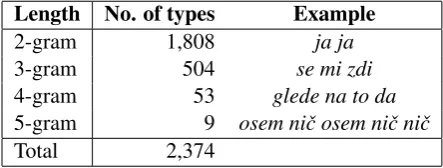
Gries,2012), producing only partially overlapping recommendations of the most salient multi-word units in a language (Evert,2009), including Slove-nian (Dobrovoljc, 2017). Instead of opting for a single method, we narrowed the initial list of frequently recurring n-grams to the union of top-1,000 candidates ranked by each of the six meth-ods (frequency, Dice, t-score, LL, MI, MI3). This amounted to the final list of 2,374 formulaic se-quences for subsequent annotation (Table1).
Length No. of types Example
2-gram 1,808 ja ja
3-gram 504 se mi zdi
4-gram 53 glede na to da
5-gram 9 osem niˇc osem niˇc niˇc
[image:2.595.71.293.505.589.2]Total 2,374
Table 1: Number of identified formulaic sequences in GOS by length. (English translations from top to bot-tom: “yes yes”, “it seems”, “given the fact that”, “eight zero eight zero zero”.)
4 Annotation of formulaic sequences
The list of formulaic sequences has been split into multicolumn spreadsheets containing the se-quences, slots for predefined labels and the hyper-links to the corresponding concordances in GOS.
line concordancer atwww.korpus-gos.net.
Each spreadsheet was manually annotated by two independent annotators (trained native speakers) based on the guidelines summarized below, with disagreements adjudicated by an expert third an-notator.
4.1 Syntactic structure
In terms of syntactic structure, the sequences have been categorized into structurally complete and in-complete sequences. Structurally in-complete are the sequences that can be attributed a specific syntac-tic role in a utterance. This includes complete ut-terances or phrases (e.g.to je res“that’s true”,no no“well well”), sentence elements, such as pred-icates (boˇs videl “you-will see”), predicate argu-ments (glava druˇzine“head of the family”) and ad-juncts (pol ure“half an hour”), as well as modifiers (bolj ali manj “more or less”), multi-word con-junctions (zaradi tega ker “given the fact that”), and connectives (tako da“so that”).
Incomplete sequences, on the other hand, in-clude fragments of the above constructions (da bi se“that they”,minute ˇcez “minutes past”), in-cluding speech-specific sequences involving fillers (eee in eee“uhm and uhm”), discourse markers (ja tako da “yes so”) and repetitions (kaj kaj “what what”).
4.2 Pragmatic function
In terms of pragmatic function, the guidelines fol-lowed previous influential functional taxonomies (Simpson-Vlach and Ellis, 2010; Biber et al.,
2004), in which formulaic sequences are divided into referential expressions that reference physi-cal or abstract entities and their properties (e.g.
to je bilo “that was”, v skladu z “in line with”,
uradni list ˇst. “official gazette no.´’), stance ex-pressions that express attitudes or assessments of certainty (e.g.na nek naˇcin“in a way”,se mi zdi“I think”,naj bi bil“is supposed to”,ja ne vem“well I don’t know”), and discourse organizers that con-tribute to textual and interactional coherence (e.g.
kar pomeni da “which means that”, to se pravi
“that is to say”, tako da je “so that is”, ja ja ja
“yes yes yes”).
4.3 Lexicographic relevance
whether the sequence is a multi-word expression they would expect to find in a general dictionary intended for both native and non-native speakers of Slovenian. Specifically, they were instructed to identify multi-word expressions as opposed to free word combinations, ranging from collocations (na internetu “on the Internet”) to fixed multi-word units with denominative (javni sektor“public sec-tor”), syntactic (kljub temu da “despite the fact that”), or pragmatic functions (tako rekoˇc “so to speak”, dame in gospodje “ladies and gentle-men”), regardless of semantic transparency.
4.4 Disambiguation
Only one label was allowed per category. In case of ambiguity, the annotators were advised to in-spect a random sample of the concordances pro-vided and decide for the most frequently occur-ring structural or functional interpretation, i.e. a primary interpretation for the given string. For se-mantic relevance, on the other hand, the annotators were instructed to label a sequence as relevant re-gardless of the frequency of this particular usage.
5 Inter-annotator agreement
On average, the two annotators agreed on 81.6% of categorization decisions, with disagree-ments distributed similarly across different n-gram lengths. This confirms the relatively high level of subjectivity involved in this annotation task, spe-cific not just in terms of categories (intuitive inter-pretations of abstract classes), but also in terms of items under investigations (highly ambiguous and multifunctional), and the annotation setting itself (lack of immediate context, simple guidelines).
As expected, best inter-annotator agreement was observed for syntactic structure (86% absolute agreement, Cohen’s Kappa 0.66), where annota-tors mostly disagreed on the structure of sequences occurring as both syntactically complete and in-complete units with similar frequency distribution (e.g. veˇs kaj “you know what”). Other frequent groups with structure disagreement include predi-cates with transitive verbs (bom rekel“I-will say”), numerals (deset tisoˇc“ten thousand”), repetitions (dobro dobro “good good”), fragments of prepo-sitional phrases (danaˇsnji dan“(on) this day”), as well as strings of discourse connectives (in s tem
“and thus”), and clause stems (kar pomeni“which means”).
For pragmatic function, the moderate
inter-annotator agreement (81% agreement, Cohen’s Kappa 0.54) was mostly due to disagreement on the referential or discourse-organizing role of specific groups of sequences, such as sentence fragments containing discourse particles and con-nectives (zato je “so is”, eee mi “uhm us”), anaphors (na ta naˇcin “in this way”), and words with metadiscursive meaning (govorimo o “we-are-talking about”, v nadaljevanju “in the con-tinuation”). Similarly, expressions with compet-ing referential and stance-markcompet-ing interpretations include sequences with modal verbs and adverbs (morati “have to”,lahko “can”), verbs of reason-ing (vedeti“know”,misliti“think”) and the condi-tional auxiliarybi“would”.
The lowest agreement was observed for seman-tic relevance (78% agreement, Cohen’s Kappa 0.43), where the annotators disagreed on the rel-evance of semantically bleach multi-word units, such as discourse particles (bi rekel “say”), in-terjections (a ja “oh really”, daj no “come on”) and general extenders (ali kaj “or what”); modi-fied connectives (tudi ˇce“even if”,takrat ko “ex-actly when”); institutionalized matrix clauses (kar pomeni da“which means that”, predlagam da “I suggest that”), as well as collocations involving numerals (petnajst minut“fifteen minutes”), deic-tics (vse to“all this”,z drugimi“with others”) and auxiliary verbs (bomo naredili“we-will do”).
For all three categories, the competing annota-tions were resolved by an expert third annotator. However, given the high level of ambiguity and subjectivity inherent to the annotation task, the in-formation on the degree of inter-annotator agree-ment for each decision has been preserved in the final data release.2
6 List of annotated sequences
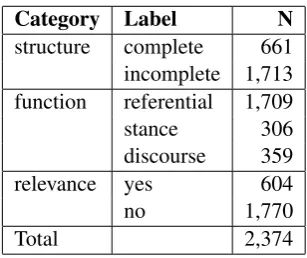
In general, the distribution of specific annota-tion labels in the resulting list of formulaic se-quences (summarized in Table 2) confirms pre-vious empirical observations that formulaic se-quences mostly consist of structurally incomplete n-grams (72.2%) with referential function (72.0%) that do not correspond to traditional dictionary-relevant multi-word expressions (74.6%). Specif-ically, 50.6% of sequences (1,201) have been la-belled with this exact combination of
tics, among which sentence fragments (da je“that is”,je to“is this”,ki je v“which is in”) prevail.
Category Label N
structure complete 661
incomplete 1,713 function referential 1,709
stance 306
discourse 359
relevance yes 604
no 1,770
[image:4.595.104.258.99.228.2]Total 2,374
Table 2: Number of annotated formulaic sequences in GOS by type.
Nevertheless, the annotated list reveals several other groups of formulaic language in spoken Slovenian with potential relevance for further lin-guistic inquiries and applications. From the point of syntactic structure, the structurally complete sequences (27.8%) include a diverse set of con-structions, ranging from sentence elements, such as predicates (smo rekli“we-have said”), and ad-juncts (v Sloveniji “in Slovenia”, dve leti “two years”), to various types of modifiers (ˇse en “an-other”) and sentence-peripheral multi-word ex-pressions. This last group also corresponds to the function-related findings that show a notable share of formulaic sequences with discourse-organizing (15.1%, e.g.tako da“so that”,na primer“for ex-ample”,a ne“right”,dobro jutro“good morning”) and stance-marking functions (12.9%, e.g. se mi zdi “it seems”, mislim da“I think”, po svoje“in a way”), confirming the importance of discourse structuring, interaction management and speaker mitigation in speech.
In line with the observations above, the sub-set of sequences recognized as dictionary-relevant (25.4%) includes a heterogeneous set of speech-specific multi-word expressions, such as formu-laic replies and questions (kaj ˇse“what else”toˇcno to “exactly”, kaj pa jaz vem“what do I know”), expressions of politeness (hvala lepa “thank you very much”), temporal expressions (na zaˇcetku
“in the beginning”,ˇse zmeraj“still”,do zdaj “un-til now”), intensifiers (zelo zelo “very very”, ˇse bolj “even more”), discourse-structuring devices (pri tem “in doing so”, prav tako “as well”), hedging expressions (ne vem “I don’t know”, v bistvu“actually”), colloquial expressions (na hitro
“quickly”,ful dobro“awesome”), as well as other
expressions related to event-specific topics (na televiziji “on TV”,predsednik vlade “prime min-ister”,v letoˇsnji sezoni “this season”). Although the large majority of dictionary-relevant sequences consists of syntactically complete units, some in-complete structures have also been marked as rel-evant, such as multi-word prepositions (ne glede na“regardless of”), verbs and phrases with typical prepositions (govorimo o “talk about”, pride do
“come to”,hvala lepa za“thanks for”, priloˇznost za “a chance to”) and discourse-structuring sen-tence stems (to pomeni da “this means that”, ˇce pogledamo“if we look at”).
7 Conclusion
This paper presented the identification of the most frequent and statistically prominent word n-grams in the reference spoken corpus of Slovenian and their annotation in terms of syntactic structure, pragmatic function and lexicographic relevance. The annotation campaign resulted in a preliminary lexicon of formulaic sequences in (spoken) Slove-nian with a high potential for future explorations in both theoretical and applied formulaic language research.
In particular in relation to the latter, our re-search represents an important addition to existing corpus-based collections of multi-word units in Slovenian (Gantar et al.,2016;Kosem et al.,2018;
Ljubeˇsi´c et al.,2015), which predominantly focus on units with propositional meaning. The large number of formulaic expressions with discourse-organizing and stance-marking functions iden-tified in this research, however, confirms the need for future investigations of non-propositional multi-word expressions, as well.
Acknowledgments
The author acknowledges the financial support from the Slovenian Research Agency through the research core funding no. P6-0411 (Language resources and technologies for Slovene language) and the research project no. J6-8256 (New gram-mar of contemporary standard Slovene: sources and methods).
References
Douglas Biber. 2009. A corpus-driven approach to for-mulaic language in English: Multi-word patterns in speech and writing.International Journal of Corpus Linguistics, 14(3):275–311.
Douglas Biber, Susan Conrad, and Viviana Cortes. 2004. If you look at ...: Lexical Bundles in Univer-sity Teaching and Textbooks. Applied Linguistics, 25(3):371–405.
Julian Brooke, Adam Hammond, David Jacob, Vi-vian Tsang, Graeme Hirst, and Fraser Shein. 2015.
Building a lexicon of formulaic language for lan-guage learners. InProceedings of the 11th Work-shop on Multiword Expressions, pages 96–104, Den-ver, Colorado. Association for Computational Lin-guistics.
Kathy Conklin and Norbert Schmitt. 2012. The Pro-cessing of Formulaic Language. Annual Review of Applied Linguistics, 32:45–61.
Kaja Dobrovoljc. 2017. Multi-word discourse markers and their corpus-driven identification. International journal of corpus linguistics, 22(4):551–582.
Stefan Evert. 2009. Corpora and collocations. In Cor-pus Linguistics. An International Handbook, vol-ume 1, pages 1212–1248.
Polona Gantar, Iztok Kosem, and Simon Krek. 2016.
Discovering Automated Lexicography: The Case of the Slovene Lexical Database. International Journal of Lexicography, 29(2):200–225.
Stefan Th Gries. 2012. Frequencies, probabilities, and association measures in usage-/exemplar-based lin-guistics: some necessary clarification. Studies in Language, 11(3):477–510.
Iztok Kosem, Simon Krek, Polona Gantar, ˇSpela Arhar Holdt, Jaka ˇCibej, and Cyprian Laskowski. 2018. Collocations Dictionary of Modern Slovene. InProceedings of the XVIII EURALEX International Congress: Lexicography in Global Contexts, pages 989–997.
Luka Krsnik, ˇSpela Arhar Holdt, Jaka ˇCibej, Kaja Do-brovoljc, Aleksander Kljuˇcevˇsek, Simon Krek, and Marko Robnik- ˇSikonja. 2019. Corpus extraction
tool LIST 1.0. Slovenian language resource reposi-tory CLARIN.SI.
Nikola Ljubeˇsi´c, Kaja Dobrovoljc, and Darja Fiˇser. 2015. *MWELex – MWE Lexica of Croatian, Slovene and Serbian Extracted from Parsed Corpora.
Informatica, 39(3):293–300.
Carlos Ramisch, Aline Villavicencio, and Christian Boitet. 2010. Multiword expressions in the wild?: The mwetoolkit comes in handy. In Proceedings of the 23rd International Conference on Computa-tional Linguistics: Demonstrations, COLING ’10, pages 57–60, Stroudsburg, PA, USA. Association for Computational Linguistics.
Rita Simpson-Vlach and Nick C. Ellis. 2010. An Aca-demic Formulas List: New Methods in Phraseology Research.Applied Linguistics, 31(4):487–512.
John Sinclair. 1991. Corpus, concordance, colloca-tion. Oxford University Press, Oxford.
Darinka Verdonik, Iztok Kosem, Ana Zwitter Vitez, Si-mon Krek, and Marko Stabej. 2013. Compilation, transcription and usage of a reference speech cor-pus: the case of the Slovene corpus GOS.Language Resources and Evaluation, 47(4):1031–1048.
Alison Wray. Formulaic Language and the Lexicon. Cambridge University Press.
Alison Wray. 2013. Formulaic Language. Language Teaching, 46(3):316–334.