DESIGN AND TESTING OF UNDERWATER IM
EXPLOSIVE CHARGE
T. Yarom, A. Kalkstein, M. Rav-Hon, S. Mandelbaum
RAFAEL, MANOR - Propulsion & Explosive Systems Division
I S R A E L
ABSTRACT
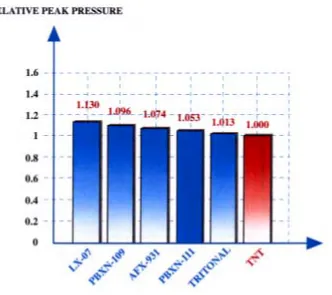
Underwater charges loades with PBX explosives are more powerful and less vulnerable than the ones with traditional explosives. As a part of a research in the area of underwater applications, a comparison of the performance of six explosive compositions have been conducted, including TNT, Tritonal, LX-07, PBXN-109, AFX-931 and PBXN-111 (Israeli). The comparison related to the shock wave performance and the pressure profile was observed at different distances. The explosive samples weighted about 5 Kg. Comparison shows that no major differences were observed in the peak pressure, but the PBXN-111 provided an increase of about 50% in the total impuse compared to TNT. A special IM Initiation Train (IMIT) was developed and tested based on the measured critical diameter. The IMIT contains a large booster of PBXN-110 initiated by a 3 gr. PBXN-5 pellet. The detonation transfer reliability of the main explosive was experimentally tested by reducing the booster weight. After a detailed design of the charge was completed, a series of representative IM tests were conducted. These tests include Bullet Impact, Fragment Impact and Slow Cookoff with and without the initiation train. A slow burning reaction was observed in the Slow Cookoff tests and in the Fragment Impact test. No reaction occurred in the Bullet Impact test and charge remained in one piece. The paper provides a detailed description of the explosive charge development process starting from the shock wave comparison tests, the design and testing of the initiation train and the IM tests and results.
1. INTRODUCTION
Underwater charges loades with PBX explosives are more powerful and less vulnerable than the ones with traditional explosives. As a part of a research in underwater warhead applications, the explosive charge design has been adressed, including IM consideration. The objective of this work was scan and learn about optional explosive compositions and their performance, and to design and test a generic IM underwater explosive charge so that a specific charge could be easily designed in the future.
1. A sereis of underwater comparison tests of shock wave of PBX and traditional explosive
compositions
2. Design and testing of IM initiation train
3. Partial IM testing of representative charge.
2. EXPLOSIVE COMPARISON TESTS
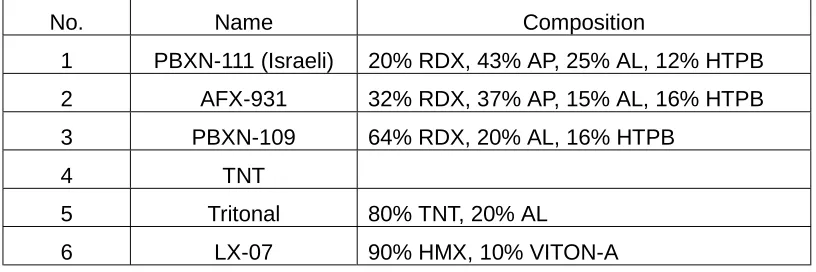
The comparison tests mainly related to the underwater shock wave performance of the various explosives. Six explosive compositions were tested, Three cure-cast and three traditional explosives. The explosives and their composion are shown Table 1. The first explosive is the Israeli PBXN-111, developed and qualified by the Israeli Defence Forces (IDF). Explosive No. 2 is the Israeli AFX-931, designated PX -29.
No. Name Composition
1 PBXN-111 (Israeli) 20% RDX, 43% AP, 25% AL, 12% HTPB
2 AFX-931 32% RDX, 37% AP, 15% AL, 16% HTPB
3 PBXN-109 64% RDX, 20% AL, 16% HTPB
4 TNT
5 Tritonal 80% TNT, 20% AL
[image:2.595.119.527.286.422.2]6 LX-07 90% HMX, 10% VITON-A
Table 1: Tested explosives
All tested samples weighted 4.8 Kg. The PBXN-111 sample, shown in Figure 1, has a 1.5 mm aluminum casing and a special initiation train, described in Section 2. In order to obtain comparative results, identical initiation train was used for all explosive compositions.
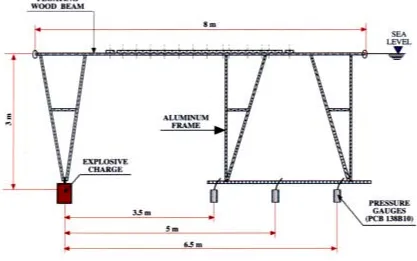
The test setup is shown in Figure 2. It consists of a floating wooden beam connected to underwater Aluminum frames, which carried the explosive charge and the pressure gauges. The pressure profile (pressure vs. time) was measured at three distances: 3.5, 5 and 6.5 meters. Two PCB 138B10 pressure gauges were located at each distance, so that a total of six pressure gauges were used in each test. Tests were conducted about 3 meters below sea level.
Six pressure profiles, collected from each test, were compared and analyzed [4]. Figure 3 shows a typical graph of the pressure vs. time for PBXN-111 and TNT at a distance of 3.5 meters. From the graphs one can observe that there is no much difference in the peak pressure but the total impulse of the PBXN-111 is much higher than the TNT.
Figure 1:
Underwater explosive charge
[image:3.595.126.543.427.688.2]Figure 3:
Pressure Vs. time at 3.5 m distance
[image:4.595.148.480.434.729.2]Figure 5:
Relative total impulse (normalized to TNT)
The series of comparative tests, as well as the literature [1] [7], show that the PBXN-111 provides the maximum shock wave impulse and energy. This composition was, therefore, chosen for further work in underwater applications.
3. DESIGN AND TESTING OF IM INITIATION TRAIN
We learn from the literature [8] that the critical diameter of PBXN-111 produced in different countries vary, not as other explosive properties. The critical diameter of the Israeli PBXN-111 was measured. Table 2 (partly from [8]) provides the critical diameter and other properties of the American PBXN-111, Australian PBXW-115, French B 2211 which is equivalent to the others and the Israeli PBXN-111.
PBXN-111
(US Navy)
PBXW-15
(Aust.)
B2211
(French)
PBXN-111
(israeli)
Density [gr/cm2] 1.800 1.795 1.803 1.800
Critical diameter [mm]
37.6 80 65 50 - 60
Maximum detonation velocity [m/sec]
5760 5640 5500 5640
[image:5.595.115.533.572.726.2]The initiation train, shown in Figure 1, consists of a large booster of 140 gr. Filled with PBXN-110 initiated by a 3gr. Pellet of PBXN-5. The PBXN-110 was chosen due to its high energy and high reaction tempertature. This design asures reliable detonation transfer and meets IM conditions. The pellet – booster interface has been developed and tested [9] and is in use in other Israeli operational warheads.
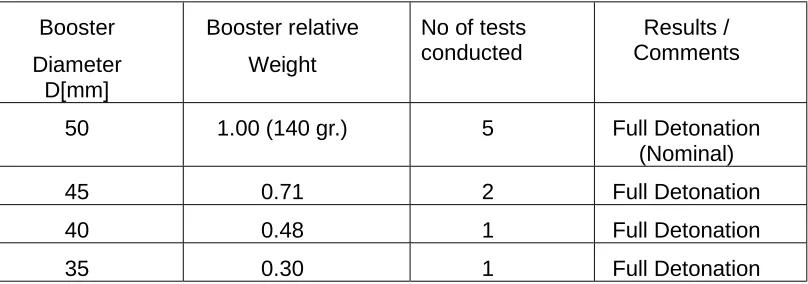
The detonation transfer reliability was tested by reducing the dimensions (and weight) of the booster. The booster diameter, D, is identical to its length, as shown in Figure 1. The nominal diameter and length are 50 mm. In the detonation transfer reliability tests, the diameter was reduced to 30mm thus reducing the booster weight to 0.3 of its original weight. In all the tests which were conducted in the configuration of Figure 1 a full detonation reaction has been observed. Table 3 shows the tests parameters and results. Booster Diameter D[mm] Booster relative Weight
No of tests conducted
Results / Comments
50 1.00 (140 gr.) 5 Full Detonation
(Nominal)
45 0.71 2 Full Detonation
40 0.48 1 Full Detonation
[image:6.595.121.525.271.413.2]35 0.30 1 Full Detonation
Table 3: Booster – main charge detonation transfer reliability tests
4. SYSTEM IM TESTS
The PBXN-111 is known for its insensitivity and the literature provides lots of data on warheads filled with this explosive which meet most, if not all, of the criteria of IM. Our approch was to test the explosive chagre (including the initiation system) in few IM tests including Slow Cookoff and Fragment Impact tests which are more chalenging.
The tests conducted were:
1. Slow cookoff of the explosive charge without the initiation train;
2. Slow Cookoff of the system with the initiation train;
3. Bullet Impact;
4. Fragment Impact.
The operational warhead has an outer diameter of 125 mm and a 1.5 mm aluminum casing. Its weight is 15Kg - 20kg and. For simplicity, the IM tests were conducted on a 4.8 Kg sample, shown in figure 1. The test sample has identical diameter, casing and initiation train, it differ from the operational warhead in its length only.
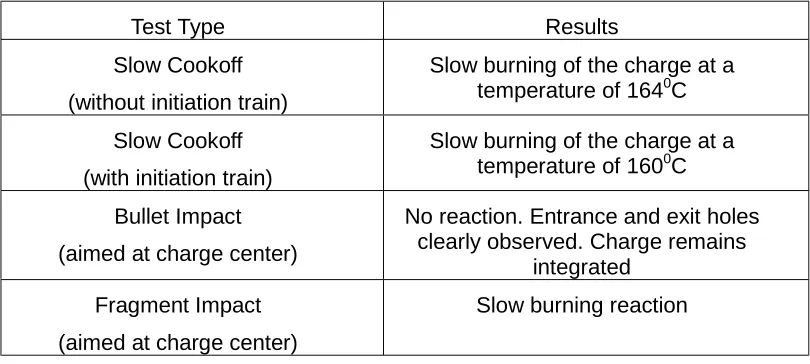
A single bullet was aimed toward the center of the charge. The bullet entered and exits the charge, leaving a clear entrance and exit holes. No reaction was observed. The charge remained integrated without any scattered pieces.
The Fragment Impact test was conducted using an EFP with copper liner which provides a sphere projectile with mass and velocity as required by the MIL-STD-2105B. The method has been used successfully before [7], [10]. The fragment was aimed to the center of the charge. A slow burning reaction was observed. No explosive or metal pieces were scatered around.
Table 4 summarizes the IM tests and results. All the tests conducted on the generic charge met the IM requirements.
Test Type Results
Slow Cookoff
(without initiation train)
Slow burning of the charge at a temperature of 1640C
Slow Cookoff
(with initiation train)
Slow burning of the charge at a temperature of 1600C
Bullet Impact
(aimed at charge center)
No reaction. Entrance and exit holes clearly observed. Charge remains
integrated
Fragment Impact
(aimed at charge center)
[image:7.595.120.525.252.434.2]Slow burning reaction
Table 4: IM tests and results
5. SUMMARY
6. REFERENCES
1. Carleone, J., Tactical Missile Warheads, Published by American Institute of Aeronautics and Astronautics, Inc., Washington, 1993.
2. Held, M., Blast waves in Free Air,
3. Held, M., Similarities of Shock Wave Damage in Air and in Water, Proc. Of the Fifteenth Symposium of Propellants, Explosives and Pyrotechnics, p 149-156, 1990.
4. Kalkstein, A., Explosives for underwater applications – shock wave comparison tests, TR 2000/M1/885 RAFAEL/MANOR (internal report), January 2000.
5. Natsubori, M., Aoki, A. and Miyoshi, H., Effects of Aluminum on the energy of Underwater Explosion for the Insensitive PBXs, Proc. Of ADPA Insensitive Munition Symposium, Tampa FL, October 1997.
6. Smith, P. D., and Hetherington, J. G., Blast and Ballistic Loading of Structures,
Butterworth-Heinemann, Oxford, UK, 1994.
7. Tsur, D., and Miller, S., and Avnon, I., and Henik, D., EFP Charge as a Fragment Launcher in FI Test, Insensitive Munitions Technology Symposium, Williamsburg VA, 6-9 June 1994.
8. Whelan, D. J., and Bocksteiner, G., PBXW-115, an Extremely Insensitive Detonating Substance? DSTO-TR-0632, Defence Science and Technology Organisation, Canberra, Australia, March 1998.
9. Yarom, T., Design and Testing of Cookoff Resistant Initiation Trains based on PBXN-5 Boosters, Proc. Of ADPA Insensitive Munition Symposium, Tampa FL, October 1997.
![Table 2: Comparison of cure-cast explosives properties (partly from [8])](https://thumb-us.123doks.com/thumbv2/123dok_us/1485372.688421/5.595.158.482.71.352/table-comparison-cure-cast-explosives-properties-partly.webp)