Uncertainty reduction as a measure of cognitive processing effort
Stefan L. Frank University of Amsterdam Amsterdam, The Netherlands
Abstract
The amount of cognitive effort required to process a word has been argued to depend on the word’s effect on the uncertainty about the incoming sentence, as quanti-fied by the entropy over sentence probabil-ities. The current paper tests this hypoth-esis more thoroughly than has been done before by using recurrent neural networks for entropy-reduction estimation. A com-parison between these estimates and word-reading times shows that entropy reduc-tion is positively related to processing ef-fort, confirming the entropy-reduction hy-pothesis. This effect is independent from the effect of surprisal.
1 Introduction
In the field of computational psycholinguistics, a currently popular approach is to account for read-ing times on a sentence’s words by estimates of the amount of information conveyed by these words. Processing a word that conveys more information is assumed to involve more cognitive effort, which is reflected in the time required to read the word.
In this context, the most common formaliza-tion of a word’s informaformaliza-tion content is its sur-prisal (Hale, 2001; Levy, 2008). If word string wt
1 (short for w1, w2, . . . wt) is the sentence so
far andP(wt+1|w1t)the occurrence probability of
the next word wt+1, then that word’s surprisal is
defined as −logP(wt+1|wt1). It is well
estab-lished by now that word-reading times indeed cor-relate positively with surprisal values as estimated by any sufficiently accurate generative language model (Boston et al., 2008; Demberg and Keller, 2008; Frank, 2009; Roark et al., 2009; Smith and Levy, 2008).
A lesser known alternative operationalization of a word’s information content is based on the un-certainty about the rest of the sentence, quantified
by Hale (2003, 2006) as the entropy of the prob-ability distribution over possible sentence struc-tures. The reduction in entropy that results from processing a word is taken to be the amount of information conveyed by that word, and was ar-gued by Hale to be predictive of word-reading time. However, this entropy-reduction hypothesis has not yet been comprehensively tested, possibly because of the difficulty of computing the required entropies. Although Hale (2006) shows how sen-tence entropy can be computed given a PCFG, this computation is not feasible when the grammar is of realistic size.
Here, we empirically investigate the entropy-reduction hypothesis more thoroughly than has been done before, by using recurrent neural net-works as language models. Since these netnet-works do not derive any structure, they provide estimates of sentence entropy rather than sentence-structure entropy. In practice, these two entropies will gen-erally be similar: If the rest of the sentence is highly uncertain, so is its structure. Sentence en-tropy can therefore be viewed as a simplification of structure entropy; one that is less theory depen-dent since it does not rely on any particular gram-mar. The distinction between entropy over sen-tences and entropy over structures will simply be ignored in the remainder of this paper.
Results show that, indeed, a significant fraction of variance in reading-time data is accounted for by entropy reduction, over and above surprisal.
2 Entropy and sentence processing 2.1 Sentence entropy
LetW be the set of words in the language andWi the set of all word strings of length i. The set of complete sentences, denotedS, contains all word strings of any length (i.e.,S∞
i=0W
i), except that a
special end-of-sentence marker </s>is attached to the end of each string.
A generative language model defines a proba-bility distribution overS. The entropy of this dis-tribution is
H =− X
wj1∈S
P(wj1) logP(w1j).
As words are processed one by one, the sen-tence probabilities change. When the firsttwords (i.e., the stringwt
1 ∈Wt) of a sentence have been
processed, the entropy of the probability distribu-tion over sentences is
H(t) =− X
wj1∈S
P(wj1|w
t
1) logP(w
j
1|w
t
1). (1)
In order to simplify later equations, we define the functionh(y|x) =−P(y|x) logP(y|x), such that Eq. 1 becomes
H(t) = X
wj1∈S
h(w1j|w
t
1).
If the firsttwords ofwj1do not equalw
t
1(orw
j
1
has fewer thant+ 1words),1thenP(wj1|w
t
1) = 0
soh(w1j|w
t
1) = 0. This means that, for computing
H(t), only the words fromt+ 1onwards need to be taken into account:
H(t) = X
wjt+1∈S
h(wtj+1|w
t
1).
The reduction in entropy due to processing the next word,wt+1, is
∆H(t+ 1) =H(t)−H(t+ 1). (2)
Note that positive ∆H corresponds to a
decrease in entropy. According to Hale (2006), the nonnegative reduction in entropy (i.e.,
max{0,∆H}) reflects the cognitive effort in-volved in processingwt+1and should therefore be
predictive of reading time on that word.
2.2 Suffix entropy
ComputingH(t)is computationally feasible only when there are very few sentences in S, or when the language can be described by a small grammar. To estimate entropy in more realistic situations, an
1
Since wj1 ends with</s>and wt1 does not, the two
strings must be different. Consequently, ifwj1istwords long, thenP(wj1|wt
1) = 0.
obvious solution is to look only at the next few words instead of all complete continuations ofw1t.
Let Sm be the subset ofS containing all (and only) sentences of lengthmor less, counting also the</s>at the end of each sentence. Note that this set includes the ‘empty sentence’ consisting of only</s>. The set of length-mword strings that do not end in</s>isWm. Together, these sets formWm = Wm ∪ Sm, which contains all the relevant strings for defining the entropy over strings up to lengthm.2 After processing wt
1, the
entropy over strings up to lengtht+nis:
Hn(t) = X
wj1∈Wt+n
h(wj1|w
t
1) = X
wtj+1∈Wn
h(wjt+1|w
t
1).
It now seems straightforward to define suffix-entropy reduction by analogy with sentence-entropy reduction as expressed in Eq. 2: Simply replaceHbyHnto obtain
∆Hnsuf(t+ 1) =Hn(t)−Hn(t+ 1). (3)
As indicated by its superscript label, ∆Hnsuf quantifies the reduction in uncertainty about the upcomingn-word suffix. However, this is concep-tually different from the original ∆H of Eq. 2, which is the reduction in uncertainty about the identity of the current sentence. The difference becomes clear when we view the sentence proces-sor’s task as that of selecting the correct element from S. If this set of complete sentences is ap-proximated byWt+n, and the task is to select one element from that set, an alternative definition of suffix-entropy reduction arises:
∆Hnsent(t+ 1)
= X
wj1∈Wt+n
h(wj1|w
t
1) − X
wj1∈Wt+n
h(wj1|w
t+1 1 )
= X
wjt+1∈Wn
h(wtj+1|w
t
1) − X
wjt+2∈Wn−1
h(wtj+2|w
t+1 1 )
=Hn(t)−Hn−1(t+ 1). (4)
The label ‘sent’ indicates that∆Hsent
n quantifies the reduction in uncertainty about which sentence forms the current input. This uncertainty is ap-proximated by marginalizing over all word strings longer thant+n.
It is easy to see that
lim
n→∞∆H
suf
n = lim n→∞∆H
sent
n = ∆H,
2The probability of a stringwm
1 ∈ Wmis the summed
probability of all sentences with prefixwm
so both approximations of entropy reduction ap-propriately converge to ∆H in the limit. Nev-ertheless, they formalize different quantities and may well correspond to different cognitive factors. If it is true that cognitive effort is predicted by the reduction in uncertainty about the identity of the incoming sentence, we should find that word-reading times are predicted more accurately by
∆Hnsentthan by∆Hnsuf.
2.3 Relation to next-word entropy
In the extreme case ofn= 1, Eq. 4 reduces to
∆H1sent(t+ 1) =H1(t)−H0(t+ 1) =H1(t),
so the reduction of entropy over the single next word wt+1 equals the next-word entropy just
be-fore processing that word. Note that∆H1sent(t+1)
is independent of the word at t+ 1, making it a severely impoverished measure of the uncertainty reduction caused by that word. We would there-fore expect reading times to be predicted more ac-curately by∆Hsent
n withn >1, and possibly even by∆H1suf.
Roark et al. (2009) investigated the relation be-tween H1(t+ 1)and reading time on wt+1, and
found a significant positive effect: Larger next-word entropy directly after processing wt+1
cor-responded to longer reading time on that word. This is of particular interest because H1(t + 1)
necessarily correlates negatively with entropy re-duction ∆Hsent
n (t+ 1): If entropy is large after wt+1, chances are that it did not reduce much
through processing of wt+1. Indeed, in our data
set, H1(t+ 1) and ∆Hnsent(t + 1) correlate
be-tween r = −.29 and r = −.26 (for n = 2 to n = 4) which is highly significantly (p ≈0) dif-ferent from 0. Roark et al.’s finding of a positive relation between H1(t+ 1) and reading time on
wt+1 therefore seems to disconfirm the
entropy-reduction hypothesis.
3 Method
A set of language models was trained on a corpus of POS tags of sentences. The advantage of using POS tags rather than words is that their probabil-ities can be estimated much more accurately and, consequently, more accurate prediction of word-reading time is possible (Demberg and Keller, 2008; Roark et al., 2009). Subsequent to training, the models were made to generate estimates of sur-prisal and entropy reductions∆Hnsuf and∆Hnsent
over a test corpus. These estimates were then com-pared to reading times measured over the words of the same test corpus. This section presents the data sets that were used, language-model details, and the evaluation metric.
3.1 Data
The models were trained on the POS tag se-quences of the full WSJ corpus (Marcus et al., 1993). They were evaluated on the POS-tagged Dundee corpus (Kennedy and Pynte, 2005), which has been used in several studies that investigate the relation between word surprisal and reading time (Demberg and Keller, 2008; Frank, 2009; Smith and Levy, 2008). This 2 368-sentence (51 501 words) collection of British newspaper editorials comes with eye-tracking data of 10 participants. POS tags for the Dundee corpus were taken from Frank (2009).
For each word and each participant, reading time was defined as the total fixation time on that word before any fixation on a later word of the same sentence. Following Demberg and Keller (2008), data points (i.e., word/participant pairs) were removed if the word was not fixated, was presented as the first or last on a line, contained more than one capital letter or a non-letter (e.g., the apostrophe in a clitic), or was attached to punc-tuation. Mainly due to the large number (over 46%) of nonfixations, 62.8% of data points were removed, leaving 191 380 data points (between 16 469 and 21 770 per participant).
3.2 Language model
Entropy is more time consuming to compute than surprisal, even for n = 1, because it requires es-timates of the occurrence probabilities att+ 1of all word types, rather than just of the actual next word. Moreover, the number of suffixes rises ex-ponentially as suffix length ngrows, and, conse-quently, so does computation time.
Roark et al. (2009) used an incremental PCFG parser to obtain H1 but this method rapidly
be-comes infeasible as ngrows. Low-order Markov models (e.g., a bigram model) are more efficient and can be used for largernbut they do not form particularly accurate language models. Moreover, Markov models lack cognitive plausibility.
P(wt+1|wt1) efficiently and relatively accurately.
They thereby allow to approximate sentence en-tropy more closely than the incremental parsers used in previous studies. Unlike Markov models, SRNs have been claimed to form cognitively re-alistic sentence-processing models (Christiansen and MacDonald, 2009). Moreover, it has been shown that SRN-based surprisal estimates can cor-relate more strongly to reading times than surprisal values estimated by a phrase-structure grammar (Frank, 2009).
3.2.1 Network architecture and processing
The SRNs comprised three layers of units: the in-put layer, the recurrent (hidden) layer, and the out-put layer. Each inout-put unit corresponds to one POS tag, making 45 input units since there are 45 dif-ferent POS tags in the WSJ corpus. The network’s output units represent predictions of subsequent inputs. The output layer also has one unit for each POS tag, plus an extra unit that represents</s>, that is, the absence of any further input. Hence, there were 46 output units. The number of recur-rent units was fairly arbitrarily set to 100.
As is common in these networks, the input layer was fully connected to the recurrent layer, which in turn was fully connected to the output layer. Also, there were time-delayed connections from the recurrent layer to itself. In addition, each re-current and output unit received a bias input.
The vectors of recurrent- and output-layer ac-tivations after processing wt1 are denoted arec(t)
andaout(t), respectively. At the beginning of each
sentence,arec(0) = 0.5.
The input vector ai
in, representing POS tag i,
consists of zeros except for a single element (cor-responding to i) that equals one. When inputiis processed, the recurrent layer’s state is updated ac-cording to:
arec(t) =frec(Wrecarec(t−1) +Winaiin+brec),
where matrices Win and Wrec contain the
net-work’s input and recurrent connection weights, re-spectively;brecis the vector of recurrent-layer
bi-ases; and activation functionfrec(x)is the logistic
functionf(x) = (1+e−x)−1
applied elementwise tox. The new output vector is now given by
aout(t) =fout(Woutarec(t) +bout),
where Wout is the matrix of output connection
weights;boutthe vector of output-layer biases; and fout(x)the softmax function
fi,out(x1, . . . , x46) =
exi P
je xj.
This function makes sure that aout sums to one
and can therefore be viewed as a probability dis-tribution: Thei-th element ofaout(t)is the SRN’s estimate of the probability that the i-th POS tag will be the input att+ 1, or, in caseicorresponds to </s>, the probability that the sentence ends aftertPOS tags.
3.2.2 Network training
Ten SRNs, differing only in their random initial connection weights and biases, were trained us-ing the standard backpropagation algorithm. Each string of WSJ POS tags was presented once, with the sentences in random order. After each POS in-put, connection weights were updated to minimize the cross-entropy between the network outputs and a 46-element vector that encoded the next input (or marked the end of the sentence) by the correspond-ing element havcorrespond-ing a value of one and all others being zero.
3.3 Evaluation
3.3.1 Obtaining surprisal and entropy
Since aout(t) is basically the probability
distribu-tionP(wt+1|wt1), surprisal andH1can be read off
directly. To obtain H2, H3, and H4, we use the
fact that
P(wtt++1n|w
t
1) =
n
Y
i=1
P(wt+i|wt
+i−1
1 ). (5)
Surprisal and entropy estimates were averaged over the ten SRNs. So, for each POS tag of the Dundee corpus, there was one estimate of surprisal and four of entropy (forn= 1ton= 4).
Since Hn(t) approximates H(t) more closely asngrows, it would be natural to expect a better fit to reading times for largern. On the other hand, it goes without saying thatHnis only a very rough measure of a reader’s actual uncertainty about the upcoming n inputs, no matter how accurate the language model that was used to compute these entropies. Crucially, the correspondence between Hn and the uncertainty experienced by a reader will grow even weaker with largern. This is ap-parent from the fact that, as proven in the Ap-pendix,Hn can be expressed in terms ofH1 and
Hn−1:
1 2 3 4 0
0.25 0.5
suffix length n
correlation with surprisal
∆H
n suf
∆H
[image:5.595.72.269.60.215.2]n sent
Figure 1: Coefficient of correlation between es-timates of surprisal and entropy reduction, as a function of suffix lengthn.
whereE(x)is the expected value ofx. Obviously, the expected value ofHn−1 is less appropriate as
an uncertainty measure than isHn−1itself. Hence,
Hncan be less accurate thanHn−1 as a
quantifi-cation of the actual cognitive uncertainty. For this reason, we may expect largernto result in worse fit to reading-time data.3
3.3.2 Negative entropy reduction
Hale (2006) argued for nonnegative entropy re-duction max{0,∆H}, rather than ∆H itself, as a measure of processing effort. For ∆Hsent, the difference between the two is negligible because only about 0.03% of entropy reductions are neg-ative. As for ∆Hsuf, approximately 42% of val-ues are negative so whether these are left out makes quite a difference. Since preliminary ex-periments showed that word-reading times are pre-dicted much more accurately by ∆Hsuf than by
max{0,∆Hsuf}, only ∆Hsuf and ∆Hsent were
used here, that is, negative values were included.
3.3.3 Relation between information measures
Both surprisal and entropy reduction can be taken as measures for the amount of information con-veyed by a word, so it is to be expected that they are positively correlated. However, as shown in Figure 1, this correlation is in fact quite weak, ranging from .14 for ∆H4suf to .38 for ∆H1sent.
In contrast, ∆Hsuf
n and ∆Hnsent correlate very strongly to each other: The coefficients of correla-tion range from.73whenn= 1to.97forn= 4.
3Not to mention the realistic possibility that the cognitive sentence-processing system does not abide by the normative chain rule expressed in Eq. 5.
0 4 8 12
10−4 10−3 10−2 10−1 100
Effect size
Significance (p−value)
p = .05
[image:5.595.316.512.61.216.2]3.84
Figure 2: Cumulative χ2
distribution with 1 de-gree of freedom, plotting statistical significance (p-value) as a function of effect size.
3.3.4 Fit to reading times
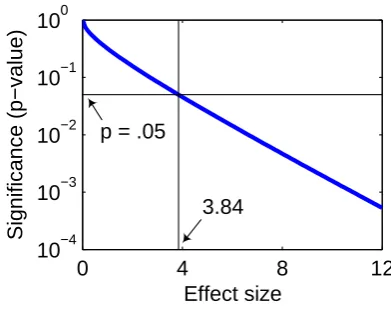
A generalized linear regression model for gamma-distributed data was fitted to the reading times.4 This model contained several well-known predic-tors of word-reading time: the number of letters in the word, the word’s position in the sentence, whether the next word was fixated, whether the previous word was fixated, log of the word’s rel-ative frequency, log of the word’s forward and backward transitional probabilities,5and surprisal of the part-of-speech. Next, one set of entropy-reduction estimates was added to the regression. The effect size is the resulting decrease in the re-gression model’s deviance, which is indicative of the amount of variance in reading time accounted for by those estimates of entropy reduction. Fig-ure 2 shows how effect size is related to statis-tical significance: A factor forms a significant (p < .05) predictor of reading time if its effect size is greater than 3.84.
4 Results and Discussion 4.1 Effect of entropy reduction
Figure 3 shows the effect sizes for both measures of entropy reduction, and their relation to suffix length n. All effects are in the correct direction, that is, larger entropy reduction corresponds to longer reading time. These results clearly support the entropy-reduction hypothesis: A significant
4The reading times, which are approximately gamma dis-tributed, were first normalized to make the scale parameters of the gamma distributions the same across participants.
1
2
3
4
0
5
10
suffix length n
∆
H
neffect size
∆
H
nsuf∆
H
[image:6.595.323.525.58.228.2]n sent
Figure 3: Size of the effect of∆Hsuf
n and∆Hnsent as a function of suffix lengthn.
fraction of variance in reading time is accounted for by the entropy-reduction estimates ∆Hsent
n , over and above what is explained by the other fac-tors in the regression analysis, including surprisal. Moreover, the effect of∆Hsent
n is larger than that of∆Hsuf
n , indicating that it is indeed uncertainty about the identity of the current sentence, rather than uncertainty about the upcoming input(s), that matters for cognitive processing effort. Only at n = 1was the effect size of∆Hnsentsmaller than that of ∆Hnsuf, but it should be kept in mind that
∆Hsent
1 is independent of the incoming word and
is therefore quite impoverished as a measure of the effort involved in processing the word. Moreover, the difference between∆Hsent
1 and∆H1suf is not
significant (p > .4), as determined by the boot-strap method (Efron and Tibshirani, 1986). In con-trast, the differences are significant when n > 1
(allp < .01), in spite of the high correlation be-tween∆Hnsentand∆Hnsuf.
Another indication that cognitive processing ef-fort is modeled more accurately by∆Hsent
n than by
∆Hsuf
n is that the effect size of∆Hnsent seems less affected byn. Even though∆H, the reduction in entropy over complete sentences, is approximated more closely as suffix length grows, increasingn is strongly detrimental to the effect of ∆Hnsuf: It is no longer significant for n > 2. Presumably, this can be (partly) attributed to the impoverished relation between formal entropy and psychologi-cal uncertainty, as explained in Section 3.3.1. In any case, the effect of∆Hsent
n is more stable. Al-though∆Hnsufand∆Hnsentnecessarily converge as n→ ∞, the two effect sizes seem to diverge up to
1 2 3 4
5 10 15 20
effect size
suffix length n H
1
surprisal
∆H
[image:6.595.74.284.61.224.2]n sent
Figure 4: Effect size of entropy reduction
(∆Hnsent), next-word entropy (H1), or surprisal,
over and above the other two predictors.
n = 3: The difference between the effect sizes of ∆Hsent
n and ∆Hnsuf is marginally significantly (p < .07) larger forn= 3than forn= 2.
4.2 Effects of other factors
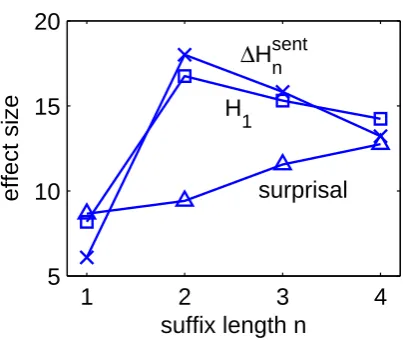
It is also of interest that surprisal has a significant effect over and above entropy reduction, in the cor-rect (i.e., positive) dicor-rection. When surprisal esti-mates are added to a regression model that already contains ∆Hsent
n , the effect size ranges from 8.7 forn= 1to 13.9 forn= 4. This show that there exist independent effects of surprisal and entropy reduction on processing effort.
Be reminded from Section 2.3 that Roark et al. (2009) found a positive relation between reading time on wt+1 and H1(t+ 1), the next-word
en-tropy after processing wt+1. When that value is
added as a predictor in the regression model that already contains surprisal and entropy reduction
∆Hnsent, model fit greatly improves. In fact, as can be seen from comparing Figures 3 and 4, the ef-fect of∆Hsent
5 Discussion and conclusion
The current results contribute to a growing body of evidence that the amount of information conveyed by a word in sentence context is indicative of the amount of cognitive effort required for processing, as can be observed from reading time on the word. Several previous studies have shown that surprisal can serve as a cognitively relevant measure for a word’s information content. In contrast, the rele-vance of entropy reduction as a cognitive measure has not been investigated this thoroughly before. Hale (2003; 2006) presents entropy-reduction ac-counts of particular psycholinguistic phenomena, but does not show that entropy reduction gener-ally correlates with word-reading times. Roark et al. (2009) presented data that could be taken as ev-idence against the entropy-reduction hypothesis, but the current paper showed that the next-word entropy effect, found by Roark et al., is indepen-dent of the entropy-reduction effect.
It is tempting to take the independent effects of surprisal and entropy reduction as evidence for two distinct cognitive representations or pro-cesses, one related to surprisal, the other to en-tropy reduction. However, it is very well possible that these two information measures are merely complementary formalizations of a single, cogni-tively relevant notion of word information. Since the quantitative results presented here provide no evidence for either view, a more detailed qualita-tive analysis is needed.
In addition, the relation between reading time and the two measures of word information may be further clarified by the development of mech-anistic sentence-processing models. Both the sur-prisal and entropy-reduction theories provide only functional-level descriptions (Marr, 1982) of the relation between information content and process-ing effort, so the question remains which under-lying mechanism is responsible for longer read-ing times on words that convey more information. That is, we are still without a model that pro-poses, at Marr’s computational level, some spe-cific sentence-processing mechanism that takes longer to process a word that has higher surprisal or leads to greater reduction in sentence entropy. For surprisal, Levy (2008) makes a first step in that direction by presenting a mechanistic account of why surprisal would predict word-reading time: If the state of the sentence-processing system is viewed as a probability distribution over all
possi-ble interpretations of complete sentences, and pro-cessing a word comes down to updating this distri-bution to incorporate the new information, then the word’s surprisal equals the Kullback-Leibler di-vergence from the old distribution to the new. This divergence is presumed to quantify the amount of work (and, therefore, time) needed to update the distribution. Likewise, Smith and Levy (2008) ex-plain the surprisal effect in terms of a reader’s opti-mal preparation to incoming input. When it comes to entropy reduction, however, no reading-time predicting mechanism has been proposed. Ideally, of course, there should be a single computational-level model that predicts the effects of both sur-prisal and entropy reduction.
One recent model (Frank, 2010) shows that the reading-time effects of both surprisal and entropy reduction can indeed result from a single
pro-cessing mechanism. The model simulates
sen-tence comprehension as the incremental and dy-namical update of a non-linguistic representation of the state-of-affairs described by the sentence. In this framework, surprisal and entropy reduc-tion are defined with respect to a probabilistic model of the world, rather than a model of the language: The amount of information conveyed by a word depends on what is asserted by the sentence-so-far, and not on how the sentence’s form matches the statistical patterns of the lan-guage. As it turns out, word-processing times in the sentence-comprehension model correlate pos-itively with both surprisal and entropy reduction. The model thereby forms a computational-level account of the relation between reading time and both measures of word information. According to this account, the two information measures do not correspond to two distinct cognitive processes. Rather, there is one comprehension mechanism that is responsible for the incremental revision of a mental representation. Surprisal and entropy re-duction form two complementary quantifications of the extent of this revision.
Acknowledgments
References
M. F. Boston, J. Hale, U. Patil, R. Kliegl, and S. Va-sishth. 2008. Parsing costs as predictors of read-ing difficulty: An evaluation usread-ing the Potsdam Sen-tence Corpus. Journal of Eye Movement Research, 2:1–12.
M. H. Christiansen and M. C. MacDonald. 2009. A usage-based approach to recursion in sentence pro-cessing. Language Learning, 59:129–164.
V. Demberg and F. Keller. 2008. Data from
eye-tracking corpora as evidence for theories of syntactic processing complexity. Cognition, 109:193–210.
B. Efron and R. Tibshirani. 1986. Bootstrap methods for standard errors, confidence intervals, and other measures of statistical accuracy. Statistical Science, 1:54–75.
J. L. Elman. 1990. Finding structure in time.
Cogni-tive Science, 14:179–211.
S. L. Frank. 2009. Surprisal-based comparison be-tween a symbolic and a connectionist model of sen-tence processing. In N. A. Taatgen and H. van Rijn, editors, Proceedings of the 31st Annual Conference
of the Cognitive Science Society, pages 1139–1144.
Austin, TX: Cognitive Science Society.
S. L. Frank. 2010. The role of world knowledge in sentence comprehension: an information-theoretic analysis and a connectionist simulation. Manuscript
in preparation.
J. Hale. 2001. A probabilistic Early parser as a
psy-cholinguistic model. In Proceedings of the
sec-ond conference of the North American chapter of the Association for Computational Linguistics,
vol-ume 2, pages 159–166. Pittsburgh, PA: Association for Computational Linguistics.
J. Hale. 2003. The information conveyed by words.
Journal of Psycholinguistic Research, 32:101–123.
J. Hale. 2006. Uncertainty about the rest of the sen-tence. Cognitive Science, 30:643–672.
A. Kennedy and J. Pynte. 2005. Parafoveal-on-foveal effects in normal reading. Vision Research, 45:153– 168.
R. Levy. 2008. Expectation-based syntactic compre-hension. Cognition, 106:1126–1177.
M. Marcus, B. Santorini, and M. A. Marcinkiewicz.
1993. Building a large annotated corpus of
en-glish: the Penn Treebank. Computational
Linguis-tics, 19:313–330.
D. Marr. 1982. Vision. San Francisco: W.H. Freeman and Company.
B. Roark, A. Bachrach, C. Cardenas, and C. Pallier. 2009. Deriving lexical and syntactic expectation-based measures for psycholinguistic modeling via incremental top-down parsing. In Proceedings of
the 2009 Conference on Empirical Methods in Nat-ural Language Processing, pages 324–333.
Associ-ation for ComputAssoci-ational Linguistics.
N. J. Smith and R. Levy. 2008. Optimal processing times in reading: a formal model and empirical in-vestigation. In B. C. Love, K. McRae, and V. M. Sloutsky, editors, Proceedings of the 30th Annual
Conference of the Cognitive Science Society, pages
Appendix
It is of some interest thatHncan be expressed in terms ofH1and the expected value ofHn−1. First,
note that
h(wjt+1|w
t
1) =−P(w
j t+1|w
t
1) logP(w
j t+1|w
t
1)
=−P(wt+1|w1t)P(w
j t+2|w
t+1 1 ) log
³
P(wt+1|wt1)P(w
j t+2|w
t+1 1 )
´
=P(wjt+2|w
t+1
1 )h(wt+1|w1t) +P(wt+1|w1t)h(w
j t+2|w
t+1 1 ).
For entropyHn(t), this makes
Hn(t) = X
wjt+1∈Wn
h(wjt+1|w
t
1)
= X
wjt+1∈Wn
P(wjt+2|w
t+1
1 )h(wt+1|wt1) + X
wtj+1∈Wn
P(wt+1|w1t)h(w
j t+2|w
t+1 1 )
= X
wt+1∈W1
h(wt+1|w
t
1) X
wtj+2∈Wn−1
P(wtj+2|w
t+1 1 )
+
X
wt+1∈W1
P(wt+1|w
t
1) X
wjt+2∈Wn−1
h(wjt+2|w
t+1 1 )
= X
wt+1∈W1
h(wt+1|w1t) +
X
wt+1∈W1
P(wt+1|wt1)Hn−1(t+ 1)