www.wjpr.net Vol 6, Issue 16, 2017. 1587
SPECTRAL CHARACTERIZATION AND ANTI-FUNGAL ACTIVITY
OF ZINC OXIDE (ZNO) NANOPARTICLES SYNTHESIZED USING
CYNODON DACTYLON
LEAF EXTRACT
Arvind Singh K. Heer*
Department of Chemistry, Bhavan’s College, Andheri (West), Mumbai-400058, Maharashtra,
India.
ABSTRACT
A simple method for the green synthesis of Zinc oxide nanoparticles
(ZnO) using aqueous extract of Cynodon dactylon leaf as a reducing
and stabilizing agent. ZnO NPs were rapidly synthesized using
aqueous extract of Cynodon dactylon leaf with Zn(NO3)2 within 4hrs.
The green synthesized ZnO NPs were characterized using
physic-chemical techniques viz., X-ray diffraction (XRD) and Scanning
electron microscope (SEM) coupled with X-ray energy dispersive
spectroscopy (EDX). Characterization data reveals that the particles
were crystalline in nature and spherical shaped with an average size of
86.84 nm. The zeta potential of ZnO NPs was determined at different
pH. The zeta potential curve showed that with the increase in pH the
zeta potential of the prepared nanoparticles decreases. The as synthesized ZnO NPs were
found to exhibit strong antifungal activity against Candida albicans, Candida parapsilosis
and Aspergillus niger was investigated along with standard control, Nystatin. The
synthesized ZnO NPs exhibited a potent antifungal activity against tested fungal strains.
KEYWORDS:Zinc Oxide, Green synthesis, zeta potential, XRD, FE-SEM, DSC, Antifungal
activity, Candida albicans, Candida parapsilosis and Aspergillus niger.
1. INTRODUCTION
Nanomaterials were at the leading edge of the rapidly developing field of nanotechnology.
Their unique size-dependent properties make these materials superior and indispensable in
many areas of human activity. Although chemical and physical methods may successfully
produce pure, well-defined nanoparticles there these methods were quite expensive and
Article Received on 16 October 2017,
Revised on 07 Nov. 2017, Accepted on 28 Nov. 2017
DOI: 10.20959/wjpr201716-10356
8533
*Corresponding Author
Arvind Singh K. Heer
Department of Chemistry, Bhavan’s College, Andheri
(West), Mumbai-400058, Maharashtra, India.
www.wjpr.net Vol 6, Issue 16, 2017. 1588 potentially dangerous to the environment. Use of biological organisms such as
microorganisms, plant extract or plant biomass could be an alternative to chemical and
physical methods for the production of nanoparticles in an eco-friendly manner.[1–3] The
properties of metal nanoparticles depend largely on their synthesis procedures. The variety of
metal oxide is great and their range of properties and possible applications appear to be
enormous. Zinc Oxide is very suitable for sensor and transducer usage with its relatively
bio-safe and biocompatible material. Besides, nanostructured metal oxide has been found to
display appealing nano-morphological, functional, biocompatible, non- toxic and catalytic
properties.[4] The market demand for the ZnO nanopowders is increasing and widely used in
industries due to their ultraviolet filtering, catalytic, anti-corrosion and anti-bacterial
properties. Recently, they have mainly been used in sunscreens as an ultraviolet-resistant
additive. Other applications of zinc oxide nanopowder include electro-photography,
photo-printing, capacitors, protective coatings, anti-microbial, and conductive thin-films in LCDs,
solar cells, and blue laser diodes.[5] In the recent years, resistance of fungal infections has
emerged as major health problem.[13] Candida spp. represents one of the most common
pathogens which are responsible for causing hospital acquired sepsis with an associated
mortality rate upto 40%.[14] Furthermore, these biologically synthesized nanoparticles were
found to produce a high fungicidal activity.
2. EXPERIMENTAL
2.1. Preparation of extract
Cynodon dactylon leaves were collected and washed several times with water to remove the
dust particles and then to remove the residual moisture. The extract used for the reduction of
zinc ions (Zn2+) to zinc nanoparticles (ZnO) was prepared by placing 20g of washed dried
finely powdered Cynodon dactylon leaves in 250 mL glass beaker along with 100 mL of
sterile distilled water. The mixture was then boiled for 30 minutes until the color of the
aqueous solution changes from colorless to brownish yellow. The extract was cooled to room
temperature and filtered using Whatman filter paper No.1. The extract was stored in a
refrigerator in order to be used for further experiments.
The presence of aldehydic group in the plant extract is responsible for reduction of metal ions
and the functional group such as –C=O and –C=N helps in capping of ionic substance into
www.wjpr.net Vol 6, Issue 16, 2017. 1589 2.2. Preparation of zinc oxide nanoparticles
For the synthesis of nanoparticle, 50 ml of Cynodon dactylon leaves extract was taken and
boiled at 60-80oC using magnetic stirrer and heater. When the temperatures reaches 60oC,
0.02moles of Zinc Nitrate (Zn(NO3)2) was added to the solution. This mixture is then boiled
until it is reduced to a deep yellow colored paste. This paste was then collected in a quartz
crucible and sintered in a horizontal furnace at 900oC for 3 hours. A white colored powder
was obtained and it was carefully collected and packed for further characterization. The
material was mashed in a mortar-pestle so as to get a fine nature of particles for
characterization.[12]
2.3. Materials and Characterization
Synthesizing Zinc Oxide nanostructure in this research includes the use of several materials
such as Zinc Nitrate (Zn(NO3)2) ≥99% purity (Sigma aldrich) and Cynodon dactylon leaves
extract. Zinc Nitrate was used as precursor and plant leaves extract was used as a reagent.
X-ray diffraction (XRD) patterns of the synthesized ZnO NPs were collected on Seifert
Rayflex 300TT X-ray diffractometer with Cu K (k = 1.542 Å) radiation. Elemental
composition of the present sample was analyzed with energy dispersive analysis of X-ray
(EDX) spectroscopy using Oxford Inca Penta FeTX3 EDS instrument connected to
JSM-6360 Scanning Electron Microscope. Particle size and zeta potential of ZnO NPs were
measured using Nanopartica (HORIBA), Differential Scanning Calorimetry (DSC) (TA
Instruments DSC Q10) in the range 50-600 °C.
2.4. Antifungal activity of ZnO NPs
Antifungal activity of the synthesized ZnO NPs was determined using the agar well diffusion
assay method. Stock cultures of Candida albicans, Candida parapsilosis and Aspergillus
niger were prepared and maintained in Sabouraud Dextrose Agar (SDA) slants at 4ºC. A
positive control drug (Nystatin) was also done parallel. The plates were examined for
evidence of zone of inhibition, which appear as a clear area around the wells [13]. The
diameter of such zones of inhibition was measured using a meter ruler. Mean value was
www.wjpr.net Vol 6, Issue 16, 2017. 1590 3. RESULTS AND DISCUSSIONS
3.1. Zinc Oxide Nanostructures
Based on the experimental work that has been done, there are series of chemical reaction that takes place. The complete hydrolysis of zinc nitrate with the aid of Cynodon dactylon aqueous leaves extract solution should result in the formation of a ZnO colloid. The final product was obtained as a result of the equilibrium between the hydrolysis and condensation reaction. Due to heating, Zinc nitrate within the solution undergoes hydrolysis forming nitrate ions and zinc ions. The abundance of electrons in the oxygen atoms makes the hydroxyl groups (-OH) of leaves extract molecules bond with the zinc ions.[7] The overall chemical reaction to form ZnO nano-powder when Cynodon dactylon aqueous leaves extract was used as solvent as well as reagent stated as follows:
Zinc hydroxide nitrate is an intermediate product of the hydrolysis reaction, formed in the
presence of H2O and OH ions. It can be easily transformed into ZnO at higher temperature
and with prolonged refluxing. Nitrate is water soluble and could therefore be removed from
the end product. High purity ZnO nano-powder could therefore be obtained successfully by
this green technique.[8,12]
3.2. X-Ray Diffractometer (XRD)
X-Ray Diffraction patterns of zinc oxide nanoparticles are presented in Figure.1. XRD
spectra of zinc oxide nanoparticles displayed number of strong diffraction peaks
corresponding to 100, 002, 101, 102, 110, 103, 112 and 201 reflection lines of hexagonal
wurtzite structure of zinc oxide nanoparticles as per Joint Committee on Powder Diffraction
Studies Standards (JCPDS Card number 008, 82-1042 and 5-0664). The XRD patterns
showing strong and narrow diffraction peaks indicate that the zinc oxide nanoparticles
synthesized are crystalline in nature. In Addition, diffraction peaks from other species were
not found indicating that zinc oxide nanoparticles are free from impurities. The average
particle size of the biosynthesized zinc oxide nanoparticles was determined using
Debye-Scherrer's formula, D=0.9λ/(β cosθ), where D is the crystallite size, λ is the X-ray
wavelength, θ is Bragg's angle in radians and β is the full width half maximum, in radians.
The average particle size of the nanostructures was around 86 nm, corresponding to (100)
www.wjpr.net Vol 6, Issue 16, 2017. 1591 Figure 1: XRD pattern of Zinc Oxide.
3.3. Field Emission Scanning Electron Microscope (FE-SEM)
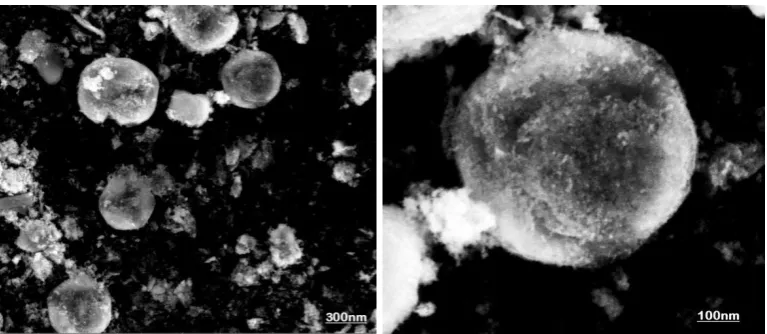
SEM analysis was carried out to find the surface morphology of zinc oxide nanoparticles
prepared from leaf extract using JSM-6360 scanning electron microscope at different
magnification levels and results were shown in Figure.2, respectively. The micrographs
(Figure.2) showed that the network formation occurred at the zinc oxide nanoparticles. It was
clearly indicated that the agglomeration had been taken place. From the images it was
confirmed that the synthesized zinc oxide nanoparticles were in well agreement with the
result obtained from XRD. Moreover the synthesized zinc oxide nanoparticles had a spherical
shape with rough surface.
[image:5.595.107.491.509.676.2]
www.wjpr.net Vol 6, Issue 16, 2017. 1592 3.4. Particle size determination
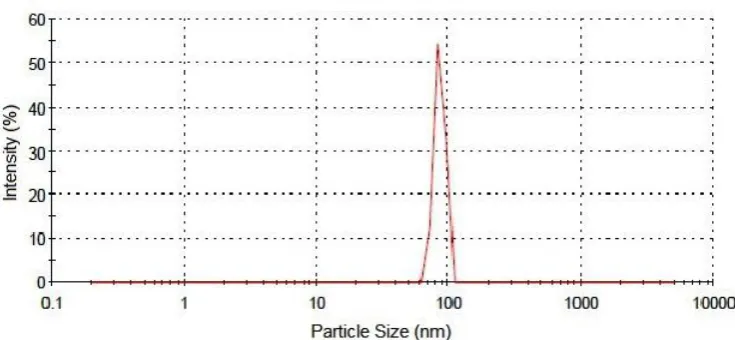
As showed in Fig.3 and Table. 1, for particle size analysis it has absolutely confirmed that the
synthesized ZnO powder is in nanosize form. The particle size of synthesize ZnO powder is
about 86.84 nm. This result is based on their length. In the measurement of particle size
analyzer, the assumptions are based on the length of structure. This result correspond to the
XRD which indicated that the synthesized ZnO nano-powder exhibit good crystallinity. It is
[image:6.595.116.484.236.406.2]considered as a good result because the particle size of synthesized ZnO is below 100nm.
Figure 3: Particle size analysis of ZnO nanoparticles.
Table 1: Data for ZnO particle size.
Size(r.nm) % Intensity Width(r.nm)
86.84 57 8.125
3.5. Energy Dispersive X-ray Spectroscopy (EDX)
Fig.4 and Table.2 show results obtained from the EDX characterization suggested that the
ZnO powder has good purity (Zinc content – 78.74%; Oxygen content – 21.26%), in which
very little impurities can be seen. Theoretically, expected stoichiometric mass per-cent of Zn
and O are 80.3% and 19.7%.[8] The composition of zinc element is higher in the synthesized
ZnO nanopowder.
Table 2: EDX specifications of ZnO nanoparticle.
Element Weight % Atomic % Net Int. Error % K ratio Z R A F
O K 21.26 52.46 209.36 10.02 0.08 1.22 0.87 0.32 1
www.wjpr.net Vol 6, Issue 16, 2017. 1593 Figure 4: EDX graph of ZnO nanoparticles.
3.6. Zeta Potential measurement
Zeta potential is an important parameter that reflects the behavior of colloid. Before
measuring the Zeta potential, 10-1 M of hydrochloric acid and NaOH is mixed with deionized
water so as to come up with ZnO nanoparticles having different pH value. Figure.5 shows the
measured Zeta potential of ZnO nanoparticles having different pH value. Figure.3 shows the
measured mean particle size of the nanoparticles. By comparing Figure.5 and Figure.3, it is
known that the mean secondary particle size of the ZnO nanoparticles on the isoelectric point
is the largest. When the pH value is larger than 9.27, the surface of the particles carry
negative electricity. When the pH value is smaller than 9.27, the surface of the particles carry
positive electricity. Therefore, because of a smaller Zeta potential, phenomenon of clustering
occurs in the particles having their pH values between 7 ~ 11, making an obvious increase of
the mean secondary particle size. It is because the repulsive force between the surface double
electric layers cannot resist the mutual attractive action between the particles, so that
suspension particles having stable dimension cannot be acquired.[9,10]
[image:7.595.124.472.560.750.2]www.wjpr.net Vol 6, Issue 16, 2017. 1594 3.7. Differential Scanning Calorimetry (DSC)
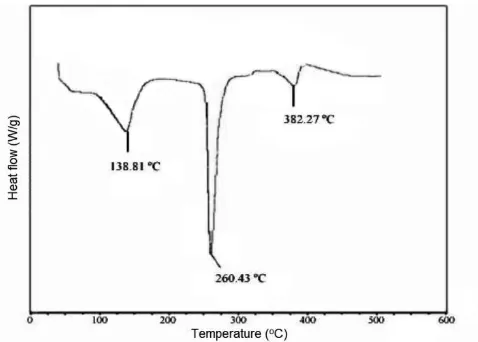
The isothermal oxidation behavior and the oxidized structure of ZnO nanoparticles have been
investigated using DSC technique over a temperature range of 50-600°C in ambient air.
Figure.6 shows DSC curve of zinc oxide nanoparticles. A small low temperature endothermic
peak at 138.81oC is due to loss of volatile surfactant molecule adsorbed on the surface of zinc
oxide nanoparticles during synthesis conditions. A large high temperature endothermic peak
at 260.43ºC is assigned the conversion of zinc hydroxide to zinc oxide nanoparticles. A small
high temperature endothermic peak at 382.77 ºC attributed the conversion of zinc oxide into
[image:8.595.179.418.270.441.2]zinc nanoparticles.
Figure 6: DSC thermogram of synthesized ZnO nanopowders.
3.8. Antifungal activity
The antifungal activity of ZnO NPs against Candida albicans, Candida parapsilosis and
Aspergillus niger was investigated using antifungal drug-Nystatin as a comparable control.
ZnO NPs exhibited a potent antifungal activity against fungal strains. Different
concentrations such as 10, 20, 30 and 40 μl were checked for antifungal activity. ZnO NPs
revealed higher antifungal activity with inhibition zone of 24, 26 and 30mm (Table.3 and
4)[14] reported that spherical ZnO NPs showed potent activity against Candida albicans
compared with that of commercially available antifungal agents. Treating infection caused by
fungi becomes a hectic problem due to serious side effects like renal and liver dysfunction
associated with amphotericin B and nystatin. Ag+ also forms complexes with bases contained
in DNA and is a potent inhibitor of fungal DNAses.[15] The rate of biosynthesis of ZnO
nanoparticles from plant leaves is cost effective and does not use toxic chemicals. It is a well
www.wjpr.net Vol 6, Issue 16, 2017. 1595 with its decreased size and shape owing to increased surface area with enhanced
antimicrobial effect.
Table 3: Antifungal activities of H. musciformis with control and standard.
Organism Concentration
(mg)
Zone of inhibition (mm) Control Standard Sample
Aspergillus niger 50 Nil 22 20
Candida albicans 50 Nil 42 32
Candida parasilopsis 50 Nil 37 26
Table 4: Antifungal activities of H. musciformis at different concentrations.
Organism Zone of inhibition (mm) at different Concentrations (μl)
20 40 60 80
Aspergillus niger 23 25 25 27
Candida albicans 22 23 26 26
Candida parasilopsis 17 18 20 21
4. CONCLUSION
The results showed that the ZnO spherical structure was successfully synthesized by green
method in nanosize range about 86.84 nm. The synthesized ZnO nano-powder obtained
exhibit good crystallinity. When the Zeta potential is 0, the pH value of ZnO NPs is 9.27. So
when the pH is larger than 9.27, the surface of the particle carries negative electricity,
whereas when it is smaller than 9.27, it carries positive electricity. When the pH value lies
between 7 ~ 11, phenomenon of clustering occurs towards the particles because the Zeta
potential is too smaller, making the mean secondary particle size increases obviously.
Thermal studies are carried out by DSC technique which further confirms the formation of
ZnO nanoparticles. Green synthesized ZnO NPs are found to have enhanced antifungal
activity against Candida albicans, Candida parapsilosis and Aspergillus niger. Due to the
enhanced antifungal activity of ZnO NPs, it is effectively used in the field of medicine as
well as in food and cosmetic industries.
ACKNOWLEDGEMENT
I wish to express my sincere gratitude to Bhavan’s College and Department of Chemistry, to
give us chance to do research work, Head of the Chemistry Department, Dr.Rajiv Pandit, for
providing all facilities to work in Laboratory. Earth Science Department, IIT Bombay, for
www.wjpr.net Vol 6, Issue 16, 2017. 1596 REFERENCES
1. M. Sastry, A. Ahmad, M.I. Khan, R. Kumar, Microbial nanoparticle production, in: C.M.
Niemeyer, C.A. Mirkin (Eds.), Nano-biotechnology, Wiley-VCH, Weinheim, 2004. 126.
2. D. Bhattacharya, G. Rajinder, Crit. Rev Biotechnol, 2005; 25: 199.
3. P. Mohanpuria, N.K. Rana, S.K. Yadav, J. Nanopart. Res, 2008; 10: 507.
4. Wahab, H.A & Salama, A.A et al. Optical, structural and morphological studies of ZnO
nano-rod thin film using sol-gel, 2013; 3: 46-51.
5. Chai, C. The Global Market for Zinc Oxide Nanopowders 2012. New Report on Global
Zinc Oxide Nanopowder Market, 2012; 135-140.
6. Nikita Chamria, Sajid M. Mansoori, Satish R. Ingale and Arvind Singh Heer, IJRST,
2017; 7(1): 79(100-116): 2249-0604.
7. Yung, K., Ming, H., Yen, C. & Chao, H., Synthesis of 1D,2D and 3D ZnO
Polycrystalline Nanostructures Using Sol-Gel Method. Journal of Nanotechnology, 2012;
1-8.
8. Bari, A. R., Shinde, M. D., Vinita. D. & Patil, L. A. Effect of Solvents on the Particle
Morphology of nanostructured ZnO. Indian Journal of Pure & Applied Physics, 2009; 47:
24-27.
9. H. Chang, C. S. Jwo, C. H. Lo, T. T. Tsung, M. J. Kao and H. M. Lin // Reviews.
Advanced. Mater. Sci, 2005; 10: 128.
10.P. Mulvaney, Zeta Potential and Colloid Reaction Kinetics (Weinheim: WILEY-VCH,
1998).
11.Arvind Singh K. Heer, et al., J. Chem. & Cheml. Sci, 2017; 7(4): 297-306.
12.Arvind Singh K. Heer, Nikita Chamria, Sajid M. Mansoori, WJPR, 2017; 7(10): 818-826,
ISSN-2277-7105, DOI: 10.20959/wjpr201710-9365.
13.Cheesebrough, M. District Laboratory Practice in Tropical Countries. Low price edition.
The press syndicate of the University of Cambridge, Trumpington Street Cambridge,
2000; part-2: 157.
14.Kim, J.S., Kuk, E., Yu, K.N., Kim, J.H., Park, S.J., Lee, H.J., Kim, S.H., Park, Y.K.,
Park, Y.H., Huwang, .Y., Kim, Y.K., Lee, Y.S., Jeong, D.H., Cho, M.H. Antimicrobial
effects of silver nanoparticles. Nanomed. Nanotehnol. Biol. Med., 2007; 3: 95-101.
15.Ghandour, W.J.A., Bubard, J., Deistung, M.N., Hughes, N., Poole, R.K. The uptake of
silver by Escherichia coli K12 toxic effect and interaction with copper. Appl. Microbiol.