Transit timing variations in the WASP-4 planetary system
⋆
John Southworth
1, M. Dominik
2, U. G. Jørgensen
3, M. I. Andersen
4, V. Bozza
5,6,
M. J. Burgdorf
7, G. D’Ago
8, S. Dib
9,10, R. Figuera Jaimes
11, Y. I. Fujii
3,4,12, S. Gill
1,13,
L. K. Haikala
14, T. C. Hinse
15, M. Hundertmark
10, E. Khalouei
16, H. Korhonen
17,
P. Longa-Pe˜na
18, L. Mancini
19,10,20,21, N. Peixinho
22, M. Rabus
23,24, S. Rahvar
16,
S. Sajadian
25, J. Skottfelt
26, C. Snodgrass
27, P. Spyratos
1, J. Tregloan-Reed
18,
E. Unda-Sanzana
18, C. von Essen
281Astrophysics Group, Keele University, Staffordshire, ST5 5BG, UK
2Centre for Exoplanet Science, SUPA, School of Physics & Astronomy, University of St Andrews, North Haugh, St Andrews KY16 9SS, UK 3Niels Bohr Institute & Centre for Star and Planet Formation, University of Copenhagen, Øster Voldgade 5, 1350 Copenhagen, Denmark 4Niels Bohr Institute, Blegdamsvej 17, 2100 Copenhagen, Denmark
5Dipartimento di Fisica “E.R. Caianiello”, Universit`a di Salerno, Via Giovanni Paolo II 132, 84084, Fisciano, Italy 6Istituto Nazionale di Fisica Nucleare, Sezione di Napoli, Napoli, Italy
7Universit¨at Hamburg, Department of Earth Sciences, Meteorological Institute, Bundesstraße 55, 20146 Hamburg, Germany
8Instituto de Astrof´ısica, Facultad de F´ısica, Pontificia Universidad Cat´olica de Chile, Av. Vicu˜na Mackenna 4860, 7820436 Macul, Santiago, Chile 9Laboratoire d’Astrophysique de Bordeaux, Universit´e de Bordeaux, CNRS, B18N, all´ee Geoffroy Saint-Hilaire, 33615, Pessac, France
10Max Planck Institute for Astronomy, K¨onigstuhl 17, D-69117 Heidelberg, Germany
11Facultad de Ingenier´ıa y Tecnolog´ıa Universidad San Sebast´ıan, General Lagos 1163, Valdivia 5110693, Chile
12Institute for Advanced Research and Department of Physics, Nagoya University, Furo-cho, Chikusa-ku, Nagoya, 464-8601, Japan 13Department of Physics, University of Warwick, Gibbet Hill Road, Coventry CV4 7AL, UK
14Instituto de Astronom´ıa y Ciencias Planetarias de Atacama, Universidad de Atacama, Copayapu 485, Copiapo, Chile 15Chungnam National University, Department of Astronomy and Space Science, 34134 Daejeon, Republic of Korea 16Department of Physics, Sharif University of Technology, PO Box 11155-9161 Tehran, Iran
17DARK, Niels Bohr Institute, University of Copenhagen, Lyngbyvej 2, 2100 Copenhagen, Denmark
18Centro de Astronom´ıa (CITEVA), Universidad de Antofagasta, Avda. U. de Antofagasta 02800, Antofagasta, Chile 19Department of Physics, University of Rome Tor Vergata, Via della Ricerca Scientifica 1, I-00133 Rome, Italy 20INAF – Osservatorio Astrofisico di Torino, via Osservatorio 20, I-10025 Pino Torinese, Italy
21International Institute for Advanced Scientific Studies (IIASS), Via G. Pellegrino 19, I-84019 Vietri sul Mare (SA), Italy 22CITEUC – Center for Earth and Space Science Research of the University of Coimbra, 3040-004 Coimbra, Portugal 23Las Cumbres Observatory Global Telescope, 6740 Cortona Dr., Suite 102, Goleta, CA 93111, USA
24Department of Physics, University of California, Santa Barbara, CA 93106-9530, USA 25Department of Physics, Isfahan University of Technology, Isfahan 84156-83111, Iran
26Centre for Electronic Imaging, Department of Physical Sciences, The Open University, Milton Keynes, MK7 6AA, UK 27Institute for Astronomy, University of Edinburgh, Royal Observatory, Edinburgh EH9 3HJ, UK
28Stellar Astrophysics Centre, Department of Physics and Astronomy, Aarhus University, Ny Munkegade 120, 8000 Aarhus C, Denmark
14 September 2019
ABSTRACT
Transits in the planetary system WASP-4 were recently found to occur 80 s earlier than ex-pected in observations from the TESS satellite. We present 22 new times of mid-transit that confirm the existence of transit timing variations, and are well fitted by a quadratic ephemeris with period decaydP/dt=−9.2±1.1ms yr−1. We rule out instrumental issues, stellar
activ-ity and the Applegate mechanism as possible causes. The light-time effect is also not favoured due to the non-detection of changes in the systemic velocity. Orbital decay and apsidal pre-cession are plausible but unproven. WASP-4 b is only the third hot Jupiter known to show transit timing variations to high confidence. We discuss a variety of observations of this and other planetary systems that would be useful in improving our understanding of WASP-4 in particular and orbital decay in general.
Key words: planetary systems — stars: fundamental parameters — stars: activity — stars:
individual: WASP-4
⋆ Based on data collected by MiNDSTEp with the Danish 1.54 m telescope
at the ESO La Silla Observatory.
taken over 3.3 yr to find a quadratic term in the orbital ephemeris of WASP-12 to a significance of 5σ (see also Patra et al. 2017; Maciejewski et al. 2018b), and WASP-47 b shows sinusoidal TTVs due to the presence of two smaller short-period planets (Becker et al. 2015).
In this work we show that WASP-4 b (Wilson et al. 2008) is the third giant planet known to exhibit detectable TTVs, with a signifi-cance of 8.4σ. This confirms preliminary suggestions from Bouma et al. (2019, hereafter B19) based on data from the TESS satellite (Ricker et al. 2015). Baluev et al. (2015) have also claimed a ten-tative detection of TTVs in WASP-4, in the form of a sinusoidal variation with a period near 5 d; we do not confirm this detection. When needed, we will adopt the physical properties of the WASP-4 system given by Southworth (2012). In brief, the planet has mass 1.25MJupand radius 1.36RJup, and is on a 1.338 d orbit around
a star of mass 0.93M⊙ and radius 0.91R⊙. The star’s effective
temperature is 5500 K (Mortier et al. 2013) and it shows magnetic activity in the form of dark starspots (Sanchis-Ojeda et al. 2011). No companion stars have been found in high-resolution imaging studies (Ngo et al. 2015; Evans et al. 2016) and no long-term trend in systemic velocity has been identified (Knutson et al. 2014).
2 OBSERVATIONS
We have been monitoring transits in the WASP-4 system for approximately a decade using the Danish 1.54 m telescope and DFOSC imager at ESO La Silla, as a side-project of the MiND-STEp Consortium (Dominik et al. 2010). Four transits observed in the 2008 season were presented in Southworth et al. (2009b), and we also observed one transit in 2009, two in 2011, three in 2015, three in 2016, two in 2017 and three in 2018. All observations were obtained through a CousinsRfilter with the CCD unbinned and the telescope significantly defocussed to enhance the photometric pre-cision (Southworth et al. 2009a). The scatters of the datasets versus transit fits (see below) range from 0.54 to 1.03 mmag with cadences of typically 140 s.
We also observed one transit in the WASP-4 system using the NTT and EFOSC2 imager (Buzzoni et al. 1984) with an SDSSr
filter (ESO filter #784) on the night of 2011/10/21. The telescope was defocussed, the CCD was not binned, and only one comparison star was used due to the small field of view. The light curve is of very high quality (see Tregloan-Reed & Southworth 2013), with a scatter of 0.47 mmag.
Finally, we observed three transits using the SAAO 1.0 m tele-scope at Sutherland, South Africa: two in 2016 and one in 2019. The STE4 CCD was used with a CousinsRfilter, 2×2 binning to
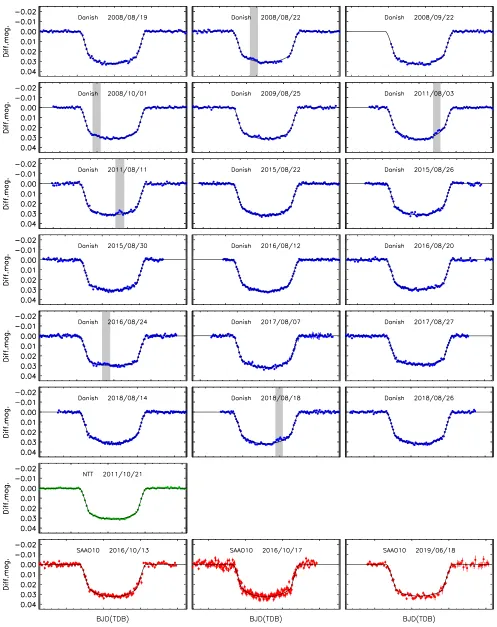
all cases we used a linear or quadratic polynomial and the coeffi-cients were included as fitted parameters in all subsequent analyses. The best light curve was obtained by manually iterating the aperture sizes and which comparison stars were included – we found that the choices made here do affect the scatter of the light curve but have no significant effect on its shape. We did not per-form bias or flat-field calibrations because they have a negligible effect on DFOSC data except for an increase in the noise level of the light curve (Southworth et al. 2014). All new data are shown in Fig. 1.
The timestamps were converted to the BJD(TDB) timescale using routines from Eastman et al. (2010). Manual time checks were performed for images in most observing sequences, and no discrepancies were noticed1. We have previously found a good agreement between the timestamps on the Danish and MPG 2.2m telescopes (Southworth et al. 2015), supporting the reliability of both.
Southworth et al. (2009b) used an early version ofDEFOTso the 2008 data were re-reduced with the current version. This allo-wed the use of image motion tracking, additional comparison stars, and timestamps on the BJD(TDB) timescale. The re-reduced data supersede those from Southworth et al. (2009b).
3 MEASUREMENTS OF THE TRANSIT TIMES
Each transit was fitted in isolation using the JKTEBOP2 code (Southworth 2013, and references therein). The fitted parameters were the transit midpointT0, the fractional radii of the two com-ponents (rA = RA
a andrb = Rb
a whereRAis the radius of the
star,Rbis the radius of the planet, andais the semimajor axis of the relative orbit) expressed as their sum and ratio, the orbital in-clination, and the coefficients of the polynomial versus time. We modelled limb darkening using the quadratic law, fitted for the lin-ear coefficient, and fixed the quadratic coefficient at an appropriate value.
Uncertainties on the transit times were obtained using Monte Carlo simulations and multiplied bypχ2
νwhereχ2νis the reduced χ2
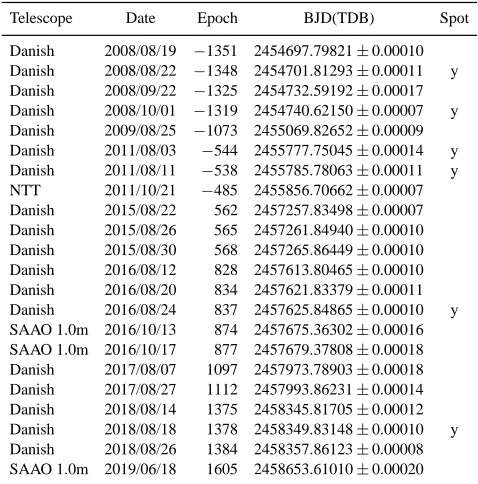
of the fit. This final step is necessary because the aperture pho-tometry routine used in our pipeline tends to underestimate the ob-servational uncertainties. Table 1 gives the 22 transit times calcu-lated in this work. To this dataset we added all timings from table 2
1 The 2009 season with the Danish Telescope suffered from a timing
pro-blem (Southworth et al. 2009c, 2010). We have investigated this further and found that it did not affect any observations of WASP-4 presented here. 2 JKTEBOPis written inFORTRAN77 and the source code is available at
Figure 1. All new photometric data presented in this work. In each case the x-axis shows 0.2 d centred on the time of minimum measured for that transit. The
telescope and date are labelled on each panel. Starspot crossing events are visible during totality in six of the light curves, and are indicated by the grey boxes. TheJKTEBOPbest fits are shown using black lines.
Danish 2016/08/12 828 2457613.80465±0.00010
Danish 2016/08/20 834 2457621.83379±0.00011
Danish 2016/08/24 837 2457625.84865±0.00010 y
SAAO 1.0m 2016/10/13 874 2457675.36302±0.00016
SAAO 1.0m 2016/10/17 877 2457679.37808±0.00018
Danish 2017/08/07 1097 2457973.78903±0.00018
Danish 2017/08/27 1112 2457993.86231±0.00014
Danish 2018/08/14 1375 2458345.81705±0.00012
Danish 2018/08/18 1378 2458349.83148±0.00010 y
Danish 2018/08/26 1384 2458357.86123±0.00008
SAAO 1.0m 2019/06/18 1605 2458653.61010±0.00020
of B19, which includes 41 measurements from the literature and 18 timings from the TESS light curve.
4 TRANSIT TIMING ANALYSIS
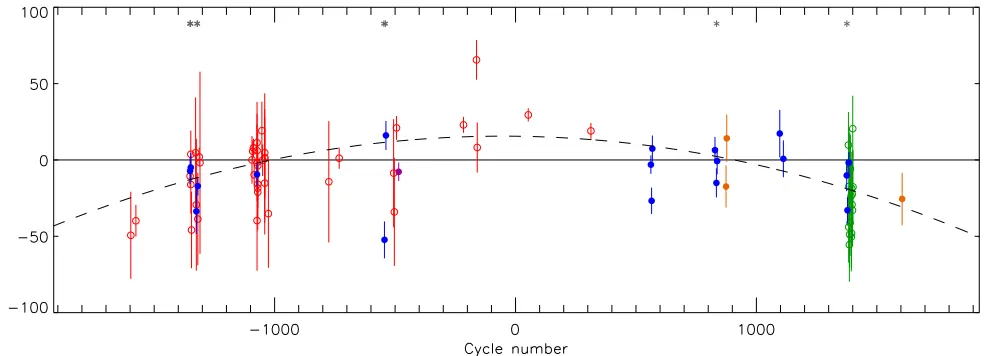
Our analysis was performed on the transit timings assembled above. We fitted a straight line to the times as a function of or-bital cycle, using a zeropoint for cycle number near to the mid-point of the available data to avoid correlations between the para-meters of the ephemeris (Fig. 2). This yielded a poor fit so we tried a quadratic ephemeris instead, finding a significant improvement. The best-fitting linear ephemeris is:
T0= BJD(TDB) 2 456 505.748953(20) + 1.338231429(20)E
withχν2= 1.80and an rms scatter of 24.6 s. The bracketed
quanti-ties indicate the uncertainquanti-ties in the preceding digits and have been increased bypχ2
ν to account for the imperfect fit. The best-fitting
quadratic ephemeris is:
T0 = BJD(TDB) 2 456 505.749133(27)
+ 1.338231408(18)E −(1.95±0.23)×10−10E2
withχ2
ν = 1.41and an rms scatter of 19.9 s. As above, the
uncer-tainties have been increased bypχ2
ν to account for the imperfect
fit. We also fitted a cubic ephemeris but found it to be a negligible improvement on the quadratic ephemeris.
This quadratic coefficient corresponds to a period change of
dP
dE = (−3.91±0.46)×10 −10
day per orbital cycle, and to a period derivative of
dP
dt = −9.2±1.1 ms yr −1
This is roughly3σlower than the value of−12.6±1.2ms yr−1 found by B19. We investigated this by applying our analysis to only the transit times used by B19, which precisely reproduced their re-sults. Therefore the difference in the period derivatives found by
ski et al. 2018a). The 8.4σsignificance level of the quadratic term already includes an allowance for this largeχν2. Fig. 2 shows that
our new timings are consistent with published values in all cases where such a comparison can be drawn.
WASP-4 A shows starspots and these are expected to add scat-ter to timing measurements both on theoretical (Ballerini et al. 2012; Oshagh et al. 2013) and empirical (Maciejewski et al. 2018b) grounds. The obvious outlier at cycle−544and residual−64s is affected by starspots. To investigate this we rejected the six timings clearly affected by starspot crossing events (Table 1) and recalcu-lated the ephemerides. We find that theχν2 drops to 1.30 for the
quadratic and 1.70 for the linear ephemeris, the quadratic term is not significantly changed, and its detection significance becomes 8.2σ. We conclude that spot activity increases the scatter of the transit timings but that TTVs are still detected to high confidence.
Visual inspection of Fig. 2 suggested the possibility of a si-nusoidal variation superimposed on the quadratic term. We there-fore calculated a periodogram of the residuals of the best fit to the quadratic ephemeris, using thePERIOD04 package (Lenz & Breger 2004). The periodogram contained no significant peaks, with the highest having a signal-to-noise ratio of 2.7. We find no significant peak near the period of 5.1 d tentatively identified by Baluev et al. (2015), so do not confirm this detection of sinusoidal variation. Fur-ther observations are needed to refine these conclusions.
5 POSSIBLE CAUSES OF THE TRANSIT TIMING VARIATION
In the previous section we have demonstrated that WASP-4 exhibits a quadratic variation in its transit times with a significance of 8.4σ. We now discuss possible causes of this effect.
5.1 Starspots
[image:4.595.42.281.133.375.2]Figure 2. Plot of the residuals of the timings of mid-transit versus a linear ephemeris. The results from this work are shown with filled circles: blue for the
Danish telescope, orange for the SAAO 1.0m, and purple for the NTT. Published results are shown using open circles: red for the literature data collected by B19 and green for the TESS timings from B19. The dotted line shows the difference between the best-fitting linear and quadratic ephemerides. Grey asterisks have been placed near the top of the figure to indicate transit times measured from a light curve with a spot crossing event.
previously found visual methods to perform well in the identifica-tion of spot anomalies in transit light curves (Moˇcnik et al. 2017). We have indicated the transits with spot crossing events on Fig. 2, and find no clear correlation with the residuals versus the quadratic ephemeris fit. The quadratic term in the ephemeris is also detected to almost the same significance if these timings are rejected from the ephemeris fit.
From Fig. 1 we see that starspots are preferentially detected in WASP-4 towards the start or end of totality in the transit light curve. This is because the starspots move with the stellar surface at an approximately constant angular speed, and thus at a variable linear speed when projected into the plane of the sky. The starspots move faster when they are near the projected centre of the star, so are less likely to be found there. Conversely, smaller starspots may be preferentially found away from the limb of the star because limb darkening will attenuate their photometric signal and make their detection less likely. Both effects should be accounted for in detailed statistical studies of these phenomena.
Watson & Dhillon (2004) investigated the effect of starspots on timing measurements due to the Wilson depression: the phe-nomenon that starspots are slightly depressed into the surface of the star. They found that this effect was sufficient to cause a change in the measured time of an eclipse at the level of a few seconds for a white dwarf plus M-dwarf binary. The effect will be less than a second for WASP-4 due to the larger radius ratio, so is not capable of causing the TTV we have found.
5.2 Applegate mechanism
Changes in the quadrupole moment of the star (Applegate 1992) have been proposed as a possible cause of TTVs in planetary sys-tems. Watson & Marsh (2010) calculated the amplitude of the TTVs for WASP-4 for three scenarios concerning the length of the activity cycle in the host star. The largest TTV amplitude was found to be 15.3 s for a 50 yr activity cycle, so is a factor of six too small to explain the observed TTVs.
5.3 Orbital decay
Tidal effects will cause the majority of known hot Jupiters to merge with their host stars on a timescale of several Gyr (Levrard et al. 2009; Jackson et al. 2009). This orbital decay will initially appear as a continuous decrease in their orbital period, causing a quadratic variation in the transit times. We followed the approach of Patra et al. (2017) to calculate the modified stellar tidal quality factor for the WASP-4 system, findingQ′
⋆= 104.58±0.03.
A wide range of possibleQ′⋆values have been found in
previ-ous studies, both theoretical and observational. The canonical value ofQ′⋆is106(e.g. Ogilvie & Lin 2007), a value of105.5was found
to be a good match to a sample of extrasolar planets (Jackson et al. 2008), and a theoretical study by Essick & Weinberg (2016) yielded
Q′⋆ ≈ 105 to106for short-period hot Jupiters. But other studies
disagree: theoretical work by Penev & Sasselov (2011) constrained
Q′⋆to be108–109.5, an observational study by Penev et al. (2012)
foundQ′⋆>107, and Collier Cameron & Jardine (2018) used the
distribution of orbital separations of the known population of tran-siting hot Jupiters to deduceQ′
⋆= 108.26±0.14.
The value ofQ′⋆is also expected to depend on the nature of
the tidal perturbation and the internal structure of the star (Ogilvie 2014; Penev et al. 2018), on orbital period (Barker 2011), and on planet mass (Barker & Ogilvie 2010). Barker (2011) found a de-pendence on orbital period ofQ′⋆ ∝P14/5, giving a value of
ap-proximately105.3
for the WASP-4 system.
A tidal quality factor small enough to cause the TTV observed in WASP-4 is smaller than any determined in the observational and theoretical studies listed above. However, it is sufficiently close to the lower envelope ofQ′⋆values, and this envelope is sufficiently
large, that it is not currently possible to rule out orbital decay as a cause of the TTV. Further work is needed to better understand the possible values ofQ′⋆and its dependence on system parameters
such as planet mass and orbital period.
5.4 Light-time effect
The presence of a third component in the system on a wider orbit than WASP-4 b will cause a change in the measured transit
If present, this third object would imprint an orbital mo-tion of amplitude ∼500 m s−1 on the radial velocity (RV) of the star. Knutson et al. (2014) searched for changes in the sys-temic velocity of WASP-4 A, finding an insignificant value of
˙
γ = −0.0099+0.0052
−0.0054m s −1
d−1. The 3σ upper limit on this is 5.9 m s−1yr−1, so would be 36 m s−1over the 6-year time interval covered by the RVs and 69 m s−1over the 11.7-year time interval covered by the transit timings. The lowest possible RV change over a 6-year time interval is 67 m s−1, two times larger than allowed by the 3σupper limit onγ˙, so the third-body interpretation is moder-ately inconsistent with the data.
Additional possibilities that could be invoked to bring the third-body hypothesis into better agreement with the data are or-bital eccentricity (which must be sufficiently low to yield a roughly quadratic variation over the 11.7-year interval covered by the avai-lable timings), an inclined orbit (which will not help much because it would require a larger third body mass to obtain the same am-plitude of the light-time effect), and a longer orbital period (which would also require a more massive third body). We conclude that the light-time effect is not a good explanation for the observed TTVs. Further analysis and RV measurements of the host star would help to strengthen this conclusion.
5.5 Apsidal motion
Patra et al. (2017) attempted to explain the quadratic orbital ephemeris of WASP-12 through apsidal precession, finding that it was consistent with the data but disfavoured relative to an orbital decay model. It is difficult to apply this model to WASP-4 because it requires measurements of the midpoint of occultations as well as transits over a significant time interval. Whilst some occultation timings are available (Beerer et al. 2011; C´aceres et al. 2011; Zhou et al. 2015) they lack the precision and time sampling necessary to provide useful constraints on apsidal motion in the system (see also B19). We recommend that new high-precision observations of occultations in the WASP-4 system are obtained.
Apsidal motion can only occur in eccentric systems. Triaud et al. (2010) founde <0.018for WASP-4 and Beerer et al. (2011) foundecosω = 0.00030±0.00086: these do not constrain ec-centricity sufficiently to rule out apsidal precession. One problem for this hypothesis, however, is the need for the system to have a non-zero eccentricity despite the presence of strong tidal effects in this short-period system containing a cool star with an extensive convective envelope.
a factor of six smaller than observed. The light-time effect due to a third body struggles to match our results. Apsidal precession is plausible and deserves further investigation, in particular the ob-servation of secondary eclipses so the orbital period found from transits can be compared to that found from occultations.
Orbital decay is a plausible but not favourable option for caus-ing the observed TTV. The tidal quality factor needed, Q′⋆ =
104.58±0.03
, is smaller than those predicted from theoretical argu-ments or measured from the population of known transiting planets. However, the envelope of possible values ofQ′
⋆is broad and close
to the value found for WASP-4, so it is not currently possible to discount this hypothesis.
A program of transiting timing measurements of a wide va-riety of planetary systems would help by providing observational constraints on orbital decay as a function of stellar type, planet mass, and orbital period. AsQ′⋆is expected to depend on the
sys-tem parameters, it also would be interesting to perform TTV anal-yses on other systems similar to WASP-4. We used the TEPCat3 catalogue (Southworth 2011) to identify HATS-2 and WASP-64 as the best candidates. These were found 5–6 years later than WASP-4 so their transit timings cover a smaller time interval, but this could be compensated for by obtaining a larger number of high-quality transit observations in the near future.
We also advocate obtaining new observations of the WASP-4 system, and will be keeping it on the target list of the MiNDSTEp transit monitoring program. New transit times would refine and ex-tend the baseline of the quadratic ephemeris. Further timings of secondary eclipses would allow the apsidal motion hypothesis to be ruled in or out. RV measurements of the planet host star would give stricter limits on the change in systemic velocity of the system. WASP-4 and WASP-12 stand out as the only hot Jupiters for which unexplained TTVs have been detected: as this phenomenon is un-common it is reasonable to propose unusual or unlikely scenarios for such systems.
ACKNOWLEDGEMENTS
This paper uses data from the South African Astronomical Ob-servatory (SAAO) under programmes Southworth-2016-05-1.0-m and Southworth-2019-01-40-inch-228, and froSouthworth-2016-05-1.0-m ESO un-der programme ID 088.C-0204 (P.I. Tregloan-Reed). The re-duced light curves presented in this work will be made availa-ble at the CDS (http://cdsweb.u-strasbg.fr/) and at
3 TEPCat (the Transiting Extrasolar Planet Catalogue) is available at
http://www.astro.keele.ac.uk/jkt/. We are grateful to Luke Bouma, Adrian Barker and an anonymous referee for very useful comments that helped to significantly improve our pa-per. This project was partially funded by the MINEDUC-UA ESR project ANT 1795. The following internet-based resources were used in research for this paper: the ESO Digitized Sky Survey; the NASA Astrophysics Data System; the SIMBAD database operated at CDS, Strasbourg, France; and the arχiv scientific paper preprint service operated by Cornell University.
REFERENCES
Akaike, H., 1974, IEEE Transactions on Automatic Control, 19, 716
Applegate, J. H., 1992, ApJ, 385, 621 Baliunas, S. L., et al., 1995, ApJ, 438, 269
Ballerini, P., Micela, G., Lanza, A. F., Pagano, I., 2012, A&A, 539, A140
Baluev, R. V., et al., 2015, MNRAS, 450, 3101 Barker, A. J., 2011, MNRAS, 414, 1365
Barker, A. J., Ogilvie, G. I., 2010, MNRAS, 404, 1849
Becker, J. C., Vanderburg, A., Adams, F. C., Rappaport, S. A., Schwengeler, H. M., 2015, ApJ, 812, L18
Beerer, I. M., et al., 2011, ApJ, 727, 23 Birkby, J. L., et al., 2014, MNRAS, 440, 1470 Bouma, L. G., et al., 2019, AJ, 157, 217 Buzzoni, B., et al., 1984, The Messenger, 38, 9 C´aceres, C., et al., 2011, A&A, 530, A5
Collier Cameron, A., Jardine, M., 2018, MNRAS, 476, 2542 Dominik, M., et al., 2010, AN, 331, 671
Eastman, J., Siverd, R., Gaudi, B. S., 2010, PASP, 122, 935 Essick, R., Weinberg, N. N., 2016, ApJ, 816, 18
Evans, D. F., et al., 2016, A&A, 589, A58 Gibson, N. P., et al., 2010, MNRAS, 401, 1917 Harpsøe, K. B. W., et al., 2013, A&A, 549, A10 Holman, M. J., Murray, N. W., 2005, Science, 307, 1288 Jackson, B., Greenberg, R., Barnes, R., 2008, ApJ, 678, 1396 Jackson, B., Barnes, R., Greenberg, R., 2009, ApJ, 698, 1357 Knutson, H. A., et al., 2014, ApJ, 785, 126
Lenz, P., Breger, M., 2004, in J. Zverko, J. ˇZiˇznovsky, S. J. Adel-man, & W. W. Weiss, ed., The A-Star Puzzle, Cambridge Uni-versity Press, Cambridge, UK., vol. 224 of IAU Symposium, p. 786
Levrard, B., Winisdoerffer, C., Chabrier, G., 2009, ApJ, 692, L9
Maciejewski, G., Stangret, M., Ohlert, J., Basaran, C. S., Ma-ciejczak, J., Puciata-Mroczynska, M., Boulanger, E., 2018a, In-formation Bulletin on Variable Stars, 6243
Maciejewski, G., et al., 2016, A&A, 588, L6 Maciejewski, G., et al., 2018b, AcA, 68, 371 Mazeh, T., et al., 2013, ApJS, 208, 16
Mortier, A., Santos, N. C., Sousa, S. G., Fernandes, J. M., Adibekyan, V. Z., Delgado Mena, E., Montalto, M., Israelian, G., 2013, A&A, 558, A106
Moˇcnik, T., Southworth, J., Hellier, C., 2017, MNRAS, 471, 394 Ngo, H., et al., 2015, ApJ, 800, 138
Ogilvie, G. I., 2014, ARA&A, 52, 171
Ogilvie, G. I., Lin, D. N. C., 2007, ApJ, 661, 1180
Oshagh, M., Santos, N. C., Boisse, I., Bou´e, G., Montalto, M., Dumusque, X., Haghighipour, N., 2013, A&A, 556, A19 Patra, K. C., Winn, J. N., Holman, M. J., Yu, L., Deming, D., Dai,
F., 2017, AJ, 154, 4
Penev, K., Sasselov, D., 2011, ApJ, 731, 67
Penev, K., Jackson, B., Spada, F., Thom, N., 2012, ApJ, 751, 96 Penev, K., Bouma, L. G., Winn, J. N., Hartman, J. D., 2018, AJ,
155, 165
Ricker, G. R., et al., 2015, Journal of Astronomical Telescopes, Instruments, and Systems, 1, 014003
Sanchis-Ojeda, R., Winn, J. N., Holman, M. J., Carter, J. A., Osip, D. J., Fuentes, C. I., 2011, ApJ, 733, 127
Schwarz, G., 1978, Annals of Statistics, 5, 461 Southworth, J., 2011, MNRAS, 417, 2166 Southworth, J., 2012, MNRAS, 426, 1291 Southworth, J., 2013, A&A, 557, A119
Southworth, J., et al., 2009a, MNRAS, 396, 1023 Southworth, J., et al., 2009b, MNRAS, 399, 287 Southworth, J., et al., 2009c, ApJ, 707, 167 Southworth, J., et al., 2010, ApJ, 723, 1829 Southworth, J., et al., 2014, MNRAS, 444, 776 Southworth, J., et al., 2015, MNRAS, 447, 711 Southworth, J., et al., 2016, MNRAS, 457, 4205
Tregloan-Reed, J., Southworth, J., 2013, MNRAS, 431, 966 Triaud, A. H. M. J., et al., 2010, A&A, 524, A25
Watson, C. A., Dhillon, V. S., 2004, MNRAS, 351, 110 Watson, C. A., Marsh, T. R., 2010, MNRAS, 405, 2037 Wilson, D. M., et al., 2008, ApJ, 675, L113
Woltjer, J., J., 1922, BAN, 1, 93
Zhou, G., Bayliss, D. D. R., Kedziora-Chudczer, L., Tinney, C. G., Bailey, J., Salter, G., Rodriguez, J., 2015, MNRAS, 454, 3002