doi:10.4236/wet.2011.22008 Published Online April 2011 (http://www.SciRP.org/journal/wet)
Performance Tradeoff with Routing Protocols for
Radio Models in Wireless Sensor Networks
Manju Bala, Lalit Awasthi
Department of Computer Science and Engineering, National Institute of Technology, Hamirpur, India. Email: [email protected]
Received November 16th, 2010; revised February 15th, 2011; accepted February 18th, 2011.
ABSTRACT
In this paper, we have simulated and evaluated the performance tradeoff with routing protocols: Constrained Flooding, the Real-Time Search and the Adaptive Tree on MICA and MICAz platform with different radio models using PROW-LER for wireless sensor networks. The simulation results establish that the MICAz motes give low latency, high throughput, high energy consumption, low efficiency but better lifetime while the MICA motes give high success rate and less loss rate. It has been, thus, concluded that in case of all the radio models the MICAz is preferably better than MICA in applications where energy is a constraint. Moreover, use of MICAz motes increases the network lifetime in comparison to MICA for the radio models. Further, the AT protocol can be applied to achieve better energy consump-tion, efficiency and lifetime in real time for wireless sensor networks.
Keywords: Constraint-Based Routing, Meta-Strategies, Real-Time Reinforcement Learning, Routing Tree, Wireless Sensor Networks
1. Introduction
Wireless sensor networks (WSNs) contain hundreds or thousands of sensor nodes equipped with sensing, com-puting and communication abilities. Each node has the ability to sense elements of its environment, perform simple computations, and communicate among its peers or directly to an external base station (BS) [1]. Routing in sensor network, however, has very different characteris-tics than routing in traditional communication networks. First of all, address-based destination specification is replaced by a more general feature-based specification, such as geographic location [2] or information gain [3]. Secondly, routing metrics are not just shortest Latency, but usually multiple objectives, including energy usage [4] and information density [3]. Thirdly, in addition to peer-to-peer communication, multicast (one-to-many) and converge-cast (many-to-one) are major traffic pat-terns in sensor networks. Even for peer-to-peer commu-nication, the source/destination pairs often are dynamic (changing from time to time) or mobile (moving during routing).
Lot of research has been done recently on routing me-chanisms that take QoS and trade-off specifications into consideration. Message-initiated Constrained-Based Routing (MCBR) [5] for wireless ad-hoc sensor networks
is one of them. MCBR is a framework of routing mecha-nisms composed of the explicit specification of con-strained-based destinations, route constraints and QoS requirements for messages, and a set of QoS-aware me-ta-strategies.
Three distributed Meta routing strategies based on real-time reinforcement learning [6]: Real-Time Search (RTS) [7], Constrained Flooding (CF) [8], and Adaptive Tree (AT) [9] have also been proposed. All of these use the same reinforcement learning core, which estimates and updates the cost from the current node to the destina-tion. In contrast to most existing QoS routing, learn-ing-based meta-strategies do not create and maintain ex-plicit routes; instead, packets discover and improve the routes over time.
packets/sec), loss rate, success rate, energy consumption, energy efficiency and lifetime (years). Here the per-formance evaluation is done by using the event-driven simulator PROWLER integrated with Routing Modeling Application Simulation Environment (RMASE) [10].
The organization of the paper is as follows: after brief introduction in Section 1, the Section 2 describes the simulation model under different radio models. Section 3 reported the comparative findings for CF, RTS & AT protocols with the influence of Normal Radio Model (NRM), Radio Model with SINR (RMSINR); Radio Model with Rayleigh Fading (RMRYF); and Radio Model with Rician Fading (RMRCF) for targeted Berke-ley MICA and MICAz motes. Finally Section 4 con-cludes the paper.
2. Simulation Model
Currently there are many network simulators are avail-able such as SensorSim [11], TOSSIM [12], NS2 [13], OPNET [14]. In this paper a matlab-based simulator PROWLER has been used which was developed by NEST, Vanderbilt University [15]. It provides an easy way of application prototyping with nice visualization capabilities. It is an event-driven tool that simulates the nondeterministic nature of the communication channel and the low-level communication protocol of the wireless sensor nodes [16]. To produce replicable results while testing the application, prowler can be set to operate in deterministic mode also. It can incorporate arbitrary number of nodes on arbitrary and even dynamic topology. Prowler models all the important aspects of the commu-nication channel and the application. Here the following radio and MAC models have been compared to investi-gate their performance.
2.1. Radio, MAC and Routing Models
The simple radio model in PROWLER attempts to simu-late the probabilistic nature in wireless sensor communi-cation observed by many. The propagation model deter-mines the strength of a transmitted signal at a particular point of the space for all transmitters in the system. Based on this information the signal reception conditions for the receivers can be evaluated and collisions can be detected. Here the work reported in [15] has been ex-tended by developing a new radio model Rician. Subse-quently the comparative findings have been reported with different routing protocols CF, RTS and AT for wireless sensor networks in a simulated environment for MICA and MICAz Berkley motes.
The transmission model is given by [17]:
, 1 1 , where 2 4
rec ideal transmit
P d P d
, ,
,
1
,
rec rec ideal i j 1
P i j P d i j t (2)
where Ptransmitis the signal strength at the transmitter and
Prec, ideal (d) is the ideal received signal strength at
dis-tance d, α and β are random variables with normal dis-tributions N(0, σα) and N(0, σβ), respectively.
A network is asymmetric if σα > 0 or σβ > 0. In
Equa-tion (2), α is static depending on locations i and j only, and β is dynamic which changes over time. A node j can receive a packet from node i if Prec (i, j) > ∆ where ∆> 0
is the threshold. There is a collision if two transmissions overlap in time and both could be received successfully. Furthermore, an additional parameter perror models the
probability of a transmission error caused for any other reason. The default radio model in PROWLER has γ = 2,
σα = 0.45, σβ = 0.02, ∆ = 0.1 and perror = 0.05. Figure 1(a)
shows a snapshot of the radio reception curves in this model.
The transmission model for radio model with SINR in PROWLER is given by:
, ,
,
1
rec rec ideal i j
P i j P d i j,
(3)where all the variables have the same values and mean-ing as in case of normal radio model with SINR de-scribed above. Figure 1(b) shows a snapshot of the radio
reception curves in this model.
The transmission model for radio model with Rayleigh fading in PROWLER is given by:
, ,
,
rec rec ideal i j
P i j P d R (4)
where R is a random variable with exponential distribu-tion (μ = 1). The coherence time is τ = 1 sec. Figure 1(c)
shows a snapshot of the radio reception curves in this model.
The transmission model for radio model with Rician fading in PROWLER is given by:
, filter chan,
,
,
rec rec ideal i j
P i j P d (5)
where chan = Ricianchan (ts, fd, k). Here ts = 1–4 sec is
the sampling time, fd = 100 kHz is the Doppler shift and
k = 5 is the Rician factor. Figure 1(d) shows a snapshot
of the radio reception curves in this model.
(1)
Signal power (P_trans = 1)
distance (x) 2
1.5
1
0.5
0
0 2 4 6 8 10
Prec_id
Prec(sβ = 0)
Prec
limit
(a)
Signal power (P_trans = 1)
distance (x) 1.4
1.2
0 2 4 6 8 10
Prec_id
Prec(sβ = 0)
Prec
Idle limit Rec noise var
1 0.8 0.6 0.4 0.2 0
(b)
Signal power (P_trans = 1)
distance (x)
0 2 4 6 8 10
Prec_id
Prec(sβ = 0)
Prec
Idle limit Rec noise var
1 2
0.5 1.5
0
(c)
Signal power (P_trans = 1)
distance (x)
0 2 4 6 8 10 0.2
0
Prec_id
Prec(sβ = 0)
Prec
Idle limit Rec noise var
0.4 0.6 0.8 1
[image:3.595.87.259.81.704.2](d)
Figure 1. Radio reception curves for (a) NRM (b) RMSINR (c) RMRYF (d) RMRCF.
After the reception of a packet on the receiver’s side, the application receives a Packet Received or Collided Pack-et Received event, depending on the success of the transmission. An application built on PROWLER inte-grated with RMASE which provides network generation and performance evaluations for routing algorithms. RMASE supports a layered architecture, including at least the MAC layer, a routing layer and the application layer, with the MAC layer at the bottom and the applica-tion layer at the top. It is the algorithm designer’s choice to put individual functions at different layers so that dif-ferent algorithms can share common functions.
3. Results and Discussions
Here, we have used a real application to test the per-formance of the energy-aware and shortest path protocols. The application, Pursuer Evader Game (PEG) [19], is used for the sensor network to detect an evader and to inform the pursuer about its location. The communica-tion problem in this task is to route packets sent out by one of the sensor nodes to the mobile pursuer. The source is changing from node to node, following the movement of the evader and the destination is mobile. In our tests, the network is a 7 × 7 sensor grid with small random offsets. The maximum radio range is about 3d, where d is the standard distance between two neighbour nodes in the grid. Figure 2 shows an instance of the connectivity
of such a network.
[image:3.595.326.520.577.701.2]The normal radio model (NRM, default radio model in PROWLER), radio model with SINR (RMSINR), radio model with Rayleigh fading (RMRYF) and radio model developed with Rician fading (RMRCF) are used in our experiments. The radio data rate is 40 kbps [20] for MI-CA and each packet has 960 bits. On the other hand, for MICAz motes the radio data rate is 250 kbps [21] with each packet having 960 bits. The application sends out one packet per second from the sources. The results are based on the average of 10 random runs. The other pa-rameters used for MICA and MICAz motes are men-tioned in Table 1.
Figure 3 indicates the comparison of latency with CF,
ATS & AT for different radio models in case of MICA and MICAz. From Figure 3 it has been observed that for
realistic model RMRCF the latency is highest that with all routing protocols under consideration while it is minimum in case of NRM. Here the results reveal that the performance AT routing protocol is proved to be vi-gorous under the influence of all kind of fading radio models in both cases of MICA and MICAz motes. Moreover it has been observed that latency is less in case of MICAz with respect to mica for all types of routing algorithms under consideration.
Table 1. Parameters for MICA and MICAz motes.
MICA MICAz Chipset TR 1000 CC 2420 Radio frequency [MHz] 433/915 2400 to 2483.5
Max data rate (kbps) 40 250 RX power (mW) 3.8 19.7 TX power (mW) 12 17.4
Powerdown power (A) 0,7 1 Turn on time (ms) 0.02 1.2
Modulation ASK DSSS-O-QPSK Receive sensitivity –95 dBm –94 dBm
Outdoor range To 92 m 75 m to 100 m
Multichannel no yes
(a)
[image:4.595.314.530.276.547.2](b)
Figure 3. Latency with CF, ATS & AT for different radio models in case of (a) MICA (b) MICAz.
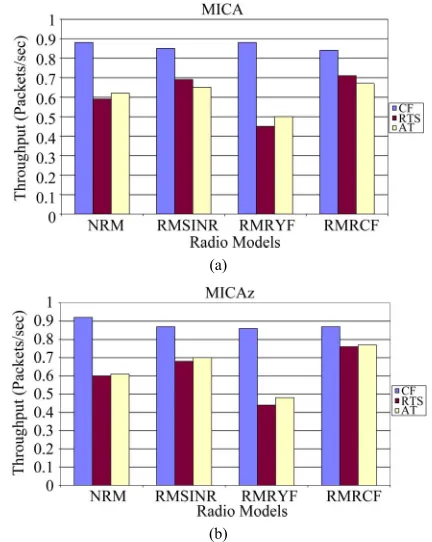
Throughput with CF, ATS & AT for different radio models in case of MICA and MICAz has been shown in
Figure 4. The results obtained prove that the throughput
highest with CF routing protocol while it is moderate for AT protocol for all types of radio models under consid-eration. MICA vis-à-vis MICAz indicates improved throughput for MICAz.
Results for loss rate with CF, ATS & AT for different radio models in case of MICA and MICAz are shown in
Figure 5. From Figure 5 (a) it has been observed that
the loss rate negligible in case of RMRYF for CF proto-col with mica mote while there is no loss rate for other radio models with both type of motes. Similarly results (Figure 6) have been reported for success rate and CF
protocol proved to be the best for both types of motes.
(a)
(b)
Figure 4. Throughput with CF, ATS & AT for different radio models in case of (a) MICA (b) MICAz.
[image:4.595.320.528.582.718.2](b)
Figure 5. Loss Rate with CF, ATS & AT for different radio models in case of (a) MICA (b) MICAz.
(a)
(b)
Figure 6. Success rate with CF, ATS & AT for different radio models in case of (a) MICA (b) MICAz.
Energy consumption with CF, ATS & AT for different radio models in case of MICA and MICAz have been shown in Figure 7. Results indicate that the energy
con-sumption is minimum in case of NRM and RMRYF for RTS for MICA and MICAz respectively. On the other hand for realistic radio model RMRCF the energy consumed is minimum for AT in comparison with CF and RTS.
In Figure 8 efficiency results ascertain that the CF
routing protocol proved to be feeble with all types of radio models. Figure 9 shows the lifetime with CF, ATS
& AT for different radio models in case of MICA and MICAz. The results obtained establish that for realistic
(a)
[image:5.595.64.282.86.212.2](b)
Figure 7. Energy with CF, ATS & AT for different radio models in case of (a) MICA (b) MICAz.
(a)
(b)
[image:5.595.63.284.255.532.2] [image:5.595.309.540.407.693.2](a)
[image:6.595.66.278.87.354.2](b)
Figure 9. Lifetime with CF, ATS & AT for different radio models in case of (a) MICA (b) MICAz.
model RMRCF the lifetime with AT routing protocol is more in comparison with CF and ATS protocols. The results obtained in this paper establish that the behaviour of routing protocols is different with various radio mod-els under consideration. Therefore it evident from dis-cussion that there is performance trade-off with routing protocols for radio models for wireless sensor networks. The results ascertain that the MICAz motes give low latency, high throughput, high energy consumption, low efficiency but better lifetime while the MICA motes give high success rate and less loss rate for all routing proto-cols but there performance trade-off that is dependent of radio models. It has been, thus, concluded that in case of all the radio models the MICAz is preferably better than MICA in applications where energy is not a constrain. For greater lifetime applications MICAz has to be pre-ferred over MICA for all radio models.
4. Conclusions
In this paper, the simulation results on the performance of routing protocols Constrained Flooding (CF), Real- Time Search (RTS) and Adaptive Tree (AT) for wireless sensor networks using different radio models have been presented. The investigations have been reported for MICA and MICAz motes and are based on various per-formance metrics like: latency, loss rate, success rate, throughput, energy consumption, efficiency and lifetime.
It has been observed that the latency in case of MICAz with respect to MICA for all types of routing algorithms under consideration is less. However throughput is high-est with CF routing protocol for all the radio models. On the other hand, loss rate is insignificant in case of RMRYF for CF protocol with MICA mote while it is zero for other radio models with both types of motes. Similarly the success rate proves to be the best in case of CF protocol for both types of motes. The energy con-sumption is low in presence of NRM and RMRYF for RTS in case of MICA and MICAz respectively. For real-istic radio model RMRCF the energy consumed is found to be minimum for AT protocol in comparison with CF and RTS. In case of efficiency, the results obtained indi-cate that the CF routing protocol proves to be weak with all types of radio models. Moreover, the results indicate that for realistic model RMRCF the lifetime with AT routing protocol is significantly high in comparison with CF and RTS protocols. Finally, it is concluded that the AT protocol can be applied to achieve better energy consumption, efficiency and lifetime in real time for wireless sensor networks.
REFERENCES
[1] J. N. Al-Karaki and A. E. Kamal, “A Taxonomy of Rout-ing Techniques in Wireless Sensor Networks,” In M. Ilyas and I. Mahgoub, Eds., Handbook of Sensor Net-works: Compact Wireless and Wired Sensing Systems, Chapter 6, CRC Press, Boca Raton, 2005, pp. 1-24. [2] B. Karp and H. T. Kung, “GPSR: Greedy Perimeter
Stateless Routing for Wireless Networks,” Proceedings of
6th International Conference on Mobile Computing and Networks, Boston, 6-11 August 2000, pp. 243-254.
doi:10.1145/345910.345953
[3] M. Chu, H. Haussecker and F. Zhao, “Scalable Informa-tion-Driven Sensor Querying and Routing for Ad Hoc Heterogeneous Sensor Networks,” International Journal of High Performance Computing Applications, Vol. 16, No. 3, 2002, pp. 293-313.
doi:10.1177/10943420020160030901
[4] Y. Yu, R. Govindan and D. Estrin, “Geographical and Energy Aware Routing: A Recursive Data Dissemination Protocol for Wireless Sensor Networks,” Technical Re-port UCLA/CSD-TR-01-0023, Computer Science Depart- ment, University of California, Los Angeles, May 2001. [5] Y. Zhang and M. P. J. Fromherz, “Message-Initiated
Constraint-Based Routing for Wireless Ad-Hoc Sensor Networks,” Proceedings of 1st IEEE Consumer Commu-nication and Networking Conference, Las Vegas, 5-8 January 2004, pp. 648-650.
Routing Strategies for Sensor Networks,” Proceedings of AAAI Sensor Networks Workshop, San Jose, 26 July 2004, pp. 1-8.
[8] Y. Zhang and M. P. J. Fromherz, “Constrained Flooding: A Robust and Efficient Routing Framework for Wireless Sensor Networks,” Proceedings of 20th IEEE Interna-tional Conference on Advanced Information Networking and Applications, Vienna, 18-20 April 2006, pp. 1-6. [9] Y. Zhang and Q. F. Huang, “Adaptive Tree: A Learning-
Based Meta-Routing Strategy for Sensor Networks,” Pro- ceedings of 3rd IEEE Consumer Communications and Networking Conference, 8-10 January 2006, pp. 122-126. [10] Y. Zhang, G. Simon and G. Balogh, “High-Level Sensor
Network Simulations for Routing Performance Evalua-tions,” Proceedings of 3rd International Conference on Networked Sensing Systems, Chicago, 31 May-2 June 2006, pp. 1-4.
[11] S. Park, A. Savvides and M. B. Srivastava, “SensorSim: A Simulation Framework for Sensor Networks,” Pro-ceedings of the 3rd ACM International Workshop on Modeling, Analysis and Simulation of Wireless and Mo-bile Systems, Boston, 20 August 2000, pp. 104-111. [12] P. Levis, N. Lee, M. Welsh and D. Culler, “TOSSIM:
Accurate and Scalable Simulation of Entire TinyOS Ap-plications,” Proceedings of the 1st International Confer-ence on Embedded Networked Sensor Systems, Los An-geles, 5-7 November 2003, pp. 126-137.
doi:10.1145/958491.958506
[13] K. Fall and K. Varadhan, “The VINT Project,” The NS Manual, November 2008.
http://www.isi.edu/nsnam/ns/doc/
[14] OPNET Technologies, Inc., “The OPNET Simulator,” Bethesda. http://www.opnet.com
[15] G. Simon, “Prowler: Probabilistic Wireless Network Si-mulator,” Institute for Software Integrated Systems, Nashville, 2003.
http://www.isis.vanderbilt.edu/projects/nest/prowler [16] G. Simon, P. Volgyesi, M. Maroti and A. Ledeczi, “Si-
mulation-Based Optimization of Communication Proto-cols for Large-Scale Wireless Sensor Networks,” Procee- dings of IEEE International Aerospace Conference, Big Sky, Vol. 3, 8-15 March 2003, pp. 1339-1346.
[17] M. Haenggi, “Probabilistic Analysis of a Simple Mac Scheme for Ad Hoc Wireless Networks,” Proceedings of IEEE CAS Workshop on Wireless Communications and Networking, Pasadena, 5-6 September 2002, pp. 1-4. [18] U. C. Berkeley Wireless Embedded Systems, 2003.
http://webs.cs.berkeley.edu
[19] Y. Zhang and M. Fromherz, “A Robust and Efficient Flooding-Based Routing for Wireless Sensor Networks,”
Journal of Interconnection Networks, Vol. 7, No. 4, 2006, pp. 549-568. doi:10.1142/S0219265906001855
[20] Crossbow: MICA, Wireless Measurement System Data-sheet.
http://www.xbow.com/Products/Product_pdf_files/Wirele ss_pdf/MICA.pdf
[21] Crossbow: MICAz, Wireless Measurement System Data-sheet.