
Analytical solution of coupled non-linear second order
reaction differential equations in enzyme kinetics
Govindhan Varadharajan, Lakshmanan Rajendran
Department of Mathematics, The Madura College, Madurai, India; [email protected]
Received 16 April 2011; revised 10 May 2011; accepted 17 May 2011.
ABSTRACT
The coupled system of non-linear second-order reaction differential equation in basic enzyme reaction is formulated and closed analytical ex-pressions for substrate and product concentra-tions are presented. Approximate analytical me-thod (He’s Homotopy perturbation meme-thod) is used to solve the coupled non-linear differential equations containing a non-linear term related to enzymatic reaction. Closed analytical expres-sions for substrate concentration, enzyme sub-strate concentration and product concentration have been derived in terms of dimensionless reaction diffusion parameters k, and us-ing perturbation method. These results are compared with simulation results and are found to be in good agreement. The obtained results are valid for the whole solution domain.
Keywords: Non-Linear Reaction Equations; Mathematical Modelling; Steady-State; Homotopy Perturbation Method;Simulation
1. INTRODUCTION
Enzyme kinetics is the study of the chemical reaction that are catalysed by enzymes. In enzyme kinetics, the reaction rate is measured and the effects of varying the conditions of the reaction investigated. Enzymes are usually protein molecules that manipulate other mole-cules the enzymes substrate. These target molemole-cules bind to an enzyme’s active site and are transformed into products through a series of steps known as the enzy-matic mechanism. These mechanisms can be divided into single-substrate and multiple-substrate mechanisms. To understand the role of enzyme kinetics, the researcher has to study the rates of reaction, the temporal behav-iours of the various reactants and the conditions which influence the enzyme kinetics. Introduction with a ma-thematical bent is given in the books by Rubinow [1], Murray [2], Segel [3] and Roberts [4].
The generalized theoretical treatment of the tran-sient-state kinetics of enzyme reaction system described [5-9] under the conditions
E0 S0 , the enzymeconcentration
E remains effectively constant during the course of the reaction and only the substrate concen-tration
S changes appreciably with time. The rate of second-order reactions in chemistry are frequeuntly stu-died within PFO kinetics [10,11]. Numerical studies of reaction (1) far from the QSS or equilibrium approxima-tions demonstrate that if the excess reactant concentra-tion ratio
E0 :
S0 say, is less than 10-fold,apprecia-ble errors are introduced in the pseudo-first-order kinet-ics description [7]. Silicio and Peterson [10] have nu-merical estimates for second-order reactions that show that the fractional error in the observed pseudo-first- order constant is less than 10% if the reactants ratio is 10-fold. However, Corbett [12] has found that a pseu-do-first-order reaction can yield more accurate data than is generally realized, even if only a two-fold excess of one the reactants is employed. For enzyme catalyzed reactions, Kasserra and Laidler [5] suggest that an ex-cess of initial enzyme concentration is neex-cessary to guarantee that the reaction follows first-order kinectics in transient-phase studies.
Schnell and Maini [13] have shown that, under the condition
E0 >>
S0 , the appropriate frame work tostudy the Michaelis-Menten reaction (1) is the reverse quasi-steady-state approximation (rQSSA) or equilib-rium approximation. The reverse quasi-steady-state as-sumption considers the substrate S to be in a quasi- steady-state with respect to the enzyme-substrate comp- lex C by assuming thatd S
dt
0. Recently Schnell and Mendoza [14] have obtained the analytical expres-sion of concentration by the linearization of the Micha-elis-Menten reaction by pseudo-first-order kinetics. Re-cently Meena, Eswari and Rajendran [15] have derived the analytical solution of non-linear reaction equations containing a non-linear term related to the enzymatic reaction using variational iteration method (VIM).analytical expressions for substrate concentration, en-zyme substrate concentration and product concentration interms of dimensionless reaction diffusion parameters k,
and using Homotopy perturbation method (HPM) and compartive study of the same with Numerical simu-lation.
2. MATHEMATICAL FORMULATION OF
THE PROBLEM
The model of an enzyme action, initially developed by Michaelis and Menten revealed the binding of free en-zyme to the reactant forming an enen-zyme-reactant com-plex. In turn this complex undergoes a transformation, releasing the product and free enzyme and the presence of free enzyme leads to another round of binding to a new reactant. The simplest reversible association be-tween an enzyme E and a substrate S yield an intermedi-ate enzyme-substrintermedi-ate complex C that irreversibly breaks down to form a product P, and the mechanism is often written as:
1 2
1
k k
k
E S C E P (1)
This mechanism illustrates the binding of substrate S and release of product P. E is the free enzyme and C is the enzyme-substrate complex. The time evolution of reaction (1) is obtained by applying the law of mass ac-tion to yield the set of coupled non-linear differential equation [14]:
1 0 S
d S
k E C S K C
dt (2)
1 0 M
d C
k E C S K C
dt (3)
2
d P
k C
dt (4)
and by imposing the laws of mass action:
E0 E t
C t
S0 S t
C t
P t
with initial conditions at t = 0
S S , E
0 E , C , P0 0
0 (5) In this system the parameters k k1, - 1and k2 arepositive rate constants, KS k1 k1 is the equilibrium
dissociation constant, Kk k2 1 the Van Slyke-Cullen
constant and K K KM S is known as the
Micha-elis-Menten constant. By introducing the following pa-rameters
1 0
0 0
, , v ,
k E t S t C t
u
ε S E
2
00 1 0 0 0
, , M , E
P t k K
w τ k
E k S S S
the system of Eqs.2-4 with initial condition (5) can be represented in dimensionless form as follow:
du
uε u k v
d (6)
( )
dv u u k v
d (7) dw
v
d (8)
0 1,
0 0 ,
0 0u v w (9)
3. ANALYTICAL SOLUTION OF STEADY
STATE CONCENTRATION USING
HOMOTOPY PERTURBATION
ME-THOD
Recently, many authors have applied the Homotopy perturbation method to various problems and demon-strated the efficiency of the Homotopy perturbation me-thod for handling non-linear structures and solving vari-ous physics and engineering problems [15-18]. This method is a combination of topology and classic pertur-bation techniques. Ji Huan He used the Homotopy per-turbation method to solve the Lighthill equation [19], the Duffing equation [20] and the Blasius equation [21]. The idea has been used to solve non-linear boundary value problems, integral equations and many other problems. In these papers [22-27], the homotopy perturbation me-thod is applied and the obtained results show that the Homotopy perturbation method is very effective and simple. The Homotopy perturbation method is unique in its applicability, accuracy, efficiency and uses the im-bedding parameter p as a small parameter and only a few iterations are needed to search for an asymptotic solution. Using this method, we can obtain the following solution to Eqs.6-8 (Ref Appendix-A and B)
(k ) 2
k
-2
-
e e e
u e
k k k
k e e
k e
k k
(10)
k k
k 2
2
2
e e e
v
k
e e
k k k
k
k 2
1 1 1
2 1
1
2 2
e e e
w
k k k k
e e
k k k k
(12)
Eqs.10-12 represents the analytical expression of the dimensionless substrate concentration u
, enzyme substrate concentration v
and product concentration w
for all values of parameters k, and .4. NUMERICAL SIMULATION
The non-linear differential Eqs.2-4, are also solved using numerical methods. The functionbvp4c in Scilab software which is a function of solving two-point boun-dary value problems (BVPs) for ordinary differential equations is used to solve this equation. Its numerical solution is compared with Homotopy perturbation me-thod and it gives satisfactory result. The Scilab program is also given in Appendix (C).
5. RESULT AND DISCUSSION
Figures 1-6 show the analytical expression of conen-trations of substrate u, enzyme-substrate complex v and product w for various values of dimensionless reaction parameters k, and , wherein k and
[image:3.595.74.286.80.151.2]values are same and is different. From these fig-ures, it is inferred that the vlaue of the concentration of substrate decreases gradually from its intial value (u
0 1 ). The concentration of the substrate becomesFigure 1. Normalised concentration profiles u
, v
and w as a function of dimensionless time for various values of reaction/diffusion parameter k0.98, 6 and 0.98 . These concentrations were computed using
[image:3.595.311.539.80.256.2]Eqs.10-12. The line denotes Eqs.10-12 and +, *, ^ denote the numerical simulation.
Figure 2. Normalised concentration profiles u
, v
and w as a function of dimensionless time for various values of reaction/diffusion parameter k2.3, 6.8 and
2.3
. These concentrations were computed using Eqs. 10-12. The line denotes Eqs.10-12 and +, *, ^ denote the nu-merical simulation.
Figure 3. Normalised concentration profiles u
, v and
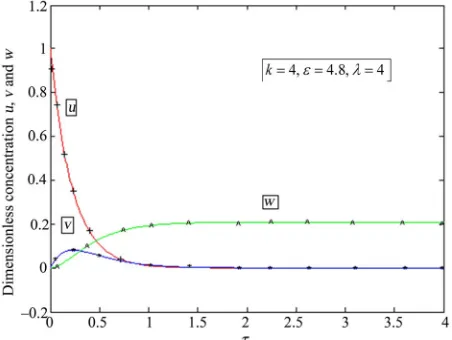
w as a function of dimensionless time for various values of reaction/diffusion parameter k4, 4.8 and 4 .
These concentrations were computed using Eqs.10-12. The line denotes Eqs.10-12 and +, *, ^ denote the numerical simu-lation.
zero when 0.5 and reaches the steady-state value (u0) when 1. The enzyme substrate concentra-tion v increase gradually from its intial value (v
0 0) and attains maximum in the interval [0,0.5] and degrees gradually, after that attains steady state val-ue when 1 for all values of reaction parameter. [image:3.595.312.538.351.521.2]Figure 4. Normalised concentration profiles u
, v and
w as a function of dimensionless time for various values of reaction/diffusion parameter k0 .85, 6 .5 and
0.85
[image:4.595.311.540.82.252.2] . These concentrations were computed using Eqs. 10-12. The line denotes Eqs.10-12 and +, *, ^ denote the nu-merical simulation.
Figure 5. Normalised concentration profiles u
, v and
w as a function of dimensionless time for various values of reaction/diffusion parameter k0 .98, 5 .8 and
0.98
. These concentrations were computed using Eqs. 10-12. The line denotes Eqs.10-12 and +, *, ^ denote the nu-merical simulation.
when 1 for all values of reaction parameter. Also when the value of the parameter decreases the prod-uct conentration increases. It is noted that in the interval [1,1.5] concentration of substrate u attains minimum value where as the product concentration attains its maximum value. Our approximate analytical expression of substrate concentration, enzyme substrate concentra-tion and product concentraconcentra-tion are compared with simu-lation results in Figures 1-6. A satisfactory agreement
Figure 6. Normalised concentration profiles u
, v and
w as a function of dimensionless time for various values of reaction/diffusion parameter k0 .6, 6 5 and .
0 .6
. These concentrations were computed using Eqs. 10-12. The line denotes Eqs.10-12 and +, *, ^ denote the nu-merical simulation.
is noted.
6. CONCLUSIONS
Pseudo-first-order kinetics serves the purpose of solving the set of differential equations governing the time course of the reaction, which can be validated by a proper choice of conditions. The time dependent non- linear reaction-diffusion equation has been formulated and solved analytically and numerically. Analytical ex-pressions for the substrate concentration, enzyme sub-strate concentration and product concentration have been derived interms of dimensionless reaction diffusion pa-rameters k, and using the HPM. The primary result of this work is simple approximate calculations of concentrations for all values of dimensionless parame-ters k, and The HPM is an extremely simple method and it is also a promising method to solve other non-linear equations. This method can be easily ex-tended to all kinds of system of coupled non-linear equa-tions in multi-substrate systems and networks of coupled enzyme reactions.
7. ACKNOWLEDGEMENTS
[image:4.595.58.286.350.522.2]REFERENCES
[1] Rubinow, S.I. (1975) Introduction to Mathematical Biol-ogy. Wiley, New York.
[2] Murray, J.D. (1989) Mathematical biology. Springer Verlag, Berlin.
[3] Segel, L.A. (1980) Mathematical models in molecular and cellular biology. Cambridge University Press, Cam-bridge.
[4] Roberts, D.V. (1977) Enzyme kinetics. Cambridge Uni-versity Press, Cambridge.
[5] Kasserra, H.P. and Laidler, K.J. (1970) Transient-phase studies of a trypsin-catalyzed reaction. Canadian Journal of Chemistry, 48, 1793-1802
[6] Pettersson, G. (1976) The transient-state kinetics of two-substrate enzyme systems operating by an ordered ternary-complex mechanism. European Journal of Bio-chemistry, 69, 273-278.
[7] Pettersson, G. (1978) A generalized theoretical treatment of the transient-state kinetics of enzymic reaction sys-tems far from equilibrium. Acta Chemica Scandinavica - Series B, 32, 437-446.
[8] Gutfreund, H. (1995) Kinetics for life sciences: Recep-tors, transmitters and catalysis. Cambridge University
Press, Cambridge.
[9] Fersht, A.R. (1999) Structure and mechanism in protein science: A guide to enzyme catalysis and protein folding. Freeman, New York.
[10] Silicio, F. and Peterson, M.D. (1961) Ratio errors in pseudo first order reactions. Journal of Chemical
Educa-tion, 38, 576-57
[11] Moore, J.W. and Pearson, R.G. (1981) Kinetics and Me-chanism. Wiley, New York.
[12] Corbett, J.F. (1972) Pseudo first-order kinetics. Journal of Chemical Education, 49, 663 [13] Schnell, S. and Maini, P.K. (2000) Enzyme kinetics at
high enzyme concentration. Bulletin of Mathematical
Bi-ology, 62, 483-4
[14] Schnell, S. and Mendoza, C. (2004) The condition for pseudo-first-order kinetics in enzymatic reaction is inde-pendent of the initial enzyme concentration. Journal of Biophysical Chemistry, 107, 165-174.
[15] Meena, A., Eswari, A. and Rajendran, L. (2010) Mathe-matical modelling of enzyme kinetics reaction mecha-nism and analytical sloutions of non-linear reaction
equa-tions. Journal of Mathematical Chemistry, 48, 179-186.
[16] Li, S.J. and Liu, Y.X. (2006) An improved approach to nonlinear dynamical system identification using pid neu-ral networks. International Journal of Nonlinear Science and Numerical Simulation, 7, 177-182.
[17] Mousa, M.M., Ragab, S.F. and Nturforsch, Z. (2008) Application of the homotopy perturbation method to lin-ear and nonlinlin-ear schrödinger equations. Zeitschrift für Naturforschung, 63, 140-144.
[18] He, J.H. (1999) Homotopy perturbation technique.
Computer Methods in Applied Mechanics and Engineer-ing, 178, 257-262.
[19] He, J.H. (2003) Homotopy perturbation method: a new nonlinear analytical Technique. Applied Mathematics and Computation, 135, 73-79.
[20] He, J.H. (2003) A Simple perturbation approach to Bla-sius equation. Applied Mathematics and Computation,
140, 217-222
[21] He, J.H. (2006) Some asymptotic methods for strongly nonlinear equations. International Journal of Modern Physics B, 20, 1141-1199.
[22] He, J.H., Wu, C.G. and Austin, F. (2010) The variational iteration method which should be followed. Nonlinear Science Letters A, 1, 1-30.
[23] He, J.H. (2003) A coupling method of a homotopy tech-nique and a perturbation techtech-nique for non-linear prob-lems. International Journal of Non-Linear Mechanics, 35,
[24] Ganji, D.D., Amini, M. and Kolahdooz, A. (2008) Ana-lytical investigation of hyperbolic equations via he’s me-thods. American Journal of Engineering and Applied Sciences, 1, 399-407.
[25] Loghambal, S. and Rajendran, L. (2010) Mathematical modeling of diffusion and kinetics of amperometric im-mobilized enzyme electrodes. Electrochimica Acta, 55,
[26] Meena, A. and Rajendran, L. (2010) Mathematical mod-eling of amperometric and potentiometric biosensors and system of non-linear equations—Homotopy perturbation approach. Journal of Electroanalytical Chemistry, 644,
[27]Eswari, A. and Rajendran, L. (2010) Analytical solution of steady state current an enzyme modified microcylinder electrodes. Journal of Electroanalytical Chemistry, 648,
APPENDIX A
Basic idea of Homotopy – perturbation me-thod (HPM)
To explain this method, let us consider the following function
0,A w f r r (A1) With the boundary conditions of
, w 0,
B w r
n
(A2)
where A, B, f r
and are a general differential operator , a boundary operator, a known analytical func-tion and the boundary of the domain , respectively. Generally speaking, the operator A can be divided into a linear part L and a nonlinear partN. Eq.A1 can therefore, be written as
0L w N w f r (A3) By the Homotopy technique, we construct a Homo-topy z r p
,
:
0,1 R which satisfies
0
, 1
0 [0,1],
H z p p L z L w
p A z f r p r
(A4)
Or
,
0
0
0H z p L z L w pL w p N z f r
(A5) where p
0,1 is an embedding parameter, whilew
0 is an initial approximation of Eq.A1, which satisfies the boundary conditions. Obviously, from Eqs.A4 and A5, we will have
,0
0 0H z L z L w (A6)
,1
0.H z A z f r (A7) The changing process of p from zero to unity is just that of z r p
, from w0 to w r
. In topology, this iscalled deformation, while L z
L w
0 and
A z f r are called Homotopy. According to the HPM, we can first use the embedding parameter p as a “small parameter”, and assume that the solutions of Eqs. A4 and A5 can be written as a power series in p:
2 0 1 2 ...
zz pz p z (A8) Setting p1 results in the approximate solution of Eq. A1
0 1 2 1
lim ...
p
w z z z z
(A9)
The combination of the perturbation method and the Homotopy method is called the HPM, which eliminates
the drawbacks of the traditional perturbation methods while keeping all its advantages.
APPENDIX B
Solution of the Eqs.2 and 3 using Homotopy perturba-tion method. In this Appendix, we indicate how Eqs.10, 11 and 12 in this paper are derived. Furthermore, a Homotopy was constructed to determine the solution of Eqs.2 and 3.
1-0
du
p u
d du
p u u v k v v
d
(B1)
1- p
dv kv p dv k v u u v 0d d
(B2)
and the initial approximations are as follows:
(0) 1, 0 0
u v (B3)
approximate solutions of (B1) and (B2) are
2 3
0 1 2 3 ...
u u pu p u p u (B4) and
2 3
0 1 2 3 ...
v v pv p v p v (B5)
Substituting Eqs.B4 and B5 into Eqs.B1 and B2 and comparing the coefficients of like powers of p
0 0
0
: 0du
p u
d (B6)
1 1
1 0 0 0 0
: du 0
p u u v kv v
d (B7)
2 2
2 0 1 1 0 1 1
:du =0
p u u v u v kv v
d (B8)
And 0 0 0
: 0dv
p kv
d (B9)
1 1
1 0 0 0
: 0dv
p kv u u v
d (B10)
2 2
2 1 0 1 1 0
: + dv = 0
p kv u u v u v
d (B11)
Solving the Eqs.B6-B11, and using the boundary con-ditions (B3), we can find the following results
0
u e (B12)
1 = 0
u (B13)
(k ) 22
e e e
u
k k k
k
-2
k e e
k e
k k
(B14)
And
0 0
v (B15)
k1
e e
v
k
(B16)
k
2
k
2
2 2
e e e
v
k k k k
(B17)
According to the HPM, we can conclude that
lim p 1
0 1 2u u u u u
(B18)
limp 1
0 1 2v v v v v
(B19)
Using Eqs.B12, B13 and B14 in Eqs.B18 and Eqs. B15, B16 and B17 in Eqs.B19, we obtain the final re-sults as described in Eqs.10 and 11. The dimensionless concentration of the product is given by
0
k
k 2
v
1 1 1
k k k k 2
1 1
2 k k 2 k k
w d
e e e
e e
(B20)
The above equation represent the new analytical ex-pression of product w
for all values of parameters, and
k which is given in Eq.12.
APPENDIX C
Scilab program to find the solutions of the Eqs. 6-9 function main123456
options= odeset('RelTol',1e-6,'Stats','on'); %initial conditions
x0 = [1; 0;0]; tspan = [0 10]; tic
[image:7.595.62.290.82.281.2][t,x] = ode45(@TestFunction,tspan,x0,options); toc
figure hold on plot(t, x(:,1)) plot(t, x(:,2)) plot(t, x(:,3)) legend('x1','x2') ylabel('x') xlabel('t') return
function [dx_dt]= TestFunction(t,x) b=6.5;a=0.85;d=0.85;
dx_dt(1)=-b*x(1)+b*(x(1)+a-d)*x(2); dx_dt(2) =x(1)-((x(1)+a)*x(2)); dx_dt(3) =d*x(2);
dx_dt = dx_dt'; return
APPENDIX D
Nomenclature
Symboles
E Enzyme concentration (M)
C Enzyme-substrate complex (M)
S Substrate concentation(M)
E0 Initial enzyme concentration (M)
S0 Initial substrate concentraton (M)M
K Michaelis-Menten constant
S
K Equilibrium dissociation constant
(M)
K Van Slyke-Cullen constant (M)
1, - 1, 2
k k k Positive rate constants (None)
, ,
k Reaction diffusion parameter (None) u Dimensionless Substrate concentra-tion (None)
v Dimensionless enzyme substrate con-centration (None)
w Dimensionless product concentration (None)
t Time (Sec)

![figure hold on plot(t, x(:,1)) plot(t, x(:,2)) plot(t, x(:,3)) legend('x1','x2') ylabel('x') xlabel('t') return function [dx_dt]= TestFunction(t,x) b=6.5;a=0.85;d=0.85; dx_dt(1)=-b*x(1)+b*(x(1)+a-d)*x(2); dx_dt(2) =x(1)-((x(1)+a)*x(2)); dx_dt(3) =d*x(2); dx_dt = dx_dt'; return](https://thumb-us.123doks.com/thumbv2/123dok_us/9055539.401801/7.595.62.290.82.281/figure-legend-ylabel-xlabel-return-function-testfunction-return.webp)
