SpeCam: Sensing Surface Color and Material with the
Front-Facing Camera of a Mobile Device
Hui-Shyong Yeo
1[email protected]
Juyoung Lee
2[email protected]
Andrea Bianchi
3[email protected]
David Harris-Birtill
1[email protected]
Aaron Quigley
1[email protected]
1
School of Computer Science, University of St Andrews, Scotland, United Kingdom
2Graduate School of Culture Technology, KAIST, Republic of Korea
3
Department of Industrial Design, KAIST, Republic of Korea
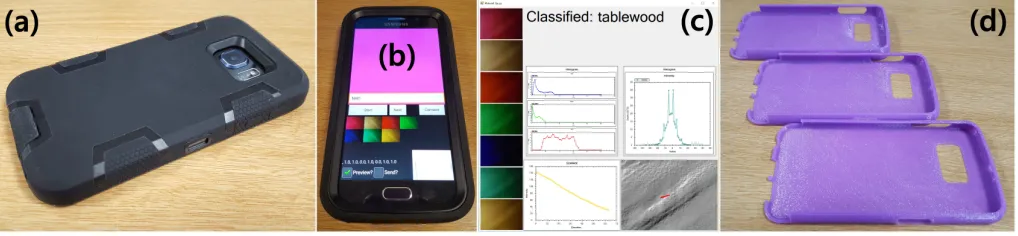
Figure 1. a) The phone is facing down while the screen flashes different colors and the camera captures images of the reflected light. b) The UI of the phone, showing the main light source and the captured images. c) The UI of the classification server, showing the received images, the classification results on top and the extracted features (color histogram, gradient, etc). d) 3D printed cases with different height for the pilot study.
ABSTRACT
SpeCam is a lightweight surface color and material sensing approach for mobile devices which only uses the front-facing camera and the display as a multi-spectral light source. We leverage the natural use of mobile devices (placing it face-down) to detect the material underneath and therefore infer the location or placement of the device. SpeCam can then be used to support discreet micro-interactions to avoid the numerous distractions that users daily face with today’s mo-bile devices. Our two-parts study shows that SpeCam can i) recognize colors in the HSB space with 10 degrees apart near the 3 dominant colors and 4 degrees otherwise and ii) 30 types of surface materials with 99% accuracy. These find-ings are further supported by a spectroscopy study. Finally, we suggest a series of applications based on simple mobile micro-interactions suitable for using the phone when placed face-down.
Permission to make digital or hard copies of all or part of this work for personal or classroom use is granted without fee provided that copies are not made or distributed for profit or commercial advantage and that copies bear this notice and the full citation on the first page. Copyrights for components of this work owned by others than ACM must be honored. Abstracting with credit is permitted. To copy otherwise, or republish, to post on servers or to redistribute to lists, requires prior specific permission and/or a fee. Request permissions from [email protected].
MobileHCI ’17,September 04-07, 2017, Vienna, Austria © 2017 ACM. ISBN 978-1-4503-5075-4/17/09. . . $15.00 DOI:http://dx.doi.org/10.1145/3098279.3098541
ACM Classification Keywords
H.5.2. Information Interfaces and Presentation (e.g., HCI): User interfaces—Input devices and strategies;
Author Keywords
Surface detection; material detection; discreet interaction.
INTRODUCTION
Today, mobile computing readily affords us the opportunity to determine our approximate location and to use this informa-tion to customize our interacinforma-tions. From navigainforma-tion to gaming, or location based reminders to recommendation engines, loca-tion based services are ubiquitous with GPS, assisted-GPS or hybrid approaches to sensing [12, 13].
[image:1.612.56.565.230.348.2]In understanding where a mobile device is, prior work has attempted to determine the location of devices using a variety of sensing methods including light, sound, vibrations, radio-waves and images captured through micro-cameras. However, most of these methods rely on external hardware support and do not work with off-the-shelf devices. Moreover, although early work has showcased that it is possible to estimate the location of a device by determining the material on which it is placed, the feasibility was demonstrated only for a limited set of selected materials.
In this paper, we propose a lightweight color and surface ma-terial recognition system that uses only the built-in sensors on a mobile device (figure 1b). We use the smartphone’s display as the multi-spectral light source and the front-facing camera to capture the reflected light. We trained a machine learn-ing classifier for the recognition and showed high recognition accuracy. Unlike previous work, our method only leverages the built-in capabilities of off-the-shelves mobile devices and does not require additional or customized electronic hardware. Moreover, in this paper we present a detailed study of the detection system for different colors and materials. We finally discuss how the ability to sense the surface material enables a wide variety of interaction capabilities such as subtle and discreet interactions.
RELATED WORK
Researchers have explored several methods for inferring the material placed underneath a mobile device using customized electronic hardware.Lightweight Material Detection[5] and
SpecTrans[14] are capable of recognizing the materials using the light reflected by specular, textureless, and transparent surfaces. However, both methods work by using custom elec-tronics, such as multi-spectral LEDs and high-speed light-to-frequency converters.Magic finger[21] uses a micro camera placed on the tip of a finger to capture images of the textures for different objects, and then uses a classifying algorithm to identify the corresponding materials.HyperCam[3] uses a so-phisticated camera system capable of capturing multi-spectral images, providing high detection of salient textured surfaces for disambiguating objects and organic surfaces. SCiO[11] is a consumer device that uses Near Infra Red (NIR) to sense materials, mainly for testing the quality of food and pills.
RadarCat[22] uses a custom radar chip (the Google Soli sen-sor) to capture the spectrum of reflected continuous waves with modulated frequencies for recognizing materials and objects. All of the aforementioned methods require custom hardware. On the other hand, past research also includes techniques that use only the built-in sensors and actuators of a mobile device. For example,Vibrotactor[7] relies on the vibration echoes captured by the microphone and accelerometer to infer the surface where the phone is placed. Similarly,SurfaceSense
[1] combines multiple sensors such as the accelerometer, mag-netometer and vibration actuator. However, these methods might distract the users due to the usage of vibrations, and also cannot disambiguate different materials with similar stiffness. Finally, sound or acoustic signals can also be used to infer the material on which the phone is placed. Using inaudible acoustic signal with a phone’s speakers and sensing its
reflec-tions with the phone’s microphones,EchoTag[16] can tag and remember indoor locations, while Hasegawa et al. [6] uses the same technique for material detection.Sweep Sense[9] also uses a similar method, but focuses on new contextual input methods rather than material recognition.
Alternative sensing techniques involve the usage of different sensors, often combining those already present on the mo-bile device with additional custom hardware. For example,
Phoneprioception[18] uses a combination of both the phone’s built-in sensors with a custom capacitive grid and a multi-spectral sensor to recognize the surface material on which the phone is placed or kept.
The system presented in this paper is based on the color detec-tion and reflecdetec-tion properties of the surface on which the phone is placed. Using the phone’s display as a light emitter and the camera as a sensor, we do not require additional and custom electronic hardware nor do we disrupt the user experience with audible sound or vibrations. It is therefore worth mentioning few related work that leveraged the phone camera as main sensing unit.HemaApp[17] uses the front camera for blood screening on the finger. It uses similar sensing hardware as we do, but it requires a custom LED and UV/IR ring for the light source.CapCam[20] uses the phone’s rear camera to perform pairing and data transmission between a touch display and the mobile device. Low et al. [10] uses the rear camera and the flash to detect pressure force applied by the user’s palm. Finally,Cell Phone Spectrophotometer[15] combines the rear camera and transmission diffraction grating as a spectrometer.
SPECTROSCOPY FUNDAMENTALS
Spectroscopy enables the understanding of the emissions and of the reflectance optical properties of materials, separating the color components across the visible spectrum. The surfaces of different objects have unique color spectral signatures that can be used to help classify objects of interest. Spectrometers generally use diffraction grating to take incoming light from a broad spectrum and spread it out like a rainbow across a charge-coupled device (CCD) to then measure the contribution from each of the small wavelength bands across the whole visible spectrum (the spectrometer used in this study has sub nanometer resolution).
The spectrometer can therefore be used to detect the emission spectrum from any emitted light, or, by emitting white light and collecting the light reflection through fibre optic cables, and then measuring the reflectance spectrum. By analyzing the reflected spectrum of the surface of different materials, it is possible to gain an understanding of the material’s optical properties (i.e., light scattering and reflectivity), and then use these to train a machine learning classifier, so to recognize spectrally distinctive characteristics.
DESIGN CONSIDERATIONS
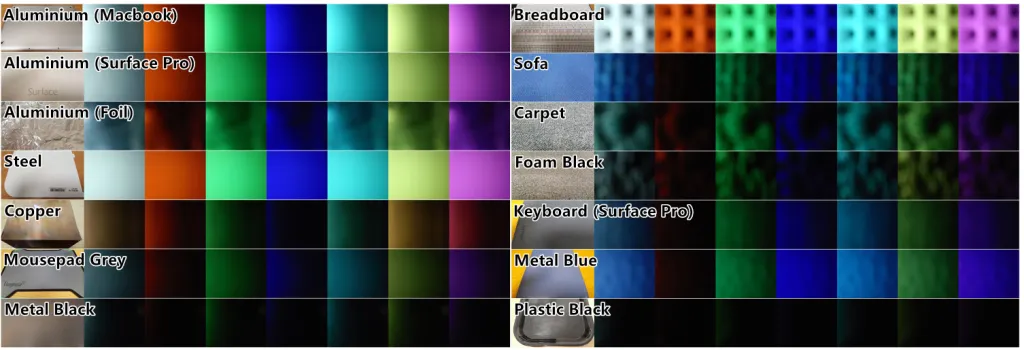
Figure 2. Sample materials with similar colors, and the captured images on (left) white materials and (right) brown and red materials.
Figure 3. Sample materials and the captured images with the reflected colors on (left) metallic materials and (right) textured materials.
And with these sensors we can achieve various novel sensing capabilities. In line with our objective of achieving color and surface material recognition, we largely employ two built-in components, namely the front-facing camera and the display. We re-purposed the screen display to act as a multi-spectral light source and the front-facing camera as a sensor.
In SpeCam, when the phone is placed facing down (figure 1a), the phone’s display rapidly changes the display color, and then the camera captures the reflected light (figure 1b). In effect, the display acts as a multi-spectral light source. Our technique relies on the fact that different types of surface materials have varying structural and spectral properties (e.g., specular or diffuse, glossy or matte), resulting in different ways in which light is reflected. The front-facing camera of the device is used to capture an image for each of the colors emitted, as shown in figure 2 & 3. This allows us to uniquely identify a particular material, and associate it with a particular placement. For example, a wooden table, sofa or an aluminium laptop.
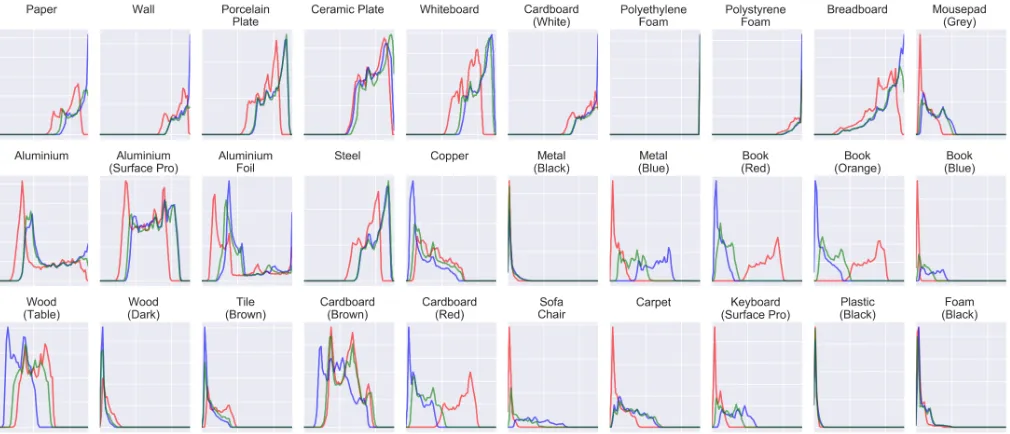
[image:3.612.54.566.293.468.2]Figure 4. Color histogram of visually similar materials: (top) white and grey (middle) metal and books (bottom) brown, dark and textured materials. The x-axis represents the 64 color bins whereas the y-axis represents the amplitude and is automatically scaled for clarity, which can be seen in the varying grid. Note that this is the color histogram of the white image only. Using more features from other color can improve the accuracy further.
introduce a small gap between the screen and the surface in order to protect the device from damage. Our technique takes advantage of this feature for optimal performance. Yet, many commercially available bumper cases only raise the screen 1mm to 2mm from the contact surface, in order to keep the overall dimensions small, except the rugged version for more protection. During our preliminary tests with several bumper cases with 1-2mm raised lips, we found that it is possible to recognize some materials, but they are not adequate in recognizing dark and diffuse materials, due to the extremely low light reflectance captured by the front-facing camera. Therefore, we 3D-printed several modified bumper cases for the phone and experimentally tested different heights for the gap (figure 1d). Our results indicate that 3mm is the minimum feasible height for consistent performance with the darkest material we used in our study - the black plastic tray. Un-doubtedly, a larger gap allows more light to enter the camera and allows the camera to obtain a sharper focus, potentially allowing advanced texture analysis and pattern recognition techniques. However, a very thick bumper case is not aesthet-ically pleasing for the user, thus is less practical. Hence we decided for testing to use a rugged bumper case which we pur-chased off-the-shelf (ULAK113in1 Shockproof case, figure 1a). This bumper case introduced a 3mm gap and allows the front-facing camera to capture enough light even on dark and diffuse materials, as can be seen in figure 3 (bottom).
Complementary Sensors Consideration
Although in this paper we only focus on leveraging the camera and display, here we also describe how other existing sensors can supplement/complement our technique.
1
https://www.amazon.co.uk/ULAK-Shockproof-SiliconeProtective-Samsung/dp/B01DVREZHM?th=1
• Using the inertial sensor, we know whether a phone has been moved or not. As such, we only trigger the camera for light detection when the phone is significantly moved. We therefore do not need to continually detect the surface underneath the phone, if it has not moved.
• Using the orientation sensor and the proximity sensor, we know when the phone is facing down and is near to a surface. Therefore, we can avoid accidentally triggering SpeCam when the device is facing upwards.
• Using the magnetometer, we can infer whether a nearby surface is metal or non-metal, so that our system is not confused by a layer of metallic coating or paint.
IMPLEMENTATION
Figure 5. Measured screen emission spectral for Galaxy S6 (AMOLED) and Nexus 5 (LCD). The line colors match with the screen colors (e.g., yellow line represents the yellow screen) except the black line which rep-resents a white screen. These spectral show the wavelength range of the three color bands, which are activated in different proportions for differ-ent colors.
These features are then fed into the WEKA toolkit [4] for training a machine learning classifier using a Support Vector Machine (SVM). For the spectrometer, 2048 features along the supported wavelength (350-1000 nm) are used.
We also capture the reflected light intensity using the built-in light sensor built-in the front of the phone, yieldbuilt-ing 7 features for 7 color images. However, our initial tests show that it is very inaccurate in classifying material, which aligns with prior observations [5]. We also calculate the image gradient using the Sobel operator on both the x and y direction, using a kernel size of 11. Then we extract the histogram of the gradient image (figure 1c, bottom right) with 64 bins. However, when using the gradient as extra features, we found that the classification accuracy actually decreases. Therefore, we removed them from our final evaluation. As we will show later, using only the color histogram alone (figure 4) yields very high accuracy.
EVALUATION
To validate our proposed approach and to evaluate its feasi-bility and accuracy, we conducted a two-part evaluation - i) color and ii) material classification, using both our proposed system and a spectrometer for providing ground truth. First we describe the apparatus we used - a) a spectrometer and b) our SpeCam smartphone-based system.
Apparatus
Before testing SpeCam, we collected ground truth data using a spectrometer (Ocean Optics Flame-S-VIS-NIR Spectrometer) which has an optical wavelength range from 350-1000 nm. We recorded the spectrum of the outgoing light from the phones at each color used for phone surface sensing. By placing the spectrometer on two phones with different displays: the Samsung Galaxy S6 and Nexus 5, we recorded the spectrum of the phone’s display, as shown in figure 5.
[image:5.612.54.292.65.154.2]Using the spectrometer, we also recorded the spectrum of the light reflected for all the objects and printed color sheets. We used a white light source (Ocean Optics Halogen Light Source HL-2000-FHSA) and a fibre optic cable (Ocean Optics QR400-7-VIS-BX Premium 400 um Reflection Probe) to transmit the light to the objects surface, and used a fibre optic cable in the centre of the output fibers to measure reflected light. For each object and color sheet, the fibre bundle was positioned
Figure 6. Results for color detection, the black and white line show where error occurs for the spectrometer and the phone, respectively. The inner numbers are the number of errors (out of 10) and the outer num-bers are the hue angle (divided by 10). We can observe that the errors occur near to the three dominant colors, especially for green color.
3mm above the surface at random locations for ten times, and during each time, the data for each spectrum was acquired. The exposure time for the color sheets (experiment 1) and ob-jects (experiment 2) is 20 ms and each spectrum is an average of 10 scans. Increasing the exposure time led to saturation effects for highly reflective objects, such as the foil, therefore we averaged 10 scans as to increase the signal to noise ratio. We noted that when acquiring the spectrum from certain ob-jects with inconsistent surfaces the intensity varied at different positions. This was particularly true for highly reflective ob-jects with a warped surface and smudges (such as the copper heat-sink blocks).
For our smartphone-based system, we decided to use the Sam-sung Galaxy S6 smartphone with an AMOLED panel (figure 5). With the phone facing down, the screen flashes 7 colors (white, red, green, blue, cyan, yellow and magenta) in quick succession and the camera captures the images, which consist of reflected light and surface properties. The whole process takes roughly 1 second. We used a resolution of 640 x 480 (higher resolution is possible but we found negligible improve-ments). The images are sent to the server through WiFi for real-time classification and are also stored in the phone for eventual offline analysis.
Color Recognition
Figure 7. (left) Confusion matrix for the experiment using spectrometer with leave-one-out evaluation, using SVM classifier 2048 features along the wavelength. (right) Confusion matrix for the experiment using SpeCam phone-based system with leave-one-out evaluation, using SVM classifier with features extracted from 4 color images, e.g., 768 features. Zeros are omitted for clarity.
analysis, with 10-fold cross-validation using an SVM classifier. We achieve 82.12% using the spectrometer data, and 88.61% accuracy using our camera-based system. We observed that errors only occur near the three dominant colors (RGB), while the rest are very accurate, as shown in figure 6. It is worth noting that both the spectrometer and our system resulted in more errors around the pure RGB values, indicating that the problem is most likely related with the printed colored sheets used for the color detection.
Therefore, we proceed to test the limit of accuracy for non-dominant colors. We selected a color range outside the dom-inant colors, i.e., the orange color and printed 10 sheets of this color, differing by only 2 degrees each along the hue. We used a similar process as the one above (10 random positions, 10-fold cross-validation) and we achieved 73.64% (spectrom-eter) and 63.64% (camera) accuracy. We then increased the distance to 4 degrees apart, and the result increases to 90.0% (spectrometer) and 91.67% (camera) accuracy.
With this result, we are confident that our system can recognize colors at 4 degrees apart outside the dominant colors and 10 degrees apart near the dominant color (RGB), and hence it can recognize surface materials - the subject of the next experiment.
Surface Material Classification
We gathered 30 materials selected from common objects found in a domestic environment, as shown in figure 2 and figure 3. With the data collected using the spectrometer (30 objects, collected at 10 random positions for each object), we evaluated the system using 10-fold cross-validation and achieve 78.22% accuracy (figure 7 left).
We collected data of the materials spanning across two days using our phone-based system, at random positions. It resulted in 6 x 5 = 30 data points for each material. The dataset is publicly available athttps://github.com/tcboy88/SpeCam. We
Test Conditions
Evaluation using SVM classifier 1 color 4 colors 7 colors
[image:6.612.57.562.65.255.2]Leave-one-out 97.78% 99.00% 99.11% 10-fold cross-validation 98.22% 99.33% 99.44%
Table 1. Evaluation results for the phone-based system on surface mate-rial recognition, using different sets of features (1, 4 or 7 colors).
evaluated the system using both the leave-one-out process and 10-fold cross-validation. We also evaluated it using different feature sets, e.g., 1 color, 4 colors and 7 colors. The results are shown in table 1 and the confusion matrix in figure 7 right. We experimented with extra features such as the gradient and LBP. However, it reduced the recognition accuracy. Since the accuracy of our system is high using just the color histogram, we discarded the extra features. We observe that the accuracy increases along with increasing numbers of colors used, in both leave-one-out and 10-fold cross-validation (table 1).
DISCUSSION
evaluation with high-quality color palettes, or to use a color calibrated display as the test surface.
For surface material recognition, the overall accuracy of our system was very high, and yields better results than the spec-trometer. We attribute these results to the limitation of the spectrometer which uses a single point measurement, and therefore cannot account for the overall surface material prop-erties such as texture, gradient and reflection. For example, this can be seen in the center of the confusion matrix (figure 7 left), where breadboard and foams cannot be accurately recog-nized using a spectrometer. For the phone-based system, we do observe that materials of similar colors induce some confu-sion (figure 7 right). Visually inspecting the color histogram (figure 4) we can see similarities between white materials. Sur-prisingly, dark materials such as black plastic, black metal and black foam were very accurately recognized (figure 3). In order to capture the weak light reflected from dark materials, we used a fixed, maximum exposure on the camera settings. This caused over exposed images for certain materials, such as polyethylene, which resulted in white images for all colors (figure 2 (polyethylene)). In fact, when using a low exposure, it is possible to get useful images for polyethylene, but then it would not capture enough light for darker materials. In future work we will try adaptive exposure to account for this issue. We realized that different phones have different panel types and maximum brightness. In our initial test, the LCD panel (Nexus 5) with back-light allows the camera to capture more light than the OLED panel (Galaxy S6), thus it may enable better recognition of darker materials. However, from figure 5 we can see that the OLED has purer spectral bands which would enable better spectral distinctions.
POTENTIAL APPLICATIONS AND SCENARIOS
When considering SpeCam as a new type of material-detection sensor, then potentially a large number of applications and scenarios can be considered. One can envision the technique being used as an accurate color picker for a tangible painting application. Picking a matching color or texture from real world and using it in painting applications is often tedious if not impossible. Our technique acts as a “probe” that connects the real world and the virtual world, for seamlessly picking colors and textures.
However, it is the non-obvious uses of SpeCam in typical mobile device settings that open up a wide range of potential applications. For example, the placement of a device can afford new forms of interaction that supports eyes-free and single-handed use, simply through the placement of the device on different surfaces.
The form factor and use of mobile technology today gives rise to people seeking to hide it, make it invisible, camouflage it [8] or demonstrate polite use (e.g., placing it face down when with others). However, commodity devices are not well equipped to support such use as they require obvious interaction with touch, movement or speech. And while haptic and audio signals may provide subtle outputs, the input required to operate the device is not subtle. The subtle, inconspicuous and hopefully polite use of technology is what we term “Discreet Computing”. By
supporting face-down interaction, SpeCam can support more inconspicuous forms of interaction.
Take for example the common scenario of people placing their mobile devices face-down to signal their intent to engage so-cially with those around them. People do this to limit their ac-cess to distractions, external entertainment or self-gratification. Maintaining this orientation while supporting interaction isn’t readily possible today. SpeCam, as a means to detect surfaces, affords the opportunity to marry the placement or movement of one’s mobile device onto different surfaces as a means of interaction. For example, when dining one can consider plac-ing a phone on a table, place mat, menu, or side plate and this might trigger food ordering items. Likewise, placement of the mobile device might trigger audio recording, speech recognition activation, calendar setting in support of the social engagement activity.
By contrast, some people may keep such devices fully hidden from view in a bag or pocket. SpeCam may be employed to measure such surfaces. In this case, we can envisage our tech-nique being used to enable shortcut commands for launching different applications, making phone calls, start a timer, by just placing the phone on different surfaces. Equally we suggest the placement of ones mobile device around the home or office can now afford new forms of smart-environment interaction with SpeCam. The placement of a device may allow people to alter the context of the environment intelligently, including lighting effects and music genres. In the bedroom, side-tables or carpets might trigger the setting of a low light level, alarm and lower volume level of music. While placing ones device on a kitchen surface might trigger the display of particular recipes, set an auto-response on incoming calls and recon-figure the lighting to suit food preparation. The living room can be divided with multiple forms of interaction for multiple people, triggering settings, content filters, auto setup and play for media types and speakers and lighting arrangements.
LIMITATION AND FUTURE WORK
Our technique only works with surface materials, i.e., it does not see inside an object covered by paint or reflective coat-ings. This is the natural disadvantage of camera/vision-based systems. Using the built-in magnetometer, it is possible to infer whether a surface is solid metal or it is just covered with metallic paint. Potential solutions may be combining with other types of sensing technique, such as using radar-based systems [22] or Terahertz imaging system [19].
the future phones with wider lens and better low light perfor-mance.
As the phone display with OLED panel is able to output 16 million colors in the RGB space, a naive approach for improve-ment is to explore a wider range of multi-spectral light sources, e.g., a sweep of all the possible colors. However, given that a typical smartphone camera is only able to capture at 30 to 60 frames per second (fps), we must take into account the time required to recognize a surface, as striking a good balance between speed and accuracy is very important. Nonetheless, as our results show, using only 4 to 7 colors already yields very high accuracy.
CONCLUSION
In this paper, we introduced a new color and material sens-ing technique for object surfaces ussens-ing commodity mobile devices. Our implementation is light-weight and relies only on the device’s display and built-in sensors. Specifically, in the paper we report on a two part evaluation of SpeCam which demonstrates that our approach is accurate, and we supported the results by comparing them with the results obtain by a dedicated spectrometer. Finally, our applications and use scenarios provide an introduction to what is possible with SpeCam. Our future work will aim to explore this sensing technique to enable a variety of new interaction capabilities, such as supporting context-aware computing and new forms of discreet computing.
REFERENCES
1. Rajkumar Darbar and Debasis Samanta. 2015. SurfaceSense: Smartphone Can Recognize Where It Is Kept. InProceedings of the 7th International Conference on HCI, IndiaHCI 2015 (IndiaHCI’15). ACM, New York, NY, USA, 39–46.DOI:
http://dx.doi.org/10.1145/2835966.2835971
2. Android Developers. 2017. Android Camera API. (2017). Retrieved January 1, 2017 fromhttps://developer. android.com/reference/android/hardware/Camera.html. 3. Mayank Goel, Eric Whitmire, Alex Mariakakis, T. Scott
Saponas, Neel Joshi, Dan Morris, Brian Guenter, Marcel Gavriliu, Gaetano Borriello, and Shwetak N. Patel. 2015. HyperCam: Hyperspectral Imaging for Ubiquitous Computing Applications. InProceedings of the 2015 ACM International Joint Conference on Pervasive and Ubiquitous Computing (UbiComp ’15). ACM, New York, NY, USA, 145–156.DOI:
http://dx.doi.org/10.1145/2750858.2804282
4. Mark Hall, Eibe Frank, Geoffrey Holmes, Bernhard Pfahringer, Peter Reutemann, and Ian H. Witten. 2009. The WEKA Data Mining Software: An Update.SIGKDD Explor. Newsl.11, 1 (Nov. 2009), 10–18.DOI:
http://dx.doi.org/10.1145/1656274.1656278
5. Chris Harrison and Scott E. Hudson. 2008. Lightweight Material Detection for Placement-aware Mobile Computing. InProceedings of the 21st Annual ACM Symposium on User Interface Software and Technology (UIST ’08). ACM, New York, NY, USA, 279–282.DOI:
http://dx.doi.org/10.1145/1449715.1449761
6. Tatsuhito Hasegawa, Satoshi Hirahashi, and Makoto Koshino. 2016. Determining a Smartphone’s Placement by Material Detection Using Harmonics Produced in Sound Echoes. InProceedings of the 13th International Conference on Mobile and Ubiquitous Systems: Computing, Networking and Services (MOBIQUITOUS 2016). ACM, New York, NY, USA, 246–253.DOI:
http://dx.doi.org/10.1145/2994374.2994389
7. Sungjae Hwang and Kwangyun Wohn. 2013. VibroTactor: Low-cost Placement-aware Technique Using Vibration Echoes on Mobile Devices. InProceedings of the Companion Publication of the 2013 International Conference on Intelligent User Interfaces Companion (IUI ’13 Companion). ACM, New York, NY, USA, 73–74.
DOI:http://dx.doi.org/10.1145/2451176.2451206
8. Matt Jones, Simon Robinson, Jennifer Pearson, Manjiri Joshi, Dani Raju, Charity Chao Mbogo, Sharon Wangari, Anirudha Joshi, Edward Cutrell, and Richard Harper. 2017. Beyond “yesterday’s tomorrow”: future-focused mobile interaction design by and for emergent users.
Personal and Ubiquitous Computing21, 1 (2017), 157–171.DOI:
http://dx.doi.org/10.1007/s00779-016-0982-0
9. Gierad Laput, Xiang ’Anthony’ Chen, and Chris Harrison. 2016. SweepSense: Ad Hoc Configuration Sensing Using Reflected Swept-Frequency Ultrasonics. InProceedings of the 21st International Conference on Intelligent User Interfaces (IUI ’16). ACM, New York, NY, USA, 332–335.DOI:
http://dx.doi.org/10.1145/2856767.2856812
10. Suzanne Low, Yuta Sugiura, Dixon Lo, and Masahiko Inami. 2014. Pressure Detection on Mobile Phone by Camera and Flash. InProceedings of the 5th Augmented Human International Conference (AH ’14). ACM, New York, NY, USA, Article 11, 4 pages.DOI:
http://dx.doi.org/10.1145/2582051.2582062
11. Consumer Physics. 2017. SCiO: The world’s first pocket size molecular sensor. (2017). Retrieved January 1, 2017 fromhttps://www.consumerphysics.com/.
12. A. Quigley, B. Ward, C. Ottrey, D. Cutting, and R. Kummerfeld. 2004. BlueStar, a privacy centric location aware system. InPLANS 2004. Position Location and Navigation Symposium (IEEE Cat. No.04CH37556). 684–689.DOI:
http://dx.doi.org/10.1109/PLANS.2004.1309060
13. Aaron Quigley and David West. 2005. Proximation: Location-Awareness Though Sensed Proximity and GSM Estimation. InLocation- and Context-Awareness. Springer Science Business Media, 363–376.DOI:
http://dx.doi.org/10.1007/11426646_33
and Transparent Surfaces. InProceedings of the 33rd Annual ACM Conference on Human Factors in Computing Systems (CHI ’15). ACM, New York, NY, USA, 2191–2200.DOI:
http://dx.doi.org/10.1145/2702123.2702169
15. Alexander Scheeline and Kathleen Kelley. 2017. Cell Phone Spectrophotometer. (2017). Retrieved May 20, 2017 fromhttp://www.asdlib.org/onlineArticles/ elabware/Scheeline_Kelly_Spectrophotometer/index.html. 16. Yu-Chih Tung and Kang G. Shin. 2015. EchoTag:
Accurate Infrastructure-Free Indoor Location Tagging with Smartphones. InProceedings of the 21st Annual International Conference on Mobile Computing and Networking (MobiCom ’15). ACM, New York, NY, USA, 525–536.DOI:
http://dx.doi.org/10.1145/2789168.2790102
17. Edward Jay Wang, William Li, Doug Hawkins, Terry Gernsheimer, Colette Norby-Slycord, and Shwetak N. Patel. 2016. HemaApp: Noninvasive Blood Screening of Hemoglobin Using Smartphone Cameras. InProceedings of the 2016 ACM International Joint Conference on Pervasive and Ubiquitous Computing (UbiComp ’16). ACM, New York, NY, USA, 593–604.DOI:
http://dx.doi.org/10.1145/2971648.2971653
18. Jason Wiese, T. Scott Saponas, and A.J. Bernheim Brush. 2013. Phoneprioception: Enabling Mobile Phones to Infer Where They Are Kept. InProceedings of the SIGCHI Conference on Human Factors in Computing Systems
(CHI ’13). ACM, New York, NY, USA, 2157–2166.DOI:
http://dx.doi.org/10.1145/2470654.2481296
19. Karl D. D. Willis and Andrew D. Wilson. 2013. InfraStructs: Fabricating Information Inside Physical Objects for Imaging in the Terahertz Region.ACM Trans. Graph.32, 4, Article 138 (July 2013), 10 pages.DOI:
http://dx.doi.org/10.1145/2461912.2461936
20. Robert Xiao, Scott Hudson, and Chris Harrison. 2016. CapCam: Enabling Rapid, Ad-Hoc, Position-Tracked Interactions Between Devices. InProceedings of the 2016 ACM on Interactive Surfaces and Spaces (ISS ’16). ACM, New York, NY, USA, 169–178.DOI:
http://dx.doi.org/10.1145/2992154.2992182
21. Xing-Dong Yang, Tovi Grossman, Daniel Wigdor, and George Fitzmaurice. 2012. Magic Finger:
Always-available Input Through Finger Instrumentation. InProceedings of the 25th Annual ACM Symposium on User Interface Software and Technology (UIST ’12). ACM, New York, NY, USA, 147–156.DOI:
http://dx.doi.org/10.1145/2380116.2380137
22. Hui-Shyong Yeo, Gergely Flamich, Patrick Schrempf, David Harris-Birtill, and Aaron Quigley. 2016. RadarCat: Radar Categorization for Input & Interaction. In
Proceedings of the 29th Annual Symposium on User Interface Software and Technology (UIST ’16). ACM, New York, NY, USA, 833–841.DOI: