Structure Sharing with Binary Trees
Lauri Karttunen SRI International, CSLI Stanford
Martin Kay Xerox PARC, CSU Stanford
Many current interfaces for natural language
represent syntactic and semantic information in the
form of directed graphs where attributes correspond
to vectors and values to nodes. There is a simple
correspondence between such graphs and the matrix
notation linguists traditionally use for feature sets.
.
' n " < ' a ' " "
sg 3rd
b.
I cat: np -]1 r n u m b e r : sg agr: [..person: 3rdJJFigure I
The standard operation for working with such graphs
is unification. The unification operation succedes only
on a pair of compatible graphs, and its result is a
graph containing the information in both
contributors. When a parser applies a syntactic rule, it unifies selected features of input constituents to
check constraints and to budd a representat=on for the output constituent.
Problem: proliferation of copies
When words are combined to form phrases,
unification is not applied to lexlcat representations directly because it would result in the lexicon being
changed. When a word is encountered in a text, a
copy is made of its entry, and unification is applied to
the copied graph, not the original one. In fact,
unification in a typical parser is always preceded by a
copying operation. Because of nondeterminism in
parsing, it is, in general, necessary to preserve every
representation that gets built. The same graph may
be needed again when the parser comes back to
pursue some yet unexplored option. Our experience
suggests that the amount of computational effort
that goes into producing these copies is much greater
than the cost of unification itself. It accounts for a
significant amount of the total parsing time.
In a sense, most of the copying effort is wasted. Unifications that fail typically fail for a simple reason.
If it were known in advance what aspects of structures are relevant in a particular case, some effort could be
saved by first considering only the crucial features of
the input.
Solution: structure sharing
This paper lays out one strategy that has turned out to
be very useful in eliminating much of the wasted
effort. Our version of the basic idea is due to Martin Kay. It has been implemented in slightly different
ways by Kay in Interlisp-O and by Lauri Karttunen in
Zeta Lisp. The basic idea is to minimize copying by
allowing graphs share common parts of their
structure.
This version of structure sharing is based on four
• Binary trees as a storage device for feature
graphs
• "Lazy" copying
• Relative indexing of nodes in the tree
• Strategy for keeping storage trees as balanced
as possible
Binary trees
Our structure-sharing scheme depends on
represented feature sets as binary trees. A tree
consists of cells that have a content field and t w o
pointers which, if not empty, point to a left and a
right cell respectively. For example, the content of the
feature set and the corresponding directed graph in
Figure 1 can be distributed over the cells of a binary
tree in the following way.
Figure 2
The index of the top node is 1; the two cells below have indices 2 and 3. In general, a node whose index
is n may be the parent of ceils indexed 2n and 2n + 1.
Each cell contains either an atomic value or a set of
pairs that associate attribute names with indices of
cells where their value is stored. The assignment of
vaiues to storage cells is arbitrary; =t doesn't matter
which cell stores which value. Here, cell 1 conta,ns the
information that the value of the at"tribute cat is found in ceil 2 and that of agr in cell 3. This is a slight
simplification. As we shall shortly see, when the value in a cell involves a reference to another cell, that
reference is encoded as a relative index.
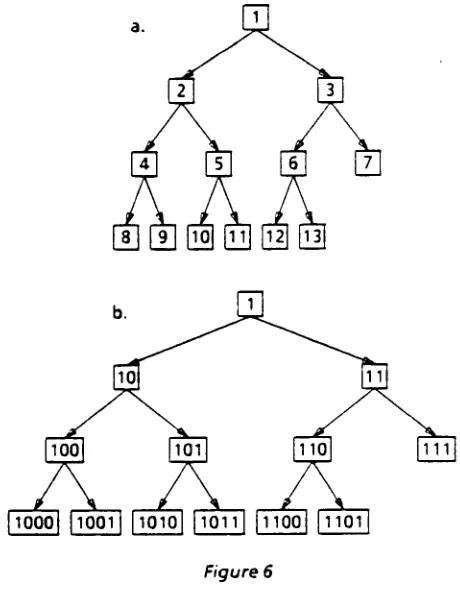
The method of locating the cell that corresponds to a
given index takes advantage of the fact that the tree branches in a binary fashion. The path to a node can
be read o f f from the binary representation of its index
by starting after the first 1 in this number and taking 0
to be a signal for a left turn and 1 as a mark for a right
turn. For example, starting at node 1, node S is
reached by first going down a left branch and then a
right branch. This sequence of turns corresponds to
the digits 01. Prefixed with 1, this is the same as the
binary representation of 5, namely 101. The same
holds for all indices. Thus the path to node 9 (binary 1001) would be LEFT-LEFT-RIGHT as signalled by the
last three digits following the initial 1 in the binary
numeral (see Figure 6).
Lazy copying
The most important advantage that the scheme
minimizes the amount of copying that has to be done.
In general, when a graph is copied, we duplicate only
The operation that replaces copying in this scheme
starts by duplicating the topmost node of the tree
that contains it. The rest of the structure remains the
same. It is Other nodes are modified only ~f and when
destructive changes are about to happen. For
example, assume that we need another copy of the
graph stored in the tree in Figure 2. This can be
obtained by producing a tree which has a different
root node, but shares the rest of the structure with its original. In order to keep track of which tree actually
owns a given node, each node tames a numeral tag
that indicates its parentage. The relationship
between the original tree (generation 0) and its copy
(generation 1) is illustrated in Figure 3 where the
generation is separated from the index of a node by a
colon.
1:0 1:1
person 4 2:0 I n p l 3:0 number S
4:0 S:O
If the node that we want to copy is not the topmost
node of a tree, we need to duplicate the nodes along
the branch leading to it.
When a tree headed by the copied node has to be
changed, we use the generation tags to minimize the
creation of new structure. In general, all and only the
nodes on the branch that lead to the site of a
destructive change or addition need to belong to the
same generation as the top node of the tree. The rest
of the structure can consist of old nodes. For example,
suppose we add a new feature, say [gender: femJ to
the value of agr in Figure 3 to yield the feature set in
Figure 4.
p
at: np Fperson: 3rd 1 1 Jnumber: sg agr:gender: fern
Figure 4
Furthermore, suppose that we want the change to
affect only the copy but not the original feature set.
In terms of the trees that we have constructed for the example in Figure 3, this involves adding one new cell
to the copied structure to hold the value fem, and
changing the content of cell 3 by adding the new
feature to it.
The modified copy and its relation to the original is
shown in Figure S. Note that one half of the structure
is shared. The copy contains only three new nodes.
2 : 0 ~ 4
/
~
J...~ml~t ~ j number 5/ " ~ gender 6
4:0,1~"]
S:oF'~
f
6:1 ~m'--~,
Figure 5
From the point of view of a process that only needs to find or print out the value of particular features, it
makes no difference that the nodes containing the
values belong to several ,trees as long as there is no
confusion about the structure.
Relative addressing
Accessing an arbitrary cell in a binary tree consumes
time in proportion to the logarithm of the size of the
structure, assuming that cells are reached by starting at the top node and using the index of the target
node as an address. Another method is to use relative
addressing. Relative addresses encode the shortest
path between two nodes in the tree regardless of
where they are are. For example, if we are at node 9
in Figure 6.a below and need to reach node 11, it is
easy to see that it is not necessary to go all the way up
to node 1 and then partially retrace the same path in
looking up node 11. instead, one can stop going
upward at the lowest common ancestor, node 2., of
nodes 9 and 11 and go down from there.
[image:3.612.318.548.369.664.2]a.
Figure 6
up, then down as if going to node 7". In general,
relative addresses are of the form <up,down > where
< u p > is the number of links to the lowest common
ancestor of the origin and < d o w n > is the relative
index of the target node with respect to it.
Sometimes we can just go up or down on the same
branch; for example, the relative address of cell 10
seen from node 2 is simply 0,6; the path from 8 or 9 to
4is 1,1.
As one might expect, it is easy to see these
relationships if we think of node indices in their
binary representation (see Figure 6.b). The lowest
common ancestor 2 (binary 10) is designated by the
longest common initial substring of 9 (binary 1001)
and 11 (binary 1011). The relative index of 11, with respect to, 7 (binary 111), is the rest of its index with 1
prefixed to the front.
In terms of number of links traversed, relative
addresses have no statistical advantage over the
simpler method of always starting from the top. However, they have one important property that is
essential for our purposes: relative addresses remain
valid even when trees are embedded ~n other trees; absolute indices would have to be recalculated.
Figure 7 is a recoding of Figure S using relative addresses.
2:0 ~ 3.01 ~ o ~ , ~ 1 ~ I ~ : l l person1,4
/ \
I
I number 1,s
4:01 ira I 5:01 sg I 6:1
Figure 7
K e e p i n g t r e e s b a l a n c e d
When two feature matrices are unified, the binary
trees corresponding to them have to be combined to form a single tree. New attributes are added to some
of the nodes; other nodes become "pointer nodes,"
i.e., their only content is the relative address of some
other node where the real content is stored. As long
as we keep adding nodes to one tree, it is a simple
matter to keep the tree maximally balanced. At any
given time, only the growing fringe of the tree can be
incompletely filled. When two trees need to be
combined, it would, of course, be possible to add all
the cells from one tree in a balanced fashion to the
other one but that would defeat the very purpose of
using binary trees because it would mean having to
copy almost all of the structure. The only alternative
is to embed one of the trees in the other one. The
resulting tree will not be a balanced one; some of the
branches are much longer than others. Consequently,
the average time needed to look up a value ~s bound
to be worse than in a balanced tree.
For example, suppose that we want to unify a copy of
the feature set in Figure lb, represented as in Figure 2
but with relative addressing, with a copy of the
feature set in Figure 8.
a. agr: [gender: fem]]
l:01agr0,2 J
gender
2:ol
1,31
3:o
Figure 8
a. [-cat: np
I person: 3rd I I Lagr: I-number: sg-~
Lgender : fem~J
I cat0,2 l b. 1"1 aqr0,3
Z . 0 [ ~ ~ ~ ~ ~ ~ n 1,4
• ~1_:.~ I number 1,5
1:11 agrO,2 I
2:11 --> 2,1 I
3:0
Although the feature set in Figure 9.a is the same as
the one represented by the right half of Figure 7, the
structure in Figure 9.b is more complicated because it
is derived by unifying copies of t w o separate trees, not by simply adding more features to a tree, as in
Figure 7. In 9 b , a copy of 8.b has been embedded as
node 6 of the host tree. The original indices of both
trees remain unchanged. Because all the addresses are relative; no harm comes from the fact that indices
in the embedded tree no longer correspond to the
true location of the nodes. Absolute indices are not
used as addresses because they change when a tree is
embedded. The symbol - > in node 2 of the lower tree
indicates that the original content of this
node--<jender 1,3~has been replaced by the address
of the cell that it was unified with, namely cell 3 in the host tree.
In the case at hand, it matters very little which of the
t w o trees becomes the host for the other. The
resulting tree is about as much out of balance either
way. However, when a sequence of unifications is
~erformed, differences can be very significant. For
example, if A, B, and C are unified with one another, ~t
can make a great deal of difference, which of the t w o alternative shapes in Figure 10 is produced as the final result.
A A
.., ¢ ~
~
,&
Figure 10
When a choice has to be made as to which of the t w o
• ,rees to embed in the other, it is important to
minimize the length of the longest path in the
resulting tree. To do this at all efficiently requires addtitional infornation to be stored with each node. According to one simple scheme, this is simply the
length of the shortest path from the node down to a
node with a free left or right pointer. Using this, it is a
simple matter to find the shallowest place in a tree at
which to embed another one. If the length of the
longer path is also stored, it is also easy to determine
which choice of host will give rise to the shallowest combined tree.
Another problem which needs careful attention
concerns generation markers. If a pair of trees to be
unified have independent histories, their generation
markers will presumably be incommensurable and
those of an embedded tree will therfore not be valide in the host. Various solutions are possible for this
problem. The most straightforward is relate the histories of all trees at least to the extent of drawing
generation markers from a global pool. In Lisp, for
example, the simplest thing is to let them be CONS cells.
C o n c l u s i o n
We will conclude by comparing our method of
structure sharing with two others that we know of: R.
Cohen's immutable arrays and the idea discussed in
Fernando Pereira's paper at this meeting. The three
alternatives involve different trade-offs along the
space/time continuum. The choice between them wdl
depend on the particular application they are intended for. No statistics on parsing are avadable yet
but we hope to have some in the final version.
A c k n o w l e d g e m e n t s
This research, made possible in part by a gift from the
Systems Development Foundation, was also
supported by the Defense Advanced Research Projects
Agency under Contracts N00039-80- C-0575 and
N00039-84-C-0524 with the Naval Electronic Systems Command. The views and conclusions contained in
this document are those of the author and should not
be interpreted as representative of the official policies, either expressed or implied, of the Defense
Advanced Research Projects Agency, or the United