Semantic Consistency: A Local Subspace Based Method for Distant
Supervised Relation Extraction
Xianpei Han and Le Sun
State Key Laboratory of Computer Science
Institute of Software, Chinese Academy of Sciences
HaiDian District, Beijing, China.
{xianpei, sunle}@nfs.iscas.ac.cn
Abstract
One fundamental problem of distant supervi-sion is the noisy training corpus problem. In this paper, we propose a new distant supervi-sion method, called Semantic Consistency, which can identify reliable instances from noisy instances by inspecting whether an in-stance is located in a semantically consistent region. Specifically, we propose a semantic consistency model, which first models the lo-cal subspace around an instance as a sparse linear combination of training instances, then estimate the semantic consistency by exploit-ing the characteristics of the local subspace. Experimental results verified the effectiveness of our method.
1
Introduction
Relation extraction aims to identify and categorize relations between pairs of entities in text. Due to the time-consuming annotation process, one criti-cal challenge of relation extraction is the lack of training data. To address this limitation, a promis-ing approach is distant supervision (DS), which can automatically gather labeled data by heuristi-cally aligning entities in text with those in a knowledge base (Mintz et al., 2009). The under-lying assumption of distant supervision is that every sentence that mentions two entities is likely to express their relation in a knowledge base.
Relation Instance Label
S1:Jobs was the founder of Apple Founder-of, CEO-of S2:Jobs joins Apple Founder-of, CEO-of
Figure 1. Labeled instances by distant supervi-sion, using relations CEO-of(Steve Jobs, Apple
Inc.) and Founder-of(Steve Jobs, Apple Inc.)
The distant supervision assumption, unfortu-nately, can often fail and result in a noisy training corpus. For example, in Figure 1 DS assumption will wrongly label S1 as a CEO-of instance and S2
as instance of Founder-of and CEO-of. The noisy training corpus in turn will lead to noisy extrac-tions that hurt extraction accuracy (Riedel et al., 2010).
Figure 2. The regions the two instances in Figure 1 located, where: 1) S1 locates in a semantically consistent region; and 2) S2 locates in a
semanti-cally inconsistent region
To resolve the noisy training corpus problem, this paper proposes a new distant supervision method, called Semantic Consistency, which can effectively identify reliable instances from noisy instances by inspecting whether an instance is lo-cated in a semantically consistent region. Figure 2 shows two intuitive examples. We can see that, semantic consistency is an effective way to iden-tify reliable instances. For example, in Figure 2 S1 is highly likely a reliable Founder-of instance be-cause its neighbors are highly semantically con-sistent, i.e., most of them express the same rela-tion type – Founder-of. On contrast S2 is highly likely a noisy instance because its neighbors are semantically inconsistent, i.e., they have a diverse relation types. The problem now is how to model the semantic consistency around an instance.
To model the semantic consistency, this paper proposes a local subspace based method. Specifi-cally, given sufficient training instances, our method first models each relation type as a linear subspace spanned by its training instances. Then, the local subspace around an instance is modeled and characterized by seeking the sparsest linear combination of training instances which can re-construct the instance. Finally, we estimate the se-mantic consistency of an instance by exploiting the characteristics of its local subspace.
+
+
+ +
+
×
× ×
×
× S2
× S1 ×
+: CEO-of
×: Founder-of
+ ×
+
× × ×
+ : Manager-of
: CTO-of
This paper is organized as follows. Section 2 reviews related work. Section 3 describes the pro-posed method. Section 4 presents the experiments. Finally Section 5 concludes this paper.
2
Related Work
This section briefly reviews the related work. Cra-ven and Kumlien (1999), Wu et al. (2007) and Mintz et al.(2009) were several pioneer work of distant supervision. One main problem of DS as-sumption is that it often will lead to false positives in training data. To resolve this problem, Bunescu and Mooney (2007), Riedel et al. (2010) and Yao et al. (2010) relaxed the DS assumption to the at-least-one assumption and employed multi-in-stance learning techniques to identify wrongly la-beled instances. Takamatsu et al. (2012) proposed a generative model to eliminate noisy instances.
Another research issue of distant supervision is that a pair of entities may participate in more than one relation. To resolve this problem, Hoffmann et al. (2010) proposed a method which can com-bine a sentence-level model with a corpus-level model to resolve the multi-label problem. Surdeanu et al. (2012) proposed a multi-instance multi-label learning approach which can jointly model all instances of an entity pair and all their labels. Several other research issues also have been addressed. Xu et al. (2013), Min et al. (2013) and Zhang et al. (2013) try to resolve the false negative problem raised by the incomplete knowledge base problem. Hoffmann et al. (2010) and Zhang et al. (2010) try to improve the extrac-tion precision by learning a dynamic lexicon.
3
The Semantic Consistency Model for
Relation Extraction
In this section, we describe our semantic con-sistency model for relation extraction. We first model the subspaces of all relation types in the original feature space, then model and character-ize the local subspace around an instance, finally estimate the semantic consistency of an instance and exploit it for relation extraction.
3.1 Testing Instance as a Linear Combina-tion of Training Instances
In this paper, we assume that there exist k distinct relation types of interest and each relation type is represented with an integer index from 1 to k. For ith relation type, we assume that totally ni training
instances VVii==ffvvi;1i;1;;vvi;2i;2; :::;; :::;vvi;ni;niigg have been collected using DS assumption. And each instance is represented as a weighted feature vector, such
as the features used in (Mintz, 2009) or (Surdeanu et al., 2012), with each feature is TFIDF weighted by taking each instance as an individual document.
To model the subspace of ith relation type in the original feature space, a variety of models have been proposed to discover the underlying patterns of Vi. In this paper, we make a simple and
effective assumption that the instances of a single relation type can be represented as the linear combination of other instances of the same rela-tion type. This assumption is well motived in rela-tion extracrela-tion, because although there is nearly unlimited ways to express a specific relation, in many cases basic principles of economy of ex-pression and/or conventions of genre will ensure that certain systematic ways will be used to ex-press a specific relation (Wang et al., 2012). For example, as shown in (Hearst, 1992), the IS-A re-lation is usually expressed using several regular patterns, such as “such NP as {NP ,}* {(or | and)} NP” and “NP {, NP}* {,} or other NP”.
Based on the above assumption, we hold many instances for each relation type and directly use these instances to model the subspace of a relation type. Specifically, we represent an instance y of ith type as the linear combination of training in-stances associated with ith type:
y=®i;1vi;1+®i;2vi;2+:::+ +®i;nivi;ni y=®i;1vi;1+®i;2vi;2+:::+ +®i;nivi;ni (1)
for some scalars , with j = 1, 2, …,ni. For
ex-ample, we can represent the CEO-of instance “Jobs was the CEO of Apple” as the following
lin-ear combination of CEO-of instances:
0.8:Steve Ballmer is the CEO of Microsoft 0.2:Rometty was served as the CEO of IBM
For simplicity, we arrange the given ni training
in-stances of ith relation type as columns of a matrix
Ai= [vi;1;vi;2; :::;vi;ni]
Ai= [vi;1;vi;2; :::;vi;ni], then we can write the matrix form of Formula 1 as:
y=Aixi
y=Aixi (2)
where xxii= [= [®®i;1i;1; :::; ®; :::; ®i;ni;nii]] is the coefficient vec-tor. In this way, the subspace of a relation type is the linear subspace spanned by its training in-stances, and if we can find a valid xi, we can
ex-plain y as a valid instance of ith relation type.
3.2 Local Subspace Modeling via Sparse Representation
Based on the above model, the local subspace of an instance is modeled as the linear combination of training instances which can reconstruct the in-stance. Specifically, to model the local subspace, we first concatenate the n training instances of all k relation types:
Then the local subspace around y is modeled by seeking the solution of the following formula:
y=Ax
y=Ax (3) However, because of the redundancy of train-ing instances, Formula 3 usually has more than one solution. In this paper, following the idea in (Wright et al., 2009) for robust face recognition, we use the sparsest solution (i.e., how to recon-struct an instance using minimal training in-stances), which have been shown is both discrimi-nant and robust to noisiness. Concretely, we seek the sparse linear combination of training instances to reconstruct yby solving:
(l1) :x¤ = arg minkxk
1 s.t.kAx¡yk2·" (l1) :x¤ = arg minkxk
1 s.t.kAx¡yk2·" (4) where xx= [= [®®11;;11; :::; ®; :::; ®11;n;n11; :::; ®; :::; ®i;i;11; ®; ®i;i;22; :::; ®; :::; ®i;ni;nii; :::; :::]] is a coefficient vector which identifies the span-ning instances of y’s local subspace, i.e., the
in-stances whose 𝛼𝑖,𝑗≠ 0 . In practice, the training
corpus may be too large to direct solve Formula 4. Therefore, this paper uses the K-Nearest-Neigh-bors (KNN) of y (1000 nearest neighbors in this paper) to construct the training instance matrix A for each y, and KNN can be searched very effi-ciently using specialized algorithms such as the LSH functions in (Andoni & Indyk, 2006).
Through the above semantic decomposition, we can see that, the entries of x can encode the underlying semantic information of instance y. For ith relation type, let be a new vector whose only nonzero entries are the entries in x that are associated with ith relation type, then we can compute the semantic component corresponding to ith relation type as . In this way a testing instance y will be decomposed into k se-mantic components, with each component corre-sponds to one relation type (with an additional noise component ):
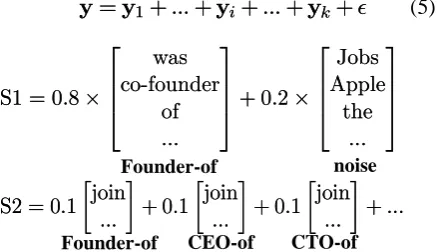
y=y1+:::+yi+:::+yk+²
y=y1+:::+yi+:::+yk+² (5)
S1 = 0:8£ 2 6 6 4 was co-founder of ... 3 7 7
5+ 0:2£ 2 6 6 4 Jobs Apple the ... 3 7 7 5 S1 = 0:8£
2 6 6 4 was co-founder of ... 3 7 7
5+ 0:2£ 2 6 6 4 Jobs Apple the ... 3 7 7 5
S2 = 0:1 ·
join ...
¸ + 0:1
· join
... ¸
+ 0:1 ·
join ...
¸ + ... S2 = 0:1
· join
... ¸
+ 0:1 ·
join ...
¸ + 0:1
· join
... ¸
[image:3.595.71.290.560.686.2]+ ...
Figure 3. The semantic decomposition of the two instances in Figure 1
Figure 3 shows an example of semantic decom-position. We can see that, the semantic decompo-sition can effectively summarize the semantic
consistency information of y’s local subspace: if
the instances around an instance have diverse re-lation types (S2 for example), its information will be scattered on many different semantic compo-nents. On contrast if the instances around an in-stance have consistent relation types (S1 for ex-ample), most of its information will concentrate on the corresponding relation type.
3.3 Semantic Consistency based Relation Extraction
This section describes how to estimate and exploit the semantic consistency for relation extraction. Specifically, given y’s semantic decomposition:
y=y1+:::+yi+:::+yk+²
y=y1+:::+yi+:::+yk+²
we observe that if instance y locates at a semantic consistent region, then all its information will con-centrate on a specific component yi, with all other
components equal to zero vector 0. However, modeling errors, expression ambiguity and noisy features will lead to small nonzero components. Based on the above discussion, we define the se-mantic consistency of an instance as the sese-mantic concentration degree of its decomposition: Definition 1(Semantic Consistency). For an in-stance y, its semantic consistency withith relation type is:
Consistency(y; i) = P kyik2
ikyik2+k²k2
Consistency(y; i) = P kyik2
ikyik2+k²k2
where Consistency(y, i) and will be 1.0 if all information of y is consistent with ith relation type; on contrast it will be 0 if no information in y
is consistent with ith relation type.
Semantic Consistency based Relation Ex-traction. To get accurate extractions, we deter-mine the relation type of y based on both: 1) How much information in y is related to ith type; and 2) its semantic consistency score with ith type, i.e., whether yis a reliable instance of ith type.
To measure how much information in y is re-lated to ith relation type, we compute the propor-tion of common informapropor-tion between y and yi:
sim(y;yi) =
y¢yi
y¢y sim(y;yi) =
y¢yi
y¢y (6) Then the likelihood for a testing instance y ex-pressing ith relation type is scored by summariz-ing both its information and semantic consistency:
rel(y; i) = sim(y;yi)£Consistency(y; i)
rel(y; i) = sim(y;yi)£Consistency(y; i)
and y will be classified into ith relation type if its likelihood is larger than a threshold:
rel(y; i) ¸ ¿i
rel(y; i) ¸ ¿i (7)
where is a relation type specific threshold learned from training dataset.
Founder-of CEO-of
Founder-of noise
Multi-Instance Evidence Combination. It is often that an entity pair will match more than one sentence. To exploit such redundancy for more confident extraction, this paper first combines the evidence from different instances by combing their underlying components. That is, given the matched m instances Y={y1, y2, …, ym} for an en-tity pair (e1, e2), we first decompose each instance as yyjj ==yy11jj++::::::++yykjjk++²², then the entity-pair level decomposition yy==yy11++::::::++yykk++²² is
ob-tained by summarizing semantic components of different instances: yyii==PP11··jj··mmyyijji. Finally, the likelihood of an entity pair expressing ith relation type is scored as:
rel(Y; i) = sim(y;yi)Consistency(y; i)log(m+ 1) rel(Y; i) = sim(y;yi)Consistency(y; i)log(m+ 1)
where is a score used to encourage extractions with more matching instances.
3.4 One further Issue for Distant Supervi-sion: Training Instance Selection
The above model further provides new insights into one issue for distant supervision: training in-stance selection. In this paper, we select informa-tive training instances by seeking a most compact subset of instances which can span the whole sub-space of a relation type. That is, all instances of ith type can be represented as a linear combination of these selected instances.
However, finding the optimal subset of training instances is difficult, as there exist 2N possible so-lutions for a relation type with N training instances. Therefore, this paper proposes an approximate training instance selection algorithm as follows:
1) Computing the centroid of ith relation type as vi =
P
1·j·ni vi;j vi =
P
1·j·ni vi;j
2) Finding the set of training instances which can most compactly span the centroid by solving:
(l1) :xi= arg minkxk
1 s.t.kAix¡vik2·" (l1) :xi= arg minkxk
1 s.t.kAix¡vik2·" 3) Ranking all training instances according to
their absolute coefficient weight value ; 4) Selecting top p percent ranked instances as
final training instances.
The above training instance selection has two benefits. First, it will select informative instances and remove redundant instances: an informative instance will receive a high value because many other instances can be represented using it; and if two instances are redundant, the sparse so-lution will only retain one of them. Second, most of the wrongly labeled training instances will be filtered, because these instances are usually not
regular expressions of ith type, so they appear only a few times and will receive a small .
4
Experiments
In this section, we assess the performance of our method and compare it with other methods.
Dataset. We assess our method using the KBP dataset developed by Surdeanu et al. (2012). The KBP is constructed by aligning the relations from a subset of English Wikipedia infoboxes against a document collection that merges two distinct sources: (1) a 1.5 million documents collection provided by the KBP shared task(Ji et al., 2010; Ji et al., 2011); and (2) a complete snapshot of the June 2010 version of Wikipedia. Totally 183,062 training relations and 3,334 testing relations are collected. For tuning and testing, we used the same partition as Surdeanu et al. (2012): 40 que-ries for development and 160 queque-ries for formal evaluation. In this paper, each instance in KBP is represented as a feature vector using the features as the same as in (Surdeanu et al., 2012).
Baselines. We compare our method with four baselines as follows:
Mintz++. This is a traditional DS assump-tion based model proposed by Mintz et al.(2009).
Hoffmann. This is an at-least-one as-sumption based multi-instance learning method proposed by Hoffmann et al. (2011).
MIML. This is a multi-instance multi-la-bel model proposed by Surdeanu et al. (2012).
KNN. This is a classical K-Nearest-Neighbor classifier baseline. Specifically, given an entity pair, we first classify each matching in-stance using the labels of its 5 (tuned on training corpus) nearest neighbors with cosine similarity, then all matching instances’ classification results are added together.
Evaluation. We use the same evaluation set-tings as Surdeanu et al. (2012). That is, we use the official KBP scorer with two changes: (a) relation mentions are evaluated regardless of their support document; and (b) we score only on the subset of gold relations that have at least one mention in matched sentences. For evaluation, we use Mintz++, Hoffmann, and MIML implementation from Stanford’s MIMLRE package (Surdeanu et al., 2012) and implement KNN by ourselves.
4.1 Experimental Results
4.1.1 Overall Results
method, we use top 10% weighted training in-stances. All features occur less than 5 times are filtered. All l1-minimization problems in this pa-per are solved using the augmented Lagrange multiplier algorithm (Yang et al., 2010), which has been proven is accurate, efficient, and robust. To select the classification threshold for ith re-lation type, we use the value which can achieve the best F-measure on training dataset (with an ad-ditional restriction that precision should > 10%).
Figure 4. Precision/recall curves in KBP dataset
System Precision Recall F1
Mintz++ 0.260 0.250 0.255
Hoffmann 0.306 0.198 0.241
MIML 0.249 0.314 0.278
KNN 0.261 0.295 0.277
Our method 0.286 0.342 0.311
Table 1. The best F1-measures in KBP dataset
Figure 4 shows the precision/recall curves of different systems, and Table 1 shows their best F1-measures. From these results, we can see that: 1) The semantic consistency based method can achieve robust and competitive performance: in KBP dataset, our method correspondingly achieves 5.6%, 7%, 3.3% and 3.4% F1 improve-ments over the Mintz++, Hoffmann, MIML and KNN baselines. We believe this verifies that the semantic consistency around an instance is an ef-fective way to identify reliable instances.
2) From Figure 4 we can see that our method achieves a consistent improvement on the high-re-call region of the KBP curves (when rehigh-re-call > 0.1). We believe this is because by modeling the se-mantic consistency using the local subspace around each testing instance, our method can bet-ter solve the classification of long tail instances which are not expressed using salient patterns.
3) The local subspace around an instance can be effectively modeled as a linear subspace
spanned by training instances. From Table 1 we can see that both our method and KNN baseline (where the local subspace is spanned using its k nearest neighbors) achieve competitive perfor-mance: even the simple KNN baseline can achieve a competitive performance (0.277 in F1). This re-sult shows: a) the effectiveness of instance-based subspace modeling; and b) by partitioning sub-space into many local subsub-spaces, the subsub-space model is more adaptive and robust to model prior. 4) The sparse representation is an effective way to model the local subspace using training in-stances. Compared with KNN baseline, our method can achieve a 3.4% F1 improvement. We believe this is because: (1) the discriminative na-ture of sparse representation as shown in (Wright et al., 2009); and (2) the sparse representation globally seeks the combination of training in-stances to characterize the local subspace, on con-trast KNN uses only its nearest neighbor in the training data, which is more easily affected by noisy training instances(e.g., false positives).
4.1.2 Training Instance Selection Results
To demonstrate the effect of training instance se-lection, Table 2 reports our method’s performance using different proportions of training instances.
Proportion 5% 10% 20% 100% Best F1 0.282 0.311 0.305 0.280
Table 2. The best F1-measures using different proportions of top weighted training instances
From Table 2, we can see that: ① Our training in-stance selection algorithm is effective: our method can achieve performance improvement using only top weighted instances. ② The training instances are highly redundant: using only 10% weighted instances can achieve a competitive performance.
5
Conclusion and Future Work
This paper proposes a semantic consistency method, which can identify reliable instances from noisy instances for distant supervised rela-tion extracrela-tion. For future work, we want to de-sign a more effective instance selection algorithm and embed it into our extraction framework.
Acknowledgments
Reference
Andoni, Alexandr, and Piotr Indyk . 2006. Near-opti-mal hashing algorithms for approximate nearest neighbor in high dimensions. In: Foundations of Computer Science, 2006, pp. 459-468.
Bunescu, Razvan, and Raymond Mooney. 2007. Learning to extract relations from the web using minimal supervision. In: ACL 2007, pp. 576.
Craven, Mark, and Johan Kumlien. 1999. Constructing biological knowledge bases by extracting infor-mation from text sources. In : Proceedings of AAAI 1999.
Downey, Doug, Oren Etzioni, and Stephen Soderland. 2005. A probabilistic model of redundancy in infor-mation extraction, In: Proceeding of IJCAI 2005.
Gupta, Rahul, and Sunita Sarawagi. 2011. Joint train-ing for open-domain extraction on the web: exploit-ing overlap when supervision is limited. In: Pro-ceedings of WSDM 2011, pp. 217-226.
Hearst, Marti A. 1992. Automatic acquisition of hypo-nyms from large text corpora. In: Proceedings of COLING 1992, pp. 539-545.
Hoffmann, Raphael, Congle Zhang, and Daniel S. Weld. 2010. Learning 5000 relational extractors. In: Proceedings of the 48th Annual Meeting of the As-sociation for Computational Linguistics, 2010, pp. 286-295.
Hoffmann, Raphael, Congle Zhang, Xiao Ling, Luke Zettlemoyer, and Daniel S. Weld. 2011. Knowledge-based weak supervision for information extraction of overlapping relations. In: Proceedings of ACL 2011, pp. 541-550.
Ji, Heng, Ralph Grishman, Hoa Trang Dang, Kira Grif-fitt, and Joe Ellis. 2010. Overview of the TAC 2010 knowledge base population track. In: Proceedings of the Text Analytics Conference.
Ji, Heng, Ralph Grishman, Hoa Trang Dang, Kira Grif-fitt, and Joe Ellis. 2011. Overview of the TAC 2011 knowledge base population track. In Proceedings of the Text Analytics Conference.
Krause, Sebastian, Hong Li, Hans Uszkoreit, and Feiyu Xu. 2012. Large-Scale learning of relation-extrac-tion rules with distant supervision from the web. In: ISWC 2012, pp. 263-278.
Mintz, Mike, Steven Bills, Rion Snow, and Dan Juraf-sky. 2009. Distant supervision for relation extrac-tion without labeled data. In: Proceedings ACL- AFNLP 2009, pp. 1003-1011.
Min, Bonan, Ralph Grishman, Li Wan, Chang Wang, and David Gondek. 2013. Distant Supervision for Relation Extraction with an Incomplete Knowledge Base. In: Proceedings of NAACL-HLT 2013,pp. 777-782.
Min, Bonan, Xiang Li, Ralph Grishman, and Ang Sun. 2012. New york university 2012 system for kbp slot filling. In: Proceedings of TAC 2012.
Nguyen, Truc-Vien T., and Alessandro Moschitti. 2011. Joint distant and direct supervision for rela-tion extracrela-tion. In: Proceedings of IJCNLP 2011, pp. 732-740.
Riedel, Sebastian, Limin Yao, and Andrew McCallum. 2010. Modeling relations and their mentions with-out labeled text. In: Machine Learning and Knowledge Discovery in Databases, 2010, pp. 148-163.
Riedel, Sebastian, Limin Yao, Andrew McCallum, and Benjamin M. Marlin. 2013. Relation Extraction with Matrix Factorization and Universal Schemas. In: Proceedings of NAACL-HLT 2013, pp. 74-84.
Roth, Benjamin, and Dietrich Klakow. 2013. Combin-ing Generative and Discriminative Model Scores for Distant Supervision. In: Proceedings of ACL 2013, pp. 24-29.
Surdeanu, Mihai, Julie Tibshirani, Ramesh Nallapati, and Christopher D. Manning. 2012. Multi-instance multi-label learning for relation extraction. In: Pro-ceedings of EMNLP-CoNLL 2012, pp. 455-465.
Takamatsu, Shingo, Issei Sato, and Hiroshi Nakagawa. 2012. Reducing wrong labels in distant supervision for relation extraction. In: ACL 2012,pp. 721-729.
Wang, Chang, Aditya Kalyanpur, James Fan, Branimir K. Boguraev, and D. C. Gondek. 2012. Relation ex-traction and scoring in DeepQA. In: IBM Journal of Research and Development, 56(3.4), pp. 9-1.
Wang, Chang, James Fan, Aditya Kalyanpur, and Da-vid Gondek. 2011. Relation extraction with relation topics. In: Proceedings of EMNLP 2011, pp. 1426-1436.
Wright, John, Allen Y. Yang, Arvind Ganesh, Shankar S. Sastry, and Yi Ma. 2009. Robust face recognition via sparse representation. In: Pattern Analysis and Machine Intelligence, IEEE Transactions on, 31(2), 210-227
Wu, Fei, and Daniel S. Weld. 2007. Autonomously se-mantifying wikipedia. In: Proceedings of CIKM 2007,pp. 41-50.
Xu, Wei, Raphael Hoffmann Le Zhao, and Ralph Grishman. 2013. Filling Knowledge Base Gaps for Distant Supervision of Relation Extraction. In: Pro-ceedings of ProPro-ceedings of 2013, pp. 665-670.
Yang, Allen Y., Shankar S. Sastry, Arvind Ganesh, and Yi Ma. 2010. Fast l1-Minimization Algorithms and
An Application in Robust Face Recognition: A Re-view. In: Proceedings of ICIP 2010.
without labelled data. In: Proceedings of EMNLP 2010, pp. 1013-1023.
Zhang, Congle, Raphael Hoffmann, and Daniel S. Weld. 2012. Ontological smoothing for relation ex-traction with minimal supervision. In: Proceedings of AAAI 2012, pp. 157-163.