Proceedings of the 2019 Conference on Empirical Methods in Natural Language Processing
856
Multi-agent Learning for Neural Machine Translation
Tianchi Bi, Hao Xiong, Zhongjun He, Hua Wu and Haifeng Wang Baidu Inc. No. 10, Shangdi 10th Street
Beijing, 100085, China
{bitianchi, xionghao05, hezhongjun, wu hua, wanghaifeng}@baidu.com
Abstract
Conventional Neural Machine Translation (NMT) models benefit from the training with an additional agent, e.g., dual learning, and bidirectional decoding with one agent decod-ing from left to right and the other decoddecod-ing in the opposite direction. In this paper, we extend the training framework to the multi-agent sce-nario by introducing diverse agents in an in-teractive updating process. At training time, each agent learns advanced knowledge from others, and they work together to improve translation quality. Experimental results on NIST Chinese-English, IWSLT 2014 German-English, WMT 2014 English-German and large-scale Chinese-English translation tasks indicate that our approach achieves absolute improvements over the strong baseline sys-tems and shows competitive performance on all tasks.
1 Introduction
Training with more than one agents has attracted intensive research interest in recent years, for ex-ample, dual learning (He et al., 2016;Xia et al., 2017,2018) and bidirectional decoding (Liu et al., 2016;Zhang et al., 2019b). The former method leverages the duality between the two related agents as the feedback signal to regularize train-ing, while the latter targets the agreement between one agent decoding from left to right (L2R) while the other decoding in opposite direction (R2L). Both methods enhance the translation models by introducing a regularization term into the training objective.
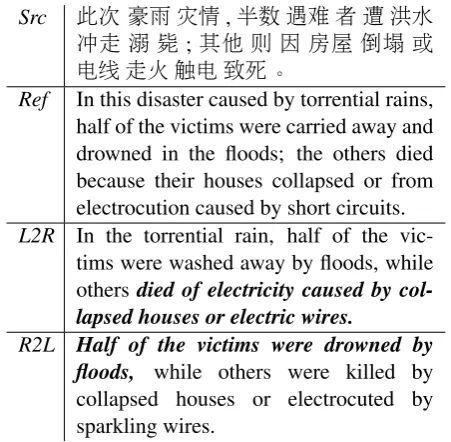
The effectiveness of these two methods lies in the fact that appropriate regularization can help each agent to learn from the superior models while integrating their advantages (e.g., good transla-tions for prefixes for L2R, and good translation quality for suffixes for R2L). As shown in the Ta-ble1, due to the exposure biasproblem (Ranzato
Src 此次 豪雨灾情,半数遇难者遭洪水
冲走溺 毙 ;其他则 因 房屋 倒塌或
电线走火触电致死。
Ref In this disaster caused by torrential rains, half of the victims were carried away and drowned in the floods; the others died because their houses collapsed or from electrocution caused by short circuits.
L2R In the torrential rain, half of the vic-tims were washed away by floods, while others died of electricity caused by col-lapsed houses or electric wires.
[image:1.595.304.530.221.442.2]R2L Half of the victims were drowned by floods, while others were killed by collapsed houses or electrocuted by sparkling wires.
Table 1: In this sample, NMT systems with different implementations present diverse translation errors for one long sentence. The agent decoding from left to right (L2R) tends to generate better prefixes and bad suffixes (bold letters), and theR2Lagent has the oppo-site preference.
et al., 2016), the agent trained to decode from left to right tends to generate better prefixes and bad suffixes, and the agent decoding in the re-verse direction demonstrates the opposite prefer-ence. By introducing additional Kullback-Leibler (KL) divergences between the probability distri-butions defined by L2R and R2L models into the NMT training objective (Zhang et al.,2019b), it is possible for two models to learn advantages from each other.
problems. First, when deploying the multi-agent system, should we focus on the diversity or the strength of each agent? (Wong et al.,2005; Mar-colino et al.,2013) Second, learning in multi-agent scenario is many-to-many, as opposed to the rel-atively simpler one-to-one learning in two-agent training, and requires an effective learning strat-egy.
There have been many alternatives to improve the diversity of models even based on the Trans-former model (Vaswani et al.,2017). For exam-ple, decoding in the opposite direction usually re-sults in different preferences: good prefixes and bad prefixes (Zhang et al., 2019b). Rather, self-attention with relative position representations en-hances the generalization to sequence lengths un-seen during training (Shaw et al.,2018). Further-more, increasing the size of layers in the encoder is expected to specialize in word sense disambigua-tion (Tang et al., 2018;Domhan, 2018). In this paper, we investigate the effects of two teams of multi-agents: a team of alternative agents men-tioned above, and a uniform team of different ini-tialization for the same model.
To resolve the second problem, we simplify the
many-to-many learning to the one-to-many (one teacher vs. many students) learning, extending ensemble knowledge distillation (Fukuda et al., 2017; Freitag et al., 2017; Liu et al., 2018; Zhu et al.,2018). During the training, each agent per-forms better by learning from the ensemble model (Teacher) of all agents integrating the knowledge distillation (Hinton et al., 2015; Kim and Rush, 2016) into the training objective. This proce-dure can be viewed as the introduction of an ad-ditional regularization term into the training ob-jective, with which each agent can learn advan-tages from the ensemble model gradually. With this method, each agent is optimized not only to the maximization of the likelihood of the train-ing data, but also to the minimization of the di-vergence between its own model and the ensemble model.
However, the above learning strategy converges on the local optimum rapidly in our empirical studies. It seems that each agent tends to focus on learning from the ensemble model while com-pletely ignoring its own exploration. To alleviate this problem, we train each agent to learn from the ensemble models when necessary, and to dis-till the knowledge based on the translation quality
(BLEU score) of the ensemble model. This means we evaluate the quality of the ensemble model to see whether it is good enough to be studied. Con-sequently, the knowledge distillation from the en-semble model to the agent stems from the better translation generated by the ensemble model.
We evaluate our model on NIST Chinese-English Translation Task, IWSLT 2014 German-English Translation task, large-scale WMT 2014 English-German Translation task and large-scale Chinese-English Translation Task. Extensive ex-perimental results indicate that our model signifi-cantly improves the translation quality, compared to the strong baseline systems. Moreover, our model also reports competitive performance on the German-English and English-German translation tasks, achieving 36.27 and 29.67 BLEU scores, re-spectively.
To the best of our knowledge, this is the first work on training NMT model with more than two agents1. The contributions of this paper are
sum-marized as follows:
• We extend the study on training with two agents to the multi-agent scenario, and pro-pose a general learning strategy to train mul-tiple agents.
• We investigate the effects of the diversity and the strength of each agent in the multi-agent training scenario.
• We simplify complexmany-to-manylearning in multi-agent learning toone-to-many learn-ing by forclearn-ing each agent learnlearn-ing knowledge from ensemble model as necessary.
• Extensive experiments on multiple transla-tion tasks confirm that our model signifi-cantly improves the translation quality and reports the new state-of-the-art results on IWSLT 2014 German-English and competi-tive results on WMT 2014 English-German translation tasks.
2 Background
Conventional autoregressive NMT models ( Bah-danau et al.,2015;Sutskever et al.,2014) decode target tokens sequentially, which indicates that the
determination of the current token is conditioned by the previous generated sequence. Formally, at time stept, the generation of the current tokenyt
is determined by the following equation:
p(yt) =p(yt|y<t, x;θ) (1)
where y<t represents the previously generated
sequence, andθare the parameters of the represen-tation of the source sequence and the partial target sequence.
Furthermore, the usual training criterion is to minimize the negative log-likelihood for each sample from the training data,
LN LL=− T X
t=0 |V| X
k=1
1{yt=k}logp(yt=k|y<t, x;θ) (2)
where T is the length of the target sequence,
|V| is the size of vocabulary and 1{·} is the in-dicator function. This objective can be viewed as minimizing the cross-entropy between the cor-rect translation y∗ and the model generation p(yt|y<t, x;θ).
3 Multi-agent Learning
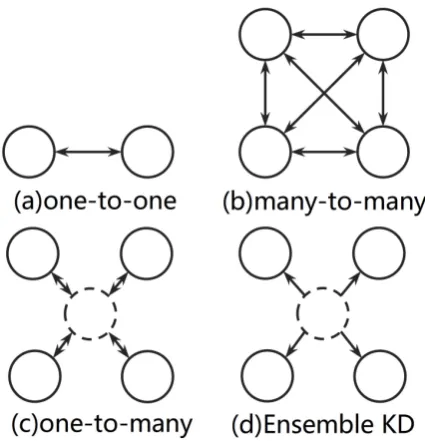
Empirical studies indicate that one agent is trained to perform better through learning advantages from the other agent in the two-agent scenario, namely one-to-one learning (Figure 1.(a)). The training objective of the agent is regularized, which is to learn better models by leveraging the relationship between the two agents as feedback, i.e., duality in dual learning problem, and agree-ment in bidirectional decoding.
Extending the study to the multi-agent scenario is feasible and desirable, as multiple agents might supply more reliable and diverse advantages com-pared to the two-agents scenario. However, the agent is expected to learn advantages from each other in the multi-agent scenario, which results in a complexmany-to-manylearning problem(Figure 1.(b)).
Instead of tacklingmany-to-manylearning, we force the agent to learn from a common Teacher
[image:3.595.309.522.60.281.2]by introducing ensemble knowledge distillation, thus reduce the learning to one-to-many (Figure 1.(c)). With this learning strategy, each agent can learn to improve the performance in an interactive updating process.
Figure 1: Illustration for different learning approaches.
As opposed to ensemble Knowledge Distilla-tion (KD) (Figure1.(d)), the important difference is that in the knowledge distillation of an ensem-ble of models, the Teachernetwork is fixed after pre-training, during the training process. While in our framework, the state of theTeachernetwork is updated at each iteration, and its performance can be further improved by the improvements of each agent explicitly, in an interactive updating process. In some ways the ensemble KD can be viewed as a particular case of our model, as we fix the update of theTeachernetwork in the training framework.
3.1 Overall Framework
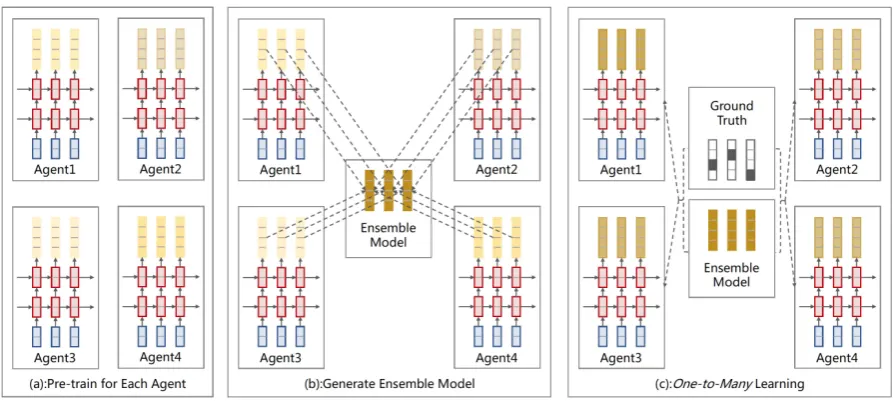
For the sake of simplicity, four variant agents are referred to as Agent1, Agent2, Agent3 and Agent4. We begin by pre-training each agent in-dependently (Figure2.(a)), and then enhance the model in the multi-agent scenario in two steps: 1) Generating Ensemble Model (Figure2.(b)), and 2)
One-to-ManyLearning (Figure2.(c)). The perfor-mance of each agent is improved in an interactive updating process, through repeating the above two steps.
3.2 Generate Ensemble Model
As pointed out in the work of Liu et al. (2018), ensemble models can empirically alleviate prob-lems existing in the standard NMT model, such as ambiguities in the training data, and discrepancy between training and testing.
ensem-Figure 2: In this example, four agents decode the similar sentence with different model capacity. (a): At first, each agent is pre-trained to generate the translation independently. (b) The ensemble model is generated by the average prediction from each agent. (c): TheOne-to-Manylearning distills the knowledge from the ensemble model to each agent as necessary. The performance of each agent is improved explicitly in an interactive updating process, through repeating the process (b) and (c).
ble models, it is relevant to force agents to learn from the ensemble model, instead of learning from each other separately. Following previous work, we develop our ensemble model by averaging the model distributions of all agents.
Formally, the model distribution of the i-th agentagentiis defined asp(yit|y<ti , x;θ). Assume
we have N agents, the model distribution of the ensemble model can be formulated as:
q(yt|y<t, x;θt) = 1 N
N X
i=1 p(yit|y
i
<t, x;θi) (3)
whereθtare parameters for representing the
en-semble model. Notably, we do not train it in the training process.
In the above formula, the probability q(yt|y<t, x;θt) is one reliable estimator of
the model distribution, as the majority of the agents are likely to generate correct sequence. From this perspective, we expect that more agents will lead to better and more robust performance.
3.3 One-to-ManyLearning
In the one-to-many learning framework, the en-semble model acts as theTeachernetwork, which distills knowledge to each agent iteratively.
Rather than minimizing cross-entropy with the observed data, we minimize the cross-entropy with the probability distribution from the
ensem-ble model for each agent.
Li KD=−
T X
t=0 |V| X
k=1
q(yt=k|y<t, x;θt)×
logp(yit=k|yi<t, x;θ)
(4)
With the above formula, the agent is optimized to the minimization of the model divergence be-tween its own model and the ensemble model.
However, integrating the above regularization term into the training objective straightforwardly is problematic in practice. The agent tends to fo-cus on learning from the ensemble model rather than exploring its own prediction to converge rapidly. Consequently, the model converges at a suboptimal point, and fails to enhance the perfor-mance by learning from each other due to the lack of evaluation of the ensemble model.
To alleviate this problem, we train each agent to learn from the ensemble model when necessary, distilling the knowledge conditioned by the trans-lation quality of the ensemble model. We evaluate the quality of the ensemble model to see whether it is good enough to be studied. The knowledge distillation from the ensemble model to the agent comes from the better translation generated by the ensemble model. Otherwise, the agent is forced to learn its own distribution.
Let < Xg, Yg > be one sentence pair in the
[image:4.595.75.522.61.262.2]mea-sured by the BLEU score,
score(Yt) = BLEU(Yt, Yg) (5)
whereYtis generated by the model distribution
q(yt|y<t, x;θt). The quality of the translation
se-quence generated by each agent can also be de-fined using the similar metric,
score(Ysi) = BLEU(Y i
s, Yg) (6)
whereYsiis generated by the model distribution p(yit|yi<t, x;θ)of each agent.
Conditioned by the translation quality of the en-semble model, we modify the training objective for each agent as follows:
LiKD=− T X
t=0 |V| X
k=1
S×logp(yit=k|y i
<t, x;θ) (7)
whereSis defined as:
S= (
q(yt=k|y<t, x;θt) score(Yt)> score(Ysi) 1s{yti=k} otherwise
(8)
where1s{·}is an indicator, conditioned by the
existence ofyti =kin the sequenceYsi.
In practice, each agent is not only optimized to maximize the likelihood of the training data, but also to minimize the model divergence between its own model and the ensemble model:
Li
a=λiLN LL+ (1−λi)LiKD (9)
where λi is a hyperparameter, balancing the
weight of two factors.
From the perspective of learning, the agent learns to minimize the training objective by gen-erating competitive translations, which leads to a global improvement for all agents. On the other hand, a sequence-level training objective might al-leviate theexposure biasproblem implicitly ( Ran-zato et al.,2016).
3.4 Joint Learning
In the work ofZhang et al.(2019b), they proposed a relatively complex joint learning framework for training two agents. In this paper, according to the
Algorithm 1:Multi-agent Learning
Input: N variant agents;
1 Pre-train each agentagentiindependently; 2 repeat
3 foreach training sample(Xg, Yg)do 4 Ensemble Model:q(yt|y<t, x;θt);
5 Generate sequence:
Yt←arg max 0≤t<T
q(yt|y<t, x;θt);
6 foreach agentagenti do
7 Generate sequence:
Ysi ←arg max 0≤t<T
p(yti|y<ti , x;θ);
8 Compute KDloss:LiKD ←
(q(yt), p(yti), Yt, Ysi, Xg, Yg);
9 Compute NLLloss:
LN LL←(p(yti), Xg, Yg);
10 Compute Agentloss:
Li
a←λLN LL+ (1−λ)LiKD; 11 end
12 Modelloss:Lf inal=PNi=1Lia; 13 Update gradients for each agent;
14 end
15 untilconvergence;
previous experiments, we find that a simple multi-task learning technique without sharing any mod-ules presents promising performance,
Lf inal= N X
i=1 Li
a (10)
In Algorithm1, we describe the overall proce-dure of our approach. It deserves noting that in line3, we assume the model reads a single pair of training examples per timestep for simplistic de-scription, while in practice the model reads a batch size of samples at each step.
4 Experiments
In this paper, we evaluate our model on four translation tasks: NIST Chinese-English tion Task, IWSLT 2014 German-English tion Task, WMT 2014 English-German Transla-tion Task and large-scale Chinese-English Trans-lation Task.
4.1 Data Preprocessing
MODEL MT02 MT03 MT04 MT08 AVERAGE IMPROVEMENTS Results for Best Agent Results for each Agent
Wang et al.(2018) - 46.60 47.73 - - -a.L2R 48.53 47.07 48.43 42.21 46.56 -b.R2L 47.06 45.58 47.14 41.04 45.20 -c.Enc 48.86 47.54 48.57 42.93 46.97 -d.Rel 48.12 48.19 48.33 42.51 46.78
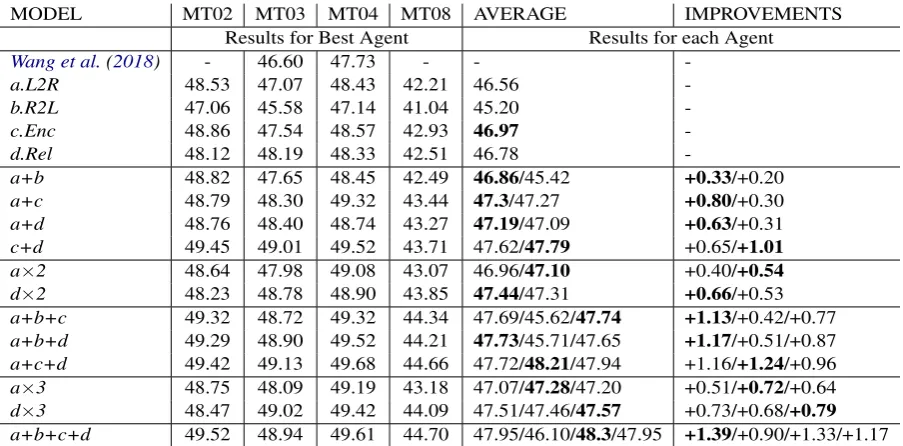
[image:6.595.75.527.61.284.2]-a+b 48.82 47.65 48.45 42.49 46.86/45.42 +0.33/+0.20 a+c 48.79 48.30 49.32 43.44 47.3/47.27 +0.80/+0.30 a+d 48.76 48.40 48.74 43.27 47.19/47.09 +0.63/+0.31 c+d 49.45 49.01 49.52 43.71 47.62/47.79 +0.65/+1.01 a×2 48.64 47.98 49.08 43.07 46.96/47.10 +0.40/+0.54 d×2 48.23 48.78 48.90 43.85 47.44/47.31 +0.66/+0.53 a+b+c 49.32 48.72 49.32 44.34 47.69/45.62/47.74 +1.13/+0.42/+0.77 a+b+d 49.29 48.90 49.52 44.21 47.73/45.71/47.65 +1.17/+0.51/+0.87 a+c+d 49.42 49.13 49.68 44.66 47.72/48.21/47.94 +1.16/+1.24/+0.96 a×3 48.75 48.09 49.19 43.18 47.07/47.28/47.20 +0.51/+0.72/+0.64 d×3 48.47 49.02 49.42 44.09 47.51/47.46/47.57 +0.73/+0.68/+0.79 a+b+c+d 49.52 48.94 49.61 44.70 47.95/46.10/48.3/47.95 +1.39/+0.90/+1.33/+1.17
Table 2: BLEU score for the representative models in multi-agent training on NIST Chinese-English translation. X×Ystands forY agents with the indentical modelXbut from different initializing seeds.
vocabulary size to 20K and 18K for Chinese-English, a joint 20K vocabulary for German-English, and a joint 32K vocabulary for English-German, respectively.
For Chinese-English task, the training data con-sists of about 1.5M sentence pairs extracted from LDC corpora 2. We choose the NIST 2006 (MT06) dataset for validation, and NIST 2002-2004 (MT02-04), as well as NIST 2008 (MT08) datasets for testing. For large-scale Chinese-English task, the training data consists of about 40M sentence pairs extracted from web data.
4.2 Agent Variants
To increase the diversity of agents, we implement the following variants of the Transformer based system: L2R, the officially released open source toolkit for running Transformer model, R2L, the standard Transformer decodes in reversed direc-tion,Enc, the standard Transformer with 30 layers in the encoder, and Rel, the reimplementation of self-attention with relative position (Shaw et al., 2018).
2
LDC2002E18, LDC2002L27, LDC2002T01, LDC2003E07, LDC2003E14, LDC2004T07, LDC2005E83, LDC2005T06, LDC2005T10, LDC2005T34, LDC2006E24, LDC2006E26, LDC2006E34, LDC2006E86, LDC2006E92, LDC2006E93, LDC2004T08(HK News, HK Hansards )
4.3 Training Details
We implement our models using PaddlePaddle3, an end-to-end open source deep learning platform developed by Baidu. It provides a complete suite of deep learning libraries, tools and service plat-forms to make the research and development of deep learning simple and reliable.
We use the hyperparameters of the base ver-sion for the standard Transformer model of NIST Chinese-English and IWSLT German-English translation tasks, except the smaller token size (batch size = 320). For WMT English-German and large-scale Chinese-English translation tasks, we use the hyperparameters of thebigversion. As described in the previous section, we use a hyper-parameter λi for each agent to balance the
pref-erence between learning from the observed data and the ensemble model. According to the perfor-mance of each agent after pre-training, we set this value as follows:
λi= 0.5 + max(−0.5,min(0.5,Bi−Bavg
10 )) (11)
whereBiis the BLEU score obtained by the
pre-training of the i−th agent, and the Bavg is the
average BLEU score of all agents.
The above formula suggests the agent learns more from the ensemble model as its performance
Task L2R Rel KD-4 Dual-5 Rel-4 De-En 33.63 34.91 35.53 34.70 36.27
Table 3: BLEU score on IWSLT 2014 German-English translation. KD-4 stands for ensemble knowledge dis-tillation with four agents. Dual-5 is the SOTA model from the work ofWang et al.(2019). And Rel-4 is our best model (Rel) training with four diverse agents.
is worse than the majority vote, rather than focus-ing on explorfocus-ing by its own prediction.
We train our model with parallelization at data batch level. For NIST Chinese-English task, it takes about 1.5 days to train models on 8 NVIDIA P40 GPUs, 5 days for WMT English-German task, 8 hours for IWSLT German-English task and 7 days for large-scale Chinese-English task. The de-tailed training process is as follows, first we train each agent until BLEU doesn’t improve any more and then execute Algorithm 1 for one-to-many learning which takes 30K-40K steps to converge.
4.4 Chinese-English Results
Study on different numbers of agents. We first assess the impact of diverse agents on translation quality. From Table 2, we see that the model’s performance consistently improves as the number of agents increases, and we observe that 1) The four baseline systems with different implementa-tions present diverse translation quality, in particu-larRelwith refined position encoding achieves the best performance. 2) The improvement of each agent after multi-agent learning is dependent on the performance of the co-trained agent (+0.33, +0.8, +0.63 improvements obtained byL2Rwhen training withR2L,EncandRel). 3) Better results can be obtained by increasing the number of train-ing agents (e.g., 47.3→47.73→47.95 for L2R). From the overall results, increasing the num-ber of agents in multi-agent learning significantly improves the performance of each agent (at most +1.39, +0.9, +1.33, +1.17 in a+b+c+d), which suggests that each agent learns advantages from the other agents, and more agents might lead to further improvement. More importantly, our im-provements are obtained from the advanced train-ing strategy without any modification in decodtrain-ing stage, which indicates its practicability in deploy-ment.
Study on uniform agents.To measure the impor-tance of diversity in multi-agents, we conduct
mul-Models En-De
ConvS2SGehring et al.(2017) 25.2 TransformerVaswani et al.(2017) 28.4
RelShaw et al.(2018) 29.2
DynamicConvWu et al.(2019) 29.7 Back-translationSergey et al.(2018) 35.00
Dual-3Wang et al.(2019) 29.92
Dual-3 + Mono Data 30.67
L2R 28.37
Rel 29.16
[image:7.595.309.525.61.213.2]Rel-4 29.67
Table 4: BLEU score on newstest2014 for WMT English-German translation.
tiple experiments by initializing the similar model with different initialization seeds to generate mul-tiple agents. As reported in Table2, although the single Rel model achieves the best performance compared to the other three single agents, the d × 2 (47.44) and d × 3 (47.57) perform worse than the best counterpartsc+d(47.79) anda+c+d
(47.94). Moreover, when training with more than two agents, the performance of d × 3 (47.57) is even lower than arbitrary diverse counterparts (a+b+c(47.74);a+b+d(47.73)).
These results suggest that multi-agent learning is better conducted with diverse agents instead of the uniform agents with excellent single perfor-mance. On the other hand, in our multi-agent learning, training with more agents brings consis-tent improvements even when deployed by identi-cal models from different initialization seeds.
4.5 German-English and English-German Results
We work with the IWSLT German-English trans-lation to compare our model to the SOTA model. From Table3, we observe that both KD-4 and Rel-4 models achieve the best result on this dataset (35.53 and 36.27), which manifests the effective-ness of using multiple agents.
Even when trained with four agents, our model outperforms the dual model trained with five agents (34.70), and reports a SOTA score on this translation task. Moreover, we argue that fine-tuning with L2R to obtain a better performance could further improve the performance of Rel-4, as there exists a large gap between L2RandRel, which affects the learning efficiency.
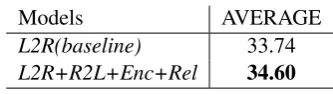
Models AVERAGE
L2R(baseline) 33.74
[image:8.595.96.263.60.107.2]L2R+R2L+Enc+Rel 34.60
Table 5: BLEU score for the L2R model in multi-agent training on large-scale corpus of Chinese-English translation. Because we only use L2R model in Baidu Translate, so part of results are presented.
model on the WMT English-German translation task, which achieves a competitive result of 29.67 BLEU score on newstest2014. From Table4, we can see that another related work, multi-agent dual learning (Wang et al., 2019) achieves promising results. This confirms that training with more agents leads to better translation quality, and re-veals the relevance of using multiple agents.
Although Sergey et al.(2018) reports a BLEU score of 35.0 on this dataset, they leverage refined training corpus and a large number of monolin-gual data. We argue that our model can bring further improvement using their back-translation technique. Moreover, the goal of this paper is in-troducing a general learning framework for multi-agent learning rather than exhaustively fine-tuning to report a SOTA results. We argue that the perfor-mance of our model can be further improved using an advanced single agent, such as DynamicConv (Wu et al.,2019) and Dual (Wang et al.,2019).
4.6 Large-Scale Chinese-English Results
In order to prove that multi-agent learning can yield improvement in large-scale corpus, we con-ducted experiments on 40M Chinese-English sen-tence pairs with the same data processing method as NIST. We built test sets of more than 10K sen-tences which cover various domains such as news, spoken language and query logs. From Table5, we can see that multi-agent learning can increase the average baseline BLEU score of several test sets by 0.86. This technique has already been applied to Baidu Translate.
4.7 Contrastive Evaluation
In this paper, we evaluate our model on the two types of contrastive evaluation datasets:
Lingeval97 4 and ContraWSD 5. The former is utilized to measure the performance of different models on dealing with subject-verb agreement in
4
https://github.com/rsennrich/ lingeval97
5https://github.com/a-rios/ContraWSD
Models SVA (%) WSD (%)
L2R 89.06 78.05
R2L 88.92 77.97
Enc 89.13 79.07
Rel 89.21 78.75
L2R+R2L 89.28 77.94
L2R+Enc 89.42 78.29
L2R+Rel 89.39 78.47
L2R+R2L+Enc 89.26 78.36
L2R+R2L+Rel 89.58 78.28
L2R+Enc+Rel 89.39 78.84
L2R+R2L+Enc+Rel 89.47 78.62
Table 6: Accuracy of subject-verb agreement (SVA) and word sense disambiguation (WSD) for different models. We report the performance ofL2Rin differ-ent models for comparison of using differdiffer-ent agdiffer-ents.
English-German translation, while the latter eval-uates the performance on word sense disambigua-tion in German-English transladisambigua-tion. We suggest the readers refer to the work (Sennrich,2017;Tang et al., 2018) for detailed descriptions of the two datasets.
From Table6, we can see that theL2Rtraining with multiple agents improves the accuracy both on SVA and WSD, and we observe that: 1) The
L2Rimproves its ability of SVA with the help of the other agents significantly. 2) TheEncpresents better advantage in resolving WSD than in SVA, while Rel has the opposite preference. 3) Al-though theR2L presents ordinary BLEU score, it still does help theL2Rresolve the SVA.
5 Related Work
The most related work is recently proposed by Wang et al.(2019), who introduced a multi-agent algorithm for dual learning. However, the major differences are 1) the training in their work is con-ducted on the two agents while fixing the param-eters of other agents. 2) they use identical agent with different initialization seeds. 3) our model is simple yet effective. Actually, it is easy to incorpo-rate additional agent trained with their dual learn-ing strategy in our model, to further improve the performance. More importantly, both of our work and their work indicate that using more agents can improve the translation quality significantly.
[image:8.595.309.522.62.224.2]the ensemble model of all agents is leveraged as theTeacher network, to distill the knowledge for the correspondingStudent network. However, as described in the previous section, the knowledge distillation is one particular case of our model, as the performance of theTeacher in their model is fixed, and cannot be further improved by the learn-ing process.
Our work is also motivated by the work of train-ing with two agents, includtrain-ing dual learntrain-ing (He et al., 2016;Xia et al.,2017,2018), and bidirec-tional decoding (Liu et al., 2016; Zhang et al.,
2018, 2019b,a). Our method can be viewed as
a general learning framework to train multiple agents, which explores the relationship among all agents to enhance the performance of each agent efficiently.
6 Conclusions and Future Work
In this paper, we propose a universal yet effective learning method for training multiple agents. In particular, each agent learns advantages from the ensemble model when necessary. The knowledge distillation from the ensemble model to the agent stems the better translation generated by the en-semble model, which enables each agent to learn high-quality knowledge while retaining its own exploration.
Extensive experimental results prove that our model brings an absolute improvement over the baseline system, reporting SOTA results on IWSLT 2014 German-English and competitive re-sults on WMT 2014 English-German translation tasks.
In the future, we will focus on training with more agents by translating apart of one sentence considering its advantage for each agent, rather than translating the whole sentence.
References
Dzmitry Bahdanau, Kyunghyun Cho, and Yoshua Ben-gio. 2015. Neural machine translation by jointly learning to align and translate. InInternational Con-ference on Learning Representations.
Tobias Domhan. 2018. How much attention do you need? a granular analysis of neural machine trans-lation architectures. InProceedings of the 56th An-nual Meeting of the Association for Computational Linguistics (Volume 1: Long Papers), volume 1, pages 1799–1808.
Markus Freitag, Yaser Al-Onaizan, and Baskaran Sankaran. 2017. Ensemble distillation for neural machine translation. arXiv preprint arXiv:1702.01802.
Takashi Fukuda, Masayuki Suzuki, Gakuto Kurata, Samuel Thomas, Jia Cui, and Bhuvana Ramabhad-ran. 2017. Efficient knowledge distillation from an ensemble of teachers. Proc. Interspeech 2017, pages 3697–3701.
Jonas Gehring, Michael Auli, David Grangier, Denis Yarats, and Yann N Dauphin. 2017. Convolutional sequence to sequence learning. InProc. of ICML.
Di He, Yingce Xia, Tao Qin, Liwei Wang, Nenghai Yu, Tie-Yan Liu, and Wei-Ying Ma. 2016. Dual learn-ing for machine translation. InAdvances in Neural Information Processing Systems, pages 820–828.
Geoffrey Hinton, Oriol Vinyals, and Jeffrey Dean. 2015. Distilling the knowledge in a neural network. InNIPS Deep Learning and Representation Learn-ing Workshop.
Yoon Kim and Alexander M Rush. 2016. Sequence-level knowledge distillation. InProceedings of the 2016 Conference on Empirical Methods in Natural Language Processing, pages 1317–1327.
Lemao Liu, Masao Utiyama, Andrew Finch, and Eiichiro Sumita. 2016. Agreement on target-bidirectional neural machine translation. In Pro-ceedings of the 2016 Conference of the North Amer-ican Chapter of the Association for Computational Linguistics: Human Language Technologies, pages 411–416.
Yijia Liu, Wanxiang Che, Huaipeng Zhao, Bing Qin, and Ting Liu. 2018. Distilling knowledge for search-based structured prediction. InProceedings of the 56th Annual Meeting of the Association for Computational Linguistics (Volume 1: Long Pa-pers), pages 1393–1402. Association for Computa-tional Linguistics.
Leandro Soriano Marcolino, Albert Xin Jiang, and Milind Tambe. 2013. Multi-agent team formation: diversity beats strength? In Twenty-Third Interna-tional Joint Conference on Artificial Intelligence.
Marc’Aurelio Ranzato, Sumit Chopra, Michael Auli, and Wojciech Zaremba. 2016. Sequence level train-ing with recurrent neural networks. InInternational Conference on Learning Representations.
Rico Sennrich. 2017. How grammatical is character-level neural machine translation? assessing mt qual-ity with contrastive translation pairs. InProceedings of the 15th Conference of the European Chapter of the Association for Computational Linguistics: Vol-ume 2, Short Papers, volume 2, pages 376–382.
Meeting of the Association for Computational Lin-guistics (Volume 1: Long Papers), volume 1, pages 1715–1725.
Edunov Sergey, Ott Myle, Auli Michael, and David Grangier. 2018. Understanding back-translation at scale. InProceedings of the conference on empirical methods in natural language processing, pages 489– 500. Association for Computational Linguistics.
Peter Shaw, Jakob Uszkoreit, and Ashish Vaswani. 2018. Self-attention with relative position represen-tations. In Proceedings of the 2018 Conference of the North American Chapter of the Association for Computational Linguistics: Human Language Tech-nologies, Volume 2 (Short Papers), volume 2, pages 464–468.
Ilya Sutskever, Oriol Vinyals, and Quoc V Le. 2014. Sequence to sequence learning with neural net-works. InAdvances in neural information process-ing systems, pages 3104–3112.
Gongbo Tang, Mathias M¨uller, Annette Rios, and Rico Sennrich. 2018.Why self-attention? a targeted eval-uation of neural machine translation architectures. In Proceedings of the 2018 Conference on Empiri-cal Methods in Natural Language Processing, pages 4263–4272. Association for Computational Linguis-tics.
Ashish Vaswani, Noam Shazeer, Niki Parmar, Jakob Uszkoreit, Llion Jones, Aidan N Gomez, Łukasz Kaiser, and Illia Polosukhin. 2017. Attention is all you need. InAdvances in Neural Information Pro-cessing Systems, pages 5998–6008.
Mingxuan Wang, Jun Xie, Zhixing Tan, Jinsong Su, Deyi Xiong, and Chao Bian. 2018. Neural machine translation with decoding history enhanced atten-tion. InProceedings of the 27th International Con-ference on Computational Linguistics, pages 1464– 1473.
Yiren Wang, Yingce Xia, Tianyu He, Fei Tian, Tao Qin, ChengXiang Zhai, and Tie-Yan Liu. 2019. Multi-agent dual learning. InInternational Conference for Learning Representation (ICLR).
KY Michael Wong, SW Lim, and Zhuo Gao. 2005. Ef-fects of diversity on multiagent systems: Minority games. Physical Review E, 71(6):066103.
Felix Wu, Angela Fan, Alexei Baevski, Yann N. Dauphin, and Michael Auli. 2019. Pay less atten-tion with lightweight and dynamic convoluatten-tions. In ICLR.
Yingce Xia, Tao Qin, Wei Chen, Jiang Bian, Neng-hai Yu, and Tie-Yan Liu. 2017. Dual supervised learning. In Proceedings of the 34th International Conference on Machine Learning-Volume 70, pages 3789–3798. JMLR. org.
Yingce Xia, Xu Tan, Fei Tian, Tao Qin, Nenghai Yu, and Tie-Yan Liu. 2018. Model-level dual learning. In International Conference on Machine Learning, pages 5379–5388.
Jiajun Zhang, Long Zhou, Yang Zhao, and Chengqing Zong. 2019a. Synchronous bidirectional inference for neural sequence generation. arXiv preprint arXiv:1902.08955.
Xiangwen Zhang, Jinsong Su, Yue Qin, Yang Liu, Ron-grong Ji, and Hongji Wang. 2018. Asynchronous bidirectional decoding for neural machine transla-tion. arXiv preprint arXiv:1801.05122.
Zhirui Zhang, Shuangzhi Wu, Shujie Liu, Mu Li, Ming Zhou, and Enhong Chen. 2019b. Regularizing neu-ral machine translation by target-bidirectional agree-ment. InAAAI.