P r o b a b i l i s t i c C o r e f e r e n c e in I n f o r m a t i o n
A n d r e w K e h l e r
SRI International
333 Ravenswood Avenue
Menlo Park, CA 94025
[email protected]
E x t r a c t i o n
A b s t r a c t
Certain applications require t h a t the out- put of an information extraction system be probabilistic, so t h a t a downstream sys- tem can reliably
.fuse
the o u t p u t with pos- sibly contradictory information from other sources. In this paper we consider the problem of assigning a probability distri- bution to alternative sets of coreference re- lationships among entity descriptions. We present the results of initial experiments with several approaches to estimating such distributions in an application using SRI's FASTUS information extraction system.1 I n t r o d u c t i o n
Natural language information extraction (IE) sys- tems take texts containing natural language as input and produce database templates populated with in- formation that is relevant to a particular application. These records may be fed as input to a downstream system for which the IE system is only one of sev- eral sources of information. In such a scenario, the downstream system must
.fuse
the incoming informa- tion from each of its sources, requiring the resolution of conflicts. To accomplish this, the fusion system must know the reliability of the information received from each source; in this way unreliable information from one source can be disregarded in favor of highly reliable information from another.Figure 1 exhibits this scenario with a typical IE system such as SRI's FASTUS system (Hobbs et al., 1996). The IE system has two components. The first component consists of a series of phases that recog- nize domain-relevant patterns in the text and create templates representing event and entity descriptions from them. The second component merges tem- plates created from different phrases in the text t h a t overlap in reference. The resulting set of templates
constitutes a formal description of the state of af- fairs as described in the text with respect to the application specification, which is then fed to the downstream system.
As part of determining this state of affairs, the IE system must create templates describing the rel- evant entities t h a t are reported on. This requires determining when two or more templates describe the same entity, as templates created from corefer- ring phrases need to be merged. We have performed an informal study of FASTUS's processing of a set of texts which indicates that the merging phase is where most of the ambiguities (as well as most of the errors) lie. However, most IE systems, including FASTUS, have pursued a deterministic strategy for merging and report only a single possible state of affairs. This limitation makes it difficult for a down- stream system to fuse the information with possibly contradictory information from other sources, as no information about the IE system's certainty of the results is passed along, nor is information about pos- sible alternative states of affairs and their associated levels of certainty.
In this paper, we consider the problem of assign- ing a probability distribution to alternative sets of coreference relationships among entity descriptions. We present the results of initial experiments with several approaches to estimating such distributions in an application using FASTUS.
2 O v e r v i e w o f t h e P r o b l e m
Let us consider an example text of the sort that we encounter in our application: 1
NL Text
INFORMATION SOURCE
I INFORMATION EXTRACTION
PATTERN ] ~[ TEMPLATE] RECOGNITION[-'--"] MERGING [
INFORMATION ~ SOURCE
DOWNSTREAM PROCESSING
Figure 1: A Scenario Employing an Information Extraction System
Sub j: Kinston Military Rail Depot
A rail depot was found 100 km southwest of the capitol of Raleigh, consisting of ex- tensive admin and support areas (similar to the ammunition depot in Fairview), two material storage areas, extensive transship- ment facilities (some of which are under construction immediately east of the de- pot), and several training areas.
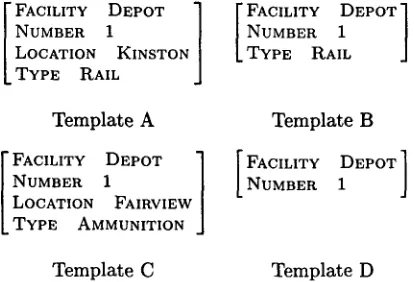
We focus on the four mentions of depots in the text, which are highlighted with italics. The pat- tern matching phases of FASTUS produce templates similar to those shown in Figure 2.
FACILITY D E P O T N U M B E R 1
LOCATION KINSTON T Y P E RAIL
FACILITY DEPOT - NUMBER 1 T Y P E RAIL
Template A Template B
FACILITY DEPOT NUMBER 1
LOCATION FAIRVIEW TYPE AMMUNITION
FACILITY 1DEPOT ] NUMBER
Template C Template D
Figure 2: Templates Representing Depots Men- tioned
We will refer to a set of templates that have po- tential coreference relationships among them as a
ture is more telegraphic.
coreference set, 2 and possible partitions of corefer- ential templates in the set as coreference configura- tions. In the coreference set containing templates A, B, C, and D, system knowledge external to the probabilistic model indicates that the type Ammuni- tion in template C is not compatible with the type Rail in A and B; therefore these are taken a pri- ori to be non-coreferential. Given these incompati- bilities, seven possible coreference configurations re- main. Template names grouped within parentheses are taken to be mutually coreferring; we will refer to such a grouping as a cell of the coreference configu- ration.
1. (A B D) (C) 5. (B D) (A) (C)
2. (A B) (C D)
6. (C D) (A) (S)
3. ( h B ) (C) (D) 7. (A) (S) (C) (D) 4. (A D) (B) (C)
The first of these configurations expresses the correct coreference relationships for the example.
Given a coreference set of templates, possibly cou- pled with a list of template pairs known a priori not to corefer, the task is to assign a probability distri- bution over the possible coreference configurations for that set.
R e l a t i o n s h i p t o P a s t W o r k While there have been previous investigations of empirical approaches to coreference, these have generally centered on the task of assigning correct referents for anaphor/c ex- pressions (Connolly, Burger, and Day, 1994; Aone and Bennett, 1995; Lappin and Leass, 1994; Dagan
[image:2.612.136.547.68.226.2] [image:2.612.95.302.479.620.2]and Itai, 1990; Dagan et al., 1995; K e n n e d y and Boguraev, 1996a; Kennedy and Boguraev, 1996b). The current task deviates from t h a t problem in sev- eral respects. First, in our task, all coreference re- lationships among templates are modeled regardless of the "referentiality" of the phrases t h a t led to their creation. For instance, indefinites will sometimes corefer with a previously described entity; a typ- ical case is illustrated by the coreference between the indefinite "a rail depot" and the depot intro- duced in the subject line in the example passage. Also, entities described with bare plurals are com- monly found to be coreferential with other entities, in addition to cases in which they have their more standard generic meanings. On the other hand, def- inite noun phrases are often not referential to items evoked in the text (e.g., "the ammunition depot in Fairview"). Determining when such expressions are discourse-anaphoric is part of the task; this informa- tion is generally not known to the system a priori.
Second, the results of this task will be evaluated by the probability assigned to the correct state of affairs with respect to an entire coreference set, and not by the number of correct antecedents assigned to anaphoric expressions. Modeling at the level of coreference sets ensures that the probabilities are consistent when considering the global state of af- fairs being described in the text. Furthermore, the role of probabilities for this application goes beyond selecting the correct coreference relationships - the probability assigned to an alternative will be cen- tral in determining how the downstream system will weigh it against information from other sources dur- ing d a t a fusion. A system that assigns a probability of 0.9 to correct answers is more successful t h a n one that assigns a probability of 0.6 to them.
The Limitations o f I E S y s t e m s T h e properties of typical IE systems such as FASTUS also make this task challenging. For one, successful modeling of coreference relationships is hampered by the crude- ness of the representations used. T h e templates t h a t are created are fairly shallow and m a y be incom- plete. A reliance on detailed information about the context can prove detrimental if such information is often missed by the system. Also, FASTUS also does not build up complex representations for the syntax and semantics of sentences, placing limits on the extent to which such information can be utilized in determining coreference. Lastly, there are the in- accuracies t h a t result from processing real text. T h e p a t t e r n matching phases of FASTUS m a y intermit- tently misanalyze phrases that serve as antecedents for subsequent referring expressions. Therefore, for
example, with respect to an identified coreference set, it may be correct to place a referential pronoun in its own cell (implying that it does not corefer with anything), simply because system error caused its antecedent not to be included in the set.
O u t l i n e o f the Approach The number of coref- erence configurations over which a distribution is to be assigned depends on the number of templates in the coreference set, and the set of a priori constraints against coreference between some of its members. As there are many scenarios t h a t will never be encoun- tered in a corpus of training d a t a of any reasonable size, it would be hopeless to a t t e m p t to estimate a conditional distribution for each possibility directly. To make matters worse, training d a t a comes at a cost, as keys have to be coded by hand. One of the goals of this effort is to allow the ability to train up probabilities in new domains quickly, which requires an approach t h a t is successful with a limited amount of training data.
However, it would be reasonable to expect t h a t we have enough d a t a to estimate distributions for coreference sets with only two members. This sug- gests a two-step approach. First, we develop a gen- eral model of coreference between any two templates, and apply it to pairwise combinations of templates in a given coreference set without regard to the other templates in the set. We then utilize a m e t h o d for combining the resulting probabilities to form a dis- tribution over all the possible coreference configura- tions. We describe our method for modeling prob- abilities between pairs of templates in the next sec- tion, and describe two methods for deriving a dis- tribution over the coreference configurations in Sec- tion 4. We report on an evaluation and comparison of the approaches in Section 5.
3
Training A Model for Pairs of
Templates
Our first task is to derive a model for determining the probability t h a t two templates corefer, condi- tioned on various characteristics of the context. For this we employ an approach to maximum entropy modeling described by Berger et al. (1996).
those expressions in the text. We refer to the col- lection of such characteristics for a given example as its context x, a n d the value denoting the o u t p u t of the process as y. We can define a set of binary
fea-
tures
t h a t relate a possible value of a characteristic of x with a possible o u t c o m e y, i.e., whether the two templates corefer (y = 1) or not (y = 0). For exam- ple, a featurefl(x, y)
pairing the characteristic of S and T having identical slot values with the o u t c o m e t h a t they corefer would be defined as follows. B i n a r y F e a t u r e f l ( x , Y ) :fl(x,y) = {
1 if S and T have identical slot values and S and T corefer 0 otherwise
From these features we can define
constraints
on the probabilistic model t h a t is learned, in which we assume t h a t the expected value of the feature with respect to the distribution of the training d a t a (Pd) holds with respect to the general model (Pro). C o n s t r a i n t s :pal(X, y)f(x, y) = ~ pd(x)pm (ylx)f(X, y)
X , y X , y
Given t h a t we have chosen a set of such constraints to impose on our model, we wish to identify t h a t model which has the m a x i m u m e n t r o p y - this is the model t h a t assumes the least information be- yond those constraints. Berger et al. (1996) show t h a t this model is a m e m b e r of an exponential family with one p a r a m e t e r for each constraint, specifically a model of the form
1 ~ I~ (x,~)
p(yl ) = E '
in which
z(x) =
e Z ,
Y
T h e p a r a m e t e r s A1, ..., An are Lagrange multipliers t h a t impose the constraints corresponding to the chosen features f l , ..-,fn- T h e t e r m
Z(x)
normal- izes the probabilities by s u m m i n g over all possible outcomes y. Berger et al. (1996) d e m o n s t r a t e t h a t the optimal values for t h e Ai's can be obtained by maximizing the likelihood of the training d a t a with respect to the model, which can be performed using theirimproved iterative scaling
algorithm.In practice, we will not want to incorporate con- straints for all of the features t h a t we might define,
b u t only those t h a t are m o s t relevant and informa- tive. Therefore, we use a procedure for selecting which of our pool of features should be m a d e
active.
At each iteration, the algorithm a p p r o x i m a t e s the gain in the model's predictiveness t h a t would result from imposing the constraints corresponding to each of the existing inactive features, and selects the one with the highest anticipated payoff. U p o n making this feature active, the Ai's for all active features are (re)trained so t h a t the constraints are all m e t simul- taneously. T h e feature selection process is iterated until the a p p r o x i m a t e gain for all the remaining in- active features is negligible.C h a r a c t e r i s t i c s o f C o n t e x t for T e m p l a t e C o r e f e r e n c e We now need a set of possible char- acteristics of context on which the algorithm could choose to conditionalize in deriving the probabilis- tic model. For our initial experiments, we uti- lized a set of easily c o m p u t a b l e , b u t fairly crude, characteristics. 3 These characteristics fall into three categories. In w h a t follows, we take S a n d T to be a r b i t r a r y t e m p l a t e s where the n a t u r a l language ex- pression from which T was created a p p e a r s later in the t e x t t h a n the expression from which S was cre- ated.
T h e first category relates to the contents of the t e m p l a t e s themselves. We model the relationship between S and T as one of the following: S and T have
identical slot values,
S isproperly subsumed by
T, S properly subsumes
T, or S and T areotherwise
consistent.
For instance, in our example in Section 2, t e m p l a t e A is properly s u b s u m e d by t e m p l a t e B, and A, B, a n d C are all properly s u b s u m e d by D, since in each case the latter t e m p l a t e is m o r e general t h a n the former. We also have a binary characteristic for S and T having at least two (non-nil) slot values in common. Finally, we have a characteristic for modeling when the values of the N A M E slot of a t e m p l a t e are b o t h multi-worded a n d identical; this is a crude heuristic for identifying m a t c h i n g unique identifiers.Template S Template T Probability
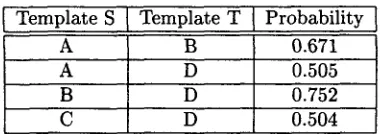
A B 0.671
A D 0.505
B D 0.752
C D 0.504
Table 1: Pairwise Probabilities for Example Coref- erence Set
scribed with an indefinite phrase, a definite phrase (including pronouns), or neither of these (e.g., a bare, non-pronominal noun phrase). In the case of definite expressions, we also consider the recommen- dations of a distinct coreference module within FAS- TUS. We have a characteristic representing whether the potential antecedent is the preferred antecedent, 4 a non-preferred, but possible antecedent, or not on the list of possible antecedents. 5
T h e final category of characteristics relates to the distance in the text between the expressions from which S and T were created, which we categorize as being in one of five equivalence classes: very close, close, mid-distance, far away, and very far away. These distances are measured crudely (i.e., by character length) so as not to be dependent on the accuracy of methods for identifying more com- plex boundaries (e.g., clause, sentence, and discourse segment boundaries).
T h e results of training the maximum entropy models are discussed in Section 5. To illustrate the approaches described in the next section, we will use the probabilities for the templates from the example passage in Section 2, shown in Table 1, which were produced from the parameters induced from one of the training sets.
4 I n f e r r i n g a M o d e l f o r C o r e f e r e n c e S e t s
We now have a method for obtaining a model t h a t assigns probabilities to the pairs of templates (hence- forth, "pairwise probabilities") in a coreference set t h a t can possibly corefer. If there are only two tem- plates in the coreference set, then we have the distri- 4preferred reference is a transitive relation, that is, template S is treated as a preferred referent of template T if there is a chain of preferred referents linking them, e.g., if there is a template R that is the preferred referent of T and template S is the preferred referent of R.
5Although we do not model information about the surface positions of the expressions from which S and T were created within their respective sentences, the coref- erence module does take such information into account in determining likely antecedents of definite expressions.
bution we seek. However, if there are more than two templates, we must utilize the pairwise probabili- ties to derive a distribution over the members of the set of coreference configurations. In the following sections, we describe two approaches to recovering such a distribution, followed by a description of two baseline metrics. An evaluation of these approaches is then given in Section 5.
4.1 A n Evidential Reasoning Approach
The first approach we describe uses the pairwise probabilities as sources of evidence t h a t inform the choice of model for the coreference sets. T h e list of coreference configurations for our example passage are repeated below; we will refer to these configura- tions by their corresponding numbers.
1. (A B D) (C) 5. (B D) (A) (C) 2. (A B) (C D) 6. (C D) (A) (B) 3. ( A B ) (C) (D) 7. (A) (S) (C) (D) 4. (A D) (B) (C)
We recast a probability that two templates S and T corefer as a mass distribution over two members of the power set of coreference configurations, namely the set containing exactly those configurations in which S and T occupy the same cell, and the set containing those in which they do not. For instance, the probability t h a t A and B corefer was determined to be 0.671; mapping this to corresponding sets of coreference configurations results in the mass distri- bution mAB in which
mAB({Configs 1, 2, 3}) = 0.671 and
mAB({Configs 4, 5, 6, 7}) = 0.329
This mass distribution can be seen as representing the beliefs of an observer who only has access to templates A and B, and who is therefore ignorant about their relationship to C and D. We can view the other pairwise probabilities for the coreference set in the same manner.
[image:5.612.80.270.75.142.2]and D corefer are mutually exclusive. Therefore, there would have to be a distribution t h a t assigns 0.505 of probability mass to a set of configurations that is mutually exclusive from a set t h a t is assigned 0.504 of probability mass. Obviously, this cannot be done with a set of probabilities t h a t add up to 1.
This inconsistency arises from the manner in which the pairwise probabilities are estimated. T h e probability of coreference between templates situ- ated similarly to A and D m a y be 0.505 with re- spect to all contexts in the training data, however it is almost certainly not this high with respect to the subset of cases in which a t e m p l a t e similar to C is similarly situated. T h e same reasoning applies to the probability of C and D coreferring in light of the existence of A. Unfortunately, the existence of tem- plates other t h a n the pair being modeled is the type of conditional information for which we have little hope of accounting in a general and statistically sig- nificant manner.
Therefore, we may be left with a series of mass distributions defined over sets of coreference configu- rations t h a t are in inherent conflict. Instead of view- ing these distributions as constraints on the under- lying probabilistic model, we view them as sources of evidence. T h e question is then how to take these sources into account, given t h a t they m a y be par- tially contradictory.
Dempster's Rule of Combina-
tion
(Dempster, 1968) provides a mechanism for do- ing this. Dempster's rule combines two mass distri- butions m 1 and m 2 to form a third distribution m 3t h a t represents the consensus of the original two dis- tributions; the new mass distribution in effect leans toward the areas of agreement between the origi- nal distributions and away from points of conflict. Dempster's rule is defined as follows:
1
E
ml(Ai)m2(Aj)
m3(Ak)
- - 1 - -AinAj--Ak
in which
~=
E ml(Ai)m2(Aj)
AiNAj----O
T h e Al in our case are members of the power set of possible coreference configurations. In our example above,
mAB
a s s i g n s probability mass to two such Am, the set containing configurations 1, 2, and 3, and the set containing configurations 4, 5, 6, and 7. T h e value a is called theconflict
between the mass distributions being combined; it provides a measure of the degree of disagreement between them. When = 0, the original distributions are compatible; when ,¢ = 1, they are in complete conflict and theresult is undefined. When 0 < ,~ < 1, some conflict between the distributions exists; Dempster's rule has the effect of focusing on the agreement between the distributions by eliminating the conflicting portions and normalizing what remains.
We can therefore use Dempster's Rule to resolve the conflict between the pairwise probability distri- butions to generate a distribution over the coref- erence configurations. Because we have pairwise probabilities for each possibly coreferring pair in the coreference set, it turns out t h a t the Dempster solu- tion is more easily stated and computed here t h a n in the general case. T h e solution is identical to the one t h a t results when the probabilities of all the rele- vant pairwise relations (indicating either coreference or not) are multiplied, normalized by the a m o u n t of probability mass assigned to coreference configura- tions t h a t are impossible because coreference is tran- sitive. For instance, the probability for the corefer- ence configuration ((A B) (C)) is initially c o m p u t e d to be 6
p(A =c B) * p(A ¢c C) * p(B Pc C)
However, using this method, impossible combina- tions (e.g., A =c B, B =c C, A ¢ c C) will also re- ceive positive probability mass. If we normalize the probabilities of possible combinations by distribut- ing the sum of the probability assigned to all im- possible combinations, the result is the same as t h a t gotten by iteratively combining the pairwise distri- butions using Dempster's Rule.
T h e resulting distribution for our example is: 1. (A B D) (C) = .383
2. (A B) (C D) = .184 3. (A B) (C) (D) = .123 4. (A D) (B) (C) - - . 0 6 2 5. (B D) (A) (C) = .125 6. (C D) (A) (B) = .061 7. (A) (B) (C) (D) = .061
In motivating our approach, we noted t h a t we can- not expect to have the amount of training d a t a nec- essary to directly estimate distributions for all the possible scenarios with which we may be confronted. Limiting ourselves to modeling probabilities between pairs of templates, however, leads to inconsistencies because of the failure to take into account the crucial information provided by the existence of other com- patible templates. Dempster's Rule can be seen as a very coarse-grained approach to conditioning on con- text in this regard. T h e contributions of the pairwise models are conditioned not on the existence of other
templates in context, but by virtue of the existence of conflicting models derived from those templates. For instance; the pairwise probability of coreference between C and D was originally 0.504, which might be reasonable if those were the only two templates generated from the text. 7 However, the probability t h a t C and D corefer in the final distribution is only 0.245, the sum of the probabilities of the two parti- tions in which C and D occupy the same cell. This adjustment results from the existence of templates A and B: the fact that template D has a high probabil- ity of coreferring with each, combined with the fact t h a t template C is incompatible with each, reduces the likelihood that C and D corefer. Therefore, the preferences for particular coreferential dependencies can change when considering the larger picture of possible coreference sets.
In practice, coreference sets t h a t are significantly larger than the one we have considered here can lead to an explosive number of possible coreference con- figurations. We have implemented simple methods for pruning very low probability configurations dur- ing processing and for smoothing the resulting distri- bution. The latter step is accomplished, when nec- essary, by eliminating certain low-probability config- urations at the end of processing. T h e probability mass from these configurations is distributed uni- formly over all the possible configurations t h a t have been eliminated. While this is unlikely to be the best strategy for smoothing from the standpoint of probabilistic modeling, we are constrained by the number of alternatives we can report to the down- stream system. Smoothing in this way allows us to report only the coreference configurations with non- negligible probability, along with a single probability t h a t is assigned uniformly to the remainder of the possible configurations.
4 . 2 A M o d e l B a s e d o n M e r g i n g D e c i s i o n s
T h e second approach we consider models the like- lihood of correctness of decisions t h a t a template merger such as the one used in FASTUS would make in processing a text. To illustrate, consider the case in our example in which the probability of the coref- erence configuration ((A B D) (C)) is determined. The merger would make the following decisions in deriving such a configuration, in which the notation "B&A" represents the template t h a t results from 7Actually this number is lower than it would have been, because template B was identified as the preferred antecedent for template D instead of template C. If C and D were the only two templates generated, then C would have been identified as the preferred antecedent, thus raising the probability.
templates A and B having previously been merged.
1. B =c A? ~ yes
2. C =c B&A? ~ no 3. D = c C ? ~ n o 4. D =c B&A? ~ yes
We therefore model the probability of this coref- erence configuration as the product of each of the corresponding pairwise probabilities. Since we can- not model coreference involving objects that have re- sulted from previous (hypothetical) merges - the ap- propriate feature values for distance and form of re- ferring expression would become unclear - we make the following approximation:
p ( X =o Yl~...&Y.) ~ p ( x =o y . )
in which Yn is the most recently created template in
Yt, ..., Yn.
Using the probabilities from Table 1, s the prob- ability assigned to ((A B D) (C)) would therefore be
p ( B =c A) * p ( C 7to B ) * p ( D ~tc C) * p ( D ~-c B ) =
0.671 * 1 * (1 - 0.504) * 0.752 = 0.250 Note t h a t unlike the evidential approach, the proba- bility of the pair D and A coreferring does not come into play, given that coreference between D and B and between B and A has been factored in.
This approach yields a probabilistic model as given, t h a t is, the probabilities sum to 1 without normalization. However, in certain circumstances the approximation above will generate probability mass for an impossible case, specifically when it is known a priori t h a t X is incompatible with one of the templates Y1,..., Y,~-i. For instance, if templates B and C in our example had been compatible (with A and C remaining incompatible), then the approxi- mation above would assign positive probability mass to the coreference configuration ((A B C) (D)), be- cause the zero probability of A coreferring with C would not come into play. Therefore we modify the above approximation to apply only if X and each of Y1, ..., Yn-1 are compatible; otherwise, the probabil- ity mass assigned is used for normalization. One can see t h a t this can only improve the pure form of the model.
Using the pairwise probabilities from Table 1, the results of the model as applied to the example are:
1. (A B D) (C) = .250 2. (A B) (C D) = .338 3. (A B) (C) ( D ) = .083 4. (h D) (S) (C) = .020 5. (B D) ( A ) ( C ) = .123 6. (C D) (A) (S) = .166 7. (A) (S) (C) (D) = .020 4.3 T w o Bases o f C o m p a r i s o n
We compared the two learned models with two base- line models. First, as an absolute baseline, we com- pared the model with the uniform distribution, that is, the distribution that assigns equal probability to each alternative. We then sought a more challeng- ing, yet straightforward baseline. We defined a sim- ple, "greedy" approach to merging similar to the one used in FASTUS, in which merging of newly- created templates is attempted iteratively through the prior discourse, starting with the most recently produced object. Any unifications that succeed are performed. For instance, in the above example, the greedy method produces the configuration ((A B) (C D)), because A is compatible with B, C is not compatible with either, and D is compatible with C (with which merging would be attempted before the earlier-evoked templates B and A). Alternatively, in cases in which all of the templates in a coreference set are pairwise compatible, the greedy method will produce the configuration in which they are all coref- erential.
We then calculated how often this approach yielded the correct results in each training set. We distinguished between three values: the percentage of correctness for coreference sets of cardinality 2 (call this P2), the percentage for coreference sets of cardinality 3 (call this P3), and the percentage for coreference sets of cardinality 4 or more (call this P>3). The greedy model was defined such that the result of the greedy merging strategy is assigned the appropriate probability Pk, with the remainder of the probability mass 1 - p } distributed uniformly among the remaining possible alternatives. (No al- ternatives were included that were a priori known to be impossible due to incompatibilities.)
For instance, in the first training set we describe below, p2--.571, p3=.652, and p>3=.344 (the per- centage for the whole training corpus was p=.555). If there are 4 templates, and 10 coreference con- figurations are possible, then the answer derived by the greedy strategy would receive probability .344, and the remaining 9 alternatives would re- ceive probability 1-.3449 = .0729. In the second training set we describe below, p2--.646, p3=.600, and p>3--.345 (the percentage for the whole train-
ing corpus was p=.549), and in the third training set, p2--.628, p3=.600, and p>3=.280 (the percentage for the whole training corpus was p=.523).
5 E x p e r i m e n t s
5.1 T r a i n i n g t h e M a x i m u m E n t r o p y M o d e l s
For reasons described below, we trained separate pairwise probability models for each of the two ap- proaches. We ran FASTUS over our development corpus, 72 texts of which produced coreference data. The texts gave rise to 132 coreference sets, and pro- duced characteristics of context for 647 potential coreference relationships between pairs of templates. We created a key by analyzing the texts and entering the correct coreference relationships.
We created three splits of training and test data. In the first split, the training set contained 60 mes- sages, giving rise to 110 coreference sets, and the test set contained 12 messages, giving rise to 22 corefer- ence sets. In the second split, the training set con- tained 57 messages, giving rise to 102 coreference sets, and the test set contained 15 messages, giving rise to 30 coreference sets. The third test set was created by combining the first and second test sets. The training set contained 47 messages, giving rise to 88 coreference sets, and the test set contained 25 messages (the first two test sets overlapped by two messages), which gave rise to 44 coreference sets.
For training the maximum entropy model, only the sets of characteristics of context for pairwise coreference are relevant; the number of such sets dif- fered between the two approaches as discussed be- low. The evaluations were performed on the test sets with respect to the final distribution generated for the coreference sets, with the result being measured in terms of the average cross-entropy between the model and the test data.
D a t a for t h e E v i d e n t i a l M o d e l The evidential model utilizes the pairwise probabilities between all pairs of templates in a coreference set. Therefore, we used all such pairs in each training set to train the maximum entropy model. In the first training set, the 110 coreference sets gave rise to characteristics of context for 578 pairs of templates; in the second, the 102 coreference sets gave rise to characteristics for 581 pairs of templates. In the third training set, the 88 coreference sets gave rise to characteristics for 525 pairs of templates.
systems of ,ki values learned, negative values were learned for the features in which template S prop-
erly subsumes template T and in which S and T are
otherwise consistent. These two features model the
cases in which template T contains information not contained in template S, reflecting the fact t h a t ex- pressions referring to the same entity usually do not become more specific as the discourse proceeds. A positive value was learned for the feature modeling cases in which templates S and T had at least two identical non-nil slot values, as well as for the feature modeling an exact match of complex name values. As one might expect, a negative value was learned for the case in which template T was created from an indefinite expression. A positive value was learned for the case in which template T was created from a definite expression and S was (perhaps transitively) the preferred referent according to the coreference module. Interestingly, no value was learned for tem- plate S being a possible but non-preferred referent, but a small positive value was learned for it not be- ing on the list at all - presumably this covers cases in which the coreference module fails to identify an existing referent. All the distance features except for
close and mid-distance received negative hi values,
suggesting t h a t coreference between close and mid-
distance templates was more likely than coreference
between templates that were very close, far away,
and very far away.
The cross-entropy of the learned model as applied to the training d a t a in each case was a b o u t 0.80. Given t h a t the cross-entropy of the uniform distri- bution and the d a t a is 1 (as there are only two pos- sible values for the random variable, i.e., S and T are coreferent or not), this relatively small reduc- tion suggests t h a t the problem has some amount of difficulty, which is consistent with the notable lack of clear signals of coreference characteristic of the texts in our domain.
D a t a f o r t h e M e r g i n g D e c i s i o n M o d e l Unlike the evidential model, the merging decision model does not always utilize all of the palrwise probabili- ties between pairs in a coreference set. For instance, in determining the probability of a coreference con- figuration ((A B C)), it does not consider the prob- ability assigned to the pair A and C except to check t h a t they are compatible. Therefore, the training set for the maximum entropy algorithm was pared down to only contain those pairs t h a t the merger would have considered in deriving the correct coref- erence configurations. T h e resulting d a t a had the same coreference sets as the training d a t a for the acteristic of context paired with the result of coreference.
evidential approach, but consisted of characteristics of context for 415 template pairs in the first train- ing set, 405 pairs in the second training set, and 370 pairs in the third training set. T h e features selected were similar to those in the training of the evidential model.
T h e cross-entropies of the learned maximum en- tropy models and the training d a t a were notably b e t t e r than those for the evidential model, at about 0.70 in each case. This improvement is not partic- ularly surprising. In the evidential case, the fact t h a t all pairs of templates are considered results in a certain amount of "washing out" of the data, due to redundancy in coreference relationships. For in- stance, coreference between two templates that are far away might be unlikely if there are no corefer- ring expressions between them, but quite likely if there are. When just considering the pairwise fea- ture sets, these two cases are not distinguished, so the resulting probability will be mixed. However, in the merging decision case, pairs t h a t are far away will not be in the d a t a set if there are coreferring expressions between them, and thus the probability for coreference at long distances will be diminished. T h e result is a "cleaner" set of d a t a in which clearer distinctions may be found, as evidenced by the lower cross-entropy achieved.
5.2 E v a l u a t i o n R e s u l t s
T h e cross-entropies of the various approaches as ap- plied to the three sets of test d a t a are shown in Ta- ble 2. The number within parentheses indicates the number of times t h a t the coreference set with the highest probability was the correct one. As hoped, both the evidential and merging decision approaches outperformed the uniform and greedy approaches with respect to cross-entropyJ °
Interestingly, and perhaps surprisingly, the evi- dential approach outperformed the merging decision model, even though in many respects the latter is more natural and elegant. While considering fea- ture sets for all pairs may wash out the training d a t a for the pairwise probability model somewhat, the evidence provided by all pairs appears to more than make up for the difference. Given t h a t a goal of these experiments is to see how well the strate- gies would perform with a fairly crude, easily com- putable, and portable set of characteristics of con- 1°The merging decision approach did not do any better than the greedy approach in terms of raw accuracy, and
[I Test Set 1 Test Set2 Test S e t s l a n d 2 Uniform I 2.12 (--) 1.76 (--) 2.01 (--)
Greedy 1.50 (15) I 1.30 (20) 1.41 (30) Merging Decision 1.32 (15) 1.13 (20) 1.27 (27) Evidential 1.10 (17) 0.89 (21) 1.00 (35)
Table 2: Initial Evaluation Cross-Entropies
text, we are encouraged by the results of these ex- periments, especially considering the limited amount of training data that was available.
Nonetheless, additional data is necessary to con- firm the results of these initial evaluations. Although the consistency of the results between the first two training/test divisions may suggest that the amount of training data is sufficient for the rather coarsely grained feature set used, the size of the test sets are potentially of concern, which motivated our in- clusion of the third training/test division. Despite the reduction in training data and corresponding in- crease in test data, the results of this experiment appear to consistent with the first two.
There are a variety of characteristics of context that one might add to improve the models. For instance, one could add a characteristic indicating when a template is created from a phrase in a sub- ject line or table, as many cases of coreference with subsequent indefinite phrases occur in this circum- stance. Other types of information about text type, text structure, and more finely grained distinctions with respect to referential types (e.g., modeling pro- nouns differently than other definite NPs) would all likely further improve the model, although for some of these additional training data would be required and more domain and genre dependence may result. While this work was motivated by a need to pass probabilistic output to a downstream data fusion system, these methods can be applied system inter- nally also, to supplant existing algorithms for merg- ing in IE settings that do not allow for probabilistic output. In this scenario, the system simply performs the template merging dictated by the most proba- ble coreference configuration for a given coreference set. However, as noted earlier, the texts in our appli- cation are relatively short, and therefore the coref- erence sets are usually of manageable size. Signif- icantly larger coreference sets can lead to an enor- mous number of possible coreference configurations. Therefore, to address this task in applications with much longer texts, mechanisms beyond those that were necessary here will be required for intelligently pruning the search space and subsequently smooth-
ing the distributions. 6 C o n c l u s i o n s
Certain applications require that the output of an in- formation extraction system be probabilistic, so that a downstream system can reliably
]use
the output with possibly contradictory information from other sources. In this paper we considered the problem of assigning a probability distribution to alterna- tive sets of coreference relationships among entity descriptions. We presented the encouraging results of initial experiments with several approaches to es- timating such distributions in an application using SRI's FASTUS information extraction system. We would expect further gains from encoding additional training data and modeling more informative char- acteristics of context.A c k n o w l e d g m e n t s
The author thanks John Bear, Joshua Goodman, and two anonymous reviewers for helpful comments and criticisms, and the SRI Message Handler project team for their contributions to the system in which this work is embedded. This work was supported by the Defense Advanced Research Projects Agency un- der contract number 4099SCL001 (E-Systems Inc., prime contractor).
R e f e r e n c e s
Aone, Chinatsu and Scott William Bennett. 1995. Evaluating automated and manual acquisition of anaphora resolution strategies. In
Proceedings of
the 33rd Annual Meeting of the Association for
Computational Linguistics (ACL-95),
pages 122- 129, Cambridge, MA, June.Berger, Adam, Stephen A. Della Pietra, and Vin- cent J. Della Pietra. 1996. A maximum entropy approach to natural language processing.
Compu-
tational Linguistics,
22(1):39-71. [image:10.612.171.468.74.140.2]anaphoric reference. In Proceedings of the Inter- national Conference on New Methods in Language Processing (NeMLaP).
Dagan, Ido and Alon Itai. 1990. Automatic acquisi- tion of constraints for the resolution of anaphora references and syntactic ambiguities. In Proceed- ings of the 13th International Conference on Com- putational Linguistics (COLING-90), pages 330- 332.
Dagan, Ido, John Justenson, Shalom Lappin, Her- bert Leass, and Amnon Ribak. 1995. Syntax and lexical statistics in anaphora resolution. Applied
Artificial Intelligence, 9(6):633-644, Nov/Dec.
Dempster, Arthur P. 1968. A generalization of Bayesian inference. Journal of the Royal Statis- tical Society, 30:205-247.
Hobbs, Jerry R., Douglas E. Appelt, John Bear, David Israel, Megumi Kameyama, Mark Stickel, and Mabry Tyson. 1996. FASTUS: A cascaded finite-state transducer for extracting information from natural-language text. In Finite State De- vices for Natural Language Processing. MIT Press, Cambridge, MA.
Kennedy, Christopher and Branimir Boguraev. 1996a. Anaphora for everyone: Pronominal anaphora resolution without a parser. In Pro- ceedings of the 16th International Conference on Computational Linguistics (COLING-96).
Kennedy, Christopher and Branimir Boguraev. 1996b. Anaphora in a wider context: Track- ing discourse referents. In Proceedings of the 12th European Conference on Artificial Intelli- gence (ECAI-96).