Proceedings of the 2019 Conference on Empirical Methods in Natural Language Processing
3280
An Entity-Driven Framework for Abstractive Summarization
Eva Sharma1* Luyang Huang2* Zhe Hu1* and Lu Wang1
1Khoury College of Computer Sciences, Northeastern University, Boston, MA 02115 2Department of Electrical and Computer Engineering, Boston University, Boston, MA 02215
1[email protected], [email protected], [email protected]
Abstract
Abstractive summarization systems aim to produce more coherent and concise summaries than their extractive counterparts. Popular neural models have achieved impressive re-sults for single-document summarization, yet their outputs are often incoherent and unfaith-ful to the input. In this paper, we intro-duce SENECA, a novel System for ENtity-drivEn Coherent Abstractive summarization framework that leverages entity information to generate informative and coherent abstracts. Our framework takes a two-step approach: (1) anentity-aware content selection module first identifies salient sentences from the in-put, then (2) anabstract generation module conducts cross-sentence information compres-sion and abstraction to generate the final sum-mary, which is trained with rewards to pro-mote coherence, conciseness, and clarity. The two components are further connected using reinforcement learning. Automatic evalua-tion shows that our model significantly out-performs previous state-of-the-art on ROUGE and our proposed coherence measures on New York Times and CNN/Daily Mail datasets. Human judges further rate our system sum-maries as more informative and coherent than those by popular summarization models.
1 Introduction
Automatic abstractive summarization carries strong promise for producing concise and co-herent summaries to facilitate quick information consumption (Luhn, 1958). Recent progress in neural abstractive summarization has shown end-to-end trained models (Nallapati et al.,2016;Tan et al.,2017a;Celikyilmaz et al.,2018;Kry´sci´nski et al., 2018) excelling at producing fluent sum-maries. Though encouraging, their outputs are
* These authors contributed equally. Work done while
LH was at Northeastern University.
Input Article:
. . .Prime Minister Bertie Ahernof Ireland called Sunday for a general election on May 24.
[Mr. Ahern] and his centrist party have governed in a coali-tion government since 1197. . .
Under Irish law, which requires legislative elections every five years,Mr. Ahernhad to call elections by midsummer. On Sunday,{he}saidhewould basehiscampaign for re-election onhis work to strengthen the economy and ef-forts to revive Northern Ireland’sstalled peace process this year.
Political analysts said they expectedMr. Ahern ’swork in
Northern Irelandto be an asset. . .
Human Summary:
1 Prime Min Bertie Ahernof Ireland calls for general election on May 24.
2 [He] is required by law to call elections by midsummer. 3 Opinion polls suggesthiscentrist government is in dan-ger of losing its majority in Parliament because of public disgruntlement about overburdened public services.
4 {Ahern} says he would base his campaign for re-election onhiswork to strengthen economy andhisefforts to reviveNorthern Ireland’sstalled peace process.
5 Analysts expecthiswork inNorthern Irelandto be as-set.
Figure 1: Sample summary of an article from the New York Times corpus (Sandhaus,2008). Mentions of the same entity are colored. Underlined sentence in the ar-ticle occurs relatively at an earlier position in the sum-mary (2) to improve topical coherence. Mentions in brackets (“[]”,“{}”) show different ways in which the same entity is referred to in the article and the sum-mary. Detailed explanation is given in§1.
frequently found to be unfaithful to the input and lack inter-sentence coherence (Cao et al., 2018;
See et al., 2017; Wiseman et al., 2017). These observations suggest that existing methods have difficulty in identifying salient entities and related events in the article (Fan et al., 2018), and that existing model training objectives fail to guide the generation of coherent summaries.
In this paper, we present SENECA, a System for ENtity-drivEn Coherent Abstractive summa-rization.1 We argue that entity-based modeling
Prime Minister Bertie AhernofIrelandcalled for a general election on May 24 …..Mr. Ah-ernand his centrist party, have governed in a coalition government since 1997. Under Irish law, which requires legislative elections every five years, Mr. Ahernhad to call elections by midsummer. On Sunday,hesaidhewould base his campaign for re-election onhiswork to strengthen efforts to reviveNorthern Ireland’s stalled peace process this year. Political analysts said they expectedMr. Ahernfiswork in North-ern Irelandto be an asset …
Input Article
prime min bertie ahernofirelandcalls for general election on may 0.ahernand his centrist party, have governed in coalition government since 0. …Ahern
sayshewould basehiscampaign for re-election on
hiswork to strengthen economy andhisefforts to reviveNorthern Ireland’sstalled peace process.
Output Summary
{Prime Minister Bertie Ahern, Mr. Ahern, he, he, his, Mr. Ahern’s}
{Ireland, Northern Ireland, Northern Ireland’s}
Entity Mention Clusters
Entity-aware Content Selector
Political analysts … On Sunday,hesaid …
Mr. Ahernand his …
Extracted Sentences
[image:2.595.71.289.61.256.2]Abstract Generator
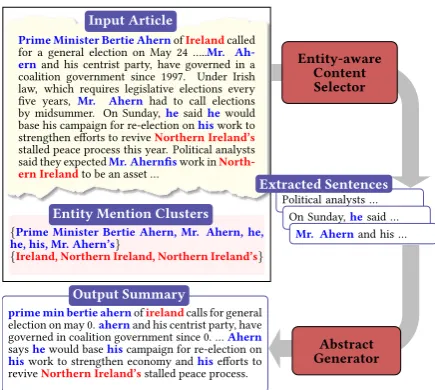
Figure 2: Our proposed entity-driven abstractive sum-marization framework. Entity-aware content selector extracts salient sentences and abstract generator pro-duces informative and coherent summaries. Both com-ponents are connected using reinforcement learning.
enables enhancedinput text interpretation,salient content selection, andcoherent summary genera-tion, three major challenges that need to be ad-dressed by single-document summarization sys-tems (Jones et al., 1999). We use a sample sum-mary in Fig.1to show entity usage in summariza-tion. Firstly, frequently mentioned entities from the input, along with their contextual informa-tion, underscores the salient content of the arti-cle (Nenkova,2008). Secondly, as also discussed in prior work (Barzilay and Lapata, 2008; Sid-dharthan et al.,2011), patterns of entity distribu-tions and how they are referred to contribute to the coherence and conciseness of the text. For in-stance, a human writer places the underlined sen-tence in the input article next to the first sensen-tence in the summary to improve topical coherence as they are about the same topic (“elections”). More-over, the human often optimizes on conciseness by referring to entities with pronouns (e.g., “he”) or last names (e.g., “Ahern”) without losing clarity.
We therefore propose a two-step neural abstrac-tive summarization framework to emulate the way humans construct summaries with the goal of im-proving both informativeness and coherence of the generated abstracts. As shown in Fig.2, an entity-aware content selection component first selects important sentences from the input that includes references to salient entities. An abstract gen-eration component then produces coherent sum-maries by conducting cross-sentence information ordering, compression, and revision. Our abstract
Prime Minister Bertie…
Mr. Ahernand his centrist … On Sunday,hesaidhe… Political analysts said they …
Input Article
Prime Minister Bertie AhernhMENTi
Mr. AhernhMENTihehMENTi… Ireland hMENTi Northern Ire-landhMENTi…
Entity Mention Clusters
CON
V
CON
V
CON
V
Bi-LSTM h1
h2
h3
h4
CON
V
CON
V
CON
V
e1
e2
Political analysts … On Sunday,hesaid …
Mr. Ahernand his … Extracted sentences
h2
h3
h4
LSTM
1
2 3
Figure 3: Our proposed entity-aware content selector. Arrows denote attention, with darker color representing higher weights.
generator is trained using reinforcement learning with rewards that promote informativeness and op-tionally boost coherence, conciseness, and clar-ity of the summary. To the best of our knowl-edge, we are the first to study coherent abstractive summarization with the inclusion of linguistically-informed rewards.
We conduct both automatic and human eval-uation on popular news summarization datasets. Experimental results show that our model yields significantly better ROUGE scores than previous state-of-the-art (Gehrmann et al., 2018; Celiky-ilmaz et al., 2018) as well as higher coherence scores on the New York Times and CNN/Daily Mail datasets. Human subjects also rate our sys-tem generated summaries as more informative and coherent than those of other popular summariza-tion models.
2 Summarization Framework
In this section, we describe our entity-driven ab-stractive summarization framework which follows a two-step approach as shown in Fig. 2. It com-prises of (1) an entity-aware content selection component, that leverages entity guidance to select salient sentences (§2.1), and (2) anabstract gener-ation component(§2.2), that is trained with rein-forcement learning to generate coherent and con-cise summaries (§2.3). Finally, we describe how the two components are connected to further im-prove the generated summaries (§2.4).
2.1 Entity-Aware Content Selection
[image:2.595.309.526.64.209.2]and their contexts with human summaries. Con-cretely, we employ two encoders: one learns entity representations by encoding their mention clus-ters and the other learns sentence representations. A pointer-network-based decoder (Vinyals et al.,
2015b) selects a sequence of important sentences by jointly attending to the entities and the input, as depicted in Fig.3.
Entity Encoder.We run off-the-shelf coreference resolution system from Stanford CoreNLP ( Man-ning et al., 2014) on the input articles to extract entities, each represented as a cluster of mentions. Specifically, from each input article, we extract the coreferenced entities, and construct the men-tion clusters for all the menmen-tions of each entity in that article. We also consider non coreferenced entity mentions as singleton entity mention clus-ters. Among all these mention clusters, for our experiments, we only consider salient entity men-tion clusters. We label clusters as “salient” based on two rules: (1) mention clusters with entities ap-pearing in the first three sentences of the article, and (2) topkclusters containing most numbers of mentions. We experimented with different values of k and found thatk= 6gives us the best set of salient mention clusters having an optimal overlap with entity mentions in the ground truth summary. For each mention cluster, we concatenate men-tions of the same entity as they occur in the input into one sequence, segmented with special tokens (<MENT>). Finally, we get entity representations
ei for thei-th entity by encoding each cluster via
a temporal convolutional model (Kim,2014).
Input Article Encoder. For article encoding, we first learn sentence representations rj by
encod-ing words in thej-th sentence with another tempo-ral convolutional model. Then, we utilize a bidi-rectional LSTM (biLSTM) to aggregate sentences into a sequence of hidden stateshj. Both the
en-coders use a shared word embedding matrix to al-low better alignment.
Sentence Selection Decoder. We employ a single-layer unidirectional LSTM with hidden states st to recurrently extract salient sentences.
At each time stept, we first compute an entity con-text vectorce
t based on attention mechanism ( Bah-danau et al.,2014):
cet =
X
i
aeitei (1)
aet =softmax(v e
tanh(We1st+We2ei)) (2)
whereaet are attention weights, v∗ andW∗∗ de-note trainable parameters throughout the paper. Bias terms are omitted for simplicity. We further use aglimpse operation(Vinyals et al.,2015a) to compute a sentence context vectorctas follows:
ct=
X
j ahjtW
h2
hj (3)
aht =softmax(v h
tanh(Wh1st+Wh2hj)) (4)
whereaht are attention weights. Finally, sentence extraction probabilities that consider both entity and input context are calculated as:
p(ytl|yl1:t−1) =softmax(vqtanh(Wp1st+Wp2ct
+Wp3cet)) (5)
where the sentenceyl
twith the highest
probabil-ity is selected. The process stops when the model picks the end-of-selection token.
Selection Label Construction. We train our content selection component with a cross-entropy loss: −P
(yl,x)∈Dlogp(yl|x;θ), here ylare the ground truth sentence selection labels andxis the input article.θdenotes all model parameters.
To acquire training labels for sentence selec-tion, we collect positive sentences in the follow-ing way. First, we employ greedy search to select the best combination of sentences that maximizes ROUGE-2 F1 (Lin and Hovy, 2003) with refer-ence to human summary, as described by Zhou et al.(2018). We further include sentences whose ROUGE-L recall is above0.5 when each is com-pared with its best aligned summary sentence. In cases where no sentence is selected, we label the first two sentences from the article as positive. Our combined construction strategy selects an average of2.96and3.18sentences from New York Times and CNN/Daily Mail articles respectively.
2.2 Abstract Generation with Reinforcement Learning
Our abstract generation component takes the se-lected sentences as input and produces the fi-nal summary. This abstract generator is a sequence-to-sequence network with attention over input (Bahdanau et al.,2014). The copying mech-anism from See et al. (2017) is adopted to allow out-of-vocabulary words to appear in the output.
(RL). For ML training, we use teacher forcing al-gorithm (Williams and Zipser,1995), to minimize the following loss:
Lml=−
X
(y,xext)∈D
logp(y|xext;θ) (6)
whereDis the training set,xextare extracted sen-tences from our label construction.
Self-Critical Learning. Following Paulus et al.
(2017), we use the self-critical training algorithm based on policy gradients to use discrete metrics as RL rewards. At each training step, we gener-ate two summaries: a sampledsummary ys, ob-tained by sampling words from the probability distribution p(ys|xext;θ) at each decoding step, and aself-critical baselinesummaryy, yielded byˆ
greedily selecting words that maximize the output probability at each time step (Rennie et al.,2017). We then calculate rewards based on the average of ROUGE-L F1 and ROUGE-2 F1 of the two sum-maries against that of the ground-truth summary, and define the following loss function:
Lrl=−
1
N0
X
(ys,xext)∈D0
(R(ys)−R(ˆy)) logp(ys|xext;θ)
(7)
where D0 represents set of sampled summaries paired with extracted input sentences andN0 rep-resents the total number of sampled summaries.
R(y) =RRouge(y) = 12 RRouge−L(y) +RRouge−2(y),
is the overall ROUGE reward for a summaryy.
2.3 Rewards with Coherence and Linguistic Quality
So far, we have described the two basic compo-nents of our SENECA framework. As noted in prior work (Liu et al., 2016), optimizing for an ngram-based metric like ROUGE does not guar-antee improvement over readability of the gener-ations. We thus augment our framework with ad-ditional rewards based oncoherenceandlinguistic qualityas described below.
Entity-Based Coherence Reward (RCoh). We
use a separately trainedcoherence modelto score summaries and guide our abstract generator to pro-duce more coherent outputs by adding a reward RCohin the aforementioned RL training process.
The new reward takes the following form:
R(y) =RRouge(y) +γCohRCoh(y) (8)
Here we show how to calculateRCoh, to
cap-ture both entity distribution patterns and topical
continuity. Since summaries are short, (e.g. 2.0
sentences on average per summary in the New York Times data), we decide to build our coher-ence model on top of local cohercoher-ence estimation for pairwise sentences. We adopt the architecture of neural coherence model developed byWu and Hu (2018), but train it with samples that enable coherence modeling based on entity presence and their context. Here we briefly describe the model, and refer the readers to the original paper for de-tails.
Given a pair of sentences SA and SB,
con-volution layers first transform them into hidden representations, from which a multi-layer per-ceptron is utilized to yield a coherence score Coh(SA, SB) ∈ [−1,1]. We train the model
with hinge-loss by leveraging both coherent pos-itive samples and incoherent negative samples:
L(SA, S+B, S
−
B) = max{0,1 +Coh(SA, S
+
B)
−Coh(SA, SB−)} (9)
where SA is a target sentence, SA andSB+ is a
positive pair, andSAandSB−is a negative pair.
Note thatWu and Hu(2018) only consider po-sition information for training data construction, i.e.,SAandSB+must be adjacent, andSAandSB−
are at most 9sentences away with SB− randomly picked. We instead introduce two notable features to construct our training data. In addition to being adjacent, we further constrainSAandSB+to have
at least one coreferred entity and that S−B does not. Since our initial experiments show that coher-ence model trained in this manner cannot discern pure repetition of sentences, e.g., simply duplicat-ing words leads to higher coherence, we reuse the target sentences themselves as the negative pairs.
Finally, since this model outputs pairwise co-herence scores, for a summary containing more than two sentences, we use the average of all ad-jacent sentence pairs’ scores as the final summary coherence score. Summaries containing only one sentence get 0 coherence score. We also con-duct correlation study to show average aggregation works reasonably well (details in Supplementary).
Linguistic Quality Rewards(RRef&RApp). We
Pronominal Referential Clarity. Referential pro-nouns occurring without the antecedents in a sum-mary decreases its readability. For instance, a text with a pronoun “they” occurring before the required referred entity is introduced, would be less comprehensible. Therefore, at the RL step, we either penalize a summary with a reward of −1for such improper usage, or give0otherwise. In our implementation, we define improper us-age as the presence of a third personal pronoun or a possessive pronoun before any noun phrase occurs. The new reward is written as R(y) =
RRouge(y) +γRefRRef(y).
Apposition. Next, we consider a reward to teach the model to use apposition and relative clause minimally, which improves summary conciseness. For this, we focus on the non-restrictive apposi-tives and relative clauses, which often carry non-critical information (Conroy et al., 2006; Wang et al., 2013) and can be automatically detected based on comma usage patterns. Specifically, a sentence contains a non-restrictive appositive if i) it contains two commas, and ii) the word after first comma is a possessive pronoun or a deter-minant (Geva et al., 2019). We penalize a sum-mary with −1 for using non-restrictive apposi-tives and relative clauses, henceforth referred to as apposition, or give 0otherwise. Similarly, we have the total reward as R(y) = RRouge(y) + γAppRApp(y).
2.4 Connecting Selection and Abstraction
Our entity-aware content selection component ex-tracts salient sentences whereas our abstract gen-eration component compresses and paraphrases them. Until this point, they are trained separately without any form of parameter sharing. We add an additional step to connect these two networksby training them together via the self-critical learn-ing algorithm based on policy gradient (the same methodology as in§2.2).
Following the Markov Decision Process formu-lation, at each time step t, our content selector generates a set of extracted sentences (xˆext) from an input article. Our abstract generator usesxˆext
to generate a summary. This summary, evaluated against the respective human summary, receives ROUGE-1 as reward (See Eq. (7)). Note that the abstract generator, that has been previously trained with average of ROUGE-L and ROUGE-2 as re-ward to promote fluency, is not updated during
this step. In this extra stage, if our content se-lector accurately selects salient sentences, the ab-stract generator is more likely to produce a high-quality summary, and such action will be encour-aged. Whereas, action resulting in inferior selec-tions will be discouraged.
3 Experimental Setups
Datasets and Preprocessing. We evaluated our models on two popular summarization datasets: New York Times (NYT) (Sandhaus, 2008) and CNN/Daily Mail (CNN/DM) (Hermann et al.,
2015). For NYT, we followed the preprocess-ing steps byPaulus et al.(2017) to obtain similar training (588,909), validation (32,716) and test (32,703) samples. Here, we additionally replaced author names with a special token. For CNN/DM, we followed the preprocessing steps inSee et al.
(2017), obtaining 287,188training, 13,367 vali-dation and11,490testing samples.
For training our coherence model for CNN/DM, we used 890,419 triples constructed from sum-maries and input articles sampled from the CNN/DM training set. Similarly for NYT, we sampled 884,494 triples from NYT training set. For the validation and test set for the two mod-els, we sampled roughly10%from the validation and test set of the respective datasets. Our coher-ence model for CNN/DM achieves 86% accuracy and for NYT, 84%. Additional evaluation for this model is reported in§4.1.
Training Details and Parameters.We used a vo-cabulary of50Kmost common words in the train-ing set (See et al., 2017), with 128-dimensional word embeddings randomly initialized and up-dated during training. In the content selection component, for both entity and sentence encoders, we implemented one-layer convolutional network with100dimensions and used a shared embedding matrix between the two. We employed LSTM models with256-dimensional hidden states for the input article encoder (per direction) and the con-tent selection decoder (Chen and Bansal, 2018). We used a similar setup for the abstract generator encoder and decoder. During ML training of both components, Adam (Kingma and Ba,2015) is ap-plied with a learning rate0.001and a gradient clip-ping2.0, and the batch size32. During RL stage, we reduced learning rate to0.0001(Paulus et al.,
we sampled 5 sequences for each data point and took an average over these samples using batch size 10. We set γCoh = 0.01, γRef = 0.005, γApp = 0.005for NYT and CNN/DM with grid
search on validation set.
During inference, we adopted the trigram repe-tition avoidance strategy (Paulus et al.,2017;Chen and Bansal,2018), with additional length normal-ization to encourage the generation of longer se-quences as in (Gehrmann et al.,2018).
Baselines and Comparisons. Besides baseline LEAD-3, we compare with popular and exist-ing state-of-the-art abstractive summarization models on NYT and CNN/DM datasets: (1) pointer-generator model with coverage (See et al., 2017) (POINTGEN+COV); (2) sen-tence rewriting model (Chen and Bansal,
2018) (SENTREWRITE); (3) RL-based ab-stractive summarization (Paulus et al., 2017) (DEEPREINFORCE); (4) bottom-up
abstrac-tion (Gehrmann et al., 2018) (BOTTOMUP); and (5) deep communicating agents-based summarization (Celikyilmaz et al.,2018) (DCA).
We show comparison models’ results reported as in the original publications. For significant tests, we run code released by the authors of POINTGEN+COV and SENTREWRITE, and by
our implementation of DEEPREINFORCEon both datasets for training and testing. Since we do not have access to model outputs from Paulus et al. (2017), we re-implement their model, and achieve comparable ROUGE scores (e.g. on NYT, our ROUGE-1,2,L are 46.61, 29.76, and 43.46). For BOTTOMUP, we obtain model outputs from the authors for both CNN/DM and NYT datasets, whereas for DCA, we acquire summaries only for CNN/DM dataset.
In addition to SENECA base model, which combines entity-aware content selection and RL-based abstract generation (with average of ROUGE-L F1 and ROUGE-2 F1 as reward), we also report results on its variants with additional rewards during abstract generator training. We further consider SENECA (i) without entities, and (ii) end-to-end trained but with sentence se-lection only, i.e., the abstract generator simply re-peats the input.
4 Results
In§4.1, we first evaluate our entity-based coher-ence model, which produces the cohercoher-ence reward
Pairwise Shuffle
0
20
40
60
80
100
Accuracy (%)
Random EChain CosSim
[image:6.595.347.481.70.162.2]Wu & Hu Ours
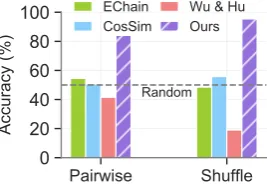
Figure 4: Accuracy of our coherence model compared to different baselines andWu and Hu(2018) on PAIR
-WISEand SHUFFLEtest sets.
(RCoh). We then present automatic evaluation for
summarization models on content, coherence, and linguistic quality (§4.2). We further discuss human evaluation results in§4.3.
4.1 Coherence Model Evaluation
We evaluate our entity-based coherence model on two tasks constructed from NYT test set: PAIR
-WISE and SHUFFLE. PAIRWISE is constructed
as described in §2.2 with equal number of posi-tive pairs and negaposi-tive pairs. SHUFFLEcomprises of full summaries, where half are original sum-maries, and the other half contain their shuffled version.
In Fig.4, we show a comparison of our model against a version trained based on the same amount of samples constructed as done by Wu and Hu (2018). Also shown are two baselines: ECHAIN, that labels a pair of sentences as more coherent if they have one or more entity men-tions coreferred, and COSSIM, that labels a pair
of sentences with higher cosine similarity as more coherent. Our model yields significantly higher accuracy (greater than 80%) on both tasks than the comparisons, which is due to the difference in training data construction. Wu and Hu (2018) only consider position information, whereas we capture entity-based coherence. The improvement in performance of the coherence model indicates the effectiveness of our training data construction in capturing multiple aspects of coherence.
4.2 Automatic Summary Evaluation
System R-1 R-2 R-L COH.
HUMAN - - - 0.79
LEAD-3 32.59 16.49 29.17 -POINTGEN+COV† 41.06 25.71 37.28 0.63 SENTREWRITE† 42.19 25.42 38.74 0.32 DEEPREINFORCE∗ † 47.03 30.72 43.10 0.59 BOTTOMUP∗ 47.38 31.23 41.81 0.56
DCA∗ 48.08 31.19 42.33
-Our Models
SENECA 47.94 31.77 44.34 0.73 Input w/o Entity 47.04 30.94 43.64 0.06 Sentence Selection Only 39.97 22.49 35.68 0.30 +RCoh 47.57 31.28 44.03 0.75
+RRef 47.57 31.22 43.92 0.70
+RApp 48.05 31.71 44.60 0.69
[image:7.595.308.522.64.251.2]+RCoh+RRef+RApp 47.52 31.25 44.01 0.76
Table 1: Results on NYT. Best results per metric are in bold. Best of our models are in italics. SENECA yields significantly higher R-1,2 and L than all compar-isons except for BOTTOMUPand DCA2(approximate
randomization test (p < 0.0005) (Edgington,1969)). For COH., our best model is also significantly better (Welch’st-test,p <0.05).∗: scores taken from origi-nal paper.†: significant test done on outputs by running code released by their authors or our implementation.
Amongst our models, the base SENECA model reports higher ROUGE and coherence score (0.73) compared to the version without entity as input. This demonstrates the importance of entity guidance during content selection as well as abstract generation. SENECA model trained with Apposition reward (RApp) reports the
highest ROUGE-L (44.60), but shows a drop in the coherence score to0.69. Whereas, SENECA with all rewards RCoh+RRef+RApp reports the
highest coherence score of 0.76 and a drop in ROUGE-L (44.01).
Results on CNN/DM. Since CNN/DM summaries are more extractive than that of NYT (Grusky et al.,2018), all SENECA models produce higher ROUGE-1 scores with SENECA base model achieving the highest, outperforming the previous best performing models on ROUGE-1. We also report the highest coherence score (0.63), which is even higher than that reported on human summaries (0.55). Since CNN/DM gold summaries are comprised of concatenated human written highlights for input articles, they are about the same topic and are cohesive, but lack entity-based coherent structure, for instance fewer
2Significant test was not performed with B
OTTOMUPas they use different test split thanPaulus et al.(2017), and with DCA, since their outputs are unavailable on NYT.
System R-1 R-2 R-L COH.
HUMAN - - - 0.55
LEAD-3 40.23 17.52 36.34 -POINTGEN+COV∗ † 39.53 17.28 36.38 0.19 SENTREWRITE∗ † 40.88 17.80 38.54 0.41 DEEPREINFORCE∗ † 41.16 15.75 39.08 -0.21 BOTTOM-UP∗ † 41.22 18.68 38.34 0.47 DCA† 40.72 19.02 37.85 0.30
Our Models
SENECA 41.52 18.36 38.09 -0.12 Input w/o Entity 38.18 16.98 34.20 -0.15 Sentence Selection Only 41.43 18.84 37.73 -0.06 +RCoh 41.04 16.98 38.08 0.52
+RRef 41.35 16.98 38.25 -0.30
+RApp 41.38 17.22 38.43 0.00
+RCoh+RRef+RApp 40.71 16.68 38.07 0.63
Table 2: Results on CNN/Daily Mail. Our best re-sults are achieved by the variant with sentence selection only, yielding significantly better R-1 and R-2 than all comparisons except BOTTOM-UPand DCA (Welch’s
t-test, p < 0.05). For COH., our best model is also significantly better (Welch’st-test,p <0.05). We re-evaluate DCA output against full length human sum-maries. ∗: scores taken from original paper. †: signif-icant test done on outputs by running code released by their authors or our implementation.
entities get coreferred in subsequent sentences. Therefore, our coherence evaluation, which tests for entity-based coherence, gives lower coherence score to CNN/DM gold summaries.
Additionally for CNN/DM, the generated sum-maries sometimes contain less relevant words, e.g. stopwords, at the end of the summaries. This ef-fect however improves the ROUGE scores while adversely affecting the coherence scores of the summaries. Training with additional coherence re-ward alleviates the issue by appending additional sentences, thereby improving overall coherence.
Amongst our models, we observe the overall trend to be similar to that in NYT results. Our base SENECA model reports higher ROUGE and co-herence score compared to SENECA without en-tity input, again, indicating the usefulness of enen-tity information. SENECA model with all rewards also yields the highest coherence score of 0.63, whereas SENECA model with coherence reward performs considerably better on ROUGE-L with a drop in coherence score.
[image:7.595.74.288.65.250.2]pro-System NYT CNN/DM
Ref. RelCl. App. Ref. RelCl. App.
HUMAN 0.11 6.67 4.83 0.13 2.80 1.12 POINTGEN+COV 0.15 1.92 1.26 0.18 0.63 0.75 SENTREWRITE 0.13 0.75 0.68 0.11 0.28 0.19 DEEPREINFORCE 0.18 0.40 0.50 0.19 0.45 0.10 BOTTOMUP 0.12 0.62 0.54 0.10 0.23 0.09
DCA - - - 0.12 0.26 0.13
SENECA 0.13 1.15 0.68 0.10 0.22 0.06 w/o entity 0.21 1.24 0.70 0.11 0.33 0.10 +RCoh 0.12 1.15 0.71 0.06 0.07 0.05
+RRef 0.10 1.20 0.72 0.07 0.11 0.04
+RApp 0.13 0.65 0.42 0.09 0.01 0.01
[image:8.595.76.292.63.215.2]+RCoh+RRef+RApp0.12 0.94 0.59 0.07 0.04 0.01
Table 3:%of system summaries improperly using ref-erential pronouns (Ref.), or containing relative clauses (RelCl.) or appositives (App.) (lowest values in bold). Lower values indicate better performance.
nouns or possessive pronouns being used before any noun phrase. Similarly, to measure concise-ness, we report how often summaries contain at least one non-restrictive relative clause (RelCl.) or non-restrictive appositives (App.). For model summaries, we report these measures in reference to the respective gold summaries. Lower values are better.
As can be seen from Table 3, our models re-port the least percentage of improper usage of ref-erential pronouns. Particularly on NYT, the model trained withRRef reward makes much fewer
mis-takes in this category. Similarly, addingRApp
re-ports the least amount of usage of relative clause or apposition, making summaries easier to read.
4.3 Human Evaluation
Human evaluation is conducted to analyze the in-formativeness and readability of the summaries generated by our models. We randomly se-lect 30 articles from the NYT test set and ask three proficient English speakers to rate sum-maries generated by POINTGEN+COV, DEEPRE
-INFORCE(Paulus et al.,2017), our SENECA, and
SENECA + RCoh,3 along with HUMAN written
summaries. Each rater reads the article and scores the summaries against each other on a Likert scale of1(worst) to5(best) on the following three as-pects: informativeness—whether summary cov-ers salient points from the input,grammaticality, andcoherence—whether summary presents con-tent and entity mentions in coherent order.
De-3To clearly discern the improvement in coherence in
the summaries after adding coherence reward without intro-ducing effects of additional rewards, we did not consider SENECA model with all rewards for human evaluation.
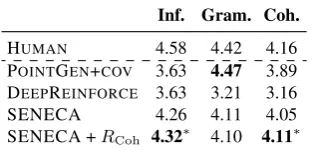
Inf. Gram. Coh.
HUMAN 4.58 4.42 4.16 POINTGEN+COV 3.63 4.47 3.89 DEEPREINFORCE 3.63 3.21 3.16 SENECA 4.26 4.11 4.05 SENECA +RCoh 4.32∗ 4.10 4.11∗
Table 4: Human evaluation on informativeness (Inf.), grammaticality (Gram.) and coherence (Coh.). Best results among systems are in bold, with significance reported over other comparisons with∗ (approximate randomization test (Edgington,1969), p < 0.0005). The Krippendorf’s α for the three aspects are 0.46,
0.64, and0.48.
tailed guidelines with sample ratings and explana-tion are shown in the Supplementary.
Table 4 shows that our model SENECA + RCoh ranks significantly higher on
informative-ness as well as coherence, reaffirming our obser-vations from automatic evaluation. Surprisingly, SENECA + RCoh ranks higher on
informative-ness even when compared to SENECA, which re-ports higher on ROUGE (see Table1). Through manual inspection, we find that SENECA model often generates summaries whose second or third sentence misses the subject, whereas SENECA + RCohtends to avoid this problem. Though not
sig-nificant, POINTGEN+COVranks higher on gram-maticality than SENECA +RCoh. We believe this
is due to the fact that SENECA +RCohlearns to
merge sentences from the input article while mak-ing some grammatical errors. We further show sample summaries in Figure5.
5 Related Work
Neural Abstractive Summarization. Two-step abstractive summarization approaches have be-come popular in recent years, where the two steps, content selection and abstraction, are con-veniently separated from each other. In these ap-proaches, salient content is first identified, usu-ally at sentence-level (Hsu et al., 2018; Li et al.,
[image:8.595.338.495.64.140.2]Human:
New Jersey Legislature recommends 0 ways to overhaul system that has produced highest property taxes in nation; plan includes 0 percent reduction in property taxes to most homeowners through direct tax credits;will place annual limit on property tax increases; will revise financing of education and end special financing of state’s poor dis-tricts
PointGen+cov:
new jersey legislature, after more than three decades of complaints about soaring property taxes and three months of hearings about ways to reduce them, designed to overhaul system that has produced highest property taxes in nation. recommendations included 0 percent reduction in property taxes to most of state’s homeowners in form of direct tax credits
DeepReinforce:
new jersey legislature, after more than three decades of complaints about soaring property taxes and three months of hearings about ways to reduce them. unveils 0 proposals designed to overhaul system that has highest property taxes in nation. recommendations include 0 percent reduction in property taxes to most of state’s and of direct tax credits
SENECA:
new jersey legislature unveils 0 proposals designed to over-haul system that has produced highest property taxes in nation. recommendations included 0 percent reduction in property taxes to most of state’s homeowners in form of di-rect tax credits
SENECA +RCoh:
new jersey legislature, unveiled 0 proposals designed to overhaul system that has highest property taxes in nation. recommendations included 0 percent reduction in property taxes to most of state’s homeowners in form of direct tax credits. other parts of plan would place limit on annual property tax increases and revise way state pays for pub-lic education, ending special financing given to state’s poor districts
Figure 5: Sample summaries for an NYT article. Our model with coherence reward overlaps the most with human summary (greenis ours,bluedenotes human).
In this work, besides informativeness, we also aim to improve upon these aspects of summaries.
Role of Entities and Coherence in Summariza-tion. Entities in a text carry useful contextual information (Nenkova, 2008) and therefore play an important role in multi-document summariza-tion (Li et al.,2006) and event summarization for selecting salient sentences (Li et al.,2015). More-over, entity mentions connecting sentences have also been used to extract non-adjacent yet coherent sentences (Siddharthan et al.,2011;Parveen et al.,
2016). For abstractive summarization, Amplayo et al.(2018) find it beneficial to leverage entities that are linked to existing knowledge bases. Un-fortunately, it fails to capture the entities that do not exist in these knowledge bases.
Grammar role-based entity transitions have been widely employed to model coherence in text generation tasks (Barzilay and Lee,2004;Lapata and Barzilay, 2005; Barzilay and Lapata, 2008;
Guinaudeau and Strube, 2013; Tien Nguyen and Joty, 2017), which often requires intensive fea-ture engineering. Neural coherence models ( Mes-gar and Strube, 2018;Li and Hovy, 2014) have, therefore, gained popularity due to their end-to-end nature. However, coherence has mainly been investigated in extractive summarization sys-tems (Alonso i Alemany and Fuentes Fort,2003;
Christensen et al.,2013;Parveen et al.,2015;Wu and Hu,2018). To the best of our knowledge, we are the first to leverage entity information to im-prove coherence for neural abstractive summariza-tion along with other important linguistic qualities.
6 Conclusion
We present an entity-driven summarization frame-work to generate informative and coherent ab-stractive summaries. An entity-aware content se-lector chooses salient sentences from the input ar-ticle and an abstract generator produces a coherent abstract. Linguistically-informed guidance further enhances conciseness and clarity, thus improving the summary quality. Our model obtains the new state-of-the-art ROUGE scores on the NYT and CNN/DM datasets. Human evaluation further in-dicates that our system produces more coherent summaries than other popular methods.
Acknowledgements
References
Laura Alonso i Alemany and Maria Fuentes Fort. 2003. Integrating cohesion and coherence for automatic summarization. In Proceedings of the tenth con-ference on European chapter of the Association for Computational Linguistics-Volume 2, pages 1–8. Association for Computational Linguistics.
Reinald Kim Amplayo, Seonjae Lim, and Seung-won Hwang. 2018. Entity commonsense representation for neural abstractive summarization. In Proceed-ings of the 2018 Conference of the North American Chapter of the Association for Computational Lin-guistics: Human Language Technologies, Volume 1 (Long Papers), pages 697–707.
Dzmitry Bahdanau, Kyunghyun Cho, and Yoshua Ben-gio. 2014. Neural machine translation by jointly learning to align and translate. In Proceedings of the International Conference on Learning Represen-tations (ICLR).
Regina Barzilay and Mirella Lapata. 2008. Modeling local coherence: An entity-based approach. Compu-tational Linguistics, 34(1):1–34.
Regina Barzilay and Lillian Lee. 2004. Catching the drift: Probabilistic content models, with applica-tions to generation and summarization. In HLT-NAACL 2004: Main Proceedings, pages 113–120, Boston, Massachusetts, USA. Association for Com-putational Linguistics.
Ziqiang Cao, Furu Wei, Wenjie Li, and Sujian Li. 2018. Faithful to the original: Fact aware neural abstrac-tive summarization. In Proceedings of the Associ-ation for the Advancement of Artificial Intelligence (AAAI).
Asli Celikyilmaz, Antoine Bosselut, Xiaodong He, and Yejin Choi. 2018. Deep communicating agents for abstractive summarization. In Proceedings of the 2018 Conference of the North American Chapter of the Association for Computational Linguistics: Hu-man Language Technologies, Volume 1 (Long Pa-pers), pages 1662–1675.
Yen-Chun Chen and Mohit Bansal. 2018. Fast abstrac-tive summarization with reinforce-selected sentence rewriting. InProceedings of the 56th Annual Meet-ing of the Association for Computational LMeet-inguis- Linguis-tics (Volume 1: Long Papers), pages 675–686, Mel-bourne, Australia. Association for Computational Linguistics.
Janara Christensen, Stephen Soderland, Oren Etzioni, et al. 2013. Towards coherent multi-document sum-marization. InProceedings of the 2013 conference of the North American chapter of the association for computational linguistics: Human language tech-nologies, pages 1163–1173.
John M Conroy, Judith D Schlesinger, Dianne P Oleary, and Jade Goldstein. 2006. Back to basics: Classy 2006. InDUC.
Eugene S Edgington. 1969. Approximate randomiza-tion tests. The Journal of Psychology, 72(2):143– 149.
Lisa Fan, Dong Yu, and Lu Wang. 2018. Robust neural abstractive summarization systems and evaluation against adversarial information. InWorkshop on In-terpretability and Robustness in Audio, Speech, and Language (IRASL). Neural Information Processing Systems.
Sebastian Gehrmann, Yuntian Deng, and Alexander Rush. 2018. Bottom-up abstractive summariza-tion. In Proceedings of the 2018 Conference on Empirical Methods in Natural Language Process-ing, pages 4098–4109, Brussels, Belgium. Associ-ation for ComputAssoci-ational Linguistics.
Mor Geva, Eric Malmi, Idan Szpektor, and Jonathan Berant. 2019. DiscoFuse: A Large-Scale Dataset for Discourse-Based Sentence Fusion. InProceedings of the 2019 Annual Conference of the North Amer-ican Chapter of the Association for Computational Linguistics. ArXiv preprint arXiv:1902.10526.
Max Grusky, Mor Naaman, and Yoav Artzi. 2018.
Newsroom: A dataset of 1.3 million summaries with diverse extractive strategies. InProceedings of the 2018 Conference of the North American Chapter of the Association for Computational Linguistics: Hu-man Language Technologies, Volume 1 (Long Pa-pers), pages 708–719, New Orleans, Louisiana. As-sociation for Computational Linguistics.
Camille Guinaudeau and Michael Strube. 2013.
Graph-based local coherence modeling. In Proceed-ings of the 51st Annual Meeting of the Association for Computational Linguistics (Volume 1: Long Pa-pers), pages 93–103, Sofia, Bulgaria. Association for Computational Linguistics.
Karl Moritz Hermann, Tomas Kocisky, Edward Grefenstette, Lasse Espeholt, Will Kay, Mustafa Su-leyman, and Phil Blunsom. 2015. Teaching ma-chines to read and comprehend. In Advances in neural information processing systems, pages 1693– 1701.
Wan-Ting Hsu, Chieh-Kai Lin, Ming-Ying Lee, Kerui Min, Jing Tang, and Min Sun. 2018. A unified model for extractive and abstractive summarization using inconsistency loss. In Proceedings of the 56th Annual Meeting of the Association for Com-putational Linguistics (Volume 1: Long Papers), pages 132–141, Melbourne, Australia. Association for Computational Linguistics.
K Sparck Jones et al. 1999. Automatic summarizing: factors and directions. Advances in automatic text summarization, pages 1–12.
Doha, Qatar. Association for Computational Lin-guistics.
Diederik P Kingma and Jimmy Ba. 2015. Adam: A method for stochastic optimization. InProceedings of the International Conference on Learning Repre-sentations (ICLR).
Wojciech Kry´sci´nski, Romain Paulus, Caiming Xiong, and Richard Socher. 2018. Improving abstraction in text summarization. InProceedings of the 2018 Conference on Empirical Methods in Natural Lan-guage Processing, pages 1808–1817.
Mirella Lapata and Regina Barzilay. 2005. Automatic evaluation of text coherence: Models and represen-tations. InIJCAI, volume 5, pages 1085–1090.
Chenliang Li, Weiran Xu, Si Li, and Sheng Gao. 2018.
Guiding generation for abstractive text summariza-tion based on key informasummariza-tion guide network. In Proceedings of the 2018 Conference of the North American Chapter of the Association for Compu-tational Linguistics: Human Language Technolo-gies, Volume 2 (Short Papers), pages 55–60, New Orleans, Louisiana. Association for Computational Linguistics.
Jiwei Li and Eduard Hovy. 2014. A model of co-herence based on distributed sentence representa-tion. In Proceedings of the 2014 Conference on Empirical Methods in Natural Language Processing (EMNLP), pages 2039–2048, Doha, Qatar. Associa-tion for ComputaAssocia-tional Linguistics.
Piji Li, Lidong Bing, Wai Lam, Hang Li, and Yi Liao. 2015. Reader-aware multi-document summariza-tion via sparse coding. In Twenty-Fourth Interna-tional Joint Conference on Artificial Intelligence.
Wenjie Li, Mingli Wu, Qin Lu, Wei Xu, and Chunfa Yuan. 2006. Extractive summarization using inter-and intra- event relevance. InProceedings of the 21st International Conference on Computational Linguistics and 44th Annual Meeting of the Asso-ciation for Computational Linguistics, pages 369– 376, Sydney, Australia. Association for Computa-tional Linguistics.
Chin-Yew Lin and Eduard Hovy. 2003. Auto-matic Evaluation of Summaries Using N-gram Co-occurrence Statistics. In Proceedings of the 2003 Conference of the North American Chapter of the Association for Computational Linguistics on Hu-man Language Technology - Volume 1, pages 71–78.
Chia-Wei Liu, Ryan Lowe, Iulian V Serban, Michael Noseworthy, Laurent Charlin, and Joelle Pineau. 2016. How not to evaluate your dialogue system: An empirical study of unsupervised evaluation met-rics for dialogue response generation. arXiv preprint arXiv:1603.08023.
Hans Peter Luhn. 1958. The automatic creation of lit-erature abstracts. IBM Journal of research and de-velopment, 2(2):159–165.
Christopher D. Manning, Mihai Surdeanu, John Bauer, Jenny Finkel, Steven J. Bethard, and David Mc-Closky. 2014. The Stanford CoreNLP natural lan-guage processing toolkit. InAssociation for Compu-tational Linguistics (ACL) System Demonstrations, pages 55–60.
Mohsen Mesgar and Michael Strube. 2018. A neu-ral local coherence model for text quality assess-ment. In Proceedings of the 2018 Conference on Empirical Methods in Natural Language Process-ing, pages 4328–4339, Brussels, Belgium. Associ-ation for ComputAssoci-ational Linguistics.
Ramesh Nallapati, Bowen Zhou, Caglar Gulcehre, Bing Xiang, et al. 2016. Abstractive text summa-rization using sequence-to-sequence rnns and be-yond.arXiv preprint arXiv:1602.06023.
Ani Nenkova. 2008. Entity-driven rewrite for multi-document summarization. In Proceedings of the Third International Joint Conference on Natural Language Processing: Volume-I.
Daraksha Parveen, Mohsen Mesgar, and Michael Strube. 2016. Generating coherent summaries of scientific articles using coherence patterns. In Pro-ceedings of the 2016 Conference on Empirical Meth-ods in Natural Language Processing, pages 772– 783, Austin, Texas. Association for Computational Linguistics.
Daraksha Parveen, Hans-Martin Ramsl, and Michael Strube. 2015. Topical coherence for graph-based ex-tractive summarization. InProceedings of the 2015 Conference on Empirical Methods in Natural Lan-guage Processing, pages 1949–1954, Lisbon, Portu-gal. Association for Computational Linguistics.
Romain Paulus, Caiming Xiong, and Richard Socher. 2017. A deep reinforced model for abstractive sum-marization.arXiv preprint arXiv:1705.04304.
Steven J Rennie, Etienne Marcheret, Youssef Mroueh, Jerret Ross, and Vaibhava Goel. 2017. Self-critical sequence training for image captioning. In Proceed-ings of the IEEE Conference on Computer Vision and Pattern Recognition, pages 7008–7024.
Evan Sandhaus. 2008. The new york times annotated corpus. Linguistic Data Consortium, Philadelphia, 6(12):e26752.
Abigail See, Peter J. Liu, and Christopher D. Manning. 2017.Get to the point: Summarization with pointer-generator networks. InProceedings of the 55th An-nual Meeting of the Association for Computational Linguistics (Volume 1: Long Papers), pages 1073– 1083, Vancouver, Canada. Association for Compu-tational Linguistics.
Jiwei Tan, Xiaojun Wan, and Jianguo Xiao. 2017a. Abstractive document summarization with a graph-based attentional neural model. InProceedings of the 55th Annual Meeting of the Association for Com-putational Linguistics (Volume 1: Long Papers), pages 1171–1181.
Jiwei Tan, Xiaojun Wan, and Jianguo Xiao. 2017b.
Abstractive document summarization with a graph-based attentional neural model. InProceedings of the 55th Annual Meeting of the Association for Com-putational Linguistics (Volume 1: Long Papers), pages 1171–1181, Vancouver, Canada. Association for Computational Linguistics.
Dat Tien Nguyen and Shafiq Joty. 2017.A neural local coherence model. In Proceedings of the 55th An-nual Meeting of the Association for Computational Linguistics (Volume 1: Long Papers), pages 1320– 1330, Vancouver, Canada. Association for Compu-tational Linguistics.
Oriol Vinyals, Samy Bengio, and Manjunath Kudlur. 2015a. Order matters: Sequence to sequence for sets. arXiv preprint arXiv:1511.06391.
Oriol Vinyals, Meire Fortunato, and Navdeep Jaitly. 2015b. Pointer networks. In Advances in Neural Information Processing Systems, pages 2692–2700.
Lu Wang, Hema Raghavan, Vittorio Castelli, Radu Flo-rian, and Claire Cardie. 2013. A Sentence Com-pression Based Framework to Query-Focused Multi-Document Summarization. In Proceedings of the 51st Annual Meeting of the Association for Compu-tational Linguistics (Volume 1: Long Papers), pages 1384–1394, Sofia, Bulgaria. Association for Com-putational Linguistics.
Ronald J Williams and David Zipser. 1995. Gradient-based learning algorithms for recurrent. Backprop-agation: Theory, architectures, and applications, 433.
Sam Wiseman, Stuart Shieber, and Alexander Rush. 2017. Challenges in data-to-document generation. In Proceedings of the 2017 Conference on Empiri-cal Methods in Natural Language Processing, pages 2253–2263, Copenhagen, Denmark. Association for Computational Linguistics.
Yuxiang Wu and Baotian Hu. 2018. Learning to extract coherent summary via deep reinforcement learning. InThirty-Second AAAI Conference on Artificial In-telligence.