Proceedings of the 2011 Conference on Empirical Methods in Natural Language Processing, pages 712–724,
Using Syntactic and Semantic Structural Kernels for
Classifying Definition Questions in Jeopardy!
Alessandro Moschitti† Jennifer Chu-Carroll‡ Siddharth Patwardhan‡
James Fan‡ Giuseppe Riccardi†
†Department of Information Engineering and Computer Science University of Trento, 38123 Povo (TN), Italy
{moschitti,riccardi}@disi.unitn.it
‡IBM T.J. Watson Research Center P.O. Box 704, Yorktown Heights, NY 10598, U.S.A. {jencc,siddharth,fanj}@us.ibm.com
Abstract
The last decade has seen many interesting ap-plications of Question Answering (QA) tech-nology. The Jeopardy! quiz show is certainly one of the most fascinating, from the view-points of both its broad domain and the com-plexity of its language. In this paper, we study kernel methods applied to syntactic/semantic structures for accurate classification of Jeop-ardy! definition questions. Our extensive em-pirical analysis shows that our classification models largely improve on classifiers based on word-language models. Such classifiers are also used in the state-of-the-art QA pipeline constituting Watson, the IBM Jeopardy! sys-tem. Our experiments measuring their impact on Watson show enhancements in QA accu-racy and a consequent increase in the amount of money earned in game-based evaluation.
1 Introduction
Question Answering (QA) is an important research area of Information Retrieval applications, which re-quires the use of core NLP capabilities, such as syn-tactic and semantic processing for a more effective user experience. While the development of most existing QA systems are driven by organized eval-uation efforts such as TREC (Voorhees and Dang, 2006), CLEF (Giampiccolo et al., 2007), and NT-CIR (Sasaki et al., 2007), there exist efforts that leverage data from popular quiz shows, such as Who Wants to be a Millionaire (Clarke et al., 2001; Lam et al., 2003) and Jeopardy! (Ferrucci et al., 2010), to demonstrate the generality of the technology.
Jeopardy! is a popular quiz show in the US which has been on the air for 27 years. In each game, three contestants compete for the opportunity to answer 60 questions in 12 categories of 5 questions each. Jeopardy! questions cover an incredibly broad do-main, from science, literature, history, to popular culture. We are drawn to Jeopardy! as a test bed for open-domain QA technology due to its broad do-main, complex language, as well as the emphasis on accuracy, confidence, and speed during game play.
While the vast majority of Jeopardy! questions are factoid questions, we find several other types of questions in the Jeopardy! data, which can ben-efit from specialized processing in the QA system. The additional processing in these questions com-plements that of the factoid questions to achieve im-proved overall QA performance. Among the various types of questions handled by the system are defini-tion quesdefini-tionsshown in the examples below: (1) GON TOMORROW: It can be the basket
below a hot-air balloon or a flat-bottomed boat used on a canal(answer: gondola); (2) I LOVE YOU, “MIN”: Overbearing
(an-swer: domineering);
(3) INVEST: From the Latin for “year”, it’s
an investment or retirement fund that pays out yearly(answer: an annuity)
where the upper case text indicates the Jeop-ardy! category for each question1.
Several characteristics of this class of questions warrant special processing: first, the clue (question)
1A Jeopardy! category indicates a theme is common among
its 5 questions.
often aligns well with dictionary entries, making dictionary resources potentially effective. Second, these clues often do not indicate an answer type, which is an important feature for identifying cor-rect answers in factoid questions (in the examples above, only (3) provided an answer type, “fund”). Third, definition questions are typically shorter in length than the average factoid question. These dif-ferences, namely the shorter clue length and the lack of answer types, make the use of a specialized ma-chine learning model potentially promising for im-proving the overall system accuracy. The first step for handling definitions is, of course, the automatic separation of definitions from other question types, which is not a simple task in the Jeopardy! domain. For instance, consider the following example which is a variation of (3) above:
(4) INVEST: From the Latin for “year”,
an annuity is an investment or retirement fund that pays out this often (answer: yearly)
Even though the clue is nearly identical to (3), the clue does not provide a definition for the answer
yearly, although at first glance we may have been misled. The source of complexity is given by the fact that Jeopardy! clues are not phrased in interrogative form as questions typically are. This complicates the design of definition classifiers since we cannot di-rectly use either typical structural patterns that char-acterize definition/description questions, or previous approaches, e.g. (Ahn et al., 2004; Kaisser and Web-ber, 2007; Blunsom et al., 2006). Given the com-plexity and the novelty of the task, we found it use-ful to exploit the kernel methods technology. This has shown state-of-the-art performance in Question Classification (QC), e.g. (Zhang and Lee, 2003; Suzuki et al., 2003; Moschitti et al., 2007) and it is very well suited for engineering feature represen-tations for novel tasks.
In this paper, we apply SVMs and kernel meth-ods to syntactic/semantic structures for modeling accurate classification of Jeopardy! definition ques-tions. For this purpose, we use several levels of lin-guistic information: word and POS tag sequences, dependency, constituency and predicate argument structures and we combined them using state-of-the-art structural kernels, e.g. (Collins and Duffy,
2002; Shawe-Taylor and Cristianini, 2004; Mos-chitti, 2006). The extensive empirical analysis of several advanced models shows that our best model, which combines different kernels, improves the F1 of our baseline model by 67% relative, from 40.37 to 67.48. Surprisingly, with respect to previous find-ings on standard QC, e.g. (Zhang and Lee, 2003; Moschitti, 2006), the Syntactic Tree Kernel (Collins and Duffy, 2002) is not effective whereas the ex-ploitation of partial tree patterns proves to be es-sential. This is due to the different nature of Jeop-ardy! questions, which are not expressed in the usual interrogative form.
To demonstrate the benefit of our question clas-sifier, we integrated it into our Watson by coupling it with search and candidate generation against spe-cialized dictionary resources. We show that in end-to-end evaluations, Watson with kernel-based defi-nition classification and specialized defidefi-nition ques-tion processing achieves statistically significant im-provement compared to our baseline systems.
In the reminder of this paper, Section 2 describes Watson by focusing on the problem of definition question classification, Section 3 describes our mod-els for such classifiers, Section 4 presents our exper-iments on QC, whereas Section 5 shows the final im-pact on Watson. Finally, Section 6 discusses related work and Section 7 derives the conclusions.
2 Watson: The IBM Jeopardy! System This section gives a quick overview of Watson and the problem of classification of definition questions, which is the focus of this paper.
2.1 Overview
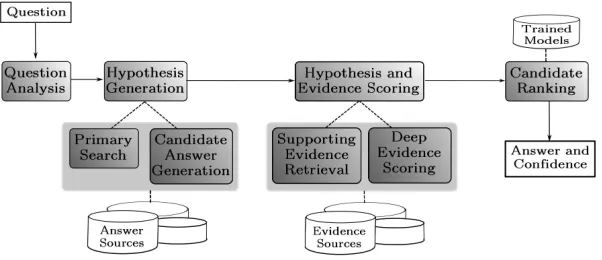
Watson is a massively parallel probabilistic evidence-based architecture for QA (Ferrucci et al., 2010). It consists of several major stages for underlying sub-tasks, including analysis of the question, retrieval of relevant content, scoring and ranking of candidate answers, as depicted in Figure 1. In the rest of this section, we provide an overview of Watson, focusing on the task of answering definitional questions.
Figure 1: Overview of Watson
type, question classes, etc.) used by later stages of the Watson pipeline. Various general purpose NLP components, such as a parser and named entity de-tector, are combined with task-specific modules for this analysis.
The task-specific analytics include several QC components, which determine if the question be-longs to one or more broad “question classes”. These question classes can influence later stages of the Watson pipeline. For instance, a question de-tected as anabbreviation question can invoke spe-cialized candidate generators to produce possible ex-pansions of the abbreviated term in the clue. Simi-larly, the question classes can impact the methods for answer scoring and the machine learning mod-els used for ranking candidate answers. The focus of this paper is on thedefinitionclass, which is de-scribed in the next section.
Hypothesis Generation: Following question anal-ysis, the Watson pipeline searches its document col-lection for relevant documents and passages that are likely to contain the correct answer to the question. This stage of the pipeline generates search queries based on question analysis results, and obtains a ranked list of documents and passages most relevant to the search queries. A variety of candidate gen-eration techniques are then applied to the retrieved results to produce a set of candidate answers.
Information obtained from question analysis can be used to influence the search and candidate gener-ation processes. The question classes detected dur-ing question analysis can focus the search towards specific subsets of the corpus. Similarly, during can-didate generation, strategies used to generate the set
of candidate answers are selected based on the de-tected question classes.
Hypothesis and Evidence Scoring:A wide variety of answer scorers are then used to gather evidence supporting each candidate answer as the correct an-swer to the given question. The scorers include both context dependent as well as context independent scorers, relying on various structured and unstruc-tured resources for their supporting evidence. Candidate Ranking: Finally, machine learning models are used to weigh the gathered evidence and rank the candidate answers. The models generate a ranked list of answers each with an associated con-fidence. The system can also choose to refrain from answering a question if it has low confidence in all candidates. This stage of the pipeline employs sev-eral machine learning models specially trained to handle various types of questions. These models are trained using selected feature sets based on question classes and candidate answers are “routed” to the appropriate model according to the question classes detected during question analysis.
2.2 Answering Definition Questions
process-ing of such definition questions could allow us to hone in on the correct answer through processes dif-ferent from those used for other types of questions.
This paper explores strategies for definition ques-tion processing to improve overall quesques-tion answer-ing performance. A key challenge we have to ad-dress is that of accurate recognition of such ques-tions. Given an input question the Watson question analysis stage uses a definition question recognizer to detect this specific class of questions. We explore several approaches for recognition, including a rule based approach and a variety of statistical models.
Questions that are recognized as definition ques-tions invoke search processes targeted towards dictionary-like sources in our system. We use a va-riety of such sources, such as standard English dic-tionaries, Wiktionary, WordNet, etc. After gather-ing supportgather-ing evidence for candidate answers ex-tracted from these sources, our system routes the candidates to definition-specific candidate ranking models, which have been trained with selected fea-ture sets.
The following sections present a description and evaluation of our approach for identifying and an-swering definition questions.
3 Kernel Models for Question Classification
Previous work (Zhang and Lee, 2003; Suzuki et al., 2003; Blunsom et al., 2006; Moschitti et al., 2007) as shown that syntactic structures are essential for QC. Given the novelty of both the domain and the type of our classification items, we rely on kernel methods to study and design effective representa-tions. Indeed, these are excellent tools for auto-matic feature engineering, especially for unknown tasks and domains. Our approach consists of using SVMs and kernels for structured data applied to sev-eral types of structural lexical, syntactic and shallow semantic information.
3.1 Tree and Sequence Kernels
Kernel functions are implicit scalar products be-tween data examples (i.e. questions in our case) in the very high dimensional space of substructures, where each of the latter is a component of the im-plicit vectors associated with the examples.
ROOT SBARQ WHADVP WRB When S VP VBN hit PP IN by NP NNS electrons , , NP DT a NN phosphor VP VBZ gives PRP RP off NP NP JJ electromagnetic NN energy PP IN in NP DT this NN form 1
Figure 2: Constituency Tree PASS P A1 phosphor A0 electron PR hit P PR energy A2 electromag. A1 phosphor P A1 energy PR give AM-TMP hit A0 phosphor ROOT VBZ OBJ NN NMOD IN PMOD NN form NMOD DT this in energy NMOD JJ electromag. PRT RP off gives SBJ NN phosphor NMOD DT a P , TMP VBN LGS IN PMOD NNS electrons by hit TMP WRB when 1
Figure 3: Dependency Tree negative mistake STK, ok PTK
NP ADJP JJ conceited CC or JJ arrogant NP NN meaning NN adjective NN 5-letter NN fowl
positive mistake STK, ok PTK
NP VP PP NP NN field VBG playing DT a IN on VBN used NP NN grass JJ green JJ artificial NP VP PP NP NN canal DT a IN on VBN used NP NN boat JJ flat-bottomed DT a PASS P A1 phosphor A0 electron PR hit P PR energy AM-MNR electromag. A1 phosphor P A1 energy PR give AM-TMP hit A0 phosphor 1
Figure 4: A tree encoding a Predicate Argument Structure Set
Although several kernels for structured data have been developed (see Section 6), the main distinc-tions in terms of feature spaces is given by the fol-lowing three different kernels:
• Syntactic Tree Kernel (STK) (Collins and Duffy,
2002) applied to constituency parse trees. This gen-erates all possible tree fragments as features with the conditions that sibling nodes from the original trees cannot be separated. In other words, substruc-tures are composed by atomic building blocks cor-responding to nodes along with all their direct chil-dren. These, in case of a syntactic parse tree, are complete production rules of the associated parser grammar2.
• Partial Tree Kernel (PTK) (Moschitti, 2006) ap-plied to both constituency and dependency parse trees. This generates all possible tree fragments, as above, but sibling nodes can be separated (so they can be part of different tree fragments). In other words, a fragment is any possible tree path, from whose nodes other tree paths can depart. Conse-quently, an extremely rich feature space is gener-ated. Of course, PTK subsumes STK but sometimes the latter provides more effective solutions as the number of irrelevant features is smaller as well. When applied to sequences and tree structures, the kernels discussed above produce many different kinds of features. Therefore, the design of appro-priate syntactic/semantic structures determines the representational power of the kernels. Hereafter, we show the models we used.
3.2 Syntactic Semantic Structures
We applied the above kernels to different structures. These can be divided in sequences of words (WS) and part of speech tags (PS) and different kinds of trees. For example, given the non-definition Jeop-ardy! question:
(5) GENERAL SCIENCE: When hit by
elec-trons, a phosphor gives off electromag-netic energy in this form. (answer: light or photons),
we use the following sequences:
WS: [when][hit][by][electrons][,][a][phosphor][gives] [off][electromagnetic][energy][in][this][form]
PS: [wrb][vbn][in][nns][,][dt][nn][vbz][rp][jj][nn][in] [dt][nn]
Additionally, we use constituency trees (CTs), see
2From here the name syntactic tree kernels
Figure 2 and dependency structures converted into the dependency trees (DTs), e.g. shown in Figure 3. Note that, the POS-tags are central nodes, the grammatical relation label is added as a father node and all the relations with the other nodes are described by means of the connecting edges. Words are considered additional children of the POS-tag nodes (in this case the connecting edge just serves to add a lexical feature to the target POS-tag node).
Finally, we also use predicate argument structures generated by verbal and nominal relations accord-ing to PropBank (Palmer et al., 2005) and NomBank (Meyers et al., 2004). Given the target sentence, the set of its predicates are extracted and converted into a forest, then a fake root node, PAS, is used to con-nect these trees. For example, Figure 4 illustrates a Predicate Argument Structures Set (PASS) encoding two relations,giveandhit, as well as the nominaliza-tionenergyalong with all their arguments.
4 Experiments on Definition Question Classification
In these experiments, we study the role of kernel technology for the design of accurate classification of definition questions. We build several classifiers based on SVMs and kernel methods. Each classi-fier uses advanced syntactic/semantic structural fea-tures and their combination. We carry out an exten-sive comparison in terms of F1 between the different models on the Jeopardy! datasets.
4.1 Experimental Setup
Corpus: the data for our QC experiments consists of a randomly selected set of 33 Jeopardy! games3. These questions were manually annotated based on whether or not they are considered definitional. This resulted in 306 definition and 4964 non-definition clues. Each test set is stored in a separate file con-sisting of one line per question, which contains tab-separated clue information and the Jeopardy! cate-gory, e.g. INVESTin example (4).
Tools: for SVM learning, we used the SVMLight-TK software4, which includes structural kernels in SVMLight (Joachims, 1999)5. For generating
con-3Past Jeopardy! games can be downloaded from
http://www.j-archive.com.
4Available athttp://dit.unitn.it/
∼moschitt
stituency trees, we used the Charniak parser (Char-niak, 2000). We also used the syntactic–semantic parser by Johansson and Nugues (2008) to gener-ate dependency trees (Mel’ˇcuk, 1988) and predicgener-ate argument trees according to the PropBank (Palmer et al., 2005) and NomBank (Meyers et al., 2004) frameworks.
Baseline Model: the first model that we used as a baseline is a rule-based classifier (RBC). The RBC leverages a set of rules that matches against lexical and syntactic information in the clue to make a bi-nary decision on whether or not the clue is consid-ered definitional. The rule set was manually devel-oped by a human expert, and consists of rules that attempt to identify roughly 70 different constructs in the clues. For instance, one of the rules matches the parse tree structure for ”It’s X or Y”, which will identify example (1) as a definition question. Kernel Models: we apply the kernels described in Section 3 to the structures extracted from Jeop-ardy! clues. In particular, we design the following models: BOW, i.e. linear kernel on bag-of-words from the clues; WSK, PSK and CSK, i.e. SK applied to the word and POS-tag sequences from the clues, and the word sequence taken from the question cat-egories, respectively; STK-CT, i.e. STK applied to CTs of the clue; PTK-CT and PTK-DT, i.e. PTK applied to CTs and DTs of the clues, respectively; PASS, i.e. PTK applied to the Predicate Argument Structure Set extracted from the clues; and RBC, i.e. a linear kernel applied to the vector only constituted by the 1/0 output of RBC.
Learning Setting:there is no particular parameteri-zation. Since there is an imbalance between positive and negative examples, we used a Precision/Recall trade-off parameter in SVM-Light-TK equal to 5.6 Measures: the performance is measured with Pre-cision, Recall and F1-measure. We estimated them by means of Leave-One-Out7(LOO) on the question set.
4.2 Results and Discussion
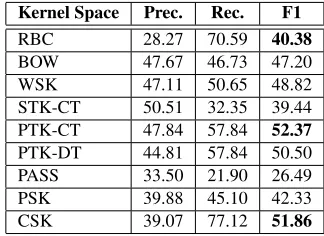
Table 1 shows the performance obtained using dif-ferent kernels (feature spaces) with SVMs. We note
6We have selected 5 as a reasonable value, which kept
bal-anced Precision and Recall on a validation set.
7LOO applied to a corpus ofNinstances consists in training
onN−1examples and testing on the single held-out example. This process is repeated for all instances.
Kernel Space Prec. Rec. F1
RBC 28.27 70.59 40.38
BOW 47.67 46.73 47.20
WSK 47.11 50.65 48.82
STK-CT 50.51 32.35 39.44 PTK-CT 47.84 57.84 52.37
PTK-DT 44.81 57.84 50.50
PASS 33.50 21.90 26.49
PSK 39.88 45.10 42.33
[image:6.612.353.515.71.189.2]CSK 39.07 77.12 51.86
Table 1: Kernel performance using leave-one-out cross-validation.
that: first, RBC has good Recall but poor Precision. This is interesting since, on one hand, these results validate the complexity of the task: in order to cap-ture the large variability of the positive examples, the rules developed by a skilled human designer are unable to be sufficiently precise to limit the recog-nition to those examples. On the other hand, RBC, being a rather different approach from SVMs, can be successfully exploited in a joint model with them.
Second, BOW yields better F1 than RBC but it does not generalize well since its F1 is still low. When n-grams are also added to the model by means of WSK, the F1 improves by about 1.5 ab-solute points. As already shown in (Zhang and Lee, 2003; Moschitti et al., 2007), syntactic structures are needed to improve generalization.
Third, surprisingly with respect to previous work, STK applied to CT8 provides accuracy lower than BOW, about 8 absolute points. The reason is due to the different nature of the Jeopardy! questions: large syntactic variability reduces the probability of find-ing general and well formed patterns, i.e. structures generated by entire production rules. This suggests that PTK, which can capture patterns derived from partial production rules, can be more effective. In-deed, PTK-CT achieves the highest F1, outperform-ing WSK also when used with a different syntactic paradigm, i.e. PTK-DT.
Next, PSK and PASS provide a lower accuracy but they may be useful in kernel combinations as they can complement the information captured by the other models. Interestingly, CSK alone is rather effective for classifying definition questions. We
be-8Applying it to DT does not make much sense as already
Figure 5: Similarity according to PTK and STK
lieve this is because definition questions are some-times clustered into categories such as 4-LETTER
WORDSor BEGINSWITH”B”.
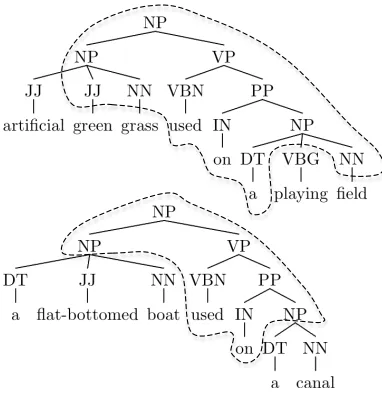
Moreover, we carried out qualitative error analy-sis on the PTK and STK outcome, which supported our initial hypothesis. Let us consider the bottom tree in Figure 5 in the training set. The top tree is a test example correctly classified by PTK but in-correctly classified by STK. The dashed line in the top tree contains the largest subtree matched by PTK (against the bottom tree), whereas the dashed line in the bottom tree indicates the largest subtree matched by STK (against the top tree). As the figure shows, PTK can exploit a larger number of partial patterns. Finally, the above points suggest that different kernels produce complementary information. It is thus promising to experiment with their combina-tions. The joint models can be simply built by summing kernel functions together. The results are shown in Table 2. We note that: (i) CSK comple-ments the WSK information, achieving a substan-tially better result, i.e. 62.95; (ii) PTK-CT+CSK performs even better than WSK+CSK (as PTK out-performs WSK); and (iii) adding RBC improves further on the above combinations, i.e. 68.11 and 67.32, respectively. This evidently demonstrates that RBC captures complementary information. Fi-nally, more complex kernels, especially the overall kernel summation, do not seem to improve the
per-Kernel Space Prec. Rec. F1
WSK+CSK 70.00 57.19 62.95
PTK-CT+CSK 69.43 60.13 64.45
PTK-CT+WSK+CSK 68.59 62.09 65.18
CSK+RBC 47.80 74.51 58.23
PTK-CT+CSK+RBC 59.33 74.84 65.79
BOW+CSK+RBC 60.65 73.53 66.47
PTK-CT+WSK+CSK+RBC 67.66 66.99 67.32
PTK-CT+PASS+CSK+RBC 62.46 71.24 66.56
WSK+CSK+RBC 69.26 66.99 68.11
ALL 61.42 67.65 64.38
Table 2: Performance of Kernel Combinations using leave-one-out cross-validation.
formance. This is also confirmed by the PASS re-sults derived in (Moschitti et al., 2007) on TREC QC.
5 Experiments on the Jeopardy System Since the kernel-based classifiers perform substan-tially better than RBC, we incorporate the PTK-CT+WSK+CSK model9 into Watson for definition classification and evaluated the QA performance against two baseline systems. For the end-to-end ex-periments, we used Watson’s English Slot Grammar parser (McCord, 1980) to generate the constituency trees. The component level evaluation shows that we achieved comparable performance as previously discussed with ESG.
5.1 Experimental Setup
We integrated the classifier into the question analy-sis module, and incorporated additional components to search against dictionary resources and extract candidate answers from these search results when a question is classified as definitional. In the final ma-chine learning models, a separate model is trained for definition questions to enable scoring tailored to the specific characteristics of those questions.
Based on our manually annotated gold standard, less than 10% of Jeopardy! questions are classified as definition questions. Due to their relatively low frequency we conduct two types of evaluations. The first isdefinition-only evaluation, in which we apply our definition question classifier to identify a large
9Since we aim to compare a purely statistical approach to
[image:7.612.320.534.71.204.2]set of definition questions and evaluate the end-to-end system’s performance on this large set of ques-tions. These results enable us to draw statistically significant conclusions about our approach to ad-dressing definition questions.
The second type of evaluation is game-based evaluation, which assesses the impact of our defi-nition question processing on Watson performance while preserving the natural distribution of these question types in Jeopardy! data. Game-based eval-uations situate the system’s performance on defini-tion quesdefini-tions relative to other types of quesdefini-tions, and enable us to gauge the component’s contribu-tions in a game-based setting.
For both evaluation settings, three configurations of Watson are used as follows:
• theNoDefsystem, in which Watson is
config-ured without definition classification and pro-cessing, thereby treating all definition ques-tions as regular factoid quesques-tions;
• the StatDef system, which leverages the sta-tistical classifier and subsequent definition spe-cific search and candidate generation compo-nents as described above; and
• the RuleDef system, in which Watson adopts
RBC and employs the same additional defini-tion search and candidate generadefini-tion compo-nents as the StatDef system.
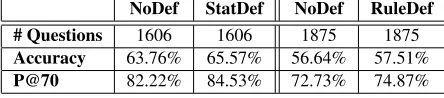
For the definition-only evaluation, we selected all questions recognized as definitional by the statistical classifier from roughly 1000 unseen games (60000 questions), resulting in a test set of 1606 questions. Due to the size of the initial set, it is impractical to manually create a gold standard for measuring Pre-cision and Recall of the classifier. Instead, we com-pare the StatDef system against the NoDef on these 1606 questions using two metrics: accuracy, defined as the percentage of questions correctly answered, and p@70, the system’s Precision when answering only the top 70% most confident questions. P@70 is an important metric in Jeopardy! game play as well as in real world applications where the system may refrain from answering a question when it is not con-fident about any of its answers. Since RBC identifies significantly more definition questions, we started
NoDef StatDef NoDef RuleDef
# Questions 1606 1606 1875 1875
Accuracy 63.76% 65.57% 56.64% 57.51%
P@70 82.22% 84.53% 72.73% 74.87%
Table 3: Definition-Only Evaluation Results
with an initial set of roughly 300 games, from which the RBC identified 1875 questions as definitional. We compared the RuleDef system’s performance on these questions against the NoDef baseline using the accuracy and p@70 metrics.
For the game-based evaluation, we randomly se-lected 66 unseen Jeopardy! games, consisting of 3546 questions after excluding audio/visual ques-tions.10 We contrast the StatDef system perfor-mance against that of NoDef and RuleDef along several dimensions: accuracy and p@70, described above, as well as earnings, the average amount of money earned for each game.
5.2 Definition-Only Evaluation
For the definition-only evaluation, we compared the StatDef system against the NoDef system on a set of 1606 questions that the StatDef system classified as definitional. The results are shown in the first two columns in Table 3. To contrast the gain obtained by the StatDef system against that achieved by the RuleDef system, we ran the RuleDef system over the 1875 questions identified as definitional by the rule-based classifier. We contrast the RuleDef sys-tem performance with that of the NoDef syssys-tem, as shown in the last two columns in Table 3.
Our results show that based on both evaluation metrics, StatDef improved upon the NoDef baseline more than RuleDef improved on the same baseline system. Furthermore, for the accuracy metric where all samples are paired and independent, the differ-ence in performance between the StatDef and NoDef systems is statistically significant at p<0.05, while that between the RuleDef and NoDef systems is not.
5.3 Game-Based Evaluation
The game-based evaluation was carried out on 66 unseen games (roughly 3500 questions). Of these
10Audio/visual questions are those accompanied by either an
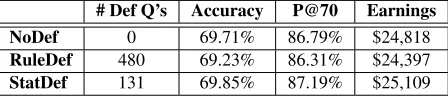
[image:8.612.315.537.73.122.2]# Def Q’s Accuracy P@70 Earnings
NoDef 0 69.71% 86.79% $24,818
RuleDef 480 69.23% 86.31% $24,397
[image:9.612.74.298.72.121.2]StatDef 131 69.85% 87.19% $25,109
Table 4: Game-Based Evaluation Results
questions, the StatDef system classified 131 of them as definitional while the RuleDef system identified 480 definition questions. Both systems were com-pared against the NoDef system using the accuracy, p@70, and earnings metric computed over all ques-tions, as shown in Table 4.
Our results show that even though in the definition-only evaluation both the RuleDef and StatDef systems outperformed the NoDef baseline, in our game-based evaluation, the RuleDef system performedworsethan the NoDef baseline. The low-ered performance is due to the fact that the Preci-sion of the RBC is much lower than that of the sta-tistical classifier, and the special definition process-ing applied to questions that are erroneously clas-sified as definitional was harmful. Our evaluation of this false positive set showed that its accuracy dropped by 6% compared to the NoDef system. On the other hand, the StatDef system outperformed the two other systems, and its accuracy improvement upon the RuleDef system is statistically significant at p<0.05.
6 Related Work
Our paper studies the use of advanced representa-tion for QC in the Jeopardy! domain. As previously mentioned Jeopardy! questions are stated as affir-mative sentences, which are different from the typ-ical QA questions. For the design of our models, we have carefully taken into account previous work. This shows that semantics and syntax are essential to retrieve precise answers, e.g (Hickl et al., 2006; Voorhees, 2004; Small et al., 2004).
We focus on definition questions, which typically require more complex processing than factoid ques-tions (Blair-Goldensohn et al., 2004; Chen et al., 2006; Shen and Lapata, 2007; Bilotti et al., 2007; Moschitti et al., 2007; Surdeanu et al., 2008; Echi-habi and Marcu, 2003). For example, language mod-els were applied to definitional QA in (Cui et al., 2005) to learn soft pattern models based on bigrams. Other related work, such as (Sasaki, 2005; Suzuki
et al., 2002), was also very tied to bag-of-words features. Predicate argument structures have been mainly used for reranking (Shen and Lapata, 2007; Bilotti et al., 2007; Moschitti et al., 2007; Surdeanu et al., 2008).
Our work and methods are similar to (Zhang and Lee, 2003; Moschitti et al., 2007), which achieved the state-of-the-art in QC by applying SVMs along with STK-CT. The results were derived by experi-menting with a TREC dataset11(Li and Roth, 2002), reaching an accuracy of 91.8%. However, such data refers to typical instances from QA, whose syntactic patterns can be easily generalized by STK. In con-trast, we have shown that STK-CT is not effective for our domain, as it presents very innovative ele-ments: questions in affirmative and highly variable format. Thus, we employed new methods such as PTK, dependency structures, multiple sequence ker-nels including category information and many com-binations.
Regarding the use of Kernel Methods, there is a considerably large body of work in Natural Lan-guage Processing, e.g. regarding syntactic parsing (Collins and Duffy, 2002; Kudo et al., 2005; Shen et al., 2003; Kudo and Matsumoto, 2003; Titov and Henderson, 2006; Toutanova et al., 2004), named entity recognition and chunking (Cumby and Roth, 2003; Daum´e III and Marcu, 2004), relation extrac-tion (Zelenko et al., 2002; Culotta and Sorensen, 2004; Bunescu and Mooney, 2005; Zhang et al., 2005; Bunescu, 2007; Nguyen et al., 2009a), text categorization (Cancedda et al., 2003), word sense disambiguation (Gliozzo et al., 2005) and seman-tic role labeling (SRL), e.g. (Kazama and Torisawa, 2005; Che et al., 2006a; Moschitti et al., 2008).
However, ours is the first study on the use of sev-eral combinations of kernels applied to sevsev-eral struc-tures on very complex data from the Jeopardy! do-main.
7 Final Remarks and Conclusion
In this paper we have experimented with advanced structural kernels applied to several kinds of syntac-tic/semantic linguistic structures for the classifica-tion of quesclassifica-tions in a new applicaclassifica-tion domain, i.e. Jeopardy!. Our findings are summarized hereafter:
11Available at http://cogcomp.cs.illinois.
First, it should be noted that basic kernels, such as STK, PTK and SK, when applied to new repre-sentations, i.e. syntactic/semantic structures, con-stitute new kernels. Thus structural representations play a major role and, from this perspective, our pa-per makes a significant contribution.
Second, the experimental results show that the higher variability of Jeopardy! questions prevents us from achieving generalization with typical syntactic patterns even if they are derived by powerful meth-ods such as STK. In contrast, partial patterns, such as those provided by PTK applied to constituency (or dependency) trees, prove to be effective.
In particular, STK has been considered as the best kernel for exploiting syntactic information in con-stituency trees, e.g. it is state-of-the-art in: QC (Zhang and Lee, 2003; Moschitti et al., 2007; chitti, 2008); SRL, (Moschitti et al., 2008; Mos-chitti et al., 2005; Che et al., 2006b); pronominal coreference resolution (Yang et al., 2006; Versley et al., 2008) and Relation Extraction (Zhang et al., 2006; Nguyen et al., 2009b). We showed that, in the complex domain of Jeopardy!, STK surprisingly provides low accuracy whereas PTK is rather ef-fective and greatly outperforms STK. We have also provided an explanation of such behavior by means of error analysis: in contrast with traditional ques-tion classificaques-tion, which focuses on basic syntactic patterns (e.g. ”what”, ”where”, ”who” and ”how”). Figure 5 shows that PTK captures partial patterns that are important for more complex questions like those in Jeopardy!
Third, we derived other interesting findings for NLP related to this novel domain, e.g.: (i) the im-pact of dependency trees is similar to the one of constituency trees. (ii) A simple computational rep-resentation of shallow semantics, i.e. PASS (Mos-chitti, 2008), does not work in Jeopardy!. (iii) Se-quence kernels on category cues, i.e., higher level of lexical semantics, improve question classification. (iv) RBC jointly used with statistical approaches is helpful to tackle the Jeopardy! complexity.
Next, our kernel models improve up to 20 abso-lute percent points over n-grams based approaches, reaching a significant accuracy of about 70%. Wat-son, exploiting such a classifier, improved previ-ous versions using RBC and no definition classifica-tion both in definiclassifica-tion-only evaluaclassifica-tions and in
game-based evaluations.
Finally, we point out that:
• Jeopardy! has a variety of different special ques-tion types that are handled differently. We focus on kernel methods for definition question for two rea-sons. First, their recognition relies heavily on parse structures and is therefore more amenable to the ap-proach proposed in the paper than the recognition of other question types. Second, definition is by far the most frequent special question type in Jeopardy!; therefore, we can obtain sufficient data for training and testing.
• We were unable to address the whole QC prob-lem using a statistical model due to the lack of suffi-cient training data for most special question classes. Furthermore, we focused only on the definition clas-sification and its impact on system performance due to space reasons.
• Our RBC has a rather imbalanced trade-off be-tween Precision and Recall. This may not be the best operating point, but the optimal point is diffi-cult to obtain empirically for an RBC, which is a strong motivation of the work in this paper. We ex-perimented with tuning the trade-off between Preci-sion and Recall with the RBC, but since RBC uses hand-crafted rules and does not have a parameter for that, ultimately the statistical approach proved more effective.
In future work, we plan to extend the current re-search by investigating models capable of exploit-ing predicate argument structures for question clas-sification and answer reranking. The use of syntac-tic/semantic kernels is a promising research direc-tion (Basili et al., 2005; Bloehdorn and Moschitti, 2007a; Bloehdorn and Moschitti, 2007b). In this perspective kernel learning is a very interesting re-search line, considering the complexity of represen-tation and classification problems in which our ker-nels operate.
Acknowledgements
References
Kisuh Ahn, Johan Bos, Stephen Clark, James R. Cur-ran, Tiphaine Dalmas, Jochen L. Leidner, Matthew B. Smillie, and Bonnie Webber. 2004. Question an-swering with qed and wee at trec-2004. In E. M. Voorhees and L. P. Buckland, editors, The Thirteenth
Text REtrieval Conference, TREC 2004, pages 595–
599, Gaitersburg, MD.
Roberto Basili, Marco Cammisa, and Alessandro Mos-chitti. 2005. Effective use of WordNet semantics via kernel-based learning. InProceedings of CoNLL-2005, pages 1–8, Ann Arbor, Michigan. Association for Computational Linguistics.
M. Bilotti, P. Ogilvie, J. Callan, and E. Nyberg. 2007. Structured retrieval for question answering. In
Pro-ceedings of ACM SIGIR.
S. Blair-Goldensohn, K. R. McKeown, and A. H. Schlaikjer. 2004. Answering definitional questions: A hybrid approach. In M. Maybury, editor,
Proceed-ings of AAAI 2004. AAAI Press.
Stephan Bloehdorn and Alessandro Moschitti. 2007a. Combined syntactic and semantic kernels for text clas-sification. InProceedings of ECIR 2007, Rome, Italy. Stephan Bloehdorn and Alessandro Moschitti. 2007b.
Structure and semantics for expressive text kernels. In
In Proceedings of CIKM ’07.
Phil Blunsom, Krystle Kocik, and James R. Curran. 2006. Question classification with log-linear models.
InSIGIR ’06: Proceedings of the 29th annual
interna-tional ACM SIGIR conference on Research and
devel-opment in information retrieval, pages 615–616, New
York, NY, USA. ACM.
Razvan Bunescu and Raymond Mooney. 2005. A short-est path dependency kernel for relation extraction. In
Proceedings of HLT and EMNLP, pages 724–731,
Vancouver, British Columbia, Canada, October. Razvan C. Bunescu. 2007. Learning to extract relations
from the web using minimal supervision. In
Proceed-ings of ACL.
Nicola Cancedda, Eric Gaussier, Cyril Goutte, and Jean Michel Renders. 2003. Word sequence kernels.
Journal of Machine Learning Research, 3:1059–1082.
E. Charniak. 2000. A maximum-entropy-inspired parser.
InProceedings of NAACL.
Wanxiang Che, Min Zhang, Ting Liu, and Sheng Li. 2006a. A hybrid convolution tree kernel for seman-tic role labeling. InProceedings of the COLING/ACL
2006 Main Conference Poster Sessions, pages 73–
80, Sydney, Australia, July. Association for Compu-tational Linguistics.
Wanxiang Che, Min Zhang, Ting Liu, and Sheng Li. 2006b. A hybrid convolution tree kernel for semantic role labeling. InProceedings of the COLING/ACL on
Main conference poster sessions, COLING-ACL ’06,
pages 73–80, Stroudsburg, PA, USA. Association for Computational Linguistics.
Y. Chen, M. Zhou, and S. Wang. 2006. Reranking an-swers from definitional QA using language models. In
Proceedings of ACL.
Charles Clarke, Gordon Cormack, and Thomas Lynam. 2001. Exploiting redundancy in question answering.
In Proceedings of the 24th SIGIR Conference, pages
358–365.
Michael Collins and Nigel Duffy. 2002. New Rank-ing Algorithms for ParsRank-ing and TaggRank-ing: Kernels over Discrete Structures, and the Voted Perceptron. In
Pro-ceedings of ACL’02.
H. Cui, M. Kan, and T. Chua. 2005. Generic soft pattern models for definitional QA. InProceedings of SIGIR, Salvador, Brazil. ACM.
Aron Culotta and Jeffrey Sorensen. 2004. Dependency tree kernels for relation extraction. InProceedings of ACL, pages 423–429, Barcelona, Spain, July.
Chad Cumby and Dan Roth. 2003. Kernel Methods for Relational Learning. InProceedings of ICML 2003. Hal Daum´e III and Daniel Marcu. 2004. Np bracketing
by maximum entropy tagging and SVM reranking. In
Proceedings of EMNLP’04.
A. Echihabi and D. Marcu. 2003. A noisy-channel ap-proach to question answering. InProceedings of ACL. David Ferrucci, Eric Brown, Jennifer Chu-Carroll, James Fan, David Gondek, Aditya Kalyanpur, Adam Lally, J. William Murdock, Eric Nyberg, John Prager, Nico Schlaefer, and Chris Welty. 2010. Building watson: An overview of the deepqa project. AI Magazine, 31(3).
Danilo Giampiccolo, Pamela Froner, Anselmo Pe˜nas, Christelle Ayache, Dan Cristea, Valentin Jijkoun, Petya Osenova, Paulo Rocha, Bogdan Sacaleanu, and Richard Suteliffe. 2007. Overview of the CLEF 2007 multilingual question anwering track. InProceedings
of the Cross Language Evaluation Forum.
Alfio Gliozzo, Claudio Giuliano, and Carlo Strapparava. 2005. Domain kernels for word sense disambiguation.
InProceedings of ACL’05, pages 403–410.
A. Hickl, J. Williams, J. Bensley, K. Roberts, Y. Shi, and B. Rink. 2006. Question answering with lcc chaucer at trec 2006. InProceedings of TREC.
Thorsten Joachims. 1999. Making large-scale SVM learning practical. Advances in Kernel Methods –
Sup-port Vector Learning, 13.
Richard Johansson and Pierre Nugues. 2008. Dependency-based syntactic–semantic analysis with PropBank and NomBank. In CoNLL 2008: Proceedings of the Twelfth Conference on Natural
Language Learning, pages 183–187, Manchester,
Michael Kaisser and Bonnie Webber. 2007. Question answering based on semantic roles. InProceedings of
the Workshop on Deep Linguistic Processing, DeepLP
’07, pages 41–48, Stroudsburg, PA, USA. Association for Computational Linguistics.
Jun’ichi Kazama and Kentaro Torisawa. 2005. Speeding up training with tree kernels for node relation labeling.
InProceedings of HLT-EMNLP’05.
Taku Kudo and Yuji Matsumoto. 2003. Fast methods for kernel-based text analysis. InProceedings of ACL’03. Taku Kudo, Jun Suzuki, and Hideki Isozaki. 2005. Boosting-based parse reranking with subtree features.
InProceedings of ACL’05.
Shyong Lam, David Pennock, Dan Cosley, and Steve Lawrence. 2003. 1 billion pages = 1 milllion dollars? mining the web to pay ”who wants to be a millionaire?
InProceedings of the 19th Conference on Uncertainty
in AI.
X. Li and D. Roth. 2002. Learning question classifiers.
InProceedings of ACL.
Michael C. McCord. 1980. Slot grammars.
Computa-tional Linguistics.
Igor A. Mel’ˇcuk. 1988.Dependency Syntax: Theory and
Practice. State University Press of New York, Albany.
Adam Meyers, Ruth Reeves, Catherine Macleod, Rachel Szekely, Veronika Zielinska, Brian Young, and Ralph Grishman. 2004. The NomBank project: An interim report. In HLT-NAACL 2004 Workshop: Frontiers
in Corpus Annotation, pages 24–31, Boston, United
States.
Alessandro Moschitti, Bonaventura Coppola, Ana-Maria Giuglea, and Roberto Basili. 2005. Hierarchical se-mantic role labeling. InCoNLL 2005 shared task. Alessandro Moschitti, Silvia Quarteroni, Roberto Basili,
and Suresh Manandhar. 2007. Exploiting syntactic and shallow semantic kernels for question/answer clas-sification. InProceedings of ACL’07.
Alessandro Moschitti, Daniele Pighin, and Roberto Basili. 2008. Tree kernels for semantic role labeling.
Computational Linguistics, 34(2):193–224.
Alessandro Moschitti. 2006. Efficient convolution ker-nels for dependency and constituent syntactic trees. In
Proceedings of ECML’06, pages 318–329.
Alessandro Moschitti. 2008. Kernel methods, syntax and semantics for relational text categorization. In
Pro-ceeding of CIKM ’08, NY, USA.
Truc-Vien T. Nguyen, Alessandro Moschitti, and Giuseppe Riccardi. 2009a. Convolution kernels on constituent, dependency and sequential structures for relation extraction. InProceedings of EMNLP, pages 1378–1387, Singapore, August.
Truc-Vien T. Nguyen, Alessandro Moschitti, and Giuseppe Riccardi. 2009b. Convolution kernels on
constituent, dependency and sequential structures for relation extraction. In EMNLP ’09: Proceedings of the 2009 Conference on Empirical Methods in Natural
Language Processing, pages 1378–1387, Morristown,
NJ, USA. Association for Computational Linguistics. Martha Palmer, Dan Gildea, and Paul Kingsbury. 2005.
The proposition bank: An annotated corpus of seman-tic roles. Computational Linguistics, 31(1):71–105. Yutaka Sasaki, Chuan-Jie Lin, Kuang-hua Chen, and
Hsin-Hsi Chen. 2007. Overview of the NTCIR-6 cross-lingual question answering (CLQA) task. In
Proceedings of the 6th NTCIR Workshop on
Evalua-tion of InformaEvalua-tion Access Technologies.
Y. Sasaki. 2005. Question answering as question-biased term extraction: A new approach toward multilingual qa. InProceedings of ACL, pages 215–222.
John Shawe-Taylor and Nello Cristianini. 2004. LaTeX
User’s Guide and Document Reference Manual.
Ker-nel Methods for Pattern Analysis, Cambridge Univer-sity Press.
D. Shen and M. Lapata. 2007. Using semantic roles to improve question answering. In Proceedings of
EMNLP-CoNLL.
L. Shen, A. Sarkar, and A. Joshi. 2003. Using LTAG Based Features in Parse Reranking. InProceedings of
EMNLP, Sapporo, Japan.
S. Small, T. Strzalkowski, T. Liu, S. Ryan, R. Salkin, N. Shimizu, P. Kantor, D. Kelly, and N. Wacholder. 2004. Hitiqa: Towards analytical question answering.
InProceedings of COLING.
M. Surdeanu, M. Ciaramita, and H. Zaragoza. 2008. Learning to rank answers on large online QA collec-tions. InProceedings of ACL-HLT, Columbus, Ohio. J. Suzuki, Y. Sasaki, and E. Maeda. 2002. Svm
an-swer selection for open-domain question anan-swering.
InProceedings of Coling, pages 974–980.
Jun Suzuki, Hirotoshi Taira, Yutaka Sasaki, and Eisaku Maeda. 2003. Question classification using hdag ker-nel. In Proceedings of the ACL 2003 Workshop on
Multilingual Summarization and Question Answering,
pages 61–68, Sapporo, Japan, July. Association for Computational Linguistics.
Ivan Titov and James Henderson. 2006. Porting statisti-cal parsers with data-defined kernels. InProceedings
of CoNLL-X.
Kristina Toutanova, Penka Markova, and Christopher Manning. 2004. The Leaf Path Projection View of Parse Trees: Exploring String Kernels for HPSG Parse Selection. InProceedings of EMNLP 2004.
Yannick Versley, Alessandro Moschitti, Massimo Poe-sio, and Xiaofeng Yang. 2008. Coreference sys-tems based on kernels methods. InThe 22nd Interna-tional Conference on ComputaInterna-tional Linguistics
Ellen M. Voorhees and Hoa Trang Dang. 2006. Overview of the TREC 2005 question answering track.
InProceedings of the TREC 2005 Conference.
E. M. Voorhees. 2004. Overview of the trec 2004 ques-tion answering track. InProceedings of TREC 2004. Xiaofeng Yang, Jian Su, and Chewlim Tan. 2006.
Kernel-based pronoun resolution with structured syn-tactic knowledge. InProc. COLING-ACL 06.
Dmitry Zelenko, Chinatsu Aone, and Anthony Richardella. 2002. Kernel methods for relation extraction. In Proceedings of EMNLP-ACL, pages 181–201.
Dell Zhang and Wee Sun Lee. 2003. Question classifica-tion using support vector machines. InProceedings of the 26th annual international ACM SIGIR conference
on Research and development in informaion retrieval,
pages 26–32. ACM Press.
Min Zhang, Jian Su, Danmei Wang, Guodong Zhou, and Chew Lim Tan. 2005. Discovering relations between named entities from a large raw corpus using tree similarity-based clustering. In Proceedings of IJC-NLP’2005, Lecture Notes in Computer Science (LNCS
3651), pages 378–389, Jeju Island, South Korea.