A NEW APPROACH FOR FINDING MINIMUM PATH IN A NETWORK USING
INTUITIONISTIC FUZZY NUMBER
1
Dr. Sophia Porchelvi
1Lecturer in Mathematics, A.V.C.College
2Associate Professor in Mathematics, A.D.M.College for women, Nagappatinam
ARTICLE INFO ABSTRACT
In this paper, we proposed a new approach that can obtain a minimum path in a network using Triangular Intuitionistic Fuzzy number (TIFN). The path labelling
help of numerical example. The minimum paths obtained from one node to each node of a network can be helpful to decision makers as they make decision to use minimum number of nodes.
Copyright © 2014 Dr. Sophia Porchelvi and Sudha. This is an open access article distributed under the Creative Commons Attribution License, which permits unrestricted use, distribution, and reproduction in any medium, provided
INTRODUCTION
Many researchers have paid much attention to the fuzzy Shortest Path Problem (SPP) since it is central to lots of application the fuzzy SPP, the fuzzy shortest length and the corresponding shortest paths are the useful information for the decision mak Determination of shortest distance and shortest path between two vertices is one of the most fundamental problems in graph theory. Let G = (V, E) be a graph with V as the set of vertices and E as the set of edges. A path between two vertices is an alternating sequence of vertices and edges starting and ending with vertices, and no vertices or no edges appear more than once the sequence. The length of a path is the sum of the weights of the edges on the path. There may exist more than one path bet a pair of vertices. The SPP is to find the path with minimum length between a specified pair of vertices. The fuzzy SPP was first analyzed by Dubois and Prade (1980) using fuzzy number instead of a real number is assigned to each edges. Okada concentrated on a SPP and introduced the concept of degree of possibility in which an arc is on the shortest path. Takahasi and Yamakami (2005) discussed the SPP from a specified node to every other node on a network. Chaung and Kung
out there are several methods to solve this kind of problem in the open literature. Amit Kumar and Manjot Kaur a existing algorithm about SPP with fuzzy arc length. Pandian and Rajendiran
minimum path in a network. Sophia Porchelvi and Sudha
as follows. In section 2, preliminary concepts and definitions are given. The procedure for finding minimum path using TIFN i developed in section 3. An illustrative example is provided in section 4 to find the minimum path from a specified node to every node in a network having imprecise weights. The last section draws some concluding remarks.
2. Prerequisites
2.1 Acyclic Digraph
A digraph is a graph each of whose edges are directed. Hence an acyclic digraph is a directed graph which does not contain a cyclic tour.
*Corresponding author: Sudha, G.
Lecturer in Mathematics, A.V.C.College (Autonomous), Mayiladuthurai, Mannampandal
ISSN: 0975-833X
International Journal of Current Research
Vol. 6, Issue, 08, pp.8103
Article History:
Received 16th May, 2014 Received in revised form 25th
June, 2014 Accepted 10th
July, 2014 Published online 31st August,2014
Key words:
TIFN, Minimum path, Path labelling algorithm, SPP.
RESEARCH ARTICLE
A NEW APPROACH FOR FINDING MINIMUM PATH IN A NETWORK USING
INTUITIONISTIC FUZZY NUMBER
Dr. Sophia Porchelvi and
2*Sudha, G.
A.V.C.College (Autonomous), Mayiladuthurai, Mannampandal Tamilnadu, India
Associate Professor in Mathematics, A.D.M.College for women, Nagappatinam, Tamilnadu, India
ABSTRACT
In this paper, we proposed a new approach that can obtain a minimum path in a network using Triangular Intuitionistic Fuzzy number (TIFN). The path labelling algorithm is illustrated with the help of numerical example. The minimum paths obtained from one node to each node of a network can be helpful to decision makers as they make decision to use minimum number of nodes.
is an open access article distributed under the Creative Commons Attribution License, which permits unrestricted use, distribution, and reproduction in any medium, provided the original work is properly cited.
Many researchers have paid much attention to the fuzzy Shortest Path Problem (SPP) since it is central to lots of application the fuzzy SPP, the fuzzy shortest length and the corresponding shortest paths are the useful information for the decision mak Determination of shortest distance and shortest path between two vertices is one of the most fundamental problems in graph theory. Let G = (V, E) be a graph with V as the set of vertices and E as the set of edges. A path between two vertices is an
ternating sequence of vertices and edges starting and ending with vertices, and no vertices or no edges appear more than once the sequence. The length of a path is the sum of the weights of the edges on the path. There may exist more than one path bet
The SPP is to find the path with minimum length between a specified pair of vertices. The fuzzy SPP was first using fuzzy number instead of a real number is assigned to each edges. Okada centrated on a SPP and introduced the concept of degree of possibility in which an arc is on the shortest path. Takahasi and
discussed the SPP from a specified node to every other node on a network. Chaung and Kung are several methods to solve this kind of problem in the open literature. Amit Kumar and Manjot Kaur
a existing algorithm about SPP with fuzzy arc length. Pandian and Rajendiran (2010) have proposed a new algorithm to find the h in a network. Sophia Porchelvi and Sudha (2013) also did the same with a SPP using TIFN.
as follows. In section 2, preliminary concepts and definitions are given. The procedure for finding minimum path using TIFN i An illustrative example is provided in section 4 to find the minimum path from a specified node to every node in a network having imprecise weights. The last section draws some concluding remarks.
A digraph is a graph each of whose edges are directed. Hence an acyclic digraph is a directed graph which does not contain a
Lecturer in Mathematics, A.V.C.College (Autonomous), Mayiladuthurai, Mannampandal-609305, Tamilnadu, India. International Journal of Current Research
Vol. 6, Issue, 08, pp.8103-8109, August,2014
OF CURRENT RESEARCH
A NEW APPROACH FOR FINDING MINIMUM PATH IN A NETWORK USING TRIANGULAR
Mannampandal-609305,
, Tamilnadu, India
In this paper, we proposed a new approach that can obtain a minimum path in a network using algorithm is illustrated with the help of numerical example. The minimum paths obtained from one node to each node of a network can be helpful to decision makers as they make decision to use minimum number of nodes.
is an open access article distributed under the Creative Commons Attribution License, which permits
Many researchers have paid much attention to the fuzzy Shortest Path Problem (SPP) since it is central to lots of applications. In the fuzzy SPP, the fuzzy shortest length and the corresponding shortest paths are the useful information for the decision makers. Determination of shortest distance and shortest path between two vertices is one of the most fundamental problems in graph theory. Let G = (V, E) be a graph with V as the set of vertices and E as the set of edges. A path between two vertices is an ternating sequence of vertices and edges starting and ending with vertices, and no vertices or no edges appear more than once in the sequence. The length of a path is the sum of the weights of the edges on the path. There may exist more than one path between The SPP is to find the path with minimum length between a specified pair of vertices. The fuzzy SPP was first using fuzzy number instead of a real number is assigned to each edges. Okada (2000) centrated on a SPP and introduced the concept of degree of possibility in which an arc is on the shortest path. Takahasi and discussed the SPP from a specified node to every other node on a network. Chaung and Kung (2005) pointed are several methods to solve this kind of problem in the open literature. Amit Kumar and Manjot Kaur (2011) introduced have proposed a new algorithm to find the same with a SPP using TIFN. This paper is organized as follows. In section 2, preliminary concepts and definitions are given. The procedure for finding minimum path using TIFN is An illustrative example is provided in section 4 to find the minimum path from a specified node to every
2.2 Intuitionistic Fuzzy Set (IFS)
Let X be a Universe of discourse, then an Intuitionistic fuzzy set A in X is given by
A =
x
,
A
x
,
A
x
/
x
X
Where the function
A
x
:
X
0
,
1
and
A
x
:
X
0
,
1
determines the degree of membership and non membership of the element x
X
,
0
A
x
A
x
1
.
2.3 Intuitionistic Fuzzy Number (IFN)
Let
A
x
,
A
x
,
A
x
/
x
X
be an IFS, then we call
A
x
,
A
x
an IFN .We denote it by
a
,
b
,
c
,
e
,
f
,
g
where
a
,
b
,
c
ande
,
f
,
g
F
I
2.4 Triangular Intuitionistic Fuzzy Number(TIFN)
A triangular Intuitionistic fuzzy number A is denoted by
A,
A/
x
R
Where µA and γA are triangular fuzzy number withγA ≤ µA C . So a TIFN ‘A’ is given by
' 3 2 ' 1 3 2
1
,
,
,
,
~
a
a
a
a
a
a
A
that is either a1 ’
≥ a2 and a3’ ≥ a3 (or) a2 ≤ a1 and a3’ ≤ a2
are membership and non-membership fuzzy numbers of A.
2.5 Minimum path
A minimum path from a node p to another node q in a network is a shortest path from p to q with the property that no other such path has a lower length.
Remark 1: The weight of the shortest path is the same as the weight of the minimum path.
Remark 2: If there is only one shortest path from a node p to a node q, then the minimum path from p to q is the shortest path. Remark 3: If (k; l(p1, ps)) is a minimum path at the node ps from p1 and (m; l(ps, pk)) is a minimum path at the node pk from ps ,
then (k + m; l(p1, ps) + l(ps, pk)) is a minimum path at the node pk from p1, where l(p1, ps) + l(ps, pk) is the path joining the two paths l(p1, ps) and l(ps , pk) at the node ps.
3. Minimum Path labelling algorithm
In a network, a label at a node ps from p1 can be represented as follows: (k ; l(p1, ps))
Where l(p1, ps) is a path from p1 to ps and k is the weight of the path l(p1, ps) which may be a intuitionistic fuzzy number or a fuzzy number or a number.
Let (ki ; li (p1, ps)), i = 1,2,3,...,m be m labels. The label (kn ; ln (p1, ps)), ),
n
1
,
2
,...,
m
is said to be a minimum label at the node ps from p1 if kn ≤ ki , for all i . The path ln (p1, ps) is the shortest path to ps from p1.Algorithm
Step 1: Find the collection of nodes N1 in the network which is adjacent to p1. If N1 is empty, then go to step 7. Step 2: Find out the minimum path at every node of N1 from p1.
Step 3: Find the collection of nodes N2 in the network which is adjacent to N1. If N2 is empty, then go to step 7. Otherwise go to step 4.
Step 4: Compute the minimum path at every node of N2 from p1 using the Remark 3. If the shortest path between p1 and any node of N2 with negative weight is a cycle, go to step 7. Otherwise go to step 5.
Step 5: Repeat the step 1 to step 4 until to compute the set of collection of nodes in the network which are adjacent to each of the minimum label node is empty.
Step 6: Find the minimum path from p1 to each of the nodes in the network in step 5. Stop. Step 7: There is no path from the node p1 to the label node. Stop.
Example 1: Consider a mobile service company which handles 23 geographical centres. A configuration of a telecommunication network is presented in Figure 1. Assume that the distance between any two centres is a Intuitionistic Triangular Fuzzy number (the arc lengths are given in Table 1). The company wants to find a shortest path for an effective message flow amongst the centres. The shortest path and the corresponding lengths are reported below.
Figure 1. The network for example1.
Table 1. The arc lengths for example 1.
Arc Lengths Arc Lengths Arc Lengths (1,2)
8
,
9
,
11
,
10
,
12
,
14
(1,3)
9
,
10
,
11
,
11
,
13
,
15
(1,4)
5
,
7
,
9
,
8
,
10
,
11
(1,5)
9
,
8
,
7
,
6
,
5
,
4
(2,6)
8
,
9
,
10
,
10
,
12
,
13
(2,7)
9
,
11
,
13
,
12
,
14
,
15
(3,8)
10
,
11
,
12
,
12
,
13
,
14
(4,7)
12
,
14
,
15
,
15
,
17
,
18
(4,11)
9
,
10
,
12
,
11
,
13
,
14
(5,8)
8
,
9
,
12
,
10
,
13
,
14
(5,11)
9
,
10
,
13
,
11
,
14
,
15
(5,12)
10
,
11
,
12
,
12
,
15
,
16
(6,9)
15
,
12
,
10
,
11
,
8
,
7
(6,10)
10
,
11
,
14
,
12
,
15
,
16
(7,10)
9
,
10
,
11
,
12
,
14
,
15
(7,11)
6
,
7
,
10
,
9
,
11
,
14
(8,13)
4
,
7
,
10
,
8
,
11
,
15
(9,16)
6
,
7
,
11
,
9
,
11
,
15
(10,16)
12
,
13
,
17
,
15
,
18
,
21
(10,17)
15
,
16
,
20
,
18
,
21
,
24
(11,14)
8
,
9
,
13
,
11
,
14
,
17
(11,17)
7
,
9
,
13
,
9
,
14
,
17
(12,14)
12
,
14
,
18
,
14
,
19
,
22
(12,15)
12
,
13
,
17
,
15
,
18
,
21
(13,19)
15
,
16
,
20
,
18
,
21
,
24
(14,21)
10
,
11
,
15
,
14
,
16
,
19
(15,18)
7
,
8
,
12
,
10
,
13
,
16
(15,19)
14
,
15
,
18
,
16
,
19
,
22
(16,20)
9
,
12
,
16
,
13
,
15
,
18
(17,20)
7
,
10
,
14
,
11
,
13
,
16
(17,21)
5
,
8
,
12
,
9
,
13
,
14
(18,21)
14
,
16
,
20
,
17
,
19
,
22
(18,22)
2
,
6
,
11
,
6
,
12
,
13
(18,23)
4
,
8
,
13
,
8
,
14
,
15
(19,22)
14
,
15
,
18
,
17
,
19
,
21
(20,23)
12
,
13
,
16
,
15
,
17
,
19
(21,23)
11
,
14
,
17
,
14
,
18
,
20
(22,23)
3
,
6
,
11
,
7
,
12
,
13
- -To compute the minimum path from the node 1 to each of the other nodes in the network
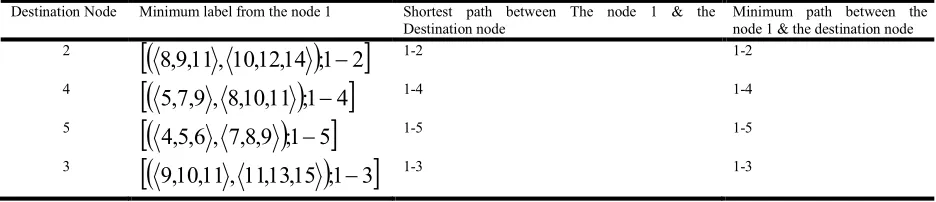
Now, N1 = {2,4,5,3} and using step 1 to step 3 of the modified algorithm, we have the following
Destination Node Minimum label from the node 1 Shortest path between The node 1 & the Destination node
Minimum path between the node 1 & the destination node
2
2
1
;
14
,
12
,
10
,
11
,
9
,
8
1-2 1-24
4
1
;
11
,
10
,
8
,
9
,
7
,
5
1-4 1-45
5
1
;
9
,
8
,
7
,
6
,
5
,
4
1-5 1-53
3
1
;
15
,
13
,
11
,
11
,
10
,
N2 = {6,7,11,12,8} and using the step 1 to the step 3 of the modified algorithm, we have the following:
Destination Node Minimum label from the node 1 Shortest path between The node 1 & the Destination node
Minimum path between the node 1 & the destination node 6
16
,
18
,
21
,
20
,
24
,
27
;
1
2
6
1-2-6 1-2-67
17
,
20
,
24
,
22
,
26
,
29
;
1
2
7
17
,
21
,
24
,
23
,
27
,
29
;
1
4
7
1-2-7 1-4-7
1-2-7
11
11
4
1
;
25
,
23
,
19
,
21
,
17
,
14
13
,
15
,
19
,
18
,
22
,
24
;
1
5
11
1-4-11 1-5-11
1-5-11
12
12
5
1
;
25
,
23
,
19
,
18
,
16
,
14
1-5-12 1-5-128
8
5
1
;
23
,
21
,
17
,
18
,
14
,
12
19
,
21
,
23
,
23
,
26
,
29
;
1
3
8
1-5-8 1-3-8
1-5-8
Now, N3 = {9,10,17,14,15,13} and using step 1 to the step 3 of the modified algorithm, we have the following table:
Destination Node Minimum label from the node 1 Shortest path between The node 1 & the Destination node
Minimum path between the node 1 & the destination node
9
9
6
2
1
;
42
,
36
,
30
,
32
,
26
,
23
1-2-6-9 1-2-6-910
10
6
2
1
;
43
,
39
,
32
,
35
,
29
,
26
26
,
31
,
35
,
35
,
41
,
44
;
1
4
7
10
1-2-6-10 1-4-7-10
1-2-6-10
17
17
11
4
1
;
42
,
37
,
28
,
34
,
26
,
21
21
,
24
,
32
,
27
,
36
,
41
;
1
5
11
17
1-4-11-17 1-5-11-17
1-5-11-17
14
14
11
4
1
;
42
,
37
,
30
,
34
,
26
,
22
26
,
30
,
36
,
33
,
42
,
47
;
1
5
12
14
1-4-11-14 1-5-12-14
1-4-11-14
15
15
12
5
1
;
46
,
41
,
34
,
35
,
29
,
26
1-5-12-15 1-5-12-1513
13
8
5
1
;
38
,
32
,
25
,
28
,
21
,
16
13
,
28
,
23
,
31
,
37
,
44
;
1
3
8
13
1-5-8-13 1-3-8-13
1-5-8-13
Now, N4 = {16,20,21,18,19} and using step 1 to the step 3 of the modified algorithm, we have the following table:
Destination Node Minimum label from the node 1 Shortest path between The node 1 & the Destination node
Minimum path between the node 1 & the destination node
16
16
10
7
4
1
;
65
,
59
,
50
,
52
,
44
,
38
29
,
33
,
43
,
39
,
47
,
57
;
1
2
6
9
16
1-4-7-10-16 1-2-6-9-16
1-2-6-9-16
20
20
16
9
6
2
1
;
75
,
62
,
52
,
59
,
45
,
38
1-2-6-9-16-20 1-4-11-17-20 1-4-11-17-20
28
,
36
,
48
,
39
,
50
,
58
;
1
4
11
17
20
21
26
,
34
,
46
,
37
,
50
,
56
;
1
4
11
17
21
32
,
37
,
49
,
44
,
53
,
61
;
1
4
11
14
21
1-4-11-17-21 1-4-11-14-21
1-4-11-17-21
18
33
,
37
,
47
,
44
,
54
,
62
;
1
5
12
15
18
1-5-12-15-18 1-5-12-15-1819
19
15
12
5
1
;
68
,
60
,
50
,
53
,
44
,
40
1-5-12-15-19 1-5-12-15-19Now, N5 = {23,22} and using step 1 to the step 3 of the modified algorithm, we have the following table:
Destination Node
Minimum label from the node 1 Shortest path between The node 1 & the Destination node
Minimum path between the node 1 & the destination node
23
37
,
48
,
63
,
51
,
68
,
76
;
1
4
11
17
21
23
43
,
51
,
66
,
58
,
71
,
81
;
1
4
11
14
21
23
37
,
45
,
60
,
52
,
68
,
77
;
1
5
12
15
18
23
1-4-11-17-21-23 1-4-11-14-21-23 1-5-12-15-18-23
1-5-12-15-18-23
22
22
18
15
12
5
1
;
75
,
66
,
50
,
58
,
43
,
35
1-5-12-15-18-22 1-5-12-15-18-22Now N6 = { }. We stop the computation. By the modified method, the shortest path and the minimum path from the node 1 to each other nodes is given below using the modified method.
Node Shortest Path Weight of the Shortest Path Minimum path 2 1-2
8
,
9
,
11
,
10
,
12
,
14
1-23 1-3
9
,
10
,
11
,
11
,
13
,
15
1-34 1-4
5
,
7
,
9
,
8
,
10
,
11
1-45 1-5
4
,
5
,
6
,
7
,
8
,
9
1-56 1-2-6
16
,
18
,
21
,
20
,
24
,
27
1-2-67 1-2-7
1-4-7
17
,
21
,
24
,
23
,
27
,
29
29
,
26
,
22
,
24
,
20
,
17
1-2-78 1-5-8
1-3-8
19
,
21
,
23
,
23
,
26
,
29
23
,
21
,
17
,
18
,
14
,
12
1-5-89 1-2-6-9
42
,
36
,
30
,
32
,
26
,
23
1-2-6-910
1-2-6-10
1-4-7-10
26
,
31
,
35
,
35
,
41
,
44
43
,
39
,
32
,
35
,
29
,
26
1-2-6-1011
1-4-11
1-5-11
13
,
15
,
19
,
18
,
22
,
24
25
,
23
,
19
,
21
,
17
,
12
1-5-12
14
,
16
,
18
,
19
,
23
,
25
1-5-1213
1-5-8-13
1-3-8-13
13
,
28
,
33
,
31
,
37
,
44
38
,
32
,
25
,
28
,
21
,
16
1-5-8-1314
1-4-11-14
1-5-12-14
26
,
30
,
36
,
33
,
42
,
47
42
,
37
,
30
,
34
,
26
,
22
1-4-11-1415
1-5-12-15
46
,
41
,
34
,
35
,
29
,
26
1-5-12-1516
1-4-7-10-16
1-2-6-9-16
29
,
33
,
43
,
39
,
47
,
57
65
,
59
,
50
,
52
,
44
,
38
1-2-6-9-1617
1-4-11-17
1-5-11-17
21
,
24
,
32
,
27
,
36
,
41
42
,
37
,
28
,
34
,
26
,
21
1-5-11-1718
1-5-12-15-18
33
,
37
,
47
,
44
,
54
,
62
1-5-12-15-1819
1-5-12-15-19
68
,
60
,
50
,
53
,
44
,
40
1-5-12-15-1920
1-2-6-9-16-20
1-4-11-17-20
28
,
36
,
48
,
39
,
50
,
58
75
,
62
,
52
,
59
,
45
,
38
1-4-11-17-2021
1-4-11-17-21
1-4-11-14-21
32
,
37
,
49
,
44
,
53
,
61
56
,
50
,
37
,
46
,
34
,
26
1-4-11-17-2122
1-5-12-15-18-22
35
,
43
,
58
,
50
,
66
,
75
1-5-12-15-18-2223
1-4-11-17-21-23 1-4-11-14-21-23 1-5-12-15-18-23
37
,
45
,
60
,
52
,
68
,
77
81
,
71
,
58
,
66
,
51
,
43
76
,
68
,
51
,
63
,
48
,
37
1-5-12-15-18-23
Conclusion
In this paper, a new algorithm namely, minimum path labelling algorithm for solving SPP as well as minimum path problems on a network is provided. In the modified method, we are able to obtain all non- dominated paths from the specified node to every other node and any two specified nodes.
REFERENCES
Amit Kumar and Manjot Kaur 2011. “A new algorithm for solving network flow problems with fuzzy arc lengths”, An official
journal of Turkish Fuzzy systems Association vol.2, No.1,p p 1-13.
Chuang T.N. and J.Y. Kung 2005. “The fuzzy shortest path length and the corresponding shortest path in a network”, Computers and Operations Researh,vol.32,no.6,pp.1409-1428
De P.K. and Amita Bhinchar 2010. “Computation of Shortest Path in a fuzzy network”, International journal computer
applications, vol. 11-no.12 , pp.0975-8887.
Dubois D. and H. Prade 1980. Fuzzy Sets and Systems: Theory and Applications, Academic Press, New York.
Kiran Yadav A., B. Ranjit Biswas 2009. “Finding a Shortest Path using an Intelligent Technique”, International Journal of
Engineering and Technology vol.1,No.2, 1793-8236
Klein C.M. 1991. “Fuzzy shortest paths”, Fuzzy Sets and Systems, vol.39, no.1, pp.27-41.
Lin K.C. and M.S. Chern 1993. “The fuzzy shortest path problem and its most vital arcs”, Fuzzy Sets and Systems, vol.58, no.3, pp.343-353.
Nagoor Gani A. and M. Mohamed Jabarulla 2010. “On Searching Intuitionistic Fuzzy Shortest Path in a Net work” Applied
Mathematical Sciences, No. 69, pp .3447-3454.
Okada S. and T. Soper 2000. “A shortest path problem on a network with fuzzy arc lengths”, Fuzzy Sets and Systems,vol.109, no.1, pp.129-140.
Pandian P. and P. Rajendiran 2010. “A new algorithm for minimum path in a network”, Applied Mathematical Sciences, vol.4, no. 54, pp. 2697-2710.
Sophia Porchelvi R. and G. Sudha 2013. “A modified algorithm for solving shortest path problem with Intuitionistic fuzzy arc lengths”, International Journal of Scientific and Engineering Research, vol.4, no.10,pp. 2229-5518.
Sophia Porchelvi R. and G. Sudha 2014. “Computation of shortest path in a fuzzy network using Triangular Intuitionistic Fuzzy Number”, International Journal of Scientific and Engineering Research, vol.5, no.12,pp. 2229-5518.
Sophia Porchelvi R. and G. Sudha, “Intuitionistic Fuzzy Critical path in a network”, International conference on Mathematical
Methods and Computations proc, Feb 2014.
Takahashi M.T. Yaamakani. A. 2005. “On fuzzy Shortest Path Problem with fuzzy parameter an algorithm American approach Proceedings of the Annual Meeting of the North Fuzzy Information Processing Society” pp.654-657
Yao J.S. and K.M. Wu 2000. “ Ranking fuzzy numbers based on decomposition principle and signed distance”, Fuzzy Sets and Systems,vol.116,p.275-288.