© 2019, IRJET | Impact Factor value: 7.34 | ISO 9001:2008 Certified Journal | Page 1175
“Cluster Analysis for Effective Information Retrieval through Cohesive
Group of Cluster Methods”
Prof. S.N. Sawalkar
1, Ms. Sheetal Yamde
21
Head Department of Computer Science and Engineering, Computer Science and Engineering, Sipna COET
Amravati, Maharashtra, India
2
Student, Computer Science and Engineering, Sipna COET Amravati, Maharashtra, India
---***---Abstract
:
Locating interesting information is one of themost important tasks in Information Retrieval (IR). The
different IR systems emphasize different query features
when determining relevance and therefore retrieved from different sets of documents. Clustering is an approach to improve the effectiveness of IR. In clustering, documents are clustered either before or after retrieval. The motivation of this paper is to explain the need of clustering in retrieving efficient information that closely associates documents which are relevant to the same query. Here IR framework has been defined which consists of four steps (1) IR system
Similarity measure (3) document clustering and (4) ranking of clusters. Furthermore, we present the short comings of cluster algorithms based on the various facets of their features and functionality. Finally based on the review of the different approaches we conclude that although clustering has been a topic for scientific community for three decades, there are still many open issues that call for more research.
Key Words:Information Retrieval, IR System, Document
Clustering, Similarity measure, Ranking
1. INTRODUCTION
Nowadays the internet has become the largest data repository facing the problem of information overload. This information explosion has lead to a growing challenge for information Retrieval systems to efficiently and effectively manage and retrieve the information for average user. The purpose of information Retrieval is to store documents electronically and assist user to effectively navigate, trace and organize the available web documents. The IR system accepts a query from the user and responds with a set of documents. The system returns both relevant and non-relevant material and a document organization approach are applied to assist the user in finding the relevant information in the retrieved set. Generally, a search engine presents the retrieved document set as a rank list of documents. The documents in the list are ordered by the probability of being relevant to the user’s request. The highest ranked document is considered to be the most likely relevant document; the next one is slightly less likely and so on. Every search engine works on above organizational approach. The user will start at the top of the list and follow it down examining the documents one at a time. A number of
alternative document retrieval approaches have been developed over the recent years. These approaches are normally based on visualization and presentation of some relationships among the documents and the user’s query.
One of such approach can play an important role towards achievement of this objective, is document clustering. Document clustering has been studied in the field of information retrieval for several decades. Willett gives an excellent overview of existing algorithm and application. The increasing importance of document clustering and the variety of its application has led to the development of wide range of algorithms with different qualities. The goal of clustering is to separate relevant documents from non-relevant documents. To accomplish this we define a measure for similarity between documents and design corresponding clustering algorithm. We can start with vector space model(VSM), which represents a document as a vector of the terms that appear in all the document set. Each feature vector contains term weights of the terms appearing in that document. The term weighting scheme is usually based on tf×idf method in IR. A collection of documents can be represented by a term-document matrix. A similarity between documents is measured using one of several similarity measures that are based on relations of feature vectors. After clustering algorithms the clusters are ranked using the ranking algorithm, which generates clusters according to their match with the query. Section 2, of this paper summarizes related work in this area. In Section 3, Analysis of problem of Information Retrieval. Section 4 Proposed Work and objectives. Section 5, shows the conclusion and discussion.
2. LITERATURE REVIEW & RELATED WORK
© 2019, IRJET | Impact Factor value: 7.34 | ISO 9001:2008 Certified Journal | Page 1176
including K-means, hierarchical agglomerative clustering,scatter/gather and suffix tree clustering (STC). When using only textual information for clustering has shown that STC outperforms other algorithms but suffix tree based method suffers from large memory requirements and poor locality characteristics. SHOC uses suffix array for phrase extraction and organizes the snippets in a hierarchy via an SVD (Singular Value Decomposition) approach. Lingo uses SVD on a term-document matrix to find meaningful long labels, generates flat clustering result. Zeng re-formalizes the clustering problem as a salient phrase ranking problem. It uses phrases rather than words and that it allows clusters to overlap. A co-occurrence based hierarchical clustering method is used to group search results into hierarchical and overlapping clusters. CoHC outperforms all other clustering algorithms. The most well known clustering methodology can be divided into two methods according to the structure of the group created as a result of clustering: the hierarchical clustering and non-hierarchical clustering method. There are diverse algorithms associated with each methodology. Within non-hierarchical clustering there is a single pass method where the results differ according to order in which the documents are inputted. Apart from this the hybrid algorithm does not require a number for the output cluster prior to the clustering. The clusters can be re-arranged according to quality measurements which occur iteratively until the quality of clusters reaches the maximum level of satisfaction. Hybrid hierarchical clustering algorithm (HHCA) outperforms the popularly used hierarchical single linked clustering algorithm.
3. INFORMATION RETRIEVAL FRAMEWORK
USING CLUSTERING
The IR framework for representing the relevant information consists mainly of four steps: the IR system, similarity measures, clustering and ranking. Fig 1 gives an overview of IR Framework. Initially user gives a query to the IR system to retrieve the relevant documents from the corpus. The IR system produces the list of the documents. The documents clustering algorithms attempt to group the documents using similarity measures. The documents that are relevant to certain topics will be allotted in a single cluster. Further these clusters are ranked with the most relevant cluster getting the highest rank and are displayed on the top of the list. This model can be loosely categorized based on rule based inference, scattering activation with a conventional database implementation. The set of documents data that they cluster search results
Collection information retrieval system they try to improve –user experience, user interface competence of the search system. A very general class of clustering is concerned with building partitions (clusters) of datasets on the basis of some performance index known also as an objective or cost function
4. ANALYSIS OF PROBLEM OF INFORMATION
RETRIEVAL SYSTEM
Today the amount of information available on the Web has increased to a point that there are great demands for effective systems that allow an easy and flexible access to information relevant to specific user’s need. The system should be capable of managing imperfect information, and to adapt its behavior to the user context. Information Retrieval aims at defining models and techniques that improves the limitations of current systems for the Information Access (mainly Information Retrieval and Information Filtering systems). Information Retrieval system has been illustrated in Figure2.
4.1. Similarity Measure
Clustering exploits similarities between the documents to be clustered. The similarity of two documents is computed as a function of the distance between the corresponding term vectors for these documents. Of the various measures used to compute this distance, the cosine measure has proved the most reliable and accurate [19].
© 2019, IRJET | Impact Factor value: 7.34 | ISO 9001:2008 Certified Journal | Page 1177
In order to cluster documents, one must first choose thetype and characteristics or attributes of the documents on which the clustering algorithms will be based. The most commonly used model is the Vector Space Model (VSM). The goal of clustering is to separate the relevant documents from the non-relevant documents. To accomplish this we need to define a measure for similarity between documents and appropriate similarity measure must be chosen for the calculation of the similarity between the documents. Some widely used similarity measures are the cosine coefficient which gives the cosine of the angle between the two featured vectors, the Jaccard coefficients, Euclidean and Pearson Correlation and the dice coefficients (all normalised).
Some clustering algorithms operate on a dissimilarity matrix. Some of the most frequently used dissimilarity measures for continuous data are: Minkowski q L distance (for 1 q), City-block (or Manhattan dissimilarity between two objects computed depends on distance or 1 L), Chebychev distance metric (or maximum or L). In the case of Chebychev distance the objects with the largest dispersion will have the largest impact on the clustering. If all objects are considered equally important, the data need to be standardized first. For interval-scaled data, Pearson correlation coefficient is used; for ordinal data, Goodman-Kruskal gamma correlation coefficient is used.
4.2. Document Clustering
Document Clustering is a technique employed for the purpose of analyzing statistical data sets. Essentially, the goal of clustering is to identify distinct groups within a dataset, and then place the data within those groups, according to their relationships with each other [6,22]. Clustering of multidimensional data is an important procedure in many information retrieval applications. In these applications, one or more clustering algorithms are
used to group similar items together to form clusters. There exists a large number of data clustering algorithms which are classified into two main categories-Hierarchical algorithms and Partitional algorithms. A Hierarchical clustering algorithm generates a cluster hierarchy, which is called a dendrogram. A dendrogram is a tree that records the process of clustering. Similar items are connected by links whose level in the tree is determined by the similarity between the two items. The hierarchical algorithms can be further divided into agglomerative approach and divisive approach. The major differences between the two approaches are agglomerative approach works in a bottom-up manner while divisive approach works in a top-down manner. A partitional clustering algorithm obtains a single partition of the data instead of a cluster hierarchy. One major advantage of this category of clustering algorithms is their fast speed. The widely used K-means method and its variances belong to this category. The K-means algorithm selects K data points as cluster centers and assigns each data point to the nearest one. The reassigning process is continued until a convergence criterion is met. The advantage of this algorithm is that it can perform with O(n) time complexity. For web page clustering, some of the previous works have adapted K-means and agglomerative hierarchical clustering algorithm. Further, density based algorithm is adapted for hierarchical clustering of web documents. The web documents contain textual information as well as hyperlinks between them. There have been efforts to use one or both of them to make clusters. The density based algorithm is introduced for using both content and linked information which has the advantages of creating clusters in various shapes and removing noisy data. In this algorithm, at first a random data item is selected and its neighborhood is investigated to determine whether it has an acceptable number of data points. Most existing hierarchical clustering algorithms are unable to undo previous clustering operations which prevent the detection of not well separated structures. Partitional clustering does not suffer from this problem but requires a pre-specified number for the output clusters. Hence the advantages of hierarchical clustering and partitional clustering techniques are combined in Hybrid clustering algorithm which is called Hybrid Hierarchical Clustering Algorithm (HHCA). The HHCA algorithm performs iteratively a process of a mixed cluster splitting and merging until the quality of clustering reaches its maximum level of satisfaction. Most of the clustering algorithm approaches can be divided into two categories: the clustering-then-labeling approach and the labeling-then-clustering approach.
© 2019, IRJET | Impact Factor value: 7.34 | ISO 9001:2008 Certified Journal | Page 1178
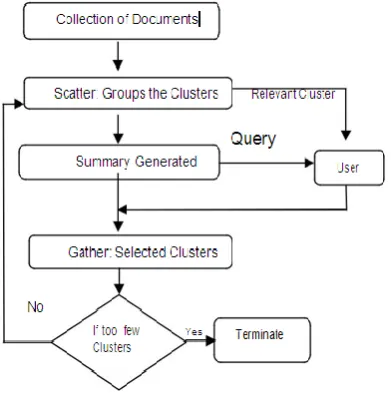
difficult to identify relevant clusters. Scatter/Gathersystem is implemented based on a variant of the classic K-Means algorithm. The Scatter/Gather browsing paradigm clusters documents into topically – coherent groups and present descriptive textual summaries to the user. The summaries consist of topical terms that characterize each cluster and a number of typical titles that sample the contents of the cluster. The user may select the summaries forming a sub-selection for iterative examination. The clustering and re-clustering is done so that different topics are seen depending on the sub-collection cluster. The schematic diagram of Scatter/Gather clustering algorithm is shown in figure 3. Scatter/Gather may be applied to the entire corpus, in which case static off-line computations may be exploited to speed dynamic online clustering. The use of Scatter/Gather successfully conveys some of the content and structure of the corpus. However, Scatter/Gather is less effective than a standard similarity search when the subjects are provided with a query.
It is possible to integrate Scatter/Gather with conventional search technology by applying it after a search to organize and navigate the retrieved documents, which then form the target document collection. The topic-coherent clusters can be used in several ways: to identify promising subsets of documents, to be pursued with other tools or re-clustered into more refined groups and to eliminate groups of documents whose contents appear irrelevant.
b) Labelling-then-clustering approach: The labelling-then-clustering approach first identifies sets of documents that share phrases and extracts these phrases as candidate cluster labels. Candidate cluster labels are ranked and some of them are selected as the final cluster labels. Base clusters are created according to these cluster labels. Grouper adopts a phrase-analysis algorithm called Suffix Tree Clustering STC, in which snippets sharing the same sequence of words are grouped together. Suffix Tree
Clustering STC is a linear time clustering algorithm that is based on identifying the phrases that are common to groups of documents. A phrase in our context is an ordered sequence of one or more words. We define a base cluster to be a set of documents that share a common phrase. STC has three logical steps: (1) document cleaning (2) identifying base clusters using a suffix tree, and (3) combining these base clusters into clusters as shown in Figure 4. A Suffix tree is a data structure that admits efficient string matching and querying. Suffix trees have
been studied and used extensively in fundamental string problems such as large volumes of biological sequence data searching, approximate string matches and text features extraction in spam email classification. In suffix tree document model, a document is considered as a string consisting of words, not characters. In Zamir and Etzioni STC algorithm, after the suffix tree construction, the overlap of the different clusters is calculated and the clusters are merged if they have more than 50% overlap. The merging method is fast but it neglects the similarity between the known overlapping parts. Another problem in the merging algorithm is that it can lead to too many clusters in hundreds and thousands with only a small amount of documents in each of it frustrating the browser to locate the desired information. Further, a new cluster merging algorithm of suffix tree clustering introduces the well known cosine similarity algorithm into the cluster merging process.
[image:4.595.68.264.332.529.2]© 2019, IRJET | Impact Factor value: 7.34 | ISO 9001:2008 Certified Journal | Page 1179
then aggregated into higher-level clusters. A termco-occurrence based method (called CoHC) is used to extract cluster labels which are composed by interrupted as well as uninterrupted sequences of words with arbitrary length. In fact, all the relevant documents are usually distributed in several clusters. After clustering each ranked list is composed of a set of clusters by using ranking algorithm.
4.3. Ranking of Clusters
A group of clusters are obtained after applying the document clustering algorithm each of which contains more or less relevant documents. By ranking the clusters we expect to determine reliable clusters and adjust the relevance score of documents in each ranked list such that relevant scores become more reasonable. In order to find the ranked cluster of the query three measures are applied: Normalized Match Ratio (NMR), Normalized Order Ratio (NOR) and Log Odds Ratio (LOR).
NMR shows the number of terms related to the topic. It calculates the number of terms with high relevance with a given query and uses this to decide which cluster will be used. After which it shows them according to their rank. The NMR measures can be defined as
Matches
NMR = Reference Term List
NOR shows the number of terms related to the topic within a selected cluster. It shows cluster according to the level of relevance within the selected clusters and shows the term list.
Matches
It is defined as NOR = Reference Clusters
LOR is a statistical measure of how relevant a term is to a cluster. It is the probability value that shows the similarity among the terms and how much they are relevant to the topic. Its value can be expressed as a probability unlike the two prior estimated values.
LOR = (Odds of an event in one Group) / (Odds of it Occurring in another Group)
By applying each of three estimated measures the cluster that matches with the topic can be shown. These measures can be used intuitively. The ranking algorithm is defined as Ranking Algorithm = NMR NOR LOR.
This technique analyses the contents of each cluster to determine the top terms and associate them with probability values. Based method suffers from large memory requirements and poor locality characteristics
In this algorithm the similarity of two clusters is not only decided by the overlap of their document but also by the similarity of non overlap parts. Suffix tree based method suffers from large memory requirements and poor locality characteristics
A new method for the document clustering is defined to group search results into hierarchical and overlapping clusters [26]. In this method, extracting meaningful, orderly, multiple
5. FINAL WORK AND OBJECTIVE
Although these methods have not performed to their best so far, we believe they still can be further improved. A better clustering algorithm to identify more reliable clusters and more elaborate formula to rank the cluster are expected to bring up the improvement. Since our approach is based on two hypotheses, we first verified them by means of experiments. We also compared our approach with other conventional approaches. The results show that each of them achieves some improvement, and that our approach compares favorably with them. We also investigated the impact of cluster size. We found that our approach is rather stable under variation in the size of clusters. Although our method showed good performance in our experiments, we believe it still can be improved further. A better clustering algorithm for identifying more reliable clusters and more elaborate formula for re-ranking ranked lists should lead to further improvement. These will be topics for our future work.
A clustering on data set is performing using k-Means clustering method. Graphical representation on the k means algorithm and the output generated by the algorithm presented in tabular form.
© 2019, IRJET | Impact Factor value: 7.34 | ISO 9001:2008 Certified Journal | Page 1180
centroid K-Means algorithm compared with newlymodified algorithm and comparison analysis
6. CONCLUSION AND DISCUSSION
We have mentioned that clustering is used to improve the IR from the collection of documents. The need of Information Retrieval mechanism can only be supported if the document collection is organized into a meaningful structure, which allows part or all the document collection to be browsed at each stage of a search. This has prompted researchers to re-examine the process of cluster based information retrieval. In the process of IR, we can calculate similarity coefficients between the query and the documents and search which clusters of documents best correspond to the query. This way of calculation is less time consuming for searching documents with high similarity than calculation of similarity coefficients between the query and individual documents. Numerous studies and anecdotal evidence hint that document clustering can be a better way of organizing the retrieval results. Hierarchical algorithms start with established clusters, and then create new clusters based upon the relationships of the data within the set. All the relationships are analyzed in the hierarchical algorithms which tend to be costly in terms of time and processing power. Moreover agglomerative hierarchical clustering does not do well because of the nature of documents, i.e., nearest neighbors of documents often belong to different classes. This causes agglomerative hierarchical clustering techniques to make mistakes that cannot be fixed by the hierarchical scheme. Partitional algorithms have better time complexity than hierarchical algorithms which allows them to be used in analyzing datasets. The disadvantage of partitional algorithm is that the initial choice of clusters is arbitrary and does not necessarily comprise all the actual groups that exist within a data set. Therefore, if a particular group is missed in the initial clustering decision the members of that group will be placed within the clusters that are closest to them, according to the predetermined parameters of the algorithms. Moreover, these algorithms will yield inconsistent results. The clusters determined this time by the algorithm probably wouldn’t be the same as the clusters generated the next time.
After the algorithm on the dataset and result generated and visualized. They are evaluated with execution time. The accuracy and the time taken to algorithm is was
reducible hence the current scenario, the modified algorithm is based suited for this performance and accuracy.
7. REFERENCES
[1] A Theoretical Study of Text Document Clustering
Yogesh Jain #1, Amit Kumar Nandanwar *2,#M.Tech Scholar, C.S.E., Vidya Niketan Samiti Group of Institutions, Bhopal, India [ 2014 ]
[2] Clustering Web Search Results-A Review Mrs.
D.A. Nikam1, Mr. N.P. Jadhav2, Miss. A.B. Shikalgar3, Mr. P.A. Chougule4 1(Computer Science and Engineering, Dr. J.J. Magdum College of Engineering, Jaysingpur., India) [ August 2014 ]
[3] Lachtar Nadia, (Design and implementation of
Information Retrieval System Based Ontology (2014).
[4] P. Willett, Recent, “Trends in Hierarchical
Document Clustering”, A Critical Review, Information Processing & Management Vol. 24, No. 5, (2012).
[5] Mayra Z. Rodriguez, Cesar H. Comin Clustering
Algorithms: A Comparative Approach, (2011).
[6] R.B. Allen, P. Obry and M.Littman, “An interface for navigating clustered document set returned by queries”, In Proceddings of ACM Conference on Organisational Computing Systems, pp.166-171, (1993).
[7] D. R. Cutting, D. R. Karger, and J. O. Pedersen, “Constant interaction-time Scatter/Gather browsing of very large document collections”, In Proceedings of ACM SIGIR, pp.126-134, (1993).
[8] D. Dubin, “Document analysis for visualization”, In
Proceedings of ACM SIGIR, pp.199-204, July (1995).
[9] M. A. Hearst and J. O. Pedersen, “Reexamining the cluster hypothesis: Scatter/gather on retrieval results”. In Proceedings of the 19th Annual International ACM SIGIR Conference on Research and Development in Information Retrieval, pp. 76-84, (1996).
[10] R. Weiss, et al., “HyPursuit: a hierarchical