PRIMT: A Pick-Revise Framework for Interactive Machine Translation
Shanbo Cheng, Shujian Huang, Huadong Chen, Xinyu Dai and Jiajun Chen
State Key Laboratory for Novel Software Technology Nanjing University
Nanjing 210023, China
{chengsb, huangsj, chenhd, daixy, chenjj}@nlp.nju.edu.cn
Abstract
Interactive machine translation (IMT) is a method which uses human-computer interac-tions to improve the quality of MT. Tradition-al IMT methods employ a left-to-right order for the interactions, which is difficult to di-rectly modify critical errors at the end of the sentence. In this paper, we propose an IMT framework in which the interaction is decom-posed into two simple human actions: pick-ing a critical translation error (Pick) and revis-ing the translation (Revise). The picked phrase could be at any position of the sentence, which improves the efficiency of human computer in-teraction. We also propose automatic sugges-tion models for the two acsugges-tions to further re-duce the cost of human interaction. Experi-ment results demonstrate that by interactions through either one of the actions, the transla-tion quality could be significantly improved. Greater gains could be achieved by iteratively performing both actions.
1 Introduction
To obtain high quality translations, human transla-tors usually have to modify the results generated by a machine translation (MT) system (called post edit-ing, PE). In many cases, PE needs a lot of modifica-tions, which is time-consuming (Plitt and Masselot, 2010). To speed up the process, interactive ma-chine translation (IMT) is proposed which instantly update the translation result after every human ac-tion (Langlais et al., 2000; Foster et al., 2002; Bar-rachina et al., 2009; Koehn, 2009; González-Rubio et al., 2013; Alabau et al., 2014). Because the trans-lation quality could be improved after every update,
IMT is expected to generate high quality transla-tions with less human actransla-tions (Sanchis-Trilles et al., 2014).
Typical IMT systems usually use a left-to-right sentence completing framework pioneered by Langlais et al (2000), in which the users process the translation from the beginning of the sentence and interact with the system at the left-most error. By assuming the translation from the beginning to the modified part (called "prefix") to be correct, the sys-tem generates new translations after the given pre-fix (Koehn, 2009; Barrachina et al., 2009; Ortiz, 2011; Alabau et al., 2014).
Despite the success of this left-to-right frame-work, one potential weakness is that it is difficult to modify critical translation errors at the end of a sen-tence. Critical translation errors are those errors that has large impact on the translation of other words or phrases. When a translation ambiguity occurs at the end of a sentence while it causes translation errors at the beginning, modifying this critical errors first may bring great positive effects on previous parts of the translation, which may reduce human efforts in an IMT process. Modifying from left to right will delay the modification of the ambiguity point and lowers the interaction efficiency.
Critical errors are often caused by the inheren-t difficulinheren-ty of inheren-translainheren-ting source phrases. Mohit et al. (2007) proposed a classifier to identify the difficult-to-translate phrases (DTPs), which were ex-tracted from syntactic trees. They demonstrated that asking human to translate these DTPs can bring a sig-nificant gain to the overall translation quality com-pared to translating other phrases. However, to our
Source 南亚 各国 外长 商讨 自由 贸易区 和 反 恐 问题 (south asian)(countries)(foreign minister)(discuss) (free)(trade zone)(and)(anti)(terrorism)(issue) Ref south asian foreign ministers discuss free trade zone and anti-terrorism issues
[image:2.612.83.531.54.136.2]Baseline south asian foreign ministers to discuss the issue of free trade area and the L2R south asian foreign ministers discuss the issue of free trade area and the PR south asian foreign ministersdiscuss free trade area andanti-terrorism issues
Table 1:Examples of applying the Left-to-right (L2R) framework and the Pick-Revise framework (PR) in modifying a Chinese-English translation. Both the PR and left-to-right actions are performed only once. The first row shows the Chinese words and their translations. The following rows are the reference translations, the translation of the baseline system, the translation after a L2R interaction cycle and the translation after a PR interaction cycle, respectively. The dashed underline phrase is picked as the error to be modified by L2R. The underline phrase is picked as the error to be modified. The bold parts show the positive effects of revising the selected translation error on the translation of their contexts in a constrained decoding.
best knowledge, there is no practice in integrating these DTPs into an IMT framework.
In this paper, we propose a Pick-Revise IMT framework (PRIMT) to explicitly split the modifi-cation of a translation result into two very simple actions. Firstly, a wrongly-translated phrase is se-lected from the whole sentence (Pick); secondly, the correct translation is selected from the translation ta-ble (or manually added) to replace the original one (Revise). Our system then re-translates the sentence and searches for the best translation using previous modifications as constraints (Section 2). Further-more, we propose two automatic suggestion models that could predict the wrongly-translated phrases and select the revised translation, respectively (Section 3). With the suggestion models, users only perform one of the actions (picking or revising) and let the suggestion models complete the other one. In this case, the interactions could be further simplified to be only one of the actions, which is as simple as one mouse click.
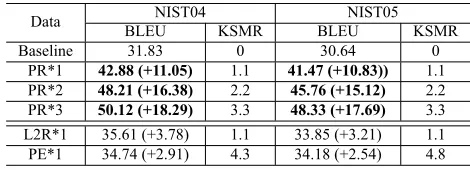
Experiment results show that by performing on-ly one mouse click, the translation quality could be significantly improved (around +2 BLEU points in one PR cycle). Performing both two actions multi-ple times will bring greater gain in translation qual-ity (+17 BLEU) with a relatively low Keystroke and Mouse-action Ratio (KSMR) (Barrachina et al., 2009) (3.3% KSMR).
2 The Pick-Revise IMT Framework
2.1 PRIMT System
We first explain the difference between Pick-Revise (PR) framework and left-to-right
frame-work (Foster et al., 2002) with an example (in Ta-ble 1). For the given input source sentence, the MT system firstly generates a baseline translation. In the left-to-right framework human translator modi-fies the left-most error from "to discuss" to "discuss". But this modification may not bring any positive ef-fects on the other part of the translation. So more interactions are needed to further improve the trans-lation quality.
In our pick-revise framework, the human trans-lator picks the phrase "反 恐" which was consid-ered the most critical translation error, and revise the translation from "the" to "anti-terrorism" according to phrase table. After a PR cycle, our constrained decoder re-translates the sentence. It not only gen-erates the correct translation for the pick-revise pair (PRP), but also improves the translation around the PRP (bold parts).
Compared to left-to-right framework, our frame-work can modify the most critical error at first, which brings larger improvements on translation quality and improves the efficiency of human interactions.
.
. Start.
Constrained Decoder
.
Revising .
Acceptable?
. Model Adaptation .
Picking .
Stop .
s1...sn .
e1...en .
no .
(sji,t) .
(sji,t′) .
yes .
[image:3.612.82.292.52.196.2](sji,t′)
Figure 1:An overview of PRIMT framework.
2.2 Picking
In the picking step, the users pick the wrongly-translated phrase, (sji,t)1, to be revised. The picking process aims at finding critical errors in the transla-tion, caused by errors in the translation table or in-herent translation ambiguities. The more critical the error is, the larger translation quality improvement can be achieved by correcting the error (Mohit and Hwa, 2007). Critical errors might have a large influ-ence to the translation of their context.
To make the picking step easier to be integrated into MT system, we limit the selection of transla-tion errors to be those phrases in the previous PR-cycle output. If it's the first PR-PR-cycle, then those er-rors come from phrases used to generate the base-line translation. For more convenient user interac-tions, in our PRIMT system, critical errors can be picked from both the source and target side by simply a mouse click on it. The correspondence/alignment between source and target phrases are visualized for easier human observation.
Green et al. (2014) demonstrated that perform-ing post-editperform-ing, i.e. directly editperform-ing the translation errors, could get acceptable translations faster than performing left-to-right IMT. Such result also indi-cates that identifying critical translation errors is not a difficult task for human to perform.
2.3 Revising
In the revising step, the users revise the translation ofsji by selecting the correct translationt′ from the translation table, or manually add one if there is no
1sj
i is the phrase that covers the source words from indexi
toj, and translated intot.
correct translation in the translation table. Whether to perform selection or adding depends on the quality of the translation table. When the translation system is trained with large enough parallel data, the quality of the translation table is usually high enough to offer the correct translation.
For a picked phrase, the translation options in the phrase table could be presented to the users as a list. The users just need to click on the correct translation to complete the revising step. The users could also type a new translation through a separated input area.
2.4 Decoder and Model Adaptation
A pick-revise pair (PRP), (sji,t′), is obtained af-ter a PR cycle for a source sentence. We use a con-strained decoder to search for the best translation with the previous PRPs as constraints. The con-strained search algorithm is similar to the algorithm in a typical phrase-based machine translation (Koehn et al., 2003). The only exception is that it makes an extra comparison between each translation option and previous PR pairs, which ignores all the phras-es that overlap with the source side of a PRP. As a result, a lot of translation options are ignored, which makes the search space much smaller than standard decoding. In this way, we could guarantee that all the PRPs are correctly translated and the whole pro-cess can be carried out in real-time.
The system could collect all PRPs and adapt the models using methods described in Germann (2014) or Marie (2015). In our current implementation, we mainly focus on the picking and revising step and leave model adaptation as future work.
3 Automatic Suggestion Models
3.1 The Picking Suggestion Model (PSM)
3.1.1 PSM Training
The picking process aims at selecting critical er-rors which has huge impact on the translation quality of their context. The goal of PSM is to automatical-ly recognize those phrases that might be wrongautomatical-ly- wrongly-translated, and suggest users to pick these phrases. In real world systems, the users can either accept or refuse the suggestion.
Within all the phrases of a source sentence, we need to separate the wrongly-translated phrases and correctly-translated phrases. Because translation er-rors often cause low translation quality, we use the translation quality gain after the revising action as a measurement. We treat those phrases that achieve translation quality improvement after revising as wrongly-translated phrases; those lead to translation quality deterioration as correctly-translated phrases. We select phrases that lead to a BLEU improve-ment/deterioration greater than a threshold as posi-tive/negative instances. In this paper, the threshold is set as 10% of the BLEU score of the baseline sen-tence.
3.1.2 PSM Features
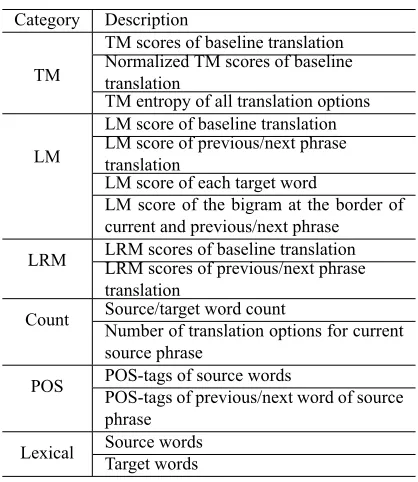
Modeling the picking process needs two aspects of information. One of them is to determine whether the phrase is difficult-to-translate; the other is to de-termine whether the current translation option is cor-rect. We use features from translation models (TM-s), language models (LM(TM-s), lexical reordering mod-els (LRMs), as well as counting and lexical features in Table 2. These features cover information of the source side, target side, translation ambiguity, and context, etc.
3.2 The Revising Suggestion Model (RSM)
3.2.1 RSM Training
The revising process aims at selecting a correc-t correc-translacorrec-tion for a given phrase under correc-the given con-text. The goal of RSM is to predict the correct lation and suggest users to replace the wrong trans-lation with the predicted one. The users can either accept it or use another translation.
Translation table has multiple translation option-s for one phraoption-se. Within the tranoption-slation option option-set of a source phrase, we need to separate the
correc-Category Description
TM
TM scores of baseline translation Normalized TM scores of baseline translation
TM entropy of all translation options
LM
LM score of baseline translation LM score of previous/next phrase translation
LM score of each target word
LM score of the bigram at the border of current and previous/next phrase LRM LRM scores of baseline translationLRM scores of previous/next phrase
translation
Count Source/target word count
Number of translation options for current source phrase
POS POS-tags of source words
POS-tags of previous/next word of source phrase
[image:4.612.322.531.51.292.2]Lexical Source words Target words
Table 2:Features for the PSM.
t and wrong translation options. Instead of asking human translators to label these translations, we use two criteria to distinguish correct translation options from wrong translation options.
Firstly, the correct translation option should be a substring of the references, which ensures the cor-rectness of the options itself. Secondly, the correc-t correc-translacorrec-tion opcorrec-tion should be consiscorrec-tencorrec-t wicorrec-th pre-trained word alignment on the translated sentence pair2. This is to ensure that the translation option does not get credit for words that are not translations of the source side phrase. The remaining options are considered wrong translations.
With the above criteria, we select all correct trans-lation options as positive instances for the revis-ing step, and randomly sample the same number of wrong translation options to be negative instances. Specifically, translation options that are used by the baseline system are included as negative instances.
3.2.2 RSM Features
The features used for RSM are showed in Table 3. For translations of a given source phrase, there is no need to compare their source-side information be-cause these translation options share the same source phrase and context. So these features mainly focus
2
on estimating the translation quality of a given trans-lation option. As a result, features for RSM only in-cluding the scores for TM, LM and LRM, etc, which are simpler compared to PSM.
Category Description
TM TM scores of current translation option LM LM score of current translation option
LM score of each target word
LRM LRM scores of current translation option count Target word count
Lexical Target words
Table 3:Features for the RSM
4 Experiments
4.1 Experiment Settings
4.1.1 Translation Settings
Through out the experiments, we use an in-house implementation of the phrase-based machine trans-lation system (Koehn et al., 2003) and incorpo-rate our PRIMT framework into the translation sys-tem. The parallel data for training the translation model includes 8.2 million sentences pairs from LDC2002E18, LDC2003E14, LDC2004E12,
LD-C2004T08, LDC2005T10, LDC2007T09. A
5-gram language model is trained with MKN smooth-ing (Chen and Goodman, 1999) on Xinhua portion of Gigaword which contains 14.6 million sentences. We use a combination of NIST02 and NIST03 to tune the MT system parameters and train the sug-gestion models. We test the system on NIST04 and NIST05 data. The translation results are evaluated with case insensitive 4-gram BLEU (Papineni et al., 2002). Our baseline phrase-based MT system has comparable performance with the open source toolk-it Moses (Koehn et al., 2003).
4.1.2 Classification Settings
We use three classification models to model the automatic suggestion models: the maximum entropy model, the SVM model and the neural network mod-el. We use a maximum entropy model (Zhang, 2004) with 30 iterations of L-BFGS. We use the LibSVM implementation (Chang and Lin, 2011) with RBF k-ernel and L2 regularization (c= 128,γ = 0.5). We use a feedforward neural network with the CNTK implementation (Agarwal et al., 2014). The neural
network has one hidden layer of 80 nodes, with sig-moid function as the activation function.
We use one-hot representation for the source and target word features when using the maximum en-tropy and SVM model, and use pre-trained word em-beddings (Mikolov et al., 2013) for the neural model.
4.2 Methodology
4.2.1 Simulated Human Interaction
Because real-world human interactions are expen-sive and time-consuming to obtain, we use simulat-ed human interactions for picking and revising in the experiment.
Directly identifying critical errors in the transla-tion is not an easy task without human annotatransla-tion. Instead, we find critical errors by judging the in-fluence of a given error to the translation of their context. We try picking every phrase in a baseline translation result and revising it using the simulated revising strategy (described below). The influence of the phrase is measured by the translation quali-ty improvement after re-translation with the current phrase be revised. The phrase with the highest trans-lation quality improvement is picked to be the simu-lated human picking result.
Given the phrase to be revised, the simulated revising action is straightforward. Among all the translation options that are considered correct (Sec. 3.2.1), we choose the longest one to be the simulated human revising result.
With the above simulated actions, one PR cy-cle takes exactly two mouse clicks and none key-stroke. For fair comparison, we use the same simu-lated revising action for the left-to-right framework. Each cycle of lefto-right framework also takes t-wo mouse clicks. We also compare the post editing method which selects the most critical error and ed-its it to be the simulated revising translation. The key-stroke count for each editing is the number of characters of the correct phrase translation.
4.3 Translation Quality Improvement in Ideal Environment
gen-Data NIST04(forced) NIST05(forced)
BLEU KSMR BLEU KSMR
Baseline 44.59 0 41.48 0
PR*1 63.21 (+18.62) 2.2 55.10 (+13.62) 2.2 PR*2 70.82 (+26.23) 4.3 63.03 (+21.55) 4.4 PR*3 73.99 (+29.50) 6.5 68.56 (+27.08) 6.7 PR*4 75.48 (+30.89) 8.6 72.20 (+30.72) 8.9 PR*5 76.59 (+32.00) 10.8 73.90 (+32.42) 11.1 PR*6 78.07 (+33.48) 12.9 75.22 (+33.74) 13.3 PR*7 79.27 (+34.68) 15.1 75.57 (+34.09) 15.5 PR*8 79.54 (+34.93) 17.2 76.02 (+34.54) 17.8
[image:6.612.310.545.55.140.2]L2R*1 49.32 (+4.73) 2.2 46.34 (+4.86) 2.2 PE*1 49.77 (+5.18) 8.3 46.81 (+5.33) 8.2
Table 4:Experiments on sentences that can be forced-decoded for both NIST04 and NIST05 data, with 186 and 92 sentence counts, respectively. (PR*ndenotes system that repeat picking and revising forn cycles; the PE system post edits the most critical error; the L2R system modifies the left most error).
erate translations exactly the same as the references. A reference translation could be generated by forced decoding means that it won't be necessary to input new words to generate a correct translation. Because we only simulate human revising actions as selecting the best translation option from phrase table (without adding new options), such a setting guarantees that the phrase table contains the correct translation for every phrase.
Table 4 shows that picking and revising the most critical error (PR*1) can bring +18 and +13 BLEU improvements in the two data sets, respectively. Re-vising the left-most error (L2R*1) only achieves an improvement around +5 BLEU. This result demon-strates that picking the critical error to be revised is critical in our PR framework. Compared to the left-to-right method, our framework has the advantage of correcting the critical errors in a high priority. By correcting such errors, the BLEU gain is much larger than left-to-right correction.
Post-editing the most critical error (PE*1) uses 8% KSMR, but only brings +5 BLEU improvement. Compared to post-editing, which just edits the criti-cal error without affecting other parts of the transla-tion, our PRIMT framework can re-decode for better translations with less human interactions.
In 8 PR-cycles (PR*8) (around 17% KSMR), the PRIMT achieves very high quality translation result-s with a BLEU result-score higher than 75 (around +35 BLEU to baseline). These results demonstrate the efficiency of PRIMT in multiple interactions.
Data NIST04 NIST05
BLEU KSMR BLEU KSMR
Baseline 31.83 0 30.64 0
PR*1 42.88 (+11.05) 1.1 41.47 (+10.83)) 1.1 PR*2 48.21 (+16.38) 2.2 45.76 (+15.12) 2.2 PR*3 50.12 (+18.29) 3.3 48.33 (+17.69) 3.3
L2R*1 35.61 (+3.78) 1.1 33.85 (+3.21) 1.1 PE*1 34.74 (+2.91) 4.3 34.18 (+2.54) 4.8
Table 5:Experiments on both NIST04 and NIST05 data. (PR*n denotes system that repeat picking and revising forncycles; the PE system post edits the most critical error; the L2R system corrects the left most error).
ASM Classifier NIST04 NIST05
PSM
MaxEnt 0.70/0.62/0.66 0.69/0.60/0.64 SVM 0.71/0.68/0.69 0.69/0.66/0.67 Feedforward 0.71/0.73/0.72 0.68/0.70/0.69
RSM
MaxEnt 0.71/0.58/0.63 0.70/0.57/0.63 SVM 0.70/0.61/0.0.65 0.68/0.62/0.65 Feedforward 0.66/0.67/0.66 0.65/0.65/0.65
Table 6: Classification performance of automatic suggestion models. The three values of each cell denotes the precision, re-call and F-score, respectively, calculated on positive instances of corresponding classifier.
4.4 Translation Quality Improvement in General Environment
We also validate the improvements of translation quality in a general environment. We perform simi-lar experiments on all NIST04 and NIST05 data. In some of the sentences, the translation table might not contain the correct translation for source phrase, due to the limitation of the training of our current MT system.
[image:6.612.73.302.55.188.2]4.5 Using Automatic Suggestion Models
We validate the effectiveness of our automat-ic suggestion models by both classifautomat-ication perfor-mance and translation perforperfor-mance.
Table 6 shows the classification performances of the PSM and the RSM, with different models. The precision and recall are calculated on positive in-stances in the test set, because only those inin-stances that are predicted as positive will be used in the IMT system. Because it is harder to automatically iden-tify the correct translation, we keep the translation unchanged when the RSM classifies all translation options to be negative.
The performance of the three classifiers are sim-ilar. Feedforward neural network has a moderate advantage. In general, the PSM could recognize the critical translation errors with an F-score around 0.67. The RSM achieves about 0.65 F-score for rec-ognizing the correct translation. The F-scores are all in the range between 60 and 70, which is reasonable considering the difficulty of the tasks themselves.
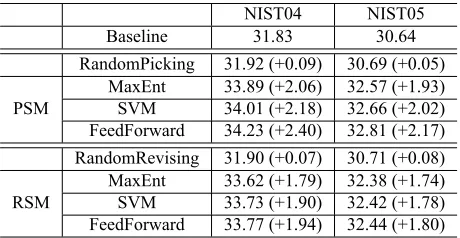
We also evaluate the translation improvements when automatic suggestion models are used in the PR framework (Table 7). If the picking action per-forms a random pick of phrase (RandomPicking), there is barely no improvement in the translation quality, even with the simulated revising action. For comparison, using PSM could achieve a significant BLEU improvement of around 2 BLEU, on both test sets. It suggests that the BLEU gain does not come from the long reference translation match in the re-vising step. Picking critical errors is crucial in our framework.
Choosing the most critical error and performing a random revising action (RandomRevising) brings no improvement in BLEU either. Using our RSM could still improve the translation quality by 1.5 BLEU.
In general, using one of our PSM and RSM could still achieve significant improvement in translation quality. But the uses only need to perform one type of actions, which might be more suitable to be per-formed by a single human translator. However, the improvement is relatively small compared to fully simulated results, suggesting that human involve-ment is still critical for improve the translation qual-ity. Better modeling or training with larger data may also improvement the performance of automatic
sug-NIST04 NIST05 Baseline 31.83 30.64 RandomPicking 31.92 (+0.09) 30.69 (+0.05)
PSM
MaxEnt 33.89 (+2.06) 32.57 (+1.93) SVM 34.01 (+2.18) 32.66 (+2.02) FeedForward 34.23 (+2.40) 32.81 (+2.17) RandomRevising 31.90 (+0.07) 30.71 (+0.08)
RSM
[image:7.612.313.543.55.174.2]MaxEnt 33.62 (+1.79) 32.38 (+1.74) SVM 33.73 (+1.90) 32.42 (+1.78) FeedForward 33.77 (+1.94) 32.44 (+1.80)
Table 7:Improvements of translation quality using random se-lection and automatic suggestion models.
gestions.
5 Example Analysis
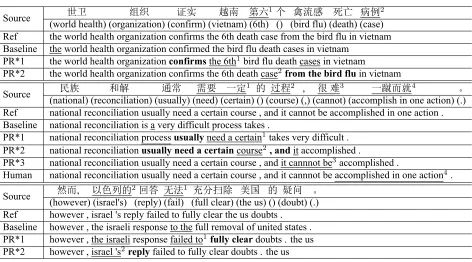
We further analyze the performance of our PRIMT system by examples. Table 8 shows the PRIMT pro-cedure of improving translation quality for three dif-ferent sentences.
In the first sentence, two PR cycles (4.7% KSM-R) lead to a perfect translation. In the first PR cy-cle (PR*1), revising the translation of "第六" from "the" to "the 6th" improves the neighboring transla-tion. The translation of "证实" change from "con-firms" to "confirm", which is a positive effect. In PR*2, revising the translation of "病例" from "cas-es" to "case" also changes the neighborhood transla-tion (the translatransla-tion of "禽流感 死亡 病例" changes to "death case from the bird flu"). After two PR cy-cles, the reference translation is obtained.
In our current settings, the reference translation could not always be obtained. The maximum achiev-able BLEU is around 60-70 in general environment. The next two examples shows some possible expla-nations.
Source 世卫 组织 证实 越南 第六1个 禽流感 死亡 病例2 (world health) (organization) (confirm) (vietnam) (6th) () (bird flu) (death) (case) Ref the world health organization confirms the 6th death case from the bird flu in vietnam Baseline the world health organization confirmed the bird flu death cases in vietnam
PR*1 the world health organizationconfirmsthe 6th1bird flu death cases in vietnam
PR*2 the world health organization confirms the 6th death case2from the bird fluin vietnam
Source 民族 和解 通常 需要 一定1 的 过程2 , 很 难3 一蹴而就4 。
(national) (reconciliation) (usually) (need) (certain) () (course) (,) (cannot) (accomplish in one action) (.) Ref national reconciliation usually need a certain course , and it cannot be accomplished in one action . Baseline national reconciliation is a very difficult process takes .
PR*1 national reconciliation processusuallyneed a certain1takes very difficult . PR*2 national reconciliationusually need a certaincourse2, andit accomplished .
PR*3 national reconciliation usually need a certain course , and it cannnot be3accomplished .
Human national reconciliation usually need a certain course , and it cannnot be accomplished in one action4.
Source 然而, 以色列的2回答 无法1 充分扫除 美国 的 疑问 。 (however) (israel's) (reply) (fail) (full clear) (the us) () (doubt) (.) Ref however , israel 's reply failed to fully clear the us doubts .
[image:8.612.75.547.50.312.2]Baseline however , the israeli response to the full removal of united states . PR*1 however , the israeli response failed to1fully cleardoubts . the us PR*2 however , israel 's2replyfailed to fully clear doubts . the us
Table 8: Examples of applying PR actions multiple times in the Chinese-English translation. The superscriptiof the underline phrases,Piin source sentence denotes the underline phrase is picked in thei-th PR cycle as the critical error. The original translation ofPiis the underline phrase without superscript in PR*(i−1) (Baseline is PR*0). The correct translation is the underline parts with superscript in PR*i. The bold parts shows the positive effects on other parts near the PRPs.
reference. This is because " 一蹴而就" should be translated into "accomplished in one action" instead of "accomplished". But there is no suitable trans-lation options for it in the current phrase table. So the system cannot generate a perfect translation. The problems will be less significant when real-world hu-man translators are involved. Huhu-man translator in-puts the correct translation "accomplished in one ac-tion", the system will generate the reference transla-tion after constrained decoding (Human).
In the last sentence in Table 8, "无法" is picked as the critical error. Revising the translation from "to the" to "failed to", leads to an improvement on neighboring phrase (the translation of "充分扫除" to "fully clear"). In the second PR cycle, "以色列 的" is picked. Revising the translation from "the is-raeli" to "israel 's", makes the translation of "回答" change from "response" to "reply", which is also a positive effect. However, after two PR cycles, all phrase translations are correct, but the translation is still different from the reference. This is because the language model and lexical reordering model prefer the wrong phrase ordering, which put "the us" at the
end of the whole sentence. This problem raises from the MT system itself, which may not be solved di-rectly in our current framework.
If more interactions are allowed, for example, per-forming reordering operations, the above problems could be solved. But the interactions become more complex, and may not be acceptable to human trans-lators. Other solutions includes using better statisti-cal models such as neural language models (Bengio et al., 2003). This is an interesting issue we will look into.
6 Conclusion
action-s. In this case every translator will focus on a single action, which might be easier to train and may have higher efficiency.
On the other hand, the performance of curren-t framework is scurren-till relacurren-ted curren-to curren-the underlying MT sys-tem. Further improvement could be achieved by sup-porting other type of interactions, such as reordering operations, or building the system with stronger sta-tistical models. We will also conduct real-world ex-periments to see how this new IMT framework work-s when human tranwork-slatorwork-s are actually involved.
7 Acknowledgement
The authors would like to thank the anonymous reviewers for their valuable comments. This work is supported by the National Natural Science Founda-tion of China (No. 61300158, 61472183), the Jiang-su Provincial Research Foundation for Basic Re-search (No. BK20130580). This reRe-search is partial-ly supported by the Collaborative Innovation Cen-ter of Novel Software Technology and Industrializa-tion, Nanjing University. Shujian Huang is the cor-responding author.
References
Amit Agarwal, Eldar Akchurin, Chris Basoglu, Guoguo Chen, Scott Cyphers, Jasha Droppo, Adam Ev-ersole, Brian Guenter, Mark Hillebrand, Xuedong Huang, Zhiheng Huang, Vladimir Ivanov, Alexey Kamenev, Philipp Kranen, Oleksii Kuchaiev, Wolf-gang Manousek, Avner May, Bhaskar Mitra, Olivi-er Nano, Gaizka Navarro, Alexey Orlov, Marko Padmilac, Hari Parthasarathi, Baolin Peng, Alex-ey Reznichenko, Frank Seide, Michael L. Seltzer, Malcolm Slaney, Andreas Stolcke, Huaming Wang, Kaisheng Yao, Dong Yu, Yu Zhang, and Geoffrey Zweig. 2014. An introduction to computational net-works and the computational network toolkit. Techni-cal Report MSR-TR-2014-112, August.
Vicent Alabau, Christian Buck, Michael Carl, Francis-co Casacuberta, M Garcıa-Martınez, Ulrich German-n, Jesús González-Rubio, Robin Hill, Philipp KoehGerman-n, LA Leiva, et al. 2014. Casmacat: A computer-assisted translation workbench. In Proceedings of the 14th Conference of the European Chapter of the Associa-tion for ComputaAssocia-tional Linguistics, pages 25--28. Sergio Barrachina, Oliver Bender, Francisco
Casacu-berta, Jorge Civera, Elsa Cubel, Shahram Khadivi, Antonio Lagarda, Hermann Ney, Jesús Tomás, En-rique Vidal, et al. 2009. Statistical approaches to
computer-assisted translation. Computational Lin-guistics, 35(1):3--28.
Yoshua Bengio, Réjean Ducharme, Pascal Vincent, and Christian Janvin. 2003. A neural probabilistic lan-guage model. The Journal of Machine Learning Re-search, 3:1137--1155.
Chih-Chung Chang and Chih-Jen Lin. 2011. Libsvm: a library for support vector machines. ACM Trans-actions on Intelligent Systems and Technology (TIST), 2(3):27.
Stanley F Chen and Joshua Goodman. 1999. An empir-ical study of smoothing techniques for language mod-eling.Computer Speech & Language, 13(4):359--393. George Foster, Philippe Langlais, and Guy Lapalme. 2002. User-friendly text prediction for translators. In
Proceedings of the ACL-02 conference on Empirical methods in natural language processing-Volume 10, pages 148--155. Association for Computational Lin-guistics.
Ulrich Germann. 2014. Dynamic phrase tables for ma-chine translation in an interactive post-editing scenari-o. InAMTA 2014 Workshop on Interactive and Adap-tive Machine Translation, Vancouver, BC, Canada, pages 20--31.
Jesús González-Rubio, Daniel Ortiz-Martínez, José-Miguel Benedí, and Francisco Casacuberta. 2013. In-teractive machine translation using hierarchical trans-lation models. InConference on Empirical Methods in Natural Language Processing, pages 244--254. Spence Green, Sida I Wang, Jason Chuang, Jeffrey
Heer, Sebastian Schuster, and Christopher D Manning. 2014. Human effort and machine learnability in com-puter aided translation. InConference on Empirical Methods in Natural Language Processing, pages 1225--1236.
Philipp Koehn, Franz Josef Och, and Daniel Marcu. 2003. Statistical phrase-based translation. In Proceed-ings of the 2003 Conference of the North American Chapter of the Association for Computational Linguis-tics on Human Language Technology-Volume 1, pages 48--54. Association for Computational Linguistics. Philipp Koehn. 2009. A web-based interactive
comput-er aided translation tool. InProceedings of the ACL-IJCNLP 2009 Software Demonstrations, pages 17--20. Association for Computational Linguistics.
Philippe Langlais, George Foster, and Guy Lapalme. 2000. Transtype: a computer-aided translation typ-ing system. InProceedings of the 2000 NAACL-ANLP Workshop on Embedded machine translation systems-Volume 5, pages 46--51. Association for Computation-al Linguistics.
on Empirical Methods in Natural Language Process-ing.
Tomas Mikolov, Ilya Sutskever, Kai Chen, Greg S Cor-rado, and Jeff Dean. 2013. Distributed representa-tions of words and phrases and their compositionality. InAdvances in neural information processing systems, pages 3111--3119. Neural Information Processing Sys-tems.
Behrang Mohit and Rebecca Hwa. 2007. Localization of difficult-to-translate phrases. InProceedings of the Second Workshop on Statistical Machine Translation, pages 248--255. Association for Computational Lin-guistics.
Franz Josef Och and Hermann Ney. 2003. A systemat-ic comparison of various statistsystemat-ical alignment models.
Computational Linguistics, 29(1):19--51.
Daniel Ortiz. 2011. Advances in fully-automatic and in-teractive phrase-based statistical machine translation. Ph.D. thesis, Universitat Politècnica de València. Kishore Papineni, Salim Roukos, Todd Ward, and
Wei-Jing Zhu. 2002. Bleu: a method for automatic eval-uation of machine translation. InProceedings of the 40th annual meeting on association for computational linguistics, pages 311--318. Association for Computa-tional Linguistics.
Mirko Plitt and François Masselot. 2010. A productivi-ty test of statistical machine translation post-editing in a typical localisation context. The Prague Bulletin of Mathematical Linguistics, 93:7--16.
Germán Sanchis-Trilles, Vicent Alabau, Christian Buck, Michael Carl, Francisco Casacuberta, Mercedes Gar-cía-Martínez, Ulrich Germann, Jesús González-Rubio, Robin L Hill, Philipp Koehn, et al. 2014. Interactive translation prediction versus conventional post-editing in practice: a study with the casmacat workbench. Ma-chine Translation, 28(3-4):217--235.