Proceedings of the 12th International Workshop on Semantic Evaluation (SemEval-2018), pages 88–96
SemEval 2018 Task 6: Parsing Time Normalizations
Egoitz Laparra University of Arizona Tucson, AZ 85721, USA [email protected]
Dongfang Xu University of Arizona Tucson, AZ 85721, USA [email protected]
Steven Bethard University of Arizona Tucson, AZ 85721, USA [email protected]
Ahmed S. Elsayed University of Colorado Boulder
Boulder, CO 80309 [email protected]
Martha Palmer
University of Colorado Boulder Boulder, CO 80309 [email protected]
Abstract
This paper presents the outcomes of the Pars-ing Time Normalization shared task held within SemEval-2018. The aim of the task is to parse time expressions into the compo-sitional semantic graphs of the Semantically Compositional Annotation of Time Expres-sions (SCATE) schema, which allows the rep-resentation of a wider variety of time expres-sions than previous approaches. Two tracks were included, one to evaluate the parsing of individual components of the produced graphs, in a classic information extraction way, and another one to evaluate the quality of the time intervals resulting from the interpretation of those graphs. Though 40 participants reg-istered for the task, only one team submitted output, achieving 0.55 F1 in Track 1 (parsing) and 0.70 F1 in Track 2 (intervals).
1 Introduction
The task of extracting and normalizing time ex-pressions (e.g., finding phrases liketwo days ago
and converting them to a standardized form like 2017-07-17) is a fundamental component of any time-aware language processing system. TempE-val 2010 and 2013 (Verhagen et al.,2010; UzZa-man et al.,2013) included a restricted version of a time normalization task as part of their shared tasks. However, the annotation scheme used in these tasks (TimeML; (ISO,2012)) has some significant lim-itations: it assumes times can be described as a prefix of YYYY-MM-DDTHH:MM:SS (so it can’t represent, e.g., the past three summers), it is unable to represent times that are are relative to events (e.g.,three weeks postoperative), and it fails to reflect the compositional nature of time ex-pressions (e.g., thatfollowingrepresents a similar temporal operation in the following dayandthe following year). This latter issue especially has discouraged machine learning approaches to time
normalization; the most accurate systems for nor-malizing times are still based on sets of complex, manually-constructed rules (Bethard, 2013;Lee et al.,2014;Str¨otgen and Gertz,2015).
The Parsing Time Normalizations shared task is a new approach to time normalization based on the Semantically Compositional Annotation of Time Expressions (SCATE) schema (Bethard and Parker,
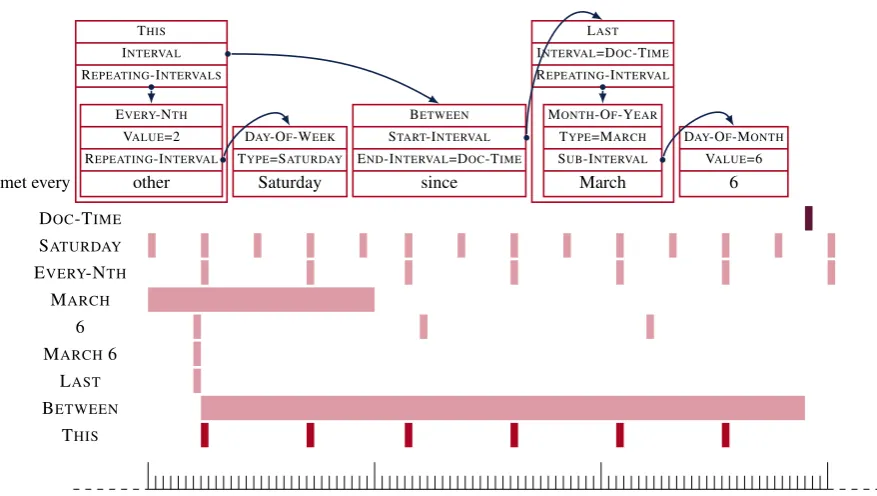
2016), in which times are annotated as composi-tional time entities. Such entities are more expres-sive, being able to represent many more time ex-pressions, and are more machine-learnable, as they can naturally be viewed as a semantic parsing task. The top of Figure1shows an example. Each an-notation in the example corresponds to a formally defined time entity. For instance, the annotation on top ofsincecorresponds to a BETWEENentity that identifies an interval starting at the most re-cent March 6 and ending at the document creation time. The bottom of Figure1shows how those time entities can be composed to identify appropriate in-tervals on the timeline. Here, the BETWEENentity finds the interval on the timeline that is between the intervals of its two arguments: the LASTand the DOC-TIME. Formally, this BETWEENoperator is defined as:
BETWEEN([t1, t2) : INTERVAL,
[t3, t4) : INTERVAL) :INTERVAL = [t2, t3)
In the proposed task, systems need only to iden-tify time entities in text and link them correctly to signal how they are to be composed (i.e., systems would only need to produce annotation structures like those at the top of Figure1). The timeline in-tervals implied by such system output are inferred through a time entity interpreter provided to the participants by the workshop organizers.
met every
THIS
INTERVAL
REPEATING-INTERVALS
EVERY-NTH
VALUE=2 REPEATING-INTERVAL
other
DAY-OF-WEEK
TYPE=SATURDAY Saturday
BETWEEN
START-INTERVAL
END-INTERVAL=DOC-TIME since
LAST
INTERVAL=DOC-TIME
REPEATING-INTERVAL
MONTH-OF-YEAR
TYPE=MARCH
SUB-INTERVAL March
DAY-OF-MONTH
VALUE=6 6 DOC-TIME
SATURDAY EVERY-NTH
MARCH 6 MARCH6
LAST BETWEEN
[image:2.595.72.511.62.310.2]THIS
Figure 1: Example of semantically compositional time annotations and their interpretation.
The remainder of this paper is organized as fol-lows. We describe the task goal and proposed tracks in Section2. Section3contains the descrip-tion of the data annotadescrip-tion schema and the statistics of our dataset. In Section4, we explain the two evaluation metrics used in the task and in Section5
the models used as baselines. We present the partic-ipant systems in Section6and the results obtained in Section7. Finally, we discuss some conclusions learned in Section8.
2 Tasks
The ultimate goal of the shared task is to interpret time expressions, identifying appropriate intervals that can be placed on a timeline. Given a doc-ument, a system must identify the time entities
by detecting the spans of characters and labeling them with the proper SCATE type. Examples of time entities and their corresponding types in Fig-ure1would be (6, DAY-OF-MONTH), (Saturday, DAY-OF-WEEK), (March, MONTH-OF-YEAR) or (since, BETWEEN). Besides the time entities ex-plicitly expressed in the text, implicit occurrences must also be identified, like the THISand LAST time entities in Figure1that do not have any ex-plicit triggers in the text.
Once time entities have been identified, they should be linked together using the relations de-scribed in the SCATE schema. Following with the example in Figure1, the time entity6 should be linked as a SUB-INTERVAL ofMarch, Saturday
should be a REPEATING-INTERVAL of the time entityother, and so on. Finally, all the time entities must be completed with some additional properties needed for their interpretation. For example, the time entityother should have a VALUEof 2, the END-INTERVALofsinceis the Document Creation Time, etc. Once again, the properties required by each time entity type are defined by the SCATE schema.1
Every resulting graph, composed of a set of linked time entities, represents atime expression
that can be semantically interpreted. For this pur-pose, we provide a Scala library2 that reads the graphs in Anafora XML format (Chen and Styler,
2013) and converts them into intervals on the time-line.
An example of interpreting the time entities cor-responding to the expressionevery Saturday since March 6 relative to an anchor time of April 21, 2017 is given in Figure 2. In this example, the valuestodayandresultstore the entities that repre-sent the time expressions April 21, 2017 andevery Saturday since March 6respectively. The Scala command on the right side interprets the latter and produces the corresponding time intervals.
The task includes two evaluation methods, one for the parsing step, i.e. time entity identification
1https://github.com/clulab/
anafora-annotations/blob/master/.schema/ timenorm-schema.xml
scala> val today = | ThisRI( | ThisRI( | Year(2017),
| RepeatingField(MONTH_OF_YEAR, 4)), | RepeatingField(DAY_OF_MONTH, 21)) scala> val result =
| ThisRIs( | Between( | LastRI( | today,
| Intersection(Set(
| RepeatingField(MONTH_OF_YEAR, 3), | RepeatingField(DAY_OF_MONTH, 6)))), | today),
| RepeatingField(DAY_OF_WEEK, 6))
scala> for (Interval(start, end) <- result.intervals) | println(start, end)
(2017-03-11T00:00,2017-03-12T00:00) (2017-03-18T00:00,2017-03-19T00:00) (2017-03-25T00:00,2017-03-26T00:00) (2017-04-01T00:00,2017-04-02T00:00) (2017-04-08T00:00,2017-04-09T00:00) (2017-04-15T00:00,2017-04-16T00:00) (2017-04-22T00:00,2017-04-23T00:00) ...
Figure 2: Interpretation ofevery Saturday since March 6.
and linking, and one to score the resulting time intervals. For the later, we only consider time ex-pressions that yield a finite set of bounded intervals, for example,last Monday. Time expressions that refer to an infinite set of intervals, likeevery month, are not considered in the interval-based part of the evaluation.
Participants only need to produce Anafora out-puts with parsed time entities; the interpretation is carried out by the evaluation system. The eval-uation system is also able to obtain the intervals from timestamps in TimeML format. Thus, sys-tems can be evaluated by both methods or just by the interval-based one, depending on the output format.
In summary, the tasks offers two tracks:
Track 1: Parse text to time entities. Systems must identify time entities in text and link them cor-rectly to signal how they have to be composed. The output must be given in Anafora format. In this track, all time entities and relations of every time expression are evaluated.
Track 2: Produce time intervals. Systems can participate through Track 1 or by providing TimeML annotations. In both cases, the in-tervals are inferred by our interpreter. In this track, only bounded time intervals are scored.
3 Data
The Parsing Time Normalization corpus3 covers two different domains: newswire and clinical notes. For the former, we have annotated a subset of Tempeval-2013 corpus (UzZaman et al., 2013), which contains a collection of news articles from
3https://github.com/bethard/ anafora-annotations/releases
different sources, such as Wall Street Journal, New York Times, Cable News Network, Voices of Amer-ica, etc. For the clinical domain, we have annotated a subset of the THYME corpus used in the Clini-cal TempEvals (Bethard et al.,2015,2016,2017), which includes a set of de-identified clinical notes and pathology reports from cancer patients at the Mayo Clinic.
The Newswire annotation was performed by linguistic students at the University of Alabama at Birmingham, and by linguistics students at the University of Arizona, funded as part of a university-sponsored undergraduate research op-portunity. The clinical portion of the corpus was annotated by linguistics students at the Univer-sity of Colorado, funded as part of the United States National Institutes of Health (NIH) award R01LM010090.
Documents have been annotated by two anno-tators and adjudicated by a third, and despite the complexity of the annotation scheme, high levels of inter-annotator agreement have been achieved: 0.917F1on annotation spans and types, and 0.821
F1on the complete task of spans, types, and links.
(We useF1 since theκcoefficient (Cohen,1960)
converges toF1 in cases where the number of
non-annotations is much larger than the number of an-notations (Hripcsak and Rothschild,2005).)
<data> <annotations>
<entity>
<id>1@e@gold</id>
<span>11,19</span><!-- "Saturday" --> <type>Day-Of-Week</type>
<properties>
<Type>Saturday</Type> </properties>
</entity> <entity>
<id>2@e@gold</id>
<span>10,15</span><!-- "other" --> <type>This</type>
<properties>
<Interval>4@e@gold</Interval>
<Repeating-Intervals>2@e@gold</Repeating-Intervals> </properties>
</entity>
<entity>
<id>3@e@gold</id>
<span>10,15</span><!-- "other" --> <type>Every-Nth</type>
<properties> <Value>2</Value>
<Repeating-Interval>1@e@gold</Repeating-Interval> </properties>
</entity> ...
</annotations> </data>
Figure 3: Snippet of the Anafora XML for Figure1.
participants in both Python4and Scala5.
Table1shows the statistics of the resulting an-notation. The Newswire portion of the corpus con-tains 98 documents with 2,428 time entities anno-tated. These entities compose a total of 968 time expressions of which 564 correspond to bounded intervals. The Clinical portions of the corpus in-cludes 408 documents. The annotation covers 27,362 time entities that compose 8,163 time ex-pressions. From these, 4,204 yield bounded inter-vals.
4 Evaluation Metrics
We propose two types of scoring metrics for this task, one for the evaluation of each track. The first follows a more traditional information extrac-tion evaluaextrac-tion: measure the precision and recall of finding and linking the various time entities. Specifically, we define:
P(S, H) = |S∩H|
|S|
R(S, H) = |S∩H|
|H|
F1(S, H) =
2·P(S, H)·R(S, H)
P(S, H) +R(S, H)
whereSis the set of items predicted by the system
andHis the set of items produced by the humans.
For these calculations, each item is an annotation,
4https://github.com/bethard/ anaforatools
5https://github.com/bethard/timenorm
and one annotation is considered as equal to an-other if it has the same character span (offsets), type, and properties (with the definition applying recursively for properties that point to other anno-tations).
The second scoring method evaluates the ac-curacy of systems with respect to the timeline in a more direct way. First, annotations, in either TimeML or SCATE format, are converted into time intervals. TimeML TIMEX3 (time expres-sion) annotations are translated into intervals fol-lowing ISO 8601 semantics of their VALUE at-tribute. For example, 2010-02-25 is converted to the interval [2010-02-25T00:00:00, 2018-02-26T00:00:00), that is, the 24-hour period starting at the first second of the day on 2010-02-25 and ending just before the first second of the day on 2010-02-26. SCATE annotations are converted to intervals according to the formal semantics of each entity, using the Scala library provided byBethard and Parker(2016). For example, Next(Year(2010), SimplePeriod(YEARS, 4)), is converted to [2011-01-01T00:00, 2015-01-01T00:00), i.e., the 4 years following 2010. Note that there may be more than one interval associated with a single annotation, as in the every Saturday since March 6 example in Figure2. Once all annotations have been converted into intervals along the timeline, we can calculate the overlap between the intervals of different anno-tations.
Given two sets of intervals, we define the in-terval precision,Pint, as the total length of the
in-tervals in common between the two sets, divided by the total length of the intervals in the first set. Interval recall,Rintis defined as the total length
Newswire Clinical Train Dev Test Train Dev Test
Documents 64 14 20 232 35 141
[image:5.595.153.444.72.158.2]SCATE entities 1,628 402 398 14,936 2,896 9,530 SCATE time exp. 636 146 186 4,469 879 2,815 SCATE bounded 391 80 93 2,303 430 1,471
Table 1: Number of documents and SCATE annotations for both sections of the corpus following the SCATE schema.
divided by the total length of the intervals in the second set. Formally:
IS \
IH ={i∩j:i∈IS∧j∈IH}
Pint(IS, IH) =
P
i∈COMPACT(ISTIH) |i| P
i∈IS |i|
Rint(IS, IH) =
P
i∈COMPACT(ISTIH) |i| P
i∈∪IH |i|
whereISandIH are sets of intervals,i∩jis the possibly empty interval in common between the intervalsiandj,|i|is the length of the intervali,
andCOMPACTtakes a set of intervals and merges any overlapping intervals.
Given two sets of annotations (e.g., one each from two time normalization systems), we define the overall precision,P, as the average of interval
precisions where each annotation from the first set is paired with all annotations that textually overlap it in the second set. Overall recall is defined as the average of interval recalls where each annotation from the second set is paired with all annotations that textually overlap it in the first set. Formally:
OIa(B) =
[
b∈B:OVERLAPS(a,b)
INTERVALS(b)
P(S, H) = 1
|S|
X
s∈S
Pint(INTERVALS(s),OIs(H))
R(S, H) = 1
|H|
X
h∈H
Rint(INTERVALS(h),OIh(S))
where S and H are sets of annotations,
INTERVALS(x)gives the time intervals associated
with the annotation x, and OVERLAPS(a, b)
de-cides whether the annotationsaandbshare at least
one character of text in common.
Note that as defined, P andR can be applied
only to time expressions that yield a finite set of bounded intervals.
5 Baseline systems
Two systems were used as baselines to compare the participating systems against.
Character-based model (Laparra et al., 2018) is a novel supervised approach for time normaliza-tion that follows the SCATE schema. This model decomposes the normalization of time expressions into two modules:
time entity identification detects the spans of characters that belong to each time expres-sion and labels them with their correspond-ing time entity type. This step is performed by character-based recurrent neural network with two stacked bidirectional Gated Recur-rent Units.
time entity composition links relevant time enti-ties together while respecting the entity type constraints imposed by the SCATE schema. This component is a rule-based algorithm that iterates over the time entities that are found by the previous step, linking them and filling in the required properties. The version used for the shared task includes some improvements to the sentence segmentation and Month-Of-Year normalization ofLaparra et al.(2018).
These two tasks are run sequentially using the out-put of the former as inout-put to the latter. Once identi-fication and composition steps are completed, the final product, i.e. the semantic composition of the time entities, can fed to the SCATE interpreter to produce time intervals.
HEIDELTIME (Str¨otgen and Gertz, 2015)6 is rule-based temporal tagger with multilingual sup-port that includes English, German, Dutch, Viet-namese, Arabic, Spanish, Italian, French, Chinese and Russian. HeidelTime identifies temporal ex-pressions based on language specific patterns and
normalizes them according to TIMEX annotations (Sundheim,1996). As the output of HeidelTime follows TimeML format, we use this system as a baseline only for Track 2.
6 Participating systems
Although 40 people registered to the the evaluation task, only 1 team submitted results. The team par-ticipated in Track 1 and, consequently, in Track 2. The team also submitted improved results just after the end of the evaluation phase. This improvement was obtained by solving a few bugs in the original system, and with no access to the test data, so we have included the fixed version in this paper as an additional run.
CHRONO (Olex et al.,2018) is a primarily rule-based system that performs time normalization by running the following three steps:
1) Temporal tokens are identified and flagged us-ing regex expressions to identify formatted dates/times, and by parsing out specific tem-poral words and numeric tokens.
2) Temporal phrases are identified by searching for consecutive numeric/temporal tokens ac-cording to certain constraints.
3) Temporal phrases are parsed and normalized into the SCATE schema via detailed rule-based parsing, including the utilization of part-of-speech tags, to identify each component of an expression and link sub-intervals appropri-ately.
A machine learning approach is taken to disam-biguate PERIODSand CALENDAR-INTERVALS af-ter the rule-base parsing has deaf-termined it is one or the other (e.g. if it sees the wordweek it will pass it to the ML module for assignment to a PERI -ODSor CALENDAR-INTERVALS). The ML feature vector is a boolean vector composed of the target token’s temporal status (1=temporal, 0=not tempo-ral), the temporal context (1=at least one temporal token within a window of±5, 0=no temporal
to-kens within window), the numeric context (1=a numeric token exists immediately before of after the target, 0=no numeric tokens in context), and the lexical context of all words within a 5-word win-dow of the target (1=word is present, 0=word is not present). The group explored different supervised models like naive Bayes, decision trees, support vector machines, and neural networks. They found
Domain Model F1 P R
Newswire Character 0.51 0.57 0.46 Newswire Chrono 0.44 0.46 0.42 Newswire Chrono* 0.55 0.61 0.50 Clinical Character 0.57 0.52 0.63
Table 2: Official results in Track 1 (parsing) for the Newswire and Clinical domains.
that the best results were obtained by the neural network.
CHRONO* improves the previous version by solving three bugs in the model. First, the parsing method for various types of temporal components were supposed to be executed in a specific order. However, some of them were swapped and not an-alyzed in the expected order. Second, the system was supposed to assume there is only one year, one month, and one day mentioned per temporal phrase. This worked for the month and day, however, it was failing with 4-digit years. Finally, for most parsing methods the system loops through each token in the temporal phrase but it skipped the loop when identifying full numeric expressions, like ”1953” or ”08091998”. Thus, phrases like ”Last 1953” were not being counted as having any numeric val-ues in them.
7 Evaluation Results
The official results are presented in Table2and Ta-ble4. For each track we present the precision (P),
recall (R) andF1score obtained by the metrics
pre-sented in Section4. The only participant of the task submitted output just for the Newswire domain, thus, we only report the performance of this system in this domain. The results of the Character-based baseline have been obtained training the model with the training set of the corresponding domain (Newswire or Clinical) and a set of randomly gen-erated dates, as explained inLaparra et al.(2018). In Track 1 (Table 2) the original version of CHRONOdo not reach the Character-based base-line, 0.44F1 vs 0.51F1. However, the fixed
ver-sion of the system (CHRONO*) outperforms the baseline in terms ofF1 (0.55) as well as in terms
ofP (0.61) andR(0.50).
[image:6.595.311.518.72.146.2]prop-SCATE-type # Char Chrono* AMPM-Of-Day 1 0.000 0.667
After 19 0.000 0.000
Before 20 0.105 0.000
Between 7 0.000 0.000
Calendar-Interval 27 0.698 0.526 Day-Of-Month 22 0.917 1.000 Day-Of-Week 16 0.812 0.903 Hour-Of-Day 2 0.000 0.667 Intersection 3 0.000 0.000
Last 40 0.500 0.333
Minute-Of-Hour 1 0.000 0.000 Month-Of-Year 36 0.824 0.917
Next 14 0.053 0.412
NthFromStart 4 0.000 0.000
Number 27 0.596 0.522
Part-Of-Day 3 0.000 1.000
Period 56 0.391 0.409
Season-Of-Year 10 0.000 0.182
Sum 1 0.000 0.000
This 37 0.429 0.552
Time-Zone 1 0.000 0.000 Two-Digit-Year 1 0.000 0.000
[image:7.595.82.282.67.400.2]Year 50 0.822 0.826
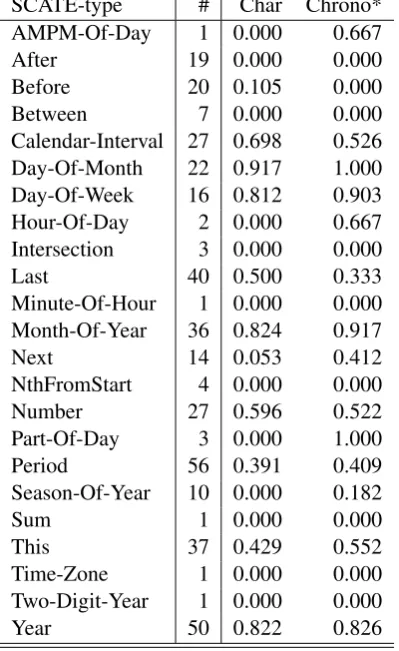
Table 3: Results in Track 1 per SCATE type. Char stands for Character-based baseline. The number of gold cases per type is included (#).
Domain Model F1 P R
Newswire HeidelTime 0.74 0.71 0.77 Newswire Character 0.77 0.83 0.72 Newswire Chrono 0.65 0.66 0.63 Newswire Chrono* 0.70 0.65 0.75 Clinical HeidelTime 0.70 0.60 0.82 Clinical Character 0.72 0.70 0.75
Table 4: Official results in Track 2 (intervals) for the Newswire and Clinical domains.
erties and links. In general, CHRONO* performs better or similar for all the types. It is remarkable that, while the outcomes for the THISand NEXT operators are much better, CHRONO* fails to ex-tract properly the LASToperator.
In Track 2 (Table 4) the best system is the Character-based baseline with 0.76F1, followed
by HEIDELTIMEwith 0.74F1. None of the
ver-sions of CHRONO performs better than the base-lines, although the fixed version (CHRONO*) gets enhanced results, 0.65F1vs 0.70F1 , following
the improvement obtained in Track 1. It is
re-markable that HEIDELTIME and CHRONO*, es-sentially rule-based systems, obtain betterRthan the Character-based baseline, that relies strongly on a supervised model. Specifically, HEIDELTIME obtains the bestR(0.77), but CHRONO* also out-performs the Character-based baseline in terms of
R, 0.75 vs 0.71. However, the Character-based
baseline obtains a much higherP (0.83) than the 0.71 of HEIDELTIMEand the 0.65 of CHRONO*.
As explained in Section4, the metric for Track 1 evaluates the individual temporal components extracted by the systems, either time entities or links between time entity pairs. On the other hand, the intervals scored by the metric for Track 2 are produced by interpreting the whole graph. More-over, not all the time expressions yield a finite set of bounded intervals, as can be seen in Table 1. Consequently, better performances in Track 1 do not necessarily yield better results in Track 2. In particular, although CHRONO* is better than the Character-based baseline in Track 1 it produces an excessive number of time expressions yielding bounded intervals (108), which affects the P in
Track 2. In contrast, the Character-based baseline is more conservative and accurate in this respect (85).
Although we didn’t receive any submission for the Clinical domain, in order to set a reference for future research, we present in Table2and Table4
the performances of the baseline systems in this domain.
8 Conclusion
The Parsing Time Normalization task is the first effort to extend time normalization to richer and more complex time expressions. We have provided a complete annotation for two different domains, newswire and clinical notes, and introduced two different metrics for evaluation. In particular, the interval based evaluation for Track 2 is a novelty for these kind of tasks. The performance of the systems shows that there is still room for improve-ment, especially for Track 1.
Although, CHRONOS included a small super-vised component in its architecture, we were ex-pecting a higher number of machine learning based approaches. However, CHRONOSshows that rule-based models can obtain competitive results. Sadly, the scarcity of participating systems does not allow us to form a further judgment.
[image:7.595.82.282.78.404.2]domain, despite a wider and more complete dataset for this domain. This was almost certainly the result of a change in management at the Mayo Clinic that put on hold the data use agreement process (which is required for access to the clinical data) for several months during the practice phase. Thus, though many people showed interest in the task (more than 40 people registered) and Mayo reported several data use agreement applications, this problem de-motivated the participation.
The CodaLab competition for the Parsing Time Normalizations shared task7 will continue to ac-cept submissions in its Post-Evaluation phase in-definitely, so as more researchers make it through the data use agreement process, we expect we will see future participation in this task.
Acknowledgements
The work is funded by the THYME project (R01LM010090) from the National Library Of Medicine. The content is solely the responsibil-ity of the authors and does not necessarily repre-sent the official views of the National Library Of Medicine or the National Institutes of Health.
References
Steven Bethard. 2013. A synchronous context free grammar for time normalization. InProceedings of the 2013 Conference on Empirical Methods in Natu-ral Language Processing, pages 821–826, Seattle, Washington, USA. Association for Computational Linguistics.
Steven Bethard, Leon Derczynski, Guergana Savova, James Pustejovsky, and Marc Verhagen. 2015. Semeval-2015 task 6: Clinical tempeval. In Pro-ceedings of the 9th International Workshop on Se-mantic Evaluation (SemEval 2015), pages 806–814, Denver, Colorado. Association for Computational Linguistics.
Steven Bethard and Jonathan Parker. 2016. A semanti-cally compositional annotation scheme for time nor-malization. In Proceedings of the Tenth Interna-tional Conference on Language Resources and Eval-uation (LREC 2016), Paris, France. European Lan-guage Resources Association (ELRA). [Acceptance rate 60%].
Steven Bethard, Guergana Savova, Wei-Te Chen, Leon Derczynski, James Pustejovsky, and Marc Verhagen. 2016. Semeval-2016 task 12: Clinical tempeval. In
Proceedings of the 10th International Workshop on
7https://competitions.codalab.org/ competitions/17286
Semantic Evaluation (SemEval-2016), pages 1052– 1062, San Diego, California. Association for
Com-putational Linguistics.
Steven Bethard, Guergana Savova, Martha Palmer, and James Pustejovsky. 2017. Semeval-2017 task 12: Clinical tempeval. In Proceedings of the 11th International Workshop on Semantic Evalua-tion (SemEval-2017), pages 565–572, Vancouver, Canada. Association for Computational Linguistics.
Wei-Te Chen and Will Styler. 2013. Anafora: A web-based general purpose annotation tool. In Proceed-ings of the 2013 NAACL HLT Demonstration Ses-sion, pages 14–19, Atlanta, Georgia. Association for Computational Linguistics.
Jacob Cohen. 1960. A coefficient of agreement for nominal scales. Educational and Psychological Measurement, 20(1):37–46.
George Hripcsak and Adam S. Rothschild. 2005. Agreement, the f-measure, and reliability in infor-mation retrieval. Journal of the American Medical Informatics Association, 12(3):296–298.
ISO. 2012. Language resource management – seman-tic annotation framework (semaf) – part 1: Time and events (semaf-time, iso-timeml). Technical report. 24617-1:2012.
Egoitz Laparra, Dongfang Xu, and Steven Bethard. 2018. From characters to time intervals: New paradigms for evaluation and neural parsing of time normalizations. Transactions of the Association for Computational Linguistics.
Kenton Lee, Yoav Artzi, Jesse Dodge, and Luke Zettle-moyer. 2014. Context-dependent semantic parsing for time expressions. InProceedings of the 52nd An-nual Meeting of the Association for Computational Linguistics (Volume 1: Long Papers), pages 1437– 1447, Baltimore, Maryland. Association for
Compu-tational Linguistics.
Amy Olex, Luke Maffey, Nicholas Morgan, and Brid-get McInnes. 2018. Chrono at semeval-2018 task 6: A system for normalizing temporal expressions. InProceedings of the 12th International Workshop on Semantic Evaluation (SemEval-2018), New Or-leans, Luisiana. Association for Computational Lin-guistics.
Jannik Str¨otgen and Michael Gertz. 2015. A baseline temporal tagger for all languages. In Proceedings of the 2015 Conference on Empirical Methods in Natural Language Processing, pages 541–547, Lis-bon, Portugal. Association for Computational Lin-guistics.
Beth M. Sundheim. 1996. Overview of results of the muc-6 evaluation. InProceedings of a Workshop on Held at Vienna, Virginia: May 6-8, 1996, TIPSTER ’96, pages 423–442, Stroudsburg, PA, USA.
Naushad UzZaman, Hector Llorens, Leon Derczyn-ski, James Allen, Marc Verhagen, and James Puste-jovsky. 2013. Semeval-2013 task 1: Tempeval-3: Evaluating time expressions, events, and temporal relations. InSecond Joint Conference on Lexical and Computational Semantics (*SEM), Volume 2: Proceedings of the Seventh International Workshop on Semantic Evaluation (SemEval 2013), pages 1– 9, Atlanta, Georgia, USA. Association for Compu-tational Linguistics.