Proceedings of NAACL-HLT 2018, pages 164–168
Determining Event Durations: Models and Error Analysis
Alakananda Vempala, Eduardo Blanco and Alexis Palmer University Of North Texas
[email protected], [email protected] [email protected]
Abstract
This paper presents models to predict event durations. We introduce aspectual features that capture deeper linguistic information than pre-vious work, and experiment with neural net-works. Our analysis shows that tense, aspect and temporal structure of the clause provide useful clues, and that an LSTM ensemble cap-tures relevant context around the event.
1 Introduction
Robust textual understanding requires identifying events and temporal relations between them. Be-yond event participants, a crucial piece of informa-tion regarding events is their durainforma-tion, an attribute rarely mentioned explicitly. For example,taking a
showerlasts a few minutes (not days), and a
vaca-tionlasts a few days (not years). Core tasks such as temporal understanding and reasoning, as well as applications such as temporal question answering (Llorens et al.,2015) would benefit from knowing the expected duration of events.
Consider a system that extracts temporal rela-tions such asIS INCLUDED(Cassidy et al.,2014, among others). When deciding whether a relation holds between an event and a temporal expression, such a system would benefit from knowing the du-ration of the event at hand. For example, argu-mentyofIS INCLUDED(built a house,y) must be a temporal span ranging from a few weeks to a year—the expected duration ofbuilt a house. Thus relation candidates such as IS INCLUDED(built a
house,4/5/2016) could be discarded right away. Similarly, event durations combined with event ordering and temporal anchoring would help to de-termine the time of subsequent events. For ex-ample, if John Doe started his drive to work at 8:00am, it is reasonable to expect him to start working by 9:00am because commuting took him (most likely) between a few minutes to an hour.
In this paper, we classify events based on their expected duration. Specifically, we differentiate between events whose duration is less than a day, and events whose duration is a day or more. The main contributions are: (a) linguistically moti-vated features that yield better results than previ-ous work, (b) an LSTM ensemble that obtains the best results to date, and (c) error analysis shedding light on the benefits of our models.
2 Related Work
TimeBank (Pustejovsky et al.,2006) is the corpus of reference for temporal information. The anno-tations follow TimeML (Pustejovsky et al.,2010) and include events, temporal expressions (e.g.,last
Friday), temporal signals (e.g.,when,during), and
links encoding relations. TimeBank does not an-notate the expected duration of events.
Annotating and learning event durations was pioneered by Pan et al. (2011), who annotated the events in TimeBank with their expected dura-tions.Gusev et al.(2011) use query patterns in an unsupervised approach to predict the duration of events. The work presented here builds upon these previous works: we introduce additional features and an LSTM ensemble that obtains the best re-sults to date. The new features are inspired by pre-vious work on assigning situation entity (SE) type labels to clauses (Friedrich et al.,2016). SE types are a linguistic categorization of semantic clause type, whereby each clause is labeled according to the type of situation it introduces to a discourse (STATE, EVENT, GENERIC, and GENERALIZING SENTENCE(also known as habituals)).
Other related works include efforts modeling event durations in social media (Williams and Katz, 2012), and temporal anchoring of, among others, durative events (Reimers et al.,2016).
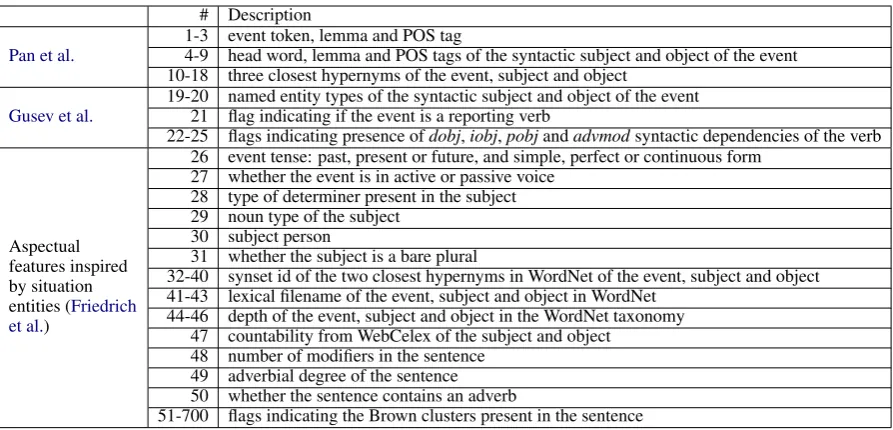
# Description
Pan et al. 1-3 event token, lemma and POS tag4-9 head word, lemma and POS tags of the syntactic subject and object of the event 10-18 three closest hypernyms of the event, subject and object
Gusev et al. 19-20 named entity types of the syntactic subject and object of the event21 flag indicating if the event is a reporting verb
22-25 flags indicating presence ofdobj,iobj,pobjandadvmodsyntactic dependencies of the verb
Aspectual features inspired by situation entities (Friedrich et al.)
26 event tense: past, present or future, and simple, perfect or continuous form 27 whether the event is in active or passive voice
28 type of determiner present in the subject 29 noun type of the subject
30 subject person
31 whether the subject is a bare plural
32-40 synset id of the two closest hypernyms in WordNet of the event, subject and object 41-43 lexical filename of the event, subject and object in WordNet
44-46 depth of the event, subject and object in the WordNet taxonomy 47 countability from WebCelex of the subject and object
48 number of modifiers in the sentence 49 adverbial degree of the sentence 50 whether the sentence contains an adverb
[image:2.595.76.523.60.275.2]51-700 flags indicating the Brown clusters present in the sentence
Table 1: Feature set to predict the expected duration of events with SVM. Features 1–25 were previously proposed for the same task. Features 26–700 are inspired by previous work assigning situation entity types to clauses (2016).
3 Corpus
We use the corpus byPan et al.(2011), who anno-tated the events in TimeBank (Pustejovsky et al.,
2003) with their expected durations by specify-ing upper and lower bounds. The authors clus-tered these bounds into two labels: less than a day (<day) and a day or longer (≥day), and the corpus
contains 2,354 events (<day: 958, ≥day: 1,396). The same event predicate may have different dura-tions depending on context as exemplified below:
• I want to be absolutely clear, to the extent
there is any implication that Mrs. Currie be-lieves that the President or anyone else tried to influence her recollection, that is abso-lutely false and a mischaracterization of the
facts. Duration ofwant:<day.
• Nationalists want to move towards Irish unity
and see this process as a bridge in that direc-tion. Duration ofwant:≥day.
4 Experiments and Results
We experiment with traditional SVM and neural networks. Our rationale behind SVM is to (a) in-corporate deeper linguistic features than previous work, and (b) establish a solid baseline. We exper-iment with neural networks to evaluate the abil-ity of word embeddings and recurrent neural net-works to capture the context required to determine event durations. Regarding SVM, we use scikit-learn (Pedregosa et al., 2011). Regarding neu-ral networks, we use Keras (Chollet et al.,2015)
with TensorFlow backend (Abadi et al.,2015). All networks use GloVe embeddings with 300 dimen-sions (Pennington et al.,2014) and the Adam opti-mizer (Kingma and Ba,2014). We use grid search and 5-fold cross-validation to tune hyperparame-ters (C andγ for SVM, and batch size, dropout rate, etc. for neural networks).
4.1 Support Vector Machine
Table 1 describes the full feature set. We use spaCy1to tokenize the input text and extract lem-mas, part-of-speech tags, named entities, and de-pendencies. The features byPan et al.(2011) and
Gusev et al.(2011) capture primarily lexical infor-mation, relying on tendencies of particular words to denote events of certain durations. These ten-dencies are, however, subject to contextual influ-ence. Duration is one component of the internal temporal structure of events, and as such it is an important factor for distinguishing between var-ious aspectual categories (Vendler, 1957; Smith,
1991). It thus stands to reason that other features which capture aspectual distinctions may also cor-relate with event duration and be useful for clas-sifying the duration of events in texts. In order to explore this intuition, we adapt features from a system designed to assign situation entity types to clauses (Friedrich et al., 2016). Diagnostic crite-ria for situation entity types include lexical aspect (stative vs. dynamic) of the main verb, generic-ity of the clause’s subject, and whether the clause
S
of
tm
ax
LSTM .. .. LSTM
Previously word
embedding additional embedding
LSTM .. .. LSTM
,
LSTM .. .. LSTM
watch
LSTM .. .. LSTM
imports
LSTM .. .. LSTM
were
LSTM .. ..
denied
LSTM .. .. LSTM
such
LSTM .. .. LSTM
duty-free
LSTM .. .. LSTM
treatment
LSTM .. .. LSTM
[image:3.595.72.522.64.153.2].
Figure 1: Neural network architecture to predict event durations. The output layer combines (a) the embedding of the verb at hand and (b) the output of three LSTMs: one for the whole sentence (bottom), one for the tokens before the event (top left), and one for the tokens after the event (top right).
is episodic, habitual, or static. It is primarily these criteria which features 26-50 aim to cap-ture. For example, bare plural subjects with a sim-ple present tense verb (e.g., Bats eat mosquitos) are a hallmark of GENERIC clauses. Although situation entity types do not directly map onto the duration labels (<day or ≥day), the criteria which contribute to determining them clearly in-fluence aspectual interpretation, thus influencing understanding of the duration of events. Regard-ing Brown clusters, we use freely available clus-ters trained on news data byTurian et al. (2010) using the implementation byLiang(2005). We in-clude one feature per cluster and set it to true if any word in the sentence belongs to the cluster.
4.2 Feed-Forward Neural Network
The first neural network we experiment with is a one-hidden-layer feed-forward neural network that takes as input the event embedding. The tun-ing process revealed that the size of the hidden layer is not important, thus we report results us-ing a hidden layer with 5 neurons. Intuitively, this vanilla network evaluates whether pretrained word embeddings can predict the duration of events.
4.3 LSTM Ensemble
The LSTM ensemble is an improvement of the vanilla feed-forward neural network. It combines the event embedding with three LSTMs ( Hochre-iter and Schmidhuber, 1997) capturing different context around the event (Figure 1). The first LSTM (200 units, bottom in Figure1) take as in-puts the full sentence, and each token is repre-sented by two embeddings: the word embedding (blue in Figure1) and an additional embedding in-dicating whether the token is the event of interest or not (light and dark grey). The other two LSTMs (200 units each, top in Figure1) take as input the sequence of tokens before and after the event at
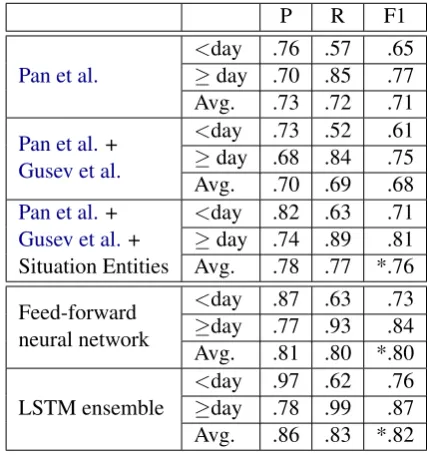
P R F1
Pan et al. <day≥day .70 .85.76 .57 .65.77
Avg. .73 .72 .71
Pan et al.+
Gusev et al.
<day .73 .52 .61
≥day .68 .84 .75 Avg. .70 .69 .68
Pan et al.+
Gusev et al.+ Situation Entities
<day .82 .63 .71
≥day .74 .89 .81
Avg. .78 .77 *.76
Feed-forward neural network
<day .87 .63 .73
≥day .77 .93 .84
Avg. .81 .80 *.80
LSTM ensemble <day≥day .97 .62.78 .99 .76.87
[image:3.595.308.522.219.447.2]Avg. .86 .83 *.82
Table 2: Results obtained using SVM and several fea-ture combinations (top), and neural networks (bottom). We indicate statistical significance with respect toPan et al.(2011) with *. Avg. stands for weighted average.
hand, respectively, and each token is represented by the corresponding word embedding. Word em-beddings remain fixed, but the additional embed-dings are initialized randomly and tuned during training along with all other network parameters.
4.4 Results
features (F1: 0.76), showing that the latter features capture contextual information useful to determine event durations. The feed-forward neural net-work outperforms the SVM (F1: 0.80) although it doesn’t have access to the context surrounding the event at hand. This shows that embeddings alone are effective at predicting event durations. Finally, despite the relatively small dataset, the LSTM en-semble complements the pretrained verb embed-ding with distributional representations of the con-text around it (the full sentence, and the words be-fore and after the event), yielding an 0.82 F1.
5 Error Analysis
In this section, we provide insights into why the additional aspectual features and neural networks are useful to predict event durations.
Aspectual features yield 7% improvement in overall F1 (0.71 vs. 0.76). Here are some exam-ples that benefit from these features:
• The company said 80% of its auction
busi-ness is usually conducted in the second and
fourth quarters. Theadverbial degreefeature
(feature 49) characterizes thatconductedis a habitual event and made the SVM correctly classify this event into≥day.
• Nationalists want to move towards Irish unity
and see this process as a bridge in that direc-tion. The subject of want is the bare plural
Nationalists(feature 31), which in turn
indi-cates that the event duration is≥day.
• Sotheby’s Holdings Inc., the parent of
the auction house Sotheby’s, said its net loss for the seasonally slow third quarter narrowed from a year earlier on a leap
in operating revenue. The event narrowed
belongs to the WordNet lexical filename
verb.change and its object (loss) belongs to
noun.possession. These semantic classes
(features 41–43) made the classifier correctly predict≥day. Another important lexical file-name isverb.possession, all events belonging to this filename are annotated≥day.
Neural Networksoutperform any feature combi-nation despite not having explicit access to any in-formation beyond the sentence to which the event belongs and pretrained word embeddings. Word embeddings alone are surprisingly effective for this task (feed-forward neural network F1: 0.80), and benefit especially when the event at hand has not been seen in training. Similar to the
Word-Net lexical filenames, embeddings cluster together events with similar durations. The benefit of em-beddings is, however, that they are pretrained on massive amounts of data and virtually account for any event (all the events annotated in the corpus we work with have a GloVe embedding). Here is an example of an unseen event in training that the embeddings predict correctly:
• Revenue totaled $1.01 billion, a 43%
in-crease from $704.4 million, reflecting the
company’s acquisition of Emery earlier this
year. The feed-forward neural network and
embeddings learnt that mathematical expres-sions last less than a day (<day).
Although the difference in F1 is small (0.82 vs. 0.80), the LSTM ensemble successfully captures context required to predict event durations. Here are two examples that benefit:
• The Portland, Ore., thrift said the
restructur-ing should help it meet new capital standards from the Financial Institution Reform,
Recov-ery and Enforcement Act. The fact that
re-structuringappears nearby and has duration
≥day helps the LSTM ensemble predict that
meetalso has duration≥day in this context,
despite most meetings lasting less than a day. Also, the LSTM ensemble has access only to the nearby events but not to their duration.
• In over-the-counter trading yesterday,
Ben-jamin Franklin rose 25 cents to$4.25
(dura-tion: <day). The LSTM ensemble is very successful when temporal cues surrounding the event at hand are present (e.g.,yesterday).
6 Conclusions
References
Mart´ın Abadi, Ashish Agarwal, Paul Barham, Eugene Brevdo, Zhifeng Chen, Craig Citro, Greg S. Cor-rado, Andy Davis, Jeffrey Dean, Matthieu Devin, Sanjay Ghemawat, Ian Goodfellow, Andrew Harp, Geoffrey Irving, Michael Isard, Yangqing Jia, Rafal Jozefowicz, Lukasz Kaiser, Manjunath Kudlur, Josh Levenberg, Dan Man´e, Rajat Monga, Sherry Moore, Derek Murray, Chris Olah, Mike Schuster, Jonathon Shlens, Benoit Steiner, Ilya Sutskever, Kunal Tal-war, Paul Tucker, Vincent Vanhoucke, Vijay Vasude-van, Fernanda Vi´egas, Oriol Vinyals, Pete Warden, Martin Wattenberg, Martin Wicke, Yuan Yu, and Xi-aoqiang Zheng. 2015. TensorFlow: Large-scale ma-chine learning on heterogeneous systems. Software available from tensorflow.org.
Taylor Cassidy, Bill McDowell, Nathanael Chambers, and Steven Bethard. 2014. An annotation frame-work for dense event ordering. InProceedings of the 52nd Annual Meeting of the Association for
Com-putational Linguistics (Volume 2: Short Papers),
pages 501–506, Baltimore, Maryland. Association for Computational Linguistics.
Franc¸ois Chollet et al. 2015. Keras. https://
github.com/fchollet/keras.
Annemarie Friedrich, Alexis Palmer, and Manfred Pinkal. 2016. Situation entity types: automatic clas-sification of clause-level aspect. InProceedings of the 54th Annual Meeting of the Association for
Com-putational Linguistics (Volume 1: Long Papers),
pages 1757–1768, Berlin, Germany. Association for Computational Linguistics.
Andrey Gusev, Nathanael Chambers, Pranav Khaitan, Divye Khilnani, Steven Bethard, and Dan Juraf-sky. 2011. Using query patterns to learn the dura-tion of events. InProceedings of the Ninth
Inter-national Conference on Computational Semantics,
IWCS ’11, pages 145–154, Stroudsburg, PA, USA. Association for Computational Linguistics.
Sepp Hochreiter and J¨urgen Schmidhuber. 1997. Long short-term memory. Neural Comput., 9(8):1735– 1780.
Diederik P. Kingma and Jimmy Ba. 2014. Adam: A method for stochastic optimization. CoRR, abs/1412.6980.
Percy Liang. 2005. Semi-supervised learning for nat-ural language. Ph.D. thesis, Massachusetts Institute of Technology.
Hector Llorens, Nathanael Chambers, Naushad UzZa-man, Nasrin Mostafazadeh, James Allen, and James Pustejovsky. 2015. Semeval-2015 task 5: Qa tem-peval - evaluating temporal information understand-ing with question answerunderstand-ing. InProceedings of the 9th International Workshop on Semantic Evaluation
(SemEval 2015), pages 792–800, Denver, Colorado.
Association for Computational Linguistics.
Feng Pan, Rutu Mulkar-Mehta, and Jerry R Hobbs. 2011. Annotating and learning event durations in text. Computational Linguistics, 37(4):727–752. F. Pedregosa, G. Varoquaux, A. Gramfort, V. Michel,
B. Thirion, O. Grisel, M. Blondel, P. Pretten-hofer, R. Weiss, V. Dubourg, J. Vanderplas, A. Pas-sos, D. Cournapeau, M. Brucher, M. Perrot, and E. Duchesnay. 2011. Scikit-learn: Machine learning in Python. Journal of Machine Learning Research, 12:2825–2830.
Jeffrey Pennington, Richard Socher, and Christo-pher D. Manning. 2014. Glove: Global vectors for word representation. InEmpirical Methods in
Nat-ural Language Processing (EMNLP), pages 1532–
1543.
J. Pustejovsky, P. Hanks, R. Sauri, A. See, R. Gaizauskas, A. Setzer, D. Radev, B. Sund-heim, D. Day, L. Ferro, and M. Lazo. 2003. The TIMEBANK corpus. In Proceedings of Corpus Linguistics 2003, pages 647–656, Lancaster. James Pustejovsky, Kiyong Lee, Harry Bunt, and
Lau-rent Romary. 2010. Iso-timeml: An international standard for semantic annotation. In Proceedings of the Seventh International Conference on
Lan-guage Resources and Evaluation (LREC’10),
Val-letta, Malta. European Language Resources Associ-ation (ELRA).
James Pustejovsky, Mark Verhagen, Roser Saur´ı, Jes-sica Littman, Robert Gaizauskas, Graham Katz, In-derjeet Mani, Robert Knippen, and Andrea Setzer. 2006. Timebank 1.2. Linguistic Data Consortium. Nils Reimers, Nazanin Dehghani, and Iryna Gurevych.
2016. Temporal anchoring of events for the time-bank corpus. In Proceedings of the 54th Annual Meeting of the Association for Computational
Lin-guistics (Volume 1: Long Papers), pages 2195–
2204, Berlin, Germany. Association for Computa-tional Linguistics.
Carlota S Smith. 1991. The parameter of Aspect, vol. 43 of Studies in Linguistics and Philosophy. Kluwer, Dordrecht.
Joseph Turian, Lev Ratinov, and Yoshua Bengio. 2010. Word representations: a simple and general method for semi-supervised learning. InProceedings of the 48th annual meeting of the association for compu-tational linguistics, pages 384–394. Association for Computational Linguistics.
Zeno Vendler. 1957. Verbs and times. The philosophi-cal review, pages 143–160.