I·
I
I,
I
I
.,.
-.'
'EUR0"STATIS11'
-s
Data for short-term economic
anal
s,is
EUROSTATISTl:QU_~ __
.S
Donnees pour
!'analyse
de la
conjonc ~Ee
\
..
·
~
eurostat
DE EUROP.tEISKE F.tELLESSKABERS STATISTISKE KONTOR
STATISTISCHES AMT DER EUROPAISCHEN GEMEINSCHAFTEN
HATIHIKH YnHPELIA TON EYPOnAfKON KOINOTHTON
STATISTICAL OFFICE OF THE EUROPEAN COMMUNITIES
OFFICE STATISTIQUE DES COMMUNAUTES EUROPEENNES
ISTITUTO STATISTICO DELLE COMUNITA EUROPEE
BUREAL
1VOOR DE STATISTIEK DER EUROPESE GEMEENSCHAPPEN
L-2920 Luxembourg
-
Tel. 43011
-
Telex: Comeur Lu 3423
B-1049 Bruxelles, Batiment Berlaymont, Rue de la Loi 200 (Bureau de liaison)-Tel. 235.11.11
Denne publikation kan fas gennem de salgssteder, som er nrevnt pa omslagets tredje side i dette hrefte.
Diese Veroffentlichung ist bei den auf der dritten Umschlagseite aufgefuhrten Vertriebsburos erhaltlich
.
Triv EKOOOT"] OUT'l µnope[u; VO TT"]V npoµT"]88UT8LT8 an6 TO ypacpe[a nWA'l08WV TO ono[a 'avacptpoVTOl OTT"]V TPLTT"] ae,\[oa TOU 8~W<PUAAOU.
This publication is obtainable from the sales offices mentioned on the inside back cover
.
Pour obtenir cette publication
,
priere de s
'
adresser aux bureaux de vente dont les adresses sont
indiquees
a
la
page 3 de
la
couverture.
Per ottenere questa pubblicazione, si prega di rivolgersi agli uffici di vendita i cui indirizzi sono
indicati
nella
3a pagina della copertina
.
EUROSTATISTIK
Oaten zur Konjunkturanalyse
EUROSTATISTICS
Data for short-term economic analysis
Luxembourg: Office des publications officielles des Communautes europeennes, 1984
Kat./cat.: CA-BJ-006-3A-C
lnhaltswiedergabe nur mit Quellennachweis gestattet
Reproduction of the contents is subject to acknowledgement of the source
La reproduction du contenu est subordonnee
a
!'indication
de la source
Hinweis
Die Veroffentlichung
Eurostatistik- Oaten zur Konjunkturanalyse ist eine von
drei Schlusse/veroffentlichungen des Eurostat, die dem Leser einen Uberblick
uber die wichtigsten quantitativen Oaten geben sol/en, die fur die Gemeinschaft
und die Mitgliedstaaten zur Verfugung stehen. Die anderen Veroffentlichungen
in dieser Reihe sind
Statistische Grundzahlen mit Oaten fur ein bestimmtes
· Jahrsowie Eurostat-Revue mit einem Zehnjahresuberblick uber die
Gemeinschaft in Zahlen.
Eine monatliche Veroffentlichung mit /aufenden Wirtschaftsdaten muB standig
angepaBt und auf den neuesten Stand gebracht werden. Zu Beginn des Jahres
1982 wurde mit der Einbeziehung von Oaten fur Griechenland und der
Abwandlung der Aufmachung eine bedeutende Anderung vorgenommen. Im
Laufe des Jahres 1982 werden nach und nach Gesamtzahlen fur die
10 Mitgliedstaaten der Gemeinschaft aufgenommen. Sobald genugend Oaten
zur Verfugung stehen, wird das Basisjahr 1975, das die Grund/age fur diese
Veroffentlichung bildet, durch das Jahr 1980 ersetzt werden. Zu einem
spateren Zeitpunkt ist vorgesehen, Oaten fur die beiden beitrittswilligen Lander
Portugal und Spanien sowie fur die Vereinigten Staaten und Japan
hinzuzufugen.
Es werden vier Arten von Oaten in
Eurostatistik veroffentlicht. Auf den Seiten 5
und 6 findet sich ein Artikel ,,Kurz notiert", der sich mit den jungsten
Tendenzen bei den verfugbaren Oaten befaBt. Die Seiten 15 bis 20 enthalten
eine schematische Darstellung der wichtigsten wirtschaftlichen Reihen fur die
Gemeinschaft und die Mitgliedstaaten. Die Seite 23 ist die erste von 56 Seiten
mit,, Gemeinschaftstabellen". Dieser Abschnitt enthalt von Eurostat auf der
Grund/age von Gemeinschaftskriterien harmonisierte Oaten. Die neuesten
Oaten sind vor/aufig und in einigen Fallen von Eurostat geschatzt. SchlieBlich
enthalt die Veroffentlichung noch einen Abschnitt,, Landertabellen ", der eine
Auswahl der in jedem Land am haufigsten verwendeten Konjunkturindikatoren
enthalt. Hierbei handelt es sich um nationale Reihen auf der Grund/age
nationaler Definitionen. Zu Vergleichszwecken ist auch eine Tabelle fur die
Vereinigten Staaten enthalten.
In alien Fallen stehen auf Anfrage Zeitreihen uber die Cronos-Datenbank des
Eurostat zur Verfugung. Es werden auBerdem statistische Bulletins uber
Arbeitslosigkeit, Preise, industrielle Produktion, Zahlungsbilanzen,
AuBenhandel und Energie monatlich oder vierteljahrlich veroffentlicht. In
Eurostatistik selbst ist ein absolutes Minimum an Erlauterungen zur Methodik
enthalten. Ausfuhrliche lnformationen uber Definitionen und Methodik sind bei
Eurostat erhaltlich.
Eurostatistik wird am Ende eines jeden Monats in einer gemeinsamen Ausgabe
I nha ltsverzeich nis
,,Kurz notiert" .
..
...
..
...
.
.
....
...
...
.
Schaubilder ...
.
...
...
...
...
...
.
.
....
.
GEMEINSCHAFTSTABELLEN ...
..
..
..
. .
1. Volkswirtschaftliche Gesamtrechnungen -
ESVG
Veranderung des Volumens
...
..
....
...
... .
Veranderung der Preise ..
..
.
...
..
...
..
.
... .
2. Beschaftigung
... .
Bevolkerung ....
..
....
.
...
.
.
.
...
.
...
.... .
Beschaftigung
.
.
...
.
...
.
...
... .
3. Arbeitslosigkeit
...
....
..
.
...
..
.
...
.
.
... .
4. lndizes der industriellen Produktion
....
....
..
. .
lndustrie, Baugewerbe .
....
.
..
.
...
...
.. .
Erzeugung nach Kategorien
...
..
....
..
.
..
. .
Erzeugung nach Produktionsbereichen ..
.
..
.
... .
Konjunkturempfindliche Bereiche ...
....
..
... .
5. Meinungsumfrage in der lndustrie (
1) . . . .6. Produktionsstatistik
.
...
.
...
.
....
.
.
...
..
..
.
. .
lndustrieerzeugnisse ...
...
.. .
Landwirtschaftliche Erzeugnisse
...
.
7. AuBenhandel .
...
.
.
...
...
.
...
.
.... .
Hauptindikatoren ...
...
...
... .
Handel mit Drittlandern
...
.
lnnergemeinschaftlicher Handel ...
.
. .
Handel nach Landern ...
..
... .
8. Preise
....
.
.
...
..
...
.
..
.
..
..
...
..
. .
lndizes der Verbraucherpreise
... .
lndizes der Erzeugerpreise
... .
lndizes der Lehne und Gehalter in der lndustrie .
. .
9. Finanzstatistik
...
.
...
.
.
...
... .
Wechselkurse
...
.
Wichtigste Finanzstatistiken ...
.
....
.
... .
10. Zahlungsbilanz
...
..
...
.
Wichtigste Salden
...
...
...
...
.
. .
LANDERTABELLEN
...
.
Belgique/Belgie
...
.
.
..
..
..
..
..
...
.
...
.
...
.
.. .
Dan mark ...
.
...
.
... .
BR Deutschland ...
.
...
.
...
.
... .
EAAAM ..
.
....
..
...
.
.... .
France
Ireland
.
.
..
..
.
...
.
.
..
..
..
...
...
... .
Italia ...
...
.
·
....
...
..
.
...
..
...
..
.. .
Seite
5
15
21
23
23
24
25
25
26
28
31
31
32
33
35
37
41
41
45
46
46
49
55
61
65
65
68
69
70
70
72
74
74
79
85
86
87
88
89
90
91
Luxembourg . . .
92
Nederland
. . .
93
United Kingdom
. . .
94
United States . . .
95
( 1) Die in diesem Teil des Bulletins enthaltenen Angaben stellen die
Ergeb-nisse der Konjunkturerhebung bei den Unternehmern in der Gemein
-schaft dar. Ausfuhrlichere Oaten werden in ,,Europaische Wirt-schaft"
veroffentlicht.
4
Zeichen und Abki.irzungen
0
1-4
6+8
%
%,
T4/TO
%, T12/TO
%, SALOO
1975= 100
EUR 9= 100
EUR10=100
MIO
MRO
T
TROEE
GWH
M3
OM
FF
LIT
HFL
BFR
LFR
UKL
IRL
OKR
USO
ECU
SZR
EG
Eurostat
EUR9
EUR 10
UEBUBLEU
ACP
ESVG
NACE
SITC
Nichts
Weniger als die Halfte der verwendeten Einheit
Kein Nachweis vorhanden
Von 1 bis4
6und8
Prozent
Prozentualer Zuwachs eines Vierteljahres
gegenOber dem entsprechenden Vierteljahr des
Vorjahres
Prozentualer Zuwachs eines Monats gegenOber
dem entsprechenden Monat des Vorjahres
Saide zwischen den positiven Antworten
(Zunahme, Verbesserung der Situation) und den
negativen Antworten (Abnahme,
Verschlechterung der Situation) der
Konjunkturbefragung bei den Unternehmern in
der Gemeinschaft
Saisonbereinigt (Landertabellen)
Basisjahr
Prozentuale Angaben im Verhaltnis zur
Gemeinschaft der 9 (
=
100)
Prozentuale Angaben im Verhaltnis zur
Gemeinschaft der 10 (
=
100)
Million
Milliarde
Metrische Tonne
Tonne Roholeinheiten
Gigawattstunde
=
1
os
kWh
Kubikmeter
Deutsche Mark
Franzosischer Franc
ltalienische Lira
Hollandischer Gulden
Belgischer Franc
Luxemburgischer Franc
Pfund Sterling
lrisches Pfund
Danische Krone
US-Dollar
Europaische Wahrungseinheit
Sonderziehungsrechte
Europaische Gemeinschaft[ en]
Statistisches Arnt der Europaischen
Gemeinschaften
Gesamtheit der Mitgliedslander der
Europaischen Gemeinschaften bis 1980
Gesamtheit der Mitgliedslander der
Europaischen Gemeinschaften ab 1981
Belgisch-luxemburgische Wirtschaftsunion
Lander Afrikas, der Karibik und des Pazifiks
-Abkommen von Lome
Europaisches System Volkswirtschaftlicher
Gesamtrechnungen
Allgemeine Systematik der Wirtschaftszweige in
den Europaischen Gemeinschaften
Eurostatistik: Kurz notiert
1. Arbeitslosigkeit: Stablllslerung
Im
Mai 1984 vor Anlauf
der neuen Schulabgingerwelle
Mit 12,2 Millionen eingeschriebenen Arbeitslosen Ende Mai 1984 in
der Europaischen Gemeinschaft scheint sich die Tendenzwende
auf dem europaischen Arbeitsmarkt zu bestatigen. Im Mai fiel die
Zunahme der Arbeitslosigkeit, die von 1980 bis 1981 einen Sprung
um 35
O/o
verzeichnete, von 1981 bis 1982 auf 23
O/o
und van 1982
bis 1983 auf 14
O/o
zuruck, um von Mai 1983 bis Mai 1984
schlieB-lich auf 6
O/o
abzusinken. In diesem Monat nahm die
Arbeitslosig-keit saisonbereinigt praktisch nicht mehr zu.
Es ware jedoch noch verfruht, bereits eine sinkende
Arbeitslosig-keit in Europa in Aussicht zu stellen, wenn man berucksichtigt, daB
die in den letzten Jahren zu beobachtende Abnahme der
Beschaf-tigungsmoglichkeiten zwar gebremst wurde, die
Erwerbsbevolke-rung jedoch gleichzeitig wachst.
Gleichwohl ware Optimismus nicht van vornherein unangebracht,
wenn sich der wirtschaftliche Aufschwung in Europa bestatigen
und verstarken sollte. Dann werden die saisonbereinigten
Arbeits-losenzahlen namlich sinken, wie das in den Vereinigten Staaten
seit dem letzten Jahr der Fall ist. Dennoch: Auch wenn sich der
saionbereinigte Arbeitslosenstand stabilisiert, so wird doch die auf
den Arbeitsmarkt zukommende Welle junger Schulabganger fur
das saisonubliche Aufblahen der Arbeitslosenzahlen sorgen. Ab
nachstem Monat ist daher zu erwarten, daB die Zahl der
einge-schriebenen Arbeitslosen im Laufe des nachsten Winters 13
Millio-nen erreichen Oder sogar ubersteigen wird.
2. Index der Verbraucherprelse: 0,5 O/o Im Mai 1984 mit
weiterhin sich abschwichender Tendenz
Der Index der Verbraucherpreise fur die EG als Ganzes stieg
zwi-schen April und Mai 1984 um 0,5
O/o.
Die gr6Bten Steigerungsraten verzeichneten
Griechenland (1,5
O/o)
und
Danemark,
wo die vorlaufige Schatzung auf 1, 1
O/o
lautet und
hauptsachlich auf die halbjahrliche Mieterhohung zuruckzufuhren
ist. In
ltalien wird die Erhohung des Index auf 0,8
O/o
geschatzt und
bleibt somit oberhalb des Gemeinschaftsdurchschnitts. MaBige
Steigerungsraten werden aus Frankreich (0,5
O/o),
dem
Vereinigten
Konigreich (0,4
O/o)
und luxemburg (0,4
O/o)
gemeldet, wahrend die
Preise in
Belgien mit 0,2
O/o
und in der BR Deutsch/and mit 0, 1
O/o
nur leicht zunahmen und die Praise in den
Nieder/anden
unveran-dert blieben.
Die Zwolfsmonatsentwicklung des Index der Verbraucherpreise
berechnet im Vergleich der lndizes vom Mai 1984 und Mai 1983
-schlug sich in einem Anstieg um
7,5
Ofonieder. Dies unterstreicht
die in den letzten beiden Jahren beobachtete Abnahme der
Infla-tion in den Landern der Europaischen Getneinschaft insgesamt.
Im Mai 1981 betrug die lnflationsrate noch 12,8
O/o,
im Mai 1982
-, 11,4
O/o,
und im Mai 1983 8,6
0/o.
Im Jahresvergleich (Mai 1984/Mai
1983) erhohten sich die Praise wie folgt; BR Deutschland: 2,9
O/o,
Niederlande: 3,7
O/o,
Vereinigtes Konigreich: 5,1
O/o,
Danemark:
6,7
O/o,
Belgian: 7,2
O/o,
Frankreich und Luxemburg: 7,7
O/o,
ltalien:
11,4
O/o
und Griechenland: 16,8
O/o.
Aus den Vereinigten Staaten und Japan warden 4,5 O/o
bzw.
1,7 O/o
Inflation gemeldet.
N.B.: Die Mai-Angaben fur ltalien und Danemark beruhen auf einer
EUROSTAT-Schatzung, wahrend es sich bei den Zahlen fur
Frankreich und die Niederlande um vorlaufige Angaben
han-3. Index der lndustrlellen Produktion: Keine Erhohung
der industriellen Produktion der Gemeinschaft im April
1984 und somit Im dritten aufeinanderfolgenden Monat
Der Gemeinschaftsindex
(EUR 10) fur den Monat April betragt
nach vorlaufigen Schatzungen 118,5; das entspricht einem Anstieg
um 2,2
O/o
gegenuber April 1983.
Der saisonbereinigte Index tor EUR 1 O liegt hingegen bei 115,4 fur
den Monat April; er ist dam it gegenOber dem Stand vom Marz
(116,5) um 1
O/o
gefallen. Der Index vom Januar 1984 (117,4)
mar-kiert den hochsten Produktionsstand in den letzten vier Jahren.
Der Tiefstand wurde im November 1982 mit 110,7 registriert.
Der Tendenzindikator (Mittelwert der letzten drei Monate
gegen-Ober dem der vorangegangenen drei Monate) weist eine Abnahme
um 0,7
O/o
aus; damit hat sich die seit einem Jahr beobachtete
Ten-denz umgekehrt. Wahrend vom Februar 1983 bis zum Januar 1984
eine steigende Tendenz beobachtetw wurde, trat im Februar und
Marz 1984 eine Verlangsamung ein. Im April schlieBlich wurde
dar-aus ein Ruckgang.
In der Tat ist der Tendenzindikator sowohl in der BR Deutschland
( -1,3
O/o)
als auch in Frankreich ( -1,4
O/o),
in Italian ( -1,2
O/o)
und
im Vereinigten Konigreich ( -1,2
O/o)
rOcklaufig, wahrend er in
Irland, den Niederlanden und Danemark ansteigt.
Ober einen Jahreszeitraum ist in samtlichen Landern der
Gemein-schaft eine Erhohung der industriellen Produktion fur die letzten
drei Monate, fur die Zahlen vorliegen, gegenOber den drei
davorlie-genden Monaten verzeichnet warden. FOr die Gemeinschaft
betragt diese Erhohung 3
O/o.
Fur die USA und Japan lauten die
entsprechenden Zahlen 15
O/o
bzw. 12
O/o.
4. Stahl: Mlt elner Erhohung der Stahlproduktion um
11,3 O/o entwlckelte slch das erste HalbJahr 1984 zum
besten Halbjahr seit 1980
Mit 10,5 Mio t ist die Rohstahlerzeugung der Gemeinschaft (ohne
Griechenland)
im Mai 1984 -
saisonbereinigt - gegenOber dem
Vormonat um 2,9
O/o
gestiegen; dieses Ergebnis liegt um 8,3
O/o
Ober dem Mai-Ergebnis 1983. Auf der Grundlage der Schatzungen
fur die Stahlwerke kann man fur Juni 1984 von einer Stabilisierung
der Rohstahlerzeugung ausgehen.
Die Rohstahlerzeugung fur das erste Halbjahr 1984 (vorlaufige
Zah-len: 61 Mio t) liegt um 11,5
O/o
Ober derjenigen fur das erste
Halb-jahr 1983. Was die Auftragseingange angeht, schlieBt die Bilanz fur
das erste Quartal 1984 mit einem Anstieg gegenuber 1982 von
11,3
O/o
ab. Samit was dies das beste 1. Quartal seit 1980.
5. Energie: Der Steinkohleanteil der Gemeinschaft an
den Gesamtbezilgen stieg zwlschen 1982 und 1983
von 75,9 O/o
auf 77 ,4 O/o.
Im Jahre 1983 haben die Kraftwerke und Kokereien erhebliche
MOhe aufgewandt, Steinkohleversorgung und -verbrauch wieder
ins Gleichgewicht zu bringen.
6
6. Handel mit Drittlandern: Leichte Verlangsamung des
ausgepragten Exportschubs der Gemeinschaft
in
den
ersten beiden Monaten des Jahres 1984
In den ersten drei Monaten des Jahres 1984 und aufgrund der
vor-liegenden Angaben (fur die Benelux-Lander liegen noch keine
Angaben tor 1984 vor) erhohten sich die Exporte in Drittlander
gegenOber dem ersten Quartal 1983 um rund 19 O/o.
Dennoch
deu-ten die Zahlen tor Marz sowie die tor April vorliegenden Angaben
auf eine Stabilisierung, wenn nicht gar Verlangsamung des in den
ersten beiden Monaten des Jahres verzeichneten Booms hin.
Unter den Landern der Gemeinschaft verzeichneten Irland
( +
39 O/o)
und das Vereinigte Konigreich (
+
20 O/o)
die besten
Ergebnisse im 1. Quartal 1984.
Andererseits nahmen die japanischen Ausfuhren jedoch
im
glei-chen Zeitraum gegenOber dem 1. Quartal 1983 um 30 O/o
zu.
Im 1. Quartal 1984 stieg die Einfuhr der Gemeinschaft aus
Drittlan-dern um rund 14 O/o
(Schatzung ohne Benelux-Lander). Die
niedrig-ste Zuwachsrate halt Frankreich (3 O/o),
die hochste Zuwachsrate
das Vereinigte Konigreich (24 O/o).
Nachdem lange Zeit nur ROckgange verzeichnet wurden, nahmen
die Einfuhren an Mineralolprodukten wieder zu, allerdings in
wesentlich geringem MaBe (8 O/o)
als die Obrigen Erzeugnisse.
In den ersten beiden Monaten des Jahres 1984 erhohten sich die
Einfuhren der USA in ECU um rund 60 O/o
, in Dollar um rund 37 O/o
.
Japan fuhrte im 1. Quartal 1984 gegenOber dem gleichen Zeitraum
1983 30 O/o
mehr Erzeugnisse ein.
Auf der Grundlage der tor das 1. Quartal 1984 vorliegenden
Anga-ben ergibt sich eine weitere Verbesserung der gemeinschaftlichen
Handelsbi/anz.
Die japanische Handelsbilanz weist weiterhin
Ober-schOsse aus (EI/Schatzung tor das 1. Quartal 1984: 2,7 Milliarden
ECU), wahrend sich in den USA, wo allein im 1. Quartal 1984 ein
geschatztes Defizit von 37 Milliarden ECU auftrat, die Lage weiter
verschlechterte.
7. Handel zwischen den Landern der Gemeinschaft:
+
16
O/o im 1. Quartal 1984
War der Handel mit Drittlandern 1983 nicht besonders aktiv, so
trifft auf den Handel zwischen den Landern der Gemeinschaft
genau das Gegenteil zu
.
Die Einfuhren der Mitgliedstaaten aus
anderen Gemeinschaftslandern nahmen 1983 um 8 O/o
auf 334 Milli
-arden ECU zu.
Im 1. Quartal 1984 lagen die Einfuhren innerhalb der Gemeinschaft
um 16 O/o
hoher als im Vergleichszeitraum 1983 (ohne Angaben tor
die Benelux-Lander).
Griechenland (
+
49 O/o)
und Irland ( +
30 O/o)
lagen an der Spitze bei
der Zunahme der Ausfuhren in andere Lander der Gemeinschaft,
wahrend Danemark mit 5 O/o
das SchluBlicht bildete.
8. Landwirtschaft: Nach EUROSTAT-Schatzungen
ausge-zeichnete Pfirsichernte und 10 O/oiger Ri.ickgang bei
der Tomatenernte
Die nachtfrostfreie, im April eher zu trockene und
im
Mai zu
feuchte Witterung hatte keine nachteiligen Folgen tor den
Garten-bau in der Gemeinschaft:
Die Tomatenerzeugung wird zur Zeit auf rund 8,40 Mio t beziffert,
was einer Abnahme um voraussichtlich 10 O/o
gegenOber der
Rekordernte 1983 entspricht. Die Steinobsternte wird auf 4,49
Mio t geschatzt und liegt somit um 3 O/o
hoher als im Vorjahr; die
Pfirsicherzeugung dOrfte auBergewohnlich gut ausfallen. Die
Apfel-erzeugung
wird auf 7,20 Mio t geschatzt, wahrend sie 1983 nur
6, 13 Mio t betrug. Die Birnenernte dOrfte hingegen nur knapp Ober
2,20 Mio t und somit unter dem Durchschnitt van 2,38 Mio t liegen.
9. Wechselkurse: Neue US-Dollar-Hausse in der ersten
Juni-Halfte; innerhalb des EWS keine
bemerkenswer-ten Anderungen
Im Verlauf des Mai 1984 und im zweiten aufeinanderfolgenden
Monat verlor der £CU Terrain gegenOber dem US-Dollar.
In den beiden Monaten April und Mai nahm der Wert des Dollar um
5,3 O/o
zu (ECU/Dollar-Durchschnitt im Mai
im Verlgeich zum Marz).
Was die Kursentwicklung der EWS-Wahrungen angeht, wurden tor
Mai im Vergleich zum April keine besonderen Veranderungen
gemeldet: leichter Anstieg des Pfund Sterling, des
belgisch-luxem-burgischen Franc und der danischen Kron
-
e gegenOber den
Obri-gen GemeinschaftswahrunObri-gen.
Der US-Dollar stieg das ganze Jahr 1983 Ober
im
Verhaltnis zu
samtlichen europaischen Wahrungen und dem Yen, wobei im
Januar 1984 der Hohepunkt der Entwicklung zu verzeichnen war.
Nach einer relativen Schwacheperiode im Februar und Marz trat er
im April
,
im Mai und in der ersten Juni-Halfte in eine neue
Hoch-phase.
Bemerkenswert ist, daB sich diese Aufwertung des Dollars vor
dem Hintergrund eines wachsenden Zahlungsbilanzdefizits der
USA vollzieht. Die starke Dollar-Nachfrage geht auf
nicht-kommer-zielle Faktoren zurOck (Zusammensetzung der
lnvestmentfonds,
Dollar-Nachfrage in den Schuldnerlandern zwecks Zinszahlungen
in Dollar). Diese Faktoren dominieren zur Zeit und Oberlagern die
rein kommerziellen Faktoren.
10. Ertrag von Staatsobligationen: Der reale langfristige
Zinssatz liegt in den USA deutlich hoher als in
samtli-chen EWG-Landern
Der reale langfristige Zinssatz (definitionsgemaB: Ertrag der um die
Jahresinflationsrate bereinigten Staatsobligationen)
in
den USA
bewegt sich weiterhin auf sehr hohem Niveau und erreichte nach
vorliegenden Angaben im April 1984 7,7 O/o.
Die amerikanischen
Zinssatze tragen naturlich dazu bei, den Dollar aufzuwerten. In der
Gemeinschaft wurden im April folgende reale langfristige Zinssatze
verzeichnet:
Danemark
7,0
010Frankreich
6,0
O/o
Vereinigtes Konigreich
5,2
O/o
ltalien
5,0
O/o
Niederlande
4,9
O/o
Deutschland
4,7
O/o
Belgien
4
,
68 O/o
Irland
4
,
0
O/o
Luxemburg
2,4
O/o
Griechenland(*)
:-0,3
O/o
(*) Angaben fur Dezember 1983
11. Zahlungsbilanz: Der Gemeinschaftsbereich weist im
1. Quartal 1984 ein Defizit in der Zahlungsbilanz aus
Die ersten Schatzungen tor das
1.
Quartal 1984 ( eventuelle
Berich-tigungen konnen in den nachsten Wochen noch erfolgen) weisen
tor den Gemeinschaftsbereich ein insgesamt defizitares Ergebnis
der Bilanz der laufenden Posten aus
.
In drei Mitgliedstaaten der Gemeinschaft ist die Bilanz der
laufen-den Posten positiv:
BR Deutschland
0,851
Milliarden ECU
Niederlande
2,228 Milliarden ECU
Vereinigtes Konigreich
0,652 Milliarden ECU
Die Obrigen Mitgliedstaaten - abgesehen van der BLWU, tor die
noch kein Material vorliegt - weisen hingegen Defizite aus:
Frankreich
-2,473 Milliarden ECU
Danemark
-0,711
Milliarden ECU
Griechenland
-1,029 Milliarden ECU
Notice
Eurostatistics -
Data for short-term economic analysis is one of three key
Eurostat publications designed to give the reader an overview of the most
important quantitative information available for the Community and Member
States. The other publications in this series are
Basic Statistics giving data for a
specific year, and
Eurostat review with its summary of the Community in figures
over the past 10 years.
A monthly publication with current economic data must be continually adapted
and updated. At the beginning of 1982 a major modification took place with the
inclusion of data tor Greece and a change in presentation. Totals for the
10-member Community are being progressively introduced in 1982. Once
sufficient data are available, the base year 1975 which is fundamental to this
publication will be replaced with 1980. At a later stage it is planned to add data
tor the two applicant countries, Portugal and Spain, as well as for the United
States and Japan.
Four kinds of information are published in
Eurostatistics. Pages 9 and 10 offer
an article 'In brief' which looks at the latest trends in the data available.
Pages 15 to 20 provide the reader with a visual presentation of the most
important economic series for the Community and the Member States. Starting
on page 23 there are 56 pages of 'Community tables'. This section contains
data harmonized by Eurostat on the basis of common criteria. The most recent
data are provisional and in some cases estimated by Eurostat. Finally there is a
section 'Tables by country' which contains a selection of economic indicators
most often used in each country. These are national series based on national
definitions. For comparison a table for the United States is also included.
For all series, historical data are available on request from Eurostat's data bank
Cronos. Statistical bulletins on unemployment, prices, industrial production,
balance of payments, external trade and energy are also published monthly or
quarterly.
Eurostatistics itself contains an absolute minimum of methodological
notes. Detailed information on definitions and methodology may be obtained
from Eurostat.
Eurostatistics is published at the end of each month in a single edition in
Contents
'In brief' ..
.
...
..
...
.
..
...
...
..
... .
Graphics ...
.
.
...
.
..
.
.
....
.
...
.
..
. .
COMMUNITY TABLES ....
.
....
.
.
...
..
..
.
...
. .
1. National accounts ESA ..
.
..
..
...
.
.
.
... .
Volume
.
....
...
.
..
...
.
...
.
.
.
...
..
.
...
.. .
Price
.
...
.
.
.
..
.
.
...
.
...
.
.
..
.
...
.
2. Employment ...
.
.
.
..
...
...
.
.
.
..
. .
Population ...
....
..
.
..
....
.
.
...
....
.
..
.. .
Employment
.
..
.
.
..
.
.
.
...
..
.
..
....
.
.
..
. .
3. Unemployment ...
.
...
.
.
.
...
..
..
....
.
4. Index of Industrial production .
...
..
...
.
.
....
. .
Industry, construction ...
.
....
.
..
.
.
.
.
.
... .
Production by category
...
.
.
.
.
.
...
.
.
.
.
.. .
Production by branch
.
..
.
...
...
.
..
... .
Branches in difficulty
.
...
.
.
.
.
..
...
.
..
..
. .
5. Opinions in industry
1 . ... . . . .. ..•. . .. . . . ..•.•6. Output .
.
...
....
..
..
...
...
...
...
.
.. .
Industrial products .
.
.
.
.
.
.
.
.
.
...
..
...
.
... .
Agricultural products
.
....
.
....
..
.
.
...
...
.
.
.
7. External trade ...
.
..
....
...
.
..
.
.
.
.
..
.
.
.
.
. .
Main indicators .
.
...
...
..
...
..
...
. .
Extra-Community trade .
...
...
..
.
.
..
.
.
...
.. .
Intra-Community trade ..
..
.
...
.
.
.
.
....
.
.
....
. .
Trade by country ....
.
...
.
..
.
.
..
... .
8. Prices
.
....
....
....
..
.
..
..
...
.
.
.
...
.
.
.
.. .
Consumer prices ...
..
...
.
...
..
.
... .
Producer prices ...
.
...
.
...
...
..
.
.
..
..
.. .
Wages and salaries in industry ..
..
.
...
.
.
..
..
.
. .
9. Financial statistics
....
..
..
..
.
.
.
...
..
....
...
.
Exchange rates .
.
.
.
...
.
...
.
.
.
.
.
.
..
..
...
.
Main financial statistics .
...
.
...
.
..
.
.
.
.
.. .
10. Balance of payments
...
.
..
....
.
...
.
.
.
... .
Main balances ...
..
.
.
..
.
...
.
...
.
..
.
.. .
TABLES BY COUNTRY ...
.
...
.
.
.
... .
Belgique/Belgie ...
.
...
.
..
.
.
.
...
..
. .
Dan mark ...
.
...
.
...
.
..
..
....
.
.
..
...
.
. .
BR Deutschland .
.
.
...
.
.
...
...
...
.
.
..
....
.
.
..
. .
EAAAM ..
.
...
..
.
.
.
.
.
.
...
.
..
.
.
.
.... .
France
Ireland
.
..
...
..
..
.
...
.
.
.
.
...
.
...
'
...
.
...
...
..
.
.
. .
Italia ..
.
....
.
...
.
...
.
..
.
....
.
.
.
.. .
Luxembourg ...
..
...
..
.
..
..
.
...
.
...
..
....
.
Nederland
..
...
..
...
.
....
...
.
.
.
..
...
...
. .
United Kingdom .
..
...
..
.
...
..
...
...
...
... .
United States ...
..
..
.
....
...
...
.
..
..
..
..
. .
Page
9
15
21
23
23
24
25
25
26
28
31
31
32
33
35
37
41
41
45
46
46
49
55
61
65
65
68
69
70
70
72
74
74
79
85
86
87
88
89
90
91
92
93
94
95
( 1) The data included in this section of the bulletin are results from a short-term-trends enquiry conducted among heads of enterprises in the Community. More detailed data appear in European Economy.
8
Symbols and abbreviations
0
1-4
6+8
%
%
,
T4/TO
%, T12/TO
%
,
BALANCE
1975= 100
EUR9= 100
EUR10=100
MIO
MRO
T
TOE
GWH
M3
OM
FF
LIT
HFL
BFR
LFR
UKL
IRL
OKR
USO
ECU
SOR
EC
Eurostat
EUR9
.
EUR 10
UEBUBLEU
ACP
ESA
NACE
SITC
Nil
Data less than half the unit used
No data available
From 1 to 4
6 and 8
Per cent
Percentage increase on the corresponding
quarter of the previous year
Percentage increase on the corresponding
month of the previous year
Balance between positive replies (increase,
improvement in the situation) and negative
replies (reduction, worsening of the situation) in
the short-term-trends enquiry conducted among
heads of enterprises in the Community
Seasonally adjusted (Tables by country),
Reference year
Data for countries expressed as a percentage of
the Community of 9 total
Data for countries expressed as a percentage of
the Community of 1 O total
Million
Thousand million
Tonne
Tonne of oil equivalent
Gigawatt hour (
=
10
6kWh)
Cubic metre
Deutsch mark
French franc
Italian lira
Dutch guilder
Belgian franc
Luxembourg franc
Pound sterling
Irish pound
Danish crown
US dollar
European currency unit
Special Drawing Right
European Communities
Statistical Office of the European Communities
Total of the member countries of the EC until
1980
Total of the member countries of the EC from
1981
Beige-Luxembourg Economic Union
African
, Caribbean and Pacific countries of the
Lome Convention
European System of Integrated Economic
Accounts
Eurostatistics: In brief
1. Unemployment: Stabilization in May 1984 prior to
arri-val of new school-leavers on the market
With a total of
1.2 . .2
million registered unemployed in the European
Community at the end of May
1984,
the slackening in the rise of
unemployment in Europe seems to have been confirmed. May
increases have been as high as
350/o
for
1980/81,
falling to
.230/o
for
1981/82
and then to
140/o
for
1982/83,
going down to a
60/o
increase between May
1983
and May
1984.
After seasonal
adjust-ment, the increase for May is close to 0.
However, it would be over-hasty to predict an incipient decline in
unemployment in Europe, given the overall upward trend in the
working population and the stagnating decline in jobs available in
Europe in recent years.
But optimism might not be out of order if Europe's economic
reco-very becomes more reliable and more widespread. Then the
sea-sonally adjusted figures for unemployment might fall, as has been
happening in the United States in the past year.
However, even if the level of unemployment becomes stable in
seasonally adjusted terms, the impending arrival of school-leavers
on the labour market will create the usual seasonal boom in
unem-ployment. It is therefore expected that from next month onwards,
the number of registered unemployed will increase and be well
over the
30
million mark next winter.
2. Consumer price index:
+0.50/o
in May 1984, slowing
down more rapidly
'
The consumer price index for the whole of the EC increased by
0.50/o
between April and May
1984.
The most marked increases were observed in Greece
(1.50/o)
and
Denmark,
where the increase is provisionally estimated at
1.1
O/o,
due mainly to the half-yearly increase in rents. The rise in the Italian
index is estimated at
0.80/o
and is still above the Community
aver-age. Moderate increases were noted in France
(0.50/o).
the United
Kingdom
(Q.40/o)
and Luxembourg
(0.40/o),
but prices only rose
slightly in Belgium
(0.20/o)
and France
(0.10/o),
and they remained
the same in the Netherlands.
The rise in the consumer price index over
12
months, calculated by
comparing the May
1984
index with that for May
1983,
was
7.50/o.
This demonstrates the downturn in inflation for all the EC countries
which has been observable over the last two years.
In May
1981
the rate was still
12.80/o,
in May
1982
it was
11.40/o
and
in May
1983
it was
8.60/o.
In one year (between May
1983
and May
1984),
prices rose by
+ 2.90/o
in France,
+
3.70/o
in the
Nether-lands,
+5.10/o
in the United Kingdom,
+6.70/o
in Denmark,
+ 7.20/o
in Belgium,
+ 7.70/o
in France and Luxembourg,
+ 11.40/o
in Italy
and
+ 16.80/o
in Greece. Over one year the corresponding
increa-ses
were
+ 4.50/o
in the USA and
+ 1.70/o
in Japan.
N.B. The May data tor Italy and Denmark were estimated by
Euro-stat, while those for France and the Netherlands are provisional.
3. Index of industrial production: In Aprll 1984 and for the
third consecutive month industrial production In the
Community failed to improve
The index for the Community
(EUR
10)
in April is provisionally
esti-mated at
118.5,
equivalent to an increase of
2.20/o
over April
1983.
However, the seasonally adjusted increase for EUR
10
is
115.4
for
the month of April, or
10/o
down on March
(116.5).
The level of the
index in January
1984 (117.4)
represents the highest level of
pro-duction in the past four years. The lowest level of the index was
The trend indicator
(ratio of the past three months to the
prece-ding three months) indicates a decline of
0.70/o
or a reversal of the
trend observed over the past year. This trend had been upward
between February
1983
and January
1984.
In February and March
1984
there was a slackening of the upward trend. The April index
points to a decline.
In point of fact, the trend indicators are also falling in France
(-1.30/o),
France
(-1.40/o),
Italy
(-1.20/o)
and the United Kingdom
( -1.20/o).
But the trend indicators rose in Ireland, the Netherlands
and Denmark.
In one year,
in all the countries of the Community, industrial
pro-duction over the last three months known has shown an increase
over the same three months in the previous year. The increase for
the Community as a whole was
30/o.
The corresponding increase
was in the region of
150/o
in the USA and
120/o
in Japan.
4. Steel: Production Increase of 11.30/o in first half of 1984
makes It the best half-year since 1980
In May 1984,
Community production of crude steel (excluding
Greece) was
10.5
mio t, representing a seasonally adjusted
increase of
2.90/o
over the previous month, or
8.30/o
more than in
May
1983.
On the basis of steelworks' estimates, production of
crude steel should be stabilize in June
1984.
Crude steel production in the first half of 1984 (provisionally
61
mio
t) was
11.50/o
higher than in the first half of
1983.
New orders
recei-ved in the first quarter of
1984
showed an increase of
11.30/o
over
1983.
It was the best quarter since
1980.
5. Energy: The share of Community coal In total supplies
rose from 75.90/o in 1982 to 77.40/o
In 1983
Power stations and coking plants made great efforts to bring the
supply and consumption of coal back into balance in
1983.
An overall reduction of
11
million t was thus achieved in supplies,
alongside a drop of 9 million t in consumption. This enabled the
increase in stocks in power stations to be curbed (
+
1.5
million t
compared with
+ 9
million t in
1982)
and coking plant stocks to be
reduced ( -1 million t). The share of Community coal in total
sup-plies rose from
75.90/o
in
1982
to
77.40/o
in
1983.
6. Extra-EC trade: March and April see a slight
slacke-ning of the high rate of Community exports In January
and February
During the first three months of 1984, according to the data
avai-lable, (none yet available for the Benelux countries for
1984),
exports to non-member countries increased by approximately
190/o
compared with the same quarter in
1983.
Nevertheless, the figures
for March and those available for April indicate some stabilization if
not a decline in the rates observed in the first two months of the
year.
The Community countries with the best performance in the first
quarter of
1984
were Ireland (
+390/o)
and the United Kingdom
( +250/o).
On the other hand, Japanese exports rose by
300/o
over this period
compared to the same period in
1983.
After a long period of decline, imports of oil products rose again
( + 80/o),
but far less markedly than other products.
In the first two months of
1984,
imports from the USA increased by
approximately
600/o
in ECU and
37010
in dollars.
10
The data available for the first quarter of 1984 indicate that the
Community
'
s balance of trade is still improving; that Japan
'
s st
i
ll
shows a surplus (the surplus for the first quarter of 1984 is
esti-mated at 2
.
7 mrd ECU)
;
and that there is a continuing deterioration
in the USA where for the first quarter of 1984 alone the defic
i
t is
put at 37 mrd ECU
.
7. Intra-EC trade:
+160/o
in the first quarter of
1984
In 1983 intra-EC trade was more vigorous than extra-EC trade. The
Member States' imports from their EC partners increased by 80/o in
1983, reaching a level of 334 mrd ECU
.
In the first quarter of 1984
,
intra
-
EC imports were roughly 160/o
higher than in the same period of 1983 (no data available for Bene
-lux countries)
.
Intra-EC exports rose most in Greece ( +490/o) and Ireland
( +300/o)
;
the lowest increase was in Denmark ( +50/o)
.
8. Agriculture: Peach production exceptionally high but
tomatoes down by 1
OO/o
according to Eurostat
esti-mates
In the absence of night frosts the rather dry April weather and the
heavy rain of May had no negative effects on the horticultural crop
in the Community
.
The tomato harvest can at present be put at 8.40 mio t
,
i.e. a
prob-able shortfall of 100/o compared with the exceptional crop of 1983.
The harvest for stone fruits could reach 4.49 mio t with a rise of 30/o
compared to last year
;
the production of peaches should be very
large. The dessert apple crop can be put at 7.20 mio t compared
with 6.13 mio t in 1983; as for pears the harvest will hardly exceed
2
.
20 mio t compared with an average of 2.38 mio
t.
9. Exchange rates: Further increase in the US dollar in
the first fortnight of June, but no major changes within
the EMS
In May 1984, for the second month in succession, the ECu lost
ground against the dolla
r
.
Over these two months (Apr
i
l and May) the inc
r
ease of the dollar
was 5
.
30/o (average ECU/dollar in May compared with same
aver-age for March)
.
Exchange rates of EMS currencies have shown no
major changes
i
n May compared with April. There was a slight
increase
i
n the pound sterling
,
the Belgian franc and the Danish
krone compared with other Community currencies
.
The US dollar rose constantly against all European currencies and
the yen throughout 1983
,
reaching a record level in January 1984.
After a "weak
"
period in February and March, it rallied again
i
n
April and May and in the first fortnight of June
.
It should be noted that this increase in the value of the dollar has
taken place despite
,
and counter to, the constant increase in the
USA's balance of payments deficit. The high demand for the dollar
is due to non-commercial factors (composition of investment
port-folios, demand for dollars by debtor countries wishing to pay their
debit interest in dollars, etc.) which are at present overriding and
play a more important part than commercial factors
.
10. Return on public sector securities: Real long-term
interest rates in the USA well above those in all EC
countries
Real long-term interest rates (defined as return on public sector
securities def
l
ated by the annual rate of inflation) remained very
high in the USA
,
as high as 7.70/o according to data for April 1984.
The American interest rates have naturally contributed to the
increase in value of the dollar. Real long-term interest rates in the
Community were as follows in Apr
i
l
:
Denmark
7
.
0 O/o
France
6
.
0 O/o
United Kingdom
5
.
2 O/o
Italy
5
.
0 O
/
o
Netherlands
4
.
9 O/o
FR Germany
4
.
7 O/o
Belgium
4
.
680/o
Ireland
4.0 O/o
Luxembourg
2.4 O/o
Greece(*)
:
-
0
.
3 O/o
(
*
) Data for December 1983
11.
Balance of payments: Balance of trade deficit for the
Community in the first quarter of
1984
First estimates for the first quarter of 1984 (subject to revision in
the coming weeks) show an overall deficit in the Community
'
s
cur-rent balance
.
Three Member states had a positive current balance:
FR Germany
:
0
.
851 mrd ECU
Netherlands:
2.228 mrd ECU
United K
i
ngdom:
0
.
652 mrd ECU
The othe
r
Member States
,
with the exception of the BLEU for
which no information is available
,
had deficits
:
France:
- 2
.
473 mrd ECU
Denmark:
-0.711 mrd ECU
Greece
:
-1.029 mrd ECU
The balance of trade estimates (fob/cif) for Italy (
-3
.
029 mrd ECU)
and Ireland ( - 0.370 mrd ECU) also indicate deficit situations.
The USA's balance of payments was 19.4 mrd dollars in the first
quarter of 1984 compared with 17.2 in the fourth quarter of 1983
,
Avertissement
Eurostatistiques-,- donnees pour !'analyse de la conjoncture est l'une des
trois publications cles d'Eurostat, destinees
a
donner au lecteur un apen;u des
informations quantitatives les plus importantes disponibles concernant la
Communaute et les £tats membres. Les autres publications de cette serie sont
les
Statistiques de base fournissant des donnees pour une an nee specifique
determinee et la Revue de l'Eurostat qui passe en revue dix ans de la
Communaute sous forme de tableaux chiffres.
Une publication mensuelle contenant des donnees economiques
conjoncturelles d'actualite doit etre continuellement adaptee et mise
a
jour. Au
debut de 1982, une modification importante est intervenue avec /'inclusion de
donnees concernant la Grece et un changement de presentation. Des totaux
pour la Communaute de dix membres seront progressivement introduits en
1982. Lorsque !'on disposera de donnees en nombre suffisant, l'annee 1975
-annee de reference pour cette publication -
sera remplacee par 1980. II est
pre vu ulterieurement d'ajouter les donnees concernant les deux pays
candidats
a
/'adhesion -
a
savoir l'Espagne et le Portugal- ainsi que pour les
Etats-Unis et le Japon.
Eurostatistiques publie quatre types d'informations. Les pages 13 et 14
contiennent un article «En bref» dans lequel les dernieres tendances pouvant
etre degagees
a
partir des donnees disponibles sont examinees. Les pages 15
a
20 fournissent au lecteur une presentation visuelle des series economiques
les plus importantes pour la Communaute et les £tats membres. Des «tableaux
communautaires» sont presentes sur 56 pages
a
partir de la page 23. Cette
section contient des donnees harmonisees par Eurostat sur la base de criteres
communs. Les donnees les plus recentes sont provisoires et, dans certains
cas, estimees par Eurostat. Entin, la section «tableaux par pays» contient une
selection des indicateurs economiques Jes plus souvent utilises dans chaque
pays. Ge sont des series nationales fondees sur des definitions nationales. A
des fins de comparaison, un tableau concernant Jes Etats-Unis est egalement
inclus.
Pour toutes Jes series, des donnees historiques sont disponibles sur demande
aupres de la banque de donnees d'Eurostat, CRONOS. Les bulletins
statistiques sur le ch6mage, Jes prix, la production industrielle, la balance des
paiements, le commerce exterieur et l'energie sont egalement pub/ies sur une
base mensuelle ou trimestriel/e. En soi,
Eurostatistiques contient un minimum
de notes methodo/ogiques. Une information detaillee concernant Jes
definitions et la methodologie peut-etre obtenue aupres d'Eurostat.
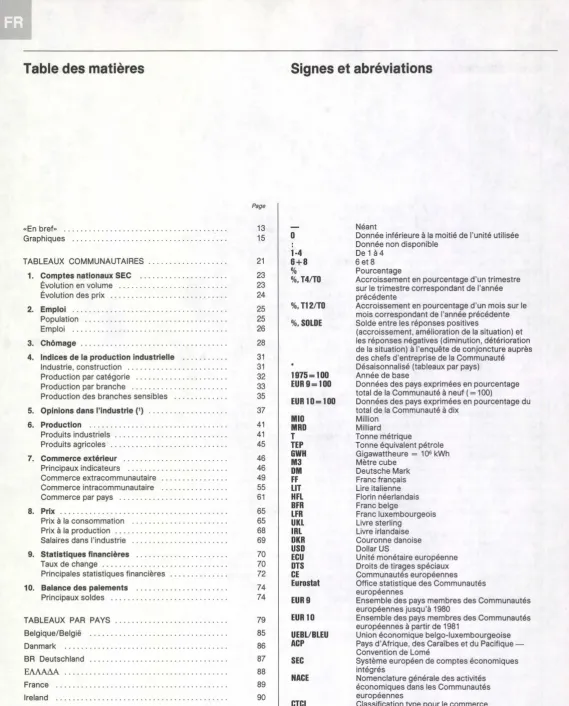
Table des matieres
«En bref
»
.
...
..
..
.
...
...
...
.
....
.
..
...
.
.
...
.
Graphiques ....
.
..
...
..
...
..
...
.
...
.
TABLEAUX COMMUNAUTAIRES
.
..
....
..
.
..
...
..
.
.
1. Comptes nationaux SEC .
.
.
..
...
.
..
.
..
..
.
... .
Evolution en volume ..
....
.
.
...
..
.
...
...
...
.
Evolution des prix
.
.
.
.
..
.
.
...
..
..
...
..
. .
2. Emploi
.
.
.
.
..
.
...
...
.
.
...
.
Population
...
.
..
.
...
.
..
...
..
....
..
. .
Emploi
....
..
..
.
.
..
.
.
.
.
.
...
.
..
.
.
..
.
....
.
3. Chomage
...
..
.
....
.
....
.
.
.
.
.
.
.
..
.
..
..
.
4. Indices de la production industrielle .
.
.
.
.
.
..
.
.
.
lndustrie, construction
.
...
.
...
...
.
....
.
Production par categorie
....
.
...
..
..
..
.
. .
Production par branche .
...
.
... .
Production des branches sensibles
...
.
..
.
..
.
5. Opinions dans l'industrie (1) .
. . •. . . .... . .. .. .. .6. Production .
.
.
..
.
...
.
...
....
.
.
..
....
.
. .
Produits industrials
.
...
..
.
.
.
....
.
.
.
...
.
Produ
i
ts agricoles ...
..
..
... .
7. Commerce exterieur
.
.
.
..
..
.
...
.
... .
Principaux indicateurs .
...
.
.
.
....
.
.
.
..
. .
Commerce extracommunautaire
...
.
.
...
...
.. .
Commerce intracommunauta
i
re .
..
.
...
.
Commerce par pays .
.
...
...
...
.
.
..
.
.
...
.
8. Prix ..
....
.
.
.
.
...
..
.
.
..
.
.
.
.
.
..
..
.
...
.
...
.
Prix a la consommation ....
..
.
..
..
.
.
.
.
.
..
.
...
.
Prix a la production
...
..
.
.
...
.
...
.
...
....
.
. .
Salaires dans l'industrie ....
.
..
.
....
.
.
..
... .
9. Statistiques financieres ....
.
.
....
.
...
.
.
.
..
.
Taux de change
..
.
.
.
...
..
...
.
....
.
Principales statistiques financieres
...
.
..
.
10. Balance des palements ..
....
..
..
...
..
....
.
Principaux soldes ...
.
..
.
...
....
...
. .
TABLEAUX PAR PAYS ..... · ... .
Belgique/Belgie ..
..
....
.
..
.
..
..
...
.
.
.
.
..
...
.
Danmark .
.
.
.
..
.
.
...
...
..
.
....
.
...
.
BR Deutschland ...
...
..
.
.
.
.
...
.
...
... .
EAAAM
.
..
.
.
...
.
.
....
.
.
.
.
.
...
..
..
.
.
...
..
. .
France
Ireland
Italia
.
.
.
.
..
.
...
...
....
..
...
.
.
..
.
...
..
.
...
.
..
... .
Luxembourg .
..
....
...
..
.
.
.
...
....
..
...
. .
Nederland
..
...
.
.
..
.
..
.
...
...
.
..
...
.
..
.
.
Page
13
15
21
23
23
24
25
25
26
28
31
31
32
33
35
37
41
41
45
46
46
49
55
61
65
65
68
69
70
70
72
74
74
79
85
86
87
88
89
90
91
92
93
United Kingdom
. . .
.
. . .
.
. .
. . .
.
. . .
.
.
.
. .
.
. . . .
.
94
United States .
.
. .
.
. .
.
. .
.
. . . .
.
. . .
.
. . .
. .
. . .
.
.
95
(1) Les donnees contenues dans cette partie du Bulletin representent les
resultats de l'enquete de conjoncture aupres des chefs d'entreprise de
la Communaute. Des donnees plus detaillees paraissent dans «Econo
-mie europeenne».
12
Signes et abreviations
0
1-4
6+8
%
%,
T4/TO
%,
T12/TO
%,
SOLOE
1975= 100
EUR 9= 100
EUR 10= 100
MIO
MRO
T
TEP
GWH
M3
OM
FF
LIT
HFL
BFR
LFR
UKL
IRL
OKR
USO
ECU
OTS
CE
Eurostat
EUR9
EUR 10
UEBUBLEU
ACP
SEC
NACE
CTCI
Neant
Donnee inferieure a la moitie de l'unite utilisee
Donnee non disponible
De 1
a
4
6
et 8
Pourcentage
Accroissement en pourcentage d
'
un trimestre
sur le trimestre correspondant de l
'
annee
precedente
Accroissement en pourcentage d
'
un mois sur le
mois correspondant de l
'
annee precedente
Solde entre les reponses positives
(accroissement
,
amelioration de la situation) et
les reponses negatives (diminution, deterioration
de la situation) a l
'
enquete de conjoncture aupres
des chefs d'entreprise de la Communaute
Desaisonnalise (tableaux par pays)
Annee de base
Donnees des pays exprimees en pourcentage
total de la Communaute a neuf (
=
100)
Donnees des pays exprimees en pourcentage du
total de la Communaute a d
i
x
Million
Milliard
Tonne metrique
Tonne equiva
l
ent pe
t
role
Gigawattheure
=
10
s
kWh
Metre cube
Deutsche Mark
Franc frarn;:ais
Lire italienne
Florin neerlandais
Franc beige
Franc luxembourgeois
Livre sterl
i
ng
Livre irlandaise
Couronne danoise
Dollar US
Unite monetaire europeenne
Droits de tirages speciaux
Communautes europeennes
Office statistique des Communau
t
es
europeennes
Ensemble des pays membres des Communautes
europeennes jusqu
'
a
1980
Ensemble des pays membres des Communautes
europeennes a partir de
1981
Union economique belgo-luxembourgeoise
Pays d'Afrique, des Cara"fbes et du Pacifique
-Convention de Lome
Systeme europeen de comptes economiques
integres
Nomenclature generale des activites
economiques dans les Communautes
europeennes
Eurostatistiques: En bref
1. Chomage: En mai 1984, stabilisation avant l'arrlvee
des jeunes bacheliers sur le marche
Avec
12,2
millions de chomeurs inscrits
a
la fin mai
1984
dans la
Communaute europeenne, !'inflexion de la montee du chomage en
Europe semble se confirmer. Pour le mois de mai, l'accroissement
du chomage qui avait bondi
a
35
010de
1980
a
1981,
est
redes-cendu a
23 0/o
de
1981
a
1982
puis a
14 0/o
de
1982
a
1983
et est
retombe
a
6 O/o
de mai
1983
a
mai
1984.
Pour le mois de mai,
l'evo-lution corrigee des variations saisonnieres est pratiquement nulle.
II serait toutefois imprudent de predire hativement que le chomage
pourrait se mettre
a
baisser en Europe quand on connait les
ten-dances lourdes de hausse de population active et de stagnation de
baisse de l'emploi observees en Europe au cours des annees
pas-sees.
Cette hypothese optimiste n'est cependant pas exclue si la reprise
economique se confirmait et s'amplifiait en Europe. On pourrait
alors assister
a
une baisse du chomage en donnees corrigees des
variations saisonnieres (C.V.S.),
a
l'instar de ce qui se passe aux
Etats Unis depuis le courant de l'annee derniare.
Toutefois, meme si le niveau du chomage se stabilise en donnees
C.V.S., l'arrivee prochaine des jeunes sortant de l'ecole sur le
mar-che du travail va provoquer l'habituel gonflement saisonnier du
chomage. II faut done s'attendre
a
ce qu'a partir du mois prochain
le nombre des personnes inscrites au chomage remonte et
depasse nettement les
13
millions au cours de l'hiver prochain.
2. L'lndlce des prix a la consommation: +0,5 O/o en mal
1984, et une tendance vers la deceleration qui
s'accentue
L'indice des prix
a
la consommation pour !'ensemble de la CE a
augmente de
0,5 O/o
entre Avril et Mai
1984.
Les hausses les plus fortes ont ete enregistrees en
Grece
(1,5 O/o)
et au
Danentark ou la hausse est estimee provisoirement a 1, 1
O/o
et elle est due principalement
a
la majoration semestrielle des
loyers. La progression de l'indice
ltalien
est estimee
a
0,8 O/o
et
demeure en-dessus de la moyenne communautaire. Des
accrois-sements moderes ont ete signales en
France
(0,5 O/o),
au
Royaume
Uni
(0,4 O/o)
et au
Luxembourg
(0,4 O/o)
tandis que les prix n'ont
monte que legerement en
Belgique
(0,2 O/o),
en
R.F. d'Allemagne
(0, 1
O/o)
et ils sont reste inchanges aux Pays-Bas.
La progression de l'IPC sur
12
mois, calcule en comparant l'indice
de mai
1984
a
celui de mai
1983,
a ete de
7,5
010.Ceci montre la
deceleration de !'inflation pour !'ensemble des pays de la
Commu-naute europeenne qu'on peut observer depuis pres de deux ans.
En mai
1981
ce taux etait encore de
12,8 O/o,
en mai
1982
de
11,4 O/o
et en mai
1983
de
8,6 O/o.
En un an (mai
1984 /
mai
1983)
les
prix ont aumente de
+
2,9 O/o
en R.F. d'Allemagne,
+
3,7 O/o
aux
Pays-Bas,
+
5, 1
O/o
au Royaume Uni,
+
6,7 O/o
au Danemark,
+
7,2 O/o
en ,Belgique,
+
7,7 O/o
en France et au Luxembourg,
+
11,4 O/o
en ltalie et de
+
16,8 O/o
en Grace.
En un an les hausses correspondantes sont de
+4,5
O/o
aux Etats
Unis et de
+
1,7 O/o au Japan.
N.B.:
Les donnees de mai pour l'ltalie et le Danemark ont ate
esti-mees par EUROSTAT, tandis que celles pour la France et les
Pays-Bas sent provisoires.
3. L'indice de la production lndustrielle: En avril 1984 et
pour le troisieme mois consecutif la production
indµs-trlelle de la Communaute 'augmente plus
L 'indice pour la Communaute (EUR
10)
du mois d'avril est
provisoi-rement estime a
118,5,
ce qui correspond a une hausse de
2,2 O/o
Cependant l'indice corrige des variations saisonnieres
pour EUR
10 est de
115,4
pour le mois d'avril, soit en baisse de
1 O/o
par
rap-port au mois de mars
(116,5).
Le niveau de l'indice en janvier
1984
(117,4)
correspond au maximum de la production depuis quatre
ans. L'indice est passe par un minimum en novembre
1982
avec un
niveau de
110,7.
L 'indicateur de tendance (rapport des trois derniers mois aux trois
mois precedents) indique une baisse de
0,7 O/o
ce qui correspond
a
une inversion de tendance du rythme que l'on a pu observer
depuis un an. Ce rythme avait ete croissant de fevrier
1983
a
jan-vier
1984.
En fevrier et mars
1984
l'on a constate un ralentissement
du rythme de hausse. Avec l'indice du mois d'avril l'on constate
une baisse.
En fait, les indicateurs de tendance sont en baisse aussi bien en
R.F. d'Allemagne (
-1,3 O/o),
qu'en France (
-1,4 O/o),
en Italia
( -1,2 O/o)
et au Royaume-Uni (
-1,2 O/o).
Les indicateurs de
ten-dance sont par centre en hausse en lrlande, aux Pays-Bas et au
Danemark.
En un an dans tous les pays de la Communaute on peut constater
une hausse de la production industrielle pour les trois derniers
mois connus par rapport aux trois memes mois correspondants.
La hausse pour la Communaute est de 3
O/o.
La hausse
correspon-dante est de l'ordre de
15 O/o
aux USA et de
12 O/o
au Japon.
4. Acier: Avec une hausse de la production de 11,3 O/o le
premier semestre 1984 deviant le mellleur semestre
depuis 1980
En mai 1984,
la production d'acier brut communautaire (sans la
Grace) avec
10,5
Mio de t a connu une augmentation
desaisonnali-see de
2,9 O/o
par rapport au mois precedent; ceci correspond
a
8,3 O/o
de plus que le mois de mai
1983.
Sur la base des
estima-tions faites par les usines, on peut prevoir pour le mois de juin
1984
une stabilisation de la production d'acier brut.
La production d'acier brut, pour le
premier semestre 1984
(avec
61
Mio de tonnes, chiffre provisoire), est en augmentation de
11,5 O/o
par rapport au premier semestre
1983.
Pour les
comman-des nouvelles, le bilan du premier trimestre
1984
se solde par une
hausse de
11,3 O/o
par rapport
a
1983.
C'est le meilleur premier
tri-mestre depuis
1980.
5. Energie: La part du charbon communautaire dans les
livraisons totales passe de 75,9 O/o en 1982
a
77 ,4 O/o en
1983
En
1983,
les centrales electriques et les cokeries ont fait de gros
efforts pour reequilibrer l'approvisionnement et la consommation
de houille.
C'est ainsi que les livraisons ont enregistre une diminution globale
de 11 millions de tonnes face
a
une