BER of OFDM System with Multiple NBI
Rejection Cascade Complex Coefficient
Adaptive IIR Notch Filter
Aloys N. Mvuma
School of Informatics, The University of Dodoma, Dodoma, Tanzania Email: [email protected]
Received August 16,2012; revised September 15, 2012; accepted September 30, 2012
ABSTRACT
In this paper, rejection of multiple narrowband interferers in a binary phase shift keying modulated orthogonal fre- quency division multiplexing (BPSK-OFDM) system is investigated. The BPSK-OFDM system in consideration oper- ates in an additive white Gaussian noise (AWGN) channel. A cascade complex coefficient adaptive infinite impulse response (IIR) notch filter with gradient-based algorithm is used to reject the interferers. Bit error ratio (BER) perform- ance of the system is studied and a general closed-form expression is derived assuming negligible steady-state leakage NBI and by estimating the decision variable as Gaussian distributed based on Central Limit Theorem (CLT). Depend- ence of the BER performance on the notch bandwidth coefficient is demonstrated by the analysis. Extensive simulation results are included to substantiate accuracy of the analysis.
Keywords: Multiple Narrowband Interference; Cascade Adaptive Notch Filter; OFDM System; Bit Error Ratio
1. Introduction
Complex coefficient adaptive notch filters (ANF) have been proposed for use in applications that require detec- tion and rejection or enhancement of narrowband signals embedded in broadband signals with in-phase and quad- rature-phase components. One such applications is in the rejection of narrowband interference (NBI) in quad- riphase shift keying (QPSK) spread-spectrum communi- cation systems [1,2]. It is well known that infinite im- pulse response (IIR) implementation of adaptive notch filters is more advantageous as compared to finite im- pulse response (FIR) with much less computation com- plexity. A complex coefficient adaptive notch filter im- plemented as a constrained IIR filter with a complex Gauss-Newton adaptation algorithm was proposed in [2]. Furthermore, its application in suppression of NBI in QPSK spread-spectrum communication system showed a substantial improvement in overall system bit error ratio (BER).
A complex coefficient adaptive IIR notch filter with a simplified gradient-based algorithm that does not require any matrix inversion was proposed in [4] and its conver-gence and steady state behaviors were extensively ana-lyzed in [3,4]. Its application in rejection of a single NBI in a QPSK DS-SS communication system over an addi- tive white Gaussian noise (AWGN) channel was also
discussed in [5]. Cascade extension of the algorithm in [4] for detection of multiple sinusoids was further pro- posed and analyzed in [6]. Its application in the rejection of multiple NBI in a QPSK direct sequence code-division multiple access (DS-CDMA) system was discussed in [7] with promising improvement in BER. However, the ANF has not been attempted in rejection of multiple NBI in an orthogonal frequency division multiplexing (OFDM) sys- tem. OFDM has recently become a preferred transmis- sion technique in emerging broadband wireless communi- cation systems [8,9]. It has been reported that WLAN and WMAN standards based on OFDM that operate in the unlicensed frequency bands are susceptible to NBI from other systems coexisting in the same spectrum. Such systems include Bluetooth, microwave ovens, cord- less telephones, etc. The observation has challenged re- searchers to find NBI rejection techniques that can alle- viate effects of NBI in OFDM systems [10-17].
for binary phase shift keying (BPSK) modulated OFDM with signal-to-interference ratios (SIR) as low as –30 dB [10]. However, the author did not show how excision filter parameters affect the BER performance of the OFDM system.
This paper employs similar method to that proposed in [10] whereby the multiple NBI excision filter is imple- mented using a cascade complex coefficient adaptive IIR notch filter with simplified gradient-based algorithm presented in [8]. The OFDM system is considered to be operating in an AWGN channel. Estimating the Fast Fourier Transform (FFT) of the ANF output for each subcarrier as Gaussian distributed based on Central Limit Theorem (CLT), a closed-form BER expression is de- rived for small step size constant with negligible steady- state leakage NBI. It is observed that besides the received signal-to-noise ratio (SNR), BER performance depends largely on the value of notch bandwidth coefficient. Com- puter simulation results are included to support analytical findings.
Main contributions of this paper are as follows: 1) It presents a systematic approach to the analysis of BER performance of OFDM systems with cascaded complex coefficient filters for multiple NBI suppression. Such approach has not been presented elsewhere; 2) It presents a simple closed-form BER expression for an OFDM sys- tem with multiple NBI suppression filters. The expres- sion relates BER with filter notch bandwidth parameter and received signal-to-noise ratio (SNR).
The organization of this paper is as follows: In Section 2, OFDM system model and the NBI suppression cas- cade complex coefficient adaptive IIR notch filter are presented. Section 3 presents BER analysis while simula- tion results and discussions on findings are presented in Section 4. Lastly, concluding remarks and future research areas are included in Section 5.
[image:2.595.57.538.585.723.2]2. System Model
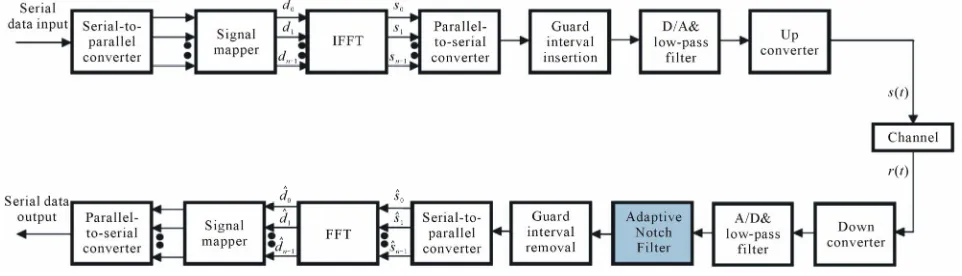
Figure 1 below shows a block diagram of the BPSK- OFDM system used in this paper. Received discrete-time
low pass equivalent BPSK-OFDM symbol is mod-
eled as n
r
n n n
r s i n (1)
n
s is the n-th of L samples in the transmitted BPSK-
OFDM symbol. It is expressed as
1 2π
0 1
e
k
L j n
L
n n k
k
s d
L
(2)k
d is the k-th data symbol from BPSK modulation con-
stellation, i.e., dk
Eb, Eb
where Eb is thesignal average energy per bit and n is a rectangular
windowing function, i.e., n 1, .n It should be noted
that sn is the inverse discrete Fourier transform (IDFT)
of L data symbols dk. n is the n-th sample of a zero-
mean complex additive white Gaussian noise (AWGN) with variance N0 2
where 0 is the power spectral density. is the n-th sample of the NBI which is mod-
eled as
N
n
i
2π
1
e i i
N
j n
n i
i
i A
(3)where Ai, , i and i are unknown amplitude, frequency
and phase of the i-th of N narrowband interferers. Valid-
ity of the interference model in (3) was discussed in de- tail in [10].
The cascade realization of the complex coefficient adaptive IIR notch filter for detection of multiple sinu- soids in noise was proposed in [8]. The equivalent trans- fer function Heq(z) from the ANF input signal rn to the
output signal yn is given by
,1
1
, 1
1 1 e
2 1 e
i n i
N eq
i i
j
i j n
H z H z
z H z
z
(4)
Here, is the notch bandwidth coefficient and i n,
is the notch frequency coefficient for the i-th section of
the cascade complex coefficient adaptive IIR notch filter at the n-th iteration, respectively.
An adaptation algorithm for the i-th notch frequency
coefficient for tracking and suppressing the i-th NBI is
expressed as [6]
, 1 , Re ,
i n i n yn i n
(5)
where Re[.] stands for real part, i n, is the i-th gradient signal and i n,
is its conjugate. Transfer function from
rnto i n, was obtained in [6] as
, , 1 1 1 1 e2 1 e
i n i n
N
i i j
j i j
j
i j
F z G z H z
j z G z z
(6)Referring to (4), the unknown frequency of the i-th
NBI at the n-th iteration can be estimated by ˆi n, where
, ,
ˆ .
i n i n
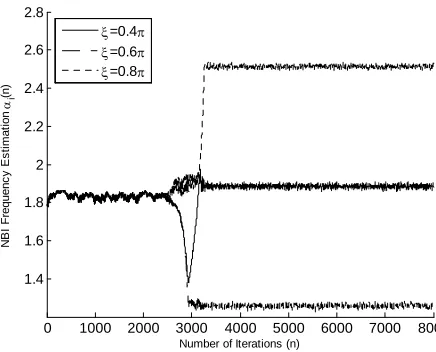
The adaptation algorithm in (5) was used in [7] for suppression of multiple NBI in QPSK DS-CDMA system with significant BER improvement. Convergence behavior of the proposed adaptation algorithm is shown in Figure 2.
3. Analysis of Bit Error Ratio
This section presents analysis of BER of the BPSK- OFDM system in the presence of multiple NBI with interference suppression cascaded complex coefficient ANF. The analysis ignores errors that can occur as a re- sult of time drift or phase offset by assuming ideal time and phase synchronization. The analysis further assumes negligible steady-state leakage NBI power. This assump- tion is valid for small values of step size .
0 1000 2000 3000 4000 5000 6000 7000 8000 1.4 1.6 1.8 2 2.2 2.4 2.6 2.8
Number of Iterations (n)
N B I F requenc y E s ti m at ion i (n)
=0.4 =0.6
[image:3.595.60.278.500.676.2]=0.8
Figure 2. Convergence behavior of the cascade complex coefficient adaptive notch filter for estimating three NBI frequencies in OFDM received signal for A1 = A2 = A3 =
20, ξ1 = 0.4π rad./s, ξ2 = 0.6π rad./s, ξ2 = 0.8π rad./s, β = 0.9, μ = 10−4, L = 64, and SNR = 0 dB.
The cascade ANF output signal n is applied to an L-point discrete Fourier transform (DFT) at the receiver.
The resulting k-th sample is therefore given by y ˆ k d 1 , 0
ˆ L exp 2π
k n k s
n
k
d y j n d d
L k,
(9)The k-th sample in (9) is composed of two
components i.e. k s, and k,
ˆ
k
d
d d . The former is the DFT
of the cascade ANF output signal due to the OFDM transmitted signal sn while the latter is due to channel
AWGN n . The assumption of negligible leakage
steady-state NBI justifies the exclusion of the DFT of the ANF output due to NBI in.
3.1. Statistical Characteristics of dk s,
The DFT of the cascade ANF output signal due to the BPSK-OFDM transmitted signal sn is given by:
1 2π
, 0
1 2π 1 2π
0
0 0 1
1 2π
0 0 1 e e e e k
L j n
eq L
k s n n
n
k k
L j n L j
eq L eq nL
n l n l
n n l
k
L j n
eq eq L
k l n l
n l
d h s
h s h s
h d h s
(10)where * denotes convolution sum and is a complex impulse response of
eq l h
eq H z 0eq hin (4) that decays expo- nentially with l. The right hand side of (10) has two
terms; the first is the desired data component while the second is due to intersymbol interference (ISI) induced by the cascade ANF. is the value of eq for
l
h l0
and is obtained by
1 01 d
2π
eq eq
h H z z
j
z
(11)
The expectation of , k s, is derived by re- ferring to (10) and by assuming statistically independent and identically distributed data symbols It is ex- pressed as
,
k s d E d
dk .1 1 2π 2π
, 0
0 0 0
0
e e
p l k
L L j n j n
eq eq L L
k s k l p
n l p
eq k
E d h d E h d
h d
(12) It can be deduced from (12) that the cascade ANF at- tenuates the expectation of the k-th data symbol E dk s, by a factor proportional to which depends on the notch bandwidth coefficient 0.eq
h
Mean-square value and variance of dk s, ,
2 , k s
E d
2 eq2 2 2
E d h d d h
2, 0
1 2 2 ,
1 var
eq
k s k k l
l eq
k s k l
l
d d h
(13)
3.2. Statistical Characteristics of dk,η
By considering the AWGN n the DFT of the cascade
ANF output signal can be sho to be given by:
wn
1 2π k 1 2π
L L
,
0 0 0
e e
k
j n j
eq L eq nL
k n n l n l
n n l
d h h
(14)Expectation of
,
k
d is zero since n is modeled as
zero mean random process. Its variance vardk, is expressed as
2 0 ,
0
var
2
eq
k l
l
N d h
(15)which depends on the notch bandwidth coefficient .
Noting that sn and n are statistically independent
and uncorrelated, varianc of e dˆk denoted as vardˆk s, becomes the total sum of vardk s, and vardk, in (13) and (15), respectively, i.e.
2 2
ˆ
var d d
heq 0
21 2 0
eq
k k l l
l l
N h
(16)
in (9) can be approximated by Gaussian distribution
y
ˆ
k
d
for large L using Central Limit Theorem (CLT). Av-
erage BER for the k-th frequency bin Pe k, is obtained by the Gaussian approximation and b ferring to (12) and (16). It is given by:
re
2 2
0 ,
2 0
2 0 2
1 0
ˆ var
2
eq k e k
k
eq
eq eq
l l
l b l
a h d P Q
d
h Q
N
h h
E
(17)
Equation (17) shows the average BER to be the same for all k0,1, 2, , L1. The average BER for the
OFDM sy e be the same as in (17). It is
observed that the average BER depends on factors that are functions of the notch bandwidth coefficient
mbol will therefor
.
4. Simulation Results
nd analytical results are pre- In this section, simulation a
sented, discussed and compared to validate accuracy of the BER closed-form expression (17) derived in the pre- vious section. All simulations results were obtained using MATLAB® software. The results presented were ob-
tained for the following OFDM signal parameters:
FFT size L 64
Number of data subcarriers 52 Number of bits per symbol 52
Number of symbols 100
The value of step size adaptation constant in (5) was fixed to 106. Simulation results were obtained by averaging over independent computer runs after the adaptation algorithm in (5) had attained its steady state.
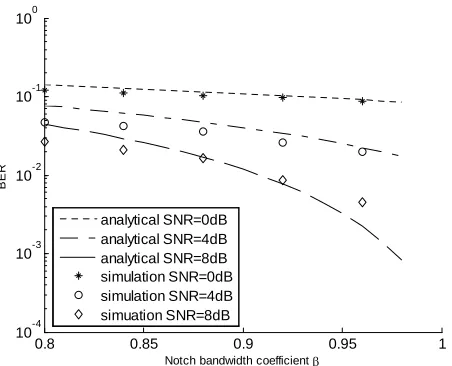
Analytical and simulation results for BER plotted ten
against notch bandwidth coefficient with signal-to- noise ratio (SNR) as a parameter for nu ber of NBIs N =
2 and N = 3 are shown in Figures 3 and 4, respectively.
Frequencies of NBIs 1, , 2 3
m
in (3) were set to 0.4π, 0.6π and 0.8π, respec erference-to-signal ratio for the i-th narrowband interferer (ISRi) was set to 10 dB,
tively. Int
0.8 0.85 0.9 0.95 1
10-3 10-2 10-1 100
Notch bandwidth coefficient
BE
R
[image:4.595.314.541.287.470.2]analytical SNR=0dB analytical SNR=4dB analytical SNR=8dB simulation SNR=0dB simulation SNR=4dB simuation SNR=8dB
Figure 3. BER analytical and simulation results for N = 2, SNRi = 10 dBi, ξ1 = 0.4π, ξ2 = 0.6π, μ = 10−5, and L = 64.
0.8 0.85 0.9 0.95 1
10-4
10-3
10-2
10-1
100
Notch bandwidth coefficient
BER
analytical SNR=0dB analytical SNR=4dB analytical SNR=8dB simulation SNR=0dB simulation SNR=4dB simuation SNR=8dB
[image:4.595.313.539.511.694.2]where
2
ISR 10log dB .
2 i i
b
A E
and Eb1.0. The figures show that the BER decreases with in b
an
oth cases. Moreover, close agreement be- tween alytical and simulation results confirms the ac- curacy of the analysis carried out in Section 3.
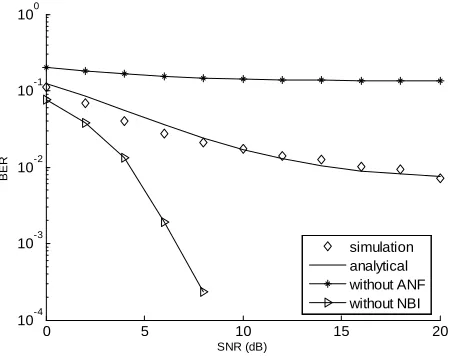
Figures 5 and 6 show analytical and simulation BER results plotted as a function of SNR for number of NBIs
N = 2 and N = 3, respectively. The value of was
likewise set to 0.9 and ISR for each NBI was set to 0 dB. BER for the ideal OFDM system without NBI and that with NBI but without NBI suppression ANF are also shown for comparison purpose. Improvement of BER to about 0.001 and 0.01 for N = 2 and N = 3, respectively is
1
0 5 10 15 20
10-4 10-3 10-2 10-1 100
SNR (dB)
BE
R
[image:5.595.61.289.521.699.2]simulation analytical without ANF without NBI
Figure 5. BER analytical and simulation results for N 2, = SNRi = 10 dBi, ξ1 = 0.4π, ξ2 = 0.6π, β = 0.9, μ = 10−5, and L = 64.
0 5 10 15 20
10-4 10-3 10-2 10-1 100
SNR (dB)
BER
simulation analytical without ANF without NBI
Figure 6. BER analytical and simulation results for N = 3,
figures. Furthermore, the figures show
SNRi = 10 dBi, ξ1 = 0.4π, ξ2 = 0.6π, ξ3 = 0.8π, β = 0.9, μ = 10−5, and L = 6
evident from the
4.
close agreement between analytical and simulation re- sults. Slight discrepancy between simulation and ana- lytical results in all figures can be attributed to the Gaus- sian distribution assumption made on the decision vari- able dˆk in (9) based on CLT. Moreover, leakage NBI
becom significant as the notch bandwidth coefficient es
approaches 1.0 that leads to slight difference between alytical and simulation results in Figures 3 and 4. an
ER) of a BPSK OFDM system with
[1] Y.-C. Wang a jection of Multiple
5. Conclusion
Bit error ratio (Bmultiple NBI rejection complex-coefficient cascade ANF was analyzed. A closed-form BER expression was de- rived using the Central Limit Theorem approximation of the decision variable. Accuracy of the derived BER ex- pression was demonstrated by computer simulation using MATLAB® software with emphasis on its dependence on notch bandwidth coefficient. Moreover, significant BER performance improvement gained by the use of complex coefficient cascade ANF for NBI rejection was also shown. In the future, Rayleigh channel, M-ary modula- tion techniques and effects of leakage NBI power on the BER performance of OFDM system will be studied.
REFERENCES
nd L. B. Milstein, “ReNarrowband Interference in Both BPSK and QPSK DS Spread Spectrum Systems,” IEEE Transactions on Com- munications, Vol. 36, No. 2,1988, pp. 195-204.
doi:10.1109/26.2750
[2] S. C. Pei and C. C. Tseng, “Complex Adaptive IIR Notch
Jiang, S. Nishimura and T. Hinamoto, “Perform-
inamoto, “Conver-
shimura and T. Hinamoto, “Steady-
Simplified Realization of Filter Algorithm and Its Applications,” IEEE Transac- tions on Circuits System, Vol. 41, No. 2, 1994, pp. 158- 163.
[3] H. Y.
ance Analysis of Complex Adaptive Notch Filters,” Pro- ceedings of IEEE International Conferences on Circuits and System, June 1998, pp. 502-505.
[4] H. Y. Jiang, S. Nishimura and T. H
gence Analysis of Complex Adaptive IIR Notch Filters for the Detection of Single Sinusoid,” IEICE Transac- tions on Fundamentals of Electronics, Vol. E82-A, No. 6, 1999, pp. 912-915.
[5] H. Y. Jiang, S. Ni
State Analysis of Complex Adaptive IIR Notch Filter and Its Application to QPSK Communication Systems,” IEICE Transactions on Fundamentals of Electronics, Vol. E85- A, No. 5, 2002, pp. 1088-1095.
[6] S. Nishimura and H. Y. Jiang, “
ultime-Performance of OFDM in Channel,” International Journal of Computer and Com- munication Engineering, Vol. 6, 2012, pp. 46-54. [8] R. V. Nee and R. Prasad, “OFDM for Wireless M
dia Communications,” The artech House, Boston, 2000. [9] G. L. Stuber, “Orthogonal Frequency Division Multi-
plexing for Wireless Communication,”Georgia Institute of Technology, Atlanta, 2006.
[10] A. J. Coulson, “Bit Error Rate
Narrowband Interference with Excision Filtering,” IEEE Transactions on Wireless Communications, Vol. 5, No. 9, 2006, pp. 2484-2492. doi:10.1109/TWC.2006.1687772 [11] Z. Nikolova, G. Iliev, M. Ovtcharov and V. Poulkov,
“NarrowbandInterference Suppression in Wireless OFDM Systems,” African Journal of Information and Communi- cation Technology, Vol. 5, No. 1, 2009, pp. 30-42. [12] R. W. Lowdermilk and F. J. Harris, “Interference Mitigation
in Orthogonal Frequency Division Multiplexing (OFDM),” IEEE International Conferences on Universal Personal Communications, Vol. 2, 1996, pp. 623-627.
doi:10.1109/ICUPC.1996.562648
[13] G. J. Saulnier, Z. Ye and M. J. Medley, “Performance of a Spread Spectrum OFDM System in a Dispersive Fading Channel with Interference,” IEEE Military Communica- tion Conferences, Vol. 2, 1998, pp. 679-683.
[14] S. Kapoor and S. Nedic, “Interference Suppression in DMT Receivers Using Windowing,” IEEE International Conferences of Communications, Vol. 2, 2000, pp. 778- 782.
[15] R. Nilsson, F. SjÖberg and J. P. LeBlanc, “A Narrow- Band Interference Canceller for OFDM-Based Systems,” Proceedings of the 4th European Personal Mobile Com- munication Conferences, February 2001.
[16] A. J. Coulson, “Narrowband Interference Suppression for OFDM,” IEEE Transactions on Wireless Communica- tions, Vol. 5, No. 9, 2010, pp. 2484-2492.
doi:10.1109/TWC.2006.1687772