A CONSTRUCT AND ITS MEASUREMENT
A thesis presented to the
Department of Psychology University of Canterbury
In fulfilment of the requirements for the Degree of Doctor of Philosophy
by
Geoffrey Ashton Elvy ::; Christchurch, New Zealand
THESIS
----: I
t:<)7S
. E.;:
I :1'2$"ABSTRACT
A problem drinking screening test for general hospital
patients was developed in five experiments as a measure of the
construct of problem drinking. In Experiment I, test
questions were selected from a group of 59 psychological and
medical items on the basis of responses from 1613 hospital
patients. The resulting Problem Drinking Screening Test
(POST) has a 23 item self-report section and an optional
physician's section of four items. Experiments II to V are
concerned with the validity and reliability of the POST.
Viewing problem drinking as a construct is justified
theoretically, and its relationship to alcoholism, to locus
of control, to labelling theory and to idiographic and
nomethetic measurement is given. A method for measuring the
construct is examined from the perspective of George Kelly's
1955 Personal Construct Theory, and a mathematical
explanation is presented.
The experiments are introduced by a comprehensive review of
the available problem drinking instruments. This review is
divided into psychological measures, biomedical measures,
combined psychological and biomedical measures, and others.
Finally, a brief review is provided of the statistical
CONTENTS
Page
Chapter 1. INTRODUCTION OO • • OO • • • &QO&Q-OGGO . . . O ... &It . . . . 9 0 . G O .. OQ . . . 1
Chapter THE CONCEPTUALISATION AND DEFINITION
OF ALCOHOLISM ; AN OVERVIEW .•....• 6
2.1 Introduction
6
2.2
Problem Drinking and AlcoholismThe Need for Further Theory on Problem
Drinking .. O.Qo . . . IO . . . e • • • • v . . . O • • • • <00.OotHH) • • • <I ILl.
Chapter 3. PROBLEM DRINKING AS A CONSTRUCT 17
3.1 Introduction
• ••..•.•...•.•••••.•.••..•..•.. 1110...
173.2
Psychological Measurement and Theory3.3
Development of the Problem Drinking Construct 203.4
The Construct, Idiographic and NometheticMeasurement ., .. 0 ... 0 ...••••.••.. 0.0.0... 38
3.5
Relationship of the Construct to Locus ofControl .. "' .. 0 0 • • • "' • • • • • • • • • • • • "' . . . 43
3.6
Alcohol Dependence and Non-Dependenceand-the Problem Drinking Construct, ... 51
3.7
Summary 0 • • 0 . 0 • • • • • • 08 • • • • • • • • • • • • • • • • • • • • " • • • • • • • • • • • • • • • • • • 0 56Chapter
4.
PROBLEM DRINKING MEASURES :A REVIEW .. 0 . 1 1 0 0 • • • • • • • • • • • • • • • • • • • • • • • • • • • • • • • • • • • • • • ;,1. 60
4.1
Introduction • • 0 . 9 • • • • • 0" • • • • • • 0 . . . 0, . . . . , . . .60
4.2
Psychological Measures... 60
4.3
Biomedical Measures 844.4
Combined Psychological and Biomedical Measures 924.5
Other MeasuresPage
Chapter 5. THE DEVELOPMENT OF A TEST TO MEASURE
THE CONSTRUCT OF PROBLEM DRINKING f03
5.1 Introduction 103
5.2 Statistical Considerations of Test Development 104
5.3 Nature of the Test ll4
Chapter 6. EXPERIMENT I: The Selection of Problem
Drinking Test Items ll6
6.1 Introduction ll6
6.2 Method ll8
6.3 Results 133
6.4 Discussion
174
Chapter 7. EXPERIMENT II: Test Construct Validity
177
7.1 Introduction
177
7.2 Method
178
7.3 Results
181
7.4 Discussion
182
Chapter 8. EXPERIMENT III: Test Cross Validity
184
8.1 Introduction
184
8.2 Method
184
8.3 Results
187
8.4 Discussion
187
Chapter 9. EXPERIMENT IV: Test Internal Consistency
189
9.1 Introduction
189
9.2 Method
189
9.3 Results
190
Contents, ctd.
Page
Chapter 10. EXPERIMENT V: Test-Retest Reliability
191
10.1
Introduction191
10.2
Method193
10.3 Results
10.~
Chapter 11.
Appendix A
Appendix B
Appendix C
Appendix D
Appendix E
Appendix F
Appendix G
Appendix H
Appendix I
Bibliography
Discussion
195
DISCUSSION AND CONCLUSIONS
197
Labelling Theory, Self-Efficacy and the
Problem Drinking Construct ... 203
A Mathematical Expression for the Problem
Drinking Construct ' u . e u H " . O • • O(HI •• ~U.6 • • • • • • • • • • • • • • (II 208
Questionnaires, SPSS Source Program and
Raw Data for Experiments I and IV 240
Calculation of Labour Needed for Experiment
271
Tables 1 to g for Experiments I, II and III 273
The Problem Dr inking ScreeningT est (PDST):
A Measure for the Construct of
Problem Drinking .. O . . . iJ • • • • • •
o
•...•.•.••• e...
281Questions, SPSS Source Program and Raw
Da ta for Exper iment II ...
283
Questions, SPSS Source Program and Raw
Da ta for ExperIment III ... 287
Questions, SPSS Source Program and Raw
Data for Experiment V ... O ••• 0CHUI,... 299
Table 1
Table 2
Table 3
Table 4
Table 5
Table 6
Table 7
Table 8
Table 9
Table 10
Table 11
Table 12
Table 13
Table 14
Table 15
Page
Trials, Incompletes and Refusals for
Experiment 1 oo" • • tI'O'HIO$ • • • ~ . . !.o • • eo • • • oeO • • ~HH'j"'H •• Q ( I " • • "i!'I 131
Structure of Phases in Experiment
132
Tests of Phase Comparability for
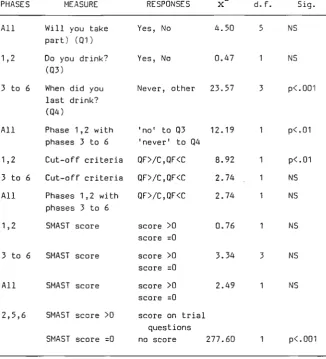
Experiment 1 OOOO&CHHDOOOO • • Ol'lo • • .,oeoCHt • • OQO • • O.U'I(t(lIHIO.O'" 134
Distribution of Self-Reported Quantity-Frequency
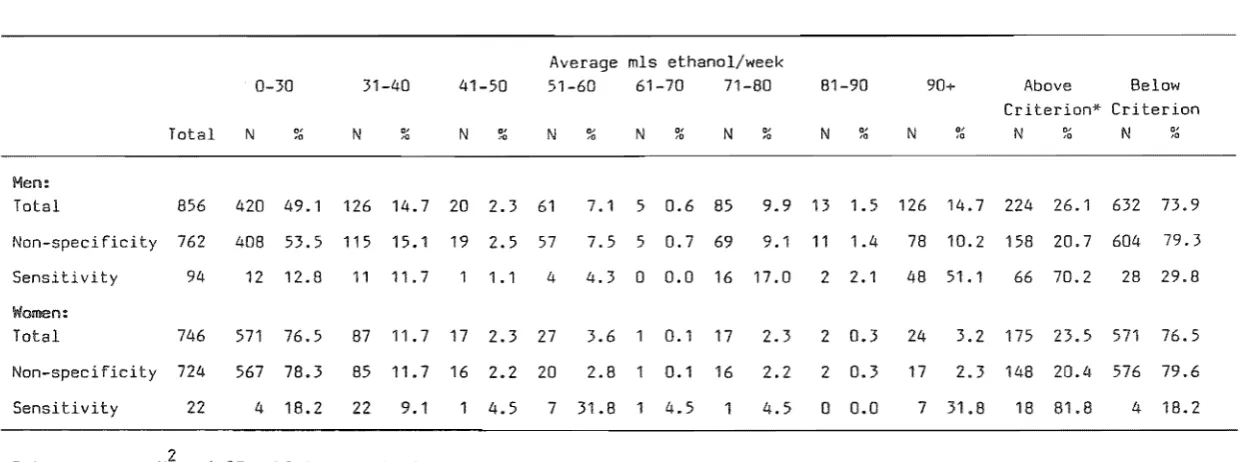
Measures OOfHIIOO.OOOOtH • • • OIll.00.<It • • • • • • • • H • • • • • • • • • • • • • • • • • G . 137
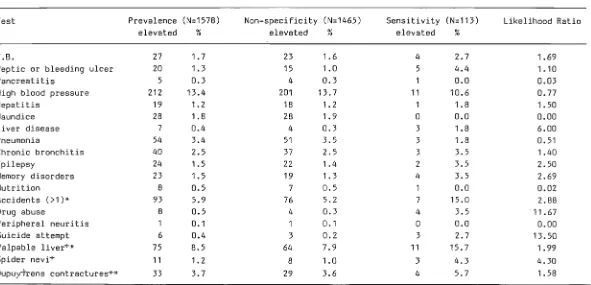
Prevalence Positive, S,ensitlvity, Non-Specificity, and Likelihood Ratios for Trial Self-Report
Questions o •• a.tI.Go.o.o.o" • • • • • • • • • o • • • o • • • • • • • • • • • • • • • • • • o 138
Prevalence, Sensitivity, Non-Specificity and Likelihood Ratios for Elevated Liver Function Tests
Prevalence, Sensitivity, Non-Specificity and Likelihood Ratios for Elevated Medical Examination Tests
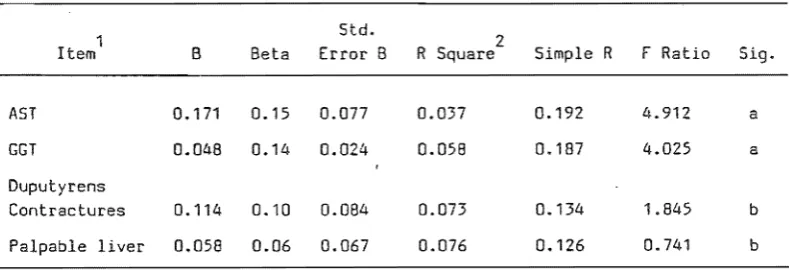
Stepwise Regression Analysis of Selected Items With Problem and Non-Problem Drinking
139
140
Dependent 0"(10 . . . 0 0 • • • 0 • • • • 0 • • • • • • • • • • • • " ' . . . 145
Stepwise Regression of Selected Physician's Items for 214 Problem and Non-Problem
Drinkers
.0 ..• 00 ... 000 •....•. 0
.•. .,".0'0...
146Raw Data on the Responses of Six Raters on the Internal-External Dimensions of the
POST Self-Report Questions •••••••••••••••••••• 152
Percentage of Inter-Rater Agreement on the Number of Self-Report POST
Internal-External Questions .. Ct • • • • • • • • • • • " . . . 153
Age and Sex Characteristics for Problem
Drinkers and Controls ." ... H . . . fI • • C' . . . -o • • tJ
Consumption Data for Problem Drinkers
and Controls ...•••••••.••.•..•.••••••.••••••.•.••••••• 156
Age Factors in Selected Physician's Items for
Problem Drinkers and Controls ... 157
POST Self-Report Score Distributions for
List of Tables, ctd.
Table 16
Table 17
Table 18
Table 19
Table 20
Table 21
Table 22
Table 23
Table 24
Table 25
Cut-off Score Effects of POST Self-Report Score Distribution for Different Item
Page
Weightings oo • • • e • • • • • • O.O • • • • " . O • • • • • OO . . . OOO • • o • • eOGOG 159
Linear Regression for 358 Problem and Control Drinkers to Determine PDST Self-Report
Cut-Off Score 0 0 0 0 0 9 0 0 0 0 0 0 0 0 • • 0 0 0 • • 0 0 0 0 0 • • • • • • 000001110100 160
PDST Self-Report Distribution in Relation to
Short MAST Scores ... 161
PDST Physician's Score Distribution for Trial
Weightings ooooo.ooo.o.ecH'.O.O.oo • • • • oo • • • oo.e • • • oo • • • ocoo 162
PDST Score Distribution (Physician's Plus Self-Report) for 214 Problem Drinkers and
Controls ..
0
.... 00 ... 00 ... 0...
163Principal Factor Matrix for POST Questions 164
Self-Report PDST and MAST Score Distributions
for 71 Alcohol Dependent Patients •....••••. 179
Relation Between pO'ST .Self-Report and MAST
Score Distributions ... 180
Self-Report PDST Score Distribution for 165
Alcohol Dependent Patients ... 186
Test-Retest Correlation Coefficients for
Figure 1
Figure 2
Figure 3
Figure
4-Figure 5
Figure 6
Figure
7
Figure 8
Figure 9
Figure 10
Figure 11
Figure 12
Figure 13
Page
The Construct of 'Non-Problem vs
Problem I DGO.O • • OOOO/fDGGOOOOOOOOOGOIIHHiHfOO$OODOO.OOOODOO.OOQ 21
The Relationship Between Subconstructs,
Poles and Elements ... 21
Three Possible Subconstruct Arrangements •• 25
Near Normal Drinking Incorporating the
Episodic Subconstruct ... ... 28
Near Hazardous Drinking Incorporating the
Episodic Subconstruct •••....•••.•••.•.•.•••••.•••.• 28
Internal and External Dimensions of Hazardous
Drinking ... 0 0 . " 31
Possible Values of External and Internal Problem Dr inking Subconstruct Scales
Relationship of Dependent to Non-Dependent
Problem Drinking "' ... 0 ••••••••••••• 00... 50
Some Levels of Subconstructs in Problem
Drinking ...
0
... 0...
52General Design for Experiment I 117
Screening Out Criteria for Experiment I 117
Screening Out Questions Used in Experiment 121
Steps and Analyses to Derive Test Items for
CHAPTER ONE
INTRODUCTION
During December 1980 the Alcohol Research Advisory Committee of the North Canterbury Hospital Board initiated a pilot study on alcoholism among patients in Christchurch Hospital, appointing me principal investigator. One of the aims of the study was to find the prevalence of problem drinking in patients admitted to a general hospital. While i t seemed a simple matter of collecting numbers, i t soon became apparent that there was no operational definition of problem drinking, regardless of the fact that the alcoholism literature and health professionals frequently referred to terms such as "alcoholic" and "problem drinker" in a way which suggested that they had very clear conceptual and operational meanings. There have been various attempts to clarify the terms, such as Keller and McCormick's Dictionary of Words about Alcohol (1968), Keller's Lexicon of
Disablements Related to Alcohol Consumption (1977), and the World Health Organisation's International Classification of Di seases (1977). However, these attempts at definition were theoretically useful but clinically inadequate. Confronted with a patient with drinking problems, clinicians seem to use terms which reflect their own phraseology rather than a label derived from a standardised measure.
describing patients suffering from drinking problems, there
is still difficulty in deciding which patient is, and which
is not a problem drinker.
The fact that this problem existed
intrigued me and prompted the investigation which forms the
basis of this thesis.
This thesis is about the construct 'problem drinking'
and its measurement.
While Cahalan (1979) is able to give an
authoritative and empirically based description of the types
of problems which describe problem drinking, the
idiosyncratic nature of the phenomenon makes i t clear that
further theory is needed to explain the relationship between
different types of drinking problems.
In Chapter two an explanation is given of the terms
'problem drinking' and
'alcoholism', and their relationship
as i t applies in this thesis.
In Chapter three problem
drinking as a construct is discussed from the viewpoint of
Kelly's 1955 theory of personal constructs. Chapter four
reviews major problem drinking measures and Chapters five to
nine are devoted to experiments which empirically develop a
test to measure the construct of problem drinking.
Experiment I is the main experiment in which problem
drinking test items were empirically selected to fit the
construct parameters.
This experiment was designed and
carried out during 1981 and involved over 1699 patients at
Christchurch Hospital.
These patients are thanked for their
co-operation as are the research assistants (Jan Reid,
Michael Rose, Robyn Inman, Linda Garforth, Pam Alexander and
3
-patient.
This data collection would not have been possible
without the support of the Department of Labour.
The
research assistants had a difficult job interviewing patients
under the constraints of a rigorous research design, while at
the same time being sensitive to the needs of patients,
nurses and doctors on the wards.
To many of the staff and
administration of Christchurch Hospital and the North
Canterbury Hospital Board this research was a major
intrusion, yet they not only allowed i t but encouraged it.
Special thanks are due to Dr David Andrews, Superintendent of
Christchurch Hospital, and to Dr Andrew Hornblow, at that
time the Acting Head of the Department of Preventive and
Community Medicine.
Both provided support, advice, and
office accommodation throughout the study.
My thanks also to
Ruth Helms who typed the questionnaires and who acted as the
contact for this experiment.
Thanks also go to the University of Canterbury for
administering the salaries of the research assistants, and
for the considerable assistance of the staff at the
University's Computer Centre for their data preparation and
advice on the seemingly never-ending complex computer
management matters.
Mr Scott Hells assisted during the summer of 1981-82
with the data management and analysis of Experiment
I.
He is
thanked for his contribution and his willingness to learn the
complexities of the University's Prime and Burroughs
computers.
test was investigated. Experiment II was a study during 1983
of convergent validity, which involved 71 patients being
treated for alcoholism, from Sunnyside and Queen Mary
Hospitals. Experiment III was a cross-validation study
carried out during 1981 on 165 similar patients, again from
the same hos tals. Thanks go to the stafr and patients of
Mahu Villa, Sunnyside, and Queen Mary Hospital for their time
and co-operation. My particular thanks to Dr Robert
Crawford, Superintendent of Queen Mary Hospital, and to the
Charge Nurses and Dr Norman Walker of Mahu Clinic. Karen
Baird and Yi Sheng-Yee kindly assisted with the data
collection during these two experiments.
Experiments IV and V were concerned with the internal
consistency and reliability of the test. Experiment IV
involved 537 of the patients from Experiment I; and
Experiment V was conducted during 1984, using 23 patients
from Mahu Villa, and 44 patients from Queen Mary Hospi tal.
These patients are thanked for their co-operation, and also
Valerie Quinn for her assistance with data collection.
My thanks to Christine Johannis for typing the pilot
questionnaires and the final questionnaires for Experiments
II to V and for attending to the endless administrative
details connected with these studies.
My initial interest in Kelly's construct theory came
from attending Professor Ken Strongman's lectures at the
University of Canterbury during 198B. It was his lectures on
personality theory which stimulated me to a
theory to the concept of problem drinking.
5
-D~ David Robinson from the Mathematics Department at the University of Canterbury assisted with a mathematical
explanation of the construct and his help is appreciated in showing me iterative and inverse matrix solutions.
The North Canterbury Hospital Board's Alcohol Research Advisory Committee provided guidance and support over the three years during which data were collected. This committee always provided constructive criticism on the organisational aspects of the studies. The committee's membership was: Dr Elisabeth Wells, Dr William Black, Dr Robert Crawford, Dr John 0' Hagan, Ms Barbara Smith, Ms Tor Wainwright and until mid-1983, Dr Laurence Malcolm as Chairman.
A major acknowledgement is given to: Dr Elizabeth Wells for her advice on statistical matters relating to the
experiments; to Dr William Black who acted as my advisor, mentor and supervisor; and to Christine Johannis who patiently typed the final manuscript.
CHAPTER TWO
OVERVIEW
2. 1
Without some accepted definitions, such commonly used terms
as alcoholism, problem drinking and alcohol dependence have
little value.
Although agreement among researchers and
clinicians is on the increase, there are still many
definitions to be found in the alcoholism literature.
While
most of these are not, strictly speaking, conflicting,
neither do they have a high degree of congruence.
A
prevalence estimate based on one definition usually cannot be
compared meaningfully with another estimate using a different
frame of reference and another population.
As an example,
the estimate of more than nine million alcoholics in the
United States was adopted by the National Institute of
Alcohol Abuse and Alcoholism and accepted by the media in
1971.
This estimate was based on evidence from
epidemiological studies reported by Cahalan and his
associates which covered numerous varieties of problem
drinking, including but not restricted to alcoholism
(Cahalan, 1970; Cahalan and Room,
1972, 1973).In
comparison, this would have been a large increase over the
official national estimate of five to six million Alcoholics
used
bythe National Advisory Committee on Alcoholism in 196
7
-is possible that the prevalence did substantially increase from 1968 to 1971, the change is more likely indicative of how the use of terms can alter perceptions and give false impressions of changes in the nature of a phenomenon. Cahalan (19713) takes the point even further:
comparing estimates of alcoholics and problem drinkers is a rather futile exercise, because the concepts of alcoholism and problem drinking are not very similar, do not necessarily apply to the same sufferers, and may have quite different
implications for etiology and preventive public health measures and treatment. (p3).
The confusion and disagreement over the use and meaning of alcoholism terms are best understood from a historical perspecti ve.
In 1946 Jellinek published a paper on the phases of
alcoholism that was based on the responses of 90 white male members of Alcoholics Anonymous who happened to respond to a questionnaire prepared by some of their members. Although Jellinek pointed out that the sample was biased and the questions scientifically imperfect, Jellinek's resulting theory (Jellinek, 1952) had a significant impact. In 1960
Jellinek devised a system of alcohol abuse: alpha (no
physical dependence, psychological dependence and symptoms), beta (medical symptoms but no physical dependence), gamma (symptoms and physical dependence), delta (physical
remnants 11 exist today. As early as 1953, however, Straus
and Bacon labelled college students who were repeatedly
getting into difficulty because of drinking. as "problem
drinkers", because they did not fit the prevailing disease
model of' alcoholism. Bacon (1973) commented that while the
traditional model has been enormously productive in the past,
it
is now "emerging as the great new cop-out for avoidingeffective response to this problem of alcoholism." (p. 26).
Based on the notion that alcoholism is by nature a
progressive disease (Jellinek, 1952.), it has usually been
assumed that minor drinking problems are probably indicative
of impending alcoholism or Jellinek's "pre-alcoholic" phase.
However, Pattison, Sobell and Sobell (1977) cite convincing
evidence that for the great many individuals, and perhaps
even the majority, the distinct progressive nature formulated
by Jellinek and others is not accurate. and often
unnecessary. Edwards (1974) concluded that there is l i t t l e
gain from dividing alcoholism behaviour into discrete and
discontinuous groups, and that viewing such behaviour as a
continuity of multidimensional variables producing different
syndromes is considerably more plausible. This view has been
supported by others (e. g. Pattison et a1., 1977; Edwards and
Gross, 1976; Hodgson, 1980; Chick, 1980; Skinner and Allen,
1982; Chick and Duffy, 1979).
The shift from the disease model of alcoholism to other
theories attempting to explain the phenomena has generated
further terms to add to the growing repertoire for the layman
and professional. Several attempts have been made to
- 9
(1972) criteria are important for emphasising both biomedical
and psychosocial factors related to excessive drinking.
However, these criteria have been criticised because they
lead to a unitary diagnosis (Pattison, 1981>, and
considerable redundancy among the criteria is evident
(Ringer, Kufner, Ancons and Feuerlein, 1977).
The Diagnostic
and Statistical Manual of Mental Disorders (DSM-III) of the
American Psychiatric Association (1988) recognises two
disorders: alcohol abuse and alcohol dependence, where the
latter condition is evident either by alcohol tolerance or
wi t hdra wal.
Previously, a World Health Organisation (WHO)
task force distinguished between a core dependence syndrome
and disabilities which either result from or are related to
excessive drinking (International Classification of Diseases,
revision 9, WHO, 1977).
However, the alcohol dependence
syndrome has not escaped criticism (Shaw, 1988) and Edwards,
Arif and Hodgson, (1982) have attempted to define terms such
as drug abuse, drug misuse, neuroadaptive state, dependence,
and drug related disability, which are important in the
syndrome.
Referring to the problems of definition researchers and
clinicans are confronted with in the alcohol field, Bacon
(1975) notes that:
The participants seemed to be talking about
different things under the same label and talking
about the same things under different labels; they
seemed to have brought different languages,
methodologies and philosophies to bear upon
whatever the label might be (p. 59).
Christie and Bruun (1969) have noted the emotionality which
pervades the alcoholism field in its definitions as well as
apply to words of fundamental importance, such as dependence,
habituation and addiction. While adding their own
contribution to the chaotic field, these authors suggest a
reason for the survival of inconsistent and imprecise
terminology: the terminology is socially functional.
However, they argue for the removal of social functionality
to achieve intellectual clarity. Keller (1977) states:
It is a comforting thought that the continuing terminological chaos in the alcohol problems field
may be symptomatic of a creative stage. For surely
this field is s t i l l in its budding stage of
conceptualisation. (p. 24).
Keller also notes that not even the combined efforts of the
World Health Organisation and the National Institute on
Alcohol Abuse and Alcoholism can dissuade people from
adopting Humpty Dumpty's attitude: "When I use a word i t
means just what I choose i t to mean."
Nevertheless, i t is impossible to discuss alcoholism without
adopt i ng some 1 abels, howeve r i nadeq ua te they may be. The
following discussion defines problem drinking as i t is used
in this thesis, and describes its relationship to alcoholism.
2.2 PROBLEM DRINKING AND ALCOHOLISM
It is difficult to determine when the term problem drinking
first appears in the literature, Undoubtedly i t had common
usage prior to Plaut's (1967) formal definition as n, ,.a
repetitive use of beverage alcohol causing physical,
psychological, or social harm to the drinker to others. "
11
-Cahalan (1970) points out that one of the difficulties of
this definition is in establishing causality in relation to
problems, and that i t is very hard to determine whether a
maladjustment in interpersonal relations stemmed from
Bomeone's excessive drinking, or whether the drinking was a
reaction to an intolerable situation. Cahalan suggests that
the terms "problems associated with the use of alcohol" or
Nproblem-related drinking" are precise, emphasizing that the
focus is on the problems associated with drinking of certain
kinds under certain circumstances, rather than implying that
drinking per se necessarily constitutes the problem. Cahalan
further adds that the terms problem drinking and drinking
problems can be used as a form of short hand, while their
meaning should be clear.
adopting this system:
Cahalan gives good reasons for
First, any labels need to be free of adverse side effects,
such as serving as barriers to thinking on the part of
clinicians and the general public. Also, the term problem
drinking should encourage research and debate about the
etiology of alcohol abuse, since the emphasis is on the
behaviour rather than on the person, permitting inquiry into
whether there may be many different types of drinking
problems and problems drinkers.
Provided the label problem drinking can always be accompanied
by a statement of the kind of problem, then i t is much to be
preferred to that of alcoholism. Again Cahalan ves good
reasons for this: One is that specifying the kind of problem
in which alcohol is involved. Another is that problem
drinking does not have the emotional connotations of
alcoholism, with alcoholism being fixed as the property of
the medical profession or Alcoholics Anonymous. All too
frequently alcoholism suggests a rock bottom condition which
does not allow for solving problems related to excessive
drinking at an early stage. Finally, the term problem
drinking has the advantage that a distinction can be made
between the problem and non-problem drinker, whereas
alcoholism implies that alcohol is at the root of the
difficulty, with l i t t l e emphasis on individual and
environmental factors.
For these reasons, problem drinking will be the concept used
in this thesis, rather than alcoholism. The next step is to
determine which problems give rise to problem drinking.
Cahalan believes that a definition of an alcohol problem
should stem from the frequency or repetitiveness of problem
behaviour. Bailey (1966) and Knupfer (1967) concur that an
operational definition of drinking problems must take into
account the type, intensity, and frequency of problems.
Cahalan lists eleven broad categories of drinking problems
which characterise problem drinking, based on the hypothises
of Jellinek (19613) I Keller (1962), Plaut (1967) and several
studies of drinking problems (Cisin, 1963; Fink, 1965;
Knupfer, Fink, Clark and Goffman, 1963; Kirsch, Newcomb and
Cisin, 1965; Cahalan, Cisin and Crossley, 1969). Four types
of problems are concerned with the drinking behaviour itself
or with reasons for drinking (frequent intoxication; binge
13
-four are connected with interpersonal relations (problems
with spouse 0[" relatives; problems with friends or
neighbours; job problems; problems with law, police,
accidents) and three are miscellaneous problems which cannot
conclusively be classified into pri~r categories (health;
f i nanci al problems; bell i gerence) . Further, Cahalan is able
to ve the criteria for a person to score on each of the
eleven categories (pp28-32),
While Cahalan restricts the term problem drinking to these
broad categories, i t is not difficult to envisage that within
each category there will be further alcohol related problems,
having their own severity and frequency and all contributing
to the broad problem category, For example, a person with
job problems may have lost a job because of drinking or
because of poor work performance related to drinking, or
because of a number of other possibilities.
Because of the large variety of alcohol problems which can
describe the problem drinker, this thesis will adopt Keller
and McCormick's broad definition of a problem drinker as:
An excessive drinker whose drinking causes private or public harm and who is seen to cause problems
for himself or for others. The category includes
the alcoholic. Often, a euphemism for alcoholic,
used especially in business and industrial programs, or to avoid the implication of a diagnosis. (1968, p.38)
This definition is by no means perfect, and i t begs the
question of what constitutes excessive drinking. Other
attempts at definition have been no better (e. g. Plaut, 1967;
Knupfer, 1967). However, Matross and Hines (1982) were able
to show that there is considerable agreement among the
the signs of problem drinking. While the content of problem
drinking will be covered in the later chapters, there are two
other supplementary considerations to Keller and McCormick's
definition which this thesis uses. First, .. problems" are
those behaviours which are perceived as problems by the
individual himself or by significant others (such as wife,
friends, employers, police or clinician). Second,
recognition must be given to the duration and severity of the
problem, since this not only indicates whether the problem is
current, but can also be used to infer the frequency of
behaviour. Both of these considerations will be explored
more fully in Chapter three.
Given that the definition of problem drinking includes those
who are alcoholic, and that being alcoholic is congruent with
being alcohol dependent (Edwards and Gross, 1976), then in
this thesis problem drinkers will be divided into two broad
categories, those who are dependent (the alcohoUcs) and those
who are non-dependent. Where possible the term alcoholic
will be avoided because of the same difficulties associated
with the term alcoholism. However, when citing literature
which refers to alcoholics the term will remain, since i t is
usually not clear whether the authors mean dependent problem
dr i nke rs, or simply problem dri nkers.
2.3 THE NEED FOR FURTHER THEORY ON PROBLEM DRINKING
There are a number of sound reasons for a further theory on
15
-First, with the exception of Jellinek's and Cahalan's
preliminary formulations there has never been any formal or
salient theoretical framework for the concept of problem
dri nki ng. This does not mean that current ideas and terms
should be replaced by something new. The theory to be
proposed here complements these and is intended to suggest
how various problem drinking terms may be related. The
theory is not concerned with the intrinsic aspects such as
etiology, epidemiology or treatment, but arises out of the
need for a framework to tentatively describe a process to
measure problem drinking.
The second need for such theory is an extension of the first.
Successful communication between researchers and treatment
professionals can substantially contribute to the ways in
which the needs of the patients will be met. If terms are
being used ambiguously or interpreted to have a different
meaning from that intended, patients are likely to suffer in
many ways. Some of these problems have been examined by
Robinson (1976), and i t seems probable that some terms are so
imprecise that they only act to add to the confusion.
Cartwright, Shaw and Sprately, (1975) have gathered
information on the way ordinary people handle concepts of
abnormal drinking, and i t is clear that although there is a
widespread token acceptance of alcoholism as a disease, there
is confusion about what is meant by problem drinking, which
is contrary to the cited evidence of Mulford (1977). It is
possible that such inconsistent views stem from the
researchers' different understanding of problem drinking)
highlighting the need for a common denominator through which
The third reason is that i t would provide a research basis
for investigating methods of assessment. To the author's
knowledge, there is currently no instrument which claims to
measure problem drinking, although various tests (summarised
in Chapter Four) designed to detect alcoholics or alcoholism
have been used as research tools for problem drinking. (See
MacIntosh (1982) for a comprehensive review). This thesis
examines the development of a screening test for problem
17
-CHAPTER THREE
PROBLEM DRINKING AS A CONSTRUCT
3.1 INTRODUCTION
Worden and Rosellini (1980) point out that alcohol-related problems are much more complicated, blurred and fuzzy than the crystalline purity that professional orthodoxy implies. Yet each individual investigator uses his own mind in subtle and complex ways to interpret these problems. In
other words, hIS cognitive processes, especially those that describe the individual's subjective view, determine for that individual the nature and extent of a particular problem. According to George Kelly (1955), all persons are primarily cognitive: they think, they learn, they interpret and
organise the world around them in their minds.
Any theory which is based on a person's subjective view of the world must explain what structures and processes for knowing the world are common to all people, otherwise i t is impossible to explain individual variations and differences. For Kelly, personal constructs, or categories for the
interpretation of events, are the basis of subjective experience. Kelly proposed that the cognitive process
individuals develop their own category system which guides
perceptions, actions, expectations and resposes. Kelly
refers to these categories as personal constructs.
The American Psychological Association's definition of a
psychological construct, in their Standards for Educational
and Psychological Tests (1974) is:
an idea developed or "constructed" as a work of informed, scientific imagination: that is, i t is a theoretical idea developed to explain and to
organise some aspects of existing knowledge.
(p.29).
This definition differs from Kelly's in that the construct is
determi ned by observors, whi Ie Kelly's is an i ndi vi duali sed
one. Kelly, in fact, explores precisely the meaning of a
particular set of constructs, and i t is this preciseness
which is appealing.
In this chapter, the reasons why problem drinking can be
viewed as a construct will be explained, drawing from George
Kelly's personal construct theory. His theory was chosen for
a number of reasons: First, while personal construct theory
is a personality theory, in the writer's view i t has direct
application to problem drinking. Second, unlike most
theorists, Kelly attempts to bridge the gap between theory
and research. He suggests a means for identifying personal
constructs in the Role Construct Repertory Test (1955,
Chapters 5 and 6). Whi Ie thi s test is not used here, some of
its derivations are. Last, Kelly's theory emphasises the
person's own view of the world. Measurement for problem
drinking needs to include the individual's own perception of
the problem since failing to do this is paramount to removing
19
-3.2 PSYCHOLOGICAL MEASUREMENT AND THEORY
Distinctions have sometimes been made between the terms
"theory" and "models" (e. g. Davidson, D., Suppes, P. and
Siegel, S., 1957; Lachman, 1960). For example, a theory can
refer to a set of assertions about inter-relationships among
processes or constructs presumed to underliQ and account for
observed phenomena in some domain. On the other hand, a
model can be restricted to a separate system of symbolic
representation. In this thesis, both theory and model will
be used in connection wi th measurement, and will refer to the
elements, properties, and relationships represented in
symbolic and mathematical systems that are co-ordinated in
experiments with properties of empirical phenomena. The
elements of the model are constructs which can be represented
by real numbers. The theory explains how to assign numbers
to the elements in such a way that the numerical operations
and relations are isomorphic to certain specified empirical
operations and relations.
Since the theoretical properties are difficult to determine
without measurement of some kind, the problem of assigning
numbers is somewhat circular and needs to be approached
iteratively by successive evaluations and subsequent changes
in measurement. However, the application of the measurement
techniques described could provide insights into the nature
of the properties of problem drinking. In discussing the
application of measurement to personality theory, Messick and
systematic attempts should be made to relate the assumptions and requirements of the model to properties of observed behavioural consistencies.
( p. 4) •
Once the structural relations of problem drinking can be
refl ec t ad in an empi ri cal domai n, me as urement can begi n. The
choice of the measurement approach will depend upon the
modelled relationship between the respondent and test
responses. Another consideration in measurement choice is to
select measures which serve the goal for which the test was
intended. Since the validity of a measure is directly
connected to the purpose for that measure (Bavelas, 1978) and
if the measure is valid, then the means and the ends of the
test match.
The remainder of this chapter is devoted to investigating a
theoretical framework from which to measure the construct of
problem drinking. The relationship of the construct to locus
of control, idiographic and nomethetic measurement and to
alcohol dependence is discussed. The involvement of
labelling theory and self-efficacy to the problem drinking
construct are also mentioned (Appendix A), and a simple
mathematical explanation is presented (Appendix B).
3.3 DEVELOPMENT OF THE PROBLEM DRINKING CONSTRUCT
In order to understand a construct, i t is necessary to
understand both what i t means and what i t does not mean. For
example, saying someone is a problem drinker has meaning only
in relation to non problem drinking. All constructs are
21
-FIGURE
1The Construct of 'Non-problem vs Problem'
non-problem
problem
FIGURE 2
The Relationship Between Subconstructs,
Poles and Elements
CONSTRUCT
LEVEL
non-problem
problem
<I
drinking
drinking
I
"-/
\.
~
"-SUBCONSTRUCT
'Zl
LEVEL
esober
drunk
work
impaired
elements of
poles
j
( 1978). However, Kelly continues to say that II i t is
s t i l l possible to conceive of graduations, as Landfield ( 1 954) did, a Ion g a d i me n s ion a l l i n e." (p. 1 41 ) .
A construct then, is a bipolar idea which organises some
aspects of existing knowledge along a continuum which has end points representing opposite poles. For instance, consider Figure 1 which represents a non-problem versus problem
construct. A person may perceive some aspect of behaviour along this dimension in terms of problem, non-problem and combinations of these.
here:
A number of comments can be made
First, viewing constructs in this way enables the user to predict or construe events. For example, as soon as a person is seen to have a combination of problem and non problem, then we imply that i t may happen again. According to Kelly, the very act of construing on a construct makes i t impossible not to suggest prediction. This is the usual process of
clinical diagnosis. That is, if problem drinking is a construct then i t should enable a clear distinction to be made between what i t is, and what i t is not. Kelly argues that constructs are primarily personal, and that the
communication of a particular construct may be misleading to the listener. Kelly further says that there is also
confusion over the two-ended nature of constructs and the possibility that one person's problem may have quite a
23
-ill-defined word labels. However, Kelly believes that the
alternatives and meanings derived from the action of
construing are
not so vast as to be unmanageable, and the
skilled clinician may be able to tease out the
meani ngs and Ii nkages .. ( p. 199)
Second, constructs according to Kelly can be formed into an
additive type of scale. If, for example, the construct
problem versus non-problem drinking is built out of the
constructs hazardous versus normal drinking, employed versus
unemployed, and married versus single, then a person's
representation on the problem versus non-problem drinking is
the sum of the representation of each of these bipolar
sub scales. It is suggested here that problem drinking is
the pole of a construct incorporating the sum of many
representations on subconstruct scales. Also, terms such as
drunk, sober, hazardous drinking, arguments, fights, etc.
frequently used in this chapter are used only as examples of
constructs for the purpose of discussion and are not intended
to have precise operational meanings.
It is now necessary to make three definitions: The first two
are from Kelly's (1955) theory, and the third is original.
1. Elements:
"The things or events which are abstracted by a construct are
2. Pole:
"Each construct involves two poles, one at each end of its
dichotomy. The elements associated at each pole are like
each other with respect to the construct and are unlike the
elements at the other pole." (p. 137)
3. Subconstruct:
A construct which subsumes a higher-order construct.
Rather than referring to a construct by the elements at both
ends of the poles, such as non-problem versus problem, in the
following discussion generally only one element will be named
to describe the construct. The opposite element will be
assumed; for example, "drunk" will represent drunk versus
sober. This method of naming is in line with Kelly who says:
Anyone of the like elements in the context of one's construct may give the construct its name.
(p.138).
"Like elements" defined by Kelly are those at one end of a
pole.
A consideration in explaining the implicit use of constructs
in problem drinking is the availability of validating data.
Cronbach and Meehl (1955) describe construct validation as
the study of .. predicted relations among observables"
( p. 31HD . However, in order to do t hi s there mus t be enough
theoretical knowledge to know what predictions to make. This
problem has been anticipated by Cronbach and Meehl;
25
-know all of the laws involving it; meanwhile, since we are in the process of discovering these laws, we do not yet know precisely what anxiety is. (p. 294).
The parallel here is that the development of a simple measure for problem drinking is impeded by the lack of detailed and sophisticated knowledge of the theory into which i t might fi
t.
Proposi ti on:
Problem drinking is a construct which contains a variety of subconstructs, each defined by the idiosyncratic responses of individuals to alcohol consumption.
Discussion of the Proposition
There are many descriptions of which responses do, and which do not make a problem drinker. Elements of problem drinking mayor may not include accidents, crime, social
misdemeanours, hazardous drinking, marital stress, poor work performance etc (see Worden and Rosellini, 1980; Cahalan, 1970). It is suggested here that these elements are the poles of bipolar sUbconstructs of problem drinking, each
operating on a continuum. Figure 2 shows diagramatically the relationship between subconstructs, poles and elements.
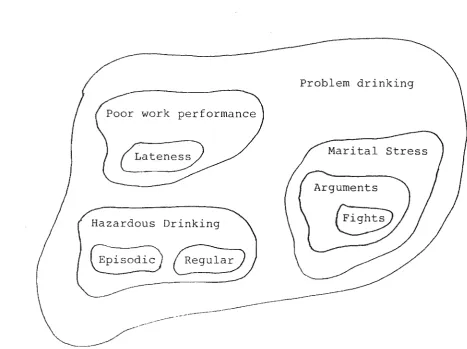
FIGURE 3
Three Possible Subconstruct Arrangements
Problem drinking
~aten~
[image:35.572.60.528.172.521.2]27
-Whenever one construct is subsumed by another, the former, by
definition, becomes a subconstruct. Kelly (1955) refers to
this process as "symbolism" (p. 138). In theory, this process
may be extended infinitely. Another example is given in
Figure 3. The outer line represents the boundary for the
construct • problem drinking' . The area outside this boundary
Kelly terms a "constellatory construct",
which permits its elements to belong to other realms concurrently, but fixes their realm membershi ps. (p. 155) .
Each of the elements in Figure 3 represent one pole of a
subconstruct. The choice of which pole (e. g. regular
drinking or irregular drinking) is purely arbitrary. There
are three possible situations in which the subconstructs can
be arranged.
The first is when the subconstruct • lateness' is a subset of
'poor work performance' which itself is a subset of . problem
dri nki ng' . • Lateness' is an amplification of the element at
the end of the poor work performance scale ( i t would
obviously be inappropriate to see lateness as an
amplification of the good work performance end of the scale),
. Lateness' itself may have subconstructs. This is the second
situation in which, for example, 'fights' is a subconstruct
of • arguments' which is a subconstruct of 'marital stress'
which is a subconstruct of 'problem drinking'.
In the third situation, • episodic' and • regular' are disjoint
subconstructs of • hazardous drinking'. • Episodic' and
I regular' may not be an amplification of either e of the
FIGURE 4
Near Normal Drinking Incorporating the Episodic Subconstruct
Hazardous drinking
Hazardous drinking
FIGURE 5
Near Hazardous Drinking Incorporating
the Episodic Construct
normal drinking
29
-combination of both. It is suggested here that the point at
which this combination occurs on the scale is idiosyncratic.
For example, some people may be episodic and near normal
drinkers (Figure 4) while others may not (Figure 5). It is
also suggested that • problem drinking' is the sum of
combinations of these elements from subconstruct scales. It
would be possible, for example, for a problem drinker to have
poor work performance although not be arriving late (Figure
3), and be a hazardous regular drinker with relative marital
harmony although involved in some fights. It would also be
possible for a problem drinker to have a completely different
combination from the same scales. This idiosyncracy is a
possible reason for the difficulty experienced in deriving an
operational definition for problem drinking.
So far, the subconstructs of problem drinking have been
represented by bipolar unidimensional scales, with
individuals responding idiosyncratically on these scales.
However, i t is necessary to examine more closely the nature
of these responses.
Responses on a problem drinking subconstruct scale are
governed by internal and external perceptions.
This corollary is closely allied to the "problem of
interpretation" (p.116) in Kelly's theory. That is,
are not easily communicated. For example, take • lateness' .
An employee arriving at work one minute past the prescribed
hour might consider i t not late, but the employer may have
very different views. In order to clarify these problems of
interpretation, i t is proposed to add another two dimensions
to the structure of scales.
In measuring the construct of problem drinking i t is
necessary to account for the confounding nature of
i di osyncrasy. Assessing unique, individual responses Allport
(1937) calls" idiographic measurement". However, in the
context of problem drinking, i t would be inappropriate to
rely totally on the idiographic responses of only one person.
In the previous example the employee's interpretation of
lateness was different £romthe employe~s. There is not
necessarily a correct or incorrect interpretation of
lateness, but in fairness both interpretations need to be
cons i de red. In other words, the response on a scale for
problem drinking should be made up from a combination of an
internally perceived interpretaton (that of the employee) and
an externally perceived interpretation (that of others or the
employer) . Failure to account for both could result in
incongruous situatons. For e xampl e, an i ndi vi dual coul d
interpret his drinking as normal while being observed by
others to be withdrawing from alcohol dependence, in which
case a diagnosis of normal drinking would not be proper.
Thus, two more dimensions of each problem drinking scale are
suggested: those of high-internal versus low-internal
perceptions and high-external versus low-external
31
-FIGURE 6
Internal and External Dimensions
of Hazardous Drinking
hi g h external
low i n t ern a 1 low external
Hazardous Drinking
H = f (internal, external)
high internal high external
perceptions. • I nternal' means those cogni ti ve processes
which determine an individual's response to a stimulus
designed to elicit attitudes or interpretations, such as "Do
you think . . . 1" or "Do you feel . . . 1" An external
perception, however, is the response to a stimulus designed
to produce observable behavioural consequences. These
behaviours are observable by all people and the observations
are not so dependent on attitudes or interpretation. A high
external stimulus could be "Have you been arrested for
drunken driving?", or "Have you been admitted to hospital
more than three times?". Naturally, no stimulus is likely to
be purely externally or internally based, but rather will be
made up of a combination of both. In the previous example
• lateness' could be fifty percent internal and fifty percent
external, or thirty percent internal and seventy percent
external, or numerous other combinations. The determination
These of these relative weightings will be discussed later.
internal and external perceptions are themselves
subconstructs, and i t is proposed in the corollary that i t is
these which determine the representation on each problem
drinking subconstruct scale.
To illustrate how this process works consider the example in
Figure 6 which shows how the internal and external
perceptions determine a person's representation on the
hazardous drinking scale. The corollary proposes that the
value on the hazardous drinking scale is a combination or
function of internal and external perceptions, or H on the
figure. Obviously H can take a variety of perception values
from low to high internal and external. stating this
33
-drinker (the value of H) depends on the perception of the individual (the internal perception) and the perceptions of others (the external perception). It is likely that this psychological process applies to any problem drinking subconstruct.
In summary, i t has been proposed that the idiosyncratic
responses to the scales of problem drinking are determined by a combination of representations on internal and external scales. Providing the sUbconstructs represent the content domain of problem drinking, i t should therefore be possible to measure the construct of problem drinking by summing the scale representations of these subconstructs.
A case history
To illustrate the application of the theory consider the following hypothetical case history:
Jane was a 17 year old student who was admitted to hospital for acute abdominal pain. She had one younger brother and was the daughter of
professional working parents. After passing the university bursary examination she moved into a flat with her boyfriend John, a 22 year old unemployed graduate, and intended to go to
university the following year. She said she left home because her family was not a happy one, with her parents constantly arguing and Jane frequently being physically abused by her father. She said she did not begin drinking heavily until she was in the seventh form. She would drink spirits
-usually vodka, in large quantities (half a bottle or more on one occasion) regularly on Friday and Saturday nights with the intention of getting
of morning trembling and nausea. She atttributed the morning nausea to her drinking, felt she would like to drink less, and thought her relationship with John was deteriorating and that he had
threatened to leave because of her drinking. All Jane's liver function tests were normal, indicating no liver damage due to alcohol.
The following are examples of some of the sUbconstructs which can be extracted from the case history:
Subconstruct Governing Perception
Regular drinker Internal
Heavy drinker Internal
Dependent on alcohol External
Craving for more Internal
Drinking to get rid of trembling Internal Deteriorating relationship Internal/external
Morning nausea Internal
Would like to drink less Internal
Normal liver function External
The governing perceptions listed above are some of those which dominate Jane's representation on each scale. Jane, for example, said that she drank regularly on Friday and
Saturday nights. Anything Jane said, unless i t was supported or contradicted by the perception of others, would mainly be her own perception of that subconstruct. The perception of others was largely external to Jane unless she supported or contradicted that particular interpretation. Thus, i t could be said that Jane was dependent on alcohol, but since the history did not suggest this then the representation would be largely external. Her placement on the I deteriorating
35
-FIGURE 7
Possible Values of External and Internal
Problem Drinking Subconstruct Scales
( a
t 1 ) ( 1 , 1 )ext ern a 1 H = f ( i n t e r n a l , external)
/
( 0 ,0)
internal ( 1 , 0 )
perceived - she said i t was deteriorating and John said he would leave. If the sUbconstructs were a representative sample from the content domain of problem drinking, then the sum of Jane's representation on each of the scales would determine her overall score on the problem drinking scale.
Suppose, for example, each internal and external scale is arbitrarily assigned values ranging from 0 to 1. Suppose also that the result of the combination of these scales had a range from 0 to 1. This situation is represented in Figure7.
The point H is the combination of the external and internal scales, mathematically represented as f( internal, external). The function f is a cognitive process which combines the external and internal scales of a particular subconstruct to gi ve a score H. There are, of course, likely to be
individual differences in the scores on these scales, the nature of the function f and, therefore, the resulting score H for any subconstruct.
One way of obtaining a total score is to find the additive sum of H's for each subconstruct. In the case of the
subconstructs listed for Jane this would mean that the problem drinking score would range in values from 0 to 9, since there are nine scales each having an H ranging from 0 to 1. However, this simplistic way of summing scores does not allow for any interactive effects between the
37
-Appendix B. This discussion translates the terms and ideas of the probem drinking construct into matrix equations,
ving examples of both general and simple solutions.
In practice, i t may be difficult to determine the relative contribution of the internal and external dimensions towards the score for anyone scale. Also, i t is useful to be able to rate any subconstruct as deriving from largely external or internal perceptions, or from a reasonable balance of both. This determination has application: for example, a problem drinker with a high internally derived score is at least admitting problems and may be more likely to receive help than one who is largely diagnosed through external
perceptions. Also, any test which is constructed to measure problem drinking needs a mixture of both externally and
internally derived measures. This ensures that the
perceptions of others and the perception of the person in question are taken into account before a diagnosis is made. This is particularly important when trying to make an early diagnosis, when more objective physical signs of alcohol dependence are not always available.
To build a number system which makes the summing of scales possible, Kelly suggests binary measures: that is, Kelly argues that because construct scales are bipolar, one end of the scale could be allocated the value 0 and the contrast pole the value 1. Suppos e, for' e xampl e, the s ubcons true t names in the case history represent the first element of each pair' (e. g. regular drinker for the scale regular versus
non-dependent drinker can be written, as in the binary
system, as 001. Extending this to all the scales from
'regular drinker' to • normal liver function' means that the
scale has a possible 9 steps running from 0000 to 1001.
Since i t has been argued that constructs operate on a
continuous bipolar scale, the obvious drawback to this
numbering system is that it does not allow for graduations
within one scale. For instance, Jane is or is not a regular
drinker (only the values 1 or 0). To alleviate this problem,
i t would be possible to arrange other scales to allow for
more graduated representations: however, it will be shown
that the binary system is preferable on utilitarian grounds.
If Jane was a problem drinker, she must have had sufficient
representation on the problem drinking pole of the problem
drinking versus non-problem drinking scale. That is, Jane's
scores could run from 0000 to 1001, and there is some score
within this range which determines problem drinking. How
much representation is required raises the question of
deciding on a cut-off score on the scale: this is
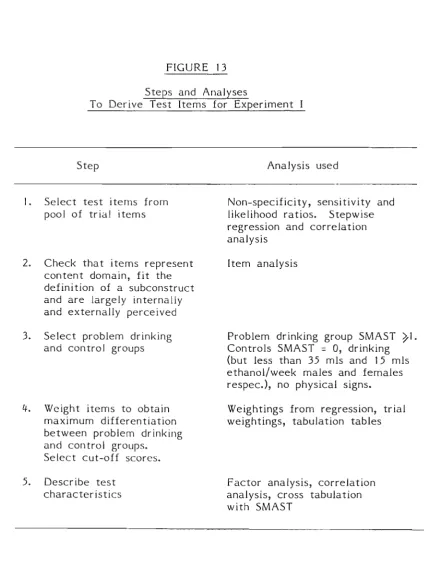
investigated in Experiment I.
3.4 THE CONSTRUCT, IDIOGRAPHIC AND NOMETHETIC MEASUREMENT
The fact that the construct of problem drinking can be
abstracted theoretically does not necessarily mean that there
is some characteristic of individuals which can be measured
in the context of that construct. A full explanation of the
problem drinking construct is made difficult by the lack of
understanding of the laws in which it operates. Is the
construct common to all individuals and measured in the same
39
-assessed differently for each? If the former holds, then
nomethetic measurement is appropriate. Alternatively, i f
the latter holds idiographic measurement should be used
(Bavelas, 1978). So far, all problem drinking instruments
have been nomethetic; that is, i t is assumed that there is