The Personality of a Human Intelligence Interrogator
The Relation Between Personality and a Comfortable Interrogator
Bachelor Thesis
B.Sc. Psychology
Marieke Grimberg
S1624369
Supervision and Examination
Dr. J.S. Oleskiewicz
Dr. Sven Zebel
Department Psychology of Conflict, Risk and Safety
Enschede, June 2018
2
Abstract
The purpose of this study is to discover if there is a relationship between personality and a comfortable Human Intelligence interrogator. Two specific interrogation methods were used, the most common used one, the Direct approach and a relatively new one, the Scharff approach. 35 participants participated in the within-group design experiment. They have executed two interviews followed by standardized protocols, one with the Scharff method and one with the Direct method. Afterwards they filled out five questionnaires. The first two questionnaires were measuring the dependent variable the comfort feelings of the participants with each approach. The three other questionnaires were measuring the independent variable, personality of the participants by using the Hexaco model, adaptability scale and uncertainty avoidance scale. Correlational analysis was used to discover if there were any relations between the personality and the comfort feelings with each approach. The results shows that someone who is easy in adapting to different situations is more comfortable in using the Scharff tactics. Moreover a relation was found between conscientiousness and a comfortable Scharff interrogator. Lastly this study shows that there is a negative relationship between honesty-humility and the comfort feelings with the direct approach. There would be suggested for future research to use these results and study as basis to further discover the relationship between the interrogators personality and preferences in interrogation method.
3
Samenvatting
4
The Personality of a Comfortable Human Intelligence Interrogator
Terrorism has increased in many aspects since the 9/11 attack in the USA (de Graaf, 2017). There is not only an increasing trend in number of attacks but also the impact of the attacks are considerably greater than before. An attack nowadays causes more victims and receives more media attention, which results in a more worried and frightened society. Furthermore, they have expanded from a local level to an international and worldwide level. That is, the terrorist groups are spreading to different countries and are not located in specific countries anymore (Lee, 2006; Bakker, de Graaf, van der Heide, de Hoog & van der Varst, 2012). Consequently, the role of anti-terrorism organizations is growing steadily. A critical task for these organizations is to gather intelligence, which refers to collecting information from different sources about the past, present, or future to improve national security and/or further national interests (Evans, Meissner, Brandon, Russano & Kleinman, 2010).
A specific form of collecting intelligence is human intelligence (HUMINT) gathering. HUMINT refers to the process of collecting information during interactions between two or more individuals (Granhag, Oleszkiewicz, Kleinman, & Strömwall, 2015; Evans et al., 2010). Interrogations could be used to gather such intelligence. Interrogations could be defined as a conversations were systematic questioning is used. The interrogator is asking question to a source who is perceived to be noncooperative. The purpose of an interrogation is to gather reliable intelligence also another purpose of the interrogator could be to move the source from noncooperative to cooperative (Evans et al., 2010). Therefore, during these interrogations, the relationship between the source and the interrogator plays a central role (Evans et al., 2010; Alison & Alison, 2017; Abe & Brandon, 2014). Building relationships during interrogations could increase
the cooperation of the source by reducing the source’s unwelcome, stressful and threatened
feelings. This relationship between the source and interrogator should be built on reciprocal empathy, acceptance, adaptation, understanding, communication, respect and trust (Alison & Alison, 2017; Alison, Giles, McGuire, 2015). Interrogators are suggested to use these principles for building a relationship during the HUMINT interaction. There are two important interrogation methods which will be discussed in this study.
5 preparation. The interrogators will consider on forehand what questions they should ask and how (Granhag et al., 2015). Moreover, during the direct method it is important that the interrogator is building rapport with the source. Hereby the interrogators are using the rapport building strategies by creating a positive interrogative atmosphere (Alison & Alison, 2017). After a relationship has been built the interrogator starts asking direct questions that are related to the information the interrogator needs. (U.S. marshal guideline chapter 3, p 3-14, 2006). When the interrogator notices that the source is avoiding answering the questions or is untruthful, the interrogator may change to another interview approach or the interrogator releases some pressure (Granhag et al., 2015).
The second HUMINT interrogation method discussed in this study, was originated by Hanns Scharff during the second World War. Scharff’s technique has recently been theoretically
conceptualized and empirically evaluated, and now goes under the name the Scharff Technique (Granhag, Kleinman, & Oleszkiewicz, 2016). The Scharff technique is strongly based on
perspective taking, which refers to the capacity to consider the world from another’s viewpoint.
Hence, this approach should feel more like a conversation between the source and interrogator, instead of asking questions and using pressure. Central to this technique is that the interrogator is sharing intelligence to create the illusion of knowing more than he or she does.
6 Previous studies
There is a lot of interest in researching the effectiveness of HUMINT interrogations. For example, there are studies about comparing law enforcement interrogations to HUMINT interrogations (Evans, Meissner, Ross, Houston, Russano & Horgan, 2013), the relationship between the interrogator and the source (Alison & Alison, 2017), and the efficacy of the interrogation technique on the source to influence the information yield (US Army Field Manual, 2006; Granhag, Montecinos & Oleszkiewicz, 2015). Hence, the effectiveness of Scharff method and direct method has already been demonstrated in a number of studies (e.g., Granhag, Kleinman & Oleszkiewicz 2016). These studies show that in comparison with the direct method, the source interviewed with the Scharff technique reveals more information that is new to the interrogator (Granhag et al., 2015).
All of the existing research on interrogation methods are of major relevance for gathering intelligence. However, all these studies have examined interrogation methods by focusing on the source. No studies, to the best of my knowledge, have considered the interrogator’s characteristics
in using different techniques. This is remarkable because in the end an interrogation is a reciprocal process between all three components; the source, the method and the interrogator (Wachi, Watanabe, Yokota, Otsuka & Lamb, 2016). Besides, how well someone is functioning on a task is related to how comfortable one is in performing on that task (Cerie-Booms, Oerlemans & Ceruseu 2017). Furthermore, research on personality states that an individual’s behaviour can be influenced
by his or her traits, hence the personality could influence the execution of the interrogation method (Wachi et al., 2016). Therefore, instead of looking to the effectiveness of standardized interrogation methods, the aim of this study is to focus on ‘who’ the interrogator is; is there a relationship in comfort feeling in using different HUMINT interrogation methods and the personality of the interrogator? Might it be that some persons fit better with certain techniques? So that the right person for the right technique which in the end might improve the effectiveness of the interrogation. This study approaches this question by examining peoples comfort feeling when using the Scharff technique and the Direct approach. To discover this relation first one need to focus on personality and consider the previous studies.
Personality
7 researchers tried to understand how personality influence other life aspects. For example couple of studies were done about how personality could influence performance (Barrick & Mount, 1991; Rothmann & Coetzer, 2003). The performances in situations are mostly based on how comfortable individuals are with the situation (Cerie-Booms et al., 2017). What could be seen as a comfortable for one may be uncomfortable for another, this is based on individuals preferences and personality (Che, Nigg & Koning, 1994). Interrogations or police work, could be seen as a specific performance too. Therefore, the interrogator’s personality might influence the comfortable feelings with an interrogation method. There are multiple models to describe someone’s personality and how this could influence ones behaviour. This study uses the Hexaco model.
Hexaco
The Hexaco model consists of six domains, the big five personality domain plus an extra one; honesty-humility, emotionality, extraversion, agreeableness, conscientiousness and openness to experience. Every domain consists of his own four facets which are represented in table 1 (Ashton & Lee, 2007).
Table 1
The Hexaco domains including the four facets on each domain
Domain Facets
Honesty-humility Sincerity, Fairness, Greed-Avoidance, Modesty
Openness to Experience Aesthetic appreciation, Inquisitiveness, Creativity, Unconventionality
Agreeableness Forgiveness, Gentleness, Flexibility, Patience Extraversion Expressive, Social Boldness, Sociability, Liveliness Conscientiousness Organization, Diligence, Perfectionism, Prudence Emotionality Fearfulness, Anxiety, Dependence, Sentimentality
The first domain, Honesty- Humility, represents the capacity to be fair and genuine in dealing with others even when one might exploit them without suffering retaliation. Individuals with a high score on honesty-humility avoid manipulating others for personal gain. They are not using others for personal benefit and are easy going in group cooperation. Low scorers are feeling a strong sense of self-importance and do less mind in using others for personal benefit (Lee & Ashton, 2008). Secondly, Openness to experiencerefers to the individual’s willingness to accept different ideas, values,
8 have a wide range of interests in many different aspects. Furthermore, they have a big imagination capacity and they are open to all values and ideas of others, for example culture and religion (Costa, et al., 1995). In contrast, low scorers are more likely to have a lower imagination capacity, avoiding creative pursuits and have little attraction towards idea that are different of their own ideas (Ashton & Lee, 2001).
Third, Agreeableness refers to the capacity to be forgiving and tolerant to others and are willing to cooperate and compromise with others. Agreeableness is focusing on the underlying behaviour during interpersonal interactions, such as sympathy, trust and cooperation (DeNeve & Cooper, 1998). Individuals high on agreeableness are not fond of placing labels on others, willing to compromise and cooperate and have a good control on their temper (Ashton & Lee, 2008). Controversially, low scorers are associated with having hard feelings to those who have harmed them, are critical to others, determined with their own opinion and feel anger to injustice. The fourth domain, Extraversion refers to an individual’s ability to deal with positive emotions,
enthusiasm, stimulation and sociability (Yu et al., 2017; DeNeve & Cooper, 1998) and associated with all social activities such as socializing, leading or entertaining (Ashton & Lee, 2008). Extravert individuals are feeling more confident and are most interested in sociable tasks and interactions. They are feeling comfortable in groups and comfortable in talking towards strangers. Contractionary, introvert individuals are less interested in tasks including social interactions (Costa et al., 1995). The fifth domain Conscientiousness can be defined as the control the individual has in executing his behaviour carefully and precisely and is associated with achievements such as planning, working and organization tasks (Yu et al., 2017). Individuals high on conscientious are hardworking and achievement striving in their performance, they are disciplined and goal orientated (McCrea et al., 1995; Ashton & Lee, 2008). Low scorers on this domain tend to be
nonchalant with their tasks, don’t like schedules, are avoiding difficult or challenging goals (Ashton & Lee, 2007). They are comfortable with an unorganized work manner (Ashton & Lee, 2009). Lastly, Emotionality, refers to altruism including not only empathic concern and emotional attachment but also the harm-avoidant and help-seeking behaviour. Individuals with a high score on emotionality need more emotional support of others because they experience more fear and
anxiety in response to life’s stresses. They have strong feelings of empathy and sentimental
attachment with others. Low scorers have limited need to share their concerns and are feeling emotionally separated from others. Moreover, low scorers feel little worried during stressful and difficult situations.
9 were the interrogator should deal with. It is often involving a highly ambiguous event, with many ambiguous factors (Alison, Kebbel & Leung, 2008). Two scales which are measuring dealing with ambiguous or uncertain events are the uncertainty avoidance (UA) and the adaptability scale (Häkkänen, Ask, Kebbel, Alison & Granhag, 2009). Individuals with a high score on uncertainty avoidance feels stressed and anxious when the outcome is unknown and the individual cannot predict the consequences. Hence, individuals with a high scores on UA, are avoiding risk taking situations (Martin, Nejad, Colmar & Liem, 2012). Closely related to uncertainty avoidance is
adaptability. Adaptability refers to an individual’s capacity to react and regulate new behaviour,
changing situations and uncertain circumstances. Someone high on adaptability could easily adapt into new situations, were someone low on adaptability has difficulties in changing behaviour to new situations (Martin et al., 2012).
10 Some reflections on the interrogator and the approach
In order to understand what kind of personality traits would make interrogators more comfortable in using the Scharff technique or more comfortable in using the direct approach, one first need to consider what the main characteristics and differences between the Scharff technique and the direct approach are.
The direct approach as described above consists of rapport building, on forehand carefully prepared and formulated direct and specific questions on certain subjects and is performed in a business-like manner. The Scharff techniques consists of the five tactics already described above. Summarizing the basic principles of the Scharff Technique: (a) using a friendly approach, (b) taking perspective of the source, (c) building a good relationship with the source, (d) creating an informal conversation, (e) masking the intention of the interrogation, (f) to evoke information rather than demanding it and (g) presenting the information that the interrogator already has to give the impression that the interrogator already knows everything of relevance to the situation.
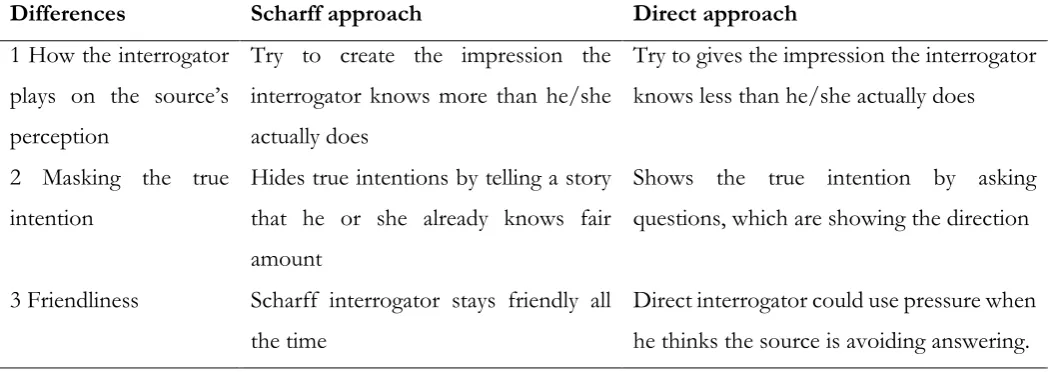
Both the direct approach and the Scharff technique are using rapport building as basis of the interrogation. Furthermore, both interrogations have the purpose to gather information. However, there are at least three differences between the direct method and the Scharff method.
First of all, the two approaches are different in how the interrogators plays on the source’s
11 Table 2
The three main differences between the Scharff and Direct approach
Differences Scharff approach Direct approach
1 How the interrogator
plays on the source’s
perception
Try to create the impression the interrogator knows more than he/she actually does
Try to gives the impression the interrogator knows less than he/she actually does
2 Masking the true intention
Hides true intentions by telling a story that he or she already knows fair amount
Shows the true intention by asking questions, which are showing the direction
3 Friendliness Scharff interrogator stays friendly all the time
Direct interrogator could use pressure when he thinks the source is avoiding answering.
These three differences and characteristics were used to motivate the idea that people with a preference for using the Scharff approach might be different from people with a preference for using the direct approach, and examine what kind of personality might suit which approach.
Present study
The previous research outcomes of Wachi et al. (2016) and Ono et al. (2011) have showed that there could be a relationship between personality and law enforcement interrogation methods. However, to the best of my knowledge no research was done regarding the personality of a human intelligence interrogations.
The leading research question in this study therefore is of exploratory nature; is there a relationship between the personality of an interrogator and the comfortableness with the Human intelligence interrogations, in specific with the Direct approach and the Scharff approach? Combining previous literature and theory above about personality and the characteristics of the two methods, predictions were made.
First prediction could be made based on the previous study of Watchi (2016) which showed that agreeableness was related to interview techniques, the theory that interrogations should be built on reciprocal empathy, acceptance, adaptation, understanding, communication, respect and trust. Furthermore the theory shows that agreeableness is based on trust and cooperation. Therefore, one can assume that there could be a relation between agreeableness and the Direct approach but also between agreeableness and the Scharff approach.
12 H1b: A high score on Agreeableness is positive related to a comfortable Scharff interrogator.
Moreover, as the reflection on both approaches showed that the Scharff interrogator should play with his information he has, where the direct interrogator asks formatted open-ended and specific questions. One could therefore assume that the comfortable Scharff interrogator should have a higher imagination, be creative, believable and easy in his storytelling. Theory showed that high scorers on openness to experience are considered to have a higher imagination and be more creative. Therefore, a positive relation between the comfortable Scharff interrogator and openness to experience is expected.
H2: A high score on Openness to experience is positively related to a comfortable Scharff interrogator
The third prediction is made about Honesty-Humility. Police officers are considered to be honest in general an integrity is a central key element in the police organization. Furthermore, the Scharff method is using a friendly approach. Nevertheless, interrogations could be seen as a manipulating strategy sometime to gather reliable information. For example, the Scharff interrogator is masking his truth intentions. This could be seen as a manipulating tactic, trying to let the source believe the interrogator already knows everything and hiding the true intentions so the source maybe reveals more information. Theory shows that low scorers on Honesty-Humility have less trouble in using manipulating strategies for personal benefit. Therefore, there is expected that Honesty-Humility should be negatively related to a Scharff interrogator where an individual should feel comfortable in using these tactics.
H3: A high score on Honesty-Humility is negatively related to a comfortable Scharff interrogator
13 H4a: A high score on Conscientiousness is positively related to a comfortable Direct interrogator
H4b: A high score on Conscientiousness is negatively related to a comfortable Scharff interrogator
Furthermore, as interrogations are all about communication, the interrogators should feel comfortable in talking with others in various situations. Moreover, the theory shows that extraversion is about sociability and communication. Hence, all interrogators should be extravert in a considerable way. Therefore, one could expect that extraversion could be positively related to comfortable interrogator with both approaches.
H5a: A high score on Extraversion is positively related to a comfortable Scharff interrogator H5b: A high score on Extraversion is positively related to a comfortable Direct interrogator
Due to the fact that interrogation could be seen as highly ambiguous and uncertain situation. The uncertainty avoidance scale and ambiguous scale were used. The Scharff interrogator has not has listed questions and should play with his information. Furthermore, because there were no direct questions the Scharff interrogator never knows how and when the source is going to react. This could feel as an uncertain situation which the interrogator should deal and adapt with. Adapting in situations refers to the capacity of individuals in dealing with new and different situations. The Scharff interrogator should not avoid the uncertain situations and should be easy in changing his behaviour during the interrogation, due to the fact that the interrogator never knows when and how the source is going to react. Therefore the Scharff interrogator should have
a high adaptability capacity’s for dealing with the uncertainties. Hence, there is expected that the
comfort of the Scharff interrogator is negatively related with uncertainty avoidance but positively with adaptability.
14
Method
Design
This experimental study employed a within-subject design, where each participant took part in both experimental interview conditions, the Scharff approach and the Direct approach. With the dependent variable comfortableness which consists of two different scales; how comfortable one was with the direct approach (DA) and how comfortable one was with the Scharff method. The independent variable personality of the interrogator consist of three different variables, HEXACO personality inventory, uncertainty avoidance and adaptability.
Participants
A sample of 35 participants with an average age of 24 years (SD = 7.5; Range = 19-56 years)
participated in a study on ‘research on interview strategies’. 9 participants were males and 26
females. The participants requirements involved a good understanding of English and a minimum age of 18 years old. The participants were recruited by the Sona system of the University of Twente,
adds on Facebook and via the author’s own social network. The participants who signed in from
the Sona system could earn one Sona credit. These credits are necessary to graduate your study. The participants who were participating without needing Sona credits or having a Sona account were participating on volunteering basis. This study was approved by the Ethical commission of the University of Twente.
Procedure
The experiment started with a short briefing and an informed consent form wherein participants were informed with the purpose and duration of the study. They were told that they were going to be the interrogator using two different interview methods and afterwards fill out a questionnaire about these interviews. That both interviews were based on a fictitious scenario concerning an attack planned by a terrorist group during a national holiday. Furthermore, it was explained that the scenarios for each interviews were different in key details of the attack (e.g., names, time, location, day and group size). At the end of the instruction the researcher stated to the participants that they could prevent the attack through gathering the right intelligence and should take it very seriously.
After giving their consent, the participants received identical instructions outlined in two
different protocol (one for each interview technique). Protocol 1 contained instructions about ‘the
direct interview approach’ and protocol 2 contained instructions about the Scharff approach, which
15 order to examine possible order effects. In the end 18 participants started with Direct approach and 17 participants started with Scharff approach. After the participant had read the first protocol (which was either the Scharff protocol or the Direct Approach protocol depending on the randomization), the researcher asked if the participant had understood everything of the first protocol. If so, the researcher brought the source into the room of the participants and the first interview started. After the first interview was finished, the source was leaving the room and the participant then received the second protocol. The participant was asked again to read this protocol carefully. Next, the researcher asked if the participant understood the second protocol, and afterwards the source was escorted into the room again and the second interview started in the same manner as in the first round.
The interview
After the participant was fully instructed and said they understood the protocol they were introduced to the source. The interrogators were instructed to invite the source to sit down on the other side of the table. The interrogator then starts by reading out the introduction of the interview protocol word-by-word. Both protocols used the same introduction were the interrogator explains to the source that he or she understands that the source is in a difficult position, but that they cannot allow bombing like this and therefore need information and some answers. Subsequently, the interrogator went on with either direct approach in asking questions see Appendix A for the background information and Appendix B for the standardized conversation or the Scharff approach in telling the story see Appendix C with the background information and Appendix D with the conversation protocol.
Direct approach protocol, includes a short case scenario about what the interrogator already knows about the upcoming attack. The protocol also contained instructions on how to execute the specific interview method correctly. Briefly, the protocol states that the participant should ask direct questions and try to gather intelligence about the planned attack. These questions are already standardized and containing the 7 key questions (who, where, which, what, why, when, how) for example, where is the attack, when does the attack take place and who are involved? Moreover, the
16 Scharff approach protocol , was introduced towards the participants as ‘’the story telling’’ approach.
The basis of this protocol was containing an explanation about the five interview tactics. The protocol describes each tactic which the participant should implement during the interview. The protocol states that the interrogator should create a friendly atmosphere, create the impression of knowing it all, ignore new information, does not ask direct questions but rather using claims and should not press for information. Moreover, there were given examples in how to behave and use each tactics during the interview. For example the tactic of ‘knowing it all and ignore information’, the participants were instructed that if the source is not responding or is giving new information, they should react like it is not of interest for them. That this illusion could be created by continuing in presenting their own information or by ignoring the answers of the source and just go on with the interview. Moreover, the participants were told that they have to present the claims at the end. The protocol explains that instead of asking for information they have to present the information as claims and notice if the source is confirming or disconfirming the claim. The participants were instructed that they already have information about two possible locations, two possible numbers of the amount of people who are working on the attack and two different delivery times for the bomb. The protocol gives for every option the most reliable one. The participant should choose whether to present the most reliable intelligence or the less reliable intelligence and wait on the reaction of the source.
After the explanation of the tactics and presenting the claims, the participant reads the standardized text which is based on storytelling a couple of times. This story consists all the information the interrogator already has. The interrogator is instructed to read this protocol word by word towards the source and leave waiting pauses for the source to react between every paragraph. At the end of the story the interrogator is implementing the last tactic ‘confirmation disconfirmation’ in presenting his own made claims.
Both interviews end by thanking the source and letting the source know that if he or she has more information they want to reveal, they could always call. After this the source is leaving the room.
Source
17 was to induce a semi-cooperative mind-set for the source instead of being overly friendly with the interrogator. See Appendix E for the scenario and background information of the Direct approach for the source, and see Appendix G for the background information of the Scharff protocol. Afterwards, the source received a standardized protocol with standardized answers and instructed time frames for when to react to ensure that there would be no differences between the different sources see Appendix F for the Direct conversation protocol and Appendix H for the Scharff conversation protocol. The standardized protocol also ensured that the source in both interviews reveals a similar amount of information to the interrogator see table 1, Appendix I for the revealed amount of information in both interviews. In addition to the protocol, the sources received verbal instructions from the author and practiced the interviews once with the author as the interrogator.
Post interview questionnaires
Directly after the interviews the participants were asked to fill out 5 short online questionnaires in Qualtrics on the laptop of the researcher. The first two questionnaires were about how comfortable they felt with each interview approach. This scale was developed to measure the comfort feelings of the participants with each interview approach. As described above, literature states that feeling comfort with a task has a positive influence on the performance of the task. Therefore the comfort feelings of the participants with each approach was used as dependent
variable, ‘Comfort feeling DA’ and ‘Comfort feeling Scharff’. Both feelings were measured with
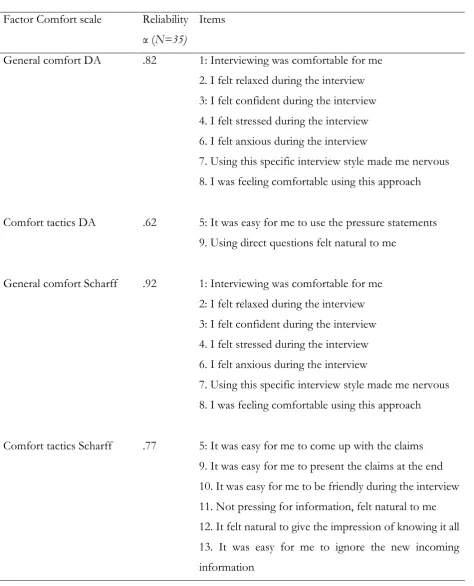
two separated scales Comfort feeling DA existing of 9 items and Comfort feeling Scharff existing of 13 items. Both questionnaires started with the same 7 items to measure how comfortable the participants felt during the interview in general. The remaining items on each scale were specifically related to the tactics the participants needed to conduct in each interview approach. For the reason that in the end the participants feelings of comfort with the interview may only rely on the specific differences in tactics on each approach, there was decided to divide the scale in two separated variables. A general comfort feeling variable, including the 7 items and a tactic related comfort feeling variable existing of the remaining items.
The variable ‘Comfort feeling DA’ was divided in: 1a General comfort DA consisting of 7
18 should bear in mind, that in the end all items together are related to the overall comfort feeling on each approach.
Table 3
Representation of the separated comfort scale.
Factor Comfort scale Reliability
α (N=35)
Items
General comfort DA .82 1: Interviewing was comfortable for me 2. I felt relaxed during the interview 3: I felt confident during the interview 4. I felt stressed during the interview 6. I felt anxious during the interview
7. Using this specific interview style made me nervous 8. I was feeling comfortable using this approach
Comfort tactics DA .62 5: It was easy for me to use the pressure statements 9. Using direct questions felt natural to me
General comfort Scharff .92 1: Interviewing was comfortable for me 2: I felt relaxed during the interview 3: I felt confident during the interview 4. I felt stressed during the interview 6. I felt anxious during the interview
7. Using this specific interview style made me nervous 8. I was feeling comfortable using this approach
19 The independent variable
The personality of the interrogatorwas measured through four different questionnaires, the BHI HEXACO personality inventory, the uncertainty avoidance scale, interpersonal reactivity scale and the adaptation scale.
HEXACO
Due to the time duration of the whole experiment, it was chosen to use a shortened version of the Hexaco inventory, the Brief Hexaco Inventory (BHI). The BHI version is a reversed version of the HEXACO PI- R. This version is existing of 24 items with 4 items on each domain. The BHI its test–retest stability, self-other agreement, and convergent correlations with full-length scales are relatively high. It has an overall convergent correlation of 0.78 with the commonly used HEXACO-PI-R (de Vries, 2013).
Adaptability scale
The adaptability scale was used for measuring the ability to adjust behaviour in changing situations (Martin, Nejad, Colmar & Liem, 2012). This questionnaire consists of 9 items that aims to measure
individuals’ tendencies to regulate cognitions, behaviour and emotions to new, changing or
uncertain situations. For example the question ‘’ I am able to revise the way I think about a new situation to help me through it.’’The 9 items comprised four key elements: (1) a response to novelty, change, variability and/or uncertainty, (2) cognitive, behavioural, or affective functions, (3) regulation, adjustment, revision and/or a new form of access to these three functions, and (4) a constructive purpose or outcome. Items were rated on a 7-point Likert scale 1 (Strongly disagree) to 7 (Strongly agree). The scale has an overall reliability of α = .90 (Martin et al., 2012).
Uncertainty avoidance
The final personality measure used was the uncertainty avoidance scale (Jung & Kellaris, 2004). This scale measures how individuals deal with ambiguous situations. Individuals with a higher score on this scale avoid ambiguous situations more than individuals with a lower score. The scale consists of 8 items (e.g., I prefer specific instructions to broad guidelines)rated on seven-point rating scales (1= fully disagree; 7= fully agree). The scale has a reliability of alpha = 0.75 (Jung & Kellaris, 2004)
Additional qualitative Analysis
20 choice question. These two participants were excluded from the qualitative analysis. The question was framed as below:
‘’ Below we would like you to describe how the “ Scharff/Direct’ approach fitted you personally. Please address if there was anything in particular that you:
a)liked about the “ Scharff/Direct” approach;
b) disliked about the ‘’ Scharff/Direct” approach;
In addition, if you can think of any changes that would have made the ‘’Scharff/Direct” approach fit your character better, please describe that too.’’
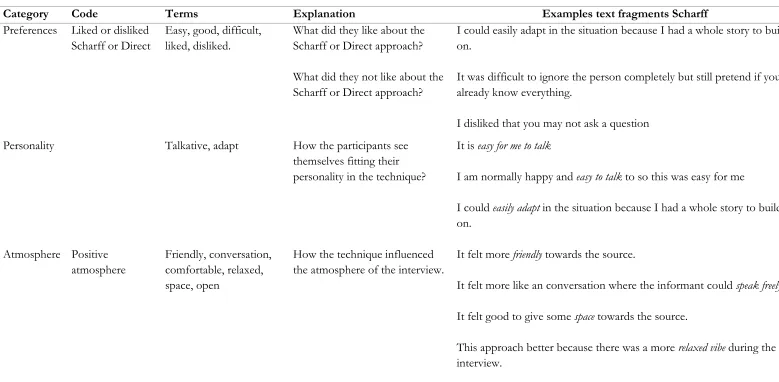
The answers on these questions were used to consider if the participants themselves feel a relationship between their personality and their comfort feeling with the Scharff or Direct approach and to figure out what this was based on. The answers were coded based on the grounded theory with an open coding of Glaser and Strauss (1967) to discover similarities and differences between coded fragments and the relative importance of categories. The purpose of the coding is to examine if there are any concepts for which participants felt comfortable with each approach. The coding scheme and process were reported for the Direct approach in table 2. Appendix J and the Scharff approach in table 3 Appendix K.
Results
21 To examine the hypothesis, correlational analysis were conducted between each independent and dependent variable. Independent variables: Hexaco inventory, adaptability and uncertainty avoidance. Dependent variables; 1a General comfort DA, 1b Comfort DA tactic, 2a General comfort Scharff and 2b Comfort Scharff tactics see method table 2.
Hexaco
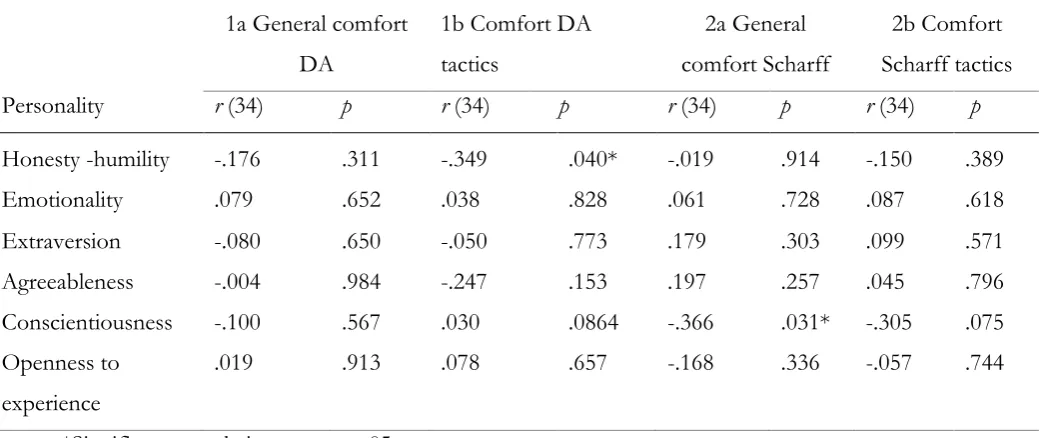
All interferential statistics of the Pearson correlations and p-values between the Hexaco personality domains and interrogation methods are represented in table 4.
To examine hypothesis 1a if agreeableness was positively related with the Comfort DA tactics a correlation was used. The Pearson correlation showed no relationship between agreeableness and Comfort DA tactics. Hence, no support was found for H1a.
To examine hypothesis 1b if agreeableness was positively related with a Comfort Scharff tactics a correlation was used. The Pearson correlation showed no relationship between agreeableness and Comfort Scharff tactics. Hence, no support was found for H1b.
Hypothesis 2 states openness to experience is positively related to the Scharff interrogator. The Pearson correlation showed no significant results. Therefore H2 could be rejected.
Hypothesis 3 stated that Honesty-Humility is negatively related with a comfortable Scharff interrogator. The Pearson correlation showed no significant results between honesty-humility and Comfort Scharff tactics. Therefore, H3 should be rejected. However the Pearson correlation did show an unexpected significant negative correlation between honesty-humility and Comfort DA tactics. In other words, someone low on honesty-humility feels more comfortable in using the pressure tactics.
Hypothesis 4a stated that conscientiousness is positively related to the direct interrogator. The Pearson correlation showed no significant relation between conscientiousness and Comfort DA tactics. Therefore, no support was found for H4a. Hypothesis 4b stated that conscientiousness was negatively related to the Scharff interrogator. The Pearson correlation showed no significant results between conscientiousness and Comfort Scharff tactics. Therefore, H4b should be rejected. However, the Pearson showed a considerably strong significant negative relation between conscientiousness and the General comfort Scharff. Which means that someone with a low score on conscientiousness feels more comfortable in using the Scharff method.
22 no significant relation between the Comfort DA tactics and Extraversion. Hence, no support was found for H5b.
Table 4
Representation of the Pearson’s r and their (non) significant level p between comfort feeling on each approach and the subscales of the Hexaco model
1a General comfort DA
1b Comfort DA tactics
2a General comfort Scharff
2b Comfort Scharff tactics
Personality r (34) p r (34) p r (34) p r (34) p
Honesty -humility -.176 .311 -.349 .040* -.019 .914 -.150 .389
Emotionality .079 .652 .038 .828 .061 .728 .087 .618
Extraversion -.080 .650 -.050 .773 .179 .303 .099 .571
Agreeableness -.004 .984 -.247 .153 .197 .257 .045 .796
Conscientiousness -.100 .567 .030 .0864 -.366 .031* -.305 .075
Openness to experience
.019 .913 .078 .657 -.168 .336 -.057 .744
*Significant correlation were p< .05
Uncertainty avoidance
Hypothesis 6 stated that uncertainty avoidance (UA) was negatively related to a comfortable Scharff interrogator. The Pearson correlation showed no significant relation between UA and Comfort Scharff tactics r(35)= -.016, p = .92 Therefore hypothesis 6 could be rejected.
Adaptability
23 Additional qualitative analysis
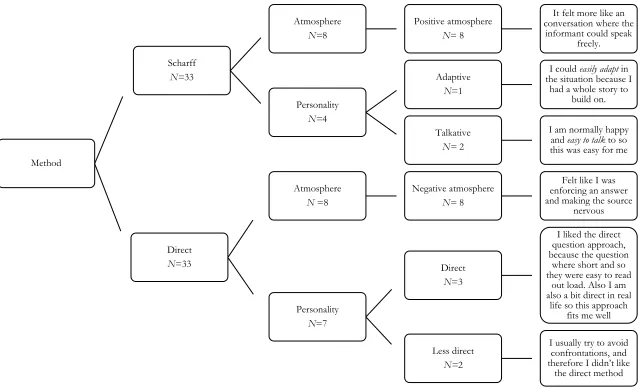
In these results a distinction is made between the Direct approach and the Scharff approach. In each approach is tried to discover why participants liked or disliked the particular approach and how it fits their personality. Furthermore if the participants were seeing a connection between their role as interrogator, their personality and there comfort feelings. The open coding makes clear that whether the participants liked or disliked he method was based on two main concepts. First of all, personality and secondly atmosphere; see Figure 1 for how many participants refer to which concept and what kind of answers were categorized as that concept.
Personality
The first concept personality was referring to how participants describe themselves fitting in the technique.
The Direct approach: In the direct approach 7 participants (21.1%) refer to their own personality. 2 participants just described in general that they think it doesn’t fit their personality.
Furthermore, 5 other participants were stating that the approach fits their personality because they were direct or less direct in daily life. Participants who describe themselves as a direct person in daily life, stated they liked the direct approach better; ‘I am often really direct and therefore I liked the straightforward questions’. Participants who describe themselves as less direct in normal life argued that the direct approach doesn’t fit their characters and therefore they more disliked the direct approach;’ I usuallytry to avoid confrontations, and therefore I didn’t like the direct method’.
The Scharff approach: Also in the Scharff approach 4 participants (12.1%) refer to their personality and how it fitted their daily personality. One participant referred that is felt more natural and wrote ‘Not having to pressure the person made it feel more natural to me.’. 2 other participants were stating that they found it easy to talk in daily life and therefore liked the Scharff approach better ‘’ I am normally happy and easy to talk to so this was easy for me.’’. Another participant referred to his ability
to adapt in the situation because of the story; ‘’ I could easily adapt in the situation because I had a whole story to build on’’.
Atmosphere
The second concept atmosphere was divided in positive atmosphere and negative atmosphere. First one remarkable point, is that in the answers of the Direct approach participants only refer to atmosphere as negative, were in the Scharff approach participants only refer to atmosphere as positive. In the end it seems to be that the participants argued that they were feeling more comfortable when there was a positive atmosphere and more disliked the approach when there was a negative atmosphere.
24 atmosphere as negative. The participant stated that they had the feeling that the direct questions were influencing the atmosphere in a negative way. One participant stated that it was difficult to connect with the source, due to the direct questions and pressure.
The relationship between personality and a comfortable HUMINT interrogator 25 Method Scharff N=33 Atmosphere N=8 Positive atmosphere N= 8
It felt more like an conversation where the
informant could speak freely.
Personality N=4
Adaptive N=1
I could easily adaptin the situation because I
had a whole story to build on.
Talkative N=2
I am normally happy and easy to talkto so this was easy for me
Direct N=33 Atmosphere N=8 Negative atmosphere N= 8
Felt like I was enforcing an answer and making the source
nervous
Personality N=7
Direct N=3
I liked the direct question approach, because the question
where short and so they were easy to read
out load. Also I am also a bit direct in real
life so this approach fits me well
Less direct N=2
I usually try to avoid confrontations, and therefore I didn’t like
[image:25.842.72.713.69.459.2]the direct method
The relationship between personality and a comfortable HUMINT interrogator
26
Discussion
This study aimed to examine relationships between personality and the comfort feeling with using two different HUMINT interrogation methods; the Scharff approach and the Direct approach. This crucial relation between the method and interrogator has been neglected in the past research. There were some interesting findings considering this relationship.
With respect to adaptability, it was predicted and found that the better people were at adapting in various situations the more comfortable they felt using the Scharff tactics. According to the literature, adaptability refers to being skilled with implementing new behaviour and adjusting to changing situations (Martin, Nejad, Colmar, Arief & Liem, 2012). Hence, it makes sense to argue that a reason for this finding could be the number of tactics included in the Scharff approach. That is, these tactics could be seen as new behaviour which the participants should implement really quickly during the interrogation. Another outcome related to adaptability was that no relationship was found between adaptability and the general comfort feeling with the Scharff approach. An
explanation for this could be that although the tactics could have been seen as “new” for the
participants, the interview interaction might not. Moreover, the execution of an interview could already be expected due to the fact that the participants have signed in to an interview study. Hence, the executing of an interview could already be expected whereas the specific tactics were not. Therefore, the participants were likely prepared and maybe didn’t felt the need to adapt executing
the Scharff interview. For this reason it could be that there was no relation found between the general Scharff comfort feeling and adaptability.
Another finding, which was not predicted, was the negative relationship between comfort with the Direct approach tactics and the personality trait of honesty-humility. Suggesting that someone who is comfortable with using pressure statements and releasing pressure has a lower score on honesty-humility. In other words, someone who is perceived to have less trouble with manipulating others feels more comfortable with applying pressure tactics. This finding might be explained through the use of pressure statements and pressure incorporated in the direct approach. Literature shows that low scores on this scale could be seen as more comfortable with manipulating others and breaking rules for personal benefit (Lee & Ashton, 2008). The U.S. Army Field Manual (2006) states that pressure could be used if the source isn’t willing to help or the strategy doesn’t
work. Therefore, the pressure tactics could be seen as coercive tactics for getting what the interrogator wants, information. This could be an explanation why a lower score on honesty-humility is related to a higher comfort feeling with the Direct pressure tactics.
The relationship between personality and a comfortable HUMINT interrogator
27 on conscientiousness, who is less organized and structured (Lee & Ashton, 2009) is feeling more comfortable using the Scharff interview, but not per definition in using the Scharff tactics. One explanation for this could be that the Scharff approach has a less overall structured working manner, there are no set questions and the interrogator should come with a story. Furthermore creating the illusion of knowing it all by ignoring the incoming information and playing with the amount of information, could also feel as less structured and organized for the interrogator. Therefore, the participants who are preferring control and structure maybe felt less comfortable with the Scharff approach. However learning and using new tactics could be seen as something that needs structure in when and how to implement them. It might be that for that reason there was no relation found between conscientiousness and the Scharff tactics.
Another finding worth to mention is that few participants referred to “interview
atmosphere” and “personality characteristics” as important factors for why they felt comfortable.
This finding fits neatly with the findings of Alison and Alison (2017) and further suggest that not only is it important that the source feels a good atmosphere, but that the atmosphere also influences the interrogator. Moreover, the feeling of a relaxed atmosphere was highest in the Scharff interview. It should also be noted that some participants stated that the Scharff interview felt more like a conversation instead of an interrogation. This is worthwhile mentioning because this is, in fact, the purpose of the Scharff interrogation. It is thus interesting that some participant have truly felt it this way. Moreover, this is also a confirmation that the protocols and instructions were developed successfully as they captured one to the true goals of the Scharff technique.
Finally, no relationships were found between uncertainty avoidance scale and four of the Hexaco domains (i.e., extraversion, openness to experience, emotionality and agreeableness) in relation to interrogative comfort. This might suggest that there are no relationships between those characteristics and being comfortable with the investigated interrogation methods. However, this might also be explained by the limitations of the study.
Limitations
The relationship between personality and a comfortable HUMINT interrogator
28 Furthermore, the small sample also means that there are less different personalities in the sample which could influence the results in a negative way.
Moreover, due to the difficulties in finding participants, the author was forced to recruit from her own social network. It is thus important to note that research has shown that there are similarities in personality characteristics between people and their friends (Vigil, 2007). That is, a person is more related to their social group than other groups (Jenkins, Reysen & Katzarska-Millers, 2012). Hence, the participants might not have been that different from each other, which might explain why relatively few relationships were found in the study. Another limitation, caused by the social network, was the relation between the source and the participants. The sources were
recruited in the author’s own social network, where sometimes the participants were also recruited in the researchers socials network. Therefore, is some cases, the source and the participants knew each other. This could result in that the overall comfort feeling, of those participants who already knew the source, could already be higher compared to those participants who does not know the source. However, the participants still needed to use two different interrogation methods. Hence in the end, the relation between the sources and participants still may not have affected the differences between both conditions, the Scharff and the Direct method and for that not the comfort feelings.
The relationship between personality and a comfortable HUMINT interrogator
29 amount of information at the same time during each interview. Due to all standardized protocols, now one can assume that the comfort feelings of the participants were mostly based on implementing the tactics and the different interview approaches.
Another limitation concerning the experimental design, which could have influenced the comfort feelings could be found in the complexity of the protocols. The Scharff protocol for example could be perceived as more complex since it contains more different tactics the participants needed to understand and implement. Complexity therefore could be seen as a potential confounded variable. In other words, instead of that only the independent variable, the personality of the participants, has effected the dependent variable comfort feelings. The variable the complexity of the protocols might have influenced the variable comfort feelings as well. Moreover, this could affect the experiment in a negative way. Since it might be difficult to really examine were the comfort feelings are coming from. Despite that the standardized protocols are a strong point of this experiment and take into account the most external factors, one should bear in mind this potential confounded variable.
The last limitations could be found in the measurements. For this study the shorten version of the Hexaco model was used, this could be seen as a limitation. Although, the test–retest stability, self-other agreement and convergent correlations with full-length scale are relatively high with an overall convergent correlation of 0.78 with the commonly used HEXACO-PI-R. Still the alpha reliability is relatively low (de Vries, 2013). Furthermore, due to the short version, no predictions could be made based on the sub facets of each domain. However, the sub facets could be more predictive for an individual than the overall domain.
Future research
The relationship between personality and a comfortable HUMINT interrogator
30 A last recommendation can be made based on the limitation of the standardized protocols. Future research could remove these standardized protocols and only try to control the theoretical framework. Meaning that the participants can choose how to do the interview but must follow the general rules. In the end it is interesting to notice how personality plays a role considering the comfort feeling with the whole approach, thus also in coming up with the story or questions and not only the tactics.
Conclusion
This exploratory study suggest that there are relationships between personality and comfortableness with interrogation methods. The findings reveal that people who are more adaptable feel more comfortable using the Scharff tactics, and people who are less organized feel more comfortable with the Scharff approach. For the direct approach, people who are having less trouble in using manipulating tactics towards others feel more comfortable using pressure tactics. Due to the results it is reasonable to assume that not every interrogator fits into every interrogation method and since interrogations are daily and important task of the police which should be done correctly to contribute to the investigation, further research is needed. Future studies might profit from using this study and results as basis for further examining the specific relationship between personality and interrogation methods. More research is needed and maybe someday, as already is done in other job functions, personality could be also used as recruitment strategy related to specific interrogation methods. Which in the end might improve the effectiveness of the interrogation because the right person would be assigned to the right technique.
Acknowledgement
The relationship between personality and a comfortable HUMINT interrogator
31
References
Abbe, A., & Brandon, S. E. (2014). Building and maintaining rapport in investigative interviews. Police practice and research, 15(3), 207-220.
Alison, L., & Alison, E. (2017). Revenge versus rapport: Interrogation, terrorism, and torture. American Psychologist, 72(3), 266.
Alison, L., Giles, S., & McGuire, G. (2015). Blood from a stone: Why rapport works and torture doesn't in'enhanced'interrogations. Investigative Interviewing: Research and Practice, Special Issue,
5-23.
Alison, L., Kebbell, M., & Leung, J. (2008). A facet analysis of police officers' self‐reported use of
suspect‐interviewing strategies and their Discomfort with Ambiguity. Applied cognitive psychology, 22(8), 1072-1087.
Ashton, M.C., & Lee, K. (2007). Empirical, theoretical, and practical advantages of the HEXACO model of personality structure. Personality and Social Psychology Review, 11, 150-166.
Bakker, E., de Graaf, B. A., van der Heide, E. J., de Hoog, D., & van der Varst, L. P. (2012). Onderzoek naar de maatschappelijke effecten van bestuurlijk optreden bij terreurdreiging en extreem geweld.: Bevindingen uit vier casusstudies.
Barrick, M. R., & Mount, M. K. (1991). The big five personality dimensions and job performance: a meta‐analysis. Personnel psychology, 44(1), 1-26.
Ceri-Booms, M., Curşeu, P. L., & Oerlemans, L. A. (2017). Task and person-focused leadership behaviors and team performance: A meta-analysis. Human Resource Management Review, 27(1),
178-192.
Che, H., Nigg, B. M., & De Koning, J. (1994). Relationship between plantar pressure distribution under the foot and insole comfort. Clinical Biomechanics, 9(6), 335-341.
Costa Jr, P. T., McCrae, R. R., & Kay, G. G. (1995). Persons, places, and personality: Career assessment using the Revised NEO Personality Inventory. Journal of Career Assessment, 3(2),
123-139.
DeNeve, K. M., & Cooper, H. (1998). The happy personality: A meta-analysis of 137 personality traits and subjective well-being. Psychological bulletin, 124(2), 197.
The relationship between personality and a comfortable HUMINT interrogator
32 Evans, J. R., Meissner, C. A., Ross, A. B., Houston, K. A., Russano, M. B., & Horgan, A. J. (2013). Obtaining guilty knowledge in human intelligence interrogations: Comparing accusatorial and information-gathering approaches with a novel experimental paradigm. Journal of Applied Research in Memory and Cognition, 2(2), 83-88.
de Graaf, B. A. (2017). Terrorisme-en radicaliseringsstudies: Een explosief onderzoeksveld. Justitiele Verkenningen, 43(3).
Granhag, P. A., Montecinos, S. C., & Oleszkiewicz, S. (2015). Eliciting intelligence from sources: The first scientific test of the Scharff technique. Legal and Criminological Psychology, 20(1), 96-
113.
Granhag, P. A., Oleszkiewicz, S., Strömwall, L. A., & Kleinman, S. M. (2015). Eliciting intelligence with the Scharff technique: Interviewing more and less cooperative and capable sources. Psychology, Public Policy, and Law, 21(1), 100.
Granhag, P. A., Kleinman, S. M., & Oleszkiewicz, S. (2016). The Scharff technique: On how to effectively elicit intelligence from human sources. International Journal of Intelligence and CounterIntelligence, 29(1), 132-150.
Häkkänen, H., Ask, K., Kebbell, M., Alison, L., & Granhag, P. A. (2009). Police officers' views of effective interview tactics with suspects: The effects of weight of case evidence and discomfort with ambiguity. Applied cognitive psychology, 23(4), 468-481.
Jenkins, S. T., Reysen, S. & Katzarska-Miller, I. (2012). Ingroup identification and
personality. Journal of Interpersonal Relations, Intergroup Relations and Identity, 5(1), 9-16.
Lee, S. P. (Ed.). (2006). Intervention, Terrorism, and Torture: Contemporary Challenges to Just War Theory (Vol. 1). Springer Science & Business Media.
Lee, K., & Ashton, M.C. (2008). The HEXACO personality factors in the indigenous personality lexicons of English and 11 other languages. Journal of Personality, 76, 1001-1053.
Life, R. S. (1994). Qualitative data analysis.
Martin, A. J., Nejad, H., Colmar, S., & Liem, G. A. D. (2012). Adaptability: Conceptual and empirical perspectives on responses to change, novelty and uncertainty. Journal of Psychologists and Counsellors in Schools, 22(1), 58-81.
The relationship between personality and a comfortable HUMINT interrogator
33 Oleszkiewicz, S., Granhag, P. A., & Kleinman, S. M. (2014). On eliciting intelligence from human sources: Contextualizing the Scharff‐technique. Applied Cognitive Psychology, 28(6), 898-907. Ono, M., Sachau, D. A., Deal, W. P., Englert, D. R., & Taylor, M. D. (2011). Cognitive ability, emotional intelligence, and the big five personality dimensions as predictors of criminal investigator performance. Criminal Justice and Behavior, 38, 471–491. http://dx. doi.org/10.1177/0093854811399406.
Rothmann, S., & Coetzer, E. P. (2003). The big five personality dimensions and job performance. SA Journal of Industrial Psychology, 29(1), 68-74.
United States Army. (2006). Intelligence Interrogation Field manual 3-31 (FM 34-52). Washington, DC:
Author.
Vigil, J. M. (2007). Asymmetries in the friendship preferences and social styles of men and women. Human Nature, 18(2), 143-161.
Wachi, T., Watanabe, K., Yokota, K., Otsuka, Y. and Lamb, M.E., 2016. The relationship between police officers' personalities and interviewing styles. Personality and Individual Differences, 97, pp.151-156.
The relationship between personality and a comfortable HUMINT interrogator
34 Appendix
Appendix A: Background information Direct approach
During this interview, you are going to read a standardized interview protocol, with the goal to gather intelligence about a possible future attack. This protocol consist open ended questions which are directly related to the attack. It will start with the basic questions, who, what, where, when, why and how. This questions are formulated in a way that they require a narrative answer instead of a
yes or a no. The source isn’t always helpful, therefore below there are presented some tactic to
release some pressure towards the source. Although, you are required to read the questions from the protocol word-by-word, you have to supplement the tactic listed below. You can this tactic before you are asking the next question. Read the instructions how to perform and use each tactic carefully. Try to follow the instructions of the protocol with as much involvement as you can.
1. When the source isn’t willing to help, sometime pressure is used during an interview. There
are some statements you can use to increase this pressure towards the source. There are 3 pressure statements you might could use during the interview. In general these statements are focusing on the answer of the source. Another way to increase the willingness is to mention the possible consequences. Some examples presented below.
a. I understand you do not want to get in trouble but we still need some answers to prevent that innocent people get hurt.
b. If we don’t prevent this attack there will be people dying. So do you know c. Are you sure you don’t know anything about ….
The relationship between personality and a comfortable HUMINT interrogator
35 Background information scenario
You’ve been contacted by a source that says s/he has information of interest to you. You know
this source has been involved with some criminal networks, so s/he usually holds good information. However, a source may not always be completely truthful and may try to avoid saying everything. The source has now approached you with some information about a planned bombing by a group named GMD. The source has inside information because a friend of him, is part of the GMD. The police already knows the group a bit. They are from Rotterdam consisting of 15 people. They have planned an attack before which failed because of a conflict inside the group. This conflict resulted in that Jesse, the founder of the group has left. Furthermore, the police now knows they are planning an attack in Enschede, which should occur the 27th of April during Kingsday. It is
important that you gather more information on this attack. The source could maybe help you.
The questions are fixed but you can use the tactics above to present the question or release some pressure. Read the protocol below as many times as you want before starting the interview, feel free to take notes. You are bringing the protocol with you so you don’t have to memorize the
The relationship between personality and a comfortable HUMINT interrogator
36 Appendix B.
Conversation protocol Direct approach
Hello and welcome. My name is _________. Good that you have signed in.
Well, there’s an important reason for you contacting me, but first just let me say that I understand
the difficult situation you’re in. At the same time you must understand that we can’t just allow bombings like this to take place. That’s why I have to make sure that the information you have really can help us. Therefore, I want to ask you some question about the attack and hopefully you can tell us more details about the attack.
Interviewer: Why is GMD planning an attack, what is their motive?
Await response
Interviewer: Who is participating in this attack?
Await response
Interviewer:What is the exact location and time of the attack?
Await response
Interviewer: When is the bomb going to be delivered on the location?
Await response
Interviewer: Is the bomb already manufactured?
Await response
Interviewer: How is the bomb going to be delivered?
Await response
Interviewer: So we have talked about ……. (summarize the interview in your own words)…..
Await response
Interviewer: Do, you have anything else you’d like to add before we end this conversation?
Await response
The relationship between personality and a comfortable HUMINT interrogator
37 Appendix C
Background information Scharff approach
During this interview, you are going to read a standardized interview protocol. This protocol consists of the story you are going to present to the source (to demonstrate your knowledge of the case). Try to follow the instructions of the protocol with as much involvement as you can. Importantly, although you are required to read the protocol word-by-word, you have to supplement this by adhering to the five tactics listed below. Read the instructions and how to perform of each tactic carefully, and use them as best as you can during the interview. The full purpose of each tactic will be explained after the study is over.
1. It is important that you create a positive atmosphere for the source. Be friendly, open and kind, and try to make the source feel comfortable and relaxed. The more relaxed you can make the source feel, the more he or she is likely to talk.
2. Try to give the impression that you already know everything about the attack. One way to give such an impression is to present the information you already have (by reading
the protocol). You can then supplement your story by saying things such as: “I already have most of the information”, “it’s unlikely that you can contribute with much
information” and so on. This impression could result in that the source feels less
pressure to reveal information that advances your knowledge, to give you new information.
3. You cannot demand any information (as this would work against that you already know a lot). Instead, you will need to evoke information from the source (i.e., draw out bits and pieces). During the storytelling (i.e., reading your protocol) you can try to influence the source to add details to your story. This could be done by being silent for a few seconds, or giving some space in your story, so the source gets the opportunity to react or fill out some details. While you are leaving space you can try to use encouraging techniques such as nodding and leaning forward.
4. Although you cannot ask direct questions, you will have the opportunity to present claims. However, you need to follow two simple rules described on the next page. Also, after presenting a claim, you have to leave some space so the source can react. If the source reacts, then treat this information as already known and continue reading the
protocol. If the source doesn’t react, wait for 4 seconds and then simply continue,