Master Thesis
Does he mean what he says? - Using Eye Tracking
to understand Victim - Offender Mediation
Author
Florian Bonensteffen S1437755
University of Twente
Faculty Behavioral, Management and Social Sciences Master Psychology of Conflict, Risk and Safety First Supervisor: Dr. S. Zebel
Second Supervisor: J. Jonas-van Dijk Enschede, The Netherlands
Abstract
The object of this study was to gain insights into the overt visual attention behavior of victims when evaluating the sincerity of an apology given by an offender in victim-offender
mediation. It was expected that victims’ attention was focused on the upper face part of the offender, including eyes and eyebrows, as these areas were expected to provide the richest informational content necessary to evaluate the apology. Also, inferences of suffering and responsibility taking and perceived emotions of regret and empathy were expected to predict the perceived sincerity of the offender. In total, fifty-eight university students were asked to take the role of a victim in a fictitious crime case scenario. They were then exposed to a video in which the offender offered his apology. During the study, eye tracking data of participants were obtained with the aim to collect fixation and attention distribution of the victims. Comparison of fixation durations and counts showed that the upper face area of the offender generally gained more attention of the victims than the offender’s lower face part. A
hierarchical model consisting of self-report measurements and eye tracking data, however, showed that these eye tracking data did not predict the specific inferences and emotions participants reported after the apology, such as the perceived sincerity of the apology. However, a relation of high expectations towards the offender’s sincerity and longer fixation durations on the offender’s upper face, could be detected. These results indicated that
participants spent more time looking at the eyes and eyebrows of the offender than on other visual areas when they had high expectations towards the offender being sincere. This study also argues that previous expectations towards the sincerity of the offender, positive attitudes towards resocialization programs and inferences of perceived suffering and responsibility taking positively predicted the perceived sincerity of the offender’ apology. The results are taken to the conclusion that applying eye tracking technology opens the door for further implementation of technology in the field of victim-offender mediation.
Acknowledgements
I would like to thank all those who supported and motivated me during the last eight mounths in which this thesis was written. It was an intensive but interesting period of time in which I had the opportunity to experience growth in the personal and educational level.
Special thanks goes to my first supervisor, Dr. Sven Zebel. Your enthusiasm, your support and guidance inspired me to finalize this thesis. From the first day, I was impressed by the way you created a very pleasant and constructive working atmosphere.
Introduction
When eleven-year-old Canadian Carys Cragg woke up at night, she heard a woman screaming. Downstairs, she saw her father lying on the floor, severely injured and bleeding. Minutes before, he had caught a burglar who offended him with a knife and escaped. Carys’s father died. Later that year, 1992, twenty-year-old drug addict Sheldon Klatt was identified as the offender. He was convicted for burglary and murder and sentenced to twenty-five years of incarceration. Nineteen years later, Carys sent him a letter, explaining “I have to understand who you are. This is the only way I can deal with the situation “. Another fifteen letters were exchanged between her and Mr. Klatt before they met on September 17, 2012, at the Drumhaller Correctional Institution under the supervision of two mediators1. Recently, Ms. Cragg shared
how this childhood incident altered the course of her life over the years and her reasons for deciding to meet with her father’s killer twenty years after the crime.
The case of Carys Cragg exemplifies the oppressive psychological consequences a crime may have on victims or their relatives. Empirical research into criminal-justice cases backs that victims often suffer from short or long-term negative emotions such as fear, anger, depression or strongly impaired feelings of agency (Shnabel & Nadler, 2008; Walters, 2015). Critics of traditional justice systems in Western society point out that victims often face insensitive psychological treatment during and after the justice process due to a lack of personal involvement and unmet needs2 (Zehr, 1990; Umbreit & Vos, 2000; Wenzel et al., 2008; Choi
& Severson, 2009; Dhami, 2012). To overcome the structural weaknesses of such traditional justice treatments, alternative conflict transforming practices have been applied in the justice system in the last decades referred to as Restorative Justice (RJ) (Braithwaite, 2002; Zehr, 2002; Wenzel et al., 2008). In this context, crime is understood as a violation of relationship rather than law (Latimer et al., 2005). Howard Zehr defines Restorative Justice as a “process to involve, to the extent possible, those who have a stake in a specific offense and to collectively identify and address harms, needs and obligations, in order to heal and put things right together.” (Zehr, 2002; p.37). This approach of a constructive dialogue assigns an active role to the victims in holding the offender accountable for his deed with the aim to make amends for the victim’s material or emotional pain (Weitekamp, 1993; Bradshaw et al., 2006).
With over a thousand programs in more than twenty countries, victim-offender
1Carys Craggs memoir „Dead Reckoning: How I Came to Meet the Man Who Murdered My Father.“ was released in 2017 and includes all memories, diary entries and motivations that lead to mediated contact with the offender in 2012.
mediation (henceforth VOM) has become one of the best known and most accessed professional forms of mediation in restorative justice practice worldwide (Umbreit et al., 2001; Latimer et al., 2005). Through direct engagement of victim and offender, VOM aims to facilitate an agreement about what the offender appropriately should do to repair the harm he or she caused (Gromet & Darley, 2011). The offender is thus held accountable for the consequences of his or her wrongdoings (Shnabel & Nadler, 2008).
In most of the programs, mediation is offered and initialized by a governmental organization that is concerned with the protection of the victim and provides orientation for the offender. In the Netherlands, mediation is organized by Perspectief Herstelbemiddeling
(Restorative Mediation Perspective)which is currently focused on the aftermaths of an offense but also offered to victims of road accidents, medical incidents caused by mistreatment and – behavior and sexual abuse (Perspectief Herstelbemiddeling, 2017).
Mediation is entered into on a voluntary basis when the agreement to initiate contact is met by both victim and offender after each side has analyzed the case with the mediator and the decision to initialize contact is made (Ponce-López et al., 2015). It is organized in a confidential and safe environment and is structured and guided by one or more trained mediator(s) (Umbreit, 2004; Pemberton et al., 2006). This way, victims have the opportunity to have their voices heard, for instance by letting the offender know how the crime affected their lives, by getting answers to lingering questions that remained unanswered and also by holding offenders accountable for what they did to them (Strang et al., 2006; Gromet & Darley, 2011; Walters, 2015). Offenders are given the opportunity to acknowledge responsibility for their action, to state reasons why they committed the crime or to make their apology as a gesture of regret (Umbreit et al., 2001; Choi & Severson, 2009; Gromet & Darley, 2011).
Several studies conducted with victims who participated in VOM indicate that obtaining an apology from the offender is one of the most important means of compensation perceived by the victim (Umbreit et al., 2005; Choi & Severson, 2009). However, the perceived quality and the evaluation of the offender’s apology strongly varies among participants in mediation (Daly, 2004). In the recent debate regarding the outcomes of mediation for victims, the question arises: Why do victims differ in their evaluation of the offender’s apology that is given in mediation? Here, it seems appropriate to take a closer look at different forms of mediation offered.
face-to-face, after a mediator has prepared the mediated contact beforehand to ensure that mediation will have no adverse consequences (perspectiefherstelbemiddeling.nl). Common forms of indirect mediation encompass letter exchange between both parties and also shuttle mediation whereby messages between both parties are relayed by a mediator. Shapland et al. (2008) argue that several victims prefer indirect channels of communication because direct confrontation with the offender was perceived as too stressful. Both forms can take place solely or complement each other. For instance, letter exchange can precede a direct meeting in order to gain knowledge about the offender and his background at first (as shown in the example at the beginning of this introduction).
However, comparing both forms of mediation, literature suggests that direct face-to-face mediation is found to have more positive effects than indirect mediation regarding its procedural and outcome effects (e.g. Umbreit et al., 2004; Shapland et al., 2008; Choi & Severson, 2009; Zebel, 2012). Compared with indirect mediation, direct mediation offers higher potential of avoiding misinterpretations in both quarters (Choi & Severson, 2009). That is, in the context of indirect mediation, victims suspected low feelings of commitment when reading a letter of an offender who made his apology. Victims judged that the offender seemed not to be sincere in his attempt to apologize, despite what the offender communicated when interviewed about his motivation to take part in VOM (Choi & Severson, 2009).
Furthermore, direct mediation has beneficial effects overcoming the negative feelings victim had before facing the offender. Zebel (2012) pointed out that direct mediation has a stronger potential than indirect forms of mediation to help the victim overcome negative feelings of fear and anger towards the offender. In his research, victims who took part in indirect mediation reported less feelings of fear afterwards; however, the anger they had towards the offender did not significantly decline by means of indirect contact (Zebel, 2012). In comparison, victims who participated in direct face-to-face forms of mediation indicated that both feelings of fear and anger were reduced afterwards.
visual input to the victim from verbal and non-verbal cues that were reported to strongly impact victims’ appraisal of the offender’s trustworthiness (Choi & Severson, 2009). In a more general context, Swaab et al. (2012) conclude that immediate visual (and vocal) feedback during direct communication regulates the quality of outcomes of negotiations and the perception of the opposite party.
These findings prove that the verbal and non-verbal behavior play a crucial role in how mediations are perceived and rated, and they also influence the victim in coming to terms with the offender. In this context, it seems important to establish to what extent visual feedback in terms of non-verbal cues affect the victim in his or her assessment of the offender to optimize the procedure of VOM, with the aim to avoid, if possible, that mediation fails. Surprisingly, there seems to be a lack of knowledge about how non-verbal behavior of the offender affects the victim’s evaluation of the mediation process. This study’s ambition therefore is to gain more insight into how these non-verbal cues are processed by the victim in face-to-face mediation and also to investigate to what extent they interact with personal previous attitudes, knowledge and inferences made pertaining to the offender’s emotions to influence the victim’s evaluation of the offender’s apology during mediation.
The methodology of VOM provides insufficient tools to examine the effects of non-verbal cues. The application of technology in VOM is in its preliminary stage and there is not much research available about the subliminal effects of non-verbal behavior in VOM. Commonly utilized measures, such as interviews and questionnaires, come with tight restrictions as to their capacity to depict processes that lie beyond levels of consciousness. This study therefore wants to contribute to the debate of how new technology can be applied in VOM thus improving the process of mediation by introducing eye tacking technology as a non-invasive means already in use in various psychological contexts to determine attention distribution. In other words, the purpose of this study is to ascertain whether predictions about a victim’s perception of an offender’s nonverbal cues can be made based on that victim’s gaze behavior. This study intends to answer the question: To what extent can eye tracking be used to predict where victims gaze at to detect emotional inferences and to determine the sincerity of an offender who offers his apology face-to-face during victim-offender mediation?
facial recognition theory in order to provide a theoretical foundation for the proposed hypotheses and research model.
The sincerity of an apology
The American Heritage college dictionary (2002) defines an apology as “an acknowledgment expressing regret or asking pardon for a fault or offense” (p. 67, derived from Choi & Severson, 2009). As Tavuchis (1991, p.5) noted earlier, an apology can not undo what happened but can account and signal commitment for the negative consequences of the deed. This is consistent with the expectations of victims who participated in VOM. Literature commonly agrees and describes an apology as an expression of admitting having done something wrong and having caused harm to someone through this (Choi & Sverson, 2009; Cels, 2016). Choi and Severson (2009) expend on diverging definitions of an apology and examine in a qualitative research the experiences of VOM taking into consideration the perception of the apology by the offender. In an apology, one admits having done something wrong to another. Also, the wrongdoer admits being responsible for the consequences, thereby indicating his willingness to make up for the harm inflicted. This has positive effects on the person who receives the apology and the individual offering the apology as well (Shnabel & Nadler, 2008, 2015). In terms of their Needs based model of Reconciliation (Shnabel & Nadler, 2008) it is argued that receiving an apology from the offender during mediation positively affects the victim’s feeling of strength such as power, influence and self-esteem, subsumed under the agency dimension of the victim. Further, the authors argue that offenders who feel remorse may experience a threat to their moral-social self-image which comes along with the fear of stigmatization and social exclusion (Shnabel & Nadler, 2015). Having the opportunity to offer an apology to the victim is found to have a positive effect on the perceived moral social image. This in turn yields positive effects on the reduction of recidivism (Shnabel & Nadler, 2015).
An important requirement to fulfill the victim’s needs is, however, that the message of the offender is perceived by the victim to be sincere, or, in other words, conveying his true feelings (Choi & Severson, 2009). In the context of this study, being sincere is used as a term to express and convey the sender’s true feelings instead of pretending to have certain feelings. With regard to an apology, sincerity therefore reflects the congruent state of inner emotions and how these are expressed.
of negative emotions such as regret, guilt and sadness have different levels of capability to communicate inferences of suffering and assuming responsibility taking by the offender. In the context of an apology, these inferences evoke positive reactions from the person they are directed to and lead to higher acceptance. (Giner-Sorolla et al., 2018).
In line with this, Choi and Severson (2009) state that an apology must at least adhere three components that are delivered to the victim by body language to be perceived genuine: sincerity, empathy and expressing regret. They further argue that all three elements must be identifiable in the offender’s appearance to be perceived as sincere. The current study wants to adopt these findings and therefore proposes:
H1: The perceived sincerity of the offender’s apology is positively predicted by inferences of suffering and responsibility taking that victims make when receiving the apology.
H2: The perceived sincerity of the offender’s apology is positively predicted based on the victim’s perception of the offender’s empathy and regret.
The link between information processing theory and emotional inferences
Abstractly spoken, information processing ascribes the interaction of the human mind with the environment via complex processes of sending and receiving stimuli within the nervous system and several brain regions (Lin Toh et al., 2011). The visual system decodes information from visible light to construct a meaningful representation of the surrounding environment (Lin Toh et al., 2011). Thus, human individuals are able to identify objects, perform tasks and also identify the expression of visible emotions in others. Moreover, Tatler et al. (2014) propose a bidirectional interaction of perception and action processes to create representations of the environment. Accordingly, visual environmental perceptions provide information about what action should adequately be taken; the action in turn influences perception processes (Tatler et al., 2014). By shifting point of focus, referred to as eye movement, visual areas of interest are processed and analyzed in order to organize sensual input in a meaningful structure. By this, the mind creates a schematic representation of single visual stimuli that serves to provide information, as it is proposed in the scanpath theory (Noton & Stark, 1971, derived from Lin Toh et al., 2011).
face recognition (Bruce & Young, 1982, as cited from Calder et al., 2000). This model explains that facial identity and facial expression of the observed subject are processed by separate routes (Calder et al., 2000). Thus, the face informs about characteristics of the subject and also about the current emotional state. In this sense, individual visual cues are assembled to create an overall impression of the content of the perceived emotion.
Literature of facial emotion recognition pioneered by the American anthropologist Paul Ekman suggests that a set of emotions expressing happiness, anger, sadness, fear, disgust and
surprise3 can directly be expressed by the contraction of certain facial muscles4, referred to as
primary or basic emotions (e.g. Ekman & Oster, 1979, Ekman, 2003). Adolphs (2003) concludes that facial displays of emotions are direct indications of intentions or moods. Ekman and Friesen (1978) introduced the Facial Action Coding System (FACS) as a means to denote facial muscle contraction into meaningful interpretations of emotions, which has been further developed in the last years by Ekman and colleagues. The model postulates that facial expressions consist of smaller components related to minimalistic impulses on one or more facial muscles called Action Units5 (AUs). For instance, expressed sadness activates three AUs (‘Inner brow raiser, brow lowerer and the lip corner depressor’) that are contracted in order to create a congruent facial expression.
In line with these findings, Smith et al. (2005) clearly argue that some regions of the face contain more useful information about the emotion expressed than other areas which seem less relevant for detecting certain emotions. Such regions rather than others have a higher discriminating potential to express certain emotion that is associated with muscle contractions in this region than others (Smith et al., 2005, derived from Chaby et al., 2017). In a study among older and younger adults, Chaby et al. (2017) tested gaze behavior consistency when participants were exposed to emotional faces. Interestingly, when faces expresses various basic emotions, there was a difference in participants’ attention fixation on the facial areas, also called Areas Of Interest (AOIs). In particular, results indicated differences in attention distribution among the AOI of lower and upper face. When looking at faces that expressed joy and disgust, more fixations were detected on the lower part of the face, which included all facial areas down from the tip of the nose, including mouth and chin. including mouth and chin. In contrast, when faces expressing the emotions fear, anger and sadness were shown, attention was directed to
3 Later, contempt was added as a 7th basic emotion directly visible in the human face. See also https://www.paulekman.com/micro-expressions/.
4 Studies give evidence based-support that these emotions and their recognition are universal within different cultures around the world (see also https://www.paulekman.com).
the upper part of the face, including eyes, eyebrows and the forehead (Chaby et al., 2017); similar findings were presented earlier by Calder et al. (2000).
Allocating the emotional inferences associated with a sincere apology, suffering and assuming responsibility, in one on the predefined areas, however, seems challenging when taking existing literature into consideration. The dimensional view of emotion recognition suggests that values on the dimensions of valence and arousal are discerned in the facial expression and subsequently used to attribute a specific emotion to the face (Russell, 1980, 1997, derived from Aviezer et al., 2008). Therefore, the inferences of suffering and
responsibility taking based on the emotions of regret, guilt and sadness are likely to be allocated in the facial regions that are associated with similar emotions, such as sadness. The studies of Calder et al. (2000) and Chaby (2017) back this concept. Hence, the following hypotheses are formulated:
H3: During the observation of the offender who gives his apology, the victim’s attention is focused more on the offender’s upper face area than on the lower face area.
H4: The degree of perceived suffering and responsibility taking of the offender are positively predicted by the victim’s fixations on the upper face part of the offender.
H5: The perceived sincerity of the apology is positively predicted by fixations on the offender’s upper face part.
Eye tracking and the current study
Tatler therefore recommends eye tracking as a reliable tool to measure these processes. Certain terms have been established as part of the common vocabulary in eye tracking.
Most studies make use of fixations, which are defined as consecutive gaze points within 1° of the visual field held with a duration of at least 200 milliseconds (Lin Toh, 2011). However, exact fixation duration may vary across different studies and measurement instruments. Most eye tracking devices provide additional analysis software with predefined terms (for the current study, these are found at https://www.tobiipro.com/siteassets/tobii-pro/user-manuals/tobii-pro-studio-user-manual.pdf, p.100) In this study, a fixation duration of at least 30 milliseconds was handled.
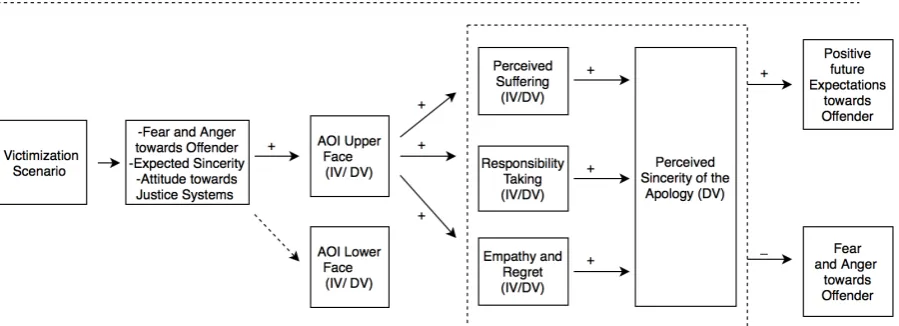
[image:12.595.76.526.455.618.2]The current study wants to explore how victims process visual cues provided in a mediation scenario, by facing the offender who offers his apology to the victim. Furthermore, it wants to test to what extend these unconscious processes are influenced by previous variables possibly influencing the victim before receiving the apology. These variables relate to attitudes, expectations and negative feelings caused by the offender. The research model of this study including independent and dependent variables is shown in Figure 1.
Method Participants
58 participants between 17 and 30 years (M = 21.26; SD = 2.99) took part in this study6. 56.9%
(N = 33) were female, 43.1% (N = 25) were male. Most participants (80%, N = 48) were bachelor students of behavioral Sciences (Psychology, Communication Science) or a similar specialization (Creative Technology) at the University of Twente. For participation, knowledge of English and Dutch language was required. Participants were approached by convenience sampling and could earn credit points for their participation or five euro as monetary compensation. During the experiment, they were asked to take the role of a person who was victimized and then took part in a face-to-face mediation with the offender. 12.1% of the participants (N = 7, 5 male, 2 female) reported that they have committed a crime at least once in their life; 29.3% (N = 17, 13 male, 4 female) knew a case in their close environment (e.g. family or friends) that has committed a crime at least once. 34.5% (N = 20, 10 male, 10 female) indicated that they have been victimized at least once in their life. 67.2% (N = 39, 19 male, 20 female) of all participants knew a case in their close environment in which someone has been victimized at least once.
Research design and experimental design
A correlational design is proposed to test the effects of previous expectations, the attitude towards justice systems, feelings of fear and anger and inferences and emotions of the offender on the perceived sincerity of the apology the offender offers. These variables are tested with regard to participants’ attention behavior including fixations and duration of eye movement.
Apparatus
Eye tracking data was collected simultaneously for both eyes with Tobii Pro Glasses 2, an infrared video-based eye-tracking head-unit device sampling eye movements every 4 ms (50 Hz) with a gaze position accuracy of 0.47. Soft- and hardware and technical support was
provided by the BMSLab powered by Tech4People (University of Twente, Enschede; https://bmslab.utwente.nl). The head unit was connected with a recording unit that stored data on a 32GB micro-SD card. A Dell tablet running Tobii Pro Glasses Controller analyze software
6A total number of 64 students completed the study procedure; four participants had to be excluded as they did not meet the requirement to understand Dutch language sufficiently; one participant was excluded due to calibration inaccuracy of the eye-tracking equipment; the pilot study (participant one) was also left out from further analysis.
was connected to the head unit and the main unit wirelessly for data acquisition. The informed consent, self-report measures and the stimulus material were presented on a 24’’ TFT LG Flatron W2442PE screen with a resolution of 1920 x 1080 pixels. Participants were seated in a distance of approximately 50 cm from the screen on a stable chair to reduce camera shake through body movement behavior during data acquisition. Data was analyzed with Tobii Pro Analyzer running on Windows 10 software. Data was mapped and corrected by comparing the motion pictures to a stable snapshot of the offender8 which can be found in Appendix C. Eye
tracking metrics were inserted and analyzed in SPSS 24 in the dataset containing all self-report measures.
Pilot study
Before collecting data for the analysis, the experimental procedure was tested and adjusted in a pilot study. Participant one was observed while doing the experiment9. The pilot study showed
that for participants who wear glasses in the daily life, an extra unit had to be put between the glasses’ lenses and the head unit of the eye tracker for measurement accuracy. Also, adjustments in the study design were made after the pilot test.
Procedure and materials
Participants were welcomed and first read and signed an informed consent form that covered all aspects about the voluntary, confidential and anonymous nature of the study. Also, they were informed that eye tracking technology is used to record their gaze behavior. The study was designed and conducted with the online customer experience software tool Qualtrics. After participants agreed to take part in the study, they were asked to put on the head unit of the eye tracking device that was adjusted to the participant’s nose and head by the researcher. Subsequently, the glasses were calibrated to generate measurement accuracy by looking at a target mark (Ø 2,5cm) that was placed to the amount of the participant’s face at a distance of approximately 50 cm. Then, recording of the participant’s gaze behavior started unobtrusively. Participants were instructed to imagine as good as possible to take the role of a victim in a violent burglary scenario that they were exposed to. Then, fear after the crime and fear and
8 See paragraph ‚Mapping eye fixations and data analysis’ at the end of the method section for a detailed description of the mapping process.
9Beforehand, it was intended to assign participants randomly to one of two conditions. In condition one they would hear the offender’s voice and in the second condition, the video waspresented without audible output. Participant one was assigned to the second condition. She reported that she was not able to make a judgement of the sincerity of the apology because hearable input was missing. Further, she explained that this was necessary to ensure that the content of the apology was not ambiguous to the offender’s nonverbal behavior. Therefore, it was decided to assign all participants to one condition with sound in order to prevent bias in the study in the
anger towards the offender were measured. After this, the concept of victim offender mediation was introduced to the participants and ; for the sake of this study, their agreement to participate in face-to-face mediation with the offender was presumed. Then, self-report measures were assessed; participants were asked to indicate their expectations towards the offender and also their attitude towards restorative and retributive juridical systems. They were asked to contact the researcher who showed them the stimulus material which was not embedded in Qualtrics due to a higher resolution. Instead of a think aloud protocol 10, participants were asked to
indicate at which areas of the video they looked at in order to avoid a higher mental work load during the video which could have influenced the visual attention accuracy. 11 Afterwards,
participants completed the questionnaire. At the end of the study, the recording was stopped and the participants were debriefed. The experiment was approved by the ethics board at the University of Twente.
Victimization scenario. Participants were asked to read a scenario in which they became victim of a violent burglary. The scenario was adopted and adjusted from Gromet and Darley (2011) and Van der Herberg (2013), as also used by Kippers (2015) and Van Dijk (2016).
On a Friday night, you go to an ATM machine to take out cash. You see nobody around you, it is a very calm night. You take your money from the machine into your wallet. Suddenly, you hear a noise and see someone approaching you. You feel a hard hit on your head and fall to the ground. The stranger is holding a gun in his hand, pointing in your direction and is shouting at you to give him your money. He grabs your wallet and runs away, leaving you lying on the sidewalk. No witnesses were around to give account to what happened. You are shocked and unable to chase the offender. The last thing you see is that he is running away. You feel a strong headache. You see blood on your hand after you intuitively touched your head. After several minutes, another person who comes to use the ATM finds you and calls 112.
You are taken to hospital; the next day, you are interrogated by a police officer about the incident.
Based on your description, the offender could be arrested and was convicted.
10In several studies using eye-tracking, think aloud protocols are used as a control measure to recorded gaze behavior; for instance, subjects are asked to describe verbally where they look at, simultaneously to the recording of their gaze behavior, recorded by an integrated microphone in the head-unit.
Stimulus material
Participants were exposed to a video clip (length: 1 min 12 s) of a man who offers his apology for his misdeed. He directly addresses the viewer of the video through eye contact and use of the 2nd person to address his apology to. The content of the apology is in Dutch language and
identical to stimulus material used by Van Dijk (2016) to represent face-to-face mediation, letter exchange and other possible forms of VOM. The full text can be found in Appendix B.
Measurement instrument
The measurement instrument consisted of nineteen sub-scales with a total number of 100 items. Two scales (fear towards the crime and fear and anger towards the offender) were presented twice; first, to measure initial feelings after being victimized, before the information about VOM was given and the offender offered his apology. Afterwards, these scales were presented again, with identical items as in the pre-measure. All items are listed in Appendix D. Reliability analysis was done for every subscale. In the description below, independent variables that also serve as dependent variables are marked with a *, and vice versa. Figure 1 in the introduction provides an overview of all measures used as independent and/ or dependent variables. All scales are also listed in the results, table 1.
Independent variables
Fear caused by the crime and fear and anger towards the offender*. After participants were instructed to put themselves in the role of a crime victim, they were asked to indicate to what extend they perceive fear that is caused by the crime and directed towards the offender two weeks after they were victimized. Five identical items were used for both measurements:
nervous, afraid, panic, insecure and fearful. (α=.65 for fear towards the offense and α=.72 for fear towards the offender in the measure before the offender offered his apology) Anger towards the offender was inquired with four items (angry, furious, mad and frustrated). These were found in Van Dijk (2016) and translated from Dutch language. Both measurements were assessed with a five point Likert scale, ranging from strongly disagree to strongly agree (α=.77). Fear towards the offense after mediation was also reliable with α=.78, Fear towards the offender after VOM with α=.80 and anger towards the offender after VOM with α=.81 also had a high inter- item reliability.
case scenario, the items were specified and directed towards the offender, for instance: „I think that the offender will tell a lie when he can benefit by doing so“. Reliability was high for this scale with α=.79.
Attitude towards justice systems. Seven items inquired whether participants prefer resocialization of the offender as a form of restorative justice policies over a retributive justice approach that emphasizes a punitive treatment of convicted offenders. These items were inspired by Gromet and Darley (2011) to examine what people thought should be done to achieve justice in general. They are also used in the study of Van Dijk (2016) and were measured on a five point Likert scale. Five items were negatively formulated (sample item: „Resocialization programs are a waste of time and money“). Reliability was high for this scale with α=.61.
Perceived emotions of the offender. After the stimulus material was shown, we were interested to know which emotions participants noticed to be expressed by the offender. On a five point Likert scale („Which emotions did you recognize..., ranging from ‚never’ to
‚always’“), participants were asked about basis emotions (e.g. sadness, fear) and more elaborate emotions such as regret and suffering that they thought were prevalent in the offender’s mind while making the apology12.
Dependent variables
Perceived suffering and responsibility taking*. Seven statements reflected on how participants perceived the offender to be suffering from what he did to the victim and to take responsibility for the consequences of his misdeed, three of them reversed. They were adopted from the scale
Passief meeroken (passive smoking) that was designed by Giner- Sorolla, Zebel and Kamau (2018), for instance: „The appearance of the offender indicates that he takes responsibility for the bad consequences of his deed“. Reliability was high for this scale with α=.83. An example for perceived suffering would be: „I doubt whether he is suffering emotionally from the effects of his actions“. (α=.85) Additionally, one statement inquired to what extend the offender was perceived to be ashamed for what he did. All were measured with a five point Likert scale.
Perceived regret and empathy. Participants were asked to indicate on a five point Likert scale to what extend they perceive the offender to regret his deed and to express empathic feelings for the victim. Two items (one reversed) were presented to measure perceived regret,
12Ekman (2017) argues that only basic emotions are visible in the human’s facial expressions and more complex emotions are covered in micro expressions lasting 1/25th of a second as a result of conscious
e.g. „If he could, the offender would make his deed unhappen“. Four empathic statements were shown, e.g. „The offender expresses empathy for the harm I suffer.” (α=.73).
Perceived sincerity of the apology. Two scales assessed how sincere the apology of the offender was perceived. First, six statements were rated on a five point Likert scale, ranging from strongly disagree to strongly agree, three in reverse, for instance: „I have the feeling that he does not mean what he said to me“. These were based on Choi and Severson (2009) and were also derived from Van Dijk (2016). After this, a second scale was presented, containing three questions regarding the offender’s sincerity, which was also rated on a five point Likert scale (strongly disagree – strongly agree). These came from Giner-Sorolla, Zebel and Kamau (2018) and were adjusted to the crime case scenario of this study. For example, it was asked: „Does the offender try to express different feelings than he actually has?“ Reliability analysis revealed a high Cronbach’s Alpha for both scales (α= .93 resp. .82). In further analysis, both scales were taken together to measure the construct perceived sincerity of the offender as they proved to have a high reliability with α=.95.
Behavioral expectations. Expectations about future behavior of the offender were assessed with four statements that reflected the estimated likelihood of the offender to become recidivistic; two were positively formulated (on a 5 point Likert scale). For example: „I think that the offender is likely to commit a similar crime in the future“. Scale reliability proved to be high with α=.88.
The ability to evaluate the apology. With a seven point Likert scale it was tested how participants rated their own ability to evaluate the apology, represented by the statement „For me, it was easy to make an estimation about the sincerity of the offender’s apology“. Compulsory text entry was attached with space for a short explanation for their choice in order to include qualitative assessment for the analysis.
Control variables
After the stimulus material, the question „Where did you look at during the video?“ was inquired with twelve items covering all visible elements of the video (e.g. eyebrows, hands, body). It was measured on a seven Point Likert scale (ranging from never to always) to test whether the gaze behavior recorded with the eye tracker varied from the respondent’s self-reported perception.
statement, the ability to take the role of the victim was reflected with five items, for instance:
„[...] to what extend could you perceive what the victim possibly feels, thinks and perceives?”
After this, it was asked to indicate how carefully the questions were read (one item). All measures were anchored at 1 and 10.
At the end of the study, demographic data including gender, age, nationality and current educational status was gathered. Also, own experiences with crime were examined (e.g. „Do you know a person you are related to (e.g. friends, family members) that has ever committed a crime (e.g. burglary)?) Facultatively, participants could indicate „no answer“ due to confidentiality. Finally, text entry was given for personal remarks regarding the study.
Eye Fixation variables and areas of interest
Via Tobii Analyzer, a list of gaze data was obtained for each participant. Gaze behavior consists of (a) fixations that were defined as the amount of continuous time that was spent looking at a 20 x 20 pixels region13 and (b) eye movement that is necessary to inspect the whole of a visual
scene in detail (Norton & Shark, 1971, derived from Boraston & Blakemore., 2007). The
number of eye fixations on the whole visual area of the stimulus material was calculated for each participant, representing the locations and the sequences (saccades) of the eye fixations.14Also, the duration of eye fixations. (in sec.) was examined. Fixation data served as independent and dependent variable as well, with respect to the hypotheses (see Figure 1).
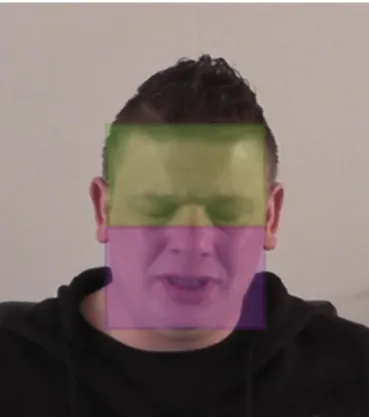
In order to compare fixation distributions, the offender’s face was categorized into look zones, also called areas of interest. In line with previous studies about facial emotion recognition conducted by Wong et al. (2005) and Chaby et al. (2017) and with regard to the initial expectations of this study, two AOIs were constructed. Both were created same sized so that differences in gaze fixations did not occur because one area was larger. One was representing the upper face part (including eyes and eyebrows) and a second area covered the lower regions of the face (nose, mouth, chin), as shown in figure 2. The Number of fixations
and the duration of the fixations were examined again, related to the specific AOIs.
Figure 2. AOIs that represent the upper and lower face, market on the snapshot of the stimulus material.
Mapping eye fixations and data analysis
In order to represent and visualize fixation distributions during the stimulus material, video sequence frames were matched to a fixed snapshot that was most appropriate to represent an average frame of the position of the offender (Appendix C). For each participant, every sequence with a value of 100ms as minimum fixation duration was compared to the snapshot to which a fixation point was added automatically by Tobii Analyzer. Every time the eyes rested on in an area of 30 x 30 pixels, the analysis tool added a fixation point to the output list. If necessary, a fixation point on the snapshot was corrected manually. The AOIs covering the face regions of the offender were previously marked on the snapshot so these events could also be allocated by the analysis tool. A table with fixation data used in the analysis was obtained via the export function of Tobi Pro Analyzer so that eye tracking metrics could be inserted in SPSS.
Results Overall view – Descriptives and Construct Validity
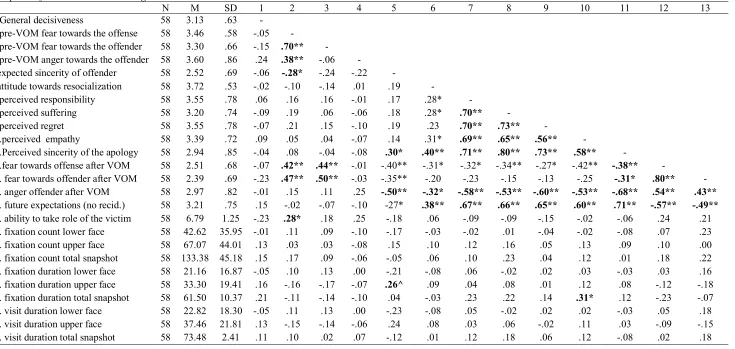
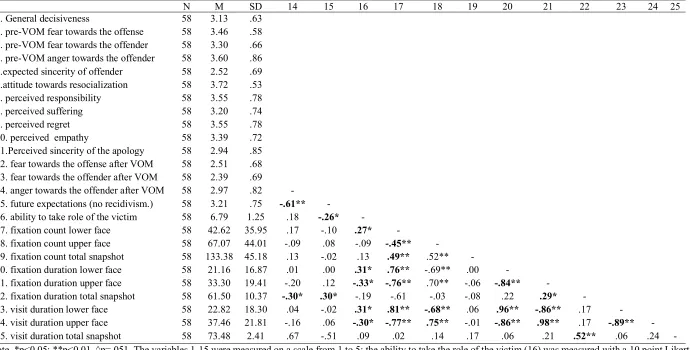
In Table 1, descriptives of the main variables are given for an overview of the data. It contains the number of participants, the mean scores with standard deviations15 for every scale and
interscale correlations of self-report measures and eye tracking metrics to display their construct validity. Eye tracking metrics were divided into visit duration, fixation duration and number of
fixations for the total snapshot that includes both AOIs of lower and upper face part of the offender and all other fixation points on the snapshot. Also, lower and upper AOI fixations and durations were listed apart. A description of the eye tracking metrics can be found in Appendix A16.
With M=3.72, participants’ attitude towards resocialization programs had the highest mean score comparing to the other scales, indicating that participants generally had a positive opinion about a restorative treatment of the offender after a crime to foster his resocialization process. Notably, pre-tests for fear towards the offense (M=3.46, SD=0.58 ) and fear (M=3.30, SD=0.66) and anger (M=3.60, SD=0.86) towards the offender before mediated contact were significantly higher than on the post-measure that was conducted after participants watched the apology of the offender (respectively M=2.51, SD=0.68, with t(57)= 10.54; M=2.39; SD=0.69 with t(57)= 10.30 and M=2.97, SD=0.82, with t(57)= 4.56, all p<.001). In other words, participants indicated that their negative feelings of fear towards the offense and fear and anger towards the offender were significantly lower after they observed the offender giving his apology.
Both expected sincerity (M=2.52, SD=0.69) and perceived sincerity (M=2.94, SD=0.89) were above the midpoint of the scale. Interestingly, the perceived sincerity of the offender offering his apology was significantly higher than the expected sincerity before participants saw the video (t(57)=-3.48, p<.005). This means that the initial opinion about the sincerity of the offender was altered within the mediation participation. Both constructs correlated negatively with fear and anger after VOM which shows that the higher expectations participants had in the sincerity of the offender and the more he was perceived to be sincere in his apology, the less fear and also less anger after VOM were reported.
Perceived sincerity highly correlated with inferences and emotions of the offender; thus as people detected higher feelings of suffering, responsibility taking, empathy and regret, they reported the apology to be more sincere, which was in line with previous expectations. These variables all correlate to a significant positive level with positive expectations towards the offender’s future behavior regarding the risk of recidivism. When people therefore had positive feelings about the offender in the current mediation scenario, they were also more optimistic regarding changes in the offender’s behavior in a short and long term perspective.
Regarding the relation of self-reports and eye tracking outcome measures, correlations were weak and in most cases non-significant. However, a pattern between perceived inferences and
emotions on the one hand and number of fixations on the other hand could be identified: Perceived regret, empathy, responsibility taking and sincerity were slightly negatively related to fixation count on lower face and positively related to fixation count on upper face which was in line with the hypothesis that participants will fixate more on the AOI (upper face) to evaluate the apology of the offender and the feelings the offender could experience. Additionally, perceived suffering negatively correlated to fixation and visit duration on the lower face AOI and positive to the upper face AOI. Nonetheless, it is important to consider that these correlations tended to approach 0 (and were non-significant) and may therefore not be appropriate to track eligible conclusions about relations of gaze behavior and estimations about the offender’s emotions or sincerity given in the self-reports.
Noteworthy, a marginal positive significant effect was observed in the correlation between the expected sincerity of the offender and the fixation duration on the upper face. Higher expectations towards the offender’ sincerity, therefore, were related to longer time spent looking at the upper area of his face. With regard on the initial expectations and the theoretical framework of this study, this finding supports the assumption that the upper face area provides more informational content about the apology and therefore attracts more interest and demands more attention than other visual areas.
Table 1
Descriptives of main variables including interscale Pearson correlations
N M SD 1 2 3 4 5 6 7 8 9 10 11 12 13
1. General decisiveness 58 3.13 .63 -
2. pre-VOM fear towards the offense 58 3.46 .58 -.05 -
3. pre-VOM fear towards the offender 58 3.30 .66 -.15 .70** - 4. pre-VOM anger towards the offender 58 3.60 .86 .24 .38** -.06 -
5.expected sincerity of offender 58 2.52 .69 -.06 -.28* -.24 -.22 -
6.attitude towards resocialization 58 3.72 .53 -.02 -.10 -.14 .01 .19 -
7. perceived responsibility 58 3.55 .78 .06 .16 .16 -.01 .17 .28* -
8. perceived suffering 58 3.20 .74 -.09 .19 .06 -.06 .18 .28* .70** -
9. perceived regret 58 3.55 .78 -.07 .21 .15 -.10 .19 .23 .70** .73** -
10.perceived empathy 58 3.39 .72 .09 .05 .04 -.07 .14 .31* .69** .65** .56** -
11.Perceived sincerity of the apology 58 2.94 .85 -.04 .08 -.04 -.08 .30* .40** .71** .80** .73** .58** -
12.fear towards offense after VOM 58 2.51 .68 -.07 .42** .44** -.01 -.40** -.31* -.32* -.34** -.27* -.42** -.38** -
13. fear towards offender after VOM 58 2.39 .69 -.23 .47** .50** -.03 -.35** -.20 -.23 -.15 -.13 -.25 -.31* .80** - 14. anger offender after VOM 58 2.97 .82 -.01 .15 .11 .25 -.50** -.32* -.58** -.53** -.60** -.53** -.68** .54** .43**
15. future expectations (no recid.) 58 3.21 .75 .15 -.02 -.07 -.10 -27* .38** .67** .66** .65** .60** .71** -.57** -.49**
Table 1 (continued)
N M SD 14 15 16 17 18 19 20 21 22 23 24 25
1. General decisiveness 58 3.13 .63
2. pre-VOM fear towards the offense 58 3.46 .58 3. pre-VOM fear towards the offender 58 3.30 .66 4. pre-VOM anger towards the offender 58 3.60 .86 5.expected sincerity of offender 58 2.52 .69 6.attitude towards resocialization 58 3.72 .53 7. perceived responsibility 58 3.55 .78
8. perceived suffering 58 3.20 .74
9. perceived regret 58 3.55 .78
10. perceived empathy 58 3.39 .72
11.Perceived sincerity of the apology 58 2.94 .85 12. fear towards the offense after VOM 58 2.51 .68 13. fear towards the offender after VOM 58 2.39 .69 14. anger towards the offender after VOM 58 2.97 .82 -
15. future expectations (no recidivism.) 58 3.21 .75 -.61** -
16. ability to take role of the victim 58 6.79 1.25 .18 -.26* -
17. fixation count lower face 58 42.62 35.95 .17 -.10 .27* -
18. fixation count upper face 58 67.07 44.01 -.09 .08 -.09 -.45** -
19. fixation count total snapshot 58 133.38 45.18 .13 -.02 .13 .49** .52** -
20. fixation duration lower face 58 21.16 16.87 .01 .00 .31* .76** -.69** .00 -
21. fixation duration upper face 58 33.30 19.41 -.20 .12 -.33* -.76** .70** -.06 -.84** -
22. fixation duration total snapshot 58 61.50 10.37 -.30* .30* -.19 -.61 -.03 -.08 .22 .29* -
[image:24.842.68.758.95.445.2]Eye tracking metrics and testing the hypotheses
Fixation distributions on all parts of the visual area including AOIs
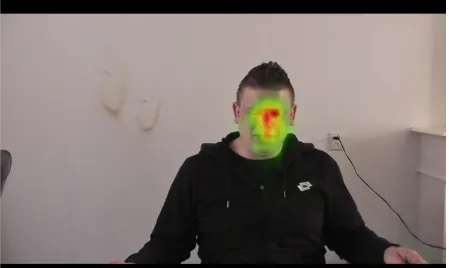
[image:25.595.72.521.383.651.2]Figure 3 and 4 give a visualization of (a) fixation duration and (b) fixation count that was acquired from 58 participants, represented on the snapshot that was used to map eye tracking metrics. Fixations and visits that were outside the computer screen were left out for further analysis as they did not relate to the visual area of the mediation scenario. Figure 3 illustrates the distribution of the visual attention, also called gaze behavior, of all participants, summarized in a heat map. It provides a heuristic overview of all data as order of fixations, individual scan paths and minor fixations are not visualized. The center of the heat map indicated by warm colors such as red and orange shows that the fixation focus of all participants predominantly lies on the left eye of the offender and the space between both eyes, including the upper part of the nose. Colored in green, the left index finger and the visual areas around the fixation focus, consisting of the right eye, the forehead and the mouth, also gained attention of the participants but to a smaller degree.
Figure 3. Heat map of visual attention for all participants.
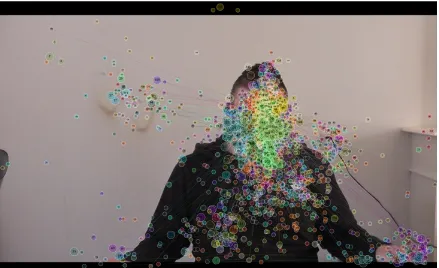
areas of the stimulus material can be seen; notably, density of fixation points on the offender’s face is higher than on the remaining areas.
Figure 4. Gaze plot indicating location, order and time spent looking at the stimulus for every participant.
For an overview of fixation distributions in the light of the expectations of this study, participants’ number of eye fixations on the predefined AOI of lower and upper face part were compared; as expected and consistent with indications of the participants17, there was a significant difference between the number of fixations on the lower face part (M=42.62; SD=35.95) and the fixation count on the upper face part (M=67.07; SD=44.01); t(57)=-2.73, p<.0, which therefore gained higher visual attention. Additionally, the duration of visits and fixations of all participants on lower and upper face part of the offender were compared. Analyses also revealed a significant difference of visit duration between the AOI; visit duration was higher on the upper face (M=37.46; SD=21.81) than on the lower face (M=22.82; SD=18.30) with t(57) =-2.86; p<.01. Also, participants spend significantly more time to fixate on the upper face of the offender (M=33.30; SD=19.41) than on the lower face part (M=20.17; SD=11.39); t(57)=-2.66, p<.05. As expected, these divisions indicate that visual attention was stronger directed to the upper face part including eyes and eyebrows than it was to the lower
17Reflected in the outcomes of the control measure „Where did you look at during the video?“. See method for
face part of the mouth and chin of the offender. These findings confirm hypothesis three18 which proposes that during the observation of the offender who gives his apology, victims’ attention is focused more on the upper face area than on the lower face area of the offender. However, further interest lies in the question to what extend these findings are relatable to the psychological inferences, emotions and expectations of the victim towards the offender. In the following, the relation of previous expectations, perceived inferences and emotions and gaze behavior will be analyzed in relation to the perception of the sincerity of the offender.
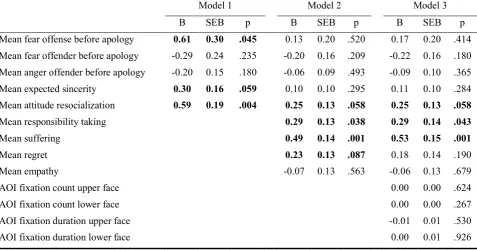
According to the temporal order proposed in the research model (figure 1), a hierarchical regression analysis was conducted to test predictions about the perceived sincerity, which served as dependent variable in each model. In total, three models were included in the analysis. Model 1 contains previous feelings of fear towards the offense, fear and anger towards the offender, expectations of the sincerity of the offender and attitude towards resocialization programs. The second model added inferences about the perceived suffering and responsibility taking of the offender and perceived feelings of regret and empathy the offender expressed towards the victim. Subsequently, eye tracking metrics were added to the analysis in Model 3. Table 2 summarizes all variables within each model, including B’s, standard deviations and p -values.
Previous expectations towards the offender, attitudes towards resocialization programs and feelings towards the offender predict the perceived sincerity of the apology
First, in Model 1 it was tested if the perceived sincerity of the offender’s apology can be predicted by the general attitude towards resocialization of offenders and previous expectations towards the sincerity of the apology, which served as independent variables within the model. Also, the feelings of fear towards the offense and the offender and anger towards the offender two weeks after the crime and before receiving the apology were added as independent variables. Model 1 was statistically significant with R2
change = .28, F(5,52) = 3.96, p < .01. The
analyses of the regression coefficients are displayed in table 2. As expected, the perceived sincerity of the apology was marginally positively predicted by the expected sincerity towards the offender (B = .30, SEB = .16, p = .059). As also expected, a positive prediction by the general attitude towards resocialization programs was found (B = .59, SEB = .19, p < .01). Surprisingly, fear towards the offense two weeks after the crime was shown to be positively predicting the perceived sincerity of the apology given by the offender (B = .61, SEB = .30, p < .05). Model 1
indicates that victims who have higher expectations towards the offender to be sincere in his apology and who have a more positive attitude towards resocialization programs also perceive his apology to be more sincere.
Table 2.
Regression model including B, SEB and p for every predicting variable. For every model, the perceived sincerity of the offender was the dependent variable.
Model 1 Model 2 Model 3 B SEB p B SEB p B SEB p Mean fear offense before apology 0.61 0.30 .045 0.13 0.20 .520 0.17 0.20 .414 Mean fear offender before apology -0.29 0.24 .235 -0.20 0.16 .209 -0.22 0.16 .180 Mean anger offender before apology -0.20 0.15 .180 -0.06 0.09 .493 -0.09 0.10 .365 Mean expected sincerity 0.30 0.16 .059 0.10 0.10 .295 0.11 0.10 .284 Mean attitude resocialization 0.59 0.19 .004 0.25 0.13 .058 0.25 0.13 .058 Mean responsibility taking 0.29 0.13 .038 0.29 0.14 .043 Mean suffering 0.49 0.14 .001 0.53 0.15 .001 Mean regret 0.23 0.13 .087 0.18 0.14 .190 Mean empathy -0.07 0.13 .563 -0.06 0.13 .679 AOI fixation count upper face 0.00 0.00 .624 AOI fixation count lower face 0.00 0.00 .267 AOI fixation duration upper face -0.01 0.01 .530 AOI fixation duration lower face 0.00 0.01 .926
The emotional inferences of suffering and responsibility taking and the perception of empathy and regret of the offender
Model 2 added perceptions about the apology of the offender, including inferences of responsibility taking and perceived suffering. Also, perceived feelings of regret and empathy expressed by the offender were added. This model proved to be statistically significant as well with R2change = .75, F(4,48) = 22.51, p < .01. In line with the expectations, the perceived sincerity of the apology is positively predicted by perceived responsibility taking (B = .29, SEB = .13, p < .05) and by perceived suffering (B = .49, SEB = .14, p < .05). This means that the recognition of these perceptions is also associated with a sincere apology. Therefore, hypothesis one is confirmed. Also, a trend for perceived regret as a predictor for the perceived sincerity can be found with B = .23, SE = .13, p = .09. Unexpectedly, perceived empathy does not predict the perceived sincerity of the offender to a statistically significant degree in this model (B = -0.07,
The perceived sincerity of the apology is positively predicted by fixations on the upper face part of the offender
Next, eye tracking metrics were added in Model 3, including fixation count and durations for both AOI of lower and upper face. Against expectations, Model 3 was not statistically significant with R2
change = .76, F(4,44) = 0.53, p = .71. In other words, in this model it cannot
be confirmed that eye tracking metrics of the victim can be regarded as predictors for the evaluation of the sincerity of the offender’s apology. Since the model does not add statistically significant explanatory value, no further analyses are permitted on the regression coefficients. Hypothesis five, that proposed that the perceived sincerity of the apology is predicted by fixations on the upper face part of the offender, could therefore not be confirmed within the model. However, as shown in the table 1, a trend can be observed in the relation of the expected sincerity and the fixation duration on the offender’s upper face area that correlate with .26 to a marginal significant degree (see table 1).
The effect on perceived regret and sincerity
[image:29.595.72.438.629.689.2]To test the effect of the fixations on the upper face on perceived regret and sincerity, a mediation analysis was conducted with fixation on upper face as predictor, the perceived regret as mediator and sincerity as criterion variable. The mediation analysis returns that the total fixation count regarding the upper face and regret explain the perceived sincerity to a statistically significant portion, with F(2, 55) = 42.95, p < .05, R2= 0.53. Within the model, the fixation count on the upper face is not statistically significant, while regret is positively related to perceived sincerity, as seen in Table 4. The indirect effect of fixations on upper face via regret on perceived sincerity was not significant, with B = 0.002, SEB = 0.002, 95%CI = [-0.002; 0.006].
Table 4
Regression coefficients and confidence interval for perceived regret and AOI, with perceived sincerity as dependent variable.
95% CI B SEB t p min Max Perceived regret 0.78 0.08 9.26 0.00 0.61 0.95 Fixation count upper face 0.00 0.00 0.41 0.68 0.00 0.01
The effect on suffering and perceived sincerity
sincerity to a statistically significant portion, with F(2, 55) = 47.43, p < .05, R2= 0.63. Within the model, the fixation count on the upper face is not statistically significant, while perceived suffering is positively related to the perceived sincerity, as seen in Table 5. The indirect effect of fixations on the upper face via suffering on perceived sincerity was not statistically significant, B = 0.001, SEB = 0.002, 95%CI = [-0.003; 0.004].
Table 5
Regression coefficients and confidence interval for perceived suffering and AOI, with perceived sincerity as dependent variable.
95% CI B SEB t p min Max Perceived suffering 3.02 0.18 17.09 0.00 0.00 0.00 Fixation count upper face 0.00 0.00 1.19 0.24 0.00 0.00
The effect on perceived responsibility and perceived sincerity
The effect of fixations on the upper face part on responsibility taking and perceived sincerity of the offender was again tested with a mediation analysis. It showed that the total fixation count regarding the upper face and perceived responsibility taking explain the perceived sincerity to a statistically significant portion, with F(2, 55) = 28.37, p < .05, R2= 0.51. Within the model, the fixation count on the upper face is not statistically significant, while perceived responsibility taking is positively related to perceived sincerity, as seen in Table 6.
The indirect effect of fixation count via perceived responsibility on perceived sincerity of the apology was not significant, B = 0.001, SEB = 0.002, 95%CI = [-0.004; 0.004].
Table 6
Regression coefficients and confidence interval for AOI and responsibility taking, with perceived sincerity as dependent variable.
95% CI B SEB t p min Max Perceived responsibility taking 0.77 0.10 7.48 0.00 0.56 0.98 Fixation count upper face 0.00 0.02 0.04 0.97 0.00 0.00
The effect on suffering, responsibility taking and perceived sincerity
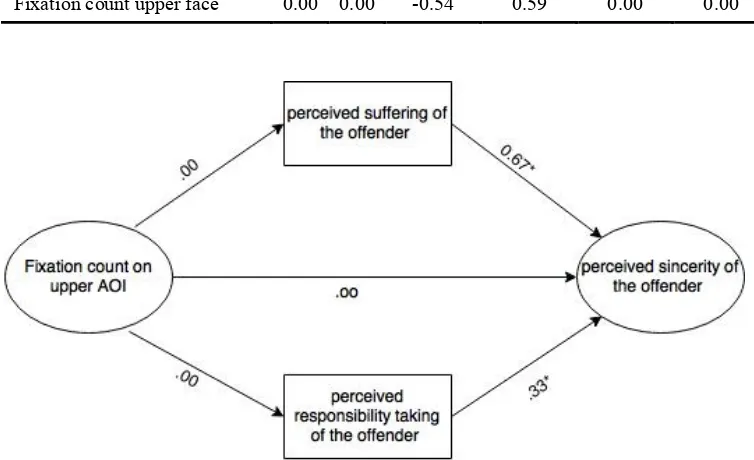
[image:30.595.72.465.592.653.2]taking explain the perceived sincerity to a statistically significant portion, F(3, 54) = 38.60, p < .05, R2= 0.68. Within the model, fixation count on the upper face is not significant, while suffering and responsibility taking are positively related to perceived sincerity, as seen in Table 7. The indirect effect of fixation count on upper AOI via suffering on perceived sincerity was not significant, B = 0.002, SEB = 0.002, 95%CI = [-0.001; 0.005]. The indirect effect of fixation count on upper AOI via responsibility taking on perceived sincerity was as well not significant, with B = 0.001, SEB = 0.001, 95% CI = [-0.001; 0.003]. Therefore, hypothesis 5 is rejected. The effects of the predicting variables on the criterion variable are displayed in figure 5.
Table 7
Regression coefficients and confidence interval for AOI and suffering and responsibility taking, with perceived sincerity as dependent variable.
95% CI B SEB t p min max Perceived suffering 0.67 0.12 5.44 0.00 0.43 0.92 Perceived responsibility taking 0.33 0.12 2.88 0.01 0.10 0.57 Fixation count upper face 0.00 0.00 -0.54 0.59 0.00 0.00
Figure 5. Mediation of the perceived sincerity on the relation between the fixation count on the upper AOI and the perceived suffering and responsibility taking of the offender.
Additional results
The role of attitude towards resocialization in the inferences about the perceived emotions and the perceived sincerity of the offender
[image:31.595.70.447.363.593.2]and responsibility taking as mediators and the perceived sincerity as criterion variable. The mediation analysis returns that attitude towards resocialization programs, the perceived suffering and responsibility taking of the offender explain the perceived sincerity to a statistically significant portion, with F(3, 54)=43.43, p<.05, R2= 0.70. Within the model, attitude towards resocialization programs is significant, while suffering and responsibility taking are positively related to the perceived sincerity, as seen in Table 3. The indirect effect of attitude towards resocialization programs via suffering on perceived sincerity was significant, B = 0.245, SEB = 0.161, 95%CI = [-0.019; 0.641]. The indirect effect of attitude towards resocialization programs via responsibility taking on perceived sincerity was significant as well, with B = 0.125, SEB = 0.076, 95% CI = [-0.008; 0.284]. Figure 6 shows the effects of the predictor on the mediators and the dependent variable.
Table 3
Regression coefficients and confidence interval for attitude, suffering and responsibility taking, with perceived sincerity as dependent variable.
95% CI
B SEB t p min max
[image:32.595.70.527.347.426.2]Attitude towards justice systems .28 .12 2.22 .03 0.03 0.52 Perceived responsibility taking .30 .11 2.71 .01 0.08 0.53 Perceived suffering of offender .63 .12 5.33 .00 0.40 0.87
Figure 6. Mediation of the perceived responsibility taking and suffering between the attitude towards resocialization and perceived sincerity of the offender (*p<.05) (The B-value of the total effect of attitude towards resocialization programs on perceived sincerity is shown in brackets).
Discussion
In the last decades, victim- offender mediation has found to be an important corner stone in the application of restorative justice principles to react on the aftermaths of a crime, in order to find the most beneficial outcomes for all parties that were involved (e.g. Strang et al., 2006; Wenzel et al., 2008; Shapland et al., 2008). Several studies among VOM suggest that an apology as a means of empathic expression often is regarded as an important and adequate immaterial compensation from the victim’s perspective (e.g. Choi, 2009; Gromet & Darley, 2011). The current study was conducted to investigate the way victims evaluate the sincerity of the offender who offered his apology, by combining self-report measurements reflecting victims’ estimations with their physiological data about unconscious visual processes that took part during a mediation scenario. Results indicated that both parameters contributed to the victim’s evaluation of the offender’s apology to a certain extend.
Furthermore, this study is the first to introduce eye tracking technology to the field of victim offender mediation to gain insight in the way victims process non-verbal cues made by the offender in their evaluation of his apology. Based on emotion recognition theory (e.g. Ekman 1979, 2003; Lin Toh, 2011; Neath-Tavares & Itier, 2016) it was tested to what extend it was possible to predict where victims look at to evaluate the apology of an offender during a fictitious face-to-face mediation scenario. For this, their eye tracking data including fixation count and durations were analyzed in order to track conclusions about their attention on different areas of interest that were expected to cover informational content associated with a sincere apology.
Discussion of the results