Synthesis of Nonlinear Control of Switching
Topologies of Buck-Boost Converter Using Fuzzy
Logic on Field Programmable Gate Array (FPGA)
Johnson A. Asumadu, Vaidhyanathan Jagannathan, Arkhom Chachavalnanont
Electrical and Computer Engineering, Western Michigan University, Kalamazoo, USA. Email: [email protected]
Received September 25th, 2009; accepted January 11th, 2010.
ABSTRACT
An intelligent fuzzy logic inference pipeline for the control of a dc-dc buck-boost converter was designed and built us-ing a semi-custom VLSI chip. The fuzzy lus-inguistics describus-ing the switchus-ing topologies of the converter was mapped into a look-up table that was synthesized into a set of Boolean equations. A VLSI chip–a field programmable gate array (FPGA) was used to implement the Boolean equations. Features include the size of RAM chip independent of number of rules in the knowledge base, on-chip fuzzification and defuzzification, faster response with speeds over giga fuzzy logic inferences per sec (FLIPS), and an inexpensive VLSI chip. The key application areas are: 1) on-chip integrated con-trollers; and 2) on-chip co-integration for entire system of sensors, circuits, controllers, and detectors for building complete instrument systems.
Keywords: Multi-Fuzzy Logic Controller (MFLC), Field Programmable Gate Array (FPGA), Buck-Boost Converter, Boolean Look-Up Table, Co-Integration
1. Introduction
The design of control laws for power converters and in-verters has been based mainly on linear control theory. However, most power electronics switching topologies have variable structures which are non-linear, character-ized by discontinuities, and are therefore more difficult to model. The three most popular control methods used are state-space averaging technique [1], variable structure control (VSC) [2], and sliding mode control [3]. The state-space technique may lead to instability, the VSC control has hysteresis as drawback, and the sliding-mode control is very complicated. The implementation of the above-mentioned control laws are complicated, high cost and almost not practical.
Fuzzy logic controllers (FLCs) are very suitable for variable structures but current applications of FLCs use software for implementation. However, hardware im-plementation will be cheaper and faster. The proposed method combines hybrid linguistic models used in FLCs and computational paradigms of Boolean algebra. The knowledge base of the converter switching topologies is used to form a look-up table which is described by Boo- lean equations which are easily implemented using FPGA. Results showed that the size of the FPGA is
in-dependent of the number inference rules in the knowl-edge base, speeds in giga FLIPS are achieved because it is hardware based, and very fast control response.
2. Proposed Method
2.1 Single-Input-Single-Output (SISO) Fuzzy Controller
Consider the generalized buck-boost converter shown in Figure 1. This is a single-input-single-output (SISO)
sys-tem. The input variable is the capacitor voltage (vC) and
the output variable is the duty ratio D. It can be shown
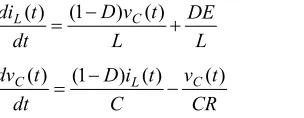
that the average model has the following equations:
L DE L
t v D dt
t
diL C
(1 ) ( ) )
(
(1)
CR t v C
t i D dt
t
dvC( )(1 )L( ) C() (2)
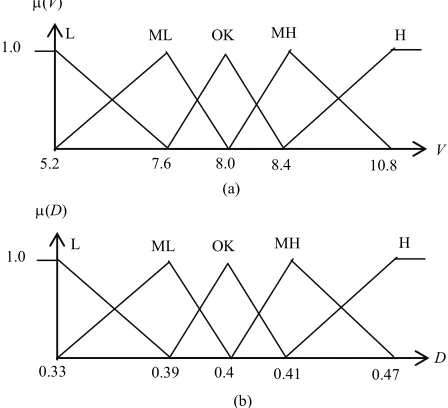
[image:1.595.366.518.592.651.2]The membership functions for vC and D are shown in
Figure 2. The SISO system of Figure 1 has a single fuzzy
input V (vC) and a single fuzzy output D.
The fuzzy membership sets V and D are represented by
five linguistic qualifiers L (low), ML (medium low), OK
L C vC R
Fuzzy Encoders Fuzzy Inference Engine
(FPGA) and Decoder
VS
[image:2.595.185.407.96.262.2]Switching frequency f with duty ratio D
Figure 1. Buck-boost switching converter with a fuzzy controller
(b) L
(D)
OK ML
0.39 0.4 0.41
H MH
1.0
0.47
0.33 D
L (V)
OK ML
7.6 8.0 8.4
H MH
1.0
10.8
5.2 V
(a)
Figure 2. Membership functions for (a) voltage and (b) duty ratio
are 5x5=25 possible combinations that can generate 25 possible rules. However, the following 5 rules are suffi-cient to describe the membership values of Figure 2.
RULE 1: IF V is H, THEN D is L
RULE 2: IF V is MH, THEN D is ML
RULE 3: IF V is OK, THEN D is OK (3)
RULE 4: IF V is ML, THEN D is MH
RULE 5: IF V is L, THEN D is H
2.2 Logic Synthesis of Fuzzy Controllers
Consider a SISO fuzzy controller with input universe of
discourse A1 and output universe of discourse B1.
Man-zoul [4] showed that the number of unique fuzzy inputs (ufi) is equal to the dimension of the input universe of discourse. That is:
ufi=dim[A1]=q
1 (4)
In the fuzzification on
(5) Each fuzzy input ha
fo
process, each input is mapped into ly one value (one element) in the input universe of discourse and zero value to all other values (elements). The objective here is to use a look-up table. Therefore,
the number of rows in the look-up table is equal q1. It
was also shown in [4] that the total least integer number
of binary bits X for all the inputs is given by
X=log2 q1
s only one output value and there-re the maximum number of distinct output values is
also equal to q1. In the defuzzification process only one
[image:2.595.185.409.302.506.2]outputs in the look-up table. If the there are p elements (p
<q1) in the output universe of discourse, the dimension of
the output universe of discourse is given as
dim[B1]=p (6)
The total least intege th
Y=log2 p (7)
3. Buck-Boost Con
er to control the output voltage
im[V]=dim[D]=29 (8)
From (5) the least th
[image:3.595.57.535.418.719.2]29=5
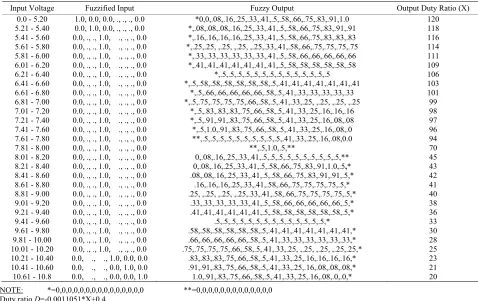
Table 1. Summary of the controller computations
Input Voltage Fuzzified Input Output Duty Ratio (X)
r number of binary bits Y for all
e outputs is given by
verter Fuzzy Controller
3.1 Fuzzy ControllerConsider a SISO controll
of the buck-boost converter of Figure 1. The input vari-able is the voltage and output varivari-able is the duty ratio. The duty ratio maintains the voltage at a selected value.
The ranges of capacitor voltage (vC) and duty ratio D are
(5.2 to 10.8) V and (0.33 to 0.47) respectively. The membership values are in the interval [0, 1], where 0 denotes no membership and 1 denotes full membership. Assume that
1 1
number of binary bits to represent e input values is given as
X=log2
Similarly, using (6) the least number of binary bits to represent output values is given as
Y=log2 29=5
In Appendix I the 5 rules of (3) are expressed numeri-cally. The fuzzy relation obtained is too big to be shown here because of the size (29x29 matrix). Table 1 of Ap-pendix I shows the summary of the complete computa-tions of the controller.
3.2 Look-Up Table
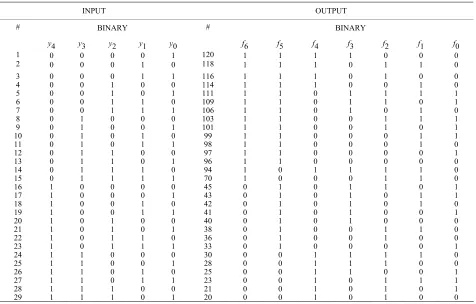
The look-up table representing the fuzzy controller is given in Table 2. The input universe of discourse has dimension of 29 and the output universe has dimension of 29. The look-up can be described by 7-variable Boo-lean equations. That is,
f 0= (5,6,8,9,10,12,16,17,1923,26,27,28)
f 1= (2,4,5,7,8,10,11,14,17,18,21,24,27)
f 2= (2,3,5,6,8,9,14,15,16,21,22,24, 25,27,28,29)
f 3= (1,5,6,7,14,16,17,18,19,20,24,25,26) (9)
f 4= (1,2,3,4,14,24,25,26,27,28,29)
f 5= (1,2,3,4,5,6,7,8,9,10,11,12,13,16,17,18,19, 20,
21, 22, 23)
f6= (1,2,3,4,5,6,7,8,9,10,11,12,13,14,15)
Fuzzy Output
0.0 - 5.20 1.0, 0.0, 0.0, ., ., ., 0.0 *0,0,.08,.16,.25,.33,.41,.5,.58,.66,.75,.83,.91,1.0 120 5.21 - 5.40 0.0, 1.0, 0.0, ., ., ., 0.0 *,
*,
.
.7
.08,.08,.08,.16,.25,.33,.41,.5,.58,.66,.75,.83,.91,.91 118 5.41 - 5.60 0.0, ., ., 1.0, ., ., ., 0.0 *,.16,.16,.16,.16,.25,.33,.41,.5,.58,.66,.75,.83,.83,.83 116 5.61 - 5.80 0.0, ., ., 1.0, ., ., ., 0.0 *,.25,.25, ,.25, ,.25, ,.25,.33,.41,.58,.66,.75,.75,.75,.75 114 5.81 - 6.00 0.0, ., ., 1.0, ., ., ., 0.0 *,.33,.33,.33,.33,.33,.33,.41,.5,.58,.66,.66,.66,.66,.66 111 6.01 - 6.20 0.0, ., ., 1.0, ., ., ., 0.0 *,.41,.41,.41,.41,.41,.41,.41,.5,.58,.58,.58,.58,.58,.58 109 6.21 - 6.40 0.0, ., ., 1.0, ., ., ., 0.0 *,.5,.5,.5,.5,.5,.5,.5,.5,.5,.5,.5,.5,.5,.5
.5,.58,. ,.41,.41 106
6.41 - 6.60 0.0, ., ., 1.0, ., ., ., 0.0 58,.58,.58,.58,.58,.5,.41,.41,.41,.41,.41 103 6.61 - 6.80 0.0, ., ., 1.0, ., ., ., 0.0 *,.5,.66,.66,.66,.66,.66,.58,.5,.41,.33,.33,.33,.33,.33
*, 5
101 6.81 - 7.00 0.0, ., ., 1.0, ., ., ., 0.0 .5,.75,.75,.75,.75,.66,.58,.5,.41,.33,.25, ,.25, ,.25, ,.2 99 7.01 - 7.20 0.0, ., ., 1.0, ., ., ., 0.0 *,.5,.83,.83,.83,.75,.66,.58,.5,.41,.33,.25,.16,.16,.16 98 7.21 - 7.40 0.0, ., ., 1.0, ., ., ., 0.0 *,.5,.91,.91,.83,.75,.66,.58,.5,.41,.33,.25,.16,.08,.08 97 7.41 - 7.60 0.0, ., ., 1.0, ., ., ., 0.0 *,.5,1.0,.91,.83,.75,.66,.58,.5,.41,.33,.25,.16,.08,.0 96 7.61 - 7.80 0.0, ., ., 1.0, ., ., ., 0.0 **,.5,.5,.5,.5,.5,.5,.5,.5,.5,.5,.41,.33,.25,.16,.08,0.0 94 7.81 - 8.00 0.0, ., ., 1.0, ., ., ., 0.0 **,.5,1.0,.5,**
0,.08,.16,.25,.33,.4 ,.5,.5,.5,.5,.5,**
70 8.01 - 8.20 0.0, ., ., 1.0, ., ., ., 0.0 1,.5,.5,.5,.5,.5 45
8.21 - 8.40 0.0, ., ., 1.0, ., ., ., 0.0 0,.08,.16,.25,.33,.41,.5,.58,.66,.75,.83,.91,1.0,.5,* 43 8.41 - 8.60 0.0, ., ., 1.0, ., ., ., 0.0 .08,.08,.16,.25,.33,.41,.5,.58,.66,.75,.83,.91,.91,.5,* 42
8.61 - 8.80 0.0, ., ., 1.0, ., ., ., 0.0 .16,.16,.16,.25,.33,.41,.58,.66,.75,.75,.75,.75,.5,*
.2 *
41 8.81 - 9.00 0.0, ., ., 1.0, ., ., ., 0.0 5, ,.25, ,.25, ,.25,.33,.41,.58,.66,.75,.75,.75,.75,.5, 40 9.01 - 9.20 0.0, ., ., 1.0, ., ., ., 0.0 .33,.33,.33,.33,.33,.41,.5,.58,.66,.66,.66,.66,.66,.5,* 38 9.21 - 9.40 0.0, ., ., 1.0, ., ., ., 0.0 .41,.41,.41,.41,.41,.41,.5,.58,.58,.58,.58,.58,.58,.5,* 36 9.41 - 9.60 0.0, ., ., 1.0, ., ., ., 0.0 .5,.5,.5,.5,.5,.5,.5,.5,.5,.5,.5,.5,.5,.5,*
58,.58, 1,.41,*
33 9.61 - 9.80 0.0, ., ., 1.0, ., ., ., 0.0 .58,.58,.58,.58,.5,.41,.41,.41,.41,.41,.4 30 9.81 - 10.00 0.0, ., ., 1.0, ., ., ., 0.0 .66,.66,.66,.66,.66,.58,.5,.41,.33,.33,.33,.33,.33,.33,* 28 10.01 - 10.20 0.0, ., ., 1.0, ., ., ., 0.0 5,.75,.75,.75,.66,.58,.5,.41,.33,.25, ,.25, ,.25, ,.25,.25,* 25 10.21 - 10.40 0.0, ., ., 1.0, 0.0, 0.0 .83,.83,.83,.75,.66,.58,.5,.41,.33,.25,.16,.16,.16,.16,* 23 10.41 - 10.60 0.0, ., ., 0.0, 1.0, 0.0 .91,.91,.83,.75,.66,.58,.5,.41,.33,.25,.16,.08,.08,.08,* 21 10.61 - 10.8 0.0, ., ., 0.0, 0.0, 1.0 1.0,.91,.83,.75,.66,.58,.5,.41,.33,.25,.16,.08,.0,.0,* 20 NOTE: *=0,0,0 **
Duty ratio D=-0.0011051*X+0.4
y controller
[image:4.595.61.537.110.414.2]INPUT OUTPUT
Table 2. Look-up table for fuzz
BINARY BINARY
# y4 0 y3 0 y1 0 y0 1 # 120 118 f6 1 f5 1 f4 1 f2 0 f1 0 f0 0 1
2 0 0
y2
0
0 1 0 1 1 1
f3
1
0 1 1 0
3 0 0 0 1 1 116 1 1 1 0 1 0 0
4 0 0 1 0 0 114 1 1 1 0 0 1 0
5 0 0 1 0 1 111 1 1 0 1 1 1 1
6 0 0 1 1 0 109 1 1 0 1 1 0 1
7 0 0 1 1 1 106 1 1 0 1 0 1 0
8 0 1 0 0 0 103 1 1 0 0 1 1 1
9 0 1 0 0 1 101 1 1 0 0 1 0 1
10 0 1 0 1 0 99 1 1 0 0 0 1 1
11 0 1 0 1 1 98 1 1 0 0 0 1 0
12 0 1 1 0 0 97 1 1 0 0 0 0 1
13 0 1 1 0 1 96 1 1 0 0 0 0 0
14 0 1 1 1 0 94 1 0 1 1 1 1 0
15 0 1 1 1 1 70 1 0 0 0 1 1 0
16 1 0 0 0 0 45 0 1 0 1 1 0 1
17 1 0 0 0 1 43 0 1 0 1 0 1 1
18 1 0 0 1 0 42 0 1 0 1 0 1 0
19 1 0 0 1 1 41 0 1 0 1 0 0 1
20 1 0 1 0 0 40 0 1 0 1 0 0 0
21 1 0 1 0 1 38 0 1 0 0 1 1 0
22 1 0 1 1 0 36 0 1 0 0 1 0 0
23 1 0 1 1 1 33 0 1 0 0 0 0 1
24 1 1 0 0 0 30 0 0 1 1 1 1 0
25 1 1 0 0 1 28 0 0 1 1 1 0 0
26 1 1 0 1 0 25 0 0 1 1 0 0 1
27 1 1 0 1 1 23 0 0 1 0 1 1 1
28 1 1 1 0 0 21 0 0 1 0 1 0 1
29 1 1 1 0 1 20 0 0 1 0 1 0 0
3.3 ntrol strument I plem ntat
sing and XS40 (XC40
ram of the fuzzy logic controller
Co In m e ion
3.3.1 FPGA Implementation
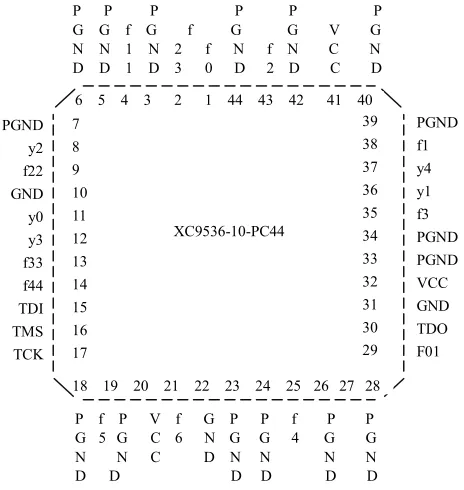
The FPGA configuration is implemented by u inx’s X95 (XC9536-10-PC44 CPLD)
05XL FPGA) boards. Both boards come with 8051 mi-crocontroller with 12 MHz speed. The Xilinx’s devel-opment system is used to implement the Boolean equa-tions, which also represents the fuzzy controller. Figure 3 shows the semi-custom VLSI chip of the FPGA func-tional block diagram.
[image:4.595.56.286.582.704.2]3.3.2 Instrument Figure 4 shows the diag
f0
SEMI-CUSTOM CHIP OF FPGA (Fuzzy Inference Engine) f1 F uzz y E nco de r A nd Fuz zi fi cat ion Fu zz y D ec ode r And De fu zz if ic at io n f6 y4 y0 y1 D V
Figure 3. Semi-custom VLSI fuzzy controller chip
p pin outs an utput waveform The b ry inp ts of
the controller y0, y1, . . ., y4 are the encoded fuzzified
crisp output voltage vC of the dc-dc converter. The binary
outputs of the controller f0, f1, . . ., f6 are defuzzified to
provide the variable duty ratio D.
3.3.3 On-Chip Cointegration
Microsystems technology has made inroads in instrumenta-tion and measurement (I&M) applicainstrumenta-tions. The fuzzy logic FPGA controller chip can be fabricated to have compact size. The FLC chip of this paper provides an interesting fabrication technique that has been identified in I&M appli-cations: cointergration of control/sensors/detectors and cir-cuits for building complete instrument systems.
s mass volume produc-e othproduc-er advantagproduc-es such as
chi d o s. ina u
Th a
compact FPGA chip, which can be fabricated as part of an integrated system of sensors, circuits, controllers, and de-tectors squeezed onto nanometer wafer. Such microchips can be used in a variety of applications in different envi-ronments and requirements. Beside
e on-chip controller mentioned in the paper uses
tion of these microchips, there ar
Legend : PGND = Tie pin to GND for additional ground path or leave unconnected VCC = Dedicated Power Pin
GND = Dedicated Ground Pin TDI = Test Data In, JTAG pin TDO = Test Data Out, JTAG pin TCK = Test Clock, JTAG pin TMS = Test Mode Select, JTAG pin PROHIBITED = User reserved pin
(a)
6 5 4 3 2 1 44 43 42 41 40 7
8 9 10 11 12 13 14 15 16 17
18 19 20 21 22 23 24 25 26 27 28 39 38 P P P
G G
P f G f G
P P G V G N N 1 N 2 f f N C N D D 1 D 3 0 2 D C D
N D
37 36 35 34 33 32 31 30 29 PGND
y2 f22 GND y0 y3 f33 f44 TDI TMS TCK
PGND f1 y4 y1 f3 PGND PGND VCC GND TDO F01 XC9536-10-PC44
P f P V f G P P f P P G 5 G C 6 N G G 4 G G N N C D N N N N D D D D D D
(b)
Figure 4. (a) FPGA pin out; (b) input and output waveforms of FLC chip
4. Results
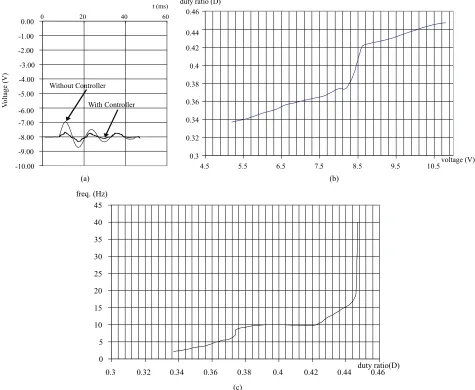
The output voltage of Figure 1 is regulated at about 8.0 V through a feedback loop using the fuzzy controller on
FPGA chip for adjusting the duty ratio D. The input
voltage Vs=12 V and the circuit parameters are L=100 H,
C=330 F. The steady-state voltage is about 8.0 V when
[image:5.595.182.414.96.341.2]-10.00 -9.00 -8.00 -7.00 -6.00 -5.00 -4.00 -3.00 -2.00 -1.00
0.00 0 20 40 60
t (ms)
With Controller Without Controller
Vo
lt
ag
e (
V
)
0.3 0.32 0.34 0.36 0.38 0.4 0.42 0.44 0.46
4.5 5.5 6.5 7.5 8.5 9.5 10.5voltage (V) duty ratio (D)
(a) (b)
0 5 10 15 20 25 30 35 40 45
0.3 0.32 0.34 0.36 0.38 0.4 0.42 0.44 duty ratio(D)0.46
freq. (Hz)
(c)
Figure 5. (a) Buck-boost converter results; (b) graph between voltage & duty; (c) relationship of frequency & duty ratio
Figure 5(a) shows the effect on the output voltage when changing the load resistance. Figure 5 shows that
the output voltage vc(t) can respond instantaneously to
changes in the duty ratio D. The hardware
implementa-tion is cheaper and faster than using software.
5. Conclusions
The fuzzy controller implemented on an FPGA was used to control a dc-dc buck-boost switching converter. The size of the semi-custom VLSI was independent of the number of rules in the k
emory space was required to store the large of rules. t aspect of the controller is that it was ed and consequently speeds over giga
circuits to provide a complete co-integration system.
REFERENCES
[1] R. Erickson, S. Cuk, and R. D. Middlebrook, “Large- signal modeling and analysis of switching regulators,” IEEE PESC, pp. 240–250, 1982.
[2] W. Gao and J. C. Hung, “Variable structure control of non-linear systems,” IEEE Transactions on Industrial Electronics, Vol. 40, No. 1, pp. 45–55, February 1993.
livar, “Sliding-mode contro via extended-linearization,” IEEE Transactions on Circuits and Systems I, Vol. 41, No.
nowledge base and therefore no [3] H. Sira-Ramirez and M. Rios Boof DC-DC power converters
m
The importan hardware-bas
FLIPS can be achieved. The on-chip controller is a com-pact FPGA which may be integrated with sensors and
l
10, 1994.
[image:6.595.60.535.99.489.2]APPENDIX I
The 5 Rules of Equation 3 Expressed Numerically RULE 1:
IF
[0,0,0,0,0,0,0,0,0,0,0,0,0,0,0,0,0,0.08,0.16,0.25,0.33,0.41 ,0.5,0.58,0.66,0.75,0.83,0.91,1.0]
THEN
[1.0,0.91,0.83,0.75,0.66,0.58,0.5,0.41,0.33,0.25, 0.16,0.08, 0,0,0,0,0,0,0,0,0,0,0,0,0,0,0,0,0]
RULE 2: IF
[0,0,0,0,0,0,0,0,0,0,0,0,0,0,0,0.5,1.0,0.91,0.83,0.75,0.66, 0.58,0.5,0.41,0.33,0.25,0.16,0.08,0]
THEN
[0.08,0.16,0.25
0.91,1.0,0.5, 0,0,0,0,0,0,0,0,0,0,0,0,0,0,0]
RULE 3: IF
[0,0,0,0,0,0,0,0,0,0,0,0,0,0.5,1.0,0.50,0,0,0,0,0,0,0,0,0,0,0,0] THEN
[0,0,0,0,0,0,0,0,0,0,0,0,0,0.5,1.0,0.50,0,0,0,0,0,0, 0,0,0,0,0,0]
RULE 4:
IF [0.08,0.16,0.25,0.33,0.41,0.5,0.58,0.66,0.75,0.83, 0.91,1.0,0.5, 0,0,0,0,0,0,0,0,0,0,0,0,0,0,0]
THEN [0,0,0,0,0,0,0,0,0,0,0,0,0,0,0,0.5,1.0,0.91,0.83, 0.75,0.66,0.58,0.5,0.41,0.33,0.25,0.16,0.08,0]
RULE 5:
IF [1.0,0.91,0.83,0.75,0.66,0.58,0.5,0.41,0.33,0.25 0,0,0,0,0,0,0,0,0]
THEN [0,0,0,0,0,0,0,0,0,0,0,0,0,0,0,0,0,0.08,0.16,0.25, 0.33,0.41,0.5,0.58,0.66,0.75,0.83,0.91,1.0]
,0.33,0.41,0.5,0.58,0.66,0.75,0.83, 0.16,0.08, 0,0,0,0,0,0,0,0,