The eHealth
Usability Matrix
Developing a usability evaluation framework
Bachelor Thesis
Developing a usability evaluation
framework for patient-facing eHealth
technologies: the eHealth Usability Matrix
Bachelor Thesis
Faculty of Behavioural, Management, and Social Sciences
University of Twente
June 28, 2019
Presented by:
Meilani Halim
S1817345
This bachelor thesis is the proud product of many hours of hard work, late nights, and a near loss of my sanity. But most importantly, it is the product of the help and support of many of my friends and
colleagues. So for that, I would like to say a special thank you to:
Marijke Broekhuis
For guiding me throughout the entire process, helping me whenever I was stuck, and being the critical counterbalance to my work that helped shape this research’s path.
Joyce Karreman
For believing in me, putting genuine care into your supervision of my research, and being the positive force that reassured me that I could do it.
Gleb Podorozhnyy
For keeping me company on those many late nights spent at university, and for making the report look pretty.
And to each and every one of you who supported or encouraged me in some way,
Thank You.
Abstract
Background. The field of eHealth has steadily grown and developed since the early 2000’s, but the available tools by which to evaluate their usability have changed little. Patient-facing eHealth technologies are those that bring internet technology into the healthcare sector for the purpose of detecting, treating, managing, or educating on various medical conditions. As such, there are a vast number of usability considerations unique to eHealth technologies that arise out of this mesh between internet technology and the healthcare domain. This research aims to develop a framework that takes into account these unique usability considerations to enable more focused usability evaluations on patient-facing eHealth technologies.
Methods. Two methods were employed in this study. The first was a systematic literature review, to gain a base knowledge of the factors that have been found by prior research to influence usability, against which the factors found in the second methodology are compared. Next, a thematic analysis of usability issues detected in seven patient-facing eHealth technologies was conducted, to extract an understanding of the factors that construct the usability of eHealth technologies specifically.
Results. After coding the datasets, 11 different aspects of an eHealth technology and 37 factors corresponding to these aspects were found to construct the technology’s overall measure of usability. Of these factors, 13 are specific to the eHealth context and 24 relate to a more general construct of usability. Further, all of these factors were found to be related to qualities of either the system, the health context, or the user. These findings were constructed into the new framework, called the eHealth Usability Matrix. This matrix visualizes the way in which the factors arise out of the cross-sections between the aspects of an eHealth technology and the actors of the system, health context, and user.
Table of Contents
1. Introduction ……….……….……….……….……….….… 4
2. Theoretical Framework ……….……….……….……….….…………..….… 5
3. Systematic Literature Review ……….……….……….……….…….…... 10
3.1 Methods ……….……….……….……….……….… 10
3.2 Results ……….……….……….……….………... 14
4. Thematic Analysis ……….……….……….……….….……….……... 20
4.1 Methods ……….……….……….……….….………...……... 21
4.2 Results ……….……….……….……….….………..………….... 24
5. Discussion and Conclusion ……….……….……….……….………....….…… 33
References ……….……….……….……….………..…….... 38
Appendices ……….…….……….……….……….………..…….…. 42
1. Introduction
Since its emergence in 1999, the use of eHealth has steadily grown in prominence as a means by which to enhance healthcare services. Though no consensus has been found on an exact definition of eHealth, it is commonly used as an umbrella term to refer to the use of technology and the internet to improve the quality and efficiency of healthcare services. Patient-facing eHealth technologies encompass any system or product that meshes internet technology with medicine or healthcare for use by patients or citizens. These take the form of technologies such as exergames, which are gamified and digitized exercise programs to support rehabilitative physiotherapy; or personal fitness tracking wearables like the Fitbit, which track the user’s daily health data such as exercise, nutrition, and sleep patterns; among many more.
Like any other system or device that is intended for medical purposes, eHealth technologies must first be tested before being rolled out to their users, to ensure that they are functional and usable. Ensuring the usability of a product or system refers to ensuring its ability to be used to achieve its users’ goals with effectiveness, efficiency, and satisfaction (International Organization for Standardization, 2018). It is, in all simplicity, a product’s ease of use. However, usability is not a single construct that manifests itself as a whole, nor can it be measured as a whole. Rather, several different usability factors, such as the system’s technical performance or the intuitiveness of its graphical user interface, make up the usability of a technology. Additionally, the usability of eHealth technologies is also constructed by the unique attributes and considerations that arise from the mesh between internet technology and the healthcare sector.
Although it takes a number of these attributes to make a system usable, it takes just one to erode the entire system’s usability. Hence, it is crucial to come to an understanding of all the factors that influence usability, in order to develop measures to evaluate and ensure them. Research has taken to doing exactly so. Over the past few decades, numerous studies have been conducted to define what it is exactly that constitutes the usability of a technology, and numerous usability evaluation instruments have been constructed to measure it. The same has been done specifically for the usability of health related technologies, and a number of instruments - such as heuristics, questionnaires, and frameworks - were developed as a result.
Nonetheless, despite efforts to create a framework that is useful for evaluating the usability of eHealth technologies, a gap still exists between what is needed and what has been developed. This gap exists because none have managed to merge general usability factors and usability factors that are specific to the health context into one coherent framework. This is the gap that this research aims to fill. The goal of this research, then, is to develop a framework that considers both general and eHealth context specific usability factors, in order to later produce a tool that detects and classifies usability errors in patient-facing eHealth programs more accurately and thoroughly.
This research is conducted in conjunction with a doctorate research at Roessingh Research and Development (RRD), an organization that combines various health and computer sciences into research on current and future innovations in rehabilitation and chronic care. The framework presented as the result of this research will go on to form the scaffolding of a new usability benchmarking tool designated for eHealth technologies that will be developed as the product of this doctorate research.
is that the framework it will present will be the first to combine general factors and health context factors into a single comprehensive framework. This will allow for a more practical and pin-pointed diagnosis of usability problems within eHealth technologies, which is the value that this research adds to practice.
In order to develop this framework, the question that must first be asked is ‘What are the usability factors that can be used within a usability evaluation framework to detect and classify
usability issues in eHealth technologies?’ To find the answer to this question, this research will first
look to the literature, and then to the data. Hence, this study consists of a systematic literature review of existing usability evaluation instruments, followed by a thematic analysis of datasets of usability errors that were detected during usability tests of eHealth programs. The goal of both analyses is to come to a comprehensive understanding of all the factors that build up the construct of usability, particularly for eHealth. Finally, the new framework will be developed based on the factors that have arisen during the analysis of the datasets, and will be compared against the factors found in existing instruments.
This report begins with a theoretical framework, in which the concepts of eHealth and usability are defined and the relation between the two is explored. Then, the methodology of the systematic literature review is outlined, followed by a report of the usability factors that were found in the corpus of prior research. The methodology of the thematic analysis is presented after this, which is followed by a report of the resulting usability factors and the introduction of the new framework. The discussion section then compares the factors found in the thematic analysis to those found in the literature review, to identify those which have been verified in prior research to influence usability and those which are novel to this research. Finally, the report ends with a discussion of this study’s limitations and the consequent suggestions for future research.
2. Theoretical Framework
In this paper, the two fields of eHealth and usability are converged. Thus, in order to come to an understanding of these two fields and their interrelation with each other, this theoretical framework will first introduce eHealth by outlining its various definitions, purposes, and applications, and will define its scope. Afterwards, the construct of usability will be explored, during which some of its core principles and the methods and instruments by which it can be evaluated will be considered. Finally, the two topics will be looked at together, and the need for a new framework for evaluating the usability of eHealth technologies will be discussed.
2.1 eHealth
eHealth is a relatively recent healthcare practice that has been in use for at least the past 20 years, since its official recognition in 1999. eHealth is, in essence, the merging of healthcare with internet technology, and as such it is a broad term that encompasses multiple domains (Mea, 2001). It is due to this broadly-encompassing nature of eHealth that no consensus has been found on its exact definition. In fact, in 2005 Oh et. al. set out to discover the meaning of eHealth, and consequently found 51 different definitions of the term. To date, the most commonly quoted definition is the one from Eysenbach (2001), which reads:
technical development, but also a state-of-mind, a way of thinking, an attitude, and a commitment for networked, global thinking, to improve health care locally, regionally, and worldwide by using information and communication technology.’
While thorough and all-encompassing, a firm understanding of what eHealth is exactly remains rather hard to grasp from this definition. Hence, looking at a few of the most unique definitions outlined in the paper by Oh et. al., it can be surmised that eHealth is ‘any use of the internet or related technology to improve: the health and wellness of the population; the quality of healthcare services and outcomes; [and] efficiencies in healthcare services or administration’ (Staudenmeir, 2004, as cited in Oh et. al., 2005, p. 5), by enabling more effective connections between patient and health worker (Beaulieu & Beinlich, 2004, as cited in Oh et. al., 2005) and providing healthcare to patients wherever they are located (Brommey, 2004, as cited in Oh et. al., 2005).
eHealth has also been defined as a new business model that uses technology to assist the provision of healthcare services (Sternberg, 2004), as well as any informational, educational, and commercial health product or service delivered over the internet (Wysocki, 2004, as cited in Oh et. al., 2005). Meanwhile, some authors see eHealth as being defined by its connectivity between networked digital technologies (Kirshbaum, 2004, as cited in Oh et. al., 2005; Marcus & Fabius, 2004, as cited in Oh et. al., 2005; Pagliari et. al., 2005). But mostly, eHealth is praised as a redefinement of the delivery of healthcare (Decker, 2004, as cited in Oh et. al., 2005), allowing patients and professionals to do the previously impossible (McLendon, 2000). One scholar has even gone so far as to say that it ‘may rank with antibiotics, genetics, and computers as among the most important changes for medical care delivery’ (Coile, 2000, p. 9).
The steady rise in use of eHealth technologies since the early 2000’s arose out of the cost-related efficiencies of integrating telecommunications and information technology into the healthcare sector (Mitchell, 2000). Healthcare professionals and patients alike had for a long while been frustrated with the maze that was the current methods of healthcare delivery, which were faced with issues of access, cost, quality, and portability (Rx2000 Institute, 2004, as cited in Oh et. al., 2005). The introduction of eHealth, then, demonstrated the promise of internet technologies to raise the efficiency of processes and make healthcare more cost-effective and accessible (Oh et. al., 2005).
This promise is fulfilled by the vast variety of functions that eHealth technologies can serve, both to patients and to health workers. For health workers, these may include enabling remote shared decision making amongst the various care workers of a patient via electronic medical records and online communication tools; and providing portable and instantly-accessible data that is updated in real-time via online databases accessed via palmtop technologies (Pagliari et. al., 2005). For patients, these include providing free, accessible online health information and coaching for patients via websites and online consultation tools; providing portable and remote care solutions via mobile monitoring systems; and enabling self help via online communities for networking with those who have the same condition; among other functions (Baur, Deering, & Hsu, 2000; Pagliari et. al., 2005).
Though the scope of eHealth technologies extends beyond patient-facing technologies to include health workers, hospitals, and even pharmacies and insurance plan providers (Oh et. al., 2005), the primary focus of this research and consequently the scope of the framework presented at the end of this research will be limited to concern the patient-facing kind.
There has been some discussion over whether eHealth encompasses or is distinct from the fields of telehealth and mHealth, as all three fields show much overlap in the type and purpose of the technologies they embody. Telehealth is the exchange of health information and the provision of healthcare services through information and communications technology (Reid, 1996), while mHealth is ‘the use of portable devices with the capability to create, store, retrieve, and transmit data in real time between end users for the purpose of improving patient safety and quality of care’ (Akter & Ray, 2010, p. 75). As can be seen from these definitions, there is no clear line that distinguishes one field from the other, and as such many authors have taken to grouping them together and calling their various technologies by the one name of eHealth (Cushing, 2017; Showell & Nohr, 2012; Wyatt & Liu, 2002). For the purposes of this paper, no clear distinction need be made between the fields of eHealth, mHealth, and telehealth. Thus, from this point forward these terms will be used interchangeably, with eHealth being the primary word used as an umbrella term to refer all technologies falling under any three of these domains.
2.2 Usability
Usability is defined as the extent to which a product can be used by specified users to achieve specified goals with effectiveness, efficiency, and satisfaction, within a specified context of use (International Organization for Standardization, 2018). Simply put, it is a measure of how easy a product, system, or technology is to use. In essence, the goal of developing the usability of a product or system is to produce something that is able to lead its users through the completion of a desired action in order to fulfil their desired goal, in a way that feels natural and enjoyable.
If usability is to be defined by the qualities of effectiveness, efficiency, and satisfaction, it is important to know what these constructs are. Typically, effectiveness is described as the degree to which a user is able to achieve a specified goal accurately and completely, often embodied by task completion rate and error rate. Efficiency is a measure of the resources, like time, that a user expends in order to achieve a goal, in relation to the accuracy and completeness with which the user achieves that goal. Finally, satisfaction is the degree to which the user feels the system has fulfilled their needs and wishes and has given them pleasure in doing so (Mifsud, 2018).
However, it is agreed that usability is not a singular static construct defined by the same components throughout each technological domain (Nathan & Yeow, 2011). Hence, it is important that research goes beyond these ‘universal’ base factors and explores the factors that impact the usability of a particular type of technology, or of technologies falling under a particular domain. Next, once the factors that construct the usability of a particular system have been identified, it is useful to develop measures with which to evaluate them, in order to be able to evaluate the system’s usability as a whole. These usability evaluations allow for the identification of specific problems in the system’s ease and enjoyment of use, by focusing on the interaction between the user and task in a defined environment (Brown III, Yen, Rojas, & Schnall, 2013). The usability of a system can be evaluated in a number of ways, and a number of instruments exist to make these evaluations possible.
Heuristic evaluations, which involve the judgement of specialists on whether the system adheres to established usability principles, are one method of usability assessment (Nielsen, 1994). Heuristics, of course, are the tools by which the heuristic evaluation of a system may be conducted. The most commonly cited heuristics for user interface design are those proposed by Nielsen in 1995, which instruct for visibility of system status, error prevention, user control and freedom, the presentation of only relevant information, and a match between the system and the real world, among others.
There are also methods that make use of users as evaluators of the system. One such method is the concurrent think-aloud method, which judges the system’s ability to lead the user to the next correct action when completing a task by asking him to perform a number of tasks while explaining in real-time his reasoning process (van den Haak, De Jong, & Jan Schellens, 2003). Additionally, questionnaires, interviews, and focus groups ask users directly about their satisfaction with and experience of the usability of the system (Donker, & Markopoulos, 2002). A commonly used ‘quick and dirty’ questionnaire is the System Usability Scale (SUS), which asks users about their level of agreement with statements such as ‘I think that I would like to use this system frequently,’ and ‘I think that I would need the support of a technical person to be able to use this system’ (Brooke, 1996).
Finally, frameworks contribute towards the administration of usability evaluations by presenting a structured conceptualization of the factors that influence usability and the relations between them. This structure can then go on to form the basis off of which other evaluation instruments like questionnaires, checklists, or heuristics can be built. A number of frameworks have already been developed, such as the Usability Measurement Framework by Becker, Clever, Holler, and Shitkova (2013), which sees usability as a product of both the environment - which involves the technology itself and its context of use - and the usability attributes of the technology. Another framework developed by Han, Yun, Kim, and Kwahk (2000) in the domain of consumer electronic products interprets usability slightly differently, representing it as being based on two equally-weighted aspects of the product’s performance and the impression felt by it.
What can be derived from this is that each framework presents a slightly different rendition of what constitutes usability, based on what is true for the particular domain it was developed in or technology it was developed for. Therefore, it becomes apparent that there is also a need for a usability evaluation framework that reflects the unique usability considerations of the eHealth domain.
2.3 Usability in eHealth
instance, the impact that patient’s disability might have on their experience of the system’s usability, or the patient understanding the link between the technology and their therapy. There are also considerations related to the user’s age that impact their experience of an eHealth system’s usability (Broekhuis, van Velsen, ter Stal, Weldink, & Tabak, 2019). A small body of work has been done towards producing a framework related to the factors that constitute the usability of eHealth technologies. Nonetheless, these frameworks, while useful in their own right, are not exactly frameworks that are useful for evaluating the usability of a patient-facing eHealth technology.
One such framework is the Health IT Usability Evaluation Model (Health-ITUEM), which was developed by Yen (2010) in response to the gaps in existing usability models for the purpose of classifying usability problems in health IT technologies. This framework categorizes its usability factors, such as Memorability, Error Prevention, and Perform Speed, as being either a subjective or objective measure of usability. The criticism of the Health-ITUEM is that the usability factors constructing this framework are rather general in nature, and do not reflect any context-specificness to the health domain. Furthermore, the framework was developed based on a diagnosis of a nursing staff scheduling system, which is an eHealth system that is geared towards health workers, not patients. Hence, this framework is not maximized for patient-facing eHealth technologies.
Another framework, the MOLD-US by Wildenbos, Peute, and Jaspers (2018), takes a look at the potential barriers to usability that result from the complexities of aging. The framework consists of four aging barrier categories: Cognition, Motivation, Perception, and Physical Abilities. Each of these aging barriers represent a diminishment of various abilities, such as hand-eye coordination or computer literacy, as a result of certain illnesses or conditions that come with age. The diminishment of these abilities can negatively affect the usability of mHealth applications by impeding on any of the five usability aspects of Satisfaction, Memorability, Learnability, Efficiency, and Errors, as presented by Nielsen (2012). The focus of this framework is on the link between aging-related illnesses and complications, the aging barriers they result in, and the usability factors they consequently affect. As such, this focus makes it more practical for identifying and predicting which aging barriers one’s target users may have and which usability elements will likely suffer as a result. It is this very same focus on aging barriers, however, that makes it less practical for use as a usability evaluation framework for an extensive variety of eHealth technologies.
Finally, there is the User Context Model, put forward by Kaur and Haghighi (2016), which presents four user context factors that should be considered during the development of a mHealth mobile application. These context factors are Psychological, relating to the user’s cognitive characteristics that affect their functions; Demographical, which highlights the different user factors related to age, literacy level, and the user’s location; Social, which is the extent to which the user interacts with others; and Physical, referring to the various physical disabilities that users of mHealth apps are likely to have. This comprehensive mapping of the different areas from which user context factors stem makes this framework useful as a means by which to get a complete overview of these various user factors impacting an mHealth app’s usability. However, similar to the pitfall of the MOLD-US framework, this model is again only focused on user context factors, making it ill-suited for a holistic evaluation of an eHealth technology. Furthermore, what all three of these frameworks lack is a consideration of both general and health-context specific usability factors - both of which are important when contemplating the usability of a patient-facing eHealth system.
instrument. A previous study by Broekhuis, van Velsen, and Hermens (2019) examined the suitability of existing usability benchmarking tools, among them the commonly-used SUS, for usability evaluations of eHealth technologies. The study concluded that the SUS is in fact not suitable as a stand-alone metric for assessing the usability of eHealth technologies. Because of this, the researchers stress the need for the development of a usability benchmarking tool specifically for eHealth. Hence, this research aims to produce the framework on which this new usability benchmarking tool will stand.
2.4 Towards a New Framework
At this point, it is clear that existing frameworks and benchmarking instruments are simply not suited to the evaluation of patient-facing eHealth technologies. This study, then, purports to develop a new usability evaluation framework, by asking the question:
What are the usability factors that can be used within a usability evaluation framework to detect and classify usability issues in eHealth technologies?
This question will be answered by means of both a systematic literature review, and a thematic analysis of databases containing usability issues encountered by several eHealth technologies. During the systematic literature review, the existing body of work on this topic will serve as a means to collect a base knowledge of the factors that have been found by prior research to impact usability. The sub-question that this literature review will investigate is:
What usability factors can be found in existing usability evaluation instruments?
Finally, the thematic analysis of usability issues will attempt to fill the gaps in what has been found from this literature search by looking into the data whilst keeping an eye out for health-related contextual factors. Thus, the sub-question that the thematic analysis will answer is:
What usability factors are derived from classifying usability issues of eHealth technologies?
Once both sub-questions have been answered, the factors found in the thematic analysis will be constructed into the new usability evaluation framework. The factors within this framework will then be compared with the factors found in literature, to determine which factors have never before been found to impact usability and are thus novel to this research. After both methodologies have been completed and the new framework has been presented, the central research question of this paper will have been answered.
3. Systematic Literature Review
The first phase of this research is to conduct a systematic literature review on the factors that have been found by previous studies to influence usability. This is done firstly to come to a comprehensive understanding of how usability is constructed; and secondly to provide a basis off of which the factors of new framework can be compared, to determine those which have been verified in prior research to impact usability and those which are novel to this research and hence need further verification.
3.1 Methods of the Systematic Literature Review
on frameworks, articles that presented other usability evaluation instruments were also reviewed. Such studies were included because not all factors that impact usability can necessarily be found in frameworks. Rather, many can be identified from the overarching constructs under which questionnaire items are categorized, or from a list of usability factors. Furthermore, heuristics tend to be more context-specific than factors, and are therefore insightful for understanding usability in the context of eHealth. Thus, this literature review searched for usability frameworks, factors, heuristics, and questionnaires, in order to throw a wider net by which a greater scope of usability factors can be caught.
Though this study will produce a framework specifically for patient-facing eHealth technologies, this literature search did not only evaluate studies dealing with patient-facing technologies but also those concerning therapist-facing technologies. This was done because considering only the instruments developed for patient-facing technologies would have set far too narrow of a scope, likely resulting in many studies that present relevant usability factors being overlooked.
Furthermore, the focus of this methodology is to discover the factors that have been found to impact the usability of eHealth technologies. However, it is also important to discover the factors that have an impact on usability in general. Articles that presented generic usability factors were therefore also considered for inclusion, because of their potential to contain factors that have a significant impact on usability in general but that cannot be found in any eHealth usability study. Thus, two searches were conducted: one searching for eHealth usability studies, and one searching for ‘general’ usability studies.
3.1.1 Databases and Search Terms
To carry out the literature search, two databases were consulted, namely Scopus and Google Scholar. These databases were selected on the merit that they contain a large number of studies relevant to both fields of usability and eHealth. Articles were found in two ways: by means of database searches and by means of snowballing off of the articles found in those database searches.
For the search on general usability studies, the search terms used include “usability,” “evaluation,” “measure,” “test,” “framework,” “model,” “taxonomy,” and “questionnaire.” For the search on eHealth usability studies, the search terms used are the same as those used for general usability studies, plus terms related to health, which includes “eHealth,” “mHealth,” “telemedicine,” “telehealth,” and “health.” The search strings used for each database are outlined in Table 1. Different search strings were used for Google Scholar than were used for Scopus, because the Google Scholar search engine works with simple phrases rather than the Boolean search commands used for databases like Scopus.
3.1.2 Inclusion and Exclusion Criteria
Studies published during the past 20 years (from 1999 to 2019) were considered for inclusion. This date range was chosen to correspond with the past 20 years in which eHealth has been officially recognized as a domain and as a distinct term that is used in literature. Additionally, it is important that the studies are not too old to be relevant after so many years of technological advancement, but also that key studies are not overlooked upon merit of their age - thus, 20 years seemed to strike an appropriate balance between the two considerations. Furthermore, all studies must be in English to be considered.
After meeting these core requirements, studies were considered for inclusion if a) they were conducted in the domain of internet technology, including websites, mobile apps, software systems, electronic databases, or technological products; and b) they concerned the development and/or validation of usability frameworks, questionnaires, factors, or heuristics. Studies were excluded if they concerned the application of frameworks, questionnaires, factors, or heuristics - unless it lead to adaptations being made to that framework, questionnaire, or list of factors or heuristics. Furthermore, articles were excluded if the usability factors presented in them did not go deeper than the basic core factors of usability such as ‘effectiveness, efficiency, and satisfaction.’
3.1.3 Data Collection Method
Data collection began by searching on the two databases using the various search strings. The database function ‘sort by relevance’ was selected, and the first five pages of results on each database were examined. The articles went through several phases of screening, first by title, then abstract, then full-text skimming.
Snowball sampling was conducted after these three screening phases, during which the references cited in the literature considered for full-text skimming were inspected and consequently included in the sample based on their conformance to the established inclusion and exclusion criteria. Multiple rounds of snowballing were conducted, in which further articles were pulled from studies identified during previous rounds of snowballing. All articles identified through snowballing also underwent the same three phases of screening by title, abstract, and full-text skimming.
heuristics; or those that are about the application of such. The final screening phase was an in-depth reading of the full article text, during which data such as the instrument and usability factors it contains was extracted from each article. If the factors extracted from an article did not go deeper than the basic core factors of usability, the article was excluded from the final sample.
This final screening stage was split into two rounds: in the first round, articles in the health domain were read in-depth, in order to sift out those that did not add usability factors or conceptualizations of usability that were unique. In the second round, articles outside of the health domain underwent the in-depth reading process, in order to select only the ones that contributed something unique to what was already presented by the health usability studies.
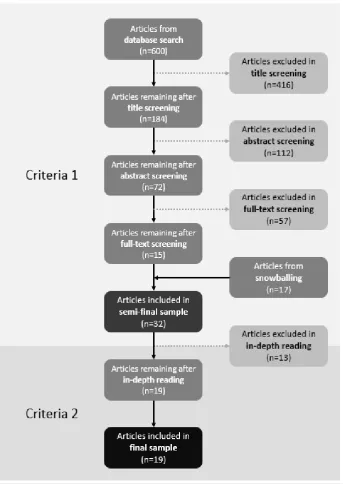
[image:15.595.127.471.266.754.2]Figure 1 outlines the data collection process, including the different screening phases, the criteria that each article was screened for at each screening phase, and the number of articles included and excluded at each screening phase.
3.1.4 Data Analysis Method
During the in-depth reading screening phase, the usability factors found in the articles were extracted from each and judged for the uniqueness of their contribution towards gaining an in-depth - but not overly repetitive - compilation of factors that impact usability. In order to give a more comprehensive understanding of the nature and context surrounding the collected usability factors, some additional information was extracted from each study as well. Hence, the data taken from each article was:
● Full reference
● Brief description of the study and its purpose
● Technological domain; namely whether it is in the domain of…
o Websites o Mobile apps o Software systems o Electronic databases o Technological products
● User group (if specified)
● Type of usability evaluation instrument presented; namely whether it is a...
o Framework o Questionnaire o List of factors o List of heuristics
● Usability factors. These were derived from the presented framework, list of factors or heuristics, or overarching constructs of the questionnaire.
Information sheets containing the above data were made for each reviewed article, and were complimented by any interpretive or observatory notes made by the researcher. Once all articles were read in-depth, the researcher reviewed the information sheets of the articles in order to select each for inclusion or exclusion based on the contributory value of the usability factors they contained. Once the final sample of articles had been curated, the researcher went over the information sheets once again to look for any patterns or notable characteristics within the data. The findings of this analysis are reported in the next section.
3.2 Results of the Systematic Literature Review
The final sample of articles resulting from this systematic literature review of usability studies consists of 10 articles developed in the health domain, and 9 articles that were not developed within any particular field. The selected articles consisted mostly of frameworks (n=9), but also presented three other types of instruments for usability evaluation, namely questionnaires (n=2), heuristics (n=4), and lists of usability factors (n=4). In the following section, the articles presenting usability factors specifically for eHealth technologies will be expounded upon first, followed by those which were developed outside of the health sector.
3.2.1 Studies Presenting eHealth Usability Factors
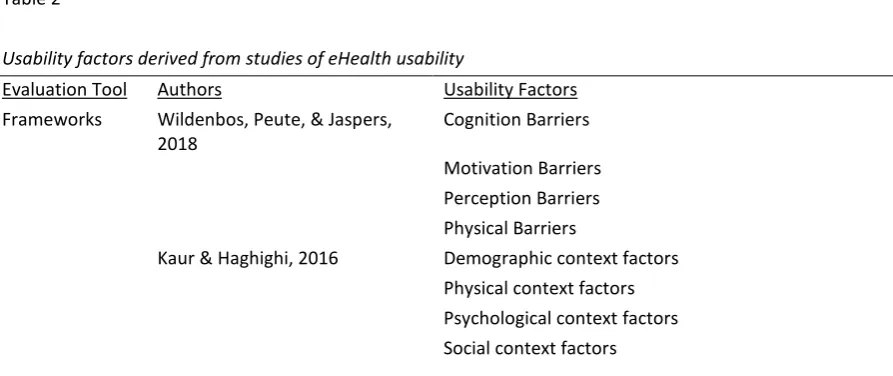
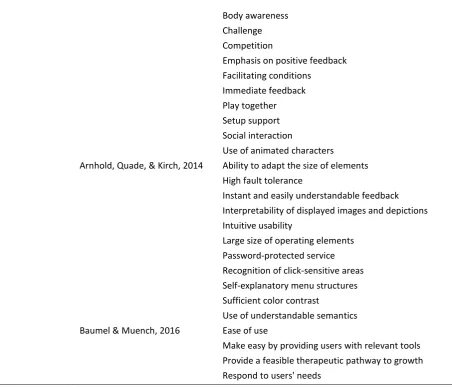
literature search, which are the usability factors that were derived from each study, can be found in Table 2 at the end of this section.
The three eHealth usability frameworks discussed in the theoretical framework - the Health-ITUEM, the MOLD-US, and the User Context Model - were criticised for their inappropriateness for holistic usability evaluations of patient-facing eHealth technologies. This criticism was not meant to discredit the relevance of the usability factors they contain, however. Thus, these three frameworks were considered for analysis in this literature review, and their factors were pulled from each. Both the MOLD-US Aging Barriers framework (Wildenbos et. al., 2018) and the User Context Model (Kaur & Haghighi, 2016) present only factors related to the user - as stemming from the four aging barrier categories or the four user context factor categories - and none relating to the system. Meanwhile, the Health-ITUEM (Yen, 2010) sits at the opposite end of the spectrum, displaying only factors related to the system, that are categorized into objective and subjective measures of usability.
The one questionnaire that was found, the mHealth Mobile App Rating Scale (MARS), was developed by Stoyanov et. al. (2015) as a multidimensional scale for rating and classification of mHealth app quality. Similar to the Health-ITUEM, it also judges the usability of an eHealth technology based on its objective and subjective factors that are related to the system and not any particular user or health context. Furthermore, the two articles presenting lists of usability factors also only presented rather generic factors related to the system, such as Response Time and Forgiveness and Feedback (Belden, Grayson, & Barnes, 2009; Kushniruk & Patel, 2004). These two articles’ lack of health or user specific factors may be explained by the fact that both of the eHealth technologies they focus on - namely electronic medical records and clinical information systems - are therapist-facing database systems, and as such are likely little influenced by particular health or user related considerations.
[image:17.595.77.524.573.761.2]Of the four articles presenting heuristics for eHealth technologies, only the one by Farzandipour, Riazi, and Jabali (2018) presents only generic system related heuristics. Two others, one by Nawaz et. al. (2016) and the other by Arnhold, Quade, and Kirch (2014), focused on the usability of eHealth systems for older adults, and as such present rather niche heuristics such as ‘Avoid showing personal data on screen’ and ‘Large size of operating elements.’ On the other hand, the article by Baumel and Muench (2016) targets the broad category of eHealth interventions in general, and as such presents heuristics such as ‘Provide a feasible therapeutic pathway to growth’ that can be generalized to a broad population of eHealth technologies on the trade-off that they are rather vague and difficult to materialize.
Table 2
Usability factors derived from studies of eHealth usability
Evaluation Tool Authors Usability Factors
Frameworks Wildenbos, Peute, & Jaspers,
2018 Cognition Barriers
Motivation Barriers Perception Barriers Physical Barriers
Kaur & Haghighi, 2016 Demographic context factors
Yen, 2010 Competency Error prevention
Flexibility/Customizability Information needs Learnability Memorability Other outcomes Performance speed
Questionnaires Stoyanov et. al., 2015 Aesthetics
Engagement Functionality Information Subjective quality Lists of Factors Belden, Grayson, & Barnes,
2009 Consistency
Effective information presentation Effective use of language
Efficient interactions Forgiveness and feedback Minimizing cognitive load Naturalness
Preservation of context Simplicity
Kushniruk & Patel, 2004 Color
Consistency of operations Graphics
Layout / screen organization Meaning of labels
Navigation Overall ease of use Resolution
Response time
Understanding of system instructions / error messages Visibility of system status
Heuristics Farzandipour, Riazi, & Jabali,
2018 Auditory presentation
Conformity with user expectations Controllability
Error tolerance Self-descriptiveness
Suitability for individualization Suitability for learning Suitability for the task Visual clarity
Nawaz et. al., 2016 Absence of native language
Body awareness Challenge Competition
Emphasis on positive feedback Facilitating conditions
Immediate feedback Play together Setup support Social interaction
Use of animated characters
Arnhold, Quade, & Kirch, 2014 Ability to adapt the size of elements High fault tolerance
Instant and easily understandable feedback Interpretability of displayed images and depictions Intuitive usability
Large size of operating elements Password-protected service Recognition of click-sensitive areas Self-explanatory menu structures Sufficient color contrast
Use of understandable semantics
Baumel & Muench, 2016 Ease of use
Make easy by providing users with relevant tools Provide a feasible therapeutic pathway to growth
Respond to users' needs
3.2.2 Studies Presenting General Usability Factors
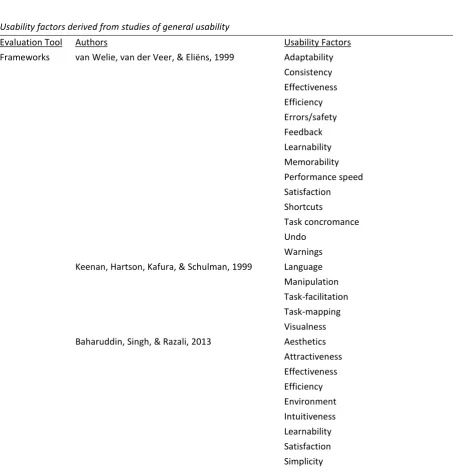
[image:19.595.76.529.63.450.2]After reviewing the compilation of usability factors derived from the eHealth usability studies, a selection of non health related usability articles was made from the entire corpus of found literature. Articles were included for further analysis on the basis that they present factors, classifications of factors, or breakdowns of usability that had not already been seen in the previously-reviewed studies. This final sample of studies that examine usability criteria of technologies outside of the health context provided a total of 94 usability factors. This section will briefly describe some overarching qualities that were observed in the collection of usability factors, and a list of these factors can be found in Table 3 at the end of this section.
Many authors have made reference to the core constructs of usability of Effectiveness, Efficiency, and Satisfaction (Baharuddin, Singh, & Razali, 2013; Hasan & Al-Sarayreh, 2015; Oztekin, Nikov, & Zaim, 2009; van Welie, van der Veer, & Eliëns, 1999). Of these studies, two have conceptualized usability as stemming from these three measures of usability as ‘higher-level’ constructs, under which more specific ‘lower-level’ factors are nested (Oztekin et. al., 2009; van Welie et. al., 1999).
Flexibility (Keinonen, 2004), Controllability (Oztekin et. al., 2009), and Learnability (Baharuddin et. al., 2013; Hasan & Al-Sarayreh, 2015; Muhtaseb et. al., 2012; van Welie et. al., 1999). Others, like Usefulness (Baharuddin et. al., 2013; Keinonen, 2004) and Accessibility (Hasan & Al-Sarayreh, 2015; Keinonen, 2004; Muhtaseb et. al., 2012), regard the system’s seeming ‘first requirements’ that must be met for users to be able to begin making use of the system.
[image:20.595.78.532.290.766.2]Further, some studies recognize the importance of taking into account not only the functionality and interaction of the system, but also its more pleasurable and subjective attributes. These factors are, for example, Attractiveness (Baharuddin et. al., 2013), Aesthetics (Baharuddin et. al., 2013; Hasan & Al-Sarayreh, 2015), and Funability (Mostakhdemin-Hosseini, 2009). Finally, one article by Alonso-Ríos, Vázquez-García, Mosqueira-Rey, and Moret-Bonillo (2010) focuses only on the various context factors related to the User, the Task, and the Environment that make an impression on the usability of a system.
Table 3
Usability factors derived from studies of general usability
Evaluation Tool Authors Usability Factors
Frameworks van Welie, van der Veer, & Eliëns, 1999 Adaptability
Consistency
Effectiveness
Efficiency
Errors/safety
Feedback
Learnability
Memorability
Performance speed
Satisfaction
Shortcuts
Task concromance
Undo
Warnings
Keenan, Hartson, Kafura, & Schulman, 1999 Language
Manipulation
Task-facilitation
Task-mapping
Visualness
Baharuddin, Singh, & Razali, 2013 Aesthetics
Attractiveness
Effectiveness
Efficiency
Environment
Intuitiveness
Learnability
Satisfaction
Task
Technology
Understandability
Usefulness
User
Alonso-Ríos, Vázquez-García, Mosqueira-Rey, &
Moret-Bonillo, 2010 User
Task
Environment
Hasan & Al-Sarayreh, 2015 Accessibility
Appropriateness
Effectiveness
Efficiency
Learnability
Operability
Productivity
Recognisability
Satisfaction
Universality
User error protection
User interface aesthetics
Oztekin, Nikov, & Zaim, 2009 Assurance
Controllability
Effectiveness
Efficiency
Integration of communication
Navigation
Quality of information
Reliability
Responsiveness
Satisfaction
Questionnaires Keinonen, 2004 Accuracy
Affect
Compatibility
Consistency
Ease of use
Familiarity
Feedback
Flexibility
Functionality
Internal locus of control
Intuitiveness
Length of sequences
Location
Modality of a device
Power associated with distinct functions
Qualities of presentation
Readability
Simplicity
Size
Understandability
Usefulness
Versatility
Lists of Factors Muhtaseb, Lakiotaki, & Matsatsinis, 2012 Accessibility
Content
Design structure
Interactivity
Learnability
Memorability
Navigation
Performance speed
Personalization
Privacy and security
Mostakhdemin-Hosseini, 2009 Adjustability
Funability
Reliability
Satisfaction
In conclusion, from examining usability studies both in the general and in the eHealth domain, more than 150 different factors were found to build up the construct of usability. When looking at the eHealth usability factors, it was interesting - though not surprising - to see that some related quite heavily to the health context or various user considerations, while others portrayed principles of generic system functionality and ease of use. Furthermore, several factors, such as Simplicity and Learnability, were mentioned in both general and eHealth usability studies. This indicates that, while the usability of an eHealth system is certainly affected by contextual factors, at the core its usability is quite similar to the usability of any other technology.
On the other hand, there appeared quite a number of general usability factors that went unmentioned in the studies of eHealth usability. While it is possible that these factors truly do not impact the usability of eHealth systems specifically, it is also possible that some of these factors might surface during the following analysis of eHealth usability errors. The next step of this research, then, is to conduct a thematic analysis on several datasets of usability errors detected in eHealth technologies, in order to come to an own understanding of all the factors - general or eHealth specific - that influence the usability of an eHealth technology.
4. Thematic Analysis
4.1 Methods of the Thematic Analysis
After having already looked into literature for factors influencing usability, the next step of this research is to have a look into the data to see what usability factors can be found to influence the usability of eHealth technologies. This was done by means of a thematic analysis, which is a process of searching within the data for themes that emerge as being descriptive of the data and the phenomena that underpin it (Daly, Kellehear, & Gliksman, 1997). As such, datasets containing fragments that describe the issues encountered during usability tests of various eHealth technologies were coded inductively to extract these underlying themes from the data.
The decision to analyse datasets of usability problems in order to discover what factors affect the usability of eHealth technologies was based upon the fact that the list of problems encountered during usability tests are a raw representation of the usability problems encountered, which allows for direct inspection of the nature and cause of the problem. Furthermore, as a (well-executed) usability test accurately represents and predicts - to a large extent - the problems that are likely to occur during use of the technology in its intended setting (Nielsen, 1994), this data can be considered to be a reliable representative of usability influencers in ‘real life’ use of eHealth technology. Henceforth, a number of datasets representing a variety of eHealth technologies will be inspected in order to attempt to grasp an understanding of the factors that influence usability in a health context.
4.1.1 Sample
A total of six datasets were coded, all of which contain an average of 70 unique usability issues each. These databases were collected via convenience sampling from RRD and other medical research and development centers in the Netherlands. The datasets contain descriptions of the usability problems encountered during usability tests on seven different eHealth technologies (one dataset contained the results of a test and comparison of two technologies). The usability tests employed an average of 17 representative participants each, and used either concurrent think aloud or observations as a testing method. The language used in the datasets was English - any datasets that were originally in Dutch were translated into English.
The technologies featured in the data are all patient-facing, and include a gamified application for maintaining physical and cognitive fitness; an exercise program to be practiced via a tablet and via a humanoid robot for frailty screening in older adults; a home monitoring tool consisting of a mobile app connected to a blood pressure monitor for heart failure patients and Chronic Obstructive Pulmonary Disease (COPD) patients; an online health and lifestyle coaching platform with virtual coaches; a mobile application for registration and hospitality services at a care center; and a mobile application giving work, life, health, and pregnancy advice to pregnant women. Out of all seven technologies, six target an older adult user group, and one targets pregnant women.
4.1.2 Ethical Considerations
for their data to be used for evaluative purposes. Nonetheless, no data that would allow any of the participants to be personally identified by the researchers was included in the databases - participants were simply referred to as ‘participant’ or ‘user.’
4.1.3 Analysis Plan
The purpose of this thematic analysis is to analyse and interpret each usability issue in order to understand their nature and underlying cause, and then codify this into a usability factor. These usability factors are then pulled from the data and synthesised into a framework depicting the factors that impact the usability of eHealth technologies. To do this, the data was explored based on valid inference and interpretation, which is characteristic of inductive analyses (Wildemuth, 2017). Yet, the knowledge gained from the systematic literature review serves as ‘informal’ input into the interpretation process - thus, this thematic analysis employs inductive coding with deductive reasoning. This so-called ‘deductive reasoning’ involves taking inspiration from concepts or variables from previous studies, and is particularly useful during qualitative research at the inception of data analysis (Berg, 2001).
As such, this deductive reasoning was employed primarily in the first round of inductive coding, when the data was explored for the first time. In practical terms, this means that the researcher coded the datasets based on intuitive interpretation, but also based on pre-knowledge of the existing usability factors (codes) discovered during the literature review. The inductive method of coding served to give room for usability problems to be looked at from a fresh, context-specific perspective, which is imperative for the purpose of this research. The deductive reasoning behind the initial coding process, on the other hand, contributed a ‘base-level knowledge’ about the types of usability problems that are generally classified under certain usability factors.
A potential limitation to the use of such deductive reasoning, however, is that by having become familiar with the general way in which existing studies look at certain usability problems and the usability factors that are generally used to classify them, it could be considered that this pre-knowledge ‘clouded’ the researcher’s vision and stunted the ability to derive authentic codes that understand and classify the problem from a uniquely eHealth perspective. To combat this, a second researcher was introduced who had not conducted the literature review, and thus acted as a balance to this risk of ‘importing concepts’ (Wilson & Hutchinson, 1996). This second researcher was also introduced for the purpose of combating the general risk of lone researcher bias that befalls all qualitative studies, as well as to foster a higher level of conceptual thinking and abstraction than could be achieved by a solo researcher (Barry, Britten, Barber, Bradley, & Stevenson, 1999).
4.1.4 Coding Scheme
Three rounds of coding and discussion were performed, during which the codebook and the framework were developed iteratively and validated against the data. The researchers started by coding and discussing half of the data, which was then followed by coding and discussing the second half of the data. Coding the first three databases on the first round, rather than only one or two databases, was done because the researchers wanted to have a more open and less structured examination of the unique problems presented in each dataset. Particularly as the technologies within the databases are quite different to each other in terms of type and purpose, they are quite likely to show different types of usability problems.
of the problem to be at that instant. Defining a codebook after having coded a smaller number of datasets would have added more deductive structure to an otherwise inductive coding process, resulting in less room for deeply explorative coding. As a consequence, it is likely that unique usability problems holding the potential to be understood in a new way would have instead been interpreted and coded in a way that conforms to a predefined definition or understanding. The activities involved in the three rounds of coding are described in detail below.
First round of coding. Databases 1, 2, and 3 are coded independently by the two researchers. Coding is done inductively. Based on the codes they defined, both researchers define their own codebook. Defining the codebooks is an iterative process that occurs throughout the process of coding the three databases, rather than only at the end. This is done in order to be more consistent in keeping track of the meanings of the codes and the ‘rules’ of which kinds of codes they should be assigned to, as well as how this changes and develops over time.
After all three databases are coded and the codebooks are defined, the researchers independently revise their coded databases, re-coding the fragments to match the codes as they are defined in their current iteration of the codebook. This is done to help the researchers get a consistent picture of the fragments that fall under each code, as well as of any fragments that may no longer fit under the new definition of a code. This independent revision of coded databases is only necessary during this initial phase of data exploration when concepts are still vague and loosely defined.
First round of discussion. The two researchers sit together to discuss their codebooks and merge them into one codebook that will be used by both researchers in the next round of coding. Meanings of codes are revised, and codes are added, removed, and merged. The result is Codebook V1. Based on this codebook, the first iteration of the new framework is developed, resulting in Framework V1.
Second round of coding. Databases 1, 2, and 3 are re-coded independently by the two researchers. Coding is done deductively based on Codebook V1.
Second round of discussion. Inter-coder reliability is calculated for databases 1, 2, and 3. The inter-coder reliability at this stage is 32%, or κ 0.288. As this is the first stage of coding with the first iteration of the unified codebook, many discrepancies occurred and many fragments did not fit under the previously-defined codes, resulting in several new codes arising from the data. The two researchers then sit together to compare the codes that each assigned to the fragments in the three databases. When a discrepancy is found, it is discussed and consequently decided upon which code will be assigned to that fragment based upon how well a given code captures the underlying nature of the problem. The codebook is redefined as needed, resulting in Codebook V2. The framework is revised based on the new codebook, resulting in Framework V2.
Third round of coding. Databases 4, 5, and 6 are independently by the two researchers. Coding is done deductively based on Codebook V2, as well as inductively when new unique usability problems are encountered and the codebook cannot sufficiently describe them. The new codes derived from these events are added to the codebook independently by both researchers.
consequently decided upon which code will be assigned to that fragment based upon how well a given code captures the underlying nature of the problem. The codebook is redefined as needed, resulting in Codebook V3, which is the final iteration of the codebook. The framework is again revised based on the final codebook, resulting in Framework V3, the final iteration of the framework.
Datasets 1-6 will be recoded using this final iteration of the codebook and the inter-coder reliability will be recalculated, to check for the reliability of this final set of codes. It is expected that the inter-coder reliability at this stage will rise.
4.2 Results of the Thematic Analysis
After having coded all datasets, 11 different aspects of an eHealth technology and 37 factors corresponding to these aspects were found to construct the technology’s overall measure of usability. All of these factors were also found to be related to qualities of either the system, the health context, or the user. Five of the factors related to the user were found to be moderating variables. These are variables that have an impact upon the usability of an eHealth technology but that are not able to be controlled or doctored in an attempt to improve the usability of the system, as they are attributes of the user.
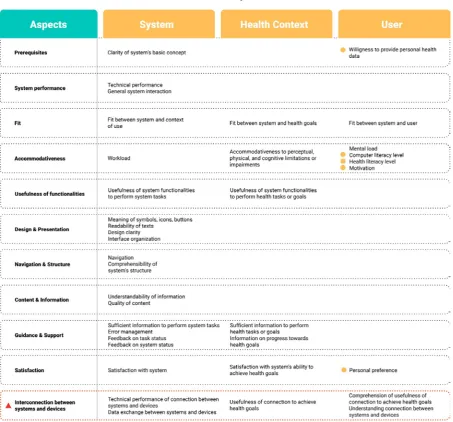
This analysis found factors that are specific to the usability of eHealth technologies, as well as those that are more generic and build up the construct of usability in general. The majority of the factors related to the qualities of the system and the user are more general constructs of usability that are not specific to the eHealth domain. Meanwhile, the factors related to the health context, and two of the user moderating variables, are factors that this thematic analysis has found to form the construct of usability specifically for eHealth technologies. The aspects, factors, and moderating variables have been constructed into the new framework, called the eHealth Usability Matrix, presented in Figure 2 on the next page.
This framework sees usability as arising from the interplay between the three actors of the system, the user, and the health context. These actors form the three pillars of the matrix. Next, the usability of an eHealth technology is constructed by 11 different aspects of the technology, which form the matrix’s rows. The 39 factors that impact the usability of an eHealth technology stem from the cross-sections between the aspects of the technology and the three actors of system, health context, and user.
The factors falling under the System pillar relate to the qualities of the system, the performance of the system, or the performance of system-related tasks. Factors falling under the Health Context pillar relate to the considerations brought into the equation by the health context, or to the performance of health-related tasks or the achievement of health goals. Finally, factors that fall under the User pillar relate to the qualities and abilities of the user.
Figure 2: eHealth Usability Matrix
4.2.1 Prerequisites
There are two ‘prerequisite’ requirements that determine the basis of whether an eHealth system can be used successfully to achieve its purpose.
Willingness to provide personal health data. The second prerequisite for successful system use is that the user is willing to provide the personal health data that is required for the system to carry out its core purpose. If, for instance, the user is unwilling to provide a dietary health tracking app with information about their body weight and eating habits, the app will be unable to execute its core function and will hence not be useful to the user. This, however, is a moderating variable, which means that it is a factor that is dependent on the individual user and is not able to be manipulated in attempt to ensure the usability of the system.
4.2.2 System performance
Another foundational element of a system’s usability is the quality of its performance. This relates to the ‘behind the scenes’ functioning of the system itself, as well as the functionality and ease-of-use of the elements with which the user interacts.
Technical performance. As a starting point, the system must be functional, error-free, and allow for smooth using. The question this factor asks is ‘Does it work, and does it work well?’ Issues that this factor stems from relate to system errors, such as a system crash or requesting users to perform a task they already completed; incompatibility with the device it is used on, such as being unable to scale its interface to match the device’s screen size; and slow loading and response times.
General system interaction. The user-facing end of the system, meaning all elements and manipulation functions the user interacts with in order to work with the system, must also be intuitive and easy to use. This refers to the usability of interaction elements such as buttons and scroll bars, and interaction functions such as swipes and clicks. An indicator of there being problems with this aspect could be that users do not understand how they can interact with the system by means of the system’s buttons, scrollbars, and textfields.
4.2.3 Fit
A system is only considered to be usable if it can be used by specified users who want to achieve specified goals within a specified context of use. Hence, it is imperative that there is a match between an eHealth system’s characteristics and abilities and what is required by these specific users, goals, and contexts.
Fit between system and context of use. For every technology, there is always a specified context in which it will - or will never - be used. Regardless of how functional or well-developed the system is, it must fit with this context of use, else it will not be useful. Take, for example, a computerized exercise program developed to assist older adults in becoming more physically active. This exercise program may be fully functional and engaging, but when a user reports that he would not be able to use this exercise program because his computer is located in his study where there is no room to exercise, this program does not fit with its context of use and is therefore not useful and will never be used.
demonstrate the exercises in the way that they should truly be performed, for example by taking small rather than big steps. Thus, the robot’s characteristics did not fit with what was needed to successfully achieve the users’ health goal of performing the exercises correctly.
Fit between system and user. There must also be a fit between the content of the system, such as the information, advice, tasks, or choice options presented by the system, and the user’s individual situation. For instance, one issue reported that neither of the two options that a user had to choose from (‘deceased child’ and ‘baby born before 37 weeks of pregnancy’) reflected her personal situation (pregnancy terminated due to medical condition). Another issue reported that the user found the information and coaching strategies of the system to be too general and not tailored to their own specific situation. In cases such as these, more could have been done to ensure a fit between the system and its users.
4.2.4 Accomodativeness
There are certain factors that are brought into the picture by the user or by the health context of eHealth technologies that the system should accommodate for. Additionally, the abilities of the user should be matched by the difficulty and intensity of the system.
Workload. The system should generate an appropriate amount of workload for the user - not too much, but not too little. Workload involves anything that the user must do within the system, such as the number of tasks the user is required to accomplish in order to reach their goal, or the complexity of the system interaction. Workload should not be too much, so as not to overburden the user or cause them to become frustrated or lose interest, and workload should not be too little, so as not to make the user feel bored or unchallenged.
Mental load. Similarly, the system should not require too much mental activity at once from its users, so as not to cause a mental overload. Problems listed in the datasets that represent cases of mental overload include, for example, that the explanation video went too fast for the user, or that it was hard for the user to perform the physical exercises while simultaneously having to watch the NAO robot demonstrate them.
Accomodativeness to perceptual, physical, and cognitive impairments or limitations. Particularly in the health context, it is highly likely that several users within the target group have a perceptual, physical, or cognitive impairment or limitation. It is for the benefit of both the user and the system’s usability for the system to accommodate for or be able to adapt to them. To elaborate on what is meant by these impairments and limitations, perceptual impairments relate to the five senses - the most relevant of which are sight and hearing - such as hearing impairments, short-sightedness, or colorblindness. Physical impairments include, for instance, poor hand-eye coordination, range of motion, or joint flexibility, or the lack of a limb. Cognitive impairments can include issues such as limited working memory or Alzheimer’s.
level, there is not much that can be done to deter issues relating to computer literacy because it is a moderating variable and a characteristic of the users themselves.
Health literacy level. An individual user’s health literacy level, meaning their level of knowledge of basic health information, was also found to impact the usability of the system for that individual. An exemplary issue of this is one user of the pregnancy app misinterpreting ‘ultrasound’ to mean ‘loud noise.’ This is also a moderating variable that is a quality of the user, and is thus the system can only attempt to accommodate for it.
Motivation. Finally, an individual user’s motivation to perform a task or engage with the system also impacts their ability to use the system with satisfaction. For example, users were unwilling to watch the instructional video, or did not want to know more about the app. Again, this is a moderating variable and as such is not manipulatable.
4.2.5 Usefulness of functionalities
There are numerous functionalities within a single system; some are vital to the core processing and some are more ‘frill factors.’ Regardless of the type, each functionality must actually be useful for the performance of a task or the achievement of a goal, be it a system task or a health goal.
Usefulness of functionalities to perform system tasks. System tasks include, for example, sending an email, steering an avatar through a game, and filling in a form. Each functionality that is in place to enable the user to complete these tasks, such as keyboard navigation keys or a ‘confirm send?’ button, should serve an actual purpose towards that task. An instance in which a functionality was reportedly not useful was the use of a function that checked in real-time for any mismatch between the passwords that were filled into the two password entry fields on the system’s login page. Because it checked the match in real time, a ‘password mismatch’ error message appeared when the user had only typed in two characters of the password into the second entry field, which caused much confusion with the user. In this case, the real-time functionality of the password check was not truly useful for the accomplishment of the system task of logging into the system.
Usefulness of functionalities to perform health tasks or achieve health goals. The same holds true for functionalities put in place to help a user perform a health-related task or achieve one of their health goals. A health-related task may be the performance of an exercise, while a health goal may be having an insightful session with a virtual health coach. A functionality that reportedly did not truly help towards the achievement of this health goal was the use of background stories about the virtual health coach. While it may be a nice ‘frill factor,’ if in the end the user does not find it useful or beneficial, the system would be more effective and efficient without it.
4.2.6 Design and Presentation
The clarity and organization of the system’s interface and the various elements that compose it make for a system that is (or is not) easy to use and make sense of.