Cover Page
The handle
http://hdl.handle.net/1887/28522
holds various files of this Leiden University
dissertation.
Categories and Logical Syntax
Categories and Logical Syntax
Academisch Proefschrift
ter verkrijging van de graad van doctor
aan de Universiteit Leiden
op gezag van de Rector Magnificus prof. mr. C.J.J.M Stolker
volgens besluit van het College voor Promoties
te verdedigen op donderdag 4 september 2014
klokke 10.00 uur
door
Ansten Mørch Klev
Promotor: Prof. dr. B.G. Sundholm
Overige Leden: Prof. dr. Ø. Linnebo (Oslo) Prof. dr. M. Marion (Montreal) Prof. dr. S. Rahman (Lille) Dr. M.S. van der Schaar
This research was supported by the Promoties in de Geesteswetenschappen pro-gramme of the Nederlandse Organisatie voor Wetenschappelijk Onderzoek (NWO).
Versteht man unter Kategorie die logische Form im weitesten Sinne, so muß der Begriff der Kategorie zum obersten Begriff der Logik werden.
Introduction
Gilbert Ryle opens his paper Categories (1938) by remarking that “doctrines of categories and theories of types are explorations in the same field.” He goes on to show how in particular Aristotle’s doctrine of categories can be seen as a special case of the theory of types. That particular proposal will not be defended here, but a principle underlying Ryle’s argument serves to organize what follows: categories, or types, and logical syntax are closely affiliated notions. It will be argued that Aristotle’s as well as Kant’s categories are close associates of what I shall call syllogistic syntax, namely a logical syntax that takes the form ‘S is P’ as basic; while type theory is a close associate of function–argument syntax, namely a logical syntax that takes the form
f(a), function applied to argument, as basic.
The dissertation is divided into two chapters, the first dealing with syllogistic syntax and the second with function–argument syntax. The traditional doctrine of categories and type theory each invite different sets of reflection. A discussion in one chapter is therefore in general not mirrored by a discussion in the other chapter, and neither does a discussion in one chapter in general depend on one in the other; but certain themes from the first chapter recur in the second; and it is hoped that the first chapter adds depth and perspective to the second. Apart from the relation of categories to logical syntax, recurring themes are the generality of the categories and the nature of the items categorized. Throughout, our emphasis is on logical aspects of categories. For an overview of the content of each chapter the reader is referred to the table of contents and to the synopses at the beginning of each chapter.
Frege’s works; the role of the notion of range of significance in Russell’s type theories; and the proper understanding of Husserl’s pure grammar in relation to categorial grammar. The chapter ends with a brief discussion of the notion of material categories, with which we leave the domain of logic and enter that of phenomenology. A thorough treatment of that topic therefore lies outside the scope of this dissertation. Chapter 1 is more historical in character, but I have tried to avoid painstaking exegesis; not that there is anything wrong with painstaking exegesis, but it would be out of place in a work with a scope as broad as the current one. Besides the synthesis already mentioned, the main contributions of chapter 1 are found in its sections 1 and 2, in particular in their examination, firstly, of the items categorized by, and secondly, of the generality of Aristotle’s categories.
Contents
Introduction vi
Acknowledgements xii
Bibliographical abbreviations xiii
Chapter 1. Categories and Syllogistic Syntax 1
Synopsis 2
1. Items categorized 3
1.1. Things said without combination 3
1.2. Subject and predicate 10
2. The generality of the categories 15
2.1. The predicables 15
2.1.1. Aristotle’s Topics 15
2.1.2. Porphyry’s Introduction 18
2.2. The ordering of genera 19
2.2.1. Trees in Plato and Porphyry 21
2.3. Categories and the ordering of genera 23
3. The skopos of the Categories 29
3.1. The commentators 29
3.2. A recent contention 34
4. The parts of speech 36
4.1. Introduction 36
4.2. Categories and the parts of speech 40
4.2.1. In the Stoics 40
4.2.2. In Aristotle 42
4.3. Syncategorems 46
5. Kantian themes 52
5.1. Kant’s table of categories 52
5.2. Generating the categories 58
5.2.2. Derivation without completeness 62
Appendix 1: Aristotle’s categories 66
Appendix 2: Kant’s table of categories 66
Chapter 2. Categories and Function–Argument Syntax 67
Synopsis 68
1. The simple type hierarchy 69
1.1. Frege: function and argument, and function and object 69 1.2. Frege’s types and Aristotle’s ontological square 79
1.3. Categorial grammar 87
2. Ranges of significance 95
2.1. Russell’s type theories 95
2.2. Sommers’s type theory 103
2.2.1. The law of categorial inclusion 106
2.2.2. Types and homonymy 112
2.2.3. Sommers and simple types 115
2.3. Ranges of significance and categories 116
2.3.1. Westerhoff on categories 118
3. Category mistakes 121
3.1. A taxonomy of nonsense 121
3.2. Types and category mistakes 126
3.2.1. Frege and Quine on the universal range of significance 127
4. Type predications 132
4.1. Ryle–Sommers type predications 132
4.1.1. Sets in constructive type theory 136
4.2. Simple type predications 143
4.2.1. The problem of the concept horse 143
4.2.2. Tractarian silence 147
4.2.3. The Russell–Carnap reduction 149
4.2.4. Types in constructive type theory 153
4.2.5. Notions of function 157
5. Sortals, identity, and generality 162
5.1. Sortals 162
5.1.1. Identity 166
5.2. Quantification and generality 167
6. Formal and material categories 174
6.2. Husserl on regions and formal categories 178 6.3. Formal and material categories in Carnap’sAufbau 184
Bibliography 189
Samenvatting 211
Acknowledgements
I am very grateful to my supervisor, Göran Sundholm, for all the guidance, inspi-ration, and support he has given me since I first met him at his house in April 2007. How he has informed my thinking and my approach to philosophy cannot easily be expressed in words, but I think it shows itself on almost every page of what follows.
With Stefan Roski and Robert Goené I have had countless discussions about categories, types, and related topics. Many thanks are due to them as well as to the students of a seminar on categories that I gave at Leiden in the autumn of 2012.
The influence of Per Martin-Löf on the present work will be evident to anyone who is acquainted with his lectures on the philosophical aspects of constructive type theory. I am grateful for the opportunity I had to discuss constructive type theory with him at Leiden in February 2014.
Without the critical remarks from Frans de Haas on an early draft of my PhD fellowship application I believe that the application would never have been successful; for those remarks I remain thankful. The Philosophical Institute at Leiden University has offered a relaxed atmosphere during the last four years; special thanks are due to its administration for assisting me in all matters extra-philosophical.
A precondition for this dissertation’s having been written is the PhD fellowship very kindly granted to me by the Dutch research council, NWO, through its pro-gramme Promoties in de Geesteswetenschappen. As well as expressing my gratitude to that institution I wish to express my hope that it will continue to finance indepen-dent PhD projects in the humanities.
Bibliographical abbreviations
Works by Aristotle
Unless otherwise noted below, the translations used are the Oxford translations of Barnes (1984). The Greek texts consulted are the relevant editions of the Oxford Classical Texts.
Cat Categories
Int De Interpretatione
APr Prior Analytics (Striker, 2009)
APo Posterior Analytics
Top Topics (Smith, 1997)
SE Sophistical Refutations
Phys Physics
DA De Anima
Met Metaphysics
Rhet Rhetoric
Poet Poetics
Commentaries on Aristotle
These are abbreviatedin APr, in Cat, and in Int, for In Aristotelis Categorias com-mentarium, etc. The Greek texts consulted are the relevant editions ofCommentaria in Aristotelem Graeca (CAG). Page references (also found in the translations) are to these volumes. The following translations are used.
Alexander of Aphrodisias in APr Barnes et al. (1991)
Ammonius in Cat Cohen and Matthews (1991)
Ammonius in Int Blank (1996)
Dexippus in Cat Dillon (1990)
Porphyry in Cat Strange (1992) Porphyry Isagoge (Isag) Barnes (2003) Simplicius in Cat Chase (2003)
Other ancient works
DL Diogenes Laertius,Lives of Eminent Philosophers GG Grammatici graeci
GL Grammatici latini
Works by Frege
Bs Begriffsschrift Frege (1879)
GLA Die Grundlagen der Arithmetik Frege (1884)
FB Funktion und Begriff Frege (1891)
BG Begriff und Gegenstand Frege (1892a)
SB Sinn und Bedeutung Frege (1892b)
Gg Grundgesetze I and II Frege (1893, 1903a)
UGG Über die Grundlagen der Geometrie I and II Frege (1903b, 1906)
WF Was ist eine Funktion? Frege (1904)
Ged Der Gedanke Frege (1918)
Vern Die Verneinung Frege (1919)
NS Nachgelassene Schriften Frege (1983)
WB Wissenschaftlicher Briefwechsel Frege (1976)
Works by Kant
KrV Kritik der reinen Vernunft (Kant, 1787)
Prolegomena Prolegomena zu einer jeden
künftigen Metaphysik (Kant, 1783)
Jäsche Logik (Kant, 1800)
Page references are to theAkademie editions.
Works by Russell
PoM Principles of Mathematics Russell (1903)
PM Principia Mathematica, volume 1 Russell and Whitehead (1910)
Works by Husserl
CHAPTER 1
Synopsis
In this chapter we study various traditional doctrines of categories: Aristotle’s doctrine, the grammatical doctrine of the parts of speech, and Kant’s doctrine. The main point of attention is Aristotle’s doctrine of categories; the discussions of the parts of speech and of Kant’s categories are both set against that background.
1. Items categorized
In order to understand what sorts of items fall under Aristotle’s categories it is natural to look to chapter 4 of theCategories, where the categories are first introduced (the list can be found in Appendix 1 at the end of this chapter (p. 66)). They are said there to collect “things said without combination” (ta kata m¯edemian symplok¯en leg¯omena).1 Section 1.1 investigates this and related notions in Aristotle’s work; it is proposed that items categorized are terms in the technical sense of syllogistics. It is sometimes held that items categorized are predicates; this view is scrutinized in section 1.2 and shown when properly understood to be subsumed by the view that items categorized are terms.
1.1. Things said without combination. The examples of things said without combination that Aristotle lists in chapter 4 of theCategories include ‘man’, ‘white’, ‘four-foot’, ‘double’, ‘in the Lyceum’; as examples of things said with combination he lists in chapter 2 of the same work ‘man runs’ and ‘man wins’. But apart from these examples Aristotle gives only a negative characterization of the notion: being saidwith combination is a prerequisite for being true or false. That truth and falsity presupposes combination is a claim one finds not only in theCategories(2a10, 13b10),
but at several places in Aristotle’s works,2and it may be regarded as one of the main theses of Plato’s Sophist. It is in fact reasonable to assume that Aristotle with his notion of thing said without combination alludes to this work of his teacher.3 Plato
there (261d–263d) notes that alogoscomes to be when certain spoken sounds (ph¯onai) “fit together.”4 A list of verbs such as ‘walks runs sleeps’ remains a list, as does a list of
nouns such as ‘lion stag horse’, for these words do not fit together. But when a noun and a verb are combined,5as in ‘Socrates walks’, the words fit, and the result is alogos.
Things said without combination would therefore be the elements combined in alogos.
1We follow Ackrill in using ‘thing said’ as the translation oflegomenon, a participle ofleg¯o; thus the ‘thing’
is supplied by the English.
2Int 16a11, DAIII.6 430b2, Met E.4 1027b19. Whereas theCategories speaks only ofsymplok¯e, these cited places uses the pair of termssynthesis(combination) anddiaresis (separation). It is clear from the citedDApassage that Aristotle sees a close parallel between combination and separation, so for ease of exposition I shall omit separation from the discussion. For the claim that a term by itself is not yet a proposition, see alsoTop101b26–28.
3As was perhaps first noted by Trendelenburg (1846, pp. 11–12).
4Plato was probably reacting to “the problems of predication” raised by Parmenides and Antisthenes: how
is false, and how is non-tautological predication possible? (cf. Nuchelmans, 1973, pp. 9–12) The problem of falsity (and non-being) is a main theme throughout the greater part of theSophist. Antisthenes’s problem of non-tautological predication is raised at 244c: “Surely it is absurd for someone to agree that there are two names when he maintains that there’s only one thing” (cf. 251b–c).
Let us not worry now about the fact that Plato calls these elements noun and verb; as we shall see in the next paragraph Aristotle introduces a different terminology, and as we shall see in section 4.1, he reserves ‘noun’ and ‘verb’ for making more purely grammatical distinctions.
The notion oflogos that Plato describes in theSophist is taken over by Aristotle with his notion of logos apophantikos, translated by Ackrill as ‘statement-making sentence’. This is a sentence in which there is truth or falsity (Int 17a2); hence it is a thing said with combination. Moreover, it says something of something (ti kata tinos, 17a25). Thus, firstly, a statement-making sentence is a combination, and secondly, it says something of something. It is reasonable therefore to suggest that what is combined in a statement-making sentence are the two “somethings” of the formula ‘something of something’, namely the something said of something else and the something else of which that something is said. In the context of Aristotle’s syllogistics these are both called terms (APr 24b16):
I call a term that into which a proposition is resolved, that is, what is predicated and what it is predicated of, with the addition of to be or not to be.
What is here called a proposition (protasis) is “a sentence (logos) affirming or deny-ing somethdeny-ing of somethdeny-ing” (APr I.1 24a16), and thus coincides with the notion of a statement-making sentence as defined in theDe Interpretatione. Instead of “some-things” this definition speaks of ‘what is predicated’ and ‘what it is predicated of’, and baptizes these things ‘terms’. Since a statement-making sentence was taken to be a combination of the two “somethings” in the formula ‘something of something’, it can therefore also be said to be a combination of terms: a statement-making sentence is a combination of terms.
(1) man is (not)
(2) man is (not) recovering
(3) man recovers/does not recover.
Here (2) is of syllogistic form, and Aristotle holds that (3) is reducible to (2): replacing the finite verb ‘recovers’ in (3) by a copula and a participle we get ‘man is recovering’.6 Aristotle says little about the first form, and the reason is perhaps that it is difficult to see that it involves any combination at all.7 In fact, when Brentano in the 19th
century suggested a revision of logical syntax, taking the form (1), ‘S exists (not)’, as basic, he did so partly on the grounds of a conviction that not all judgements involve a combination.8 However that may be, Aristotle disregards this form in his logic, and his reduction of (3) to (2) allows him to concentrate on the form ‘S isP’, and that is a combination of terms. But if a thing said with combination is a combination of terms, then a thing said without combination must be a term; hence we propose to identify things said without combination with terms. The proposal is therefore also that items categorized by Aristotle’s categories are terms.
In theAnalytics Aristotle gives many examples of terms, including ‘there being a single science’ (to mian einai epist¯em¯en, APr I.36) and ‘there is knowledge of the good, that it is good’ (tou agathou estin epist¯em¯e hoti agathon,APr I.38). Hence one sees that terms need not be of the simple form exhibited by ‘man’ and ‘white’, but may have a varying degree of complexity. InAPr I.35 Aristotle in fact distinguishes between simple and complex terms, calling the former onomata and the latterlogoi
(48a29–30). But if a term is a thing said without combination, then we need to
un-derstand the complexity of a complex term otherwise than as the sort of combination yielding a thing said with combination. To that end let us first consider the word
logos, employed by Aristotle for complex terms.9
According to the De Interpretatione a logos is a significant spoken sound that has parts significant in separation, while anonomais a significant spoken sound that does not have parts significant in separation. Ackrill translates logos in this context as ‘sentence’. Hence, as a sentence is presumably a thing said with combination, one is led to think that having parts significant in separation is just the same as being said with combination. A more thorough examination shows that such an identification
6The same reduction is made atMet ∆.71017a27ff..
7Alexander of Aprhodisias (in APr15,15–15,23) argues that this form as well is reducible to the first form, namely as ‘man is being’, hence with ‘being’ as the predicate term. This view is not compatible with our interpretation, since it would force us to assign a category to ‘being’.
8Brentano first presents his revision of syllogistic syntax in the seventh chapter ofPsychologie vom
em-pirischen Standpunkt(Brentano, 1874, pp. 271–289).
cannot be upheld. The translation of logos as ‘sentence’ is not compatible with Aristotle’s terminology inAPr I.35, where it means complex term; but that may be just another instance of the famous polysemy of this Greek word. There are, however, reasons to think that this is not so. In Poetics 20, a chapter that repeats almost verbatim the definition oflogos given in theDe Interpretatione, Aristotle on the one hand says that there arelogoi without verbs, hence sub-sentential units, and on the other hand he calls theIlliad, a super-sentential unit, a logos (cf. APo II.10 93b35). Thus, the wordlogos seems to signify complex sayings quite generally.10 Nothing in Aristotle’s definition of logos atInt 4 and Poet 20 excludes such an interpretation, and even in the De Interpretatione (16a21) one finds an example of a sub-sentential
unit, namely ‘white field’, being called a logos (cf. Int 17a16). That a logos need not be a thing said with combination is in fact confirmed by the example ‘rational mortal animal’. This phrase, or whatever one takes to be the definition of man, is a logos according toPoet 1457a25; but it is synonymous to ‘man’, since a defined
term is synonymous to its definition (Cat 1a6); but ‘man’ is a thing said without
combination (Cat 1a19); hence, on the reasonable assumption that two synonymous
phrases are either both said with or both said without combination it follows that ‘rational mortal animal’ must also be a thing said without combination. We cannot therefore identify the two notions of having parts significant in separation and being said with combination, for there are items having parts significant in separation that are not said with combination.
This is not to say that there are nologoi that are things said with combination: statement-making sentences, logoi apophantikoi, are precisely that. We thus have a genus oflogos, defined as a sign having parts significant in separation, with the two species under it of complex terms on the one hand and things said with combination on the other. These are species oflogos, and so are complex sayings, but they differ in the nature of their complexity: on the one hand we have the complexity pertinent to terms and on the other the complexity pertinent to sentences. A similar distinction has been drawn in more recent times by Jespersen (1924, esp. pp. 96–144) between what he calls
nexus andjunction. A junction is a complex term, typically generated by adding one or more qualifiers to a simple term (ibid. pp. 108–114); so it has parts significant in separation in Aristotle’s sense. A nexus is a sentence or a sentence-like combination (ibid. esp. pp. 117–122), corresponding to Aristotle’s thing said with combination. That a nexus need only be sentence-like means that the notion comprehends apart from sentences—be it as main or subordinate clauses—also accusatives with infinitive
10Barnes (2007, p. 180) translateslogosin this context as ‘saying’, while the German translation of
and the combination of a verbal or adjectival noun with a genitive, as in ‘the doctor’s arrival’. Like Aristotle, Jespersen relies on our intuitive grasp of the difference between these two manners of combination, and the only general characterization he offers are elucidations of a junction as “lifeless, stiff, rigid” and as “a single idea,” and of a nexus as “having life in it,” being “pliable, as it were, animate and articulated” and “always containing two ideas which must necessarily remain separate” (ibid. pp. 115– 116). We have maybe reached a point here where crisp descriptions must give in, and elucidations by means of metaphors or otherwise take their place.
In any event we must distinguish complex terms from sentences. Complex terms have parts significant in separation, but are not said with combination; sentences are things said with combination. A simple term must then be a term that has no parts significant in separation. As is seen from a discussion in Porphyry’s commentary on theCategories (3rd century AD), this definition is problematic. Porphyry maintains that verbs in the first-person as well as certain idiomatic third-person forms are, even when said by themselves, things said with combination.11 Although the subject is not then expressed, it is implicit in the verbs themselves (in Cat 87,38ff.).12 Among these idiomatic third-person forms Porphyry counted ‘it rains’, in Greek expressed by the one word huei.13 According to Aristotle’s definition of the verb (Int 16b6),
it is a sign having no parts significant in separation. A verb is therefore a simple term according to the suggested definition. If Porphyry is right, however, some verbs are also things said with combination. Verbs of the kind Porphyry points to would therefore be counterexamples to the identification of simple terms with words having no parts significant in separation.
Until now we have assumed, as Aristotle also did, that a simple term is a simple expression and a complex term a complex expression. We have in effect twice found that simplicity of expression cannot be used as an indicator of saying without com-bination: there are complex terms, such as ‘mortal rational animal’, that say things
11Cf. Wittgenstein’s remark (TLP 4.032) that the simple signambulois composite.
12This view was shared by Ammonius in his discussion of the same problem atin Int28,11–28,28. 13According to Porphyryhuei has ‘Zeus’ as implicit subject. This appears to have been the common
without combination as well as simple terms, such ashuei, that say things with com-bination. But the notion we are after is perhaps not simplicity of expression, but rather simplicity of meaning. Another commentator, Ammonius (5th century AD), held that a thing said without combination is what has both a simple meaning and a simple expression (in Cat 32,26–33,4):
For (1) we can use a simple expression (ph¯on¯e) with a compound meaning (s¯emainomenon), as when I say trech¯o (‘I run’), for I refer to myself and to my action; (2) the expression may be com-pound but its meaning simple, as in ‘mortal rational animal’, for the expression is compound, but its meaning is man; (3) both may be compound, as when I say ‘Socrates runs’; or (4) both may be simple, as the categories themselves.
Ammonius here assumes that we have a means of recognizing a compound meaning in a simple expression and a simple meaning in a compound expression. But what are such means? We seem to have a good grasp of the distinction between what is sentential and what is not, and on that basis we may settle such cases astrech¯o and ‘Socrates runs’. Moreover, if we know of an expression that it has simple meaning, then we can infer that its definition will have simple meaning, as in ‘mortal rational animal’. These seem to be the means of recognition of compound meaning implicit in Ammonius’s examples. It is clear that they leave many cases unsettled. ‘White man’ is a compound expression, but does it have a compound meaning? Defining ‘Whan’ to mean ‘white man’, does ‘whan’ have a simple meaning?14 One chapter in the Organon that could be taken to deal with such questions isInt 11, but it is not clear what it says on the matter; as Barnes (2007, p. 130) notes, it “obscures rather than illuminates.” Indeed, no general test for the simplicity or otherwise of the meaning of an expression is forthcoming, it seems to me.
We are primarily seeking instruction on the sort of item that is categorized by Aristotle’s categories. Perhaps it is possible to make progress on that matter without first explicating the nature of the complexity of a complex term and the simplicity of a simple term. It seems reasonable to say that if a termtis of categoryC, then adding a suitable qualifier (e.g. an adjectival, adverbial, or prepositional phrase) totyields a new term belonging to the same categoryC, even though the qualifier taken by itself may be of another categoryC0. For instance, a white man is a man and therefore a substance, even though white is a quality. Ackrill (1963, pp. 73–74) holds that ‘white
14This question is in effect raised by Ackrill (1963, p. 73); Barnes (2007, pp. 132–133) discusses it and
man’ does not fall into any category, for it “introduces two items from two categories.” But it seems like an unnecessary restriction on the scope of Aristotle’s category theory if qualified terms could not be said to belong to a category. Man, let us assume, is defined as rational animal. Hence, if man belongs to the category of substance, then rational animal does as well. But in ‘rational animal’ we have two items from two categories. That a qualified term belongs to a category is thus presupposed by the practice of definition. More specifically, the doctrine of definition by proximate genus and differentiae seems to presuppose that a qualified term belongs to the same category as its head. The proximate genus, namely, must belong to the same category as the defined term, although the differentiae need not do so.15 Could there be other rules apart from qualification for generating categorized terms? Conjunctions such as ‘Plato and Socrates’ or ‘walking or conversing’ could perhaps be called complex substances and complex actions, but to a conjunction such as ‘cuts while being cut’ it is not possible to assign a category since it conjoins an action and an affection.16
The foregoing suggests that if we were to supply syllogistics with category spec-ifications, then we should have to assume a regimented language of some form. The problems surrounding the notion of simple term suggest that these would have to be laid down by fiat, and each assigned a category. From the simple terms new terms would be generated by formation rules formulated such that each term could be assigned a category in some sense consistent with the category of the terms from which the new term was generated. These formation rules would include a rule of qualification that would take, say, a substance term and a quality term and yield a substance term; more generally, we should need to stipulate which kind of term may qualify others, and what the category of the qualified term should be. Besides there could be rules such as intra-categorial conjunction. Assuming, as we do here, that items categorized are terms, such formation rules would also determine the extension of the concept of a term: each term belongs to a category; what does not belong to a category is not a term. It would presumably follow that Aristotle’s example of a
15Morrison (1993) argues convincingly thatP’s being a differentia ofSdoes not determine its category
(e.g. it need not be of the same category asS). An important assumption of Morrison’s is a distinction between categories of predication and ontological categories. I shall argue in section 3.2 below that this distinction is not Aristotelian; to my mind, the true Aristotelian pendant of Morrison’s “categories of predication” are the predicables (substance as a category of predication corresponds to the predicable of genus, while quality as a category of predication corresponds to the predicable of differentia (on which Aristotle was not quite clear, see section 2.1.2 below)). I am grateful to Donald Morrison for sending me a copy of his paper.
16Conjunction of terms was regarded by Porphyry as one of two ways of saying with combination (in
complex term ‘there being a single science’ is in fact not a term. It is not a term since it cannot be assigned a category. That appears not to raise a problem, however, since the sentence Aristotle wishes to formalize, ‘Of contraries there is a single science’, is simply not formalizable in syllogistic syntax.
1.2. Subject and predicate. Plato noted that any proposition (logos) is about something and says something of that thing (Sophist 262e–263d). In effect he thereby drew the now traditional distinction between the subject and the predicate of a propo-sition. As a definition of this pair of notions there are certainly shortcomings in saying merely that the subject is (that which signifies) what the proposition is about while the predicate is what is said of that thing; for as Ryle (1933) noted, ‘about’ has many meanings.17 ‘Peter’ is the subject of ‘Peter loves Mary’; but instead of saying that
this sentence is about Peter we may perhaps equally well say that it is about loving Mary; that is, it is about loving Mary and says that this is a characteristic of Peter.18
To this one could object, rightfully I think, that the original sentence was not ‘loving Mary is a characteristic of Peter’, but rather ‘Peter loves Mary’, and it is only the first of these that allows the suggested analysis. So the sentence ‘Peter loves Mary’ is not about loving Mary; but could we not say that it is about Mary, predicating Peter’s loving her of her?19 As a foolproof definition of the notions of subject and predicate is
not needed for our purposes, that is a question I shall not attempt to answer here.20
That we grasp the distinction seems enough for what follows; and I take it as an unproblematic assumption that at least speakers of English do so. We have practiced that grasp as schoolchildren analyzing sentences, and again when applying the rule S→N+VPin exercises of generative syntax.
The tradition is not always clear whether subject and predicate are linguistic or other sorts of items. Aristotle, for instance, vacillates at this point, taking subject and predicate now to belong to the level oflogos (APr 24b16ff.), now to the level of
17The definition of what a proposition is “absolutely about” defended by Goodman (1961) is of little use in
defining the notion subject, since it entails (cf. ibid. pp. 9–10) both that ‘Socrates is identical to himself’ is not about Socrates and that ‘Cows are animals’ is about the class of non-cows.
18This point was made by Ramsey (1925b, p. 404).
19Geach (1962), who defined a subject of a sentenceSas “an expression for something that S is about” (p. 23), insisted that ‘Mary’ in fact is a subject of ‘Peter loves Mary’.
20Apart from Geach, Strawson has written extensively on the distinction from the point of view of
pragma(Int 17a40).21 According to the Stoics a predicate is a “deficientlekton,” hence not an expression, but rather something like Fregean sense (DLVII.63). Ammonius (in Int 7,30), on the other hand, speaks of subject and predicate as vocal sounds (ph¯onai). In the more recent treatments of Geach (1962) and Strawson (1974) subject and predicate are understood to be expressions, and that is the practice we shall follow here. Thus we take ‘Peter’ and not Peter to be the subject of ‘Peter loves her’. Peter himself may rather be said to be the topic of the proposition. Likewise ‘loves her’ is the predicate of ‘Peter loves her’, while loving Mary may be called the comment of the proposition, relating to the topic as the predicate relates to the subject.22
One might ask whether characterizing subject and predicate is what Plato in fact does at the place in question; might the characteristics he states not just be yet other characteristics of noun and verb? Indeed, in his examples illustrating the distinction it is always a noun that serves the former role and a verb that serves the latter. In that respect the examples are deceptive, for they all consist of only two words. Consider instead the following sentence.
A young Norwegian mathematician who came from a poor family and died at the age of 26 proved that there is no general solution by radicals to quintic equations.
Here we should say that the first part ‘A young. . . the age of 26’ is the subject, while the rest is the predicate. But then one sees that there is no limit to the complexity of the subject and the predicate of a proposition, in particular, that they do not have to be single nouns and verbs respectively. One sees, moreover, that there may be noun phrases embedded in the predicate and verb phrases embedded in the subject. The fundamental contrast between subject and predicate on the one hand and noun and verb on the other lies, however, not in matters of complexity. The fundamental contrast lies in the fact that subject and predicate, unlike noun and verb, are rela-tive notions. It is only in the context of a proposition that it makes sense to speak of subject and predicate. By contrast, a word is a noun or a verb, and a phrase a
21For more examples, see Barnes (2007, pp. 114–123).
22The pair of terms ‘topic’ and ‘comment’ seems to stem from Hockett (cf. Lyons 1968, p. 335 andOED
noun phrase or a verb phrase, independently of its occurring in any given proposi-tion.23 Thus one speaks of the grammatical or logical roles or functions of subject and predicate in contrast to the parts of speech or word classes of noun and verb.
Our interest here is in propositions of syllogistic syntax, ‘S isP’. As instances of this form we should, however, count not only ‘Peter loves Mary’ (analyzed as ‘Peter is loving Mary’) or ‘man is mortal’, but also ‘some men are bald’ and ‘some men are not philosophers’. In general, a proposition of syllogistic syntax is determined not by its terms alone, but by its terms together with what is traditionally called its quantity and quality (and in modal syllogistics, its modality as well).24 These are aspects of the proposition indicating whether the predicate is said of all or of some S’s, and whether it is in fact said or rather denied of these. There is therefore a question whether, in ‘some men are bald’, one should count ‘some men’ or only ‘men’ by itself as the subject. A grammarian would presumably choose the former alternative (and would again realize the problem of defining the subject in terms of what the sentence is about: which men is ‘some men is bald’ about?). I am inclined towards choosing the latter, that is, towards saying that the termS by itself is the subject. For if the quantifier is counted as part of the subject term, then by symmetry we should also have to count negation as part of the predicate in a negative proposition; that is, we should have to countenance negative terms. It is unclear, however, what for instance a non-man is: whether it is an angel, or any substance whatsoever which is not a man, or something else. Fortunately, whether we say that ‘some men’ or rather that ‘men’ is the subject makes no difference to what follows.
A related question is whether P by itself or rather the phrase ‘isP’ should be viewed as the predicate of a syllogistic proposition. According to the stipulations of Geach (1962, p. 22ff.) it is ‘is P’ which is the predicate; likewise, the grammarian Jespersen (1924, p. 150) callsP by itself thepredicativeof the proposition and ‘isP’ its predicate. The view that P alone is the predicate can be found in Alexander of Aphrodisias (in APr 15,2ff.) and Ammonius (in Int 7,30ff.), in thePort-Royal Logic (Part II ch. 3) and in the Jäsche Logik (§ 24); let us quote Mill (1843, Bk. I ch. 1 § 2), however, who is conveniently explicit about the matter:
Every proposition consists of three parts: the Subject, the Pred-icate, and the Copula. The predicate is the name denoting that which is affirmed or denied. The subject is the name denoting the
23Cf. Chomsky (1965, pp. 68–70), who notes that in one and the same sentence the same word may serve
as the subject of one verb phrase and as the object of the other; thus in ‘John was persuaded by Bill to leave’ ‘John’ is, according to Chomsky, the object of ‘persuade’ but the subject of ‘leave’.
person or thing which something is affirmed or denied of. The cop-ula is the sign denoting that there is an affirmation or denial, and thereby enabling the hearer or reader to distinguish a proposition from any other kind of discourse. Thus, in the proposition, The earth is round, the Predicate is the wordround. . .
Mill thus takes the predicate not to include the copula. It seems to be mainly a matter of convention whether we decide for the one or for the other terminology, but it is important for our discussion here to have recognized both options.
In Aristotle’s Greekkat¯egoria sometimes means ‘predicate’. He says atCat 3a36
that “from a primary substance there is no predicate (kat¯egoria),” and atInt 21a29 he speaks of predicates (kat¯egoriai) “containing no contrariety” (where ‘dead’ is taken to contain a contrariety to ‘man’, since a dead man is not a man). Hence, in light of Aristotle’s introducing the categories inTopics I.9 (and at APo 83b15) as gen¯e t¯on
kat¯egori¯on, genera of predicates,25 we should ask whether items categorized are not terms but rather predicates. A positive answer to this question seems presupposed in the traditional designation of the categories in Latin aspraedicamenta, that which is predicated.26 Which answer one ought to give depends on how one understands the
notion of predicate in syllogistic syntax.
If such a predicate is taken to be of the form ‘is P’, then it is clear already on grammatical grounds that items categorized are not predicates. For Aristotle gives ‘man’ as an example of the category of substance, where no ‘is’ is to be found. To this it may be objected that in a Greek predication the ‘is’ is optional, thus one can say, for instance, ho Sokrat¯es anth¯opos; hence, whereas ‘is man’ is not an Aristotelian substance, what is a substance is ‘man’when said of something, that is, when predicated. Thus a predicate is a termquapredicated, whether or not an ‘is’ be attached to it.27 AtCat3a36 Aristotle said that “from a primary substance there is no 25Frede (1981, pp. 32–35) argues thatkat¯egoriain theTopicsgenerally should be rendered ‘predication’,
thus taken to signify a full proposition. But at Top I.9 Aristotle says that whatever is an accident, genus, property, or definition belongs to thegen¯e t¯on kat¯egori¯on, and whatever is one of these is not a full proposition, but a predicate as is clear fromTop I.4 101b26–27: “none of these [i.e., whatever is an accident, genus, etc.] said by itself is a proposition or problem [i.e., a predication].” For further criticism of Frede’s argument, see Ebert (1985, p. 130, fn. 29).
26Martianus Capella,The Marriage of Philology and MercuryIV.362, 383 (early 5th century AD), speaks of the categories aspraedicationes, but Boethius translates (early 6th century AD)kat¯egoriain the relevant sense aspraedicamentum, hence atCat10b19,21 and at PorphyryIsag4.15; 4.21; 6.7 (see e.g. the relevant volumes ofAristoteles Latinus). In fact, Augustine refers to Aristotle’s categories as praedicamenta at
ConfessionsIV.16.29 (around 400 AD); on the Latin translation he made use of cf. Minio-Paluello (1945, pp. 65–68).
27This appears to be the position of Apelt (1891), who says, for instance, that the categories are “Arten
predicate.” This I interpret to mean that a primary substance by itself cannot serve as a predicate. That is to say, a primary substance, such as ‘Socrates’ or ‘Bucephalus’, cannot by itself be predicated of anything. But primary substances are substances, and therefore items categorized. Hence, ‘Socrates’ is an item categorized that is not a predicate in the relevant sense. Items categorized can therefore not be identified with predicates as predicated, since primary substances are not such things.28
If, however, a predicate is understood simply as the P of ‘S isP’, then we may well say that items categorized are predicates. For in Aristotle’s logical syntax the terms S and P are syntactically similar; that is to say, whatever is an S of one proposition can be theP of another, and vice versa.29 That principle is presupposed by Aristotle’s proof method of conversion, which is fundamental to syllogistics’ being more than just a list of valid moods, namely also a system for reducing imperfect moods to perfect ones (APr I.4–6). By the principle of syntactic similarity any term may be a P, and so the class of terms coincides with what may be a P, hence so does the class of items categorized. The syntactic similarity of terms means that the category of a term has no influence on the syntactic properties of a term: terms will in general differ in category, but they are always syntactically similar. As we shall see in the next chapter (esp. section 1.3), this is a point at which syllogistic syntax parts ways with Fregean function–argument syntax. In the latter the category of a term— function of a certain order and kind, or object—determines the kinds of syntactic relations into which it may enter—a first-level unary function, for instance, can never be substituted for an object.
If items categorized are terms, then primary substances are singular terms. Fol-lowing what we just said, a singular term is syntactically similar with all other terms, although it signifies an individual. It is clear fromAPr I.33, where Aristotle considers terms such as ‘Aristomenes’ and ‘Mikkalos’, that he countenances singular terms in syllogistics. The question then arises how to accommodate this with Cat 3a36, the
statement that there is no predicate from a primary substance. Indeed, independently of the identification of primary substances with singular terms the question arises of how to interpret a proposition whoseP is a singular term. One possible answer is to say that the copula in this case must be understood as the ‘is’ of identity. A better answer to my mind is to say that the singular termP must be understood as a general term satisfied by P alone, namely as an “individual concept.” This suggestion also
28Considerations along these lines are the reasons offered by Ryle (1938, pp. 190–191) and De Rijk (2002,
368–374) for preferring to say that items categorized are terms and not predicates.
29Geach (1972, p. 47) saw in the acceptance of the syntactic similarity of subject and predicate a change
supplies an answer to the question of what the quantifier is in a proposition whose subject is singular: it may be particular as well as universal.30
2. The generality of the categories
As understood in the philosophical tradition categories are concepts of a very general kind. The commonest way of explaining the generality of Aristotle’s categories is to identify them with highest genera. A famous statement of this identification is found in the so-calledIntroduction, or Isagoge, of Porphyry (Isag 6.7–6.13):
Let it be supposed, as in the Categories, that the first genera are ten—ten first origins, as it were. . . The highest genera [ta genik¯otata], then, are ten.
Statements to the same effect are found, among the ancient commentators, in Alexan-der of Aphrodisias (in APr 291,17ff.), Ammonius (in Cat 13,15ff.), and Simplicius (in Cat 17,19ff.); among modern commentators in Bonitz (1853, pp. 591–623), Tren-delenburg (1846, e.g. p. 20), Brentano (1862, p. 100), Ross (1949, p. 25), and Ackrill (1963, pp. 79); the identification is moreover implicit in such recent works on the
Categories as Wedin (1997) and Studtmann (2008b). This section offers a critical examination of the identification.
2.1. The predicables. In traditional logic a genus is one of the four or five so-called predicables, and it is as such that we must understand highest genera when identified with categories. The doctrine of predicables originates in Aristotle’sTopics, but has perhaps more often been associated with Porphyry’sIntroduction.
2.1.1. Aristotle’s Topics. Aristotle’s Topics is structured around the notions of definition,idion, genus, and accident (cf.Top I.6 102b35–103a1): roughly,Top II–III
deal with accident,Top IV with genus,Top V withidion and TopVI-VII with defi-nition. Aristotle does not employ a technical term for these notions collectively, but they have come to be called predicables.31 The predicables characterize the relation of the predicate to the subject in a true categorical proposition. When we make ex-plicit, what Aristotle does not, the reference to such a true categorical proposition ‘S
30For this suggestion, see Barnes (2007, pp. 154–167).
31This word in the appropriate sense apparently originated with Abelard (cf. Baumgartner and Kolmer,
is P’, the definitions read as follows (cf. Top I.5). The predicateP is the definition of the subject S if it is a logos signifying the essence (to ti ¯en einai) of S. It is an idion, or proprium, or (unique) property, of S if it is not a definition of it, yet nevertheless counterpredicates with S, that is, is such that ‘P is S’ is true. Thus, (neglecting plucked hens) ‘featherless biped’ is an idion of man, since it does not reveal the essence of man, yet is nevertheless such that the converse ‘featherless biped is man’ is true. The predicateP is a genus ofS if “it is predicated in the what it is (en t¯oi ti esti kat¯egoroumenon) of many items differing in species” (102a31). A
pred-icate is predpred-icated ofS in this manner, Aristotle explains further, if the proposition in question is what would appropriately be given in answer to the question of what something is, as it is appropriate if the subject is man to say that it is an animal. Aristotle gives two definitions of what it is for P to be an accident of S. Firstly, if
P is neither the definition, nor anidion, nor a genus of S, thenP is an accident of
S. Secondly, and less trivially, if P is such that it does, but need not, belong to S, thenP is an accident ofS. According to both criteria, being-seated is an accident of Socrates, assuming that he is sitting.
At Top I.8 Aristotle presents what he takes to be a deductive proof (pistis dia sullogismou) that his list of predicables constitutes a complete classification of the ways in which a predicate may truly be said of a subject—in other words, that in any true categorical proposition the predicateP is either the definition, anidion, a genus, or an accident of the subject S. The proof is by division and runs as follows. We assume that ‘S isP’ is true. Now, the converse ‘P isS’ is either true or false. If ‘P
B, others asC, and then say that everyP which is neither anAnor aB nor aC is a D, then it needs no proof that any P is one of A,B,C, orD.
The relational character of the predicables is worth emphasizing: no term is a genus just by itself, but only a genus of another term; no term is an accident just by itself, but only an accident of another term; and likewise foridion and definition. This contrasts with the categories, for a category is not relational in this sense: which category a term belongs to is not relative to its occurrence in a true categorical proposition. For this reason the name ‘figures of predication’, translating Aristotle’s
ta sch¯emata t¯es kategorias, seems to me an unhappy description of the categories. Figures of predication would rather seem to describe the predicables, for they classify ways in which the predicate is predicated of the subject, while the categories classify predicates in isolation. Aristotle employs the name ‘figures of predication’ for instance at Met ∆.7 (1017a22ff.), in one of his distinctions of the different senses of ‘being’: “the senses of being are just as many as the figures of predication.” Recalling our reading (p. 4 above) of “with the addition of to be or not to be” atAPr I.1 24b18 to
refer to the copula, it seems natural to interpret this passage fromMetaphysics ∆as identifying the categories with the different senses of the copula, thus to hold that the being in question here is that expressed by the copula.32 But, again, it seems more reasonable to say that the copula is said in as many ways as there are, not categories, but predicables, for the predicables classify precisely different ways in whichS is P. Thus, we could say when P belongs toS as its definition thatS is nothing but P; whenP belongs toS as a genus thatSis essentially or genericallyP; whenP belongs toSas anidionthatSis properlyP; and whenP belongs toS as an accident thatS
is accidentally P. But we would not say thatS is substantially P or qualitativelyP
or quantitativelyP or relativelyP, etc., but simply thatP is a substance or a quality or a quantity or a relative, etc.
A slightly different conception of the relation between categories and figures of predication is defended by Brentano (1862, esp. pp. 108–122). According to him there is no actual identity between these things, but only a one-one correspondence; in particular, each category corresponds to a way of predicating a predicate of a primary substance. IfS is a substance, then ‘S isP’ and ‘S isP0’ differ in figure of predication if and only ifP andP0differ in category. IfSis a singular non-substance, namely an “individual accident” such as the particular whiteness of this table,33 then there is a predication ‘S is P’ if and only if S and P belong to the same category; but they all share the same figure of predication, namely that found in ‘Socrates is
a man’, viz. the figure corresponding to the category of substance. The figure of ‘S
is P’ where S is general is the same as the figure of ‘S0 is P’ where S0 is singular. The figures of predication are therefore just as many as the kinds of predicate. There are objections one could raise against this argument, but I shall not do so here. Instead I want to question, once again, the notion of figure of predication, for also on Brentano’s reading is it difficult to make sense of the idea that these correspond to the categories. Consider for instance the predication ‘Socrates is six feet tall’. Here a quantity is predicated of Socrates. Brentano’s view must be that this is a quantitative predication, that the predicate is predicated in the figure of quantity. But then one is forced to say that in this predication ‘six feel tall’ is predicated quantitatively of Socrates, and that seems to me to be either nonsensical or pleonastic. In any event it fails to clarify the notion that categories are, or correspond to, figures of predication. 2.1.2. Porphyry’s Introduction. In Thomas Blount’s Glossographia of 1656 one reads that “In Logick there are five Predicables, otherwise called Prophyries five terms.” Porphyry had in fact distinguished five rather than four predicables, also known in the tradition as thequinque voces: genus, species, differentia, idion, acci-dent. He defines genus as “what is predicated in answer to, What is it?, of several items which differ in species” (Isag2.15), which repeats almost verbatim the definition Aristotle gave atTopI.5. AtTopI.4 Aristotle had expressly treated the notion of dif-ferentia as a specimen of genus: “the difdif-ferentia, since it is genus-like should be placed together with the genus” (Top 101b18). AtTopIV.6 (128a20–29), however, Aristotle
in effect denies that differentiae are to be identified with genera, and he gives three criteria for distinguishing the two. Firstly, “the genus is said of more items than the differentiae”;34secondly, “in presenting the what it is it is more fitting to say the genus than the differentia”; thirdly, “the differentia always signifies a quality of the genus, but not so the genus of the differentia.”35 It is indeed doubtful whether Aristotle’s definition of genus as “what is said in the what it is of several items differing in species” covers the notion of differentia. Thus, in his completeness proof at Top I.8 Aristotle operates with a notion of genus simply as what is said in the definition of the subject; the proof would presumably not go through had it relied on the the official definition of genus fromTopI.5. Given this ambivalence, it is not surprising that Porphyry adds
34Here it is plain that Aristotle has in mind thedivisive, and not theconstitutive, differentiae of the genus
in question; these notions are, as far as I know, not explicated in Aristotle’s work, but Porphyry explains them in his chapter on differentia (Isag9.25–10.21).
35This third characteristic is also found atTop IV.6 144a18–22 and in the first definition of quality at
differentia to the list of predicables, and that a latter-day traditional logician such as Joseph (1916, p. 74) has followed him in doing so. Porphyry gives several accounts of the notion. According to one (Isag 11.8ff.) “a differentia is what is predicated as a qualification (en t¯oi poion ti esti) of several items which differ in species,” where one can recognize Aristotle’s second criterion above, that “the differentia always signifies a quality of the genus.” Aristotle’s two other criteria for distinguishing differentiae from genera can likewise be found in Porphyry’s text (cf.Isag 11,11 and 14,14).
Even though species (eidos) does not occur in Aristotle’s list of predicables in
Top I.5, the notion is presupposed in his definition of genus as what is predicated essentially of several items differing in species. It is therefore natural to ask why Aristotle did not include species on his list of predicables. To say that S is a species of P is usually to say that P is a genus of S; hence the name ‘species’ indicates in this case not how a predicate relates to the subject, but how a subject relates to the predicate. This is presumably what Ross (1949, p. 33) alludes to when he says that “this is Aristotle’s classification of predicables which Porphyry later mud-dled hopelessly by reckoning species as a fifth predicable.” If there is any place for the notion of species in a set of predicables, it would therefore have to be so as to cover singular essential predications; indeed, that seems to be presupposed by Por-phyry’s characterization that “a species is what is predicated in answer to ‘What is it?’ of several items differing in number” (Isag 4,12). It is, however, clear that none of Aristotle’s predicables classify such predications: not accident or idion, for these are not predicated essentially; not genus, for it is predicated of “several items differ-ing in species” (Top 102a31), so in particular not of individuals as such; and not
definition, for a definition converts with its subject (Top I.8 103b9), but a singular essential judgement does not convert—Socrates is a man, for instance, but man is not Socrates. Since Aristotle thought he had covered all possible predications in his table of predicables, it is natural to conjecture that Aristotle in theTopics did not countenance singular essential judgements (he may have countenanced accidental or proper singular judgements);36 this must therefore be the reason why species is not on his list of predicables.
Porphyry’s treatment ofidion and accident has no relevance for the following, so we omit discussion of them.
2.2. The ordering of genera. Given two terms g and s, let us write s < g to mean that g is a genus of s. Our aim in this section is to investigate this
relation.37 We shall see that it is a strict ordering among general terms with the property that above anygthere is at most one greatest element (i.e., a highest genera). If s < g, then boths and g are general terms, for a genus is a general term said of another general term. We may therefore take the field of the relation<to consist of general terms. Rohr (1979, p. 383) remarks that Aristotle’s discussion of the so-called Third Man argument, reported by Alexander of Aphrodisias (in Met 84,27–85,3), suggests that he would deny reflexivity of the<-relation; a lesson of the Third Man is precisely that self-predication of a genus leads to an infinite regress. Another reason why Aristotle should deny the reflexivity of<is that it would make definition impossible. A definition, according to Aristotle, states the genus and differentae of its definiendum.38 Hence ifgwas its own genus, it would feature in its own definition, whence the definition would be circular, hence not really a definition. That the < -relation is asymmetrical seems to be what Aristotle expresses at Top IV.1 121a12: “it is clear that the species partake of the genera, but not the genera of the species.” But asymmetry can also, just as irreflexivity, be argued for by appeal to the notion of definition: if g is a genus of s, then g will feature in the definition of s; if s in turn would be a genus of g, then it would feature in the definition of g, hence by unravelling the definition ofs(namely by replacing in itg by its own definition)39we should find that s features in its own definition, and so again the definition would be circular. Rohr (1979) argues at length, and convincingly to my mind, that the relation<is transitive; indeed, Aristotle seems to say as much atCat 1b10ff. Hence
we conclude that the relation<is a strict ordering.
Aristotle says at Top IV.2 121b29: “for it seems that whenever one species falls
under two genera, the one is embraced by the other.”40 In order-theoretic language this means that whenevers < g1 and s < g2, then eitherg1< g2 or g2 < g1 (that these
cases mutually exclude one another follows from the fact that < is asymmetrical). Let us say that an ordering which satisfies this condition is tree-like; this name is motivated by the fact that in such an ordering there is only one way upward along
<, just as in a tree there is only one way down towards the stem. Aristotle therefore says in the quoted passage that it seems that the ordering < is tree-like; but he is noncommittal about the matter, “for some think that prudence is both virtue and
37We build on the investigations of Rohr (1979) and Berg (1983).
38Cf. the already quotedTopI.8 103b15: “definition is composed of a genus and differentiae.” See further
Top139a28–29; 141b25–27; 153b14.
39This notion of unravelling a definition is Aristotelian, cf.Top II.2 110a5: “to replace the words of a definition by (their) definitions, and not to stop until one has reached what is familiar.” A technical discussion of this notion is given by Curry (1963, pp. 101–110).
knowledge and that neither of its genera is embraced by the other” (121b31). Prudence should therefore be a case of ansfor which there were two termsg1 (virtue) and g2
(knowledge) such that s < g1 ands < g2, but such that neither g1< g2 norg2 < g1
holds. Aristotle claims, however, that in this case there will be a yet higher genus by which bothg1andg2are embraced, for instance, both knowledge and virtue are states
(121b33–38). Order-theoretically this means that whenevers < g
1 ands < g2, then
there is ag3such thatg1< g3 andg2< g3; let us say that an ordering satisfying this
condition is diamond-like. A diamond-like ordering need not be tree-like, as witnessed by
• •
•
•
But Aristotle believes that any part of the<-ordering is either tree-like or diamond-like (122a1): “for if the genera are subordinate neither the one to the other nor both
to the same thing, then what is given is not a genus.” Thus, for given generag1 and
g2 of s, it holds either that g1 ≶g2 or else that there is ag3 such thatg1 < g3 and
g2< g3. It is readily seen that in an ordering satisfying this property there is at most
one highest genus above any terms. Hence, while Aristotle may not admit that the ordering of genera in general is tree-like (though he could insist that some parts of it is), he is committed to the view that above any species there is at most one highest genus. Thus, if it should turn out that the categories coincide with highest genera, what we shall call the principle of the mutual exclusion of the categories would follow: it is not the case that the same term falls into two categories, for that would mean that there were two highest genera above that term41
2.2.1. Trees in Plato and Porphyry. Before considering the relation between this ordering of genera on the one hand and the categories on the other, it is worth briefly remarking on a well-known historical antecedent and an equally well-known historical succedent to it. Plato’s method of division (diairhesis) is certainly in the background of Aristotle’s account of genera, species, differentiae, and their ordering.42 Plato’s
idea seems to have been that by “cutting along natural joints” one should reach the true definition of a given term (Phaedrus 266a, cf. Statesman 262b-263a). When
41This point was made already by Brentano (1862, p. 128) in commenting on this passage (122a1). 42On Platonic division and its role in Plato’s philosophy, see e.g. Philip (1966) and Ackrill (1971). On the
Plato carries out a division to reach the definition of, for instance, the sophist or the statesman,43what gets divided and what a particular division results in are variously
called genus and species (these terms seem to be used synonymously by Plato). And a genus is divided by means of differentiae; for instance, atSophist 219e hunting is divided into the hunting of living things and the hunting of lifeless things. Hence the structure that results from a Platonic division is a tree-like ordering ≺such that if
s≺gthengis a genus ofs, and such thatsmay be obtained fromgby the addition of one or more differentiae; this is indeed the picture we have just seen in Aristotle. That division should always be dichotomous appears to be dictated by the description of the method atPhaedrus266a,44but Plato elsewhere admits that we may not be able to divide a kind into only two subkinds, in which case “we must always cut into the nearest number as far as we can” (Statesman 287c). At the place in question Plato in fact makes a sevenfold division of arts that contribute to the caring of citizens; elsewhere he divides spoken sound (ph¯on¯e) into vowel, stop, and continuant (Philebus
18b–d). In such cases of polytomous division the question remains of course whether a sequence of dichotomous divisions is possible that would end in the polytomous one; that indeed happens in the case of spoken sound: whereas both Plato and Aristotle (inPoetics 20) divides spoken sound directly into three, the Tekhne grammatik¯e first divides it into vowel and consonant, and thereafter divides consonant further into stop and continuant.45 To the best of my knowledge Aristotle says nothing in theTopics
that commits him one or the other way regarding dichotomy. In Cat 8 he speaks about four genera of quality (one of them is in fact called a species), suggesting a division of the genus of quality into four; but it is not obvious that Aristotle thinks of quality as a genus in the technical sense (more on this below).
What is known as The Tree of Porphyry46 most likely derives from a creative
reading of the following passage in Porphyry’s Introduction(4,21–4,25):
Substance is itself a genus. Under it is body, and under body animate body, under which is animal; under animal is rational
43For an overview of the divisions in theSophistand theStatesman, see Gill (2010).
44Boole (1854, pp. 50–51), having shown that the equationx(1−x) = 0, which for him is the expression
of the law of non-contradiction, is derivable from the second degree equationx2=xremarks:
it is a consequence of the fact that the fundamental equation of thought is of the second degree that we perform the operation of analysis and classification by division into pairs of opposites, or, as it is technically said, bydichotomy.
45This observation is due to Menn (1998, p. 295, fn. 5).
animal, under which is man; and under man are Socrates and Plato and particular men.
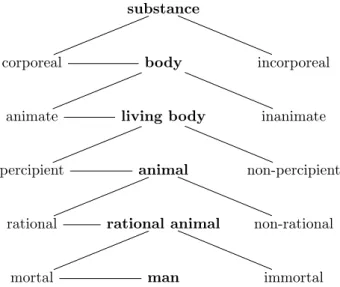
In mediaeval logic textbooks, but not in Porphyry’s Introduction itself, one finds a drawing as in Figure 1, a tree in the literal sense whose trunk is made up by genera, and whose leaves are differentiae.47 This, however, is not an ordering of genera of the
kind we have seen in Aristotle; it is indeed a tree-like ordering, but it contains a chain such as the following
substance>corporeal>body>animate> . . .
That is, it contains a chain that places differentiae under genera, while in Aristotle’s ordering it is only species that get placed under genera.
substance
corporeal body incorporeal
animate living body inanimate
percipient animal non-percipient
rational rational animal non-rational
mortal man immortal
Figure 1. Porphyry’s tree
2.3. Categories and the ordering of genera. In APo I.19 Aristotle asks whether, given a term g, it is possible (1) to form an infinitely ascending sequence
g < g0 < g00< g000 < . . .or (2) to form an infinitely descending sequence. . . < g000 < g00< g0 < g. He moreover asks (3) whether, given two terms g < g0 it is possible to form an infinite sequenceg < h < h0 < h00< . . . < g0 org < . . . < h00< h0 < h < g.
He deals with question (3) in APo I.20, assuming negative answers to questions (1) and (2); and indeed assuming that there are no infinitely ascending or descending
47This drawing derives from the one given in Barnes (2003, p. 110); for a more embellished tree, see for
sequences it is plain that we cannot find infinitely many h, h0, h00, h000, . . . such that eitherg < h < h0 < h00< . . . < g0org < . . . < h00< h0 < h < g, since in both of these cases we should produce an infinitely ascending or descending sequence. Question (1) is dealt with inAPoI.22 (82b37–83a1). Aristotle there offers the following argument,
the virtues of which need not be assessed here. Its first premise is the claim that knowledge of a term g presupposes knowledge of all g0 > g. Knowledge of g is knowledge of the definition ofg; that definition contains another genusg0 > g, which itself must be known if the definition is to be known; but knowingg0 means knowing its definition, appealing to a yet higher genus. Whence allg0> g are involved in the knowledge of g. The second premise says that an item of knowledge is finite: “you cannot survey infinitely many items in thought” (83b6). The third premise says that knowledge of terms is indeed possible. From this we are invited to draw the conclusion that any<-sequence abovegmust be finite: all terms abovegare genera found when unravelling the definition ofg, and these must all be known ifgis to be known; since knowledge ofgis possible and an item of knowledge is finite, there can be only finitely many terms aboveg. In particular, above anyg, if it is not already a highest genus, there is a highest genus. We saw in section 2.2 that above anygthere is at most one highest genus. Hence we may conclude that ifg is not already a highest genus, there is a unique highest genusg0 > g.
Aristotle takes up question (2) in APr I.27. The argument amounts essentially to the claim that individuals are not predicated of anything else. One may ask why singular predication should be relevant to the order of genera, which, as we have seen, has only general terms in its field. Anyhow, even if we did extend the field of
< to individual terms, it would not follow from Aristotle’s claim that we can have no infinitely descending sequence in <. Man is said of Callias, and Callias is an individual; but that does not exclude the possibility of there being a species below man which in its turn is predicated of Callias—male could be such a species.
So this last argument is not valid;48 but our interest here is in highest genera. As we have now seen there is, according to Aristotle, a diamond-like ordering (some sections of which may be tree-like) of genera with a unique maximal point above any genus; that is, ifgis not itself already a highest genus, then there is a unique highest genus above it. It is remarkable that Aristotle, in contrast to modern and ancient commentators, nowhere identifies these highest genera with the categories. There are even suggestions in Aristotle’s text that highest genera have a relatively low degree of generality (Cat 14a24): “good and bad are not in a genus (en genei) but are themselves
48It is then interesting to note that theJäsche Logik § 11 denies that there are lowest species (and also