Katelyn R. Browne. Queer Identities and Futuristic Families in Young Adult Science Fiction. A Master’s Paper for the M.S. in L.S degree. April, 2011. 72 pages. Advisor: Sandra Hughes-Hassell
This paper investigates the presence (or absence) of queer characters in recent, well-regarded young adult science fiction novels. Family structures and reproductive technology are used as a lens to exploring queer narratives and possible futures. Queer human teenagers were entirely absent from the books in the sample, though a few same-sex parents and one differently-gendered alien did appear. An action plan is presented to assist librarians in developing and evaluating a queer-friendly science fiction collection for their young adult patrons.
Headings:
Content analysis—Young adults' literature Science fiction
Young adults' literature
by
Katelyn R. Browne
A Master’s paper submitted to the faculty of the School of Information and Library Science of the University of North Carolina at Chapel Hill
in partial fulfillment of the requirements for the degree of Master of Science in
Library Science.
Chapel Hill, North Carolina April 2011
Approved by
Table of Contents
Introduction...3
Literature Review...6
“Queer” Is Not A Bad Word... 6
Using Popular Culture to Understand Narratives of Identity...7
Queer Identities and Young Adult Development...9
Queer Themes in Young Adult Literature... 11
Science Fiction: A Genre of Active Discourse...13
Science Fiction, Gender, and Sexuality...15
Young Adult Science Fiction...18
A Brief Introduction to the Socially Constructed Family...19
Depicting the Family...22
Research Question... 25
Methodology... 26
Selection of Sample...26
Content Analysis... 28
Queer Presence... 28
Family-Building Possibilities... 34
Findings...36
Central and Minor Characters... 36
Relationships... 37
Worldbuilding...39
Reproductive Options...40
Discussion... 42
Queer Presence...42
Family Structures... 43
Related Discourse...46
Star-Crossed Lovers: Who Can You Love?...46
Not Quite Human: Who Is Allowed To Love?... 49
Out of This World: Love and Alien Species...51
Conclusion and Action Plan...55
Appendix A: Charts With Findings...57
Appendix B: A Note on Terminology... 59
The Acronyms ... 61
Appendix C: Evaluating Queer Themes in Young Adult Science Fiction...62
Appendix D: Annotated Bibliography of Science Fiction Novels...64
Introduction
In 1976, the Gay Task Force of the American Library Association's (ALA's) Social Responsbilities Round Table—an organization that is now the ALA's GLBT Round Table—published guidelines for evaluating children's and young adult literature with “gay themes.” At that time, the number of relevant books was quite small. Over the past several decades, young adult literature has seen a proliferation of books with characters who identify as gay or lesbian, as well as a smaller number of books with characters who have other non-normative sexualities or gender identities. These books, as well as other media products (television shows, magazines, movies, etc.) with queer-positive themes, are part of a larger movement of “visibility politics” which aims to advance the societal perception and status of queer people by making queer identities more visible in mainstream culture. For young adults in particular, media products with visible, relatable queer characters can serve as a conduit through which real people can explore their own identity, their feelings about queer acquaintances and family members, and the possibilities for queer people in the past, the present, and the future.
Over the same decades, advances in reproductive technology and reproductive politics have presented new possibilities for people who hope to add children to their families without engaging in heterosexual (and fertile) intercourse followed by pregnancy and childbirth. Alternative insemination, surrogacy, adoption, fostering, and other
based on love and choice rather than economic necessity and biological inevitability, reproductive options have contributed to the “lesbian baby boom” and a general opening of the future to intentional queer families.
This combination—increasingly queer-friendly young adult literature and scientific advances that benefit nontraditional families—suggests many possibilities for the future. Will queer people continue to gain rights and social capital until they become equal and unremarkable? Will some sort of backlash occur, wiping out what progress has already been achieved? Will all children eventually be bred with the help of a laboratory, or will the children of technology and possibility become stigmatized and outcast? All of these questions, and many others, would be well explored through speculative fiction and science fiction. These overlapping genres tell stories of the future, often to make a point about a development in contemporary society.
Yet queer young adult literature is a field overwhelmingly dominated by contemporary (or “realistic”) fiction, with a few fantasy novels and works of historical fiction thrown into the mix. In my own teenage years, I read a fair bit of young adult science fiction and developed a lot of critical perspectives on contemporary society from my reading. Young adult science fiction often critiques capitalism, genetic engineering, racism, the American political system, the education system, warfare, and even peace. But none of the novels I can remember engaged with queerness or with concepts of sexuality at all, though there was an occasional brush with gender.
Literature Review
“Queer” Is Not A Bad Word
For every book or article that has been written about sexual orientation or gender identity, there is a different set of terminology used to refer to the people being discussed. While there are certainly terms that are inaccurate or rude, and while different terms have different social and political connotations, there is not one “right” way to refer to people who are not straight and cis1. In Appendix B, I have included a non-exhaustive list of
terminology that is frequently employed to describe various sexual orientations and gender identities. For the purposes of this paper, I have chosen to use the term “queer” whenever it is appropriate.
“Queer” is, of course, not a term with an unblemished history. It is still frequently heard as an insult, and it carries a connotation of being other than normal in some way (W. G. Pearson, “View” 16-17). However, “queer” is also a unifying term, joining together many different sorts of people who identify in ways that disrupt any idea of a monolithic norm. “Queer” focuses on the public and political implications of identity rather than the intrusive specifics of one’s genitalia or preferred sexual activities. To many scholars, “queer” serves as an expansive, inclusive term: “Queer is not a word that assumes everyone at the table is the same. . . . the word itself implying relativity, fluidity, defiance of categories” (Griffith & Eskridge 46).
When looking at speculative futures through science fiction, “queer” could
ostensibly come to encompass anyone who identifies outside the culturally-enforced norm of sexual orientation and gender identity. Desire is not inherently queer because of who or what it includes. A man who desires the love of another man, a penis-bearing person who desires to be understood as a woman: these people are understood as queer specifically because their desires run against the norms and culture of the time and place in which they exist. It is because of this distinction that Mary L. Gray identifies queerness as something specifically active, “fram[ing] sexual and gender identities as queer labor carried out between people and places, to map the modern experiences, conditions, and expressions that produce a sense of ‘authentic’ identity” (Gray 26). Similarly, Susan Driver notes that, for the self-identified queer girls she is studying,
the process of naming oneself queer is understood as a dynamic response and rearticulation of words and meanings in order to convey departures from
heteronormative expectations. As such, queer is not a descriptor of fixed qualities but an instigator of a process of engaging with languages and inventing
identifications (28).
In this paper, I am most interested in the ways in which room is made for a queer presence in the future. In the majority of books I read, social norms for gender and sexuality reinforced the same systems we know today, but searching for “queerness,” rather than “homosexuality” or “transgendered people” allows for an exploration that includes all transgressions of the status quo toward a true and authentic sense of one’s sex, gender, and sexual desire.
Using Popular Culture to Understand Narratives of Identity
imaginary in specific history moments” (Kaplan 410). Widely disseminated media, such as books and television, serve as tools of collective socialization, teaching us how to understand and interpret our experiences with the world (Pozner 97-98).
Media-based instruction has a special place in the creation of queer identities. While young members of racial, ethnic, or religious minority groups are likely to know (or even be related to) others with the same identity markers, it is entirely possible for a young queer person to grow up completely isolated from anyone else they know to be queer. Thus media have the power to control initial exposures to queerness; media also serve to “circulate the social grammar, appearance, and sites of LGBT-ness” (Gray 12). Television shows like Ellen and Will & Grace are repeatedly credited with introducing millions of Americans to their first gay friends (Streitmatter 3, 124-125), and for queer youth, media products can serve as an introduction to and induction into the "whole different language" that surrounds queer identity (Driver 41). On the other hand, the mainstream media narrative of American culture seeks to promote normative narratives in which queer identities have no place (see, for example, Jennifer Pozner's recent analysis of reality television narratives in Reality Bites Back).
Literature for children and young adults has the power to "make significant and often undervalued contributions to how its child readers see the world and their place in it" (Mallan 3). If we wish to understand what young people absorb about queerness, it is imperative to look at what they read. Very little research has been done on sexuality in science fiction in general, let alone young adult science fiction in particular (Pearson, Hollinger, and Gordon 7), and so I have set out to investigate the ways in which queerness is fit into the speculative futures written for young adults.
assumptions of straightness and look instead at the ways in which gender and sexuality are performed and regulated (Hollinger 32). Both now and in the hypothetical future, gender identity and sexual orientation are not presumed to be static and immutable; rather, their representations are examined to determine what a culture (or, in the case of a fictional culture, its creator) perceives, enforces, values, or challenges. This angle falls in line with the larger tradition of cultural analysis, in which the scholar examines “the power relations among discourses . . . to deduce what produces certain discourses, what culture needs them for, and whose specific needs they serve” (Kaplan 410).
Queer theory is particularly relevant to science fiction, as Wendy Gay Pearson, Veronica Hollinger, and Joan Gordon explain:
If we then take as the central task of queer theory the world of imagining a world in which all lives are livable, we understand queer theory as being both utopian and science fictional, in the sense of imagining a future that opens out, rather than forecloses, possibilities for becoming real, for mattering in the world. We begin to understand the importance of sf as a genre for exploring these very possibilities, as well as for interrogating the consequences of societies and futures in which conditions render the lives of many unlivable—sometimes in unbearably literal ways (5).
Investigating the assumptions underlying science fiction allows us to see what sorts of lives we are presenting as possible; though this is complicated by the presence of
dystopias and other imperfect futures, it is still possible to tease out the assumptions and norms that are complicit in their creation.
Queer Identities and Young Adult Development
teenagers, unlike young children, are people with sexual urges and understandings.) The cultural and legal landscape is shifting toward rights and acceptance for young people who explore queer identities. In the recently-published The Right to Be Out, educational law scholar and former classroom teacher Stuart Biegel outlines the state of case law concerning sexual identity and gender orientation in public schools. Queer and
questioning students have had a number of previously-unguaranteed rights protected for them in recent years. As Biegel points out, however, the basic tasks of psychosocial development remain more difficult for queer youth as a class, who lack the guidelines provided for their heterosexual and cisgendered peers in the “road maps developed over many centuries and communicated to them by friends, family, books, the entertainment industry, and a myriad of other sources regarding how they can and should be acting and what the consequences of such actions might be” (123).
Access to any sort of queer-themed material has been frequently challenged, often with the assumption that controlling media consumption can keep a child or teenager from developing a non-normative identity (Gray 13). Recently, state legislatures in places such as Alabama and Oklahoma have sought to limit or completely restrict libraries’ ability to collect and circulate queer-themed materials to children and young adults (Cart and Jenkins xvi). Even when young people are able to find queer materials, consuming them can be a risky endeavour as readers “worry that people might ‘see me reading something queer,’ they fear being humiliated by peers, and they suspect there are dangers of being ‘found out’ or ‘kicked out of the house’ by parents” (Driver 14; quotes are from interviews with teenage girls).
people in rural Kentucky, Mary L. Gray points repeatedly to the notion of
“metronormativity,” the persistent idea that queerness is somehow antithetical to rurality and that queer youth must leave their homes and move to a city in order to be accepted (14-15). This single-minded narrative is important to consider when reading for queerness in young adult literature—the literature is certainly revealing about our culture’s perspectives on queer identities, but is also reflects “what publishers believe, however correctly and incorrectly, will appeal to teen readers” (Cart and Jenkins 82).
Queer Themes in Young Adult Literature
Librarians have taken an active interest in the content of queer-themed literature for young adults for decades. In 1976, the Gay Task Force of the Social Responsibilities Round Table of the American Library Association (ALA)—an organization that has evolved into the Gay, Lesbian, Bisexual, and Transgendered Round Table—issued a set of guidelines entitled “What To Do Until Utopia Arrives.” This document provides guidelines both for books and for librarian behavior. For instance, homosexuality should not be chalked up to “grotesque family situations or . . . pseudo-medical observations,” but if such an explanation is present, “the librarian can point out that no such effort is ever deemed necessary to account for straight characters” (Gay Task Force, n.p.). Though “Utopia” is now 35 years old, its guidelines and suggestions are still heavily relevant to the field as they call for accurate, fair, and even casual depictions of queer people in literature for children and young adults. They will play heavily into my own suggestions for evaluating the queer-friendliness of science fiction.
have compiled a bibliography of YA titles with LGBTQ themes, which is intended to be as exhaustive as possible for English-language literature through 2004. Cart and Jenkins note that young adult literature tells stories of outsiders and the misunderstood, creating a space in which there is a “need to see one’s face reflected from the pages of a book and thus to find the corollary comfort that derives from the knowledge that one is not alone in a vast universe, that there are others ‘like me’” (1). This search for kindred spirits falls in line with one queer young adult’s observation that even as she resisted popular narratives about queerness, she “cannot deny the warm fuzzies I get when a queer character is portrayed in a good light, making me proud of my identity” (Driver 6).
To discuss and classify the queer-themed novels they have collected, Cart and Jenkins borrow from Rudine Sims Bishop’s analyses of African-American characters. Bishop used the categories “social conscience,” “melting pot,” and “culturally conscious” to describe the different levels of engagement with race that were present in novels. In turn, Jenkins has adapted these categories to classify queer subject matter as “homosexual visibility” (coming-out stories, in which being gay is sufficient), “gay assimilation” (books in which characters “just happen to be gay” but are important to the narrative in other ways), and “queer consciousness/community” (stories which take place in a context of queer community and families of choice) (xix-xx). Though these terms are specific to themes of homosexuality, Cart and Jenkins discuss books with non-normative gender identities as well.
what is generally labeled “realistic” or “contemporary” fiction, though other titles were historical fiction or fantasy.
Cart and Jenkins also found a sort of “homosexual gender segregation” among the titles—that is, books with gay boys or men typically did not include lesbian girls or women, and vice versa (40). Though some characters are of working-class or non-white backgrounds, most seem to fit Susan Driver’s observation that “differences and marginal types are segregated in these media formulas such that one is either a girl of color, a queer girl, a poor girl, or a disabled girl but never all at once” (9).
Though Cart and Jenkins’s bibliography ends in 2004, it demonstrates a clear growth in the sheer number of queer-themed titles published each decade for young-adult readers. The field of library science, too, is expanding its recognition of queer-themed books. In 2010, the ALA expanded the Stonewall Book Awards, which began in 1986 with the Gay Book Award, to include an award given specifically to a work of literature for children or young adults. (Previous years had seen other Stonewall awards go to books published for children and young adults, such as the young adult anthology Am I Blue? Coming Out From the Silence, which won the Stonewall Literature Award in
1995.)
Science Fiction: A Genre of Active Discourse
alternate histories, and completely foreign worlds. The editors of Queer Universes explain their understanding of the field as a discourse that
is intimately concerned with the question of how people live in the world and what makes the world livable for them. Often science fiction answers these questions—or extends the sequence of interrogation—by postulating alternative (often future) societies and cultures, affected by alternative, perhaps foreseeable, alterations in science and technology (Pearson, Hollinger, and Gordon 6).
Tensions exist within the genre, partially because its status as “genre fiction” has led to stigmatization. Pearson, Hollinger, and Gordon specify that they are concerned with “literary science fiction,” which is tacitly contrasted with cheap, tawdry “pulp” science fiction. Another site of conflict is found between “hard” and “soft” science fiction, a distinction that has to do with whether science or story is of primary
importance. In his analysis of representations of gender in science fiction, Brian Attebery teases out a gendered undertone in the “true” fan’s preference for hard science fiction. Science-first fiction includes the reader in “a technologically-minded elite [as] someone who can contemplate the real workings of the universe without fuzzy thinking or
sentiment” (48)—with sentiment, of course, being a stereotypically feminine concern. All of these classifications are used to police the lines of “real” science fiction and exclude (or include) works or fans with whom one disagrees or takes issue.
In the twentieth century, the genre of science fiction has its roots in magazines that published both stories and letters; as Justine Larbalestier notes in her Battle of the Sexes in Science Fiction, early figures in SF were often involved at multiple levels, both
as a site of world-altering discourse. Furthermore, Larbalestier argues that science fiction engages “discourses of knowledge” more overtly than other genres, a position she traces to Kingsley Amis and Bernard DeVoto. Larbalestier herself is interested in narratives which pit women-as-group against men-as-group in some way, and she has found a recurrence of texts which
routinely include large sections of exposition and philosophical explication. . . . [T]he battle-of-the-sexes stories’ engagement with debates about the social constructions of women and men and the organization of relations between them is made possible by science fiction’s generic rules (8).
She does not go so far into discussions of sexuality and gender identity, but there is no reason to believe that the same principle should not hold, that cultural norms of queerness in SF worlds should be understood to have been constructed intentionally and in dialogue with extant views. This active discourse can be seen throughout the twenty and twenty-first centuries as science fiction readers, writers, and publishers have engaged with ideas about gender and sex.
Science Fiction, Gender, and Sexuality
orbiting suburbia” (5). Veronica Hollinger sets up the dichotomy between potential and practice clearly:
All too often, heteronormativity is embedded in both theory and fiction as “natural” and “universal,” a kind of barely glimpsed default gender setting which remains unquestioned and untheorized. Science fiction would seem to be ideally suited, as a narrative mode, to the construction of imaginative challenges to the smoothly oiled technologies of heteronormativity, especially when/as these almost invisible technologies are pressed into the service of a coercive regime of
compulsory heterosexuality. However, in spite of science fiction's function as a literature of cognitive estrangement, and in spite of the work of both feminist writers and critics in their on-going efforts to re-think the problematics of gender--especially gender's impact on the lives of women--heterosexuality as an institutionalized nexus of human activity remains stubbornly resistant to
defamiliarization. On the whole, science fiction is an overwhelmingly straight discourse, not least because of the covert yet almost completely totalizing ideological hold heterosexuality has on our culture's ability to imagine itself otherwise. Both science fiction as a narrative field and feminism as a political and theoretical field work themselves out, for the most part, within the terms of an almost completely naturalized heterosexual binary. (Hollinger 23-24)
Yet science fiction has been troubling conventional notions of gender for quite some time (Hollinger 23, Larbalestier 2), to the point that Attebery argues that gender-based inquiry is absolutely essential to the genre (10). In the 1960s and 1970s, a wave of feminist science fiction stories by authors such as Joanna Russ and Ursula K. LeGuin swept the genre, disrupting existing discourses about men and women. The discourse that surrounded these stories has made it “virtually impossible” to ignore the question of gender in science fiction writing; “if a writer wishes to portray unchanged sex roles in the future or in an alien society, that fact has to be explained somehow” (Attebery 6). Along with altering expectations of men and women, science fiction is a field in which the entire concept of gender and sex can be challenged in any number of imaginable ways (9).
have also changed over time. Attebery points to feminist utopias as a subfield in which the sex-as-reproduction model is frequently questioned, as “desire between utopian women serves as a sign of female self-affirmation and self-sufficiency and integrates the outsider or misfit into the utopian system” (125). Historically, however, sex between men in science fiction has had much more to do with power and dominance than with desire or homosexual attraction, though men marrying one another and “male motherhood” can be found at least as far back as 1963, when Marion Zimmer Bradley and John Jay Wells (a pseudonym for Juanita Coulson) published “Another Rib” (Attebery 125).
In science fiction, sexuality can be particularly powerful as human characters set out to become intellectually, emotionally, and even physically intimate with characters and societies that are foreign to them. Writing about stories by James Tiptree, Jr. (a pseudonym for Alice Bradley Sheldon and the namesake of an award for gender-troubling science fiction), Hollinger explains that “human sexual desire for the ‘other’ results only in pain, as our objects of desire becoming increasingly, and sometimes literally, alien to us. Sexuality is the failed attempt to know the irreducibly alien” (27). In these stories, man’s reaction to new and strange creatures is to become acquainted with them sexually as well as intellectually, giving sexuality the function of gaining a seemingly unreachable understanding.
world” (Griffith and Eskridge 45).
Young Adult Science Fiction
This open exploration of gender and sexuality does not necessarily extend into science fiction written for children and young adults. In fact, when Attebery tracks the rise of gender-based discourse in the genre, he points to “the formation of a separate market for juvenile SF” as one of the factors that led to this avenue of conversation (6). Though young adult fiction is able to take some sexual liberties that would be out of place in novels for younger children, “examining what sexuality and gender identity mean to young people” remains difficult in general because of “our cultural belief that talking about sex incites sexual behavior” (Gray 173). In addition, there is a prevalent idea that talking about sexuality necessarily means talking about sexual actions, while indicators of heterosexuality, such as celebrity crushes or remarks about the attractiveness of a member of the opposite sex, are considered to be typical and age-appropriate for preteen and teenage characters.
The family, however, remains an important site of discourse and symbolism in stories for young people. Writing about young adult “urban survival” novels, a genre that shares significant turf with science fiction, Marla Harris notes that recently-published urban survival stories
do not hold out the possibility of restoration to one’s family or to an ordinary life; instead there is a decisive rupture with the past. . . . Social changes in family life over the last thirty years, including an escalating divorce rate, may also account for what Marilyn Fain Apseloff sees as the increasing prevalence of abandonment as a theme in children’s literature (74).
their families of origin and planning for their futures as adults, which can be addressed by reading about characters who are forced to confront their own adulthood at unusually young ages. For example, many of the books assessed in this paper included main characters who were somehow separated from their parents and put in a situation where they had to make basic survival decisions on their own.
I will argue that a lack of visible queerness across the genre of young adult science fiction is a troublesome trend; at this point, though, I would like to acknowledge the considerable importance of metaphorically queer characters, those “outsiders” who populate the majority of young adult fiction (Cart and Jenkins 1). Science fiction writer Kelley Eskridge tells of the particular importance of these parallel journeys when she became frustrated with the limitations of lesbian science fiction:
Eventually I hunkered down with Theodore Sturgeon, Robert Heinlein, and Marion Zimmer Bradley, all of whom wrote a different kind of coming-out story —more of coming-in stories at heart, about people coming into themselves. These stories did what the lesbian stories couldn’t—offered me ways to explore new ideas about myself in the context of straight people as well as lesbian people. I needed that to chart my way (Griffith and Eskridge 42).
A Brief Introduction to the Socially Constructed Family
era of American families, usually located in the 1950s, in which every family was white, every father had a full-time job earning a middle-class income, every mother stayed at home (and loved it), and every son and every daughter went cheerily off to school,
studied hard, and never had sex with anyone at all. An extended discussion of this mythos is not germane to this paper, but feminist scholars have been hard at work deconstructing it for years, most notably in Stephanie Coontz’s The Way We Never Were: American Families and the Nostalgia Trap.
When looking at families and reproduction in literature, it is important to look at the assumptions we make about fictional families. Often, writers mimetically reproduce the norms of the society in which they live—members of dominant classes because it’s all they know, and members of marginalized classes because they’re told the dominant narrative is what sells. Eskridge describes a class that she and Griffiths took from renowned science fiction author Samuel R. Delany, who one day
went off on us for having worldviews the size of grapes, for imagining everyone in our futures as white, middle-class, and polite (except for the dangerous characters, who were allowed to be gay or black as long as they died or were otherwise redeemed). [. . .] I remember one student in the workshop who wrote a lesbian character that looked and talked exactly like Nicola [Griffith], because she was the only out lesbian he had ever met. And he didn’t understand why she might be offended (Griffith and Eskridge 42).
Lyndon Shanley refers to these sorts of policies as aiming to create “‘as if’ families, that is, families which children to all appearances might have been born to the adoptive [or AI/IVF-using] parents” (12). This constant reproduction of “as if” families served only to reify and solidify developing cultural norms about what families should look like and who should be considered fit for parenting.
Over time, those norms have shifted. For instance, American law now requires that race not be a factor in adoption, with the exception of children who are identified as American Indian (Shanley 24-26). (It should be noted that this policy is also controversial in the Black community with regard to the adoption of Black children by non-Black parents, who may not be able to give Black children either a sense of racial identity nor the necessary skills to survive in a racist world.) The rise of feminism and the rise of middle-class, married women in the workplace has both afforded new options to women and provoked a backlash of imagery that promotes an ideal of (heterosexually) married women whose sexuality is limited and who dream only of becoming highly
sentimentalized mothers (Kaplan 422).
Depicting the Family
In recent decades, new medical technologies and evolving cultural norms have changed the ways in which it is possible to construct a family; they have also radically changed our assumptions about what families look like. In 1988, Catherine Townsend Horner published a bibliography of children’s books which featured families with single parents. Horner reminds the reader that single-parent families have existed in literature for centuries, largely due to the presence of widows and of orphans being raised by single guardians (v). Important changes in both family structure and young adult literature came with “the sexual revolution of the 1960s and 1970s, the exponential leap in the divorce rate, and the concomitant emergence of the popular psychology movement” (vi), bringing us the subgenre of the problem novel. In the 1980s, single parents—particularly from divorced families—became a full-fledged theme in children’s and young adult literature.
The sexual revolution brought particular change to the lives of women, who now had the legally-guaranteed ability to control pregnancy and childbirth through birth control and medical abortion. Meanwhile, adoption, assisted insemination, surrogate pregnancy, and in-vitro fertilization were on the rise. This unprecedented range of options allow all sorts of people and partnerships to consciously decide to become parents and to pursue parenthood, rather than having pregnancy, childbirth, and childcare be the
“natural” consequences of sexual maturity for women (Shanley 99).
women do not necessarily need men (and, outside of a surrogate womb, men do not need women) for anything other than gamete donation. Women are able to compete,
unfettered, with men in the workplace (Kaplan 411-412)—obviously an achievement for all women, but particularly making it more possible for families headed by women to have a chance at a decent standard of living. Like professional advancement, parenthood has become theoretically available to any interested person, challenging “both the notion of family as beginning with a heterosexual couple, and the notion that every child has two (and only two) parents to whom the child is biologically related” (Shanley 124; similar ideas are found in Agigian 8-9).
Family discourse in the United States still typically assumes that a child will be parented by some combination of single people and couples—for example, a single parent; two married or partnered people; two divorced parents, one of whom has remarried; and so forth. Within these confines, however, “diverse family forms— nonmarital births, divorce, same-sex marriage, non-marital cohabitation, interracial couples, blended families, and double-income couples—have proliferated” as part of something Amy Agigian refers to as “the shifting family terrain” in her work on lesbian AI (8-9).
media representations of family life. The authors note that
some individuals believe that the media, particularly television, shape our
attitudes about what kinds of family structures and interaction are acceptable and appropriate, and what kinds are serious or funny. The media also defines for us how spouses and parents and children are ‘supposed’ to relate to each other (498). Similarly, in an article for Florida Libraries, Madeline Kovarik argues that children’s books that reflect family diversity should be a collecting priority for libraries. Such images support the development of all children, not only those with nontraditional family situations, because they allow children to “identify with, understand, or become tolerant of” a wide variety of family structures (12). This argument dovetails nicely with the queer-theory ideal of “queering” one’s perspective: by decentralizing the
heteronormative family, we can challenge the idea that one kind of family structure is “normal” and the rest are unusual, existing only books we give to kids who are in special, challenging circumstances. Providing a wide variety of family images to children and young adults also suggests that those young people will be supported by the library and the community as they grow up and decide to form their own families in ways that suit their own orientations, identities, and wishes. Along with the teenage character of the problem novel who struggles constantly with the social burden of his burgeoning
Research Question
Methodology
Selection of Sample
The guiding purpose of my selection process was to cull a sample of recently-published books that practicing librarians perceived to be well-written, quality works of science fiction. The American Library Association (ALA) published a list of Best Books for Young Adults (BBYA) annually from 1966 through 2010. In 2011, this list was re-created as Best Fiction for Young Adults. The lists are re-created by committees of practicing school and public librarians, and their recommendations often serve as collection guidance to librarians across the country.
I selected my sample from the BBYA lists for 2001 through 2010, as well as the 2011 Best Fiction for Young Adults list. For brevity’s sake, I will refer to this group of lists as “the BBYA lists.” Each list has been annotated with a brief descriptive summary of every title. Using these annotations, as well as summaries and genre classifications from NoveList Plus, I compiled a list of books that appeared to fit into the genre of science fiction. This could be indicated by a “science fiction” genre label on NoveList or by a summary that indicated a setting in the future, in space, in a dystopia, or in another science-fictive location. For example, 2006 BBYA list summarizes Ann Halam’s Siberia by saying “Sloe, 13, treks through a cold dystopian wilderness full of thieves and outlaws in an attempt to find a safe haven for the DNA of genetically engineered lost animal species she's smuggling.” The presence here of the word “dystopian” was sufficient to get Siberia put onto a list of books to investigate.
North Carolina (Chapel Hill) library. I then assessed the books according to the following criteria:
1. Availability: The book had to be readily available from one of the three sources listed above.
2. Speculative Science Fiction: For the purposes of this paper, I was interested in depictions of future human (and human-adjacent) societies that could possibly have evolved from our own. This ruled out time-travel novels, such as Sherman Alexie’s Flight, that take place in the present and the past. It also rules out novels that took place in the very near future, such as Meg Rosoff’s How I Live Now, because the societies of these novels should be roughly equivalent to our own, with no real room for changing social mores. To qualify as “science fiction” rather than fantasy, all world-building should be attributable to scientifically-possible advancement rather than magic; similarly, any fantastic creatures (e.g.
werewolves or zombies) should have origins that are scientific, such as genetic engineering, rather than magical or folkloric.
protagonist who has already been to university.
4. Author Limitations: To avoid having my results skewed by multiple works from the viewpoint of the same author, I limited my sample to one book by any given author, choosing the first book of a series whenever possible. Authors such as Ann Halam (a pseudonym for Gwyneth Jones), Scott Westerfeld, and Suzanne Collins had multiple books that would otherwise have been eligible for my sample. Any inclusion of the same writer under multiple pseudonyms is entirely unintentional.
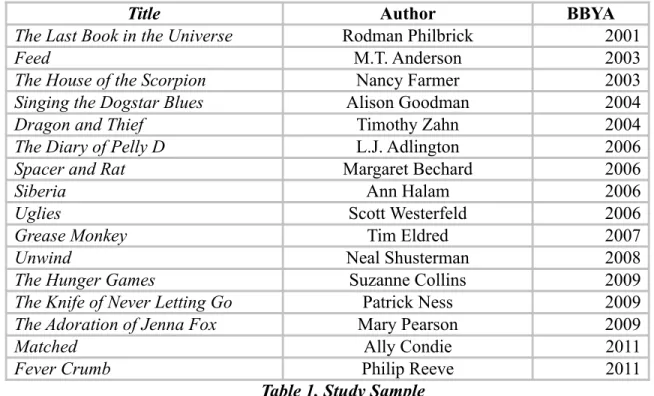
Given these criteria, I brought together a sample of sixteen books shown in Table 1:
Title Author BBYA
The Last Book in the Universe Rodman Philbrick 2001
Feed M.T. Anderson 2003
The House of the Scorpion Nancy Farmer 2003
Singing the Dogstar Blues Alison Goodman 2004
Dragon and Thief Timothy Zahn 2004
The Diary of Pelly D L.J. Adlington 2006
Spacer and Rat Margaret Bechard 2006
Siberia Ann Halam 2006
Uglies Scott Westerfeld 2006
Grease Monkey Tim Eldred 2007
Unwind Neal Shusterman 2008
The Hunger Games Suzanne Collins 2009
The Knife of Never Letting Go Patrick Ness 2009
The Adoration of Jenna Fox Mary Pearson 2009
Matched Ally Condie 2011
Fever Crumb Philip Reeve 2011
Table 1. Study Sample
Content Analysis
Queer Presence
until Utopia arrives” guidelines (“Utopia guidelines”). These guidelines identify six areas in which to “evaluate the treatment of gay themes in children’s and YA literature.” The guidelines pertain only to the depiction of gay and lesbian characters, and I have expanded them somewhat to apply to characters with other queer sexual orientations or gender identities.
1. Central characters: If the protagonist of a book is queer, are they portrayed similarly to their straight equivalents? Queer characters can exist in any situation; they can be detectives, farmers, or tuba players, and they can fill these roles similarly to non-queer characters, without either centering or othering their identities. If queerness or “coming out” is important to the plot, is it treated with respect? Does the author include a sense of the resources, media, and community that are available to real-world queer kids? If an “important person” in the protagnist’s life, such as a parent, teacher, or best friend, is queer, does the protagonist ultimately accept their identity without major negative repercussions? 2. Minor roles: Does the story include queer characters in non-central roles? Are these characters included “naturally” in the background situation of the story? 3. Illustrations: Are there any pictures of same-sex couples or people with gender-variant expression?
4. Degrees of explicitness: Are queer romantic, emotional, and/or sexual relationships developed with the same degree of explicitness as non-queer relationships?
an accurate and sympathetic impression of queer people from this book? 6. Author’s attitudes: Does the author insert negative stereotypes about queer people into the story?
Given the nature of the books in my sample, some of these questions were more relevant than others. For example, only one of the sixteen books, Grease Monkey, had any
illustrations at all. (Grease Monkey is a graphic novel, and the only graphic novel in the sample.) With these six categories of evaluation as guidelines, I developed sets of questions to assess the relative heteronormative and queer content of each book. Each question was answered based on direct source material from the books where applicable, as well as my overall impression of the characters and their situations.
CENTRAL CHARACTERS: Does this book have at least one central character who is depicted as heterosexual and cisgendered? Does this book have at least one central character with a queer sexual orientation? Does this book have at least one central character with a queer gender identity?
For the purposes of this question, “central characters” included protagonists, narrative characters, and other characters who featured heavily in the majority of the plot. Characters’ sexual orientations were assessed based on their overall character
development throughout the book, including any romantic/sexual subplots, their “crushes” or remarks about the physical attractiveness of other characters (when such remarks implied physical/sexual interest), their assumptions about their future
transitioning or feelings of gender confusion. In books in which no characters were demonstrably established to be queer, all characters were assumed to be heterosexual and cisgendered even in lieu of explicit evidence, since those are the background assumptions of the time period in which these authors were writing.
For example, in The Diary of Pelly D, narrative character Toni V muses that “he’d never really had a chance to date a girl before and wondered how you went about it. . . . There had been one girl once, a quiet white-haired girl from City Four who’d told him about her pet sawri bird and let him stroke her hair” (60-61). Toni V never expresses any desire to date boys, nor does he ever find himself in a romantic or sexual situation with a male character. Thus he was coded as heterosexual.
Singing the Dogstar Blues features an alien character, Mavkel, whose species is
described as having “two sexes in one” (7); Mavkel later chooses to identify as “he” after tiring of being called “it” by humans (93). Thus Mavkel was coded as a central character with a queer gender identity—though his identity is normative among his own species, it is still perceived as queer among the humans with whom he studies.
As I began to read and code books, I realized that, despite the occasional pair of same-sex parents, there were almost no queer young people. To explore this facet, I divided the central and minor characters into “youth” and “adult” categories, where “youth” includes the broad peer group of the young adult protagonist and “adult” includes everyone older, who typically have adult roles in society such as parenting, holding an occupation, or participating in government.
minor character with a queer sexual orientation? Does this book have at least one minor character with a queer gender identity?
Sexual orientation and gender identity were assessed similarly for this question as for the question above. “Minor characters” include all characters who are not central characters; because the protagonists of many of these books live apart from their families, this category often includes parents and other relatives. A character is considered “minor” if they are not central—that is, if they are not present for the majority of the plot.
ROMANTIC/SEXUAL RELATIONSHIPS: To what degree do non-queer characters engage in crushes, dating, sex, and marriage? To what degree do queer characters engage in crushes, dating, sex, and marriage?
This criterion relates primarily to the “degrees of explicitness” guideline; none of the books in my sample featured particularly explicit sex, but this guideline pertains to “portrayals of affection and falling in love” in general. For the purposes of coding, “crushes” include any remarks about another character that indicate potential romantic or sexual interest. In The Last Book in the Universe, for instance, Spaz narrates, “I shut up and listen to Lanaya because I love to hear her voice, even when she’s telling me I’m stupid. Also, she’s so beautiful it hurts to look at her, but the hurt feels good, which doesn’t make any sense but I swear it’s true” (103). Descriptions of crush-type situations frequently contained this sort of confusion and hurts-so-good sentiment.
Not all detailed character descriptions are classed as “crushes.” Contrast the ways in which Titus describes Link (his best friend) and Violet (his love interest) in M. T. Anderson’s Feed:
like radiation, so that it’s always going deet deet deet deet in invisible waves and people are suddenly like ‘Unit! Hey! Unit!’ and they want to be guys with him” (8-9).
On Violet: “On the one hand, I thought she was the most amazing person I had ever seen in my life, even if she was weird as shit. On the other hand, I was pretty disappointed she was skeezing this sexy talk with Link Arwaker, who women for some reason always go for [ . . . ] And then she looked at me. Just at me, and I knew she was wondering what I thought about the guys and seductiveness and skeeze and all” (19).
OTHER RELATIONSHIPS: Does the story include friendship and other non-romantic relationships between non-queer characters? Between queer characters? Between a non-queer character and a queer character?
Neither queer nor non-queer people are defined entirely by their romantic and sexual relationships; interpersonal relationships of all kinds are valuable and beneficial. For queer characters in particular, this criterion is one way of measuring the degree to which they are a rounded character—do they have traits and relationships other than “queer”? To be as inclusive as possible, this question includes familial relationships as long as both parties are invested somehow in the relationship; being the orphaned child of a queer woman who died in childbirth would not count, but having a queer sibling or parent with whom one is in regular contact would count.
WORLDBUILDING: Does this story create a place for queer people in the future? Does this story acknowledge queer people in the past?
the diversity we know now? This criterion relates most closely to the “impact on readers” section of the Utopia guidelines, which asks in part whether a book shows young queer readers a path to the future. Because queer characters exist in the context of a greater society and plot, it is hard to boil down their futures into “positive” or “negative,” but I have collected relevant sections of text to discuss the portrayal of future possibilities.
Family-Building Possibilities
To investigate the social and technological advances (or regressions) in family-building strategies, I tracked the ways in which children are brought into families in each book. The following broad categories were used:
• “Traditional”/unspecified: Heterosexual intercourse leads to uterine pregnancy and childbirth. This category was tallied when a book did not specify the details of reproduction, as it is still the societal and cultural norm for the authors.
• Babies come from laboratories OR IVF: Some kind of scientific activity is involved in procreation, for everyone or for particular families. In-vitro fertilization is specifically mentioned in The Adoration of Jenna Fox, for example, while Pelly D simply mentions having been “born” in a lab.
• Cloning: A particular form of scientific intervention, cloning involves creating a new individual who is an exact genetic copy of an existing person. Cloning is a major part of House of the Scorpion, but it is mentioned only casually in Feed, when it is revealed that Link is Abraham Lincoln's clone.
modifications, whether for physical appearance or personality traits.
• Adoption or guardianship: A parent or parents seek and are granted formal or informal custody of a child who was originally born to another family. This can include friends or relatives who taken in orphans, such as Ben and Cillian's raising of Todd in The Knife of Never Letting Go.
Findings
Charts with the book-by-book breakdown of this data can be found in Appendix A.
Central and Minor Characters
Of the sixteen books in my sample, only three (18.75%) included queer characters at any level of development. One book had both major and minor characters who were classified as queer, and two additional books had families headed by two fathers:
• The Knife of Never Letting Go: The narrative character, Todd Hewitt, is an orphan
who has been taken into the care of Ben and Cillian. These two men had been friends with his parents since before all four of them traveled to New World, the planet on which this book takes place.
• Singing the Dogstar Blues: One of the main characters in Alison Goodman’s
novel is Mavkel, an alien from the planet Choria. Chorians “have two sexes in one, like slugs” (7). While there is no exact parallel to be drawn to a human identity, and while Mavkel’s gender is not queer among Chorians, he struggles with being labeled “it” by humans and ultimately chooses to present as male while he is studying with humans (93-94). Dogstar has additional queer characters who play more minor roles: main character Joss’s mother, Ingrid, is bisexual, and her former partner, Louise, appears later in the story to give Joss some guidance. Joss briefly speaks to Louise’s new partner, also a woman, on the phone as well.
• Unwind: Lev, the religious and conservative main character of Unwind, becomes
between men was made illegal in Lev and CyFi’s society (129). (CyFi is quick to explain that he himself is only interested in girls.) CyFi’s dads appear briefly to retrieve him from a joyride of sorts, so I have classified them as minor characters. All three of these books, as well as all of the other books in my sample, included
numerous characters who were either implicitly or explicitly heterosexual or cisgendered. Mavkel is both the only major character and the only young adult character who can be read as queer; all other queer characters are gay, lesbian, and bisexual parents.
Relationships
The most frequently-occurring relationship was non-queer marriages or long-term partnerships, which were found in every book except Singing the Dogstar Blues (fifteen books, or 93.75%). (Even Dogstar has heavy implications of background heterosexual marriages, though none of its actual characters are depicted as being part of one.)
Typically, these were relationships between parents or other adults, though The Adoration of Jenna Fox includes an epilogue describing Jenna’s seventy-year-long marriage to
Ethan, with whom she had become involved during the main trajectory of the story (M. Pearson 264). Some marriages have ended by the time of the book, such as Kit Solent’s marriage in Fever Crumb, but though Kit’s wife, Katie, is dead, he reminisces about their relationship and describes it in sufficient detail as to provide a model of how such
partnerships are forged in Fever Crumb’s future world. Only three books feature
marriages (or mmarriages, per Unwind’s terminology) or long-term partnerships between queer individuals—namely, the three instances of gay parenthood previously described.
unambiguous straight crush, and ten books (62.5%) include at least one descriptive kiss with romantic intentions. I do not include Joss and Mavkel’s birthday kiss in Singing the Dogstar Blues (Goodman 147-148), because it was done as a means of expressing
Mavkel’s growing understanding of human etiquette and does not result in any sort of romantic or sexual awakening. However, Matt’s forced birthday kiss from María in House of the Scorpion was counted because Matt pushes María to kiss him specifically
because he wishes she could be his girlfriend (Farmer 109).
Only Feed includes “on-screen” fumbles toward sex, which get derailed by concerns about Violet’s mortality and end in a heated argument (Anderson 210-216). Titus’s friends are also implied to be sexually active, and a number of books include future euphemisms for sexual intercourse, but the attempted-sex scene in Feed is the only thing that comes close to the original Utopia-guidelines concept of modeling the ways in which relationships form and develop.
No queer characters are shown nursing crushes, kissing, having sex, or otherwise demonstrating the physical/sexual aspect of their relationship. Mavkel has an intense desire to pair with Joss, but this pairing, which will be discussed further, is of a familial nature, not a sexual nature. All other queer characters are adults and parents, with their relationships defined almost entirely by the raising of children with someone of the same gender (or without anyone of the opposite gender).
Dogstar Blues, every relationship between queer people is currently or has been romantic
and/or sexual in nature. In Unwind and The Knife of Never Letting Go, the pairs of fathers are the only queer characters; they are not described as having any kind of extended network of queer friends or allies. Similarly, the lesbian and bisexual characters in Dogstar are only shown to be in relationships with their current partners; Louise and
Ingrid haven’t been in touch since they broke up, and Louise is now in a relationship with Barbara.
Worldbuilding
There are no surprises in the worldbuilding of the books in the sample; the three books with queer characters (18.75%) acknowledge the existence of queer people in their present, while books without queer characters make no mention of even theoretical queerness in their worlds.
Similarly, three books acknowledge the existence of queer people or queer issues in their historical past—but Feed replaces The Knife of Never Letting Go in this count. Feed’s one reference to gay people’s place in history is brief and somewhat jarring. When
Violet is dreaming about the future she’d like to have, she plans to tell her grandchildren about their family history, including their great-great-great-great-grandfather, who
fled Germany just before the Second World War. He was a homosexual, and had to wear a pink triangle on his arm. He got to America and married a pretty
Marxist candy striper to get citizenship, and eventually they decided to have kids. My grandkids will ask me what a candy striper is (184).
That Violet’s grandkids won’t ask her what “a homosexual” is suggests that
which is the only reason he is remembered (because Violet is his direct descendent). Does this reflect the actual historical situation of some individuals? Almost certainly. But it certainly doesn’t offer much hope for either the future place or the historical memory of queer people and queer activism.
Singing the Dogstar Blues similarly links historical queerness with tragedy as Joss
stumbles upon a restoration of a section of the AIDS quilt. The squares she sees having loving and tender inscriptions on them, though we learn that most of the quilt was
deliberately burned “just after the same-sex marriage law went through” (Goodman 130). In a reversal of Feed’s world, in which the only story left about queer people is a sad one, Dogstar’s world is one where almost all interest in the AIDS quilt has been lost (131-132)
as queer people have come to receive legal and social equality.
The legal and social situation appears to have changed little for queer people—or at least for same-sex marriage—in the world of Unwind. When Lev learns that CyFi’s dads are mmarried, he is immediately confused because it became illegal for men to marry in the fallout of the Heartland War, the red-state-against-blue-state American civil war that precedes the story by at least a generation (129). Mmarriage, with the extra m, is never fully explained, but it appears to be some kind of social and potentially legal “official” status for pairs of men.
Reproductive Options
“freestyle” reproduction (179), and The Diary of Pelly D, whose main characters are a genetically engineered human hybrid with gills and the only mentions of reproduction involve children being brought home from a lab (141-142).
Adoption or guardianship was the next most frequently-documented method of bringing children into a family, appearing in six books (37.5%). Foundlings were specifically mentioned in three books (18.75%), two of which (Unwind and The Last Book in the Universe) also included adoption. Between adoption, guardianship, and the
taking-in of foundlings, a total of seven books (43.75%) included situations in which a family included children who had already been born to someone not of that family.
Five books (31.25%) contained mention of either laboratory-led reproduction or in-vitro fertilization, situations which allow potential parents to have their “own” children at a time of their own deciding rather than waiting for another person to surrender a child for adoption or guardianship. Two books (12.5%) specifically mentioned cloning: in Feed, as mentioned above, all children have to be bred in a lab, and cloning is one of
many options for creating the perfect child. In House of the Scorpion, however, most children appear to be conceived and born through traditional, sexual means; cloning is an entirely separate process, and clones are socially stigmatized and viewed as non-human because they are gestated in the wombs of cows (226).
Discussion
Queer Presence
Despite an overall penchant for technological progress and cultural roots in our own increasingly queer-friendly world, by and large, recent young adult science fiction novels are devoid of meaningful queer characters. Most notably, in the sixteen books in this sample, only one queer young adult character could be found: Mavkel, the two-gendered alien from Singing the Dogstar Blues. And even Mavkel’s gender identity is in keeping with the expectations of Chorian society; he is unusual there only because he did not die when Kelmav, his pair, died.
It is also worth noting that CyFi’s mmarried dads are mentioned on only a few pages of Unwind, and even when they appear, they are not developed as individual
characters at all, but only as a pair of fathers who come to bring their son home. When we meet the fathers, they even act as a unit: “Cyrus’s dads are there to fill the void. They help Cyrus up and hold him tight” (Shusterman 193). Meanwhile, Ben and Cillian in The Knife of Never Letting Go are never explicitly stated to be gay, to be in love, or to be
married/partnered, though there are hints in the ways they are constructed as a parallel couple of Todd’s parents. (For example: “Ma convinced Pa and Ben convinced Cillian [to move to New World] and when the ships landed and the settlement started, it was my ma and pa who raised sheep on the next farm over from Ben and Cillian growing wheat” (Ness 24).
and female characters with nonstereotypical character traits (e.g. Peeta the cookie-decorator and Katniss the hunter in The Hunger Games), gender and sexuality fail to be the site of much discourse. There are, of course, some exceptions. The Knife of Never Letting Go engages deeply with the idea of “manhood” as Todd encounters women for
the first time since his infancy, when a catastrophic event killed all the women in his town. (In fact, Knife co-won the 2008 James Tiptree, Jr., Award, which specifically recognizes critical discourse about gender in science fiction and fantasy.) Fever Crumb is the only girl/woman ever admitted to the Order of Engineers, “since it was well known that female minds were not capable of rational thought” (Reeve 8). Fever does, in fact, display a capacity for ration, but when she meets a male Engineer who left the Order to get married and have children, the hard break between rationality and emotion begins to seem less useful. Several books mention societal change that was designed to promote heterosexual attraction and reproductive sex: couples in Matched are paired to create the best possible offspring, for example, and the first pretty-making surgery in Uglies gives the New Pretty the appearance of health and hyper-fertility.
Family Structures
Reproductive technology seems to be a more crucial part of the future as
theoretically possible to obtain a child a way other than the traditional “heterosexual sex + gestation + live birth” formula. Notably, despite the historical precedent of the “lesbian baby boom” spurred by the rise of assisted insemination and discussed in the literature review, only one book includes the use of reproductive technology to create children for people living outside of heterosexual relationships: in Singing the Dogstar Blues, single mother Ingrid uses sperm from an anonymous donor, and Louise and her partner, Barb, have a son with a known sperm donor. Both pairs of fathers (in The Knife of Never Letting Go and Unwind) end up with sons for whom they hadn’t planned—Ben and
Cillian get Todd when his parents die, and CyFi’s fathers were “storked,” or had Cyrus left on their doorstep as a foundling. That is, though same-sex parents are present in three books, reproductive agency is only available to single and queer people in one book.
Attitudes toward reproductive technology differ significantly among books. Pelly D, for one, projects a very blasé attitude about the circumstances of her origin, casually mentioning that “I’ve known Moma Peg ever since Mum & Dad brought me home from the lab” (Adlington 141-142). In-vitro fertilization and unspecified “extra measures” (M. Pearson 10) seem to be common in the near-future world of The Adoration of Jenna Fox, and Jenna’s mother brings up its general acceptance in an argument with Jenna’s
grandmother, Lily, a former doctor who believes that the measures taken to keep Jenna alive were unnatural and wrong. Jenna’s mother counters that
“You of all people should understand! If it weren’t for in vitro [fertilization], I wouldn’t be here. You always called me your miracle. Why can’t I have one, too? Why do you get to decide when the miracles will end?
“It’s not natural.”
“Neither was I! You needed help. That’s all I wanted—” (41)
natural and unnatural, but that Jenna is on the safe, human side of it.)
In Feed, the rise of assisted reproduction still seems to be controversial to critical thinkers like Violet’s parents, who had “really wanted to have me freestyle. . . . Anyway, the ambient radiation was already too bad by then for freestyle. So they went test-tube” (Anderson 179). Later, as Violet prepares to die, she expresses a sense of bitterness at having been born alone, “brought into the world in a room with no one there but seven machines. We all are. My parents watched through the glass when I was taken out of the amniotic fluid” (213). Narrative character Titus’s gripes with his conception are
comparatively petty, but he’s certainly not pleased to learn that his parents requested he have “the chin, dimples, and hairline of DelGlacey Murdoch,” a never-quite-popular actor (95).
themselves, they think you are their mother. Or Life itself!” (201). Conceptually, the Lindquists are modeled after actual (plant) seed banks, which seek to preserve
biodiversity for the future. Though the possibility of breeding humans is never broached, the whole idea of saving species in “seed” form, to be revived when the time is right, has some interesting implications for assisted and artificial reproduction.
Related Discourse
I want to stress here that plotlines that can be read as queer metaphors do not constitute an appropriate substitute for the presence of actual queer characters and stories. This is a reductive conclusion in both directions—arguing that the social stigma of Spaz’s epilepsy in The Last Book in the Universe is equivalent to the social stigma against queer young people today minimizes the reality of both homophobia/transphobia and ableism (anti-disability prejudices and assumptions). However, science fiction is a genre that is actively involved in questioning dominant social narratives, and I believe it is important to look at the ways in which some of these novels question some of the larger social ideas that can contribute to the challenges faced by queer young people.
Star-Crossed Lovers: Who Can You Love?
be permitted to marry and/or raise children. As previously discussed, the actual same-sex couples in the sample were given different degrees of legitimacy: in Singing the Dogstar Blues, the passage of same-sex marriage laws is specifically mentioned (Goodman 130),
and both single women and women partnered with women are able to conceive and raise children. In Unwind, however, CyFi’s fathers are able to get “mmarried” but not married (Shusterman 129), and they obtained Cyrus when he was left on their doorstep as part of the common child-surrendering practice known as “storking.” Ben and Cillian in The Knife of Never Letting Go have the least certain status of these same-gender couples;
there is no mention in-text of their legal relationship to one another either on Earth or on New World.
Among the books in the sample, the only extended critical discourse about social regulations to love, partnership, and parenthood occurs in opposite-gender relationships. For example, Spacer and Rat lacks a distinctive romantic subplot, but prejudices and well-policed social boundaries still crop up in casual conversation. When Jack, the main character, starts hanging out with and standing up for the Earthie “rat” Kit, his fellow space-station dwellers tease him, asking if he’s “space-happy.” When one boy asks if Jack and Kit are romantically involved, another replies, “‘Oh, come on. . . . Even Jack
wouldn’t snug with an Earthie.’ And he laughed.” (Bechard 62).
socially undesirable. When Pelly D finds out that her genetic/social standing is not as prestigious as she had imagined, however, she questions her understanding of these boundaries. Circumstances which throw her together with Marek T also lead her to re-evaluate her impressions of him, and she ends up returning his initially-unrequited crush. The growing inter-group tension leads to a foreboding end for Pelly D and others of her genetic status, and Pelly D and Marek T certainly do not get a happily-ever-after ending.
The idea of controlling marriage and parenthood for the greater good is absolutely central to the plot of Matched. Cassia has grown up in comfort thanks to the efforts of the nearly-omnipotent Society, and now that she has turned seventeen, she is eligible to be Matched to her future spouse. Young people have the option of being Matched or
considered socially off-limits has its contemporary applications and could be used to spark a broader discussion about the communitarian interests of a society in drawing lines across which intimate relationships should be not be permitted.
At the center of The Last Book in the Universe, Spaz also sits in the middle of several intersecting prejudices. He has epilepsy; because of this, he has been disowned by his parents and must seek protection from a street gang; and as a consequence of his living situation, he lives in poverty and sometimes participates in criminal activity. Still, Spaz has found something of a niche for himself in the world until he meets Lanaya, a proov (geneticially improved human) who happens to be a slummer, “a proov who likes to mix with the rest of us. Gives 'em a thrill they can't find in Eden” (29). Though some degree of rebellion seems to be acceptable for proovs, the consequences for a “normal” who becomes involved with a proov can be disastrous. Spaz develops a crush on Lanaya, and she seems to be interested in him as well, When Spaz is reunited with his ailing younger sister, she promptly suggests that Spaz marry Lanaya, but Spaz is quick to correct her. “Silly girl [. . .] Proovs can't marry normals. And I'm not even a normal” (143). Even as social barriers bend and Lanaya's parents adopt a feral boy from Spaz's society, the negative stigma of epilepsy and the social privilege of being a proov create a chasm that will be difficult to ever bridge.
Not Quite Human: Who Is Allowed To Love?