Abstract
Introduction
Despite decades of research, globally ~37 million people are living with HIV and ~2.0 million people are newly infected with the virus every year [1]. Any person has the potential to contract HIV; however, there are certain areas and groups of people that can be deemed “at high-risk”. These areas are largely located in sub-Saharn Africa. Africa has ~4.2% prevalence of HIV (i.e. ~1 in every 25 people) whereas the Americas, the continent with the next highest prevalence of HIV, only has a prevalence of 0.5% [1]. HIV Pre-Exposure Prophylaxis (PrEP) is preventative method for high-risk individuals to prevent HIV infection. This treatment serves to inhibit the virus from establishing permanent infection[2]. Current methods of PrEP are dominated by daily oral pill treatments known as Truvada®. Although effective, adherence to a daily oral pill has been proven to be difficult.
Currently there are two long-acting formulations (long acting implants – LAIs) in clinical trials for HIV prevention: GSK 744-LA and TMC 278-LA. GSK 744-LA, cabotegravir (CAB LA), is an integrase inhibitor in Phase III development for HIV treatment and prevention. Similarly, TMC 278-LA, Rilpivirine LA, is in Phase III development as a non-nucleoside reverse transcriptase inhibitor. Both deliver sufficient doses to prevent potential HIV infection. However, there are several concerns and complications associated with these formulations. Both use Elan Nanocystral Technology to develop the implants. Not only does this include a complex milling process of the drug and a drug stabilizer to obtain nanoparticles, but it also results in variability in size. The range of sizes leads to a lack of reproducibility and predictability of pharmacokinetic releases. Further, nanoparticle formulated long-acting injectable drugs cannot be removed once injected. This poses consequential effects in the event of an infection or another adverse drug event. In order to account for the inability of removal, these injectables require a 4-week ‘lead-in’ oral regimen to meet current safety standards. An oral regimen of the drug is also required if the injectables are to be discontinued. Thus, the efficacy of these injectables are still contingent on the adherence to an oral regimen.
In order to identify the formulation parameters that provide the ability to fine-tune the release kinetics of the drugs from the ISFI system, we investigated the effect of GA:LA ratio in PLGA and the effect of PLGA MW on the release kinetics of dolutegravir in vitro. Three different PLGAs were used in the molecular weight study: 10 kDa, 27.2 kDa, and 53.4 kDa. The different release of DTG was recorded over many weeks to establish a pattern among the different PLGAs in formulation. Similarly, three PLGAs of the same molecular weight and different GA:LA ratios were used in a release study to determine the effect of the ratio of glycolic acid to lactic acid on the release rate of dolutegravir.
The type of drug used in ISFI formulations also impacts the release kinetics depending on physical and chemical characteristics. Dolutegravir (DTG), lamivudine (3TC), and emtricitabine (FTC) were formulated at 10 wt% in an ISFI consisting of PLGA (50:50 GA/LA, MW 27 kDa) and NMP (1:2 w/w PLGA/NMP) to investigate the effect of drug physical/chemical properties on its release kinetics from the ISFI in vitro. The drugs can interact favorably with the PLGA or the water-miscible solvent depending on their relative hydrophilic or hydrophobic natures determined by their chemical structure. Hydrophilic drugs (i.e. FTC and 3TC) will favorably interact with the solvent which should result in faster release kinetics; dissimilarly, hydrophobic drugs (i.e. DTG) will more favorably interact with the PLGA thus releasing at a slower rate.
Our goal for optimal translation to human dose for HIV PrEP is to achieve [DTG] ≥300 mg/mL. In order to maximize solubility and limit use of an organic solvent (i.e. NMP), co-solvents were tested in varying ratios with NMP to determine if the solubilizing ability of the organic solvent can be enhanced for DTG. Co-solvent solutions were super saturated with DTG and analyzed via HPLC to obtain a quantitative, maximum concentration of DTG in the co-solvent systems. NMP is the favorable organic solvent in ISFI systems [6], however it is a class 2 biocompatible solvent [7] which the FDA dictates limited use in the body due to inherent toxicity at a certain level. Thus, co-solvents can act to increase solubility of DTG in NMP while simultaneously limiting the amount of NMP required in ISFI formulations.
Materials and Methods
Materials
50:50 Poly(DL-lactide-co-glycolide) (IV Range: 0.15 – 0.25 dL/g in HFIP, MW 10 kDa), 50:50 Poly(DL-lactide-co-glycolide) (IV Range: 0.26 – 0.54 dL/g in HFIP, MW 27.2 kDa), 50:50 glycolide) (IV: 0.59 dL/g in HFIP, MW 53.4 kDa), 65:35 Poly(DL-lactide-co-glycolide) (IV: 0.63 dL/g in HFIP, MW ~55 kDa), 75:25 Poly(DL-lactide-co-Poly(DL-lactide-co-glycolide) (IV Range: 0.55 – 0.75 dL/g in CHCl3, MW ~55 kDa), 85:15 Poly(DL-lactide-co-glycolide) (IV: 0.66
dL/g in CHCl3, MW ~55 kDa) were purchased from the LACTEL division of DURECT
D-alpha-tocopheryl polyethylene glycol-1000 succinate (Vitamin E TPGS) was purchased from Eastman Chemicals (Kingsport, TN, USA). Kolliphor® HS-15 (Solutol) and sodium azide were
both purchased from Sigma-Aldrich (St. Louis, MO, USA).
High-Performance Liquid Chromatography (HPLC)
A reverse-phase HPLC method was developed for each drug to effectively quantify the concentration of the drug released in vitro from the ISFI formulations. HPLC analysis was run on a Finnigan Surveyor HPLC System (includes RI Plus Detector, PDA Plus Detector, Autosampler Plus, and LC Pump Plus) with a Intersil ODS-3 column (5μm, 4.6mm x 150mm). Chromatographic separation for DTG was done by gradient elution using a mobile made of 0.1% trifluoroacetic acid (TFA) in deionized water and acetonitrile (ACN) (95:5 v/v, respectively) with a flow rate of 1.0 mL/minute. The mobile phase used for 3TC was 50% deionized water with 50% ACN (1:1 v/v), at a flow rate of 0.7mL/min.
Preparation of ISFI Formulations
In a 4 mL scintillation vial, a specific Poly(DL-lactide-co-glycolide) (PLGA) was added in a 1:2 (w/w) ratio with N-methyl-2-pyrrolidone (NMP). In order to create a homogenous placebo formulation, mixture is sonicated (Branson 5510 Ultrasonic Cleaner) at 37°C until the PLGA is completely dissolved in NMP. Drug was subsequently added to the PLGA/NMP solution and undergoes a process of intermittent heating and followed by a vortex to optimally dissolve the drug and produce an ISFI formulation with optimized drug concentration (10% w/w). To ensure complete drug dissolution and homogeneity in the formulation, sample aliquots (n=3) were collected from three different areas in the drug formulation, dissolved in acetonitrile, and the concentration of drug was quantified by HPLC analysis.
Differential Scanning Calorimetry (DSC)
DSC was used to validate the physical state of the drug in the depot, i.e. crystalline or molecularly dispersed. A change in the physical state of the drug can alter the release rate from the depot significantly. Factors that could influence the physical state of the drug: solubility of drug in the solvent, rate of diffusion with the solvent, solubility of drug in the polymer, and rate of PLGA precipitation. DSC analysis was done on pure drug, pure PLGA, ISFI placebo, and ISFI with drug (MK-2048 and DTG) using a differential scanning calorimeter (TA Q200, USA). Samples were weighed and sealed in an aluminum pan. The DSC followed a heat/cool/heat method with starting temperature at 0°C ranging to 250°C, heating rate of 10°C/min, cooling rate of 5°C/min, under a helium atmosphere (flow rate 50 mL/min).
In vitro Release Studies
replaced with fresh release medium (1 mL). In order to avoid oversaturation and to maintain sink conditions, the release medium was replaced with fresh release medium (200 mL) every week. The aforementioned 1 mL samples were analyzed by HPLC to quantify the drug concentration released at each given time point. The concentration of drug was normalized by the total amount of drug in the injected implant.
Determination of DTG Solubility in NMP with Cosolvents
The cosolvent and NMP solutions were created in varying ratios (1:9, 1:1, 9:1 Cosolvent:NMP) and vortexed to create a homogenous solution. ~10 mg of DTG was added into a 4mL vial, followed by ~100 mg of solvent. The drug and solvent solution would sit for ~5 minutes and then it would be gently heated and vortexed. If the drug went into solution, more drug would be added in ~10 mg increments and vortexed as needed, until saturation was reached. The saturated solution is centrifuged in an Eppendorf Centrifuge 5415 R (20min, 13200rpm, 25°C). Three aliquots (n=3) were taken from the supernatant of the centrifuged vial and diluted 100x with ACN. The result sample would be run on HPLC to quantify the maximum concentration of DTG in solution.
Results and Discussion
Effect of PLGA Molecular Weight on DTG Release Kinetics
Figure 1. Cumulative in vitro release of DTG from ISFIs with varying PLGA MW. Drug release studies were carried out under sink conditions in 0.01M PBS pH 7.4 at 37ºC. Drug concentration and PLGA/NMP weight ratio were maintained constant across all PLGA MWs. All error bars represent standard deviation with n = 3.
Effect of GA:LA ratio in PLGA on DTG Release Kinetics
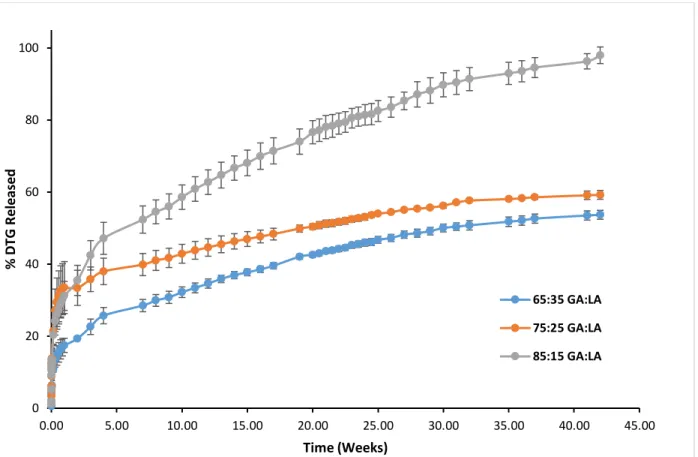
PLGA are polymers consisting of ester linkages between glycolic acid and lactic acid. There is variability among the PLGAs in the ratio of glycolic acid to lactic acid present in the polymer. In a subsequent study, we investigated the effect that the proportion of glycolic acid to lactic acid has on release kinetics of dolutegravir. ISFI formulations containing a constant concentration of DTG (80 mg/mL), constant weight ratio of PLGA/NMP (1:2) and constant MW (~55 kDa) were prepared with PLGA having varying ratios of GA/LA (65:35, 75:25, and 85:15). It is evident that the formulation with the larger GA:LA ratio (85:15) released DTG at the highest rate, releasing at ~2.3% a week, the 75:25 GA:LA formulation released at 1.4% per week, and the 65:35 GA:LA formulation released at 1.3% per week. With respect to the percent release of DTG, at day 30 the ISFI formulation containing the highest amount of GA (PLGA 85:15 GA/LA) released ~47% of DTG compared to ~26% for the PLGA containing the lowest GA ratio (65:35 GA/LA) (Figure 2).
0 20 40 60 80 100
0 5 10 15 20 25
%
D
TG
R
el
ea
sed
Time (Weeks)
Figure 2. Cumulative in vitro release of DTG from ISFIs containing PLGA with a range of GA/LA ratio. Drug release studies were carried out under sink conditions in 0.01M PBS pH 7.4 at 37ºC. Drug concentration, PLGA/NMP weight ratio and PLGA MW were maintained constant across all ISFIs. All error bars represent standard deviation with n = 3.
Effect of Drug Characteristics on their Release Kinetics from ISFI
In addition to dolutegravir, lamivudine (Epivir®) a reverse transcriptase inhibitor and zalcitabine analog, and emtricitabine (Emtriva®), a nucleoside reverse transcriptase inhibitor, were
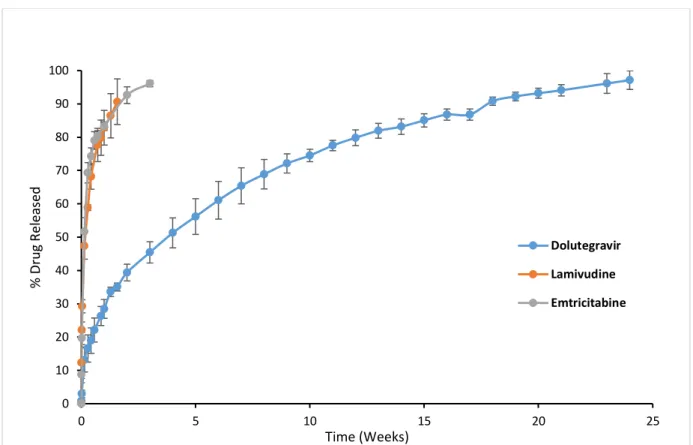
tested to determine how the different drugs interact with the ISFI formulation and how this interaction influences their release kinetics in vitro. The formulations were created using 1:2 PLGA/NMP (PLGA 50:50 GA/LA; MW 27 kDa) and adding 10% drug (w/w). This limits the variability only to the difference in characteristics of DTG, FTC, and 3TC. On average, the formulation depots containing 10% DTG (w/w) released ~91% of the drug in 18 weeks (average release rate = 5.04%/wk). Comparatively, the formulation depots containing 10% 3TC (w/w) and 10% FTC (w/w) had very similar release rates and released significantly faster than DTG. Approximately 91% of 3TC released in 12 days (average release rate ~ 7.6%/day) and ~93% of FTC was released in 14 days (average release rate 6.7%/day).
0 20 40 60 80 100
0.00 5.00 10.00 15.00 20.00 25.00 30.00 35.00 40.00 45.00
%
D
TG
R
el
ea
se
d
Time (Weeks)
65:35 GA:LA
75:25 GA:LA
Figure 3. Cumulative in vitro release of DTG, FTC, and 3TC from ISFIs containing 1:2 w/w PLGA/NMP (PLGA 27 kDa) and 100 mg drug/mL. Drug release studies were carried out under sink conditions in 0.01M PBS pH 7.4 at 37ºC. Drug concentration, PLGA/NMP weight ratio and PLGA MW were maintained constant across all ISFIs. All error bars represent standard deviation with n = 3.
Determination of DTG Solubility in NMP with Cosolvents
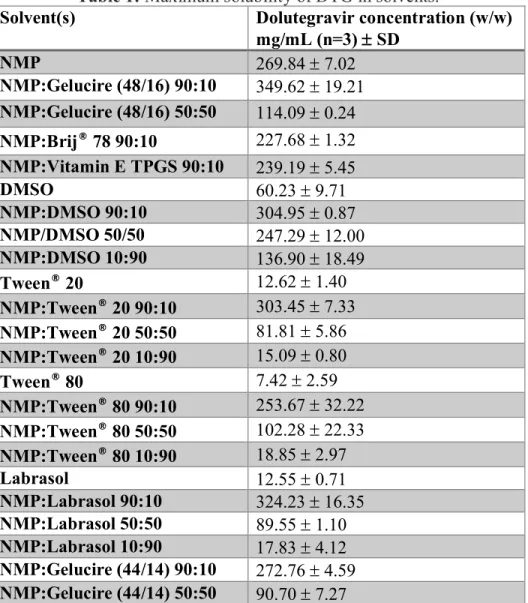
Our predicted HIV PrEP target human dose requirement of [DTG] is 300 mg/mL. In order to limit the amount of NMP (organic solvent class 2) [7] in ISFI formulations, cosolvents were tested to increase solubility of DTG in NMP. Different ratios were tested to determine what combination of NMP and cosolvent would be superior to NMP only. NMP alone has a saturation solubility of ~270 mg/mL for DTG (Table 1), and it remained the most effective stand-alone solvent, in terms of solubility. Each formulation was supersaturated and centrifuged to obtain a supernatant and drug pellet. The supernatant was analyzed for drug concentration. Four solvents were shown to increase DTG solubility in a 9:1 ratio of NMP to cosolvent, respectively. DMSO, Tween® 20, Labrasol, and Gelucire (48/16) all increased DTG’s solubility to, on average, 304.9
mg/mL, 303.4 mg/mL, 324.3 mg/mL, and 349.6 mg/mL, respectively.
0 10 20 30 40 50 60 70 80 90 100
0 5 10 15 20 25
%
D
rug
Rel
ea
sed
Time (Weeks)
Dolutegravir
Lamivudine
Table 1: Maximum solubility of DTG in solvents.
Solvent(s) Dolutegravir concentration (w/w)
mg/mL (n=3) SD
NMP 269.84 7.02
NMP:Gelucire (48/16) 90:10 349.62 19.21 NMP:Gelucire (48/16) 50:50 114.09 0.24 NMP:Brij® 78 90:10 227.68 1.32 NMP:Vitamin E TPGS 90:10 239.19 5.45
DMSO 60.23 9.71
NMP:DMSO 90:10 304.95 0.87
NMP/DMSO 50/50 247.29 12.00
NMP:DMSO 10:90 136.90 18.49
Tween® 20 12.62 1.40
NMP:Tween® 20 90:10 303.45 7.33 NMP:Tween® 20 50:50 81.81 5.86
NMP:Tween® 20 10:90 15.09 0.80
Tween® 80 7.42 2.59
NMP:Tween® 80 90:10 253.67 32.22
NMP:Tween® 80 50:50 102.28 22.33 NMP:Tween® 80 10:90 18.85 2.97
Labrasol 12.55 0.71
NMP:Labrasol 90:10 324.23 16.35 NMP:Labrasol 50:50 89.55 1.10 NMP:Labrasol 10:90 17.83 4.12 NMP:Gelucire (44/14) 90:10 272.76 4.59 NMP:Gelucire (44/14) 50:50 90.70 7.27
Differential Scanning Calorimetry
The DSC analysis for pure drug (DTG and MK-2048), optimized placebo ISFI, and optimized drug loaded ISFIs (DTG and MK-2048 ISFIs) was carried out using a differential scanning calorimeter (TA Q200, USA). Samples varying in weight from 1-10 mg were weighed, hermetically sealed in an aluminum pan, and placed in the differential scanning calorimeter. The samples were subsequently heated from 25 – 250 °C, at a heating rate of 10°C/min, under nitrogen atmosphere (flow rate 20 mL/min). The thermograms were used to determine the peak glass transition temperature (Tg).
drug and polymer indicating that MK-2048 and DTG are both stable in the ISFI formulation. Figure 4-D also shows a PLGA endotherm at 42.37°C which shows that the glass transition temperature of PLGA is maintained in the presence of MK-2048 indicating the stability of PLGA in the presence of drug.
Figure 4: Drug stability in ISFI formulation by DSC analysis. DSC thermograms: A) PLGA (neat), B) 1:2 PLGA/NMP Placebo ISFI, C) MK-2048 (neat), D) 0.8:1:2 MK-2048/PLGA/NMP ISFI, E) DTG (neat), F) 0.8:1:2 DTG/PLGA/NMP. DSC was used to characterize and ensure that the drug retains its chemical structure when in ISFI formulation. The endotherms in D and F match those seen in C and E, respectively, showing that the drugs MK-2048 and DTG both retain physical structure in formulation.
(Figure 1) whereas the heaviest PLGA tested, 53.4 kDa, only released at an average rate of 2.91%/week. The 53.4 kDa formulation displayed the most viscosity largely due to the increased molecular weight of the PLGA polymer.
The structure of glycolic acid and lactic acid differ primarily in the presence of an additional methyl group side chain in lactic acid. In Figure 5, the left group is lactic acid and the right group represents glycolic acid. The methyl side
chain reduces the hydrophilicity of lactic acid. Increasing the amount of lactic acid in a PLGA polymer will therefore further reduce the hydrophilicity of the system. This would result in a slower rate of degradation of ester linkages by hydrolysis in aqueous environments. The 65:35 GA/LA ISFI formulation
released the slowest at an average rate of ~1.26%/week (Figure 2).
This polymer was 35% lactic acid, as compared to the 85:15 ISFI formulation which released DTG at an average rate of ~2.33%/week (Figure 2) with the polymer only composed of 15% lactic acid.
Lamivudine is a reverse transcriptase inhibitor and zalcitabine analog used to treat HIV and HBV. It is a relatively small compound with hydrophilic side chains. Lipophilicity is a chemical property often used to describe the
inherent hydrophilicity or hydrophobicity of a given drug. LogP is the partition coefficient between lipophilic and aqueous phases that measures lipophilicity [3]. Lamivudine has a logP
of -1.4 which indicates the majority of lamivudine is found in the aqueous phase, therefore it is a strongly hydrophilic drug. Emtricitabine, a nucleoside reverse transcriptase inhibitor, has the same logP (-1.4), thus it shares similar hydrophilic qualities to lamivudine. Dissimilarly, dolutegravir’s logP is a positive value of 2.2, thus majority of its concentration is found in the lipophilic phase indicating a largely hydrophobic drug. The hydrophilic nature of lamivudine means that the drug will have favorable interactions with aqueous solvent, NMP. Therefore, when NMP diffuses from the formulation in release media both 3TC and FTC will favorably diffuse with NMP into media, accounting for the significant burst release seen in the first 24 hours (24 hour release 3TC = 47.3%, FTC = 51.6%) (Figure 3). Further, the hydrophilic nature of both drugs will facilitate hydrolysis of ester linkages in the ISFIs resulting in a faster release of 3TC and FTC. This pattern was observed with ~91% of lamivudine released within 12 days and 93% of FTC released in 2 weeks, as compared to ~91% of DTG released over 18 weeks (Figure 3).
N-methyl-2-pyrrolidone is a Class 2 solvent as per the FDA’s list of biocompatible solvents [7]. This suggests that NMP should be limited in use in pharmaceuticals due to its inherent toxicity. Less toxic cosolvents, in addition to increasing drug solubility in NMP, can also reduce the amount of NMP necessary in an ISFI. Four cosolvents showed a significant increase in the solubility of DTG in NMP: Tween 20, Gelucire (48/16), Labrasol, and DMSO. Adding these cosolvents in a 1:9 ratio, cosolvent to NMP, reduces the amount of NMP used in the formulation
Figure 5: PLGA
and simultaneously increases the amount of DTG that can be homogenously added to the ISFI formulation. The predicated HIV PrEP human dose requirement of [DTG] ≥ 300 mg/mL can more readily be met using a cosolvent.
Conclusions
When working on long-acting drug delivery systems, it is important to understand the variability that is possible. Specifically, the makeup of in situ forming implants allows for the associated release kinetics of drugs to be manipulated through variation of the individual components. The degradation of depots increases with a smaller molecular weight of a PLGA. This results in a faster release of DTG as compared to formulations containing higher molecular weights. Similarly, a larger proportion of glycolic acid in a PLGA will result in faster degradation due to hydrolysis of ester linkages caused by its more hydrophilic tendencies. More hydrophilic drugs release faster due to their favorable interactions in aqueous environments as seen with lamivudine and emtricitabine (logP = -1.4). Affecting release kinetics through compositional changes can serve as a critical advantage when developing treatments for populations. Cosolvents can increase DTG solubility in NMP via favorable chemical interactions with DTG to bring it into solution. Increasing the solubility of DTG in the formulation and decreasing the amount of NMP required in a formulation improves the viability of the ISFI systems moving forward.
References
1 World Health Organization. Global Health Observatory Data. 2016.
2 Centers for Disease Control and Prevention. Pre-Exposure Prophylaxis. 2018. 3 Cambridge MedChem Consulting. Lipophilicity. 2017.
4 Islam, S, et al. Lipophilic and hydrophilic drug loaded PLA/PLGA in situ implants: Studies on
thermal behavior of drug & polymer and observation of parameters influencing drug burst release with corresponding effects on loading efficiency & morphology of implants. Int. Jour. Pharm. Pharm. Sci., 2011, 3, 181-188.
5 Chen, W.; Palazzo, A.; Hennick, W. E.; Kok, R. J. Effect of Particle Size on Drug Loading and
Release Kinetics of Gefitinib-Loaded PLGA Microspheres. Mol. Pharmaceutics, 2017, 14, 459-467.
6 Wang, L.; Wang, A.; Zhao, X.; Liu, X.; Wang, D.; Sun, F.; Li, Y. Design of a long-term
antipsychotic in situ forming implant and its release control method and mechanism. Inter. Jour. of Pharmaceutics, 2012, 427, 284-292.
7