Cassandra P. Stanco. Identifying the Information Needs of Biomedical Equipment Technicians in the Developing World. A Master’s Paper for the M.S. in I.S. degree. April, 2016. 50 pages. Advisor: Clifford Missen.
This study describes a digital survey of Biomedical Equipment Technicians (BMETs), biomedical engineers, and managers in the biomedical field that work in the developing world. The survey was conducted to determine the information needs and preferences of this community regarding digital libraries and digital information seeking. A digital survey was distributed via email, posted to the online forums Infratech and HIFA, and posted to the homepage of Engineering World Health’s BMET Library
(http://library.ewh.org). The survey indicated information seeking behavior centered on print technical information, search engines, and technical forums. It illuminated specific information needs such as a desire for visual materials, specific technical information, and stable formats for digital resources.
Headings: Digital libraries
IDENTIFYING THE INFORMATION NEEDS OF BIOMEDICAL EQUIPMENT TECHNICIANS IN THE DEVELOPING WORLD
by
Cassandra P. Stanco
A Master’s paper submitted to the faculty of the School of Information and Library Science of the University of North Carolina at Chapel Hill
in partial fulfillment of the requirements for the degree of Master of Science in
Information Science.
Chapel Hill, North Carolina April 2016
Approved by
TABLE OF CONTENTS:
1.1 Introduction ... 2
2. Literature Review ... 4
2.1 Connectivity and the Digital Divide ... 4
2.2 Internet Usage ... 5
2.3 The Role of Electricity ... 6
2.4 Mobile Devices ... 7
2.5 Digital Libraries ... 8
2.6 Usability and Surveys ... 10
3. METHODS ... 12
3.1 Justification of Study ... 12
3.2 Type of Study ... 12
3.3 Sampling and Population ... 13
3.4 Data Collection: ... 14
3.5 Data Analysis: ... 15
4. IMPLICATIONS ... 17
4.1 Results ... 17
4.2 DISCUSSION ... 21
4.3 CONCLUSION ... 25
5. REFERENCES ... 27
VI. APPENDICES ... 31
6.1 Biomedical Equipment Technician (BMET) Survey ... 31
6.2 Publicity Announcement Emailer ... 36
1.1 Introduction
The developing world poses a unique set of issues for information technology management. No issue is more dominant than the digital divide or the disparity in the acquisition, usage, prevalence, and access to modern information technologies and services between developed and developing countries. While many strategies have been conceived to address the digital divide, such as offline access to digital resources, investment in infrastructure, and the promotion of mobile devices, Witten (2004) suggests that digital libraries are an unconventional, yet effective, method to bridge the digital divide. Witten (2004) argues that information about “health, agriculture, nutrition, hygiene, sanitation and safe drinking water” are the most important categories of
information that can be included in a digital library directed at developing countries. Healthcare and basic need fulfillment are critical issues in developing countries. In a recent investigation, Engineering World Health (2016) noted that fifty to eighty percent of medical and laboratory equipment is out of service in resource-poor countries, limiting the population’s access to necessary healthcare devices. The same study showed that while a number of biomedical technicians operate in developing countries, there is often a lack of useful, up-to date, native-language technical information to teach technicians how to repair and maintain medical equipment.
the specific information needs of those who work in this sub-set of the healthcare sector, such as biomedical equipment technicians (BMETs), biomedical technicians, or
biomedical engineers. This study endeavored to close that gap by surveying and understanding the needs of biomedical equipment technicians in the developing world that use or desire to use digital resources to gain information for their day-to-day
2. Literature Review
2.1 Connectivity and the Digital Divide
This literature review addresses the challenges of information technology in the developing world and delineates the definitions and issues surrounding digital libraries. The goal of this study was to gain an enhanced understanding of the information needs of biomedical equipment technicians and associated professionals in resource-poor areas and how digital libraries can address those needs.
The digital divide is the most ubiquitous issue entrenched in the literature about information technologies in the developing world (James 2004) & (Balakrishnan 2001). James (2004) defines the digital divide as the disparity in the benefit received by
2.2 Internet Usage
A common unit used to measure information technology penetration in a country is Internet usage (James 2004). According to statistics compiled by the U.S. Central Intelligence Agency, as of 2014 the ten countries with the greatest level of Internet usage are: China, the European Union as a whole, the United States, India, Japan, Brazil, Russia, Germany, Nigeria, and the United Kingdom (CIA 2015). Here, we can see that two undeveloped nations are present on this list. However, the percentage of the
population with Internet in India and Nigeria is only 19.2 and 37.6 percent respectively, compared with 86.8 percent in the United States and 89.9 percent in the United Kingdom. While Internet usage may have increased in recent years, it is clear that the proportion of users is far greater in the developed world.
Witten (2004) argues that the current state of information on the Web
“disenfranchises” countries in the developing world. Arunachalam (1999) also observes this phenomenon, arguing that the developing world is disenfranchised because access to digital material inherently requires possession of the corresponding information
technologies. This disfranchisement extends not only to computers and the Internet, but also to infrastructure like landlines. As explained in the ACC Statement on Universal Access to Basic Communication and Information Service, “comparative advantages are
wealth of digitally available knowledge. Witten (2004) and Arunachalam (1999) both establish that despite its capacity to freely and easily disseminate information, the Internet is a case study in the complications of the digital divide.
It is essential to note that Internet usage is not the only metric to measure the digital divide. James (2004) notes that that Internet usage as a metric “applies selectively across and within different countries” and that it may not be an accurate rubric for gauging the digital divide in rural populations. James argues that low literacy rates in these areas may affect usage of the Internet and information technology (James, 2004, 116). Balakrishnan (2001) proposes that the success of communication technologies in resource-poor countries should be measured based on an area’s communications infrastructure. This infrastructure includes the number of landlines, mobile phones, and computers, as well as availability of Internet access and cellular network coverage. While a host of solutions has been proposed to narrow the digital divide, one feasible strategy is renewed investment in local institutions and infrastructure, rather than the introduction of cutting-edge technology without the resources to support it (Balakrishnan 2001).
2.3 The Role of Electricity
becomes more reliable and available in resource poor areas, the number of Internet users in that area will rise. The importance of electricity as a metric can be seen strongly in the case of hospitals. In their study of hospitals in sub-Saharan Africa, Adair-Rohani et al. (2013) note that only 34 percent of hospitals surveyed in their study had dependable
electricity access. According to their study, one quarter of hospital facilities in
sub-Saharan Africa have no electricity at all. While information technologies are essential for
bridging the digital divide, these technologies cannot work without electricity. Hence, the
digital divide cannot be breached in developing countries until reliable and accessible electricity is introduced (Hosman and Armey 2015).
2.4 Mobile Devices
Internet access is not always required to access digital information. Technologies like mobile phones have a proven track record at successfully promoting learning in resource-poor areas. For example, a 2014 UNESCO study examined the correlation between mobile phones and literacy in developing countries. The study found that 62 percent of participants stated that they read greater volumes of material and read more frequently after starting to use mobile phones than they did before using mobile phones (UNESCO, 2014). Motivation for reading on mobile phones was given primarily as a matter of convenience, but affordability and a preference for digital verses analog format were also considerations (UNESCO, 2014). Kaplan (2006) notes that mobile devices are often present in low-resource areas, even if traditional books may not be plentiful
It is critical to note that statistics about mobile usage in the developing world can be misleading. Firstly, the term “mobile devices” usually refers not only to mobile phones, but also to devices like tablets, routers, and more (Gillet 2014). In a review on mobile saturation in the developing world, Gillet (2014) notes that individuals in some developing countries may have more than one SIM card due to the realities of mobile coverage in their area. Many mobile providers will record each SIM card as an individual user, thereby inflating mobile usage statistics (Gillet 2014). While mobile technology can greatly facilitate learning in resource-poor areas, it is important to take statistics about these areas with a grain of salt. In essence, while Internet access can certainly be an obstacle to the use of digital materials in the developing world, digital resources can still be a rich solution when traditional resources simply cannot cut it.
2.5 Digital Libraries
Another strategy that has been proposed to use digital materials to benefit those in resource-poor settings is the distribution of information via free digital libraries. The term digital library can be used to encompass a wide variety of digitally accessible
defined as one that collect pointers to Web-based resources, rather than hold the
resources themselves” (3). Perhaps the most comprehensive definition of a digital library comes from the Digital Library Federation (1998):
[Digital libraries are:] organizations that provide the resources, including the specialized staff, to select, structure, offer intellectual access to, interpret, distribute, preserve the integrity of, and ensure the persistence over time of collections of digital works so that they are readily and economically available for use by a defined community or set of communities.
For the purposes of this study, we will draw from a composite of these definitions and define a digital library as an organized collection of information objects in which all resources exist digitally.
Witten (2004) suggests that digital libraries provide essential information to information-seekers in the developing world and are an effective tool to combat the digital divide. Specifically, he argues that including information about “health, agriculture, nutrition, hygiene, sanitation and safe drinking water” is vital for digital libraries targeting resource poor areas (Witten, 2004, 40). Digital libraries can be used to “extend the applications of modern technology in socially responsible directions” and reduce “commercialization of information” (Witten, 2004, 43). Witten (2004) contends for free digital libraries, rather than those with paid subscriptions, a factor that will help mitigate the cost of information and reduce the burden on potential users.
digital collection to a CD or flash drive (Witten et. al. 2003).1 This exported version of a library can then be uploaded onto a computer, creating a local copy of the library for every user (Witten et. al. 2003). The library can used via interaction with a local browser. This functionality allows for wide dissemination of information at a low cost. Best practices indicate that offline-access digital libraries should be designed with compatibility in mind, utilizing programs that can be run on as many platforms and operating systems as possible, especially inexpensive platforms (Witten 2004).
2.6 Usability and Surveys
In the broadest sense, usability testing is the process of “evaluating a product or service by testing it with representative users” (U.S. Department of Health and Human Services, “Usability Testing”). In other words, usability testing is used to determine if a product or system is actually useful to potential users. The goal of usability testing is to design systems that are intuitive, “useful and valued by the target audience” (Rubin, 2008, p. 22). In her 2003 study, Thompson recounts the three major steps of usability testing as delineated by Battleson, Booth, and Weintrop (2001). These steps are: inquiry, via surveys and focus groups; inspection, based on heuristic evaluation; and formal testing, facilitated via structured observation of participants (Thompson, 2003, 22). Benefits of usability testing can include creating “a historical record of usability benchmarks for the future” (Rubin, 2008, p. 23). Due to the nature of the topic of this study, all elements were executed remotely. Web surveys were chosen for this purpose.
states that effective surveys should be broken down into three parts: introductory questions, substantive questions, and classification questions (Wildemuth 2009). Introductory questions consists of simple questions to make the participant comfortable taking the survey. Substantive questions are those that are essential to the survey purpose and make up the bulk of the survey. Classification questions include demographic
3.
M
ETHODS3.1 Justification of Study
There is a wide array of literature about information seeking behavior in the developing world and the use and effectiveness of digital libraries. However, there is little target research on the information needs of BMETs or biomedical engineers using digital resources in the developing world. This study seeks to survey the information needs of preferences of this specific group.
3.2 Type of Study
This study sought to survey the user requirements of BMETs and other biomedical professionals working in the developing world and to discover their
preferences in regards to digital libraries. While the research conducted for this study is somewhat case-specific, the identification of the user requirements of BMETs will bolster existing knowledge of technician needs in developing counties. The analysis will make an excellent starting point for further research and discussion of how to use digital repositories to meet the needs and preferences of this user group
Invitations to the survey were sent through listservs of relevant technician organizations such as Infratech: the WHO/PAHO Clinical Engineering HTM Discussion Group and HIFA: Healthcare Information for All. 3. A link to the survey was posted on the
homepage of EWH’s BMET Library at http://library.ewh.org and was made available to volunteers. Surveys were deemed appropriate for this study because they allowed the researcher to inexpensively connect with participants all over the globe without requiring travel for either researcher or participant.
3.3 Sampling and Population
The goal of this study was to gather feedback from as many participants as possible. This study used a sampling plan consisting of a combination of convenience sampling and snowball sampling. Due to the distance and specificity of participants, the researcher used convenience sampling to procure the majority of participants. The researcher posted invitations to the survey in known forums and distributed emails to a loose network of known biomedical affiliates. Next, snowball sampling was used to widen the participant pool based on feedback and recommendation from participants and advisors. For example, snowball sampling led the researcher to the discovery of the HIFA forum where an email invitation and the publicity announcement were posted.
Europe, was also collected to account for the locations of administrators, coordinators, and retirees of biomedical engineering programs. For the purpose of the study, a BMET or biomedical professional was defined as someone who is employed full-time, has been trained as a biomedical equipment technician, biomedical engineer, or equivalent, and spends approximately three quarters of their work hours repairing, maintaining, and working with medical devices and other biomedical equipment professionals. A BMET teacher, manager, or coordinator was defined as an individual who currently or
previously supervises and teaches repair, maintenance, or healthcare technology management skills to BMETs, BTAs, or other students in the clinical field in resource-poor countries.
3.4 Data Collection:
Data was collected for this study using a structured survey built in Qualtrics made
freely accessible online. To maximize the number of participants, surveys were
distributed using three distinct methods. Data collection was conducted according to the
following outline:
Data Collection Outline:
• 2/19/2016: Survey opened and posted on the homepage of the BMET Library.
• 2/20/2016: Invitation to survey posted on the Infratech forum.
• 2/29/2016: Invitation to survey posted on the HIFA forum.
• 3/15/2016: Invitation to surveys sent in a publicity announcement email by EWH.
• Publicity announcement also posted in Infratech and HIFA forums.
• 3/21/2016: Survey closed.
Data Collection Procedure:
Surveys were distributed by digital means to the BMET and biomedical
engineering community. Section 6.1 shows the survey used in this study. All surveys
included a privacy notice that participation was voluntary and no identifying information
would be collected. Data collection began by posting a link on the homepage of EWH’s
BMET Library (http://ewh.org/library). Next, invitations to the survey were posted in the Infratech and HIFA forums. Finally, the survey was distributed as a part of a publicity
announcement for the launch of EWH’s BMET Library, both as an email and a second posting the Infratech and HIFA forums. The email used for this part of the study can be
seen in section 6.2. The publicity announcement emails were sent from the address
[email protected] to a large group of BMET instructors, managers, and students. The publicity announcement and subsequent postings in Infratech and HIFA were used as a reminder and last call to participants. Responses to all of questionnaires were compiled to create the dataset for this study.
3.5 Data Analysis:
Preparing the data:
Qualtrics software was used for the first step of data preparation. Responses to
each question were compiled, downloaded, and exported as an Excel spreadsheet for data
analysis. The data was cleaned by removing the date of survey completion, IP addresses,
blank columns, and other irrelevant items.
Analyzing the Data:
such as the number of participants, most common participant language, geographic
location, and occupational titles from the dataset. The researcher then analyzed each
question and response set. A chi-squared test was used to determine significance of
4.
IMPLICATIONS
4.1
Results
The survey for this project was open for a total of thirty-two days during the period of February 18, 2016 to March 21, 2016. In total there were fifty-eight
participants, with forty-three fully completed surveys and fifteen partially completed surveys. The age group of fifty-six to seventy-five had the greatest number of
participants, with twenty-seven percent of respondents. The age groups twenty-four to thirty-five and forty-six to fifty-five both received twenty-four percent of participants.
Geographically, the greatest number of participants hailed from Africa, making up forty-four percent of participants. North America made up twenty-nine percent of
participants and Asia thirteen percent. The language preference for participants, both for language proficiency (Q2) and ideal language of resources (Q3), was overwhelmingly in favor of English. For question, two eighty-eight percent of participants selected English; for question three, eighty-four percent of participants selected English. Only two percent of users indicated that they would prefer resources in a language other than English, French, or Spanish. Of the users that specified they would prefer resources in non-English languages (Q3), no clear pattern emerged between preferred resource language and current geographical area (Q6). Of those respondents that preferred Spanish
one worked in Africa, and one did not specify location. Only one participant chose to write in a response, “tagalong,” and this participant worked in Asia.
Occupation (Q4) was the section of the survey that provided the greatest number of “other” responses. Fifty-four percent of participants gave their occupation as
Biomedical Equipment Technician (BMET), BMET Student, or Teacher or Supervisor of BMET students. Forty-six percent of participants chose to write in additional
occupational titles, such as Librarian, Biomedical Engineer, or Policy Maker. Figure 1 shows the breakdown of occupational self-identification from this dataset. In terms of occupational duties (Q5), one third of participants indicated that repairing and
maintaining medical equipment was their primary duty, while forty-four percent of participants spent less than one quarter of their time repairing and maintaining medical equipment.
Figure 1: Self-Identified Occupation (Question 4)
Preferred methods of information gathering for the workplace and professional development (Q7) included in-person group workshops and online courses. The top three
0 2 4 6 8 10 12 14 16 18 Biomedical Equipment Technician (BMET)
methods of resolving technical questions (Q9) were: Search engines (seventy-two percent), books or equipment manuals (seventy-eight percent), and asking a colleague (sixty-three percent). Responses about the type or format of resources currently in use by technicians (Q10) indicated heavy usage of print materials, with seventy-four percent of participants selecting printed equipment manuals and forty-seven percent of participants selecting textbooks and printed journals. Downloaded material such as eBooks and video were each selected by forty-four percent of participants. However, participants ranked electronic materials, such as websites, web forums, and PowerPoints as their preferred type of resource (Q12), gathering sixty-nine percent of responses. Print materials
received twenty-seven percent of responses and audio materials four percent. In terms of electronic resource format (Q19), seventy-seven percent of participants preferred PDFs as a file format for digital information, fifteen percent preferred Microsoft Word documents, and less than ten percent preferred PowerPoints or text-documents.
When asked about Internet availability (Q14 & Q15), ninety-three percent of participants indicated that they have access to the Internet every day and eighty-five percent indicated that their Internet connection is consistently reliable. Only three percent of participants responded that Internet connection was intermittent or unreliable in their area. Sixty-nine percent of users responded that they accessed the Internet most
frequently at the workplace, twenty-six percent at home, and five percent at Internet Cafes. Ninety-five percent of participants were able to quickly and successfully download large files, such as PDFs or video, in less than an hour (Q17).
diagrams with associated parts lists, as the most desired types of visual material, with forty-seven and twenty-five percent of responses respectively. Checklists, flowcharts, and photographs were ranked as the least desired format of visual materials. However,
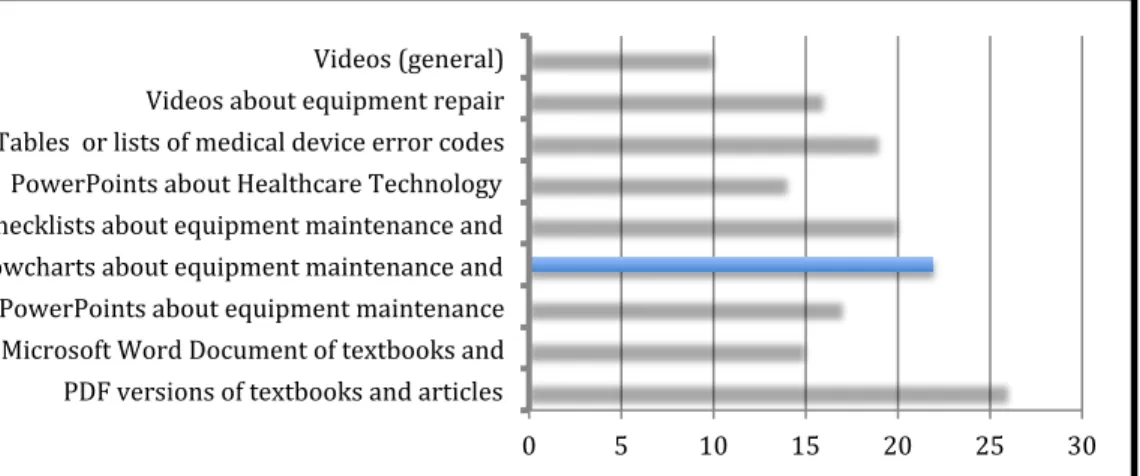
participants indicated (Q19) that they would make use of information in checklists, flowcharts, or photographs if available. Figure 2 depicts which types of resources participants would use as an on-the-job tool. When asked about what topics they would like to learn more about for their job (Q27), the top three choices were Healthcare Technology Management (HTM) with sixty-three percent, Electronics with fifty-four percent, and Medical Equipment Safety with forty-three percent. Finally, eighty-six percent of respondents indicated that they would use a resource like EWH’s BMET Library if it were freely available. Eight percent would use it if it was a paid resource and five percent would not use such a resource under any circumstances. Participant
suggestions for the improvement of the BMET Library included the addition of content such a set of manuals and videos in French, Spanish, and English, regular updates and promotion of the library, and creation of a forum for BMETs to meet and exchange ideas.
Figure 2: Preferred Resource Formats
0 5 10 15 20 25 30 PDF versions of textbooks and articles
A chi-squared analysis was used to determine if dependence existed between specific responses in the survey. A threshold of 0.1 or less was used to determine dependence. Four tests were preformed: age and occupational title (Q1 & Q4), age and preferred resource format (Q1 & Q12), location and time spent on equipment repair (Q6 & Q5), and location and resource satisfaction (Q6 & Q10). Results of this test provided scores of 0.999, 0.999, 0.973, and 0.996 respectively. In other words, no definitive dependence was found between any variables tested.
4.2
D
ISCUSSIONThe results demonstrate that the study was fairly successful in reaching its target audience. Sixty-three percent of respondents hailed from developing countries. Some respondents may be teachers or managers from Western, developed countries that are working in developing countries, rather than local technicians. However, overall the survey successfully solicited information from biomedical professionals in the target areas. While the sample represented the desired population, it is important to note that the sample size was relatively small and a larger sample is needed to solidly confirm the findings of this study.
Question four, “which best describes your occupation,” provided perhaps the most insight into the participant base of this study. When designing the study, the researcher conjectured that the majority of participants would identify as BMETs or BMET
Researchers, and Policy Makers. That diversity is a key ingredient to be taken account when assessing and building tools to fit the information needs of this community.
Diversity in occupational identification aside, the results of the study indicate that there is a clear break between the types of resources currently used by professionals in this sub-set of the biomedical field to meet their information needs and the preferred or desired resources to meet those needs. Responses indicated that print materials, such as textbooks, journals, and manuals, were the most common types of resources used on the job. After print materials, pre-downloaded digital materials, like e-books or video, were ranked as the next most commonly used resources. Here, we can see that printed
materials or static digital materials are the most frequently used resources to satisfy information needs among the studied group. In some ways this reflects the importance of equipment manuals and the issues of copyright law that do not allow them to be
disseminated legally in digital format. In other ways it reflects the inadequacy of current live digital resources. While participants frequently used print resources, digital resources were requested most by participants in the survey. For example sixty-nine recent of participants stated that they preferred digital materials (Q11). Here we can see the gap between practice and preference.
actively looking for more complex, complete, and accessible digital resources to replace or bolster the resources that they currently use.
In regards to content, participants most frequently listed visual materials as the most useful and desired types of resources. Popular choices included block diagrams, schematics and parts lists, and flowcharts. Dynamic visual material such as seemed to be in lower demand, although survey participants indicated the capacity to download and handle these types of files. Topically, the areas of Healthcare Technology Management (HTM), Maintenance and Repair, and Electronics were the topics most frequently cited as useful or desired to participants. Maintenance, repair, and electronics are topics that can be handled well using visual material like diagrams and the desire for these topics may correlate with the desire for visual materials.
The demand for HTM and other soft-skills resources are a somewhat unexpected result of this study. However, the breakdown of participants based on occupational title sheds some light on this phenomenon. A total of thirty-eight percent of participants identified as some type of supervisor, manager, or librarian. While technical skills and resources are essential for technicians, HTM and skills like budgeting and organization are crucial for supervisors and information managers, thereby explaining the higher than expected demand for these topics. This aspect of the study suggests that technicians in the developing world require more than just technical material and further research and effort could be directed at identifying these needs and providing accessible resources to cover these topics.
a low barrier of access. In this case barrier of access includes format and cost.
Technicians are specifically looking for equipment manuals and other types of visual, easily readable material as to aid them in the workplace. However, in the realm of visual material, technicians are looking for static visual material, rather than video or multi-media. The desire for visual material may also help to offset any confusion that stems from unfamiliarity with the language in which popular resources are written. In addition, this study indicates a preference for stable resources. The preference for analog materials as well as digital formats like PDF indicate that longevity and simplicity of use are of concern to technicians. While many have suggested that mobile devices will outstrip traditional computers as the best means of computer and Internet access in the developing world, participants in this study used mobile phone and laptop computers almost equally. Therefore, while mobile devices may be a step in the right direction of disseminating knowledge in resource-poor areas, resources for biomedical technicians should be hosted with accessibility for both mobile and large screen formats.
electricity, let alone Internet access, in developing countries are often limited. Therefore, the researcher expected more cases of limited Internet connectivity and difficulty of file download. The fact that participants unanimously had Internet connection likely stemmed from the digital, web-based nature of the survey. Users without stable Internet connection were unlikely to receive or participate in the survey. In the same vein, most respondents indicated that they accessed the Internet at the workplace, with few indicating the use of Intent cafes or other means. This study is also likely limited to those in the biomedical field that access the Internet at their workplace.
4.3
C
ONCLUSIONThis study sought to better understand the information needs of Biomedical Equipment Technicians (BMETs) working in the developing world. A web survey was used to study participants. The survey indicated that the information needs of biomedical technicians included a desire for visual materials and equipment manuals, PDFs and other stable file formats for web resources, and a preference for free or low-cost resources. The study also indicated that information seeking-behavior centered on search engines and technical forums and a significant need exists in the BMET community for not only technical information, but also for training and resources about soft skills like healthcare technology management (HTM),
5
.
REFERENCESAdair-Rohani, H. et al. (2013). "Limited Electricity Access in Health Facilities of Sub-Saharan Africa: A Systematic Review of Data on Electricity Access, Sources, and
Reliability." Global Health: Science and Practice 1.2, p. 249-261. Retrieved from:
http://www.ghspjournal.org/content/1/2/249.full.pdf
Ajuwon, G. (2006). “Use of the Internet for Health Information by Physicians for Patient Care in a teaching Hospital in Ibadan, Nigeria.” Biomedical Digital Libraries. DOI: 10.1186/1742-5581-3-12.
Arunachalam, S. (1999). “How the Internet is Failing the Developing World.” Australian Broadcasting Corporation. Retrieved from:
http://arizona.openrepository.com/arizona/bitstream/10150/106368/1/Article_01.htm
Balakrishnan, N. (2001). Information and Communication Technologies and the Digital Divide in the Third World Countries. Current Science, Vol. 81, No. 8., pgs. 966-76.
Borgman, C.L. (2000). From Gutenberg to the Global Information Infrastructure: Access to Information in the Networked World. MIT Press, Cambridge, MA.
Central Intelligence Agency (CIA) (2015). “The World Factbook: Country Comparison:: Internet Users.” Retrieved from: https://www.cia.gov/library/publications/the-world-factbook/rankorder/2153rank.html
Digital Library Federation (1998). “A Working Definition of a Digital Library.” Digital Library Federation. Last updated January 10, 2011. Retrieved from:
http://old.diglib.org/about/dldefinition.htm
Faulkner, L. (2003). “Beyond the Five-User Assumption: Benefits of Increased Sample Sizes in Usability testing.” Behavior Research Methods, Instruments, & Computers, Vo. 35, No. 3. Pgs. 379-383.
Garibay et. al. (2010): Evaluation of a Digital Library by Means of Quality Function
Deployment (QFD) and the Kano Model.” Journal of Academic Librarianship, Vol. 36. No. 2, pp. 125-132.
Gani, E. and Magoi, J.S. (2014). “The Emergence of Digital Libraries Services in Northwest Nigerian Universities: Challenges and Prospects.” Library Philosophy and Practice, pgs. 1-20.
Gaines, B.R. (1993). “An agenda for digital journals: The socio-technical infrastructure of knowledge dissemination.” Journal of Organizational Computing, Vol. 3, No. 2, pp, 135-193.
Gillet, J. (2014). Measuring Mobile Penetration. Mobile World Live. Last Updated: May 23, 2014. Retrieved from:
http://www.mobileworldlive.com/measuring-mobile-penetration
Hosman, L. & Armey, L.E. (2015). “The Centrality of Electricity for Internet Uptake in Low-Income Countries.” Telecommunications Policy. p. 1-21. Retrieved from:
http://www.ptc.org/ptc14/images/papers/upload/Paper_TS4_HosmanLaura.pdf
James, J. (2004). “The Global digital Divide in the Internet: Developed Countries Constructs and Third World Realities.” Journal of Information Science, Vol. 31, Ni. 2, pgs. 114-123. DOI: 10.1177/0165551505050788
Jeng, J. (2005). “What is Usability in the Context of a Digital Library and How Can it Be Measured?.” Information Technology and Libraries, pgs. 3-13.
Lihitkar, S. & Lihitkar, R. (2012). “Open source Software for Developing Digital Library: Comparative Study. DESIDOC Journal of Library & Information Technology, Vol. 32, No. 5., pp. 392-400.
Lesk, M. 1997. Practical digital libraries: Books, bytes, and bucks. San Francisco: Morgan Kaufmann.
Rosenbaum, S. and Kantner, L. (2008). “Learning about Users When You Can’t Go There: Remote Attended Usability Studies.” 2008 IEEE Professional Communication Conference, pgs. 1-6.
Rubin, J. & Chisnell, D. (2008). Handbook of Usability Testing: How to Plan, Design, and Conduct Effective Tests. Indianapolis, IN: John Wiley and Sons.
Nielsen, J. (2002) “Usability 101: Introduction to Usability.” Nielsen Norman Group. Posted January 4, 2002. Retrieved from: http://www.nngroup.com/articles/usability-101-introduction-to-usability/
Nielsen, J. (2000): Why You Only Need to Test with 5 Users. Nielsen Norman Group.
Posted March 19, 2000.
http://www.nngroup.com/articles/why-you-only-need-to-test-with-5-users/
Nielsen, J. (2004). Keep Online Surveys Short. Nielsen Norman Group. Posted February 2, 2004. Retrieved from: https://www.nngroup.com/articles/keep-online-surveys-short/
Sieker, M. et al. (2007). “What Happened to Remote Usability Testing? An Empirical Study of Three Methods.” CHI 2007 Proceedings, April 28-May 2, 2007, pgs. 1405-1414.
Thompson, S.M. (2003). “Remote Observation Strategies for Usability Testing.” Information Technologies and Libraries. Vol. 22, No. 1., pgs. 22-31.
UNESCO (2014). Reading in the Mobile Era: A Study of mobile reading in developing countries. United National Education, Scientific and Cultural organization. Retrieved from:
U.S. Department of Health & Human Services. Usability Testing. Last updated: April 30, 2015. Retrieved from: http://www.usability.gov/how-to-and-tools/methods/usability-testing.html
Witten et al. (2003). How to Build a Digital Library, Second Edition. New Zealand, University of Waikato.
Witten, I. H. (2004). Digital libraries: Developing countries, universal access, and
information for all. Lecture Notes in Computer Science (Including Subseries Lecture Notes in Artificial Intelligence and Lecture Notes in Bioinformatics), 3334, 35-44.
VI.
A
PPENDICES6.1 Biomedical Equipment Technician (BMET) Survey
BMET Information Needs Survey
Participation in this survey is completely voluntary and no identifying information will be kept or stored in any way. You may choose to exit this survey at any time without
completing it. Use the following link to browse EWH's BMET Library
(http://ewh.org/library) for 3-5 minutes. Then please answer the following questions. Q1 Which of the following best describes your age?
m 18-25 (1)
m 24-35 (2)
m 36-45 (3)
m 46-55 (4)
m 56-75 (5)
m 76+ (6)
Q2 In which of the following languages are you proficient?
q English (1)
q French (2)
q Spanish (3)
q None of the above (4)
Q22 In which language would you prefer to interact with resources?
m English (1)
m Spanish (2)
m French (3)
Q4 Which best describes your occupation?
m Biomedical Equipment Technician (BMET) (1)
m BMET student (2)
m Teacher or supervisor of BMET students (3)
m Other (4) ____________________
Q5 Approximately how much time do you spend repairing and maintaining medical equipment every week?
m Most of my time (1)
m More than half of my time (2)
m Less than half of my time (3)
m Less than one quarter of my time (4)
Q6 In what area do you currently work?
m Africa (1)
m Asia (2)
m Australia (3)
m North America (4)
m South America (5)
m Europe (6)
Q7 Which of the following ways do you prefer to study or learn new skills and information?
q Teach myself (1)
q Online courses (2)
q In-person group workshops (3)
q One-on-one work with an instructor (4)
q Other (5) ____________________
Q9 How do you currently gather information or answer technical questions for your job? (Check all that apply)
q Ask a colleague (1)
q Ask a teacher or former teacher (2)
q Books or equipment manuals (3)
q Articles from a magazine or journal (4)
q The Internet and a search engine (Google, Yahoo, etc.) (5)
q Read and ask questions in online forums (BME, Infratech, etc.) (6)
q Call a help or customer service hotline (7)
q Look it up on a preferred website (WHO, Frank's Hospital Workshop, etc) (8)
q EWH's BMET Library (9)
Q10 How satisfied are you with the resources you currently use to gather information and solve technical questions for your job?
m Very dissatisfied (1)
m Somewhat dissatisfied (2)
m Somewhat satisfied (3)
m Very satisfied (4)
Q11 What kinds of resources do you currently use? (Check all that apply)
q CDs or DVDs (1)
q Downloaded video or audio (2)
q Downloaded eBooks (3)
q Textbooks and printed journals (4)
q Printed equipment manuals (5)
q Newspaper articles (6)
Q12 Which format do you prefer?
m Print materials (books, articles, newspapers, etc.) (1)
m Electronic materials (websites, web forums, PowerPoints, etc.) (2)
m Audio materials (Recordings, podcasts, etc.) (3)
Q13 How often do you have access to the Internet?
m Every day (1)
m 1-2 times a week (2)
m A few times a month (3)
m I do not have regular Internet access (4)
Q14 How reliable is your Internet connection?
m Always works (1)
m Works for a few hours per day (2)
m Works for a few days per week (3)
m Does not work for long periods of time (4)
Q15 Where do you most often access the Internet?
m At my workplace (1)
m At my home (2)
m At Internet Cafes (3)
Q16 What devices do you use to access the Internet? (check all that apply)
q Mobile phone (1)
q Tablet (2)
q Desktop computer (3)
q Laptop computer (4)
q Other (5) ____________________
Q17 How long does it take you to download large files like PDFs, videos, or audio?
m Seconds (Explain answer below) (1) ____________________
m Minutes (Explain answer below) (2) ____________________
m Hours (Explain answer below) (3) ____________________
m I cannot download large files (Explain answer below) (4) ____________________
Q18 What is your preferred file format for textual information?
m .doc or .docx (Microsoft Word document) (1)
m .PDF (Portable document file format) (2)
m .txt (Text-only documents) (3)
m .ppt or.pptx (PowerPoints) (4)
m Other (5) ____________________
Q20 What kind of visual material would be MOST helpful to you on the job?
m Block diagrams or schematics of medical devices (1)
m Diagrams of medical devices with a list of associated parts (2)
m Checklists (3)
m Videos (4)
m Flowcharts (5)
m Photographs of specific models of medical devices (6)
m Other (7) ____________________
Q19 Which of the following items would you use as a resource for your job? (check all that apply)
q PDF versions of textbooks and articles (1)
q Microsoft Word documents of textbooks and articles (2)
q PowerPoints about equipment maintenance and repair (3)
q Flowcharts about equipment maintenance and repair (4)
q Checklists about equipment maintenance and safety (5)
q PowerPoints about Healthcare Technology Management (HTM) (6)
q Tables or lists of medical device error codes (7)
q Videos about equipment repair (8)
Q27 Which of these topics would you like to learn more about to help you at your job?
q Mathematics (1)
q Electronics (2)
q Healthcare Technology Management (HTM) (3)
q Hand tools and their usage (4)
q Professional development (interviewing, emotional literacy, interpersonal skills, etc.) (5)
q Medical equipment safety (6)
q Other (7) ____________________
Q28 A full version of EWH's BMET Library (http://ewh.org/library) can be permanently loaded onto a personal computer and used without Internet connection. If available, would you download and use such a version of EWH's BMET Library?
m Yes, and I would be willing to pay for it (1)
m Yes, but only if it were free (2)
m No, I would not use this (3)
6.2 Publicity Announcement Emailer
6.3 Survey Data
This is a report showing the cleaned data received as a result of the survey. Q1. Which of the following best describes your age?
# Answer Response %
1 18-25 2 4%
2 24-35 12 24%
3 36-45 11 22%
4 46-55 12 24%
5 56-75 14 27%
6 76+ 0 0%
Total 51 100%
Q2. In which of the following languages are you proficient?
# Answer Response %
1 English 44 88%
2 French 6 12%
3 Spanish 7 14%
Total 57
Q3. In which language would you prefer to interact with resources?
# Answer Response %
1 English 43 84%
2 Spanish 4 8%
3 French 3 6%
4 Other 1 2%
Total 51 100%
Other
Q4. Which best describes your occupation?
# Answer Response %
1
Biomedical Equipment Technician (BMET)
16 32%
2 BMET student 2 4%
3
Teacher or supervisor of BMET students
9 18%
4 Other 23 46%
Total 50 100%
Other
Biomedical Engineer Field Service Engineer policy maker
Biomedical Engineer Engineering Supervisor
Clinical Engineer - BMETs manager Consultant and researcher
Country Manager
Medical Equipment Planning Engineer
Imaging Equipment Spec Clinical Engineer
Physician
Medical Doctor, Public Health Physician Director Clinical Engineering
librarian
Technical Advoisor, BMET, in national level Librarian
Q5. Approximately how much time do you spend repairing and maintaining medical equipment every week?
# Answer Response %
1 Most of my
time 16 33%
2
More than half of my time
5 10%
3
Less than half of my time
7 14%
4
Less than one quarter of my time
21 43%
Total 49 100%
Q6. In what area do you currently work?
# Answer Response %
1 Africa 21 44%
2 Asia 6 13%
3 Australia 1 2%
4 North
America 14 29%
5 South
America 3 6%
6 Europe 3 6%
Total 48 100%
Q7. Which of the following ways do you prefer to study or learn new skills and information?
# Answer Response %
1 Teach myself 16 36%
2 Online
courses 24 53%
3
In-person group workshops
25 56%
4 One-on-one work with an instructor
17 38%
5 Other 1 2%
Other
Q8. How do you currently gather information or answer technical questions for your job? (Check all that apply)
# Answer Response %
1 Ask a colleague 29 63%
2
Ask a teacher or former
teacher 7 15%
3 Books or equipment
manuals 36 78%
4 Articles from a magazine or
journal 15 33%
5
The Internet and a search engine (Google, Yahoo, etc.)
33 72%
6
Read and ask questions in online forums (BME, Infratech, etc.)
21 46%
7 Call a help or customer
service hotline 15 33%
8
Look it up on a preferred website (WHO, Frank's Hospital Workshop, etc)
18 39%
9 EWH's BMET Library 10 22%
10 Other 1 2%
Other
Q9. How satisfied are you with the resources you currently use to gather information and solve technical questions for your job?
# Answer Response %
1 Very
dissatisfied 3 7%
2 Somewhat
dissatisfied 6 13%
3 Somewhat satisfied 31 69%
4 Very satisfied 5 11%
Total 45 100%
Q10. What kinds of resources do you currently use? (Check all that apply)
# Answer Response %
1 CDs or DVDs 14 33%
2 Downloaded video or audio 19 44%
3 Downloaded eBooks 19 44%
4
Textbooks and printed
journals
20 47%
5
Printed equipment manuals
32 74%
6 Newspaper
articles 3 7%
Q11. Which format do you prefer?
# Answer Response %
1
Print materials (books, articles, newspapers, etc.)
12 27%
2 Electronic materials (websites, web forums, PowerPoints, etc.)
31 69%
3
Audio materials (Recordings,
podcasts, etc.) 2 4%
12. How often do you have access to the Internet?
# Answer Response %
1 Every day 37 93%
2 1-2 times a week 3 8%
3 A few times a month 0 0%
4
I do not have regular Internet access
0 0%
Total 40 100%
Q13. How reliable is your Internet connection?
# Answer Response %
1 Always works 34 85%
2
Works for a few hours per day
5 13%
3
Works for a few days per week
0 0%
4
Does not work for long periods of time
1 3%
Total 40 100%
Q14. Where do you most often access the Internet?
# Answer Response %
1 At my
workplace 27 69%
2 At my home 10 26%
3 At Internet
Cafes 2 5%
4 Other 0 0%
Q15. What devices do you use to access the Internet? (check all that apply)
# Answer Response %
1 Mobile phone 29 74%
2 Tablet 11 28%
3 Desktop computer 21 54%
4 Laptop computer 28 72%
5 Other 1 3%
Other
Pi
16. How long does it take you to download large files like PDFs, videos, or audio?
# Answer Response %
1
Seconds (Explain answer below)
16 41%
2
Minutes (Explain answer below)
21 54%
3
Hours (Explain answer below)
2 5%
4
I cannot download large files (Explain answer below)
0 0%
Seconds (Explain
answer below) Minutes (Explain answer below) Hours (Explain answer below)
I cannot download large files (Explain answer below)
Less than 60 5mins for a 100Mb file depending on the connection minutes hours days
Broadband Connection until 5 minutes less than one hour. +300Mbps at work
>100Mbps at home 2
broadband rates Like 5 or 6 minutes
We have in house IT, and a very fast network.
Because of busy networks
large thruoghput
For larger pdfs and videos it usually takes a few minutes.
30 sec Download speed 50mbps
I have relatively slow internet in the office, my home is better It can vary as it depends
on the size of the file.
They tend to be large files.
Broadband connection 5-10 minutes
maximum 5 mints Depends on the size of the file Large means? I am
actually working on a fiber network, then is too fast
due to power failure
Depends on bandwidth and country overall usage
no longer than 5min
A few minutes
depending on the size of the file
Le fichier pdf je n'ai jamais calculé le temps, mais des vidéos ou audio souvent sont difficiles à télécharger
its depends on files
internet is slow and often fails
17. What is your preferred file format for textual information?
# Answer Response %
1
.doc or .docx (Microsoft Word document)
6 15%
2
.PDF (Portable document file format)
30 77%
3 .txt (Text-only
documents) 0 0%
4 .ppt or.pptx
(PowerPoints) 2 5%
5 Other 1 3%
Total 39 100%
Other
All
18. What kind of visual material would be MOST helpful to you on the job?
# Answer Response %
1 Block diagrams or schematics of medical devices
17 47%
2
Diagrams of medical devices with a list of
associated parts
9 25%
3 Checklists 2 6%
4 Videos 6 17%
5 Flowcharts 0 0%
6 Photographs of specific models of medical devices
1 3%
7 Other 1 3%
Total 36 100%
Other
19. Which of the following items would you use as a resource for your job? (check all that apply)
# Answer Response %
1 PDF versions of textbooks and
articles 26 70%
2
Microsoft Word documents of textbooks and articles
15 41%
3 PowerPoints about equipment maintenance and repair
17 46%
4 Flowcharts about equipment maintenance and repair
22 59%
5 Checklists about equipment maintenance and safety
20 54%
6 PowerPoints about Healthcare Technology Management (HTM)
14 38%
7
Tables or lists of medical device error codes
19 51%
8 Videos about equipment
repair 16 43%
Q 20. Which of these topics would you like to learn more about to help you at your job?
# Answer Response %
1 Mathematics 3 9%
2 Electronics 19 54%
3
Healthcare Technology Management (HTM)
22 63%
4 Hand tools and their usage 7 20%
5
Professional development (interviewing, emotional literacy, interpersonal skills, etc.)
12 34%
6
Medical equipment safety
15 43%
7 Other 3 9%
Other
wider clinical use or devices Sales
Q 21. A full version of EWH's BMET Library (http://ewh.org/library) can be permanently loaded onto a personal computer and used without Internet connection. If available, would you download and use such a version of EWH's BMET Library?
# Answer Response %
1
Yes, and I would be willing to pay for it
3 8%
2
Yes, but only if it were free
32 86%
3 No, I would not use this 2 5%
Total 37 100%
Q22. In your opinion, how can EWH's BMET Library (http://ewh.org/library) be improved?
Text Response
Have manufacturers device specific operators and user manuals available (if possible) Yes!
Collect all manuals and videos in at least English, French and Spanish Regular updates sent out to forums - people forget!
Continue with such Questionnaires Currently not used
not sure yet
collaboration with manufacturer and international organization. Make it accessible to low resource countries
By interacting with end users
i have not yet used it before so i can not say anything it
En donnant régulièrement les nouvelles sur les nouveaux équipements . Organiser les rencontres des techniciens biomédicales par réseau pour le recyclage pratique.
sir just make a big platform where all ewh's bmet can meet and exchange ideas by no taking a time...
create a forum where bmet can share thire experiences, locate more bmet technicians and organize bmet meetings with companies.
I am yet to start using the EWH's BMET Library. Will give better opinion after a while
Statistic Value