Deepali Kamthania, Ashish Pahwa and Srijit S. Madhavan
School of Information Technology, VIPS, GGSIP University, Delhi, IndiaMarket Segmentation Analysis and
Visualization Using K-Mode Clustering
Algorithm for E-Commerce Business
Now, all business organizations are adopting data-driven strategies to generate more profits out of their business. Growing startups are investing a lot of funds in data economy to maximize profits of the business group by developing intelligent tools backed by ma-chine learning and artificial intelligence. The nature of business intelligence (BI) tool depends on factors like business goals, size, model, technology, etc. In this pa-per, the architecture of BI tool and decision process has been discussed with a focus on market segmen-tation, based on user behavior geographical distribu-tions. Principal Component Analysis (PCA) followed by k-mode clustering algorithm has been used for segmentation. The proposed toolkit also incorporates interactive visualizations and maps.
ACM CCS (2012) Classification: Information systems
→ Information systems applications → Data mining
→ Clustering
Computing methodologies → Machine learning → Machine learning approaches → Factorization meth-ods → Principal component analysis
Applied computing → Electronic commerce → On-line shopping
Keywords: clustering, market segmentation, data vi-sualization, principal component analysis (PCA), k-mode
1. Introduction
In today's business market, segmentation is ap-plied in most market analysis processes for for-mulation of business policies. In the industrial environment, diverse segments come together and compete for delivery of merchandise and services for consumers [1]. There is a huge
po-tential for business opportunities and need of visualization for planning stratergies [2], [3] and [4]. In the present scenario, existing visu-alization tools simply act as measurement dash-boards, static depictions of organizational net-works and not as exploratory systems whereas the market demands interactive business tools. The circle segment technique using one color pixel per data value [5] has been considered as an expressive powerful tool for visualizing large amounts of high dimensional data [6]. To connect with potential customer market seg-mentation is one of the commonly used mar-keting strategies, which segregates the con-sumers with common need into groups/subsets (segments) and then target them with distinct marketing mix [7], [8] and [9]. Market segmen-tation facilitates market diversity for formula-tion of strategies to maximized segment profit margins [10], [11]. The customer segmentation improves profits through direct marketing, es-pecially catalog, mailers etc [12]. Target market-ing is a tailored approach to capture segment of customers with customized plans and schemes [13]. "The best predictor of future customer behavior is past customer behavior" [14]. For over 50 years RFM (Recency, Frequency and
under or over estimation can cause serious busi-ness loss or profit [17]. In a changing environ-ment segenviron-mentation helps in determination of potential market. With the exponential growth in the volume of data over the internet, it be-comes difficult to predict customer segment and pattern using traditional mathematical models. Timely identification of newly emerging trends from the huge volume of data plays a major role in the business process and decision making. The huge volume of data exists, but companies starve for knowledge. Data mining techniques help to overcome this knowledge scarcity. Data mining is "knowledge discovery in da-tabases (KDD) process" [18] to extract previ-ously unknown, interesting patterns as groups of related data records (cluster analysis), un-usual records (anomaly detection), and depen-dencies (association rule and sequential pattern mining) for future predictions [17], [19] and [20] from customer data due to their relatively low computational requirements. Clustering is one of the commonly used market segmen-tation techniques [21]. Clustering techniques minimize intra cluster distance and maximize inter cluster distance for data segmentation. Clustering methods can be broadly classified into four categories (17‒25): Partitioning, Hier -archical, Density-based and Grid-based meth-ods. Clustering can be applied in information retrieval, web pages grouping, image and mar-ket segmentation etc. [24]. For segment iden-tification, customer clustering is applied [25] using customer characteristics (demographics, socioeconomic factors, and geographic loca-tion), product-related behavioral characteris-tics (purchase behavior, consumption behavior, preference for attractions, experiences, and ser-vices). ANN and k-means clustering are widely used for market segmentation [26], [27], [28]. Clustering can also be applied for evaluating supermarket shopping paths [29] or deriving employers' branding strategies [30] apart from customer segmentation. In order to extend dis-tribution channel of the high end US furniture market, a socio-demographic segmentation for identification of potential buyer clustering technique has been used for analysis [31]. Data mining clustering technique has been applied to identify high-profit, high-value and low-risk customers. The data cleansing and patterns identification have been performed through
demographic clustering algorithm using IBM I-Miner and data profiling has been done to de-velop clusters to identify high-value low-risk customers. It has been observed that a cluster typically represented 10‒20 percent of cus -tomers which yields 80% of the revenue [32]. The SOM network developed using Iranian telecommunication company customer sales data showed that not only market segments but also mutual relationships between all market variables play major role [33]. Self-Organizing Map (SOM) has also been applied in tea-bev-erage for market segmentation and has showed improved results [34]. K-mean clustering has been applied for bicycle market segmentation. The different sub-segments were identified and separate policies were framed as per the seg-ment characteristics for increasing the bicy-cles sales [35]. Market researchers figured out that segments are based on realistic conditions whereas cluster analysis allows segmentation on subjectivity basis [9]. Customer/market seg-mentation is the process of finding homoge-nous sub-groups within a heterogeneous aggre-gate market in direct marketingin order to focus on profitable market segments [36]. To apply product marketing strategies, customer seg-mentation has been carried out on a beverage distribution firm using modified k-means algo-rithm, applying GRASP philosophy to get the initial centers. The meta-heuristic proved to be robust and fast compared to existing methods [37]. The Demand Side Platforms DSPs' strat-egy for market segmentation and a selection model of the granularity for segmenting (Real Time Bidding) RTB advertising markets have been studied and it has been observed that mar-ket segmentation has a crucial impact on the RTB advertising effect and DSPs should adjust their market segmentation strategies according to their total number of advertisers [38].
In this paper, an attempt has been made to pro-pose a model for formulating business strate-gies based on the users' interest and location. The clustering technique has been applied to customer's product-click data for segmentation and PCA technique has been applied to reduce dimensionality. Further, the geographical lo-cation has been fetched from an e-commerce website for data visualization.
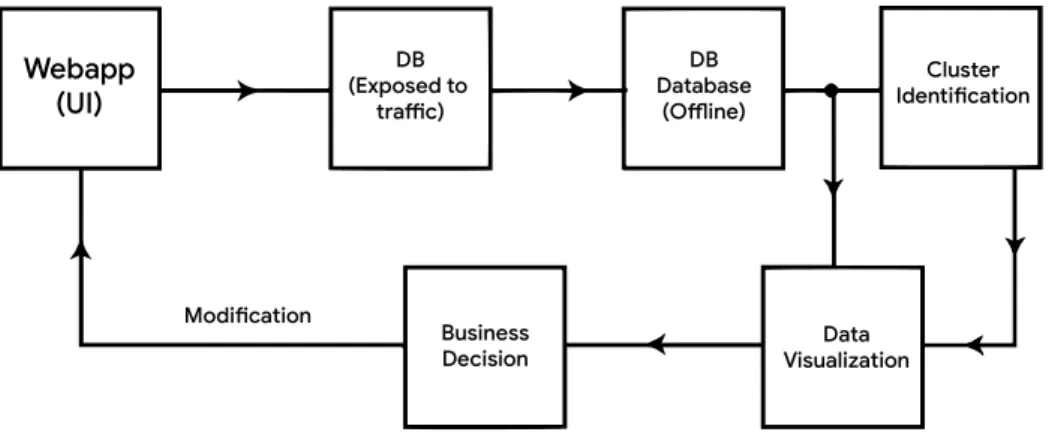
Identification Module which is responsible for segmenting the users into k clusters. Data Visu-alization Module has been used to plot latitude and longitude values of user location on an in-teractive map.
The proposed architecture has been imple-mented using the following software. The module for Data Loading, Cleaning and Trans-formation has been developed using Python 3 Jupyter Notebook. The Django Framework and Apache Web Server have been used to develop REST Service to provide value for data visual-ization. SQLite Database has been used for data storage and RStudio has been used to simulate the PCA algorithm and Data Visualization.
3. Mobile/Web User Interface
This section discusses the implementation of web user interface. At the beginning of every new session, the user is asked to provide the lo-cation on the web client. For every item click, the tracker function is called which sends the item name corresponding to the current user session to the controller function which is then written to the database along with the times-tamp. This is shown in Algorithm 1.
2. Proposed Architecture
The streaming approach is risky, mainly be-cause of the following reasons:
● Process generating the stream changes over time.
● Once two clusters are joined, there is no way to split the clusters required by the changes in the stream at a later stage. The offline approach gives us an advantage of studying changes in clusters over time by stor-ing the clusters at regular intervals. Moreover, offline methods give marketers flexibility to pull any subset of data and analyze the clusters formed during particular time intervals, which might help them retrieve greater insights and change trend from the data without dealing with the complexity of streaming architecture. Therefore, this paper laid a focus on system ar-chitecture, the flow of data and practical imple-mentation in the business context.
Figure 1 shows high level 5 phased model of the proposed design. The click data generated by the user is loaded into the system through web user interface and recorded in a database. All data is fetched from the database through a Restful HTTP API service and sent to Cluster
Figure 1. The architecture of proposed system.
under or over estimation can cause serious busi-ness loss or profit [17]. In a changing environ-ment segenviron-mentation helps in determination of potential market. With the exponential growth in the volume of data over the internet, it be-comes difficult to predict customer segment and pattern using traditional mathematical models. Timely identification of newly emerging trends from the huge volume of data plays a major role in the business process and decision making. The huge volume of data exists, but companies starve for knowledge. Data mining techniques help to overcome this knowledge scarcity. Data mining is "knowledge discovery in da-tabases (KDD) process" [18] to extract previ-ously unknown, interesting patterns as groups of related data records (cluster analysis), un-usual records (anomaly detection), and depen-dencies (association rule and sequential pattern mining) for future predictions [17], [19] and [20] from customer data due to their relatively low computational requirements. Clustering is one of the commonly used market segmen-tation techniques [21]. Clustering techniques minimize intra cluster distance and maximize inter cluster distance for data segmentation. Clustering methods can be broadly classified into four categories (17‒25): Partitioning, Hier -archical, Density-based and Grid-based meth-ods. Clustering can be applied in information retrieval, web pages grouping, image and mar-ket segmentation etc. [24]. For segment iden-tification, customer clustering is applied [25] using customer characteristics (demographics, socioeconomic factors, and geographic loca-tion), product-related behavioral characteris-tics (purchase behavior, consumption behavior, preference for attractions, experiences, and ser-vices). ANN and k-means clustering are widely used for market segmentation [26], [27], [28]. Clustering can also be applied for evaluating supermarket shopping paths [29] or deriving employers' branding strategies [30] apart from customer segmentation. In order to extend dis-tribution channel of the high end US furniture market, a socio-demographic segmentation for identification of potential buyer clustering technique has been used for analysis [31]. Data mining clustering technique has been applied to identify high-profit, high-value and low-risk customers. The data cleansing and patterns identification have been performed through
demographic clustering algorithm using IBM I-Miner and data profiling has been done to de-velop clusters to identify high-value low-risk customers. It has been observed that a cluster typically represented 10‒20 percent of cus -tomers which yields 80% of the revenue [32]. The SOM network developed using Iranian telecommunication company customer sales data showed that not only market segments but also mutual relationships between all market variables play major role [33]. Self-Organizing Map (SOM) has also been applied in tea-bev-erage for market segmentation and has showed improved results [34]. K-mean clustering has been applied for bicycle market segmentation. The different sub-segments were identified and separate policies were framed as per the seg-ment characteristics for increasing the bicy-cles sales [35]. Market researchers figured out that segments are based on realistic conditions whereas cluster analysis allows segmentation on subjectivity basis [9]. Customer/market seg-mentation is the process of finding homoge-nous sub-groups within a heterogeneous aggre-gate market in direct marketingin order to focus on profitable market segments [36]. To apply product marketing strategies, customer seg-mentation has been carried out on a beverage distribution firm using modified k-means algo-rithm, applying GRASP philosophy to get the initial centers. The meta-heuristic proved to be robust and fast compared to existing methods [37]. The Demand Side Platforms DSPs' strat-egy for market segmentation and a selection model of the granularity for segmenting (Real Time Bidding) RTB advertising markets have been studied and it has been observed that mar-ket segmentation has a crucial impact on the RTB advertising effect and DSPs should adjust their market segmentation strategies according to their total number of advertisers [38].
In this paper, an attempt has been made to pro-pose a model for formulating business strate-gies based on the users' interest and location. The clustering technique has been applied to customer's product-click data for segmentation and PCA technique has been applied to reduce dimensionality. Further, the geographical lo-cation has been fetched from an e-commerce website for data visualization.
Identification Module which is responsible for segmenting the users into k clusters. Data Visu-alization Module has been used to plot latitude and longitude values of user location on an in-teractive map.
The proposed architecture has been imple-mented using the following software. The module for Data Loading, Cleaning and Trans-formation has been developed using Python 3 Jupyter Notebook. The Django Framework and Apache Web Server have been used to develop REST Service to provide value for data visual-ization. SQLite Database has been used for data storage and RStudio has been used to simulate the PCA algorithm and Data Visualization.
3. Mobile/Web User Interface
This section discusses the implementation of web user interface. At the beginning of every new session, the user is asked to provide the lo-cation on the web client. For every item click, the tracker function is called which sends the item name corresponding to the current user session to the controller function which is then written to the database along with the times-tamp. This is shown in Algorithm 1.
2. Proposed Architecture
The streaming approach is risky, mainly be-cause of the following reasons:
● Process generating the stream changes over time.
● Once two clusters are joined, there is no way to split the clusters required by the changes in the stream at a later stage. The offline approach gives us an advantage of studying changes in clusters over time by stor-ing the clusters at regular intervals. Moreover, offline methods give marketers flexibility to pull any subset of data and analyze the clusters formed during particular time intervals, which might help them retrieve greater insights and change trend from the data without dealing with the complexity of streaming architecture. Therefore, this paper laid a focus on system ar-chitecture, the flow of data and practical imple-mentation in the business context.
Figure 1 shows high level 5 phased model of the proposed design. The click data generated by the user is loaded into the system through web user interface and recorded in a database. All data is fetched from the database through a Restful HTTP API service and sent to Cluster
Figure 1. The architecture of proposed system.
4. Database
The dataset refers to 200 users of dummy e-commerce website developed and hosted on-line as a part of the experiment conducted for this research. It displayed 68 items for sale. Us-ers were asked to click on the items in order of their preference. Every click for each current user session is registered in an online database which tracks the order in which the items are clicked by the user. At some time t, the data is pulled by a remote machine and loaded in the memory for further analysis, as shown in Figure 3.
5. User Segment Identification
Module
In this module, collected data is transformed into N×n-dimensional sparse Boolean feature matrix M, where each row represents a user ses-sion and columns represent items such that,
M [i, j] = 1, if user i clicked on the item j,
M [i, j] = 0, otherwise
N = Number of items
n = Number of user sessions
PCA is performed on this matrix to identify the features in which most of the information is contained, thereby reducing the dimensionality of the original dataset.
5.1. Principal Component Analysis (PCA) PCA maps the number of correlated variables into a smaller set of uncorrelated variables called the principal components. The first prin-cipal component represents maximum vari-ability in the data and succeeding components describe the remaining variability [39]. PCA and the linear transformation are used for di-mensionality and noise reduction and initial centeroid computation for k-means clustering algorithm [36] and [40]. The heuristics ap-proach is used to reduce the number of distance calculation to assign the data point to the clus-ter. It has been analyzed that as the number of records increases, the time execution of both techniques is increased. It has also been ob-served that fuzzy c-means performs better than the k-means algorithm [41]. Fuzzy c-means, compared with respect to other Clustering
Al-gorithm, requires more computation time [42]. In the current study, the purpose of the analysis of principal components is to compress infor-mation in a large set of correlated variables to few factors that can synthesize most of the total information contained in the original variables. The new set of features is sent as an input to k-mode clustering algorithm.
Figure 4 depicts the flow of data in the process-ing pipeline that transforms the raw data into clusters. Dimensionality reduction is performed
using PCA followed by k-modes clustering al-gorithm to obtain a dictionary of similar users where the key represents cluster number and values are lists of similar users identified by session id.
Figure 7 shows that it was observed that 20 components explained approximately 98.29% of the variance. So, for k-mode, only those 20 components were taken into consideration.
6. Data Mining and Clustering
Methods
The k-means [43] is the most commonly used clustering technique where the accuracy de-pends upon the choice of the initial seeds [44]
Figure 3. Record fetched from the server database.
Algorithm 2. Algorithm for fetching records for analysis.
1. Initialize API endpoint object 2. Make post request to the endpoint 3. Parse the data in JSON format 4. Compute the number of records 5. Create database connection object
6. For each record fetch the following values: ID, Username, pathname, Host_name, valueKey, Session_value, Latitude, Longitude, tagData, dateVal.
Figure 4. Flow of PCA and k-mode clustering implementation.
Algorithm 3. PCA Implementation.
1. Load the data 2. Identify predictors
3. Identify and remove zero variance columns from the dataset
4. The PCA is performed using R function prcomp (). It centers the variable so it has the mean value equal to zero. It also normalizes the variables to have standard deviation equal to 1.
Figure 5. Screenshot of dataset.
Figure 6. Snapshot of 68 boolean predictor variables. Figure 7. Principal component vs cumulative proportion of variance.
Algorithm 1. User Session Details.
1. Get unique session ID from 'data-username' attribute.
2. If unique session ID is not set:
(i) Generate new unique session ID with random values.
(ii) Store generated ID into the database.
3. Create new temporary session (with timestamp as the unique parameter) ‒
(i) Store session in sessionStorage of the browser. 4. Get latitude and longitude.
5. Get pathname and hostname.
6. Insert all required session details to database: Current Session, Path Name, Hostname, Latitude, Longitude, Unique Session ID
7. ('a' tag or 'button' tag with data attribute ‒ data-analysis = TagName)
8. Get tag name from the clicked attribute.
4. Database
The dataset refers to 200 users of dummy e-commerce website developed and hosted on-line as a part of the experiment conducted for this research. It displayed 68 items for sale. Us-ers were asked to click on the items in order of their preference. Every click for each current user session is registered in an online database which tracks the order in which the items are clicked by the user. At some time t, the data is pulled by a remote machine and loaded in the memory for further analysis, as shown in Figure 3.
5. User Segment Identification
Module
In this module, collected data is transformed into N×n-dimensional sparse Boolean feature matrix M, where each row represents a user ses-sion and columns represent items such that,
M [i, j] = 1, if user i clicked on the item j,
M [i, j] = 0, otherwise
N = Number of items
n = Number of user sessions
PCA is performed on this matrix to identify the features in which most of the information is contained, thereby reducing the dimensionality of the original dataset.
5.1. Principal Component Analysis (PCA) PCA maps the number of correlated variables into a smaller set of uncorrelated variables called the principal components. The first prin-cipal component represents maximum vari-ability in the data and succeeding components describe the remaining variability [39]. PCA and the linear transformation are used for di-mensionality and noise reduction and initial centeroid computation for k-means clustering algorithm [36] and [40]. The heuristics ap-proach is used to reduce the number of distance calculation to assign the data point to the clus-ter. It has been analyzed that as the number of records increases, the time execution of both techniques is increased. It has also been ob-served that fuzzy c-means performs better than the k-means algorithm [41]. Fuzzy c-means, compared with respect to other Clustering
Al-gorithm, requires more computation time [42]. In the current study, the purpose of the analysis of principal components is to compress infor-mation in a large set of correlated variables to few factors that can synthesize most of the total information contained in the original variables. The new set of features is sent as an input to k-mode clustering algorithm.
Figure 4 depicts the flow of data in the process-ing pipeline that transforms the raw data into clusters. Dimensionality reduction is performed
using PCA followed by k-modes clustering al-gorithm to obtain a dictionary of similar users where the key represents cluster number and values are lists of similar users identified by session id.
Figure 7 shows that it was observed that 20 components explained approximately 98.29% of the variance. So, for k-mode, only those 20 components were taken into consideration.
6. Data Mining and Clustering
Methods
The k-means [43] is the most commonly used clustering technique where the accuracy de-pends upon the choice of the initial seeds [44]
Figure 3. Record fetched from the server database.
Algorithm 2. Algorithm for fetching records for analysis.
1. Initialize API endpoint object 2. Make post request to the endpoint 3. Parse the data in JSON format 4. Compute the number of records 5. Create database connection object
6. For each record fetch the following values: ID, Username, pathname, Host_name, valueKey, Session_value, Latitude, Longitude, tagData, dateVal.
Figure 4. Flow of PCA and k-mode clustering implementation.
Algorithm 3. PCA Implementation.
1. Load the data 2. Identify predictors
3. Identify and remove zero variance columns from the dataset
4. The PCA is performed using R function prcomp (). It centers the variable so it has the mean value equal to zero. It also normalizes the variables to have standard deviation equal to 1.
Figure 5. Screenshot of dataset.
Figure 6. Snapshot of 68 boolean predictor variables. Figure 7. Principal component vs cumulative proportion of variance.
Algorithm 1. User Session Details.
1. Get unique session ID from 'data-username' attribute.
2. If unique session ID is not set:
(i) Generate new unique session ID with random values.
(ii) Store generated ID into the database.
3. Create new temporary session (with timestamp as the unique parameter) ‒
(i) Store session in sessionStorage of the browser. 4. Get latitude and longitude.
5. Get pathname and hostname.
6. Insert all required session details to database: Current Session, Path Name, Hostname, Latitude, Longitude, Unique Session ID
7. ('a' tag or 'button' tag with data attribute ‒ data-analysis = TagName)
8. Get tag name from the clicked attribute.
and it often falls in local optima, which is a ma-jor disadvantage for post-hoc market segmen-tation cases as accurate market clusters des-ignation is not possible for market managers. Therefore, in the current study, k-mode cluster-ing algorithm has been considered.
6.1. K-Mode Clustering Algorithm
K-mode clustering algorithm is an extension to the standard k-means clustering algorithm. Un-like k-means, k-mode operates on categorical data. The major modification includes distance function, cluster center representation and iter-ative clustering process [45] and [46].
6.1.1. The K-Modes Algorithm
Let D = {X1, X2, …, Xn} be a set of n categorical objects, where each Xi = [xi,1, xi,2, …, xi,m] is
described by m categorical attributes A1, …, Am.
Each attribute Aj describes a domain of values,
denoted by
( )
{
( ) ( )1, 2 , , ( )pj}
j j j j
Dom A = a a a
where pj is the number of category values of
attribute Aj. The k-modes algorithm operates on
the k-means model to search a partition of D
into k clusters such that it minimizes the objec-tive function P with unknown variables U and Z
according to following equations: [47]
(
,)
1 1 1 ,(
, , ,)
k n mi j i j i j l i j
P U Z u d x z
= = =
=
∑∑ ∑
(1) Subject to
1 , 1, 1 k
i j
l= u i n
= ≤ ≤
∑
(2)
ui j, ∈
{ }
0,1 , 1≤ ≤i n, 1≤ ≤l k (3)where
● U is a n × k partition matrix, u(i,j), is a bi-nary variable, and u(i,j) = 1, indicates that object xi is allocated to cluster Ci;
● Z = {Z1, Z2, …, Zk} is a set of vectors
repre-senting the centers of the k clusters, where
Zi = [Zl,1, Zl,2, …, Zl,m} (1 ≤ l ≤ k)
6.1.2. Distance Function
d(xi,j, zi,j) is a distance or dissimilarity measure
between object Xi and the center of cluster Ci
on attribute Aj. In k-modes algorithm, a simple
matching distance measure is used. That is, the distance between two distinct categorical val-ues is 1, while the distance between two identi-cal categoriidenti-cal values is 0. More precisely [47],
(
)
( )
(
)
(
)
, ,
, ,
, ,
0, ,
1,
i j i j i j i j
i j i j
x z
d x z f x
x z
=
= =
≠
(4)
The optimization problem in k-modes cluster-ing can be solved by iteratively solvcluster-ing the fol-lowing two minimization problems [47]:
1. Problem P1: FixZ = Ẑ, solve the reduced
problem P(U, Ẑ)
2. Problem P2: FixU = Û, solve the reduced
problem P(Û, Z)
Problems P1 and P2 are solved according to the two following theorems, respectively.
Theorem 1: Let Z = (Ẑ) be fixed, P(U, Ẑ) is minimized if and only if
( )
(
, ,)
(
, ,)
1 1
1, , , , 1
0, otherwise
ij
m m
i j i j i j h j
j j
u f x
d x z d x z h h k
= =
= =
≤ ∀ ≤ ≤
=
∑ ∑
Theorem 2: Let U = Û be fixed P(U, Ẑ) is min-imized if and only if
( )
, r
i j j
z =a
where a( )jr is the mode of attribute values of Ai
in the cluster Ci that satisfies
( )
(
r)
(
( )t)
, 1j l j l j
f a C ≥ f a C ∀t ≤ ≤t p
Here f a C
(
( )jr l)
denotes the frequency countof attribute value ( )r j
a in the cluster Ci i.e.
( )
(
)
{
( )}
, , , , 1
r r
j l i j i j j i j
f a C = u x =a u =
6.1.3. The K-Modes Algorithm Implementation
1. Randomly choose an initial Z(1). Determine
U(1) such that P(U, Z (1)) is minimized. Set
t = 1.
2. Determine Z(t+1) such that P(U(t),Z (t+1)) is minimized. If P(U(t),Z (t+1)) = P(U(t),Z (t)), then stop; otherwise go to step 3
3. Determine U(t+1) such that P(U(t+1),Z (t+1)) is minimized. If P (U(t +1), Z (t +1)) =
P(U(t),Z (t+1)) , then stop; otherwise t = t + 1 go to step 2
6.2. Cluster Analysis and Identification Process
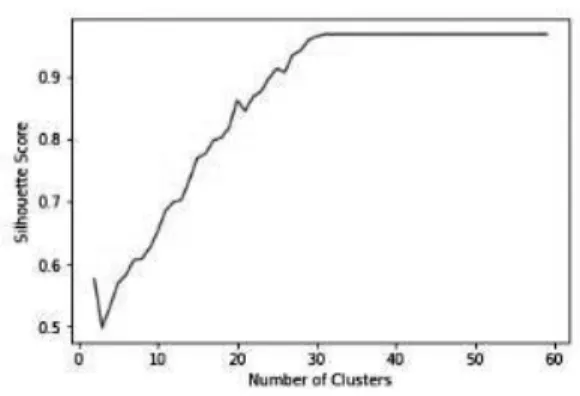
To study the hidden underlying user clusters in the dataset, the assumed number of clusters (k) were iteratively incremented from 2 to 60 and the model was trained using the k-mode algo-rithm.
6.2.1. Cluster Evaluation
In the current study, clusters have been eval-uated using Silhouette Score Evaluation Met-ric. Silhouette Score is a measure of similarity which measures the proximity of an object to its own cluster (cohesion) compared to other clusters (separation) [48]. The performance of clusters obtained at each iteration using the al-gorithm discussed in the previous section has
been evaluated using Silhouette Score for the different number of pre-initialized cluster cen-ters. The maximum value of Silhouette Score observed during the experiment was 0.967742, when the assumed number of underlying clus-ters was set to 31, as shown in Figure 8.
For behavior models it is important to make some intuitive sense to humans. In this section, results of qualitative analysis of a few behav-ioral clusters are discussed. The e-commerce website used for the experiment consisted of 68 male and female garment categories. Each click triggered an event which was recorded as either 1 or 0 for that user session. It was observed that 68% of sessions that belonged to cluster #1 had a high preference for female category items. 57% sessions belonging to this cluster showed interest in mostly all Nike items presented on the site. In Cluster 3, most visitors did not click any item at all.
7. Mapping Geographical Distribution
Knowledge of the geographical distribution of consumer base helps business organizations to make better marketing strategies in order to im-prove their profits. This subsystem in the pro-posed model is designed to interactively study the geographical distribution of customers vis-iting e-commerce websites.Algorithm 4. Evaluation Procedure.
For i in range (1, 60)
Set number_of_clusters = i
Train the model using the k-mode algorithm Obtain cluster centroids
Exit
Figure 8. Number of clusters vs silhouette score.
and it often falls in local optima, which is a ma-jor disadvantage for post-hoc market segmen-tation cases as accurate market clusters des-ignation is not possible for market managers. Therefore, in the current study, k-mode cluster-ing algorithm has been considered.
6.1. K-Mode Clustering Algorithm
K-mode clustering algorithm is an extension to the standard k-means clustering algorithm. Un-like k-means, k-mode operates on categorical data. The major modification includes distance function, cluster center representation and iter-ative clustering process [45] and [46].
6.1.1. The K-Modes Algorithm
Let D = {X1, X2, …, Xn} be a set of n categorical objects, where each Xi = [xi,1, xi,2, …, xi,m] is
described by m categorical attributes A1, …, Am.
Each attribute Aj describes a domain of values,
denoted by
( )
{
( ) ( )1, 2 , , ( )pj}
j j j j
Dom A = a a a
where pj is the number of category values of
attribute Aj. The k-modes algorithm operates on
the k-means model to search a partition of D
into k clusters such that it minimizes the objec-tive function P with unknown variables U and Z
according to following equations: [47]
(
,)
1 1 1 ,(
, , ,)
k n mi j i j i j l i j
P U Z u d x z
= = =
=
∑∑ ∑
(1) Subject to
1 , 1, 1 k
i j
l= u i n
= ≤ ≤
∑
(2)
ui j, ∈
{ }
0,1 , 1≤ ≤i n, 1≤ ≤l k (3)where
● U is a n × k partition matrix, u(i,j), is a bi-nary variable, and u(i,j) = 1, indicates that object xi is allocated to cluster Ci;
● Z = {Z1, Z2, …, Zk} is a set of vectors
repre-senting the centers of the k clusters, where
Zi = [Zl,1, Zl,2, …, Zl,m} (1 ≤ l ≤ k)
6.1.2. Distance Function
d(xi,j, zi,j) is a distance or dissimilarity measure
between object Xi and the center of cluster Ci
on attribute Aj. In k-modes algorithm, a simple
matching distance measure is used. That is, the distance between two distinct categorical val-ues is 1, while the distance between two identi-cal categoriidenti-cal values is 0. More precisely [47],
(
)
( )
(
)
(
)
, ,
, ,
, ,
0, ,
1,
i j i j i j i j
i j i j
x z
d x z f x
x z
=
= =
≠
(4)
The optimization problem in k-modes cluster-ing can be solved by iteratively solvcluster-ing the fol-lowing two minimization problems [47]:
1. Problem P1: FixZ = Ẑ, solve the reduced
problem P(U, Ẑ)
2. Problem P2: FixU = Û, solve the reduced
problem P(Û, Z)
Problems P1 and P2 are solved according to the two following theorems, respectively.
Theorem 1: Let Z = (Ẑ) be fixed, P(U, Ẑ) is minimized if and only if
( )
(
, ,)
(
, ,)
1 1
1, , , , 1
0, otherwise
ij
m m
i j i j i j h j
j j
u f x
d x z d x z h h k
= =
= =
≤ ∀ ≤ ≤
=
∑ ∑
Theorem 2: Let U = Û be fixed P(U, Ẑ) is min-imized if and only if
( )
, r
i j j
z =a
where a( )jr is the mode of attribute values of Ai
in the cluster Ci that satisfies
( )
(
r)
(
( )t)
, 1j l j l j
f a C ≥ f a C ∀t ≤ ≤t p
Here f a C
(
( )jr l)
denotes the frequency countof attribute value ( )r j
a in the cluster Ci i.e.
( )
(
)
{
( )}
, , , , 1
r r
j l i j i j j i j
f a C = u x =a u =
6.1.3. The K-Modes Algorithm Implementation
1. Randomly choose an initial Z(1). Determine
U(1) such that P(U, Z (1)) is minimized. Set
t = 1.
2. Determine Z(t+1) such that P(U(t),Z (t+1)) is minimized. If P(U(t),Z (t+1)) = P(U(t),Z (t)), then stop; otherwise go to step 3
3. Determine U(t+1) such that P(U(t+1),Z (t+1)) is minimized. If P (U(t +1), Z (t +1)) =
P(U(t),Z (t+1)) , then stop; otherwise t = t + 1 go to step 2
6.2. Cluster Analysis and Identification Process
To study the hidden underlying user clusters in the dataset, the assumed number of clusters (k) were iteratively incremented from 2 to 60 and the model was trained using the k-mode algo-rithm.
6.2.1. Cluster Evaluation
In the current study, clusters have been eval-uated using Silhouette Score Evaluation Met-ric. Silhouette Score is a measure of similarity which measures the proximity of an object to its own cluster (cohesion) compared to other clusters (separation) [48]. The performance of clusters obtained at each iteration using the al-gorithm discussed in the previous section has
been evaluated using Silhouette Score for the different number of pre-initialized cluster cen-ters. The maximum value of Silhouette Score observed during the experiment was 0.967742, when the assumed number of underlying clus-ters was set to 31, as shown in Figure 8.
For behavior models it is important to make some intuitive sense to humans. In this section, results of qualitative analysis of a few behav-ioral clusters are discussed. The e-commerce website used for the experiment consisted of 68 male and female garment categories. Each click triggered an event which was recorded as either 1 or 0 for that user session. It was observed that 68% of sessions that belonged to cluster #1 had a high preference for female category items. 57% sessions belonging to this cluster showed interest in mostly all Nike items presented on the site. In Cluster 3, most visitors did not click any item at all.
7. Mapping Geographical Distribution
Knowledge of the geographical distribution of consumer base helps business organizations to make better marketing strategies in order to im-prove their profits. This subsystem in the pro-posed model is designed to interactively study the geographical distribution of customers vis-iting e-commerce websites.Algorithm 4. Evaluation Procedure.
For i in range (1, 60)
Set number_of_clusters = i
Train the model using the k-mode algorithm Obtain cluster centroids
Exit
Figure 8. Number of clusters vs silhouette score.
Data is read from sqlite3 database and ap-pended to csv file. It is then pulled by the pro-gram written in R which generates a map.html file with all the locations marked as different color points. The file is served on the browser through apache web server on a local system. The geocoordinates from the data collected during the visitor session are appended to a .csv file which is then plotted on an interactive map using ggplot and leaflet packages of R pro-gramming language.
8. Visualization
Visualizations helps business decision makers to examine a large amount of data quickly hid-ing the complexities of what is actually stored in databases or excel sheets. Thus the impor-tance of data visualization in business intelli-gence cannot be ignored. The proposed sub-system aims to provide interactive time series, bar plots and graphs to answer some important business questions. The goal of the module is to answer the following important questions:
● Which was the most popular product on any given day?
● How the popularity of any product varies over time?
The architecture of the system is discussed in the following subsection.
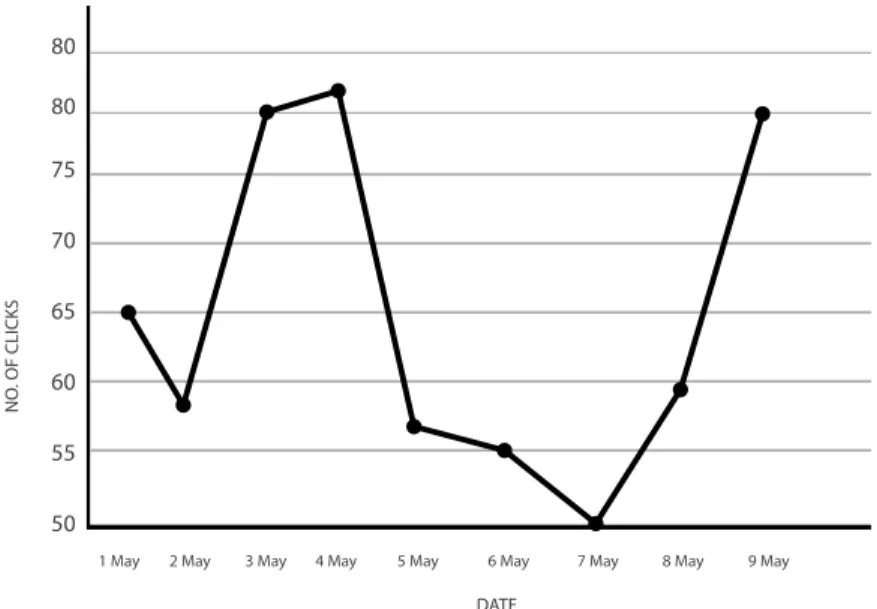
Figure 11 shows the high-level architecture of visualization module developed on Django framework. It computes the count of clicks on each product for a range of days in order to vi-sualize how a product is performing over a pe-riod of time. The counts are sent as json object for each product whenever a web client requests them and graphical representation is displayed on the browser, transformed to list of coordi-nates and pushed into the server. The informa-tion is fetched by a web applicainforma-tion from the server which plots the information on the sys-tem of the decision maker, once it is available. A decision is made and the suggested changes are reflected back to the original e-commerce content displayed to users.
In Figure 12, x-axis shows name of product and y-axis shows total number of clicks on a selected day.
In Figure 13, x-axis shows date and y-axis shows number of clicks for a selected product.
9. Conclusions
The paper describes the BI tool and a decision process for market segmentation based on user behavior analysis and geographical informa-tion. PCA, followed by the application of the k-mode clustering algorithm, has been applied for segmentation. The proposed architecture
provides a simplified system for formulating business strategies suitable for the small inter-net business owners or growing startups. It is a complete toolkit from data cleaning to visual-ization. The proposed system also identifies the popularity of each product within a time period using interactive visualizations in targeting the unique segments for connecting with potential customers for business expansion.
10. Future Work
The proposed architecture can be extended to integrate with real-time analytical tools. The proposed system can be scaled up by adopting HDFS and MapReduce techniques to build a fully fledged production system.
References
[1] R. C. Basole and W. Rouse, "Complexity of Ser-vice Value Networks: Conceptualization and Em -pirical Investigation", IBM Systems Journal, vol. 47, no. 1, pp. 53–70, 2008.
http://dx.doi.org/10.1147/sj.471.0053
[2] H. Chen et al., "Business Intelligence and Analyt-ics: from Big Data to Big Impact", MIS Quarterly (Special Issue Business Intelligence Research), vol. 36, no. 4, pp. 1165–1188, 2012.
https://ai.arizona.edu/sites/ai/files/MIS611D/ chen-bi-december-2012.pdf
[3] R. Lengler and M. J. Eppler, "Towards a Peri-odic Table of Visualization Methods for Manage-ment", in IASTED Proceeding of the Conference on Graphics and Visualization in Engineering (GVE 2007), 2007, pp. 83‒88.
Figure 11. Architecture for data visualization.
Figure 10. Geographical distribution of users generated by ggplot2 and leaflet.
Figure 12. Number of clicks for products.
75 80 80
70
65
60
55
50
1 May 2 May 3 May 4 May 5 May 6 May 7 May 8 May 9 May
NO
. OF CLICKS
DATE
Data is read from sqlite3 database and ap-pended to csv file. It is then pulled by the pro-gram written in R which generates a map.html file with all the locations marked as different color points. The file is served on the browser through apache web server on a local system. The geocoordinates from the data collected during the visitor session are appended to a .csv file which is then plotted on an interactive map using ggplot and leaflet packages of R pro-gramming language.
8. Visualization
Visualizations helps business decision makers to examine a large amount of data quickly hid-ing the complexities of what is actually stored in databases or excel sheets. Thus the impor-tance of data visualization in business intelli-gence cannot be ignored. The proposed sub-system aims to provide interactive time series, bar plots and graphs to answer some important business questions. The goal of the module is to answer the following important questions:
● Which was the most popular product on any given day?
● How the popularity of any product varies over time?
The architecture of the system is discussed in the following subsection.
Figure 11 shows the high-level architecture of visualization module developed on Django framework. It computes the count of clicks on each product for a range of days in order to vi-sualize how a product is performing over a pe-riod of time. The counts are sent as json object for each product whenever a web client requests them and graphical representation is displayed on the browser, transformed to list of coordi-nates and pushed into the server. The informa-tion is fetched by a web applicainforma-tion from the server which plots the information on the sys-tem of the decision maker, once it is available. A decision is made and the suggested changes are reflected back to the original e-commerce content displayed to users.
In Figure 12, x-axis shows name of product and y-axis shows total number of clicks on a selected day.
In Figure 13, x-axis shows date and y-axis shows number of clicks for a selected product.
9. Conclusions
The paper describes the BI tool and a decision process for market segmentation based on user behavior analysis and geographical informa-tion. PCA, followed by the application of the k-mode clustering algorithm, has been applied for segmentation. The proposed architecture
provides a simplified system for formulating business strategies suitable for the small inter-net business owners or growing startups. It is a complete toolkit from data cleaning to visual-ization. The proposed system also identifies the popularity of each product within a time period using interactive visualizations in targeting the unique segments for connecting with potential customers for business expansion.
10. Future Work
The proposed architecture can be extended to integrate with real-time analytical tools. The proposed system can be scaled up by adopting HDFS and MapReduce techniques to build a fully fledged production system.
References
[1] R. C. Basole and W. Rouse, "Complexity of Ser-vice Value Networks: Conceptualization and Em -pirical Investigation", IBM Systems Journal, vol. 47, no. 1, pp. 53–70, 2008.
http://dx.doi.org/10.1147/sj.471.0053
[2] H. Chen et al., "Business Intelligence and Analyt-ics: from Big Data to Big Impact", MIS Quarterly (Special Issue Business Intelligence Research), vol. 36, no. 4, pp. 1165–1188, 2012.
https://ai.arizona.edu/sites/ai/files/MIS611D/ chen-bi-december-2012.pdf
[3] R. Lengler and M. J. Eppler, "Towards a Peri-odic Table of Visualization Methods for Manage-ment", in IASTED Proceeding of the Conference on Graphics and Visualization in Engineering (GVE 2007), 2007, pp. 83‒88.
Figure 11. Architecture for data visualization.
Figure 10. Geographical distribution of users generated by ggplot2 and leaflet.
Figure 12. Number of clicks for products.
75 80 80
70
65
60
55
50
1 May 2 May 3 May 4 May 5 May 6 May 7 May 8 May 9 May
NO
. OF CLICKS
DATE
[4] K. Zhang, "Using Visual Languages in Manage-ment", Journal of Visual Languages & Comput-ing, vol. 23, no. 6, pp. 340–343, 2012.
http://dx.doi.org/10.1016/j.jvlc.2012.09.001 [5] M. Ankerst et al., "Circle Segments: A Technique
for Visually Exploring Large Multidimensional Data Sets", in Proc. Visualization '96, Hot Topic Session, San Francisco, CA, 1996.
http://citeseerx.ist.psu.edu/viewdoc/download? doi=10.1.1.68.1811&rep=rep1&type=pdf [6] D. A. Keim, "Pixel-oriented Visualization
Tech-niques for Exploring Very Large Databases",
Journal of Computational and Graphical Statis-tics, vol. 5, pp. 58‒77, 1996.
https://pdfs.semanticscholar.org/ce1e/
b9ed41232690a1ab0b6b7322cfdb10a385cc.pdf [7] P. Kotler, "Marketing Management – Analysis,
Planning and Control" (4th ed.), Prentice-Hall, 1980.
[8] M. J. Crotft, "Market Segmentation: A Step-by-step Guide to Profitable New Business", Rout-ledge, Paperback, 1994.
[9] M. Sarstedt and E. Mooi, "A Concise Guide to Market Research", Springer Texts in Business and Economics, Springer-Verlag Berlin Heidel -berg, pp. 273‒324, 2014.
http://dx.doi.org/10.1007/978-3-642-53965-7 [10] A. Weinstein, "Market Segmentation: Using De
-mographics, Psychographics and other Niche Marketing Techniques to Predict and Model Cus-tomer Behavior", Chicago: Probus Pub. Co., 1994 [11] V. Venugopal and W. Baets, "Neural Networks and
Statistical Techniques in Marketing Research: A Conceptual Comparison", Marketing Intelligence and Planning, vol. 12, no. 7, pp. 30–38, 1994. http://dx.doi.org/10.1108/02634509410065555 [12] David Shepard Associates, "The New Direct
Marketing: How to Implement a Profit-Driven Database Marketing Strategy", 3rd edition, 1998. [13] P. Kotler, "Marketing Management", Englewood
Cliffs, Prentice-Hall, 2001.
[14] C. Swearingen, "101 Powerful Marketing Strate-gies for Growing Your Business Now!", SmallBiz Marketing Services, pp. 24‒27, 2009.
[15] C. K. Bhensdadia and Y. P. Kosta, "Discover-ing Active and Profitable Patterns with RFM (Recency, Frequency and Monetary) Sequential Pattern Mining – a Constraint based Approach",
International Journal of Information Technology and Knowledge Management, vol. 4, no.1, pp. 27‒32, 2011.
https://pdfs.semanticscholar.org/6771/
423d0ac5347555c5ead347374175d3cd7ea2.pdf [16] A. L. Majurin, "Industrial Segmentation. A
Re-view", Memo-Stencil, Preliminära Forsknings-rapporter från Företagsekonomiska, 208, 2001, ISSN 0357-4571.
http://web.abo.fi/fak/esf/fei/wrkpaper/ms208/ memostencil208.pdf
[17] R. Adner, "The Wide Lens: A New Strategy for Innovation", Penguin Group, vol. 30, no. 1, pp. 277, 2012.
https://doi.org/10.1111/j.1467-9310.2012.00697 xhttp://www.vikalpa.com/pdf/articles/2014/ vikalpa-39-1-159.pdf
[18] U. Fayyad et al., "From Data Mining to Knowl-edge Discovery in Databases", AI Magazine, vol. 17 no. 3, pp. 37‒54, 1996.
https://doi.org/10.1609/aimag.v17i3.1230
[19] T. Harris, "Optimization Creates Lean Green Supply Chains", Data Mining Book, 2008. [20] M. Hartely, "Using Data Mining to Predict Inven
-tory Levels", Data Mining Book, 2005.
[21] M. Wedel and W. A. Kamakura, "Market Seg-mentation Conceptual and Methodological Foun-dations", Kluwer Academic Publishers, 2000. [22] I. H. Witten and E. Frank, (2000). Data mining:
Practical machine learning tools and techniques. Morgan Kaufmann series in data management systems.
[23] S. Hwang and J. C. Thill, "Using Fuzzy Cluster -ing Methods for Delineat-ing Urban Hous-ing Sub -markets", Proceedings of the 15th International Symposium on Advances in Geographic Informa-tion Systems, [17] IDC, 2013, IDC Big Data and Business Analytics Forum 2013, in Leveraging Data for Agile Business.
http://dx.doi.org/10.1145/1341012.1341031 [24] D. T. Pham and A. A Afify, "Clustering
Tech-niques and their Applications in Engineering",
Proceedings of the Institution of Mechanical Engineers, Part C: Journal of Mechanical Engi-neering Science, 2006, pp. 103‒119.
http://dx.doi.org/10.1016/B978-008045157-2/50060-2 [25] G. Saarenvirta, "Mining Customer Data", DB2
Magazine, vol. 3, no. 3, pp. 10–20, 1998.
[26] C. Hung and C. Tsai, "Market Segmentation based on Hierarchical Self Organizing Map for Markets of Multimedia on Demand", Expert Systems with Applications, vol. 34, pp.780–787, 2008.
http://dx.doi.org/10.1016/j.eswa.2006.10.012 [27] K. C. Gehr and S. Shim, "A Shopping Orientation
Segmentation of French Consumers: Implications for Catalog Marketing", Journal of Interactive Marketing, vol. 12, no. 4, pp. 34–46, 1998. http://dx.doi.org/10.1002/(SICI)1520-6653 (199823)12:4%3C34::AID-DIR4%3E3.3.CO;2-F [28] R. J. Kuo et al., "Integration of Self-organizing
Feature Maps and Genetic-Algorithm-Based Clustering Method for Market Segmentation",
Journal of Organizational Computing and Elec-tronic Commerce, vol. 14, no.1, pp. 43–60, 2004. http://dx.doi.org/10.1207/s15327744joce1401_3
[29] J. S. Larson et al., "An Exploratory Look at Su-permarket Shopping Paths", International Jour-nal of Research in Marketing, vol. 22, no.4, pp. 395–414, 2005.
http://dx.doi.org/10.1016/j.ijresmar.2005.09.005 [30] L. Moroko, and M. D. Uncles, "Employer
Brand-ing and Market Segmentation", Journal of Brand Management, vol. 17, no. 3, pp. 181–196, 2009. http://dx.doi.org/10.1057/bm.2009.10
[31] L. E. ThiThu Hoa et al., "Decision Support Sys-tem based on Socio-demographic Segmentation and Distribution Channel Analysis in the US Furniture Market", International Conference on Industrial Engineering and Systems Management (IESM), 2009, Montreal, Canada.
[32] S. Rajagopal, "Customer Data Clustering using Data Mining Technique", International Journal of Database Management Systems (IJDMS), vol. 3, no. 4, pp. 1‒11, 2011.
http://dx.doi.org/10.5121/ijdms.2011.3401 https://arxiv.org/ftp/arxiv/papers/1112/1112.2663.pdf [33] P. Hanafizadeh et al. "An Expert System for Per-fume Selection using Artificial Neural Network",
Expert Systems with Applications, vol. 37, no. 12, pp. 8879‒8887, 2010.
http://dx.doi.org/10.1016/j.eswa.2010.06.008 [34] C. W. Hong, "Using the Taguchi Method for Ef
-fective Market Segmentation", Expert Systems with Applications, vol. 39, no. 5, pp. 5451‒5459, 2012.
http://dx.doi.org/10.1016/j.eswa.2011.11.040 [35] Z. Li et al., "Bicycle Commuting Market
Anal-ysis using Attitudinal Market Segmentation Ap-proach", Transportation Research Part A: Policy and Practice, vol. 47, pp. 56‒68, 2013.
http://dx.doi.org/10.1016/j.tra.2012.10.017 [36] A. Fahmida et al., "Comparative Performance of
Using PCA With K-Means and Fuzzy C-Means Clustering For Customer Segmentation", Interna-tional Journal of Scientific and Technology Re-search, vol. 4, no.10, pp. 70‒74, 2015.
[37] L. Diana et al., "An Iterated Greedy Heuristic for a Market Segmentation Problem with Multiple Attributes", European Journal of Operational Research, vol. 261, no. 1, pp. 75‒87, 2017. [38] R. Qin et al., "Exploring the Optimal
Granular-ity for Market Segmentation in RTB Advertising via Computational Experiment Approach", Elec-tronic Commerce Research and Applications, vol. 24, pp. 68‒83, 2017.
http://dx.doi.org/10.1016/j.elerap.2017.07.001 [39] S. S. Deshmukh et al., "Pose Variant Based
Com-parative Analysis of PCA and LDA", Second In-ternational Conference on Emerging Trends in Engineering & Technology, 2009.
http://dx.doi.org/10.1109/ICETET.2009.181
[40] S. Tajunisha, "Performance Analysis of K-means with Different Initialization Methods for High Dimensional Data", International Journal of Ar-tificial Intelligence and Applications, vol. 1, no. 4, pp. 44‒52, 2010.
http://dx.doi.org/10.5121/ijaia.2010.1404
[41] A. Sheshasayee and P. Sharmila, "Comparative Study of Fuzzy C-Means and K Means Algo-rithm for Requirements Clustering", Indian Jour-nal of Science and Technology, vol. 7, no. 6, pp. 853–857, 2014.
http://www.indjst.org/index.php/indjst/article/ viewFile/47757/41449
[42] S. Tejwant and M. Manish, "Performance Com-parison of Fuzzy C-Means with Respect to Other Clustering Algorithms", International Journal of Advanced Research in Computer Science and Software Engineering, vol. 4, pp. 89‒93, 2014. https://pdfs.semanticscholar.org/3720/
5c8fe390d36bde67a2e0f614d5ce8bba829b.pdf [43] J. MacQueen, "Some Methods for Classification
and Analysis of Multivariate Observations", in L. M. L. Cam & J. Neyman (Eds.), Proceeding of the fifth Berkeley Symposium on Mathematical Statistics and Probability, vol. 1, pp. 281‒297, 1996, University of California Press.
[44] G. W. Milligan and M. C. Cooper, "An Examina-tion of the Effect of Six Types of Error Perturba-tion on Fifteen Clustering Algorithms", Psycho-metrika, vol. 45, no. 3, pp. 159‒179, 1980. http://dx.doi.org/10.1007/BF02293907
[45] J. Z. Huang, "Clustering Categorical Data with K-Modes", The University of Hong Kong, Hong Kong, pp. 246‒248, 2009, IGI Global.
http://dx.doi.org/10.4018/978-1-60566-010-3.ch040 [46] A. M. Gayathri "Enhanced Customer Relation-ship Management", International Journal of Computer Science & Engineering Technology, vol. 1, no. 4, pp. 163‒167, 2011.
[47] Z. He et al., "Attribute Value Weighting in K-Modes Clustering", Department of Computer Science and Engineering, Harbin Institute of Technology, Expert Systems with Applications, vol. 38, no. 12, pp. 42‒47, 2011.
https://arxiv.org/pdf/cs/0701013
[4] K. Zhang, "Using Visual Languages in Manage-ment", Journal of Visual Languages & Comput-ing, vol. 23, no. 6, pp. 340–343, 2012.
http://dx.doi.org/10.1016/j.jvlc.2012.09.001 [5] M. Ankerst et al., "Circle Segments: A Technique
for Visually Exploring Large Multidimensional Data Sets", in Proc. Visualization '96, Hot Topic Session, San Francisco, CA, 1996.
http://citeseerx.ist.psu.edu/viewdoc/download? doi=10.1.1.68.1811&rep=rep1&type=pdf [6] D. A. Keim, "Pixel-oriented Visualization
Tech-niques for Exploring Very Large Databases",
Journal of Computational and Graphical Statis-tics, vol. 5, pp. 58‒77, 1996.
https://pdfs.semanticscholar.org/ce1e/
b9ed41232690a1ab0b6b7322cfdb10a385cc.pdf [7] P. Kotler, "Marketing Management – Analysis,
Planning and Control" (4th ed.), Prentice-Hall, 1980.
[8] M. J. Crotft, "Market Segmentation: A Step-by-step Guide to Profitable New Business", Rout-ledge, Paperback, 1994.
[9] M. Sarstedt and E. Mooi, "A Concise Guide to Market Research", Springer Texts in Business and Economics, Springer-Verlag Berlin Heidel -berg, pp. 273‒324, 2014.
http://dx.doi.org/10.1007/978-3-642-53965-7 [10] A. Weinstein, "Market Segmentation: Using De
-mographics, Psychographics and other Niche Marketing Techniques to Predict and Model Cus-tomer Behavior", Chicago: Probus Pub. Co., 1994 [11] V. Venugopal and W. Baets, "Neural Networks and
Statistical Techniques in Marketing Research: A Conceptual Comparison", Marketing Intelligence and Planning, vol. 12, no. 7, pp. 30–38, 1994. http://dx.doi.org/10.1108/02634509410065555 [12] David Shepard Associates, "The New Direct
Marketing: How to Implement a Profit-Driven Database Marketing Strategy", 3rd edition, 1998. [13] P. Kotler, "Marketing Management", Englewood
Cliffs, Prentice-Hall, 2001.
[14] C. Swearingen, "101 Powerful Marketing Strate-gies for Growing Your Business Now!", SmallBiz Marketing Services, pp. 24‒27, 2009.
[15] C. K. Bhensdadia and Y. P. Kosta, "Discover-ing Active and Profitable Patterns with RFM (Recency, Frequency and Monetary) Sequential Pattern Mining – a Constraint based Approach",
International Journal of Information Technology and Knowledge Management, vol. 4, no.1, pp. 27‒32, 2011.
https://pdfs.semanticscholar.org/6771/
423d0ac5347555c5ead347374175d3cd7ea2.pdf [16] A. L. Majurin, "Industrial Segmentation. A
Re-view", Memo-Stencil, Preliminära Forsknings-rapporter från Företagsekonomiska, 208, 2001, ISSN 0357-4571.
http://web.abo.fi/fak/esf/fei/wrkpaper/ms208/ memostencil208.pdf
[17] R. Adner, "The Wide Lens: A New Strategy for Innovation", Penguin Group, vol. 30, no. 1, pp. 277, 2012.
https://doi.org/10.1111/j.1467-9310.2012.00697 xhttp://www.vikalpa.com/pdf/articles/2014/ vikalpa-39-1-159.pdf
[18] U. Fayyad et al., "From Data Mining to Knowl-edge Discovery in Databases", AI Magazine, vol. 17 no. 3, pp. 37‒54, 1996.
https://doi.org/10.1609/aimag.v17i3.1230
[19] T. Harris, "Optimization Creates Lean Green Supply Chains", Data Mining Book, 2008. [20] M. Hartely, "Using Data Mining to Predict Inven
-tory Levels", Data Mining Book, 2005.
[21] M. Wedel and W. A. Kamakura, "Market Seg-mentation Conceptual and Methodological Foun-dations", Kluwer Academic Publishers, 2000. [22] I. H. Witten and E. Frank, (2000). Data mining:
Practical machine learning tools and techniques. Morgan Kaufmann series in data management systems.
[23] S. Hwang and J. C. Thill, "Using Fuzzy Cluster -ing Methods for Delineat-ing Urban Hous-ing Sub -markets", Proceedings of the 15th International Symposium on Advances in Geographic Informa-tion Systems, [17] IDC, 2013, IDC Big Data and Business Analytics Forum 2013, in Leveraging Data for Agile Business.
http://dx.doi.org/10.1145/1341012.1341031 [24] D. T. Pham and A. A Afify, "Clustering
Tech-niques and their Applications in Engineering",
Proceedings of the Institution of Mechanical Engineers, Part C: Journal of Mechanical Engi-neering Science, 2006, pp. 103‒119.
http://dx.doi.org/10.1016/B978-008045157-2/50060-2 [25] G. Saarenvirta, "Mining Customer Data", DB2
Magazine, vol. 3, no. 3, pp. 10–20, 1998.
[26] C. Hung and C. Tsai, "Market Segmentation based on Hierarchical Self Organizing Map for Markets of Multimedia on Demand", Expert Systems with Applications, vol. 34, pp.780–787, 2008.
http://dx.doi.org/10.1016/j.eswa.2006.10.012 [27] K. C. Gehr and S. Shim, "A Shopping Orientation
Segmentation of French Consumers: Implications for Catalog Marketing", Journal of Interactive Marketing, vol. 12, no. 4, pp. 34–46, 1998. http://dx.doi.org/10.1002/(SICI)1520-6653 (199823)12:4%3C34::AID-DIR4%3E3.3.CO;2-F [28] R. J. Kuo et al., "Integration of Self-organizing
Feature Maps and Genetic-Algorithm-Based Clustering Method for Market Segmentation",
Journal of Organizational Computing and Elec-tronic Commerce, vol. 14, no.1, pp. 43–60, 2004. http://dx.doi.org/10.1207/s15327744joce1401_3
[29] J. S. Larson et al., "An Exploratory Look at Su-permarket Shopping Paths", International Jour-nal of Research in Marketing, vol. 22, no.4, pp. 395–414, 2005.
http://dx.doi.org/10.1016/j.ijresmar.2005.09.005 [30] L. Moroko, and M. D. Uncles, "Employer
Brand-ing and Market Segmentation", Journal of Brand Management, vol. 17, no. 3, pp. 181–196, 2009. http://dx.doi.org/10.1057/bm.2009.10
[31] L. E. ThiThu Hoa et al., "Decision Support Sys-tem based on Socio-demographic Segmentation and Distribution Channel Analysis in the US Furniture Market", International Conference on Industrial Engineering and Systems Management (IESM), 2009, Montreal, Canada.
[32] S. Rajagopal, "Customer Data Clustering using Data Mining Technique", International Journal of Database Management Systems (IJDMS), vol. 3, no. 4, pp. 1‒11, 2011.
http://dx.doi.org/10.5121/ijdms.2011.3401 https://arxiv.org/ftp/arxiv/papers/1112/1112.2663.pdf [33] P. Hanafizadeh et al. "An Expert System for Per-fume Selection using Artificial Neural Network",
Expert Systems with Applications, vol. 37, no. 12, pp. 8879‒8887, 2010.
http://dx.doi.org/10.1016/j.eswa.2010.06.008 [34] C. W. Hong, "Using the Taguchi Method for Ef
-fective Market Segmentation", Expert Systems with Applications, vol. 39, no. 5, pp. 5451‒5459, 2012.
http://dx.doi.org/10.1016/j.eswa.2011.11.040 [35] Z. Li et al., "Bicycle Commuting Market
Anal-ysis using Attitudinal Market Segmentation Ap-proach", Transportation Research Part A: Policy and Practice, vol. 47, pp. 56‒68, 2013.
http://dx.doi.org/10.1016/j.tra.2012.10.017 [36] A. Fahmida et al., "Comparative Performance of
Using PCA With K-Means and Fuzzy C-Means Clustering For Customer Segmentation", Interna-tional Journal of Scientific and Technology Re-search, vol. 4, no.10, pp. 70‒74, 2015.
[37] L. Diana et al., "An Iterated Greedy Heuristic for a Market Segmentation Problem with Multiple Attributes", European Journal of Operational Research, vol. 261, no. 1, pp. 75‒87, 2017. [38] R. Qin et al., "Exploring the Optimal
Granular-ity for Market Segmentation in RTB Advertising via Computational Experiment Approach", Elec-tronic Commerce Research and Applications, vol. 24, pp. 68‒83, 2017.
http://dx.doi.org/10.1016/j.elerap.2017.07.001 [39] S. S. Deshmukh et al., "Pose Variant Based
Com-parative Analysis of PCA and LDA", Second In-ternational Conference on Emerging Trends in Engineering & Technology, 2009.
http://dx.doi.org/10.1109/ICETET.2009.181
[40] S. Tajunisha, "Performance Analysis of K-means with Different Initialization Methods for High Dimensional Data", International Journal of Ar-tificial Intelligence and Applications, vol. 1, no. 4, pp. 44‒52, 2010.
http://dx.doi.org/10.5121/ijaia.2010.1404
[41] A. Sheshasayee and P. Sharmila, "Comparative Study of Fuzzy C-Means and K Means Algo-rithm for Requirements Clustering", Indian Jour-nal of Science and Technology, vol. 7, no. 6, pp. 853–857, 2014.
http://www.indjst.org/index.php/indjst/article/ viewFile/47757/41449
[42] S. Tejwant and M. Manish, "Performance Com-parison of Fuzzy C-Means with Respect to Other Clustering Algorithms", International Journal of Advanced Research in Computer Science and Software Engineering, vol. 4, pp. 89‒93, 2014. https://pdfs.semanticscholar.org/3720/
5c8fe390d36bde67a2e0f614d5ce8bba829b.pdf [43] J. MacQueen, "Some Methods for Classification
and Analysis of Multivariate Observations", in L. M. L. Cam & J. Neyman (Eds.), Proceeding of the fifth Berkeley Symposium on Mathematical Statistics and Probability, vol. 1, pp. 281‒297, 1996, University of California Press.
[44] G. W. Milligan and M. C. Cooper, "An Examina-tion of the Effect of Six Types of Error Perturba-tion on Fifteen Clustering Algorithms", Psycho-metrika, vol. 45, no. 3, pp. 159‒179, 1980. http://dx.doi.org/10.1007/BF02293907
[45] J. Z. Huang, "Clustering Categorical Data with K-Modes", The University of Hong Kong, Hong Kong, pp. 246‒248, 2009, IGI Global.
http://dx.doi.org/10.4018/978-1-60566-010-3.ch040 [46] A. M. Gayathri "Enhanced Customer Relation-ship Management", International Journal of Computer Science & Engineering Technology, vol. 1, no. 4, pp. 163‒167, 2011.
[47] Z. He et al., "Attribute Value Weighting in K-Modes Clustering", Department of Computer Science and Engineering, Harbin Institute of Technology, Expert Systems with Applications, vol. 38, no. 12, pp. 42‒47, 2011.
https://arxiv.org/pdf/cs/0701013