ISSN-L: 2501 - 1235 Available on-line at: www.oapub.org/edu
doi: 10.5281/zenodo.1414166 Volume 4 │ Issue 10 │ 2018
EFFECTS OF ORGANIZATIONAL STRESS MANAGEMENT ON JOB
PERFORMANCE: AN APPLICATION ON SPORTS ORGANIZATIONS
Burhanettin Hacıcaferoğlu1,
İlker Günel2i,
Mehdi Duyan3
1Antalya Youth and
Sports Provincial Directorate, Turkey
2Mugla Sitki Kocman University,
Faculty of Sports Sciences, Turkey
3Bitlis Eren University,
Faculty of Sports Sciences, Turkey
Abstract:
The aim of this research is to examine the relationship between organizational stresses and job performance of sports organization employees on the basis of demographic variables. Surveys were carried out on 110 personnel working in the provincial Directorate of youth services and Sports in Antalya. In order to evaluate the data; the frequency distributions of the sports workers in order to determine the personal characteristics of the Youth Services and Sports Provincial Directorate which constituted the sample were examined. In order to determine the organizational stress and work performance levels, the descriptive statistics of the total scores obtained from the scales were examined. They can increase the productivity and motivation of the employees by decreasing the stress on the employees in sports organizations. As the motivation of the employees increase, the organizational efficiency of the employees will also be ensured.
Keywords: organizational stress; stress management; job performance; sports
organizations
Introduction
organizations. This increase in organizations has become the forefront of sports management (Bulut, 2005). The services of employees who work in sports organizations effectively and efficiently fulfill correctly is essential. Providing quality services to people by implementing a more effective sporting environment is important in terms of not shaking social trust. Each organization is to increase the quantity and quality of its most important product (Yağız ve Yaman, 2003:284). The situation that most affects the performance of the employees is known to the sport managers as stress, especially work stress or other word, organizational stress. Organizations are faced with organizational stress caused by the environment in the individual media organizations that fulfill specific roles and tasks. Organizational stress is a reaction that is the result of the external environment or phenomenon that loads psychological or physical demands on the individual affected by the psychological processes and the individual differences expressed as the relationship of the individual to the environment. It is a situation that brings about changes that keep people arise from personal relationships and business relations away from their normal functions (Erdoğan, 1996:270-278). The aim of the study is to determine the effect of stress management on the performance of those who work in sports organizations.
1.Organızatıonal Stress and Stress Resources
The stress word is derived from the Latin root and has begun to be used in English. Although stress is a foreign word, it is now fully settled in our language. Selye (1977:23-25) used concept of stress for the first time and described it as “a non-specific response to
any external demand of the body”. Stress is a dynamic phenomenon and is an
indispensable part of everyday life of all people, Werther and Davis (1999:420) defines stress as a response to psychological, physical and behavioral consequences and stimuli. In general, stress is a force that forces the individual to give up or respond to the individual's need for tension, sadness, depression, and usually from within and outside the individual (Başaran, 1983: 75). The human organism reacts biologically to negative physiological conditions and emotional events. Stress sources that cause stress (stressors) create pressure and strain on individuals. According to Kreitner and Kinicki (1989:566), the stressors were examined in four groups. Stressors at individual level; is directly related to the individual's duties and responsibilities. Group and organizational stressors; includes factors such as group collaboration, intergroup conflict, organizational climate and organizational design. Finally, out-of-organization stressors occur through non-organizational factors such as family, quality of life, etc.
2.Organizational Stress Management
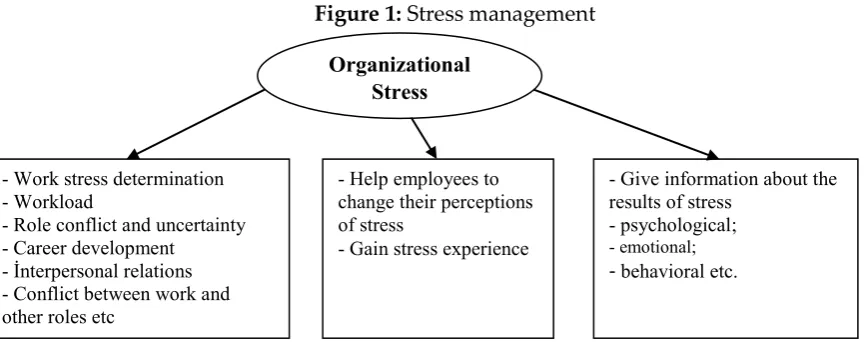
stress, understand stress responses, and then reduce or eliminate the negative consequences of stress (Figure 1).
Figure 1: Stress management
-Work stress determinat -Workload
-Role conflict and - Career development - İnterpersonal relations
Source: D. Helliriegel, J.W. Solocom Jr, R. W. Woodman (1995), Organizational Behavior, 7th Ed., West
Pub. Com, New York, p. 242.
3.The Effects of Stress on Individual and Organizational Performance
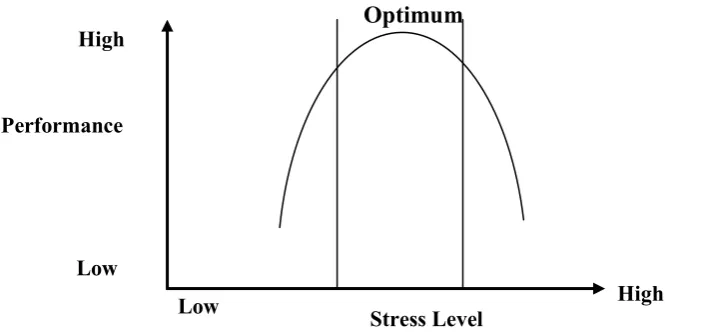
The effects of stress on performance can be listed under two headings: individual and organizational (Çetiner, 1999:12).The effects of stress on individual performance; can be specified as communication problems with other employees and customers, inability to concentrate on work, lack of time management and organization, lack of decision making, lack of motivation, lack of problem solving skills, lack of vision, etc. The effects of stress on organizational performance; can be seen as increase in employee turnover, increase in absenteeism, increase in error rate, decrease in loyalty to the company, decrease in team spirit, decrease in customer satisfaction, decrease in productivity, etc. No matter how the relationship between stress and performance results, as shown in figure 2, this relationship is explained by Inverted u curve (Inverted u-stress/performance curve) as generally accepted in the literature (Davis ve Newstrom, 1988:462; Sanders et al., 1995:46; Certo, 1992:367; Schermerborn et al., 1988:536; Robbins, 1989:513; Kreitner ve Kinicki, 1989:568; Schermerborn et al., 1994:647; Werther ve Davis, 1985:420; Hugh ve Feldman, 1986:471).
Organizational Stress
- Work stress determination - Workload
- Role conflict and uncertainty - Career development
- İnterpersonal relations - Conflict between work and other roles etc
- Help employees to change their perceptions of stress
- Gain stress experience
- Give information about the results of stress
Figure 2: Stress-performance relationship (Schermerborn vd., 1988, s.536)
According to the relationship between stress and performance, extremely high and extremely low stress has a negative effect on performance. While increasing performance in parallel with increased stress until the moderate stress level at optimum point is considered an advantage, low performance at extreme stress or low stress points is considered a disadvantage. If the stress reaches a point with time (optimum), it brings performance to the desired level and under this point; the individuals are doing their jobs with the best performance. The optimal point of stress varies according to the state of being able to tolerate stress from person to person. Stress creates two types of effects on performance: constructive stress and destructive stress (Pehlivan, 1995:70; Schermerborn vd. 1988:533). Constructive stress is a positive way of action for the individual and/or the organization. Moderate stress response has an effect that encourages the person to work more diligently, stimulates his or her creativity, increases his or her efforts, and gives energy. This stress increases the success of the individual in establishing a balanced relationship with the environment. When stress starts to be felt at a moderate level, the performance of individuals will increase, in this way they will have the energy to take advantage of new opportunities and deal with potential problems. Stress experienced in constructive stress zone has a motivating effect on individuals and this positive impulse increases their business performance while making them more committed to their work, more willing to do their work. Destructive stress causes the individual and/or organization to fail to do their jobs. Moderate stress increases productivity however, extreme stress disrupts the physical and mental system of employees. Individuals under extreme stress have a high level of absenteeism, mistakes and accidents, and less job satisfaction. Not only will the performance of individuals under extreme stress be affected negatively, but also all the negative consequences of stress are experienced.
Pe rfo rm an ces
High
Optimum
Low Low
High
4. Research Findings, Assessment and Results
4.1 Method and Model
In this section, as with the Research Model of the Universe, Sample of Research Hypothesis Research and Data Collection Tools Analyzing the data are given to sub-section. This research was modeled according to descriptive method and relational scan model. As the organizational stress management and performance levels of the staff working in sport organizations were tried to be determined, the relationship between organizational stress management and performance levels was modeled according to the relational screening model because demographic variables were examined on the basis of research descriptive method.
4.2The Universe and Sampling of the Study
The universe of the research is formed by the sports workers who are operating in Antalya Provincial Youth Services and Sports Provincial Directorate.
4.3.Data Collection Tools
performance was % 22,862 and the reliability level was ,720. The variance explained by 2 factors of 3 phrases under the heading of job satisfaction factors was 41,570 while the reliability level was ,671 (Ekin Örnek, 2017).
4.5 Resolution of Data
The data required for the research were obtained through questionnaire survey. The raw data was transferred to a computer that is obtained through surveys. In the process of finding answers to research problems SPSS 23,0 (Statistical Package for The Social Science) program was used. Sampling frequency distributions constituting Antalya Youth Services and Sports Provincial Directorate to determine the personal characteristics of the employees are examined. Organizational stress management and performance of the overall score obtained with the scale to determine the valuation level descriptive statistics were examined and the total points of its compatibility with normal distribution was tested with Kolmogorov-Smirnov. On the basis of the fact that the total scores obtained from the scales did not show normal distribution, demographic characteristics were analyzed Relationships between on the basis of organizational stress management and performance appraisal Spearman's Rho (ρ) coefficient was examined. Throughout the research, the importance levels were taken as 0,05 and 0,01.
5. Findings and Comment
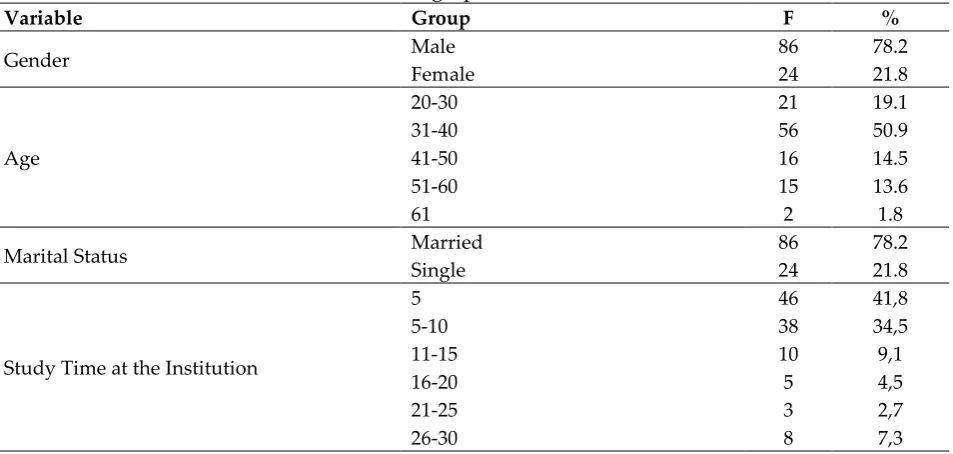
The frequency distributions of the participants of the Antalya Youth Services and Sport Provincial Directorate in order to determine the demographic characteristics of the employees were examined and the results are given in Table1.
Table 1: Demographic Characteristics
Variable Group F %
Gender Male 86 78.2
Female 24 21.8
Age
20-30 21 19.1
31-40 56 50.9
41-50 16 14.5
51-60 15 13.6
61 2 1.8
Marital Status Married 86 78.2
Single 24 21.8
Study Time at the Institution
5 46 41,8
5-10 38 34,5
11-15 10 9,1
16-20 5 4,5
21-25 3 2,7
Antalya Provincial Directorate of Youth Services and Sports in the running of the %21.8 men and % 78.2 women were found. Running %19,1 of the employees of the 20-30 age group, % 50,9 of the 31-40 age group, % 14,5 of the 41-50 age group, 51-60 years of %13.6 and %1, 8 of 61 and over were found. Running of %78,2 married and % 21,8 single were detected. Antalya Provincial Directorate of Youth Services and Sports in the running of the %41.8 5 years and under, % 34.5 of the employees 5-10 years, % 9.1 11-15 years, % 4.5 16-20 years, %2.7 21 -25 years and 7.3% between 26-30 years were found.
5.1 Reliability Analysis
In this section, the reliability of the organizational stress evaluation and subscale of job performance scales were examined with Cronbach's Alpha and the results are given in Table 2.
Table 2: Cronbach's Alpha Reliability Coefficients
Organizational Stress Scale
Subscales
Business Performance Measurement Sub-Dimensions
Total Cronbach's
Alpha Work
Structure
Organizational Structure
Management Structure
Physical Conditions
Work Performance
Job Satisfaction
,889 Cronbach’s
Alpha 0,637 0,625 0,715 0,685 0,726 0,766
Mean 10 9 14 12 12 13
Number of
items 2,462 2,770 3,608 2,684 2,232 1,908
When Table 2 is examined, it is found that the reliability analyzes of the subscales of organizational stress and job performance scales were very reliable.
5.2. Normality Test
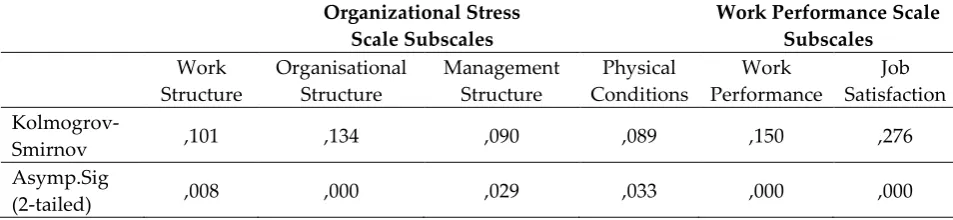
The normality test of the total scores obtained from the organizational stress evaluation and performance evaluation scales was examined with Kolmogorov-Smirnov and the results are given in Table 3.
Table 3: Kolmogorov-Smirnov Z Normality Practice
Organizational Stress Scale Subscales
Work Performance Scale Subscales
Work Structure
Organisational Structure
Management Structure
Physical Conditions
Work Performance
Job Satisfaction
Kolmogrov-Smirnov ,101 ,134 ,090 ,089 ,150 ,276
Asymp.Sig
(2-tailed) ,008 ,000 ,029 ,033 ,000 ,000
performance scale did not distribute normally. İn this case, the use of non-parametric techniques was found appropriate in the statistical hypothesis tests to be applied.
5.3. Hypothesis Testing
Table 4: The Impact of Work Stress on Business Success in Sports Workers
Dependent Variable: Work Performance
Independent Variable Beta t p
Work Structure ,388 4,294 ,000*
Organisational Structure -,050 -,470 ,640
Management Structure ,317 3,006 ,003*
Physical Conditions ,124 1,115 ,267
R= ,667; R2=,424; F=21,093; p<,000
Job Stress perceptions resulting from job structure has a significant effect on job performance of sports workers (p<=,000; p>,05). The dependent variable, job performance, is directly related to the work structure and affects employees as stressors (p<=,000; p>,05). Organizational structure, Which is a sub-dimension of work stress, is not a factor affecting job success in sports workers (p>,640; p<,05 The management structure, which is the sub-dimension of work stress, has a significant effect on the work performance of sports workers (p<,003; p<,05). Changes in management structure Problems in subordinate relationships may be an important stressor for sports workers. Physical conditions, which are sub-dimensions of work stress, are not factors that affect the work performance of sports workers (p>,267; p<,05). Sports employees work environments, heat, light cannot be seen as stressor. Regression model established to measure the effect of work stress on job success in sports workers was meaningful (F=21,093; p<,000). Except the physical conditions and organizational structure which constitute the job stress business structure and management structure explain % 42.4 of the work success in the sports workers. In other words, % 42.4 of the negativities of job success in sport workers are due to work stress. The work structure, which is work stress sub dimensions, most influences the work success in the sports workers (β= ,388; p<,000).
Table 5: Effect of Work Stress on Job Satisfaction in Sport Employees
Dependent Variable: Work Satisfactions
Independent Variable Beta t p
Work Structure ,187 1,874 ,064
Organisational Structure -161 -1,379 ,171
Management Structure ,226 1,933 ,056
Physical Conditions ,371 3.010 ,003*
R= ,567; R2=,29,6; F=12,438; p<,000
affects employees as stressors. The business structure, which is a dimension of work stress, is not a factor affecting job satisfaction in sports workers ( p>,064 ;p<,05).The organizational structure, which is the sub-dimension of work stress, is not a factor affecting job satisfaction of sports workers (p<,171 ; p<,05) .The management structure, which is the sub-dimension of work stress, is not a factor that affects the job satisfaction of sports workers (p>,56; p<,05). Physical conditions, which are sub-dimensions of work stress, have a significant effect on job satisfaction of sports workers (p>,003; p<,05).The working environments of the sports workers can be seen as an important stressor on the sports workers, the conditions of transportation to the heat, light, service, building. The regression model was established to measure the effect of work stress on job satisfaction in sports workers (F=12,438; p<,000). Except the business structure, Organisational Structure and Management Structure, which constitute the job stress, Physical Conditions explain % 42.4 of the work success in the sports workers. Regression model established to measure the effect of work stress on job success in sports workers was meaningful (F=12,438; p<,000). In other words, % 42.4 of the negativities of Work Satisfactions in sport workers are due to work stress. The physical conditions from the dimension of the stress are the dimension which affects the work satisfaction the most in the sports workers (β= ,371; p<,000).
Table 6: Results of the Kruskal Wallis_H test Analysis on
Workers' Stress Attitudes Monthly Income Variable
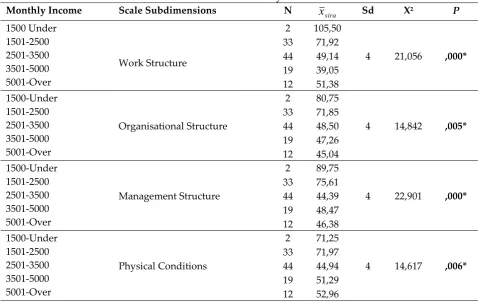
Monthly Income Scale Subdimensions N xsira Sd X2 P
1500 Under 1501-2500 2501-3500 3501-5000 5001-Over Work Structure
2 105,50
4 21,056 ,000* 33 71,92
44 49,14 19 39,05 12 51,38 1500-Under 1501-2500 2501-3500 3501-5000 5001-Over Organisational Structure
2 80,75
4 14,842 ,005* 33 71,85
44 48,50 19 47,26 12 45,04 1500-Under 1501-2500 2501-3500 3501-5000 5001-Over Management Structure
2 89,75
4 22,901 ,000* 33 75,61
44 44,39 19 48,47 12 46,38 1500-Under 1501-2500 2501-3500 3501-5000 5001-Over Physical Conditions
2 71,25
4 14,617 ,006* 33 71,97
44 44,94 19 51,29 12 52,96
Statistically significant differences between the groups with which to determine that the Mann-Whitney-analysis of results; A statistically significant difference was found according to the order average of the business structure sub-dimension X2 (4)= 21,056,
p<0,05. The effect size calculated in the test result (d: 0,19) shows that this difference was found small. The levels of Job stress perceptions arising from Work structure of sports workers whose income is below 1500, 1501-2500, 2501-3500 and 3501-5000 were found to be higher in accordance with the revenue. Similarly, the levels of job stress perceptions of the employees of the sport with income of 1501-2500, 2501-3500 and 3501-5000 were found to be higher than the ones sports workers. A significant difference was found between the organizational structure sub-dimension and monthly income variable according to rank average X2 (4)= 14,842, p<.05. The effect size
calculated in the test result (d: 0.21) shows that this difference was found small. In the organizational structure sub-dimension, the levels of job stress perceptions arising from organizational structure of sports workers with income of 1501-2500, it was found higher than sports workers 2501-3500 and 3501-5000. A significant difference was found between the monthly structure of the sub-dimension of the management structure and the monthly income variable X2 (4)= 22,901, p<.05. The effect size calculated in the test
result (d: 0.33) shows that this difference was found small. The level of job stress perceptions derived from the management structure of sports workers with a income of 1500 and below, It was found to be higher than the sports workers with income between 3501-5000. The levels of job stress perceptions resulting from the management of sports workers between 1501 and 2500 were found to be higher than those of sports workers with 2501-3500, 3501-5000 and 5001 and above. There was a significant difference between the average order of the Physical Conditions sub-dimension and the monthly income variance X2 (4)= 14,617, p<.05. The effect size calculated in the test
result (d: 0.13) shows that this difference was found small. The levels of job stress perceptions resulting from physical conditions of sports workers with income of 1501-2500, It was found higher than sports workers between 2501-3500 and 3501-5000.
Table 7: Kruskal Wallis_H test Analysis Results Regarding
the Educational Condition Variable of Work Stress Attitudes of Sports Workers
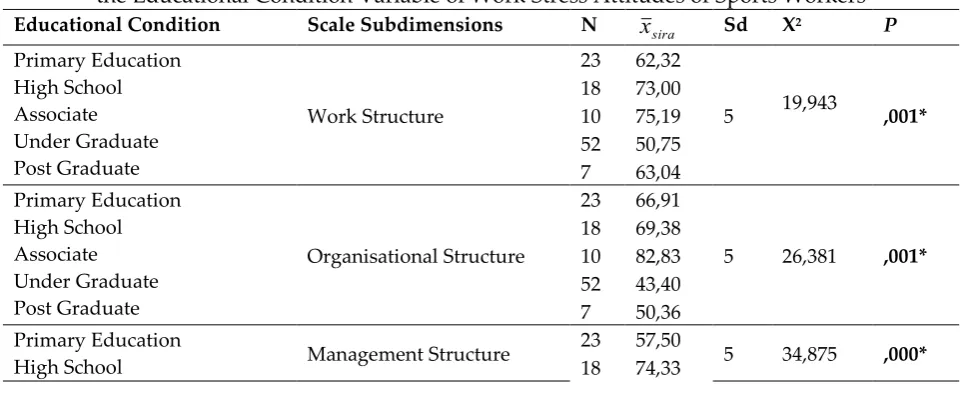
Educational Condition Scale Subdimensions N xsira Sd X2 P
Primary Education High School Associate Under Graduate Post Graduate
Work Structure
23 62,32
5 19,943 ,001* 18 73,00
10 75,19 52 50,75 7 63,04 Primary Education
High School Associate Under Graduate Post Graduate
Organisational Structure
23 66,91
5 26,381 ,001* 18 69,38
10 82,83 52 43,40 7 50,36 Primary Education
High School Management Structure
23 57,50
Associate Under Graduate Post Graduate
10 86,44 52 39,60 7 41,54 Primary Education
High School Associate Under Graduate Post Graduate
Physical Conditions
11 52,77
5 19,072 ,002* 12 72,88
18 79,06 10 44,65 52 46,36
A statistically significant difference was found in all the subscales of job stress levels experienced by the sport workers according to the educational status variable p<0,05. Statistically significant differences between the groups with which to determine that the Mann-Whitney-analysis of results; Significant difference was found according to the rank average of business structure sub-dimension X2 (5)= 19,943, p<.05. The effect size
calculated in the test result (d: 0.18) shows that this difference was found small. It was found that the levels of job stress perceptions of primary school graduates are higher than those of undergraduate and post graduates. Similarly, the level of job stress perceptions of high school graduate sports workers found to be higher than sports workers who have graduated and undergraduate degrees. A significant difference was found between the organizational structure subscale and the educational status variable according to the average order X2 (5)= 26,381, p<.05. The effect size calculated in the test
result (d: 0.24) shows that this difference was found small. It was found that the levels of job stress perceptions arising from organizational structure of primary school graduate sports workers, higher than those of pre-graduate and undergraduate sports workers.
A significant difference was found between the management structure subscale and the educational status variable according to the average order X2 (5)= 34,875, p<.05.
The effect size calculated in the test result (d: 0.31) shows that this difference was found small. The levels of job stress perceptions arising from the management of primary school graduate sports workers were found to be higher than those of high school, associate and undergraduate sports workers. The levels of job stress perceptions resulting from the management of high school graduates were found to be higher than those who read associate and undergraduate level registrants. Graduates of the level of job stress perception arising from the management structure of the sports staff was higher than the graduate degree. There was a significant difference between the physical condition subscale and the educational status variable according to the rank order average X2 (5)= 19,072, p<.05. The effect size calculated in the test result (d: 0.17)
Table 8: Results of the Kruskal Wallis_H test Analysis of
Job Stress Attitudes of Sports Employees on Employment Pattern Variability of Institution
İnstitutional employment style Scale Subdimensions N xsira Sd X2 P
Staffed Contractual
Service Prorement Work Structure
57 49,46
3 6,646 ,084 4 41,25
41 64,93 7 58,50 Staffed
Contractual
Service Prorement Organisational Structure
57 52,35
3 3,498 ,321 4 46,00
41 57,74 7 73,86 Staffed
Contractual
Service Prorement Management Structure
57 49,65
3 8,400 ,038* 4 32,25
41 65,72 7 57,43 Staffed
Contractual
Service Prorement Physical Conditions
57 50,78
3 3,844 ,279 4 60,25
41 62,83 7 49,00
There was no statistically significant difference between the work style, organizational structure and physical condition subscales of job stress perceptions according to the variation of employment type of the employees in the institution p>0,05. A statistically significant difference was found between the management structure sub-dimension and the employment type variable at the institution X2 (3)= 8,400, p<.05. The effect size
calculated in the test result (d: 0.07) shows that this difference was found small. As a result of the Mann Whitney U analysis conducted to determine which groups were significant differences; the shape of the permanent employment of the employee sports management structure in the form of employee services received from the induced work stress were significantly higher than the level of perception.
Table 9: Results of the Kruskal Wallis_H test Analysis of
Job Stress Sub-Dimensions of Institutional Job Variables of Sports Workers
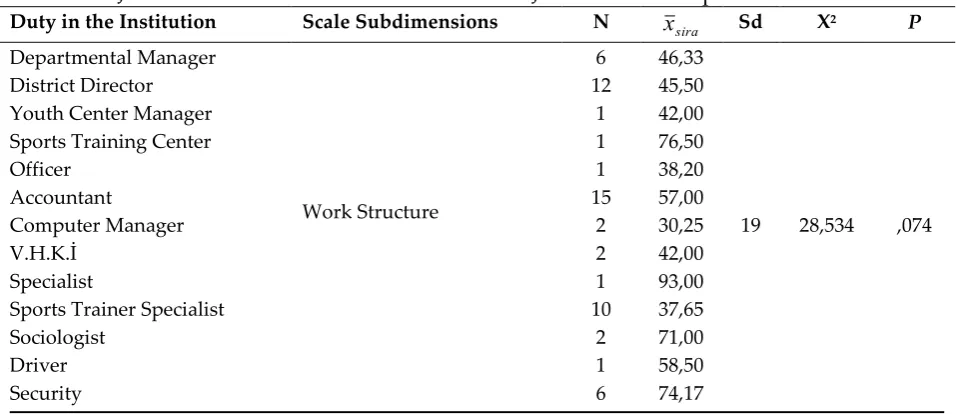
Duty in the Institution Scale Subdimensions N xsira Sd X2 P
Departmental Manager
Work Structure
6 46,33
19 28,534 ,074
District Director 12 45,50
Youth Center Manager 1 42,00
Sports Training Center 1 76,50
Officer 1 38,20
Accountant 15 57,00
Computer Manager 2 30,25
V.H.K.İ 2 42,00
Specialist 1 93,00
Sports Trainer Specialist 10 37,65
Sociologist 2 71,00
Driver 1 58,50
Youth Leader 14 48,75
Cleaner 11 62,87
Servant 3 91,67
Employee 16 74,16
Warden-Caretaker 4 76,13
Technician Of Deputy 1 76,50
Other 1 42,00
Departmental Manager
Organisational Structure
6 60,83
19 31,718 ,034*
District Director 12 48,38
Youth Center Manager 1 53,00
Sports Training Center 1 71,50
Officer 1 51,13
Accountant 15 71,25
Computer Manager 2 17,50
V.H.K.İ 2 85,00
Specialist 1 71,50
Sports Trainer Specialist 10 47,40
Sociologist 2 34,00
Driver 1 4,50
Security 6 78,92
Youth Leader 14 33,21
Cleaner 11 73,27
Servant 3 83,83
Employee 16 66,97
Warden-Caretaker 4 57,63
Technician Of Deputy 1 85,00
Other 1 4,50
Departmental Manager
Management Structure
6 40,25
19 36,826 ,008*
District Director 12 44,04
Youth Center Manager 1 48,50
Sports Training Center 1 85,50
Officer 1 39,77
Accountant 15 75,75
Computer Manager 2 19,75
V.H.K.İ 2 35,00
Specialist 1 76,50
Sports Trainer Specialist 10 45,65
Sociologist 2 69,00
Driver 1 5,50
Security 6 88,67
Youth Leader 14 42,39
Cleaner 11 68,86
Servant 3 93,83
Employee 16 69,97
Warden-Caretaker 4 76,63
Technician Of Deputy 1 76,50
Other 1 35,00
Departmental Manager
Physical Conditions 6 70,25 19 32,158 ,030*
Youth Center Manager 1 48,00
Sports Training Center 1 70,50
Officer 1 43,77
Accountant 15 71,00
Computer Manager 2 16,00
V.H.K.İ 2 79,00
Specialist 1 86,00
Sports Trainer Specialist 10 49,15
Sociologist 2 20,00
Driver 1 1,50
Security 6 85,17
Youth Leader 14 40,46
Cleaner 11 62,00
Servant 3 81,17
Employee 16 68,25
Warden-Caretaker 4 69,25
Technician Of Deputy 1 91,50
Other 1 40,00
There From the sub-dimensions of work stress in sport workers, organizational structure, management structure and physical conditions, statistically significant difference was found according to task variable in the institution p<0,05. There was founded statistically significant difference in the structure of the organization from the work stress subscales of sport workers according to the task variable of the institution X2 (19)= 31,718, p<.05. The effect size calculated in the test result (d: 0.29) shows that this
difference was found small. As a result of the Mann Whitney U analysis conducted to determine which groups were significant differences; Departmental Manager with the title of the sports workers resulting from organizational structure job stress perception level were found to be lower than that of sports workers who have computer business and Youth Leadership titles. The level of perceived job stress due to organizational structure of sports employees who have the title of Sportive Training Experts were found to be lower than those in the cleaning task. Similarly, the level of perception of job stress attributed to the organizational structure of sports workers, were found to be lower than those working in security, cleaning and guard-carer duties. The level of perception of job stress attributed to the organizational structure of sports workers with official title, were found to be at a lower level than those in the cleaning task. Management structure which is sub-scale of the work stress was found statistically effective on the sports employee, according to instructional tusk variable X2 (19)= 36,826,
employees who have civil servant title, were found to be at a lower level than workers with security, workers, cleaning and servant titles. When the table was examined, statistically significant differences were found between the Physical Stresses of Workers' X2 (19)= 32,158, p<.05. The effect size calculated in the test result (d: 0.29)
shows that this difference was found small.As a result of the Mann Whitney U analysis conducted to determine which groups were significant differences, sports workers who have branch manager titles due to Job stress perception levels of physical conditions Youth Leader was found higher than those who were in office. sports workers who have District Manager titles job stress resulting from physical conditions, The title of District Managers job stress resulting from Job stress perception levels of physical conditions were found to be lower than those in security and labor positions. The level of perception of job stress resulting from the management structure of sports workers with official title, were found to be lower than those employed in security and labor positions. Job stress perception levels caused by physical conditions of cleaning workers were found to be higher than those who were in computer operation. The level of perceived of job stress resulting from physical conditions of sports workers with sociologist titles were found to be lower than security and cleaning staff. The levels of perceived job stress resulting from physical conditions of the sports workers who have performed security service, were found to be higher than those who served as youth leaders. The levels of perceived job stress resulting from physical conditions of the sports workers who have title of youth leader, lower than those of staff and employees whereas were found to be higher than those who had the title of workers.
Table 10: Results of the Kruskal Wallis_H test analysis on monthly income variables of
performance levels in sports workers
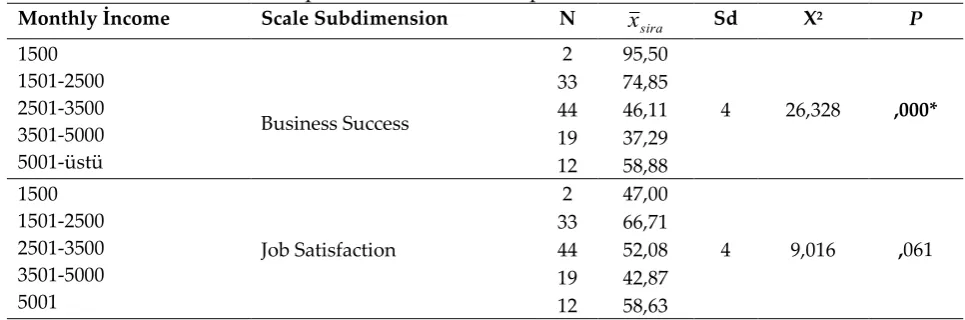
Monthly İncome Scale Subdimension N xsira Sd X2 P
1500 1501-2500 2501-3500 3501-5000 5001-üstü
Business Success
2 95,50
4 26,328 ,000* 33 74,85
44 46,11 19 37,29 12 58,88 1500
1501-2500 2501-3500 3501-5000 5001
Job Satisfaction
2 47,00
4 9,016 ,061 33 66,71
44 52,08 19 42,87 12 58,63
Statistically significant difference was found between job performance, which is a sub-dimension of performance levels according to monthly income variable of sports workers (p<,05). The effect size calculated in the test result (d: 0.24) shows that this difference was found small. A statistically significant difference was found according to the rank average of job success sub-dimension X2 (4)= 26,328, p<.05. As a result of the
success, 2501-3500, 3501-5000 were found to be higher than those of income. Likewise, the level of job success of sports workers with income of 1501-2500, 2501-3500 and 3501-5000 were found to be higher than the ones sports workers. There was no statistically significant difference between the monthly income variable and the job satisfaction, which is the sub-dimension of the performance level of the sports workers (p>,05).
Table 11: Kruskal Wallis_H test Analysis Results Regarding Educational Variables of
Performance Levels in Sport Workers
Educational Condition Scale Subdimensions N xsira Sd X2 P
Primary Education High School Associate Under Graduate Post Graduate
Business Success
23 70,45
5 27,722 ,000* 18 79,94
10 55,25 52 41,14 7 50,00 Primary Education
High School Associate Under Graduate Post Graduate
Job Satisfaction
23 57,30
5 10,381 ,065 18 73,81
10 46,95 52 50,50 7 51,00
A statistically significant difference was found between the Educational Condition of sports workers and job performance, which is the sub-dimension of performance levels (p<,05). The effect size calculated in the test result (d: 0.25) shows that this difference was found small. As a result of the Mann Whitney U analysis conducted to determine which groups were significant differences; A statistically significant difference was found according to the rank average of job success sub-dimension X2 (5)= 27,722, p<.05.
This difference is due to the fact that the level of job performance of sports workers who are graduated from primary education were significantly higher than those with bachelor's degree. The level of business success at the high school level who sports employees, were found to be higher than those of sports workers who have undergraduate and graduate degrees. There was no statistically significant difference according to the education level variable of job satisfaction, which is the sub-dimension of performance levels of sports workers (p>,05).
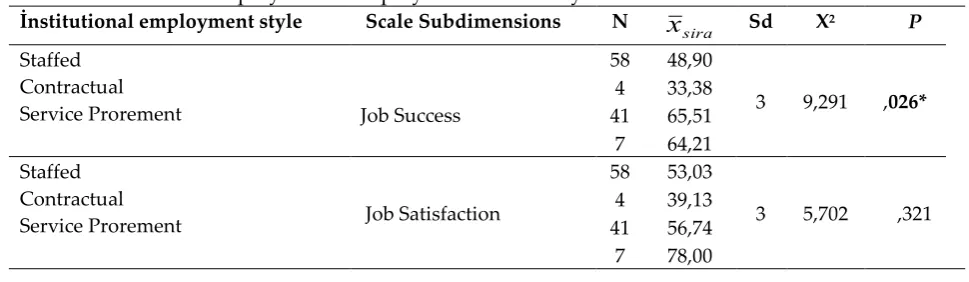
Table 12: Results of the Kruskal Wallis_H test Analysis of Performance Levels of Sports
Employees on Employment Variability in Your Institution
İnstitutional employment style Scale Subdimensions N xsira Sd X2 P
Staffed Contractual
Service Prorement Job Success
58 48,90
3 9,291 ,026* 4 33,38
41 65,51 7 64,21 Staffed
Contractual
Service Prorement Job Satisfaction
58 53,03
3 5,702 ,321 4 39,13
A statistically significant difference was found between the sport workers' work performance, which is the sub-dimension of performance levels, (P <.05). The effect size calculated in the test result (d: 0.08) shows that this difference was found small. As a result of the Mann Whitney U analysis conducted to determine which groups were significant differences; A statistically significant difference was found according to the rank average of job success sub-dimension X2 (3)= 9,291, p<.05. This difference was
found to be higher for the employees who worked as the employment type than the ones who worked for the job. That is why the possibility of promotion of positions according to the contracts of the staff may have created a motive effect in terms of business success. There was no statistically significant difference between the employees' job satisfaction, which is the sub-dimension of performance levels (p>,05).
6. Conclusion
Antalya Youth Services and Sports Provincial Directorate carried out on workers in this study organizational stress management and effects on performance of jobseekers according to demographic characteristics were examined. All these findings summarized; education status, duty status (branch manager, sportive education specialist, technician etc.) monthly income situation, affects the stress situation of those who work in the form of employment in organizations. At the end of the study, the higher the education level of workers sports caused a decrease in the impact of stressful. As the monthly incomes of employees increase, the effects of job stress decreases, changes in management structure, problems between the superior and the civil servant, the uncertainties in the task definition and the inadequate physical conditions in the working environment increase the stress levels of sports workers. In addition, stressors who have no significant difference between being male or female and stressors have the same effect on age and gender, it has been found that there is no significant difference between married-bachelors and stressors; it has been found that there was no significant difference in the duration of the study between the stressors in the institution. As a result, by reducing the pressure on the workforce in the organization that created stress, the efficiency and motivation of the workforce can be improved by increasing their work performance. Increased motivation employees to increase their business interests and willingness to do business, the organizational productivity of employees will also be ensured.
6.1 Recommendations
Managers in business should be well aware of and aware of resources that create stress in their employees
Task uncertainties for employees must be removed
References
1. Başaran, İ.E. (1983). Örgütsel Davranış, A.Ü. Eğt. Fak., Yay.No:108.Ankara, 75s. 2. Bulut, D. (2005). Gençlik Spor Genel Müdürlüğü (Gsgm) Merkez Örgütünde
Görev Yapan İş Görenlerin Çatışma Yönetimi Algıları Ve İş Doyumları Arasındaki İlişkinin İncelenmesi. Sosyal bilimler enstitüsü spor yönetimi anabilim dalı Abant izzet baysal üniversitesi. Bolu
3. Certo, S.C. (1992). Modern Management; Quality, Ethics, and the Global Environment. Fifth Edition. Boston: Allyn and Bacon.
4. Connor, P.E. and Worley C.H. (1991), “Managing Organizational Stress”. Business Quarterly, V.56, No.1, pp.61-63.
5. Çetiner, Ö. (1999). “Deprem Sonrası Stres Yönetimi”. MESS Mercek İşveren Gazetesi (Ekim).
6. Davis, K., Newstrom, J.W. (1988). Organizational Behavior; Human Behavior at Work. Ninht Edition, New Jersey: McGraw-Hill, Inc.
7. Ekin Örnek, F. (2017). Örgütsel Stresin İş Gören Performansi Üzerinde Etkileri Ve Stres Yönetimi: Kamu Ve Özel Sektör Bankaciliği Üzerine Bir Uygulama, Yüksek Lisans Tezi, Ufuk Üniversitesi, Sosyal Bilimler Enstitüsü, İşletme Anabilim Dalı,İnsan Kaynakları Yönetim Bilim Dalı, Ankara.
8. Erdoğan, İ. (1996). İşletme Yönetiminde Örgütsel Davranış, İşletme Fak. Yayını, Avcıol Basım-Yayın, İstanbul, s.270-278.
9. Hellırıegel, D., J.W. JR Slocom and R.W. Woodman (1995), Organizational Behavior, 7. Ed., West Pub. Com, New York, pp.222- 257.
10.Hugh, H.A., Feldman, D.C. (1986). Organizational Behavior, New York: McGraw-Hill Book Co.
11.Kreıtner, R. and Kınıckı, A. (1989). Organizational Behavior, Richard D. Irwin Inc., pp.564-571.
12.Okakın, N. (2009). Çalışma Yaşamında İnsan Kaynakları Yönetimi, 2. Baskı, Beta Yayınları, İstanbul. Organizational Behavior. Fifth Edition, New York: John Wiley & Sons, Inc.
13.Pehlivan, İ. (1995). Yönetimde Stres Kaynakları. Ankara:Pegem Yayınları, Personel Geliştirme Merkezi, No:16.
14.Sanders, J.C., Fulks, D.L., ve Knoblett, J.K. (1995). “Stress and Stress Management in Public Accounting”. The CPA Journal, (August).
15.Schermerborn Jr., J.R., Hunt, J.G., and Osborn, R.N. (1994). Managing Organizational Behavior. Fifth Edition, New York: John Wiley & Sons, Inc.
16.Selye, H. (1977). Stress without Distress. Teach Yourself Books, Y.3, N.21, pp.23-25.
18.Werther, W.B. and Davıs, K. (1985). Personnel Management and Human Resources, 2. Ed., McGraw-Hill Book Co., New York, p.420.
19.Yağız, K., Yaman, K. (2003). Beden Eğitimi Ve Sporda Sosyal Alanlar Kongresi, Bildiriler Kitabı, Ekim, Ankara
Creative Commons licensing terms