PRODUCING OF InGaAs BULK CRYSTALS BY DIRECT
FUSION
N. Kekelidze,
[a],[b]E. Khutsishvili,
[a][b]*T. Qamushadze,
[a],[b]N. Kobulashvili
[a]and Z. Chubinishvili
[a],[c]Keywords: ternary alloys, segregation, fusion, crystallization, compounds
The system of triple In1–xGaxAs continuous solid solutions allows the solution of the many problems of modern semiconductor technology
as microelectronics, optoelectronics, and nanoelectronics. The remarkable manufactural properties of ternary In1-XGaXAs solid solutions make them very useful nanotech performance materials for manufacture nanotech products, such as nanowires, nanotubes, etc. For successful solution of this problem, it is necessary to reveal their intrinsic properties and eliminate the effect of structural imperfections existing in thin films and layers, which is possible by investigating crystals of In1–xGaxAs solid solutions in bulk form. The complete
miscibility of components in the solid and liquid state and the linear dependence of lattice parameter on the composition of In1–xGaxAs solid
solutions allow to consider this system as a pseudo-binary alloys system of two components of (GaAs)x and (InAs)1–x like SiGe alloys
system. This feature of the alloys has enabled to apply the comparatively affordable and straightforward method of direct fusion process of InAs and GaAs components for producing of In1–xGaxAs alloys with stable chemical composition. Carefully selected conditions of the
fusion and processing of crystal growth have allowed obtaining several compositions of InAs-rich In1–xGaxAs alloys with uniform
distribution of components across the ingot of single crystal by one fusion. *Corresponding Author:
E-Mail: [email protected]
[a] Laboratory of Semiconductor Materials Science, Ferdinand Tavadze Institute of Materials Science and Metallurgy, Tbilisi, Georgia
[b] Institute of Materials Research, Ivane Javakhishvili Tbilisi State University, Tbilisi, Georgia
[c] Department of Engineering Physics, Georgian Technical University, Tbilisi, Georgia
Introduction
The development of new technologies is impossible without advances in the technology of producing semiconductor materials, among them, III–V binary semiconductor compounds. However, they cannot fully satisfy the requirements of the market of semiconductor materials. Therefore, materials with intermediate properties of binary III–V compounds are required for the development of a number of new ways of semiconductor technology, microelectronics and optoelectronics, among them, nanoelectronics. The solution of this problem is possible by obtaining multicomponent complex compounds, in particular, solid solutions of III–V binary compounds. Although the properties of such materials are not always intermediate between the properties of the original components, nevertheless, the solid solutions of III–V binary compounds enable the monitoring and the combination of the unique physic-chemical properties of their ingredients.
Among semiconductor alloys, the system of continuous solid solutions of In1–xGaxAs is of particular interest. High
mobility of electrons, direct energy bands, complete miscibility of InAs and GaAs in an arbitrary proportion in solid state enable creation on their base a wide variety of set of fundamental semiconductor devices of the new generation. The remarkable manufactural properties of ternary In1–xGaxAs alloys make them truly the best nanotech
performance materials and very useful for manufacture nanotech products, such as nanowires, nanotubes, etc.
At the same time due to the unique mutual opposite radiation properties of InAs (radiation increases current carrier concentration) and GaAs (radiation reduces current carriers concentration) In1–xGaxAs, alloys are potential
materials to create devices with the immunity to radiation like InAsP solid solutions.1 Therefore, the development of
improved technology for obtaining In1–xGaxAs solid
solutions of binary semiconductor compounds is an urgent problem. For successful solution of this problem, it is necessary to reveal their intrinsic properties and eliminate the effect of strains and dislocations existing in thin films and layers, which is possible by investigating single crystals of In1–xGaxAs solid solutions in bulk form. Obtained results
will be valid for crystals in thin films and layers form too. Therefore, the purpose of the given work is to develop an acceptable efficient, simplified method, in comparison with the existing ways of obtaining bulk crystals of In1–xGaxAs
alloys.
Features of obtaining of InGaAs solid solutions
In1–xGaxAs solid solutions may be obtained by different
methods. The choice of the technique for obtaining solid solutions of In1–xGaxAs depends on the purposes and scales
of application. Among these methods of producing solid solutions, there is the growth of epitaxial layers by vacuum evaporation and condensation, and crystallization using a chemical transport reaction through a gaseous phase. However, these methods differ by the small amount of material received and are designed for specific devices. At the same time, the purity of the resulting material is determined by the purity of the original components. Directional crystallization method is also used to produce crystals of In1–xGaxAs solid solutions. Several versions of
decomposed double and triple III–V materials have been developed.2–6 As a rule, these methods are preceded by
synthesis.
The synthesis of solid solutions of III–V binary compounds, as materials with high vapor pressure, requires a method which makes it possible to control the vapor pressure of volatile components. The disadvantage of the majority of existent methods is that they need two stages: synthesis, and then growing the crystal. Growth of ternary single bulk crystals may be carried out by several newly developed industrially important methods such as Bridgman, and zone melting of multicomponent thermal decomposing compounds.
In the given paper, there has been chosen, as a basis,LEC – the liquid encapsulated Czochralski method as a combined process of synthesis and crystal growth method of InGaAs bulk crystals. It has been taken into account that InGaAs alloys have complete miscibility in the solid state and their lattice parameter increases linearly with the fraction of InAs. These properties and the liquid-solid phase diagram of In1–
xGaxAs solid solutions allows to be limited by a
two-component system and consider InGaAs as a pseudo-binary alloys system of two components of III–V semiconductors (GaAs)1–x and (InAs)x, which dissolve continuously in an
arbitrary proportion in solid state and form homogeneous system of continuous of solid solutions.7,8
The liquid-solid phase diagram shows that crystallization of InGaAs solid solutions is a very complicated process. The whole difficulty is that the pseudo-binary solid solutions crystallize in the temperature range and the process is inclined to internal crystalline liquation. This means that a solid phase is separated in continuous solid solutions, which at gradual cooling retains an elevated concentration of the high-temperature component in comparison with the equilibrium concentration. In the case of In1–xGaxAs solid
solutions during the crystals growth from the melt, the composition of the primary crystal is enriched by GaAs, while the final part of the ingot is richer in InAs.
This phenomenon has been taken as a basis of our technology of the production of homogenous In1–xGaxAs
solid solutions for the preparation of crystals with different composition in one ingot. The proposed method is fundamentally different from the methods for obtaining In1–
xGaxAs crystals with a specific composition in one ingot,
and, in turn, requires other conditions of the processing of crystal growth. That is why the aim of the present study is to establish experimentally the limits of the physical possibilities of segregation crystal growth of In1–xGaxAs
solid solutions, which have favorable components equilibrium segregation coefficients at growing by directional crystallization.
Experimental
The bulk crystals of In1–xGaxAs solid solutions have been
obtained by direct fusion of their initial components of InAs and GaAs compounds, and then grown by directional crystallization with the known Czochralski method of pulling crystals from melt. The synthesis operation preceding the process of growing of homogeneous InGaAs
solid solutions is not fundamentally different from the synthesis of individual InAs and GaAs сompounds from the stoichiometric melt. The proposed method makes it possible to avoid the synthesis as a separate process and combine synthesis with the growing of crystal. The obtained In1–
xGaxAs crystals have been grown in a special chamber. The
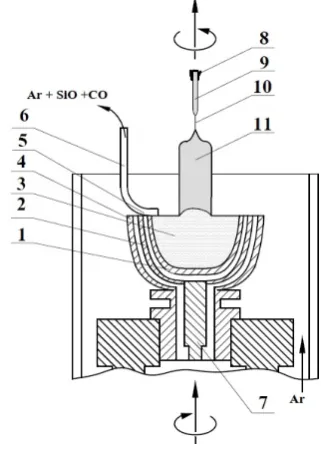
basic assembly of the technological part of the equipment, which scheme is shown in the Fig.1, presents a high-pressure system of melting camera for growing crystals of semiconductors in the Ar gas atmosphere.
Figure 1. Scheme of vacuum equipment for the production of crystals of In1–xGaxAs solid solutions. 1 – quartz crucible, 2 –
graphite stand, 3 – melt in the flux capsule, 4 – heater, 5 and 6 – gas-drawing device, 7 – crucible moving axis, 8 – seed moving rod, 9 – seed, 10 – crystal neck, and 11 – crystal of In1–xGaxAs solid
solution.
The quartz crucible (1) with a charge has been placed on graphite support (2). The graphite supporting block and quartz crucible with the uterine melt of InGaAs are possible to rotate around an axis (7) and move vertically for selection of necessary temperature conditions. Revolving mechanism of graphite supporting block and quartz crucible is placed in the lower part of equipment under the processing chamber. Penetration into an inner space of a chamber is provided by the door, which is closed hermetically and has a viewing window. The lower part of a chamber is connected to the vacuum-gas distributional system.
temperature. The flux used softens at a temperature at which the vapor pressure of arsenic is negligible and the mother melt was located in a capsule of boron anhydride.
Pieces of charge are loaded in a quartz crucible (1) an amount to fill crucible volume after melting. At the bottom of the quartz crucible (low-temperature zone), there has been placed a small excess of crushed arsenic, to compensate the evaporation losses, from above a mixture of InAs and GaAs. The mixture has been covered with pieces of B2O3, which provide a layer of 20–30mm thick after
melting. For compensating of the arsenic losses during melting due to its evaporation, the amount of arsenic has been taken with excess and was calculated by the formula:
PAs=PVM/RT,
where
P = 0.34atm (the equilibrium vapor pressure of the volatile component of arsenic over the melt),
V is the volume of the camera in liters, M is the molecular weight of As4 steam,
R is the universal gas constant (0.082 atm mol-1·K-1), and
T is the temperature of the crucible.
The melting process has been carried out in a flowing environment of protective inert argon gas under 0.5atm pressure. The chamber is preliminarily pumped out up to10– 4 Hgmm pressure. After that, the chamber is washed by a
slow flow of argon with equipped special apparatus for gas removing (gas-extracting arrangement – 5 and 6). Finally, the chamber is filled with argon up to appropriate pressure. After delivery electricity to the equipment and reaching a suitable temperature a gas-extracting arrangement is switched on. The delivery and pumping out of inert gas is regulated in such way, that pressure of argon permanently stays on the 0.5 atm level. Then the heater has been turned on and the crucible heated to a temperature of 820–880 °C. First, the flux is melted, then the charge. A liquid mixture of components is formed with heat release, and, as a result, the temperature rises to the melting point of the desired composition in the upper part of the crucible. The melting point varies depending on the composition (x) from 942 °C (for InAs) to 1240 °C (for GaAs) and the temperature slightly exceeded the melting point of the desired composition of solid solution.
Gas release products of a chemical reaction from graphitic details and quartz crucible are typical for the melting process. These chemical agents adjoin closely to the surface of the capsule of boron anhydride, are partly dissolved in it and contaminate it. Therefore gas-extracting arrangement (5 and 6) with pressure relief pipe is included in the processing camera. It removes gas release products of chemical reaction at the same moment as they origin at melting process from the processing chamber.
When the desired melting point has been reached at the top of the crucible, the melt has been maintained at this temperature for 30min to homogenize the melt. The accuracy of the temperature preservation was high because the temperature dependence of the pressure of saturated
arsenic vapor has the logarithmic regularity. After the fusion had been completed, pulling of crystal with normal crystallization (heat ejection on all sides) has been performed by the Czochralski method. GaAs crystalline rods oriented in the direction [111] with the length of 50 mm were used as the seeds. A seed crystal has dipped, through flux layer, into the melt. The rotated seed has slowly pulled single crystal from the lower end of the seed. During crystallization along the ingot, a temperature gradient was maintained at which crystallization occurs at the fixed point of the ingot and the crystallization front moves along the ingot by pulling. The obtained crystal has been subjected to slow cooling. During the process of the crystal pulling the crucible with the mother melt revolved with the rate of rotation 45 and 10 revolutions per minute in opposite directions has provided uniformity on the cross section of the bulk crystals. The pulling rate of ~ 0.25–0.30 mm per minute was supported to be equal to the growth rate of crystals to keep the growth temperature constant. Such conditions provide the symmetry of temperature field at the crystallization front into the crucible and compositional uniformity in the crystal of InGaAs. The content of pulled from melt InGaAs crystals after the directional crystallization has been defined by X-ray diffraction method by modernized DRON–4–07 the equipment at Mo-radiation in 0.5 degrees min-1, micro X-ray spectral and emissive
spectral analyses. The heterogeneities of experimental samples have been controlled by electrical properties measurements too. Effective segregation coefficient of components has also been calculated.
Results and discussion
The method we used is relatively simple and available compared to other methods. The volatile component of arsenic melts at 800 °C, and the flux at 300 °C softens and melts at 460 °C. The flux forms a thick, viscous liquid which coats the entire melt, including the crucible and in combination with the pressure in the chamber prevents sublimation of As. The flux used softens and melts at a temperature at which the vapor pressure of arsenic is negligible and the mother melt has been located in a capsule of boron anhydride. This allows a direct fusion of the initial components for the production of InGaAs solid solutions.
The method of obtaining a crystal by pulling from the melt does not ensure the uniformity of the composition along the length of the crystal. The crystal has a characteristic gradient in the distribution of the original components along the length. This gradient in the composition of solid solutions, the so-called segregation, depends on the form of the solidus, the difference between solid and liquid phase composition and on the position along the ingot. So at the directional crystallization, the separation of the components of the solid solution depends on the segregation coefficient of a component of InAs and GaAs compounds. The magnitude of equilibrium segregation coefficient of components is determined by the liquid-solid phase diagram of InGaAs and depends on the composition of alloy.7,8
much higher than unity. Therefore, the concentration of GaAs near the seed reaches the maximum value and gradually decreases towards the end of the crystal. The solid phase that is released during the crystallization of the InAs– GaAs alloys retains an increased concentration of GaAs at decreasing temperature as compared to the equilibrium composition of the initial melt.
This distinctive attribute of obtaining graded composition distribution along the length of the ingot has been applied to derive benefit from this feature. Carefully selected conditions of fusion and growing of crystal allowed to obtain across the ingot uniformity in the composition of components and chemically stable several compositions of InGaAs solid solutions by one fusion.
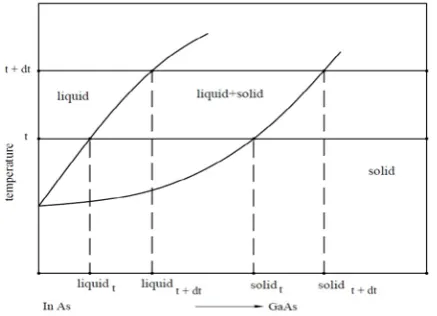
The method of direct fusion of InAs and GaAs compounds has been applied in given work for producing crystals at InAs-rich side of InGaAs alloys system. At this, the segregation degree of components is determined by the part of the liquid-solid state diagram of alloys in InAs-rich side of the system, which is shown in the Fig.2.
Figure 2. Generalized part of the state diagram of InGaAs
continuous solid and liquid solutions in system's InAs-rich side.
Crystallization of a solid solution consists of two processes:
(1) The formation of crystals of a solid solution of “solidt”
composition, which is in equilibrium with the “liquidt” only
at a given temperature t: “liquidt” ↔ “solidt." This process
assumes diffusion only in the liquid phase and proceeds comparatively easily.
(2) The change in the composition by relatively enriched by GaAs crystals formed at high-temperature t + dt. This process assumes continuous interaction of the precipitated solid phase with the melt and a change in its composition.
Therefore, only when the rate of cooling of the melt does not exceed the rate of the changes, which occur in the system of the melt-solid phase, a homogeneous solid solution crystallizes. The precise control of the temperature at the growing interface at directional crystallization and crystal pulling speed enabled to achieve uniformity in composition in the cross sections of the ingot. Therefore, it was possible to obtain solid solutions with a uniform composition over a wide range of compositions in InAs-rich
InGaAs solid solutions. The crystal composition is determined only by the temperature at the growing interface.
Figure 3. Dependence of InAs composition on a solidified fraction of melt at producing InAs-rich InGaAs solid solutions.
The dependence of InAs content on the solidified fraction of melt at producing the InAs-rich InGaAs solid solutions is shown in the Fig.3. The figure shows the slight change of the solid composition of InGaAs components along the length of the ingot.
The dependence presented in Fig.3 reflects the phenomenon of accumulation of content of InAs little by little in the melt while InGaAs crystal is pulling from melt. So during the process of crystal growth, the melt is slowly enriched by InAs because of worse solubility in the solid phase. GaAs concentration straight at the surface exceeds their concentration in the melt.
InAs content function in InGaAs crystal of the solidified fraction of the GaAs-InAs pseudo-binary growth melt depends on effective segregation coefficient of InAs in GaAs. This process is characterized by the effective segregation coefficient (k eff) of the components, which is the
ratio of the concentration of one of the components dissolved in the solid phase to the concentration- in the liquid phase.The effective segregation coefficient of InAs in GaAs for experimental samples has been calculated on the base of experimentally established data of components composition. The effective segregation coefficient of InAs in GaAs has been calculated and found to be 1.025 in presented conditions of melting. That reflects the weak dependence of InAs content on the solidified fraction of growth melt at producing the InAs-rich InGaAs alloys. Therefore the composition of the homogeneous bulk crystals of n-type In0.8Ga0.2As, In0.7Ga0.3As, and In0.6Ga0.4As can be
freely selected in one ingot crystals.
Typical X-ray diffraction spectra, X-ray microspectral, emissive spectral analyses, microstructure and electrical properties have shown that obtained single crystals have been single-phase with good uniformity of composition. Fluctuations of components concentration were found to be less than 1 at.%.
Conclusion
There have been obtained ternary In1–xGaxAs solid
enable to achieve uniformity in composition in the cross sections of the ingot. The weak dependence of InAs content on the solidified fraction of melt let freely select several compositions in the InAs-rich side of this InGaAs alloys system in one ingot.
Acknowledgment
Paper was presented at the 5th International Conference "Nanotechnologies," November 19–22, 2018, Tbilisi, Georgia (Nano–2018).
References
1Kekelidze, N., Kekelidze, G., Kekelidze, D., Khutsishvili, E.,Creation of hard radiation-resistant semiconductor electrical material, Patent of Invention # AP2016014141, Georgia, National Intellectual Property Center Saqpatenti,
2018.
2Nakajima, K., Azuma, Y., Usami, N., Sazaki, U.G.T., Fujiwara, K., Shishido, T.. The Growth of InGaAs and SiGe homogeneous bulk crystals which have complete miscibility in the phase diagrams, Int. J. Mater. Prod. Technol., 2005,
22, 186. DOI:10.1504/IJMPT.2005.005764.
3Nisjima, Y., Akasaka, O., Nakajima, K., Otsubo, K., Ishikawa, H., InGaAs ternary bulk crystal growth method using InGaAs ternary source, In: Proc. 13th Int. Conf. Indium Phosphide Related Mater.,2001, 125.
DOI: 10.1109/ICIPRM.2001.929034
4Kodama, S., Furumura, Y., Kinoshita, K., Kato, H., Yoda, S., Single crystalline bulk growth of In0.3Ga0.7As on GaAs seed using the multi-component zone melting method, J. Crystal Growth, 2000, 208, 165. https://doi.org/10.1016/S0022-0248(99)00413-3.
5Leu, Y. T., Thiel, F. A., Scheiber, J. J., Rubin Jr., H., Miller, B. I., Bachmann, K. J., Preparation and properties of bulk GaxIn1-xAs Crystals, J. Electronic Mater., 1979, 8, 663. https://doi.org/10.1007/BF02657085.
6Nakajima, K., Kusunoki, T., Takenaka, C., Growth of ternary InxGa1−xAs bulk crystals with a uniform composition through
supply of GaAs, J. Crystal Growth, 1991, 113, 485. https://doi.org/10.1016/0022-0248(91)90083-H.
7Panish, M. B., Ilegems, M., Phase equilibria in ternary III–V systems, Prog. Solid State Chem., 1972, 7, 39. https://doi.org/10.1016/0079-6786(72)90004-0
8Wooley, J. C., Smith, B. A., Solid Solution in III-V Compounds. Proc. Phys. Soc., 1958, 72, 214.
https://doi.org/10.1088/0370-1328/72/2/306.