194 e-ISSN: 2549-0265 (online)
Difference of Self Directed Learning Readiness
Between Introvert and Extrovert Personality Type
Among Medical Students
Nurlatifah Febriana Wijayanti1), Muhammad Eko Irawanto2), Bhisma Murti1,3)
1 )Faculty of Medicine, SebelasMaret University, Surakarta
2)Department of Dermatology and Venereal, Dr. Moewardi Hospital, Surakarta 3)Masters Program of Public Health, SebelasMaret University, Surakarta
ABSTRACT
Background: The paradigm of medical education has been changed from Teacher Centered Learning (TCL) to Student Centered Learning (SCL) that implemented through Problem-Based Learning (PBL) method. Medical students are expected to have the ability to learn independently or known as self-directed learning (SDL). This tendency then measured by a scale known as the Self Directed Learning Readiness Scale (SDLRS). Personality is one of the influential factors in this case. Extrovert personality type is considered more suitable to the SDL method. This study aimed to determine differences in self-directed learning readiness between introvert and extrovert personality type among medical students.
Subject and Methods: This was an observational analytic study with cross sectional design. The subjects were medical students at SebelasMaret University in 2010, 2011, 2012 and 2013.This used random sampling method. The subjects were categorized into ready and not ready for SDL. Type of personality was divided into introvert,ambivert and extrovert. Motivation was selected as a confounding variable and divided into high and low motivation. Data were analyzed using multivariate regression analysis.
Results:There were 69 students included in this study. We found that 25(36.2%) students were introvert, 16 (23.2%) students were extrovert and 28 (40.6%) students were ambivert. Based on SDLR scores, 23 (33.3%) students were ready for SDL and 46 (66.7%) students were not. Logistic regression analysis showed that extrovert students had chance to be ready for SDL 0.70 fold lower than introvert students (OR = 0.70; 95% CI= 0.18 to 2.74; p= 0.604). Otherwise, ambivert students 0.83 fold lower than introvert students (OR = 0.83; 95%CI= 0.26 to 2.64; p = 0.745) to be ready for SDL.
Conclusion:There was no statistically difference of SDLR between personality types. Keywords: self-directed learning readiness, personality type
Correspondence:
NurlatifahFebrianaWijayanti. Faculty of Medicine, Sebelas Maret University, Surakarta.
BACKGROUND
Medical education has undergone a para-digm shift from Teacher Centered Learning (TCL) to Student Centered Learning (SCL) is applied through the method of Problem Based Learning (PBL). In contrast to the TCL, SCL focuses on the independence of the student in the learning process.
Students are required to play an act-ive role in planning, monitoring and eva-luating the learning process. Related to
this, a student is expected to have the abi-lity to learn independently or called Self DirectedLearning (SDL) (Secondira, 2009). This is in line with the rapid development of medical science and the principles of lifelong learning which should be applied by a doctor (Pamungkasari and Probandari, 2012).
e-ISSN: 2549-0265 (online) 195
student is expected to have the indepen-dence and motivation to get the full benefit of their learning experience. Some students are able to achieve these expectations, but the other students and tend to have dif-ficulty finding a daunting challenge in the learning process (Mala-Maung et al, 2007). Basically everyone will have the readiness to learn independently in a variety of dif-ferent levels. Readiness is then measured by a scale of measurement known as the Self Directed Learning Readiness Scale (SDLRS) (Guglielmino, 2013).
Self-learning ability can be affectted by many factors, both external and internal. Externally, the SDL can be influenced by the teaching methods and curriculumap-plied. While internally, one of the factors that influence the personality. Personality traits have a positive correlation with SDL (Chen et al., 2006).
Based on the nature of the soul, the personality of Jung's theory divides human personality into two types, namely extro-vert and introextro-vert (Suryabrata, 2007). Ex-troverted individuals are someone who is affected by the outside world. This persona-lity type is open, agile in the association, jovial, friendly, easy to relate to people, to see the reality and necessity, immune to criticism, spontaneous emotional expres-sion, not so feel failure, and does not hold a lot of analysis and self-criticism. While introverts personal interests of individual leads to the mind and experience it your-self. Introverts personality tend to be aloof and was able to resolve its own problems. Personal introvert has properties opposite to the extrovert (Sunaryo, 2004).
Personality has a role in determining educational outcomes. The expected out-come of medical education is a lifelong learner independent (Furnham et al, 2003; Findley and Bulik, 2011). SDL method is considered as a method that supports these
goals (Gyawali et al., 2011). Students of medical education has a score SDLR dif-ferent (Findley and Bulik, 2011). Therefore, researcher interested in comparing stu-dents of the faculty of medicine according to the type of personality to the self-learn-ing readiness is reflected in the score SDLR.
In addition, the achievement of cons-tructive learning process, independent, col-laborative and contextual in accordance with the principles of PBL, the student factor is the most influential factor so important to know the personalitycharac-teristics associated with student learning readiness independently (Secondira, 2009).
SUBJECTS AND METHOD 1. Study design
This was an observational analytic study with cross sectional design.The study was conducted at Faculty of Medicine, SebelasMaret University, Surakarta in January-March, 2014.
2.Population and Sample
The population were students of the Faculty of Medicine in 2010, 2011, 2012, and 2013.Samples were taken by simple random sampling technique. The sample size was determined using a formula sample size for multivariate analysis with 15-20 independent subjects. The required sample size 2 x (15-20 samples)= 30-40 samples. There were 80 samples in this study.
3.Study variables
The independent variable was the persona-lity type. The dependent variable was the Self Directed Learning Readiness (SDLR), as well as confounding variables in this study were the motivation.
a.Personality Type
develop-196 e-ISSN: 2549-0265 (online)
ment (results of social interaction, activities and interests that shape the nature of a person). Extrovert interests are likely to lead to the surrounding environment, while the introvert personal interests of indivi-dual leads to the mind and experience it yourself. Personal ambivert have perso-nality traits mixture of both.
b.Self Directed Learning Readiness (SDLR)
Self-Directed Learning Readiness is a stu-dent's readiness to learn independently.
c. Motivation
Forced that drives a person to learn and complete the academic process.
4.Data Analysis
To test the difference SDLR extrovert intro-vert personality type with the medico used logistic regression analysis. Relationships variable personality type and SDLR examined by Chi Square.
RESULTS 1. Characteristics of Samples
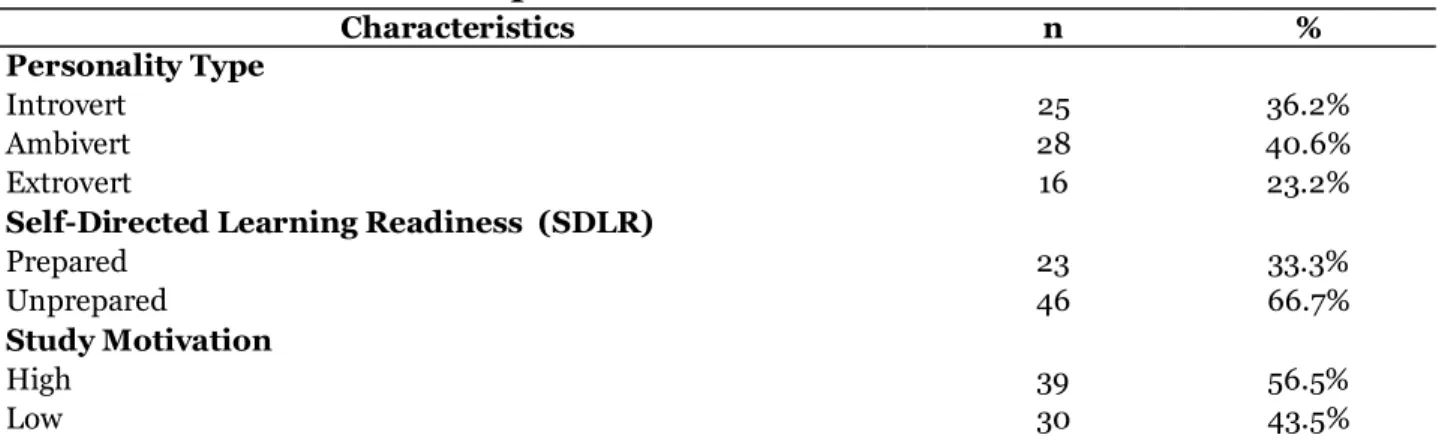
The study was conducted in January- March 2014 at the Faculty of Medicine, Se-belasMaret University, Surakarta. Samples were 80 students of Medical Education class of 2010, 2011, 2012, and 2013. A total of 11 students do not fill out the question-naire in full so that the remaining 69 samples. Characteristics of the study sam-ple are shown in Table 1.
Table 1. Characteristic of sample
Characteristics n %
Personality Type
Introvert 25 36.2%
Ambivert 28 40.6%
Extrovert 16 23.2%
Self-Directed Learning Readiness (SDLR)
Prepared 23 33.3%
Unprepared 46 66.7%
Study Motivation
High 39 56.5%
Low 30 43.5%
Students with introverted personality types in this study as many as 25 people (36.2%), personality type ambivert 28 people (40.6%), while the extrovert personality type as many as 16 people (23.2%). The level of readiness (SDLR) are categorized into two groups of students were consider-ed ready as many as 23 people (33.3%) and a group of students who are not ready for as 46 people (66.7%) (Table 1.). Students are grouped into student with high and low motivation. The division is based on the motivation level of the mean score of AMS. The mean value of AMS score in this study is at 99.9. AMS samples with a score of less
than 99.9 are grouped in the category of low motivation while samples with a score of AMS over 99.9 grouped in the category of high motivation. A total of 39 (56.5%) students are grouped in the category of high motivation and 30 (43.5%) of students in the category of low motivation(Table 1).
2.Data analysis
e-ISSN: 2549-0265 (online) 197
are divided into three categories, so we get two dummy variables.
Three categories of personality types are introvert, extrovert, ambivert and con-verted into two variables, D1 (Extrovert) and D2 (ambivert) (Table 2).
Table 2. Dummy variabel
Code Personality Type D1 D2
3 Introvert 0 0
2 Ambivert 0 1
1 Extrovert 1 0
The variables obtained by comparing ex-troverted personality and ambivert on in-verted personality as the basis.
Students introverted personality who declared ready by 9 votes (36.00%) and
were declared not ready as 16 people (64.00%) (Table 3). Students with perso-nalityambivert declared ready by 9 votes (32.14%) and were declared not ready as 19 people (67.86%) (Table 3).
Students with extroverted personality who ready by 5 votes (31.25%) and were declared not ready as 11 people (68.75%) (Table 3).
Students with ambivertedpersonality have the possibility to prepare 0.91 times lower than students with introverted perso-nality (Table 3). Students with extrovert personality type have possibility of 0.89 times lower than students with intro-vertedpersonality (Table 3).
Table 3. Result bivariate analysis type and DSLR
Personality Type
Degree of Readiness (SDLR)
OR
Not ready Ready
n % n %
Introvert 16 64.00 9 36.00
Ambivert 19 67.86 9 32.14 0.91
Ekstrovert 11 68.75 5 31.25 0.89
Table 4. Logistic regression analysis of the difference DSLR on extrovert and ambivert with controlling influence of motivation
Free Variables
Model I (Crude Analysis) Model II (Adjusted Analysis)
OR Lower 95% CI p OR 95% CI p
Limit Upper Limit Lower Limit Upper Limit
Ekstrovert 0.89 0.27 2.93 0.840 0.70 0.18 2.74 0.604
Ambivert 0.91 0.33 2.54 0.862 0.83 0.26 2.64 0.745
Motivation 2.37 0.81 6.93 0.115
N observation = 69 -2 log likehood = 85.117 NagelkerkeRSquare = 5.4 %
Currently lifelong learning skills be-come a necessity in the field of medicine and health sciences. The learning model with SDL has become quite important learning methods related thereto. Various changes and developments in medical sci-ence require students as future doctors to be able to implement SDL (Gyawali et al.,
2011). While the readiness of students to SDL strategy can be seen from the high level of SDLR. SDLR considered as a factor that may affect the student's success in implementing PBL (Gould, 2013).
Evi-198 e-ISSN: 2549-0265 (online)
dence suggests that not every student skil-led, willing and able to make decisions about whether and to what extent to be taught (O'Shea, 2003). Variables that are considered most influential in this regard are psychological variables (Abd-El-Fattah, 2010). The extent the ability and willing-ness to implement SDL can be explained psychologically by the personality (Kreber, 2006).
Extroverted personality is regarded as a strong predictor of a student tendency to engage SDL (Kreber, 2006). This is not consistent with the results in this study. Students with extrovert personality would have a lower level of readiness than the introverted students (Table 4). Extrovert prefers discussions, more active and tendsinteraction with others (Li, 2003) but this does not indicate the level of readiness of SDL higher than private introvert. Personal introverts tend to like the course (Li, 2003) it has a score SDLR higher.
Low levels of SDLR the students can relate to anxiety. Anxiety is described as having a strong relationship to the level SDLR (Hirson, 2011). While high levels of SDLR can be associated with personality, but it can be influenced by the situation (Candy, 1991). Students tend to be faced with the situation of PBL in learning will have a higher SDLR (Baker, 2012). In this study, all samples have been involved in learning with PBL system. This may explain the presence of a significant difference in the score SDLR students. In addition, the implementation of appropriate strategies in the learning system can also increase personal responsibility and increased levels SDLR on the student (Candy, 1991).
SDLR also affected the environment in which learning occurs. Personality cha-racterristics may fluctuate depending on the circumstances of the learning environ-ment (Candy, 1991). Environenviron-ment learning
that encompasses various factors such as the design of (resource and environmental structures) and the support that can be feedback from the instructor and peer le-arning (Song and Hill, 2007). The circums-tances of the learning environment to support, then it will also affect the increase-ed score SDLR. Conditionsone appro-priateof which related to the learners who already have a basic knowledge, basic skills, experience, familiar with the existing system and often face the same learning conditions (Baker, 2012).
In the application of SDL, a student as a learner needs to have certain personality traits to be able to direct himself (Brocket and Hiemstra, 1991). Personal attributes that play a role in determining the level of SDL is the self-awareness of the need to learn, is personal responsibility for learning (Bouncouvalas, 2009). Students are also expected to have a curiosity, a willingness to learn and a tendency to be able to take their own inisisatif (Guglielmino, 1977). Thus, SDL is a product of personal cha-racteristics (Hirson, 2011).
According to Fisher et al., SDLR total score greater than 150 indicates readiness for SDL. In this study, 23 students (33.3%) to the category of ready (Table 4). This shows that the students in this study were not ready (66.7%) more than the students who are ready (Table 4). This means that only 33.3% of students are ready for SDL and can set lifelong learning throughout theircareers (Greveson and Spencer, 2005). Readiness of students need to be improved because students continue to be motivated, be able to use the skills to evaluate the performance, able to identify, select and evaluate to achieve goals even when edu-cation is no longer available (Mifflin et al, 2000).
e-ISSN: 2549-0265 (online) 199
cross sectional study using a questionnaire. The accuracy of data depends on the hones-ty and memory of respondents that would affect the data and information obtained.
Cross-sectional study also has weak-nesses in determining causation because the risks and effects data retrieval is done at the same time. Study by this method is the conclusion of studyhas correlation with the risk factors most effect is weak compared with the case control and cohort. We can conclude that there were no differrences that are statistically significant in SDLR according to personality type.
Extroverted type personality are less likely to be prepared than introverted per-sonality types, but it was not statistically significant (OR=0.70; p=0.604).Likewise personality ambivert are less likely to be ready, but this relationship was not statis-tically significant (OR=0.83; p=0.745). This conclusion has taken into account the in-fluence of confounding factors of motiva-tion.
REFERENCE
Abd-El-Fattah SM (2010). Garrison's mo of
self-directed learning:
pre-eliminaryvalidation and relationship
to academic achievement.The
SpanishJournal of Psychology 13(2): 586-596.
Baker DE(2012). A study Comparing self-directed learning readiness (SDLR) in the classroom and in the clinical setting. Minneapolis, CapellaUnivers-ity.Dissertation.
Bouncovalas M (2009). Revisiting the con-cept of the self in self-directed learn-ing: Toward a more robust construct for study and practice in a global context. International Journal of Self-Directed Learning, 6 (1): 1-10.
Brocket RG, Hiemstra R (1991). Self-direct-ion in adult learning: Perspectives on
theory, study, and practice. London. Routledge.
Candy PC (1991). Self-direction for lifelong learning: A comprehensive guide to theory and practice. San Francisco, CA: Jossey-Bass.
Chen XS, CheungFM, Bond MH, Leung JP (2006).Going beyond topredict self-esteem, life satisfaction: The Chinese case. Asian Journal of Social Psycho-logy 9: 24-35.
Findley BW, BulikRJ(2011). The relation-ship of self-directed learning readi-ness to knowledge-based and perfor-mance-based measures of success in medical students. International Jour-nal of Self-Directed Learning 8(2): 28-43.
Fisher M, King J, Tague G (2001). Develop-ment of a self-directed learning readi-ness scale for nursing education. Nurse Education Today 21: 516-525. Furnham A,Chamorro-Premuzic,
McDou-gall F(2003).Personality, cognitive ability, and beliefs about intelligence as predictors of academic performan-ce.Learning and Individual Differen-ces 14: 49-66.
Gould K(2013). Comparing changes in knowledge between online learning and traditional instruction in under-graduate health professsionalstu-dents.Baltimore, Towson Univer-sity.Dissertation.
Greveson GC, Spencer JA (2005). Self-directed learning the importance of concepts and Contexts. Medical Edu-cation 39: 348-349.
Guglielmino LM(2013). The case for promoting self-directed learning is formal education. SA Educ Journal 10 (2): 1-18.
200 e-ISSN: 2549-0265 (online)
students of a medical school in Nepal. Journal of Clinical and Diagnostic Study 5 (1): 20-23.
Hirson R(2011). Personality traits, self-directed learning and career decide-ness of undergraduate students in large South African Metropolitan Uni-versity.Johannesburg, University of Johannesburg.Dissertation.
Klotz JC(2011). An examination of the re-lationshipbetweenself-directed learn-ing readiness and academic achieve-ment in the 1st half of college stu-dents.Dissertation.
Kreber C(2006). The relationships between self-directed learning, critical think-ing, and psychological type, and some implycations for teaching in higher education. Studies in Higher Edu-cation 23(1): 71-86.
Li Y(2003). Assessment of nursing college students' learning styles in Taiwan using the Myers-Briggs Type Indi-cator.LosAngeles,Universityof South-ernCalifornia.Dissertation.
Mala-Maung, Abas ZW, Abdullah A (2007). Factors Influencing the development of self-directed learning in a higher education environment. International Journal of Self-directed Learning 4 (1): 27- 36.
Mifflin BM, CB Campbell dab Price DA(2000). Achieving self-directed lifelong learning in PBL curricula.
Blackwell Science Ltd Medical
Education 34: 299-306.
O'Shea E (2003). Self-directed learning in nurse education: A review of the lite-rature. Journal of Advanced Nursing 43: 62-70.
Pamungkasari EP,Probandari A(2012). Measurement Capabilities Indepen-dent Learning on StuIndepen-dents. Journal of Educational Study and Evaluation 2: 492-510.
Secondira V, Rahayu GR, SuhoyoY (2009). Factors affecting medico GadjahMada University to carry out a constructive learning, independent, collaborative and contextual in problem-based
learning. Journal of Medical
Education and Health Professions In-donesia 4: 32-45.
Song L, Hill JR(2007). A concepttualmo-dels for understanding self-directed learninginonline environments. Jour-nal of Interactive Online Learning 6(1): 27-41
Suryabrata(2007).Psychology of Personal-ity. Jakarta: PT. King GrafindoPer-sada: 155-182; 275-315.