Received: January 4, 2016; Revised: March 15, 2016; Accepted: March 29, 2016
© The Author 2016. Published by Oxford University Press. All rights reserved. For Permissions, please email: [email protected]. doi:10.1093/carcin/bgw040
Advance Access publication April 7, 2016 Original Manuscript
607
original manuscript
A case–control analysis of smoking and breast cancer
in African American women: findings from the AMBER
Consortium
Song-Yi Park
1,*
, Julie R.Palmer
2, Lynn Rosenberg
2, Christopher A.Haiman
3,
Elisa V.Bandera
4, Traci N.Bethea
2, Melissa A.Troester
5, Emma Viscidi
2,
Laurence N.Kolonel
6, Andrew F.Olshan
5and Christine B.Ambrosone
71Cancer Epidemiology Program, University of Hawaii Cancer Center, 701 Ilalo Street, Honolulu, HI 96813, USA, 2Slone Epidemiology Center, Boston University, 1010 Commonwealth Avenue, Boston, MA 02215, USA, 3Department of Preventive Medicine and Norris Comprehensive Cancer Center, Keck School of Medicine, University of Southern California, 1441 Eastlake Avenue, Los Angeles, CA 90089, USA, 4Cancer Prevention and Control Program, Rutgers Cancer Institute of New Jersey, 195 Little Albany Street, New Brunswick, NJ 08903, USA, 5Department of Epidemiology and Lineberger Comprehensive Cancer Center, University of North Carolina, 135 Dauer Drive, Chapel Hill, NC 27599, USA, 6Office of Public Health Studies, University of Hawaii, 1960 East-West Road, Honolulu, HI 96822, USA and 7Department of Cancer Prevention and Control, Roswell Park Cancer Institute, Elm and Carlton Streets, Buffalo, NY 14263, USA
*To whom correspondence should be addressed. Tel: +1 808 564 5947; Fax: +1 808 586 2982; Email: [email protected]
Abstract
Recent population studies suggest a role of smoking in the etiology of breast cancer, but few have been conducted among African American women. In a collaborative project of four large studies, we examined associations between smoking measures and breast cancer risk by menopause and hormone receptor status [estrogen receptor-positive (ER+), ER-negative (ER−) and triple-negative (ER−, PR−, HER2−)]. The study included 5791 African American women with breast cancer and 17 376 African American controls. Odds ratios (ORs) and 95% confidence intervals (CIs) were calculated in multivariable logistic regression analysis with adjustment for study and risk factors. Results differed by menopausal status. Among postmenopausal women, positive associations were observed for long duration and greater pack-years of smoking: relative to never smoking, fully adjusted ORs were 1.14 (95% CI: 1.03–1.26) for duration ≥20 years and 1.16 (95% CI: 1.01–1.33) for ≥20 pack-years. By contrast, inverse associations were observed among premenopausal women, with ORs of 0.80 (95% CI: 0.68– 95) for current smoking and 0.81 (95% CI: 0.69–0.96) for former smoking, without trends by duration. Associations among postmenopausal women were somewhat stronger for ER+ breast cancer. The findings suggest that the relation of cigarette smoking to breast cancer risk in African American women may vary by menopausal status and breast cancer subtype.
Introduction
The epidemiological evidence for an association between cigarette smoking and breast cancer risk has been inconsistent, leading to the conclusion in the past that smoking was not a risk factor for this type of cancer (1,2). However, more recent evidence seems to support a role of smoking in the etiology of breast cancer (3–5) with some studies finding the greatest increases for long-duration
It is possible that associations of smoking with cancer out-comes differ by race. In the Multiethnic Cohort Study, Haiman and colleagues found that, among those who smoked less than 30 cigarettes per day, African Americans had signifi-cantly greater risks of lung cancer than European Americans, Asians and Hispanics (8). Also, African Americans had higher levels of total nicotine equivalents than other populations controlling for cigarettes per day (9). Such differences may be due to a number of factors including differences in smok-ing behavior, such as depth of inhalation (10) which could result in greater exposure to tobacco-smoke carcinogens, or differences in genetic variants related to carcinogen metab-olism, DNA repair and/or other pathways that may confer greater susceptibility to carcinogenesis. Results of the two studies examining relationships of smoking with breast cancer among African American women have been incon-sistent (11,12). Because African Americans have higher rates of premenopausal breast cancer compared with European Americans women, and greater proportions of estrogen receptor-negative (ER−) tumors associated with an aggres-sive pathology and poor prognosis (13), we aimed to investi-gate whether cigarette smoking is related to increased risk in these subgroups of breast cancer in African American women. In a collaborative project of four large studies with African American women, we examined associations between smok-ing exposure and breast cancer risk by hormone receptor sta-tus and menopausal stasta-tus.
Materials and methods
Study populationThe African American Breast Cancer Epidemiology and Risk (AMBER) Consortium was designed to elucidate the reasons for disparities in breast cancer subtypes among African American women. The details of AMBER have been published elsewhere (14). In brief, AMBER consists of two case–control studies, the Carolina Breast Cancer Study (CBCS) (15,16) and the Women’s Circle of Health Study (WCHS) (17,18), and two cohort studies, the Black Women’s Health Study (BWHS) (19) and the Multiethnic Cohort Study (MEC) (20). Diagnosis years (age range) were 1993–2014 (20–74 years) in CBCS and 2002–2013 (20–75 years) in WCHS. Enrollment years were 1995 (21–69 years) in BWHS and 1993–1996 (45– 75 years) in MEC. Institutional Review Board approval was granted for each individual study and for the AMBER Consortium, and informed consent was provided by all study participants. The cohort studies pro-vided nested case–control data with approximately four controls ran-domly selected from among women without breast cancer, matched on year of birth and on having completed the same questionnaire as the last questionnaire completed by the case before her diagnosis (index date) of breast cancer. The nested case–control data from BWHS and MEC were pooled with case–control data from CBCS and WCHS to create an AMBER database.
Cases of breast cancer
Eligible cases for the present study were 5819 women with a first diagnosis of invasive breast cancer or ductal carcinoma in situ and 17 453 controls. For the present study, individuals with missing data on smoking status (n = 105) were excluded, leaving 5791 cases and 17 376 controls. Pathology data from hospital records or cancer registry records were used to classify cancers by subtype based on ER, progesterone receptor (PR) and human epidermal receptor 2 (HER2). In the present study, 3099 ER-positive (ER+), 1511 ER− and 694 triple-negative (ER−, PR−, HER2−) cases were included.
Smoking measures
Smoking measures included smoking status (never, former, current), age at smoking initiation (≤14, 15–17, 18–20, ≥21 years), average number of cigarettes per day (<5, 5–14, 15–24, ≥25), smoking duration (<10, 10–19, ≥20 years), pack-years (<10, 10–19, ≥20) and years smoked prior to first birth among parous women (calculated by subtracting age at smoking initiation from age at first birth; smoked after first birth only, 1–5, 6–9, ≥10 years).
Statistical analysis
Distributions of smoking exposures between cases and controls were compared by chi-square tests. Associations between smoking and breast cancer were assessed by calculating odds ratios (ORs) and 95% confidence intervals (95% CIs) using unconditional logistic regression models. Never smokers were used as the common reference group. Basic models were adjusted for age (years), study (four studies), calendar year of interview (1993–1998, 1999–2005, 2006–2013) and geographic region (Northeast-NJ, Northeast-excluding NJ, South, Midwest, West and other). Multivariate models were further adjusted for education (<12, 12, 13–15, 16, ≥17 years, unknown), age at menarche (<11, 11–12, 13–14, 15–16, ≥17 years, unknown), age at first birth (<18, 18–19, 20–24, 25–29, 30–34, ≥35 years, unknown), parity (nulliparous, 1–2, 3–4, ≥5, unknown), age at menopause (<45, 45–49, 50–54, ≥55 years, unknown), oral contraceptive use (never/<1, 1–9, ≥10 years, unknown), estrogen only use (never, <5, ≥5 years, unknown), estrogen and progesterone use (never, <5, ≥5 years, unknown), body mass index (<18.5, 18.5–24.9, 25–29.9, 30–34.9, 35–39.9, ≥40 kg/m2, unknown), family history of breast cancer (yes, no) and alcohol consumption (never; past; current: <1; current: 1–6; current: ≥7 drinks/week; unknown). For each covariate, there was <2% missing data. In analyses limited to participants without miss-ing data on any covariate (n = 19 669; 85%), the results did not change. We also included the study and the year of interview as random effects in the models, but the result did not vary. For analyses of passive smoking, we excluded MEC due to lack of information. Women who had never been exposed to active or passive smoking at home were used as the refer-ence group. Tests for linear trend were performed by entering the ordinal variable as continuous parameter in the models, excluding never smokers. Tests for interaction were performed using Wald statistics for cross-terms.
P values were two sided and were considered statistically significant if <0.05. All analyses were performed with SAS, version 9.4 (SAS Institute, Cary, NC).
Results
As shown in Table 1, the CBCS had the highest proportion of ER− and triple-negative cases, due to oversampling of young women, and the MEC had the highest proportion of older women. Proportions of current smokers among controls ranged from 18.3 in BWHS to 20.7 in WCHS. The proportion of former smokers was higher in MEC (34.4) than in the other three stud-ies (19.7–23.4), which likely reflects the high proportions of older women in MEC.
Table 2 presents results from a basic model (adjustment for age, study, year and geographic region) and fully adjusted models for associations between smoking measures and overall risk of ER+, ER− and triple-negative breast cancer. There was lit-tle difference in ORs from the basic and multivariate models. Results were similar for each cancer subtype, with few excep-tions. Neither former nor current smoking was associated with risk for ER+, ER− or triple-negative breast cancer. Results were
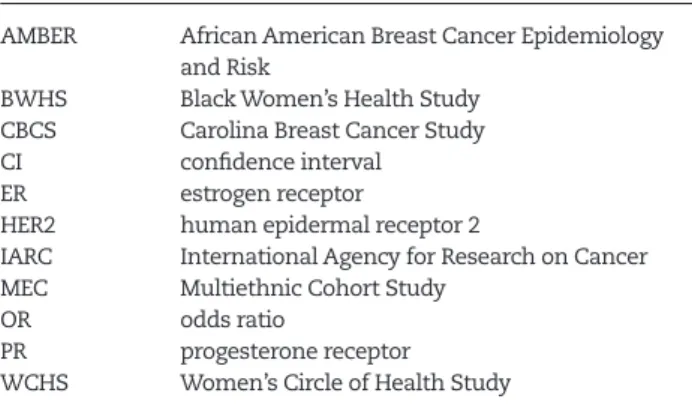
Abbreviations
AMBER African American Breast Cancer Epidemiology and Risk
BWHS Black Women’s Health Study CBCS Carolina Breast Cancer Study CI confidence interval
ER estrogen receptor
HER2 human epidermal receptor 2
IARC International Agency for Research on Cancer MEC Multiethnic Cohort Study
OR odds ratio
null for all measures of smoking among the combined group of current and former smokers except duration: there was evi-dence of an increasing risk with increasing duration of smoking for ER+ breast cancer (OR for ≥20 years duration: 1.11, 95% CI: 1.00–1.23; P trend for duration categories = 0.033), but no trend observed for ER− or triple-negative breast cancer.
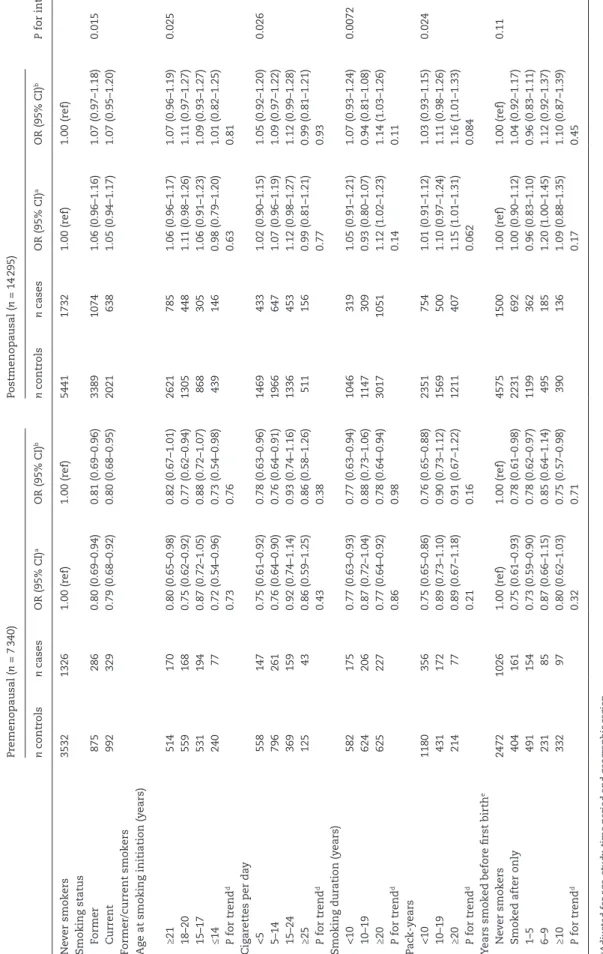
Table 3 presents data for all subtypes together, stratified by menopausal status. ORs from the basic and multivariate models were very similar. Among postmenopausal women, the OR for current relative to never smokers was 1.05 (95% CI: 0.94–1.17), with fully adjusted OR of 1.07 (95% CI: 0.95–1.20). Among pre-menopausal women, there appeared to be inverse associations for current versus never smokers (OR = 0.79, 95% CI: 0.68–0.92; fully adjusted OR = 0.80, 95% CI: 0.68–0.95). Among postmeno-pausal women, smoking duration and pack-years of ≥20 were associated with non-significant increases in risk (adjusted OR for ≥20 years duration = 1.14, 95% CI: 1.03–1.26); adjusted OR for ≥20 pack-years = 1.16, 95% CI: 1.01–1.33) compared with never smoking. By contrast, among premenopausal women, adjusted ORs for duration ≥20 years and pack-years ≥20 were 0.78 (95% CI: 0.64–0.94) and 0.91 (95% CI: 0.67–1.22), respectively, with similar estimates in basic and fully adjusted models. For initiation of smoking before age 15 relative to never smoking, ORs were 1.01 (95% CI: 0.82–1.25) in postmenopausal women and 0.73 (95% CI: 0.54–0.98) in premenopausal women. Although tests for inter-action by menopausal status were statistically significant for all smoking measures except years smoked before first birth, the P values for interaction largely reflected the differences in association for ever smoking versus never smoking rather than differences for the heaviest categories of smoking exposure. We also looked at joint exposures based on findings from previous studies. In a combined analysis of age at initiation of smoking and pack-years, ORs for smoking initiation at ≤17 years and ≥20 pack-years of smoking compared with never smoking were 1.19 (95% CI: 0.84–1.70) in premenopausal women and 1.07 (95% CI: 0.87–1.32) in postmenopausal women (data not shown). In a combined analysis of total pack-years with years smoked before first birth, ORs for ≥6 years smoked before first birth and ≥20 pack-years compared with parous never smokers were 0.89 (95% CI: 0.53–1.48) in premenopausal women and 1.07 (95% CI: 0.82– 1.40) in postmenopausal women (data not shown). Results did not vary when we restricted the analyses to invasive cases only (78% of the cases, data not shown).
In analyses stratified on study design (case–control versus cohort) of the original contributing studies, the inverse asso-ciation observed for current smoking in premenopausal women was stronger in the case–control (OR = 0.68, 95% CI: 0.52–0.89) than in the cohort studies (OR = 0.88, 95% CI: 0.71–1.08), but a test for heterogeneity was not statistically significant (P = 0.64). Among postmenopausal women, ORs for current smoking were 1.00 (95% CI: 0.77–1.29) in the case–control studies and 1.08 (95% CI: 0.95–1.23) in the cohort studies.
We repeated the analyses after excluding passive smokers from the reference category (data not shown). The ORs for pas-sive only relative to never active and never paspas-sive were 1.10 (95% CI: 0.94–1.30) among premenopausal women and 0.93 (95% CI: 0.79–1.10) among postmenopausal women. Estimates for active smoking relative to never active and never passive were similar to the estimates based on a reference group of never active smokers.
We next assessed associations with ER+, ER− and triple-neg-ative breast cancer within strata of menopausal status (Tables 4 and 5). Among premenopausal women (Table 4), results were generally similar for ER+ and ER− cancer with a few exceptions: ORs for ≥20 pack-years versus none were 1.13 (95% CI: 0.78–1.64) for ER+ and 0.55 (95% CI: 0.30–1.01) for ER−, and ORs for ≥25 cig-arettes per day were 1.09 (95% CI: 0.67–1.78) and 0.66 (95% CI: 0.33–1.32) for ER+ and ER−, respectively. Among postmenopausal women, there was some evidence of stronger associations for ER+ than ER− breast cancer. The OR for ≥20 years duration was 1.17 (95% CI: 1.04–1.32) for ER+ cancer and 1.03 (95% CI: 0.86– 1.24) for ER− cancer (Table 5). The OR for ≥10 years of smoking before first birth was 1.20 (95% CI: 0.90–1.59) for ER+ and 0.93 (95% CI: 0.59–1.47) for ER− cancer. ORs for triple-negative tumors were similar to those for ER− breast cancer.
Associations between smoking and breast cancer did not dif-fer between alcohol drinkers and non-drinkers in pre- or post-menopausal women (data not shown).
Discussion
In this collaborative study of breast cancer in African American women, associations between cigarette smoking and breast cancer risk differed by menopausal status. Among postmeno-pausal women, smoking duration of ≥20 years and pack-years of ≥20 were related to a 14 and 16% increased breast cancer risk,
Table 1. Characteristics of breast cancer cases and controls by study
CBCS WCHS MEC BWHS Total
n (%) n (%) n (%) n (%) n (%)
Breast cancer cases
Total 894 1406 1138 2353 5791
ER+ 405 (45.3) 813 (57.8) 692 (60.8) 1189 (50.5) 3099 (53.5)
ER− 401 (44.9) 313 (22.3) 244 (21.4) 553 (23.5) 1511 (26.1)
ER−, PR−, HER2− 233 (26.1) 182 (12.9) 95 (8.3) 184 (7.8) 694 (12.0)
Missing 88 (9.8) 280 (19.9) 202 (17.8) 611 (26.0) 1181 (20.4)
Age at diagnosis (years)
<40 139 (15.6) 162 (11.5) 0 (0.0) 182 (7.7) 483 (8.3)
40–49 289 (32.3) 395 (28.1) 16 (1.4) 690 (29.3) 1390 (24.0)
50–59 212 (23.7) 484 (34.4) 171 (15.0) 759 (32.3) 1626 (28.1)
≥60 254 (28.4) 365 (26.0) 951 (83.6) 722 (30.7) 2292 (39.6)
Smoking status among controls
Total 788 1221 4590 10 777 17 376
Never 470 (59.6) 705 (57.7) 2160 (47.1) 6285 (58.3) 9620 (55.4)
Former 155 (19.7) 270 (22.1) 1577 (34.4) 2519 (23.4) 4521 (26.0)
Ta
ble 2.
Smoking and br
east cancer risk b
y tumor subtype
n contr ols ER+ ER− ER−, PR−, HER2− n cases
OR (95% CI)
a
OR (95% CI)
b
n
cases
OR (95% CI)
a
OR (95% CI)
b
n
cases
OR (95% CI)
a
OR (95% CI)
b Ne ver smokers 9620 1738 1.00 (r ef) 1.00 (r ef) 860 1.00 (r ef) 1.00 (r ef) 380 1.00 (r ef) 1.00 (r ef)
Smoking status Former
4521 790 0.97 (0.88–1.07) 0.99 (0.89–1.09) 382 1.07 (0.94–1.23) 1.08 (0.94–1.24) 179 1.19 (0.98–1.44) 1.12 (0.91–1.37) Curr ent 3235 571 0.99 (0.88–1.10) 1.04 (0.93–1.17) 269 0.91 (0.78–1.05) 0.91 (0.77–1.06) 135 1.07 (0.87–1.32) 0.97 (0.77–1.21) Former/curr ent smokers Ag
e at smoking initiation (y
ears) ≥21 3294 543 0.94 (0.84–1.05) 0.97 (0.86–1.09) 243 0.98 (0.84–1.15) 1.00 (0.84–1.17) 110 1.09 (0.87–1.38) 1.03 (0.81–1.31) 18–20 2023 362 1.00 (0.88–1.14) 1.02 (0.89–1.16) 177 0.97 (0.81–1.16) 0.96 (0.80–1.16) 87 1.11 (0.86–1.43) 1.03 (0.80–1.34) 15–17 1514 285 1.01 (0.87–1.17) 1.07 (0.92–1.24) 159 1.11 (0.92–1.34) 1.12 (0.92–1.36) 81 1.29 (0.99–1.67) 1.18 (0.90–1.55) ≤14 714 148 1.04 (0.86–1.26) 1.12 (0.92–1.37) 65 0.94 (0.72–1.24) 0.97 (0.73–1.30) 35 1.12 (0.77–1.62) 1.02 (0.69–1.51) P for tr end c 0.10 0.034 0.59 0.39 0.47 0.35 Cig ar
ettes per da
y <5 2135 353 0.96 (0.84–1.09) 1.01 (0.89–1.16) 160 1.04 (0.87–1.25) 1.06 (0.88–1.28) 80 1.29 (1.00–1.68) 1.23 (0.94–1.61) 5–14 2953 529 0.96 (0.86–1.07) 0.99 (0.88–1.11) 253 0.97 (0.84–1.14) 0.98 (0.84–1.15) 127 1.14 (0.92–1.41) 1.04 (0.83–1.30) 15–24 1822 360 1.08 (0.95–1.23) 1.11 (0.97–1.27) 163 0.97 (0.81–1.17) 0.97 (0.80–1.18) 76 1.02 (0.78–1.34) 0.95 (0.72–1.25) ≥25 691 103 0.87 (0.70–1.09) 0.89 (0.71–1.11) 68 1.08 (0.82–1.42) 1.08 (0.82–1.44) 27 1.03 (0.67–1.57) 0.94 (0.61–1.46) P for tr end c 0.94 0.63 0.85 0.74 0.26 0.22 Smoking dur ation (y ears) <10 1750 281 0.94 (0.82–1.09) 0.97 (0.84–1.12) 156 0.99 (0.82–1.19) 0.99 (0.81–1.19) 79 1.18 (0.91–1.53) 1.10 (0.84–1.43) 10–19 1908 281 0.88 (0.76–1.01) 0.89 (0.77–1.03) 166 1.04 (0.86–1.24) 1.05 (0.87–1.26) 76 1.13 (0.87–1.47) 1.05 (0.80–1.39) ≥20 3848 775 1.05 (0.96–1.16) 1.11 (1.00–1.23) 319 0.99 (0.86–1.14) 1.01 (0.86–1.17) 154 1.12 (0.91–1.37) 1.03 (0.83–1.28) P for tr end c 0.066 0.033 0.76 0.86 0.56 0.57 Pac k-y ears <10 3766 654 0.93 (0.84–1.03) 0.97 (0.87–1.07) 329 0.96 (0.84–1.11) 0.97 (0.84–1.13) 170 1.14 (0.94–1.39) 1.07 (0.87–1.31) 10–19 2125 399 1.07 (0.94–1.21) 1.11 (0.97–1.26) 191 1.08 (0.90–1.28) 1.08 (0.90–1.29) 88 1.17 (0.91–1.50) 1.07 (0.82–1.39) ≥20 1524 272 1.02 (0.88–1.18) 1.05 (0.91–1.23) 116 1.01 (0.82–1.25) 1.02 (0.82–1.27) 48 1.04 (0.75–1.43) 0.96 (0.69–1.34) P for tr end c 0.18 0.20 0.49 0.52 0.57 0.51 Y
ears smoked befor
e first birth
d Ne ver smokers 7576 1421 1.00 (r ef) 1.00 (r ef) 735 1.00 (r ef) 1.00 (r ef) 333 1.00 (r ef) 1.00 (r ef) 0 2784 477 0.89 (0.79–1.00) 0.94 (0.83–1.08) 243 0.95 (0.81–1.11) 0.98 (0.82–1.17) 110 0.98 (0.77–1.24) 0.89 (0.69–1.15) 1–5 1838 302 0.91 (0.79–1.05) 0.97 (0.84–1.13) 172 0.99 (0.82–1.19) 0.99 (0.82–1.21) 87 1.13 (0.88–1.46) 1.02 (0.78–1.34) 6–9 770 149 1.12 (0.92–1.36) 1.08 (0.88–1.32) 87 1.24 (0.97–1.59) 1.20 (0.93–1.56) 41 1.37 (0.96–1.94) 1.27 (0.88–1.83) ≥10 753 148 1.11 (0.91–1.35) 1.03 (0.83–1.27) 48 0.76 (0.56–1.04) 0.78 (0.56–1.08) 27 0.99 (0.65–1.50) 1.08 (0.68–1.70) P for tr end c 0.0022 0.11 0.86 0.20 0.52 0.96
aAdjusted for a
ge
, stud
y,
time period and g
eo gr aphic r eg ion. bAdditionall
y adjusted for education,
a
ge at menar
che
, a
ge at first birth,
parity
, status of and a
ge at menopause
, or al contr ace pti ve use , estr og en onl y use , estr og
en and pr
og
ester
one use
, bod
y mass inde
x,
famil
y histor
y of br
east
cancer and alcohol consumption. cExcluding ne
ver smokers.
dAmong par
ous w
Ta
ble 3.
Smoking and br
east cancer risk b
y menopausal status
Pr emenopausal ( n = 7 340) Postmenopausal ( n = 14 295) P for inter action c n contr ols n cases
OR (95% CI)
a
OR (95% CI)
b n contr ols n cases
OR (95% CI)
a
OR (95% CI)
b Ne ver smokers 3532 1326 1.00 (r ef) 1.00 (r ef) 5441 1732 1.00 (r ef) 1.00 (r ef)
Smoking status Former
875 286 0.80 (0.69–0.94) 0.81 (0.69–0.96) 3389 1074 1.06 (0.96–1.16) 1.07 (0.97–1.18) 0.015 Curr ent 992 329 0.79 (0.68–0.92) 0.80 (0.68–0.95) 2021 638 1.05 (0.94–1.17) 1.07 (0.95–1.20) Former/curr ent smokers Ag
e at smoking initiation (y
ears) ≥21 514 170 0.80 (0.65–0.98) 0.82 (0.67–1.01) 2621 785 1.06 (0.96–1.17) 1.07 (0.96–1.19) 0.025 18–20 559 168 0.75 (0.62–0.92) 0.77 (0.62–0.94) 1305 448 1.11 (0.98–1.26) 1.11 (0.97–1.27) 15–17 531 194 0.87 (0.72–1.05) 0.88 (0.72–1.07) 868 305 1.06 (0.91–1.23) 1.09 (0.93–1.27) ≤14 240 77 0.72 (0.54–0.96) 0.73 (0.54–0.98) 439 146 0.98 (0.79–1.20) 1.01 (0.82–1.25) P for tr end d 0.73 0.76 0.63 0.81 Cig ar
ettes per da
y <5 558 147 0.75 (0.61–0.92) 0.78 (0.63–0.96) 1469 433 1.02 (0.90–1.15) 1.05 (0.92–1.20) 0.026 5–14 796 261 0.76 (0.64–0.90) 0.76 (0.64–0.91) 1966 647 1.07 (0.96–1.19) 1.09 (0.97–1.22) 15–24 369 159 0.92 (0.74–1.14) 0.93 (0.74–1.16) 1336 453 1.12 (0.98–1.27) 1.12 (0.99–1.28) ≥25 125 43 0.86 (0.59–1.25) 0.86 (0.58–1.26) 511 156 0.99 (0.81–1.21) 0.99 (0.81–1.21) P for tr end d 0.43 0.38 0.77 0.93 Smoking dur ation (y ears) <10 582 175 0.77 (0.63–0.93) 0.77 (0.63–0.94) 1046 319 1.05 (0.91–1.21) 1.07 (0.93–1.24) 0.0072 10–19 624 206 0.87 (0.72–1.04) 0.88 (0.73–1.06) 1147 309 0.93 (0.80–1.07) 0.94 (0.81–1.08) ≥20 625 227 0.77 (0.64–0.92) 0.78 (0.64–0.94) 3017 1051 1.12 (1.02–1.23) 1.14 (1.03–1.26) P for tr end d 0.86 0.98 0.14 0.11 Pac k-y ears <10 1180 356 0.75 (0.65–0.86) 0.76 (0.65–0.88) 2351 754 1.01 (0.91–1.12) 1.03 (0.93–1.15) 0.024 10–19 431 172 0.89 (0.73–1.10) 0.90 (0.73–1.12) 1569 500 1.10 (0.97–1.24) 1.11 (0.98–1.26) ≥20 214 77 0.89 (0.67–1.18) 0.91 (0.67–1.22) 1211 407 1.15 (1.01–1.31) 1.16 (1.01–1.33) P for tr end d 0.21 0.16 0.062 0.084 Y
ears smoked befor
e first birth
e Ne ver smokers 2472 1026 1.00 (r ef) 1.00 (r ef) 4575 1500 1.00 (r ef) 1.00 (r ef) 0.11
Smoked after onl
y 404 161 0.75 (0.61–0.93) 0.78 (0.61–0.98) 2231 692 1.00 (0.90–1.12) 1.04 (0.92–1.17) 1–5 491 154 0.73 (0.59–0.90) 0.78 (0.62–0.97) 1199 362 0.96 (0.83–1.10) 0.96 (0.83–1.11) 6–9 231 85 0.87 (0.66–1.15) 0.85 (0.64–1.14) 495 185 1.20 (1.00–1.45) 1.12 (0.92–1.37) ≥10 332 97 0.80 (0.62–1.03) 0.75 (0.57–0.98) 390 136 1.09 (0.88–1.35) 1.10 (0.87–1.39) P for tr end d 0.32 0.71 0.17 0.45
aAdjusted for a
ge
, stud
y,
time period and g
eo gr aphic r eg ion. bAdditionall
y adjusted for education,
a
ge at menar
che
, a
ge at first birth,
parity
, status of and a
ge at menopause
, or al contr ace pti ve use , estr og en onl y use , estr og
en and pr
og
ester
one use
, bod
y mass inde
x,
famil
y histor
y of br
east
cancer and alcohol consumption. cBased on the m
ulti
variate model.
dExcluding ne
ver smokers.
eAmong par
ous w
respectively, and associations were more apparent for ER+ than for ER− cancer. The magnitude of the associations is quite mod-est compared to the relationship between smoking and lung cancer risk, where smoking duration ≥20 years and pack-years ≥20 are associated with more than 240 and 490% increased risk of lung cancer, respectively, in women (21). Among premenopausal women, measures of smoking duration and intensity were not associated with increased risk of breast cancer and results were similar for ER+, ER− and triple-negative breast cancer. Former and current smoking were associated with an approximately 20% reduction in risk, but without a clear dose–response rela-tionship in any of the smoking variables.
Evidence for an effect of cigarette smoking on breast can-cer risk is still ‘insufficient’ in humans, according to the IARC Monographs (22). Historically, most studies found no link between cigarette smoking and breast cancer (23), but in recent years, more studies have found that smoking is related to a higher risk of breast cancer (3,4). A meta-analysis of 15 cohort studies in 2013 showed a 12% increase in risk among current smokers and a 9% increase among former smokers, compared with never smokers (5), whereas a collaborative re-analysis in
2002 concluded that smoking had no effect on the risk of devel-oping breast cancer (24). The 2013 meta-analysis also reported that smoking initiation at a younger age and before the first birth was associated with a higher risk of breast cancer, and an expert panel convened by four Canadian agencies, the Ontario Tobacco Research Unit, the Public Health Agency of Canada, Physicians for a Smoke-Free Canada and the Canadian Partnership Against Cancer, concluded that the association between active smok-ing and breast cancer is consistent with causality (3). Recently, several cohort (12,25–28) and population-based case–control (29,30) studies found an increased risk associated with various smoking measures, whereas one cohort (31) and one popula-tion-based case–control (32) study found no association with any smoking variable. However, there are few data for African American women.
Results from studies on smoking in relation to pre- and post-menopausal breast cancer are mixed (6,7). IARC Monographs in 2012 stated that results for pre- versus post-menopausal breast cancer were inconsistent (6). The US Surgeon General Report in 2014 concluded that, although a meta-analysis of 20 studies suggested greater risk in premenopausal than in
Table 4. Smoking and breast cancer risk by tumor subtype in premenopausal women
n controls
ER+ ER− ER−, PR−, HER2−
n cases OR (95% CI)a n cases OR (95% CI)a n cases OR (95% CI)a
Never smokers 3532 641 1.00 (ref) 384 1.00 (ref) 175 1.00 (ref)
Smoking status
Former 875 128 0.75 (0.60–0.95) 95 0.94 (0.72–1.23) 44 0.94 (0.64–1.38)
Current 992 165 0.87 (0.70–1.08) 89 0.69 (0.52–0.91) 51 0.82 (0.57–1.20)
Former/current smokers Age at smoking initiation (years)
≥21 514 74 0.77 (0.58–1.02) 49 0.79 (0.56–1.12) 23 0.83 (0.50–1.37)
18–20 559 77 0.74 (0.56–0.98) 47 0.69 (0.48–0.97) 27 0.87 (0.55–1.39)
15–17 531 97 0.92 (0.70–1.19) 64 0.98 (0.71–1.35) 33 0.96 (0.62–1.50)
≤14 240 44 0.87 (0.60–1.26) 23 0.78 (0.48–1.26) 12 0.80 (0.41–1.56)
P for trendb 0.16 0.38 0.79
Cigarettes per day
<5 558 75 0.78 (0.59–1.04) 38 0.82 (0.56–1.18) 21 1.11 (0.66–1.84)
5–14 796 117 0.71 (0.56–0.90) 81 0.79 (0.59–1.05) 44 0.88 (0.59–1.30)
15–24 369 76 0.99 (0.74–1.33) 53 0.87 (0.61–1.23) 26 0.80 (0.49–1.32)
≥25 125 23 1.09 (0.67–1.78) 11 0.66 (0.33–1.32) 4 0.47 (0.16–1.43)
P for trendb 0.16 0.72 0.16
Smoking duration (years)
<10 582 85 0.83 (0.63–1.07) 58 0.76 (0.55–1.05) 36 1.04 (0.68–1.59)
10–19 624 87 0.80 (0.62–1.04) 63 0.91 (0.67–1.25) 26 0.77 (0.48–1.24)
≥20 625 119 0.82 (0.64–1.05) 62 0.77 (0.56–1.07) 32 0.80 (0.51–1.25)
P for trendb 0.95 0.97 0.47
Pack-years
<10 1180 170 0.76 (0.62–0.93) 110 0.78 (0.61–1.00) 64 0.96 (0.68–1.35)
10–19 431 74 0.83 (0.62–1.11) 59 0.98 (0.70–1.37) 24 0.80 (0.49–1.32)
≥20 214 45 1.13 (0.78–1.64) 13 0.55 (0.30–1.01) 6 0.50 (0.20–1.22)
P for trendb 0.068 0.60 0.11
Year smoked before first birthc
Never smokers 2472 487 1.00 (ref) 308 1.00 (ref) 143 1.00 (ref)
Smoked after only 404 64 0.69 (0.50–0.96) 51 0.73 (0.50–1.06) 26 0.79 (0.47–1.33)
1–5 491 69 0.75 (0.55–1.02) 60 0.99 (0.71–1.40) 31 1.00 (0.62–1.60)
6–9 231 41 0.86 (0.59–1.27) 26 0.98 (0.61–1.57) 10 0.68 (0.33–1.42)
≥10 332 58 0.84 (0.60–1.19) 19 0.58 (0.34–0.99) 13 0.97 (0.49–1.92)
P for trendb 0.087 0.31 0.48
aAdjusted for age, study, time period, geographic region, education, age at menarche, age at first birth, parity, oral contraceptive use, estrogen only use, estrogen and progesterone use, body mass index, family history of breast cancer and alcohol consumption.
postmenopausal women, it remained uncertain whether the association of smoking with breast cancer differed by menopau-sal status (7). In the present study of African American women, we found inconsistent directions in the associations with smok-ing exposures by menopausal status, with inverse associations between smoking and risk of premenopausal breast cancer and positive associations with postmenopausal cancer. We can only speculate as to the biologic mechanisms that could be at play to explain reduced risk with smoking in younger African American women with breast cancer. It has been shown in numerous stud-ies that serum estradiol levels are significantly higher across the menstrual cycle in African American compared with Caucasian women (33), particularly in premenopausal women (reviewed in reference), and that serum hormone levels differ according to smoking status, with lower estradiol and estrone among premenopausal women who are smokers (34). In the Women’s Health Initiative, smoking was associated with increased risk of infertility and natural menopause occurring before the age of 50 years (35), illustrating effects on reproductive and hormonal factors. Smoking has been shown to exert estrogen-lowering effects in premenopausal women through the action of nicotine
on increasing the number of regressing follicles in the ovary and blocking the aromatase enzyme, leading to a decreased conver-sion of androgens to estrogens (36).
Because African American women have higher estrogen lev-els throughout the menstrual cycle than Caucasians and have greater prevalence of premenopausal breast cancer, it may be plausible to suggest that potential anti-estrogenic effects of cig-arette smoking, by reducing levels of estradiol and estrone, could reduce risk of premenopausal breast cancer in African American women. This reduction in estrogen levels in premenopausal women may outweigh an increased risk due to the carcino-gens in cigarette smoke. To our knowledge, inverse associations between smoking and premenopausal breast cancer have not been previously reported, and these findings among premeno-pausal African American women merit further investigation. In contrast to the findings in premenopausal women, among postmenopausal women in our study, longer duration of smok-ing was related to an increased risk of breast cancer. Tobacco smoking is associated with higher levels of sex hormones in postmenopausal women (37), which may partly explain the link between tobacco and breast cancer risk, apart from its direct
Table 5. Smoking and breast cancer risk by tumor subtype in postmenopausal women
n controls
ER+ ER− ER−, PR−, HER2−
n cases OR (95% CI)a n cases OR (95% CI)a n cases OR (95% CI)a
Never smokers 5441 1000 1.00 (ref) 415 1.00 (ref) 180 1.00 (ref)
Smoking status
Former 3389 611 1.04 (0.92–1.17) 259 1.11 (0.93–1.33) 120 1.17 (0.90–1.51)
Current 2021 365 1.12 (0.97–1.30) 145 0.93 (0.75–1.16) 68 0.97 (0.71–1.34)
Former/current smokers Age at smoking initiation (years)
≥21 2621 448 1.03 (0.90–1.18) 170 1.01 (0.83–1.24) 77 1.08 (0.80–1.46)
18–20 1305 254 1.14 (0.97–1.34) 110 1.08 (0.85–1.38) 52 1.17 (0.83–1.65)
15–17 868 165 1.08 (0.89–1.32) 81 1.13 (0.86–1.48) 39 1.17 (0.79–1.74)
≤14 439 90 1.13 (0.87–1.46) 37 1.01 (0.69–1.47) 19 1.03 (0.60–1.75)
P for trendb 0.56 0.68 0.69
Cigarettes per day
<5 1469 257 1.09 (0.93–1.27) 107 1.11 (0.88–1.41) 51 1.26 (0.90–1.77)
5–14 1966 373 1.09 (0.95–1.26) 151 1.04 (0.84–1.28) 70 1.05 (0.77–1.43)
15–24 1336 261 1.13 (0.96–1.33) 91 0.92 (0.71–1.18) 42 0.96 (0.66–1.38)
≥25 511 72 0.83 (0.63–1.09) 49 1.20 (0.86–1.68) 21 1.15 (0.69–1.90)
P for trendb 0.23 0.67 0.55
Smoking duration (years)
<10 1046 170 1.01 (0.84–1.21) 83 1.12 (0.87–1.46) 37 1.16 (0.79–1.71)
10–19 1147 176 0.92 (0.76–1.10) 81 1.03 (0.79–1.34) 41 1.21 (0.84–1.75)
≥20 3017 611 1.17 (1.04–1.32) 231 1.03 (0.86–1.24) 106 1.04 (0.79–1.37)
P for trendb 0.023 0.64 0.68
Pack-years
<10 2351 432 1.03 (0.90–1.18) 188 1.05 (0.86–1.27) 91 1.12 (0.85–1.49)
10–19 1569 301 1.18 (1.01–1.38) 113 1.02 (0.81–1.28) 53 1.09 (0.77–1.53)
≥20 1211 214 1.07 (0.90–1.27) 90 1.10 (0.85–1.42) 37 1.04 (0.71–1.54)
P for trendb 0.42 0.67 0.81
Years smoked before first birthc
Never smokers 4575 858 1.00 (ref) 375 1.00 (ref) 167 1.00 (ref)
Smoked after only 2231 393 1.00 (0.86–1.16) 165 1.00 (0.81–1.24) 72 0.90 (0.65–1.24)
1–5 1199 198 0.98 (0.81–1.18) 96 0.94 (0.73–1.21) 47 0.98 (0.68–1.42)
6–9 495 94 1.11 (0.86–1.43) 50 1.16 (0.82–1.63) 24 1.42 (0.87–2.31)
≥10 390 85 1.20 (0.90–1.59) 26 0.93 (0.59–1.47) 12 1.04 (0.53–2.03)
P for trendb 0.70 0.37 0.91
aAdjusted for age, study, time period, geographic region, education, age at menarche, age at first birth, parity, oral contraceptive use, estrogen only use, estrogen and progesterone use, body mass index, family history of breast cancer and alcohol consumption.
toxic and carcinogenic effects. The mechanism for these associ-ations is unknown but may involve more general effects on the hypothalamic–pituitary–adrenal axis (38). Therefore, cigarette smoking may not have the same effects on breast cancer risk in pre- and post-menopausal women (36,37).
Previous findings have been inconsistent on the association of smoking with breast cancer subtypes defined by hormone receptor status (6,7). Recent large cohort studies in Europe and the USA found an increased risk in current and former smokers for ER+ but not for ER− breast cancer, although the interaction tests were not statistically significant (5,26). A population-based case–control study of young women in the USA found that ever smokers had an increased risk of ER+ but not of triple-negative breast cancer (30). A case–control study in Japan reported that women who start to smoke as teenagers might have a higher risk of postmenopausal ER−/PR− cancer (39). In our study, the association of smoking with postmenopausal cancer risk was somewhat stronger for ER+ than for ER− cancer. Cigarette smok-ing has direct carcinogenic effects in breast tissue, since mam-mary carcinogens in cigarette smoke can reach breast tissue (40), form DNA adducts and cause mutations (41,42). These effects may explain the increased risk observed among postmenopau-sal women in our study. Also, carcinogens in tobacco smoke can have both estrogenic and anti-estrogenic effects (30,36,43). Therefore, the effects of tobacco smoke on breast cancer risk via estrogen metabolism are not straightforward.
To our knowledge, no study other than those participating in the AMBER Consortium reported the association between smoking and breast cancer risk in an African American population. CBCS previously found a stronger association in African Americans than in whites (11). BWHS reported an increased risk of premenopau-sal ER+ breast cancer associated with active smoking, especially smoking at younger age and higher pack-years (12). MEC and WCHS did not report separately on African American women.
Strengths of our study include a large sample size and a wide range of covariates. The AMBER Consortium offers a unique opportunity to assess risk factors for specific subtypes of breast cancer and subgroups in African American women with adequate statistical power. A limitation is that we were not able to examine exposure to passive smoking for the entire dataset, because MEC did not collect data on it. However, when we ran the analysis limited to women with secondhand smok-ing information, no significant association was found with pas-sive smoking. We were not able to consider duration or intensity of passive smoking due to insufficient information. Two of the four studies included in the analysis were case–control studies, which could be subject to recall bias and to underrepresenta-tion of smokers among controls. Separate analyses of the case– control studies and the original cohort studies did not provide evidence of such bias. Another limitation is that HER2 data were missing for many participants, since testing for HER2 expression did not become widespread until 2005. ER status was also miss-ing for a substantial proportion (20%) of subjects, which may lead to bias in risk estimates.
In conclusion, we found an increased risk of postmenopau-sal breast cancer associated with long duration and greater pack-years of smoking in African American women, possibly stronger for ER+ cancer, but a decreased risk of premenopausal breast cancer in former and current smokers.
Funding
National Cancer Institute (P01CA151135 to all investiga-tors, UM1CA164973 to S.-Y.P. and C.A.H., P50CA58223 to A.F.O.,
R01CA058420 and UM1CA164974 to L.R., T.N.B. and J.R.P., R01CA100598 to C.B.A.); Breast Cancer Research Foundation (to C.B.A.); University Cancer Research Fund of North Carolina (to A.F.O.).
Conflict of Interest Statement: None declared.
References
1. U.S. Department of Health and Human Services. (2004) The Health Consequences of Smoking: A Report of the Surgeon General. U.S. Department of Health and Human Services, Atlanta, GA.
2. IARC Working Group on the Evaluation of Carcinogenic Risks to Humans. (2004) Tobacco smoke and involuntary smoking. IARC Mon-ogr. Eval. Carcinog. Risks Hum., 83, 1–1438.
3. Johnson, K.C. et al. (2011) Active smoking and secondhand smoke increase breast cancer risk: the report of the Canadian Expert Panel on Tobacco Smoke and Breast Cancer Risk (2009). Tob. Control, 20, e2. 4. Reynolds, P. (2013) Smoking and breast cancer. J. Mammary Gland Biol.
Neoplasia, 18, 15–23.
5. Gaudet, M.M. et al. (2013) Active smoking and breast cancer risk: origi-nal cohort data and meta-aorigi-nalysis. J. Natl. Cancer Inst., 105, 515–525. 6. IARC Working Group on the Evaluation of Carcinogenic Risks to
Humans. (2012) Personal habits and indoor combustions. Volume 100 E. A review of human carcinogens. IARC Monogr. Eval. Carcinog. Risks Hum., 100, 1–538.
7. U.S. Department of Health and Human Services. (2014) The health con-sequences of smoking—50 years of progress. A report of the surgeon general. U.S. Department of Health and Human Services, Atlanta, GA. 8. Haiman, C.A. et al. (2006) Ethnic and racial differences in the
smoking-related risk of lung cancer. N. Engl. J. Med., 354, 333–342.
9. Park, S.L. et al. (2015) Variation in levels of the lung carcinogen NNAL and its glucuronides in the urine of cigarette smokers from five ethnic groups with differing risks for lung cancer. Cancer Epidemiol. Biomark-ers Prev., 24, 561–569.
10. Pérez-Stable, E.J. et al. (1998) Nicotine metabolism and intake in black and white smokers. JAMA, 280, 152–156.
11. Mechanic, L.E. et al. (2006) Polymorphisms in nucleotide excision repair genes, smoking and breast cancer in African Americans and whites: a population-based case-control study. Carcinogenesis, 27, 1377–1385. 12. Rosenberg, L. et al. (2013) A prospective study of smoking and breast
cancer risk among African-American women. Cancer Causes Control, 24, 2207–2215.
13. American Cancer Society. (2013) Cancer Facts & Figures for African Americans 2013–2014. American Cancer Society, Atlanta, GA.
14. Palmer, J.R. et al. (2014) A collaborative study of the etiology of breast cancer subtypes in African American women: the AMBER consortium. Cancer Causes Control, 25, 309–319.
15. McGee, S.A. et al. (2013) Determinants of breast cancer treatment delay differ for African American and White women. Cancer Epidemiol. Bio-markers Prev., 22, 1227–1238.
16. Newman, B. et al. (1995) The Carolina Breast Cancer Study: integrating population-based epidemiology and molecular biology. Breast Cancer Res. Treat., 35, 51–60.
17. Bandera, E.V. et al. (2013) Rethinking sources of representative controls for the conduct of case-control studies in minority populations. BMC Med. Res. Methodol., 13, 71.
18. Ambrosone, C.B. et al. (2009) Conducting molecular epidemiological research in the age of HIPAA: a multi-institutional case-control study of breast cancer in African-American and European-American women. J. Oncol., 2009, 871250.
19. Rosenberg, L. et al. (1995) The Black Women’s Health Study: a follow-up study for causes and preventions of illness. J. Am. Med. Womens. Assoc., 50, 56–58.
20. Kolonel, L.N. et al. (2000) A multiethnic cohort in Hawaii and Los Ange-les: baseline characteristics. Am. J. Epidemiol., 151, 346–357.
21. Papadopoulos, A. et al. (2011) Cigarette smoking and lung cancer in women: results of the French ICARE case-control study. Lung Cancer, 74, 369–377.
23. Palmer, J.R. et al. (1993) Cigarette smoking and the risk of breast cancer. Epidemiol. Rev., 15, 145–156.
24. Hamajima, N., et al. (2002) Alcohol, tobacco and breast cancer—collab-orative reanalysis of individual data from 53 epidemiological studies, including 58,515 women with breast cancer and 95,067 women with-out the disease. Br. J. Cancer, 87, 1234–45.
25. Bjerkaas, E. et al. (2013) Smoking duration before first childbirth: an emerging risk factor for breast cancer? Results from 302,865 Norwe-gian women. Cancer Causes Control, 24, 1347–1356.
26. Dossus, L. et al. (2014) Active and passive cigarette smoking and breast cancer risk: results from the EPIC cohort. Int. J. Cancer, 134, 1871–1888.
27. Catsburg, C., et al. (2014) Active cigarette smoking and risk of breast cancer. Int. J. Cancer, 136, 2204–2209.
28. Nyante, S.J. et al. (2014) Cigarette smoking and postmenopausal breast cancer risk in a prospective cohort. Br. J. Cancer, 110, 2339–2347. 29. McKenzie, F. et al. (2013) Cigarette smoking and risk of breast
can-cer in a New Zealand multi-ethnic case-control study. PLoS One, 8, e63132.
30. Kawai, M. et al. (2014) Active smoking and the risk of estrogen receptor-positive and triple-negative breast cancer among women ages 20 to 44 years. Cancer, 120, 1026–1034.
31. Catsburg, C. et al. (2014) Active cigarette smoking and the risk of breast cancer: a cohort study. Cancer Epidemiol., 38, 376–381.
32. Cotterchio, M. et al. (2014) Active cigarette smoking, variants in car-cinogen metabolism genes and breast cancer risk among pre- and postmenopausal women in Ontario, Canada. Breast J., 20, 468–480. 33. Shaw, N.D. et al. (2014) Evidence that increased ovarian aromatase
activity and expression account for higher estradiol levels in
Afri-can AmeriAfri-can compared with Caucasian women. J. Clin. Endocrinol. Metab., 99, 1384–1392.
34. Soldin, O.P. et al. (2011) Steroid hormone levels associated with passive and active smoking. Steroids, 76, 653–659.
35. Hyland, A., et al. (2015) Associations between lifetime tobacco expo-sure with infertility and age at natural menopause: the Women’s Health Initiative Observational Study. Tob. Control. doi: 10.1136/tobac-cocontrol-2015-052510.
36. Tankó, L.B. et al. (2004) An update on the antiestrogenic effect of smok-ing: a literature review with implications for researchers and practi-tioners. Menopause, 11, 104–109.
37. Key, T.J., et al. (2011) Circulating sex hormones and breast cancer risk factors in postmenopausal women: reanalysis of 13 studies. Br. J. Can-cer, 105, 709–722.
38. Kapoor, D. et al. (2005) Smoking and hormones in health and endocrine disorders. Eur. J. Endocrinol., 152, 491–499.
39. Nishino, Y. et al. (2014) Cigarette smoking and breast cancer risk in relation to joint estrogen and progesterone receptor status: a case-control study in Japan. Springerplus, 3, 65.
40. Hecht, S.S. (2002) Tobacco smoke carcinogens and breast cancer. Envi-ron. Mol. Mutagen., 39, 119–126.
41. Ambrosone, C.B. et al. (1996) Cigarette smoking, N-acetyltransferase 2 genetic polymorphisms, and breast cancer risk. JAMA, 276, 1494–1501. 42. Ambrosone, C.B. et al. (2008) Cigarette smoking, N-acetyltransferase 2
genotypes, and breast cancer risk: pooled analysis and meta-analysis. Cancer Epidemiol. Biomarkers Prev., 17, 15–26.