Geometry-driven Feature Detection
Changchang Wu
A dissertation submitted to the faculty of the University of North Carolina at Chapel Hill in partial fulfillment of the requirements for the degree of Doctor of Philosophy in the Department of Computer Science.
Chapel Hill 2011
Approved by:
Marc Pollefeys, Advisor
Jan-Michael Frahm, Co-principal Reader
Svetlana Lazebnik, Reader
Jack Snoeyink, Reader
Abstract
Changchang Wu: Geometry-driven Feature Detection. (Under the direction of Marc Pollefeys.)
Matching images taken from different viewpoints is a fundamental step for many
computer vision applications including 3D reconstruction, scene recognition, virtual
re-ality, robot localization, etc. The typical approaches detect feature keypoints based
on local properties to achieve robustness to viewpoint changes, and establish
corre-spondences between keypoints to recover the 3D geometry or determine the similarity
between images. The complexity of perspective distortion challenges the detection of
viewpoint invariant features; the lack of 3D geometric information about local features
makes their matching inefficient.
In this thesis, I explore feature detection based on 3D geometric information for
improved projective invariance. The main novel research contributions of this thesis are
as follows. First, I give a projective invariant feature detection method that exploits
3D structures recovered from simple stereo matching. By leveraging the rich geometric
information of the detected features, I present an efficient 3D matching algorithm to
handle large viewpoint changes. Second, I propose a compact high-level feature detector
that robustly extracts repetitive structures in urban scenes, which allows efficient
wide-baseline matching. I further introduce a novel single-view reconstruction approach to
Acknowledgments
I would like to thank my advisor, Marc Pollefeys, for supporting me over the years, and
for inspiring and guiding my research. I would also like to thank my co-advisor Jan-Michael
Frahm for his outstanding mentorship and for being a friend who is always supportive with
my work and life. Svetlana Lazebnik gave me many valuable insights to my research which
brightened my vision of the big picture. Jack Snoeyink’s insights always help me to locate
the critical places that I need to improve, and he gave valuable help on my writing skills. I
am grateful to have Frank Dellaert in my committee, and he has been very supportive with
constructive insights.
I would like to thank my many friends and colleagues at UNC-Chapel Hill and at
ETH-Z¨urich with whom I have had the pleasure of working over the years. These include Xiaowei
Li, Li Guan, Ram Krishan Kumar, Rahul Raguram, David Gallup, Brian Clipp, Christopher
Zach, Friedrich Fraundorfer, Megha Pandy, Sudipta Sinha, Seon Joo Kim, Roland Angst,
Gabriel Brostow and all the members of the Computer Vision Group at UNC-Chapel Hill and
Computer Vision and Geometry Lab at ETH-Z¨urich.
I would like to thank my friends at UNC-Chapel Hill, Ping Lu, Chen Wang, Xiaoxiao Liu,
Hao Xu, Liangjun Zhang, Yuanxin Liu, Xueyi Wang, Jun Huan, Feng Pan, Qi Zhang, and
many others, for giving me memorable experiences outside of my office during my PhD years.
Finally, I would like to thank my wife Li Li for being the love and happiness of my life,
Table of Contents
List of Figures . . . x
1 Introduction . . . 1
1.1 Motivation . . . 1
1.2 Thesis Statement . . . 3
1.3 Contribution . . . 3
1.4 Overview . . . 4
2 Background . . . 6
2.1 Invariance Based on Local Statistics . . . 10
2.2 Invariance Based on Regions . . . 14
2.3 Invariance Based on 3D Scene Geometry . . . 16
2.4 Invariance Based on Repetition . . . 18
2.4.1 Repetition Detection . . . 18
2.4.2 Repetition-based Features . . . 22
2.5 Evaluation . . . 24
3 Viewpoint-Invariant Patch (VIP) Feature . . . 26
3.1 Large Scale Reconstruction . . . 26
3.2 Viewpoint-Invariant Patch . . . 29
3.2.1 The VIP Detection . . . 30
3.2.2 Dimensions of a VIP Feature . . . 31
3.2.4 Evaluation of Repeatability . . . 34
3.3 3D Model Matching with VIPs . . . 35
3.3.1 3D Similarity from a Single VIP Match . . . 36
3.3.2 Hierarchical Hypothesis Test . . . 37
3.3.3 3D Model Matching Experiments . . . 40
3.4 Loop Closing with VIPs . . . 43
3.5 Pose Estimation with VIPs . . . 44
3.6 Location Recognition with VIPs . . . 47
3.6.1 3D Model Search System . . . 48
3.6.2 3D Model Search Evaluation . . . 50
3.7 Further Discussions . . . 53
4 Repetition Region Feature . . . 56
4.1 Reconstruction with Repetition Presence . . . 57
4.1.1 Repetition Challenges in Reconstruction . . . 57
4.1.2 Features from Repetition . . . 58
4.1.3 Repetition for Finer Reconstruction . . . 60
4.2 Related Work . . . 61
4.3 Repetition in Urban Scenes . . . 62
4.4 Sparse Repetition and Symmetry Detection . . . 62
4.4.1 Vanishing Point Refinement . . . 63
4.4.2 Repetition Intervals and Symmetry Axes . . . 65
4.5 Dense Detection . . . 67
4.5.1 Evaluation of Repetition Quality . . . 67
4.5.2 Repetition Region Detection . . . 69
4.6 Experiments . . . 72
4.6.1 Qualitative Results . . . 72
4.6.2 Quantitative Evaluation . . . 75
4.7 Further Discussion . . . 78
5 Repetition-based Reconstruction . . . 80
5.1 Dense Reconstruction from Repetition . . . 80
5.2 Related Work . . . 82
5.2.1 Reconstruction from Repetition and Symmetry . . . 82
5.2.2 Markov Random Field Stereo . . . 82
5.2.3 Symmetric Stereo . . . 83
5.3 Geometry of Repetition in A Rectified Image . . . 83
5.4 Repetition-based Optimization Framework . . . 85
5.4.1 Data Term . . . 86
5.4.2 Smoothness Term . . . 87
5.4.3 Repetition Term . . . 87
5.4.4 Reflective Symmetry Term . . . 90
5.4.5 The Algorithm . . . 92
5.5 Experiments . . . 93
5.5.1 Reconstruction of Interval Maps . . . 93
5.5.2 Repetition-based 3D Reconstruction . . . 94
5.6 Further Discussion . . . 96
6 Conclusion and Future Work . . . 99
6.1 Summary . . . 99
6.2 Future Work . . . 100
6.2.2 Applications . . . 102
6.2.3 Possible Extensions . . . 102
List of Figures
1.1 Products using image matching to organize photo collections. . . 2
2.1 Structure from Motion (SfM) using invariant features. . . 7
2.2 Feature matching example. . . 8
2.3 Feature Description. . . 9
2.4 Challenges in invariant feature detection and matching . . . 10
2.5 Detection of DoG keypoints. . . 12
2.6 Harris-Affine region features. . . 13
2.7 Maximum stable extremal regions. . . 15
2.8 3D Geometry used to generate projective normalized views. . . 17
2.9 Method for detecting repetition. . . 20
2.10 Repetition patterns difficult for existing detection methods. . . 21
2.11 Repetition lattice used as scene recognition . . . 23
3.1 Correspondence of two Viewpoint Invariant Patches(VIPs) . . . 29
3.2 The VIPs detected on a 3D model. . . 31
3.3 VIPs detected on dominant planes. . . 33
3.4 Texture warping on planar structures . . . 33
3.5 Wall images for repeatability evaluation. . . 34
3.6 Number of inliers under projective transformations . . . 35
3.7 Re-detection rate of features under projective transformations . . . 35
3.8 Three pairs of point matches given by one VIP correspondence. . . 37
3.10 Example of distributions of scale and rotation in 3D matching. . . 39
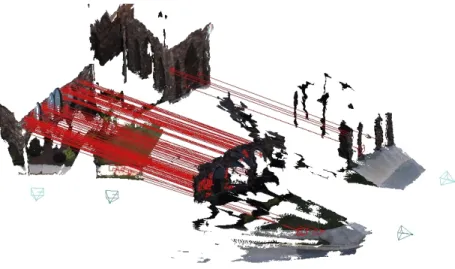
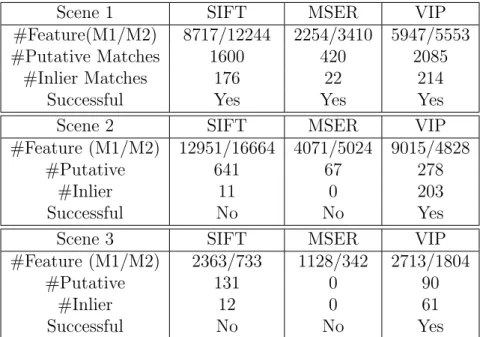
3.11 Scene 1: Matching 3D models with 45◦ viewing direction change. . . 42
3.12 Scene 2: Matching 3D models with very small overlap. . . 42
3.13 Scene 3: Matching 3D models from camera paths crossing at 90◦. . . 42
3.14 VIP-based loop closing experiment. . . 44
3.15 3D model reconstruction with VIP-based loop closing . . . 45
3.16 Pose estimation from SIFT-VIP matches. . . 47
3.17 Comparison of SIFT matching and SIFT-VIP Matching. . . 48
3.18 Illustration of SIFT-VIP match. . . 49
3.19 Mobile vision based localization. . . 50
3.20 3D model search evaluation. . . 51
3.21 Examples of from the 3D model retrieval. . . 52
3.22 Loop detection in city-scale data. . . 53
3.23 Missing geometric information of typical image features. . . 54
4.1 Overview of the repetition analysis in this thesis. . . 57
4.2 Example of the proposed repetition detection. . . 58
4.3 Drawbacks of local image features. . . 59
4.4 Example of vanishing point refinement. . . 65
4.5 Example of the detected repeating features and symmetry axes. . . 66
4.6 The proposed similarity and quality measurement. . . 69
4.7 Repetition region initialization and propagation. . . 71
4.8 Example of repetition region decomposition. . . 73
4.9 Examples of repetition detection . . . 74
4.11 Evaluation by single-feature image retrieval. . . 78
5.1 Repetition intervals give strong clues of 3D geometry. . . 81
5.2 Dense reconstruction from repetition. . . 81
5.3 Images used in comparison of dense reconstruction. . . 94
5.4 Comparison of different repetition terms. . . 95
5.5 Dense reconstruction examples. . . 97
5.6 Ortho-rectified images generated based single view reconstruction. . . 98
5.7 Example of ortho-rectified images. . . 98
6.1 Possible improvements to repetition detection. . . 101
6.2 Viewpoint invariant structure based on vertical vanishing points. . . 103
Chapter 1
Introduction
Our eyes constantly obtain information about the world we live in, while our brain is
able to efficiently process massive amount of visual data, understand the complicated
three dimensional structures of our world, and recognize the scenes we have seen before
even when they were observed from different viewpoints. A fundamental problem of
computer vision is to match images taken from different viewpoints in order to recover
the three dimensional structure or recognizing scenes. This thesis falls in the long line
of work to detect invariant image keypoint for the matching task, and focuses mainly on
developing invariant keypoints to handle the complicated matching scenarios through
the interpretation of underlying geometric information within images, particularly, 3D
dense geometry and repetition patterns.
1.1
Motivation
With the wide usage of various digital imaging devices, in our daily life, security,
docu-mentation, for military, and many other places, vast amounts of image data are being
generated every second, which drives the need for efficient organization of the data
through appearance-based matching. Particularly, 3D reconstruction from photo
col-lections or video sequences produces not only compact representations of scenes, but
Figure 1.1: Products using image matching to organize photo collections. On the left is PhotoSynth, and on the right is Google Swirl.
reconstructed 3D structure can be used for simulation or virtual reality, for example,
virtual flight training or remote medical surgery. The recovered motion enables us to
navigate photo collections according to their geometric relationship, which has been
de-veloped as a public feature in products like Google Maps and PhotoSynth. In addition
to user-tags and Geo-locations from user input or imaging devices, appearance-based
matching provides an alternative to automatically find possible image matches. For
instance, Google Goggles allows a user to search by simply taking a photo with a
cell-phone, while the servers will do the matching at the backend. Online-shopping websites
can now show products with similar photos to give shoppers an additional way to select
products.
Over the past decades, many techniques have been proposed to evaluate the similarity
of images and recover 3D geometry from images. Typically, statistics of either global
appearance or local interesting keypoints are extracted as a compact representation of
images. While global statistics are not robust to viewpoint changes due to the complexity
of the view geometry, many local interesting points have been proposed to compensate
local perspective distortion, particularly in the family of similarity transformations and
affine transformations, and thus achieve more robust features. However, local invariance
distortions. In terms of feature matching, the larger quantity of local features and the
massiveness of the image collections pose additional challenges on the computation cost.
The ambiguity in repetitive structures, especially in urban scenes, causes additional
problems to the precision of matching.
This thesis contributes algorithms to deal with the challenges in the feature
match-ing problem includmatch-ing large viewpoint changes, repetitive structures, and the large data
scale. They will be necessary steps toward the goal of efficient matching of large
com-plicated image datasets, for example, all the images on the Internet, or all the maps.
1.2
Thesis Statement
By exploiting 3D scene geometry and repetition in image(s), projective invariant feature
detection can be achieved along with stronger discriminative power, and the
geometry-driven features can be used to further improve the accuracy and efficiency of image
matching and 3D geometric reconstruction
1.3
Contribution
My thesis makes the following main contributions.
The Viewpoint Invariant Patch (VIP) feature based on 3D dense geometry.
I introduce a novel class of viewpoint independent local features for robust registration
under widely different viewpoints. This approach leverages local shape information to
detect interesting keypoints and extract invariant feature descriptors. The novel features
are designed to be invariant to 3D camera motion and a single feature correspondence can
uniquely define the 3D similarity transformation between two scenes. A novel algorithm
is then developed to use the rich information of the new features for efficient image
Repetition-based high-level region feature.
I present a robust and efficient framework to analyze large repetitive structures on
architectural facades, which essentially extracts features that possibly have high-level
meanings. A novel quality measure is proposed to evaluate how image patches fit a
repetition interval, based on which an accurate repetition boundary detection is
devel-oped. The algorithm is particularly efficient by evaluating repetition and symmetry with
adaptiveness to the scale of repetitions. The detected repeating elements are used as
high-level compact features for efficient image matching, which provide a new way to
evaluate the repeatability of repetition detection.
Repetition-based single-view dense reconstruction.
I propose a dense reconstruction algorithm to recover the 3D details of repeating
ele-ments, which extends the repetition-based feature detection. The single-view
reconstruc-tion is formulated as an energy minimizareconstruc-tion problem over the dense pixel
correspon-dences. In order to obtain dense repetitive structures, I develop a novel repetition-based
energy term to penalize the 3D structure inconsistency between the dynamically
corre-sponded pixel pairs. The proposed framework is able to enforce high-order geometric
constraints in the image domain.
1.4
Overview
The remainder of the dissertation is organized as follows.
Chapter 2 presents the background and fundamental technologies required for
in-variant feature detection and feature matching. The different families of local inin-variant
features are discussed based on the type of image content interpretation used in feature
detection, including region information, 3D scene geometry, and repetition.
Chapter 3 describes a new viewpoint invariant patch (VIP) feature and an efficient 3D
of VIP with state-of-art image features. The approached is extended to registration of
images to 3D models, and efficient search of large scale 3D models datasets.
Chapter 4 introduces a new framework to jointly analyze repetition and symmetry in
urban scenes. The robustness of the detection algorithm is evaluated on large datasets.
The detected repeating elements are used in image retrieval to evaluate the detection
repeatability.
Chapter 5 describes a novel repetition-based single view reconstruction method that
recovers the 3D geometry for repeating elements. The new optimization frame
auto-matically balances between photometric consistency, local smoothness and high-order
geometric constraints.
Chapter 6 summarizes the contributions, concludes the thesis, and discusses potential
Chapter 2
Background
Matching images taken from different viewpoints is important for 3D reconstruction
and scene recognition, which usually need to deal with arbitrarily taken images (e.g.
Figure 2.1). Instead of a direct match of all pixels, state-of-art methods typically first
establish the correspondences between some distinctive interest points, then reconstruct
camera parameters and scene structures based on projective geometry. To successfully
match images with different perspective distortions, interest points need to be extracted
such that they are invariant (robust) to viewpoint changes. Hence such interest points
are also known as invariant features.
Invariant feature detection is the class of techniques to extract distinctive points,
corners, regions, etc, with local properties that are approximately invariant to the
pro-jective transformations involved in image formation. Under relatively small viewpoint
changes (e.g. 30 degrees), projective transformations at many scene points can often be
locally approximated by similarity transformations or affine transformations. By
ex-tracting a large number of interest points that satisfy an similarity-invariant property
or affine-invariant property, some portion of the extracted points will be invariant to
similarity transformations or affine transformations respectively. Actually,
similarity-invariant and affine-similarity-invariant features satisfy the needs of many matching tasks, thus
Figure 2.1: Structure from Motion (SfM) using invariant features. Images taken from different viewpoints are related by their invariant features, from which cameras and 3D model can be recovered based on projective constraints. (best viewed in color)
invariance. Beyond them, it gets harder to achieve invariance to general projective
trans-formations due to the dimensionality reduction occurring during the projection from 3D
scene geometry to 2D images. In the last decade, many invariant feature detectors have
been developed for wide-baseline matching and recognition. Figure 2.2 shows examples
of similarity-invariant features.
To obtain an invariant description of features for matching, each invariant feature is
associated with a surrounding image region that is consistent with its local structure and
local projective transformation, so that corresponding features in different images can
be transformed to the same normalized view for description. Typically, scale invariant
features use scale-dependent circular regions and affine-invariant features use ellipses
or parallelograms [Mikolajczyk et al. (2005)]. By normalizing the features according
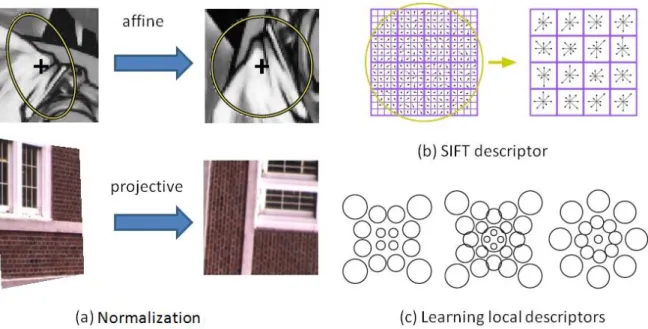
to their different spatial extents and local dominant orientations, invariant feature
de-scriptors are constructed from the normalized views (illustrated in Figure 2.3.) Another
research focus is to develop effective feature descriptors. In particular, the descriptor
invented by Lowe (2004) for Scale Invariant Feature Transform (SIFT) is one of the
most popular descriptors, and uses a 4x4 grid of Gaussian weighted 8-direction gradient
histogram. While many descriptors use image gradients histograms, Forssen and Lowe
Figure 2.2: Feature matching example. SIFT (Scale Invariant Feature Transform [Lowe (2004)]) features are shown on top of the two images on the left. Each feature is displayed as an arrow such that its direction represents feature orientation and its length represents feature size. The right image shows the resulting feature correspondences, which are mostly correct. This pair of image is hard due to relatively large viewpoint change, so there are not so many feature matches. (best viewed in color)
to illumination changes. A performance comparison of many feature descriptors has
been presented by Mikolajczyk and Schmid (2005). Winder and Brown (2007) further
tried to learn possible good representations of feature descriptors from a training patch
database.
Invariant features enable feature-based image matching. With the normalized
fea-ture descriptors, feafea-ture correspondences between two images can be found by nearest
neighbor search in the descriptor space (e.g. Figure 2.2). An additionally often-adopted
constraint is a threshold on the ratio between the smallest distance and the second
smallest distance, which has been proven effective for filtering the matches that have
Figure 2.3: Feature description. Normalized views of features are first generated ac-cording to the spatial extent of features, and descriptors are computed as a compact representation. (a) Two examples of normalization. (b) The 4x4 bin layout of SIFT de-scriptor. (c) Other examples of the descriptor bin layouts [Winder and Brown (2007)]. (Best viewed in color)
datasets is time-consuming because the number of features in an image is often large.
In feature-based recognition, a vocabulary tree approach is often used by quantizing the
descriptors to integers and using them as visual keywords to index images [Nist´er and
Stew´enius (2006)]. Although some accuracy is sacrificed, efficiency can be achieved by
replacing direct matching of descriptors with fast indexing-based search.
This thesis addresses the following challenges in feature-based matching.
• Large Viewpoint Changes. The changes of local appearances can be too hard to model and the common features detected in different images do not match. For
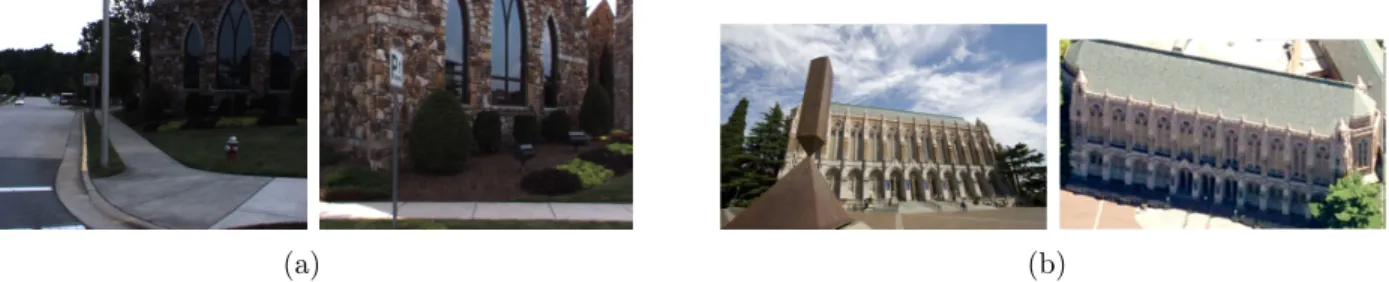
example, the two images in Figure 2.4(a) have a viewing direction difference of 90
degrees.
• Repetitive Structures, which is common in urban scenes (e.g. Figure 2.4(b)). Local feature detection results in many similar features. The resulting ambiguous
(a) (b)
Figure 2.4: Challenges in invariant feature detection and matching. (a) Large viewpoint changes make it hard to achieve invariance. (b) Repetitive structures make feature matching prone to errors.
• Large-scale Matching. When matching with too many images, the large number of local features becomes a problem. Although a speedup can be achieved by
indexing with feature-based visual words, the matching results can often be wrong
due to the lack of semantic meanings.
The next few sections will discuss some features related to the proposed features of
this thesis. Some methods achieve invariance by processing neighboring pixels without
interpretation of the underlying structure; other methods achieve improve invariance
with the guidance of high-level information, for example, regions, 3D geometry, and
repetition, etc. In Section 2.1, 2.2, 2.3 and 2.4, the related feature detectors will be
categorized and reviewed based on whether or not and how they exploit the high-level
image interpretations.
2.1
Invariance Based on Local Statistics
Characteristic scale or affine shape can be defined for an interest point solely based
on local statistics without information or interpretation about local 3D structures.
In-variance to similarity transformation and affine transformation can then be achieved by
normalizing the characteristic shapes of the features.
depth the feature scale selection problem based on the Gaussian scale space, and
pro-posed the scale selection at maxima and minima of functions based on combinations
of scale-normalized derivatives [Lindeberg (1998)]. These local statistics include
nor-malized Laplace-of-Gaussian (LoG), Difference-of-Gaussian (DoG), and Determinant of
Hessian matrix (DoH). Such detectors are also known as blob detectors since they
re-spond strongly to the structures that are darker or brighter than their surroundings.
As illustrated in Figure 2.5, Lowe (2004) designed Scale Invariant Transform (SIFT) to
use DoG function for keypoint selection, which exploits the constructed Gaussian space
to achieve efficiency. To improve the accuracy of feature localization, SIFT applies
quadratic interpolation to obtain sub-pixel locations and sub-level feature scales. The
Speed Up Robust Feature (SURF) proposed by Bay et al. (2006) detects features by
finding DoH maxima. SURF particularly uses integral images [Viola and Jones (2001)]
for fast convolution and feature descriptor generation. Improving on the Harris
cor-ner [Harris and Stephens (1988)], Mikolajczyk and Schmid (2004) proposed a method
that first detects scale-adapted Harris corner points, and then searches for local maxima
of Laplace-of-Gaussian (LoG) function to determine the scale of the interest points.
Invariance to affine transformations is another heavily investigated area of in-variant features. Based on the local characteristic scale of an interest point, a circular
region can be upgraded to affine shape according to its local second moment matrix
[Lin-deberg and Garding (1994)], which is also known as affine blob detection. Harris-affine
regions [Mikolajczyk and Schmid (2004)] starts from regions defined by scale-invariant
Harris keypoints, and refines affine shapes based on the two eigenvalues of their second
moment matrix. Kadir et al. (2004) first define a characteristic scale for an interest
point by searching for entropy maximum over scales, and then refine the shape in affine
space to obtain salient regions. Tuytelaars and Van Gool (2004) proposed an edge-based
region to define characteristic parallelograms for corners structures. From the family of
Figure 2.5: Detection of DoG keypoints [Lowe (2004)]. The left image illustrates the construction of DoG scale space by subtracting Gaussian scale space pyramid. Images are downsampled by 2 when scale doubles. Maxima and minima of the DoG images are detected by comparing a pixel (marked with X) to its 26 neighbors in 3x3 regions at the current and adjacent scales (marked with circles). (Best viewed in color)
extrema of some local statistics is chosen to be the characteristic parallelogram.
Since the shapes of the defined surrounding regions are covariant with the underlying
geometry, they are also called affine covariant regions [Mikolajczyk et al. (2005)]. As
il-lustrated in Figure 2.3, the normalized view of a feature can be obtained by transforming
ever ellipse to a circle or every parallelogram to a square, then feature descriptors can
be constructed in the same way as scale invariant features. Compared to scale-invariant
features, affine-invariant features have theoretically stronger invariance to projective
transformations, but scale-invariant SIFT often outperforms affine-invariant regions in
wide-baseline matching, probably because SIFT has more accurate localization. As a
consequence, SIFT has been chosen by many reconstruction systems [Snavely et al.
(2006); Li et al. (2008); Agarwal et al. (2009); Frahm et al. (2010)].
(a) (b)
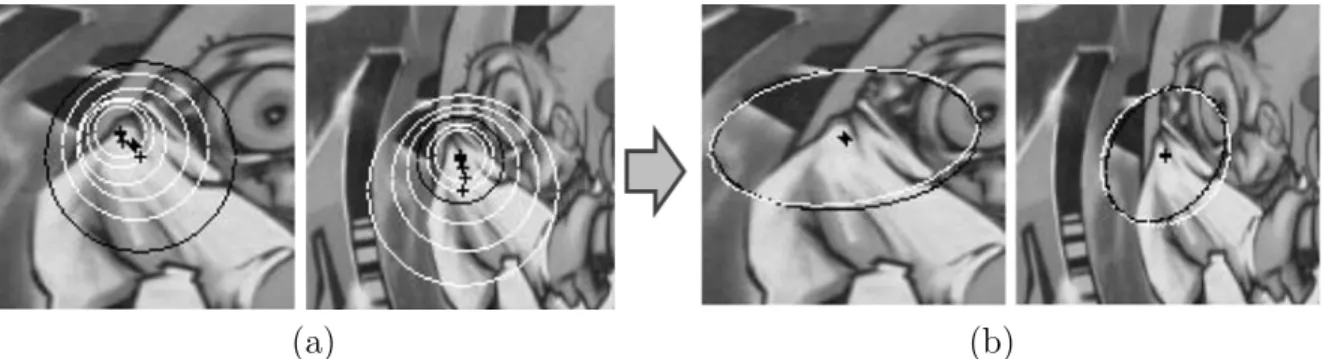
Figure 2.6: (a) Example of scale selection for Harris-Laplace detection. The black circle gives the the scale where LoG maximum is found. (b) Affine shape adaption for two corresponding Harris-Affine region features.
affine transformations. Ling and Jacobs (2005) developed a geodesic intensity histogram
(GIH), a normalized joint distribution of geodesic distance and intensity. The GIH
de-scriptors are invariant to deformation if the scale of the image does not change. Since
the geodesic for description is based on the intensity ordering of pixels, GIH is sensitive
to noise. GIH is also unable to handle scale changes due to the fixed parameter of the
geodesic distance interval. Vedaldi and Soatto (2005) presented a theoretical framework
for detecting viewpoint invariant features on non-planar surfaces. They demonstrated
the detection of 3D corners by using combinations of multiple affine transformations.
Unfortunately, this method has limited applications for wide-baseline matching, because
most local structures are locally near planar and violate their assumptions. The
self-occlusion problem of non-planar surfaces poses additional challenges.
Obviously both scale-invariant and affine-invariant features have limited robustness
to projective transformations since they are based on simplification of projective
trans-formations. Under large viewpoint changes (e.g. Figure 2.4(a)), the corresponding
appearance changes of keypoints cannot all be handled, as a result, it may be hard to
find enough good matches to recover 3D geometry or recognize scenes. On the other
hand, local projective-invariant feature detection is also not mature enough for wide
practical use, essentially due to the high dimensionality of projective space. This thesis
2.2
Invariance Based on Regions
Interpretation of local structures provides additional information for achieving viewpoint
invariance. Region extraction or image segmentation groups similar image pixels to
regions, and pixels of a region have high probability of belonging to some continuous
3D surfaces. The transformations of such regions can often be approximated by affine
transformation, and affine invariance can be achieved though region normalization.
Features can be directly defined by fitting affine shapes to regions. Researchers have
being exploring different region extraction methods for feature detection. The Maximum
Stable Extremal Region (MSER) method by Matas et al. (2002) thresholds images at
different intensity levels to get extremal regions, whose interior pixels are all darker or
brighter than the surrounding exterior pixels. It keeps the extremal regions that are
maximally stable by comparing with extremal regions of neighboring intensity levels.
Ellipses are then fitted to the detected stable regions, and the invariant descriptors
are obtained from normalized image patches. To get smaller structures, Perdoch et al.
(2007) extended MSER to require regions being only locally maximum stable. Based on
watershed segmentation, Deng et al. (2007) use the principle curvature to detect stable
regions in scale space with accurate boundaries. Intensity-based regions start from
intensity extrema, and find the extremal positions around them along each direction to
define a region [Tuytelaars and Van Gool (2004)].
Good region extraction provides a medium-level interpretation of scene geometry,
and this information can improve the affine-invariance of feature detection. Mikolajczyk
et al. (2005) conducted experiments to compare the performance of many affine covariant
regions detectors, where MSER shows better repeatability and stronger invariance to
viewpoint changes than other affine-invariant features including salient regions, Harris
affine regions, etc. Without proper handling of scales by Gaussian scale space, MSER
does have less robustness to scale changes than Hessian-affine regions. To overcome this
Figure 2.7: MSER examples [Tuytelaars and Mikolajczyk (2007)]. The left image shows a subset of detected the detected MSER regions and the right image shows a subset of the fitted ellipse. (best viewed in color)
regions in Gaussian scale space.
Texture regions can be used as an affine frame for further invariant feature detection.
Schaffalitzky and Zisserman (2001) use texons [Malik et al. (1999)] to segment images
into regions that have different texture patterns. Affine normalization is then applied
to each texture region, and initial matches can be obtained by texon matching. Further
feature detection and matching are then done using local features in the normalized
frames.
Similar to the affine invariant regions based on local statistics, region-based affine
invariant features have limited robustness to viewpoint changes and limited accuracy of
region localization. Because the region extraction in MSER relies on the intensity order
of pixels, the region boundaries can be easily affected by noise or illumination changes,
and so are the accuracy of the corresponding affine shapes.
Regions can also be defined according to high-level information like repetition. This
thesis will particularly explore feature detection based on high-level regions from
2.3
Invariance Based on 3D Scene Geometry
Beyond regions, higher level structures, particular local 3D geometry, provide more
information on the local projective transformation than that of regions, and allows us
to achieve stronger viewpoint invariance.
Many approaches can obtain 3D local geometry efficiently. By using Vanishing Point
(VP) detection, simplified planar structures can be reconstructed from a single image
along with camera calibration [Caprile and Torre (1990); Cipolla et al. (1999)]. Even
when only two vanishing points are detected, a plane can be recovered based on the
calibration or the (partially) known camera intrinsics. Digital photos often have EXIF
data that can provide relatively good calibrations [Snavely et al. (2006); Li et al. (2008);
Agarwal et al. (2009); Frahm et al. (2010)]. While considering multiple images or video
sequences, 3D structure can also be extracted by stereo reconstruction of those images
taken from similar viewpoints. Recently, 3D reconstruction has achieved real time speed
by using parallel computation on Graphic Processing Units (GPU) [Gallup et al. (2007)],
which enables efficient use of 3D local reconstruction for improved feature detection to
handle large viewpoint changes. Depth sensors, such as laser scanners and
Time-of-Flight (ToF) cameras, can provide distance data on top of image pixels without any
additional computation cost.
3D geometry and camera parameters together provide the projective transformation
from 3D space to the image domain. Because the local geometry is consistent in different
images, it allows us to generate normalized views by projecting images to tangent planes
in 3D space. Koeser and Koch (2007) use depth maps from depth sensors to generate
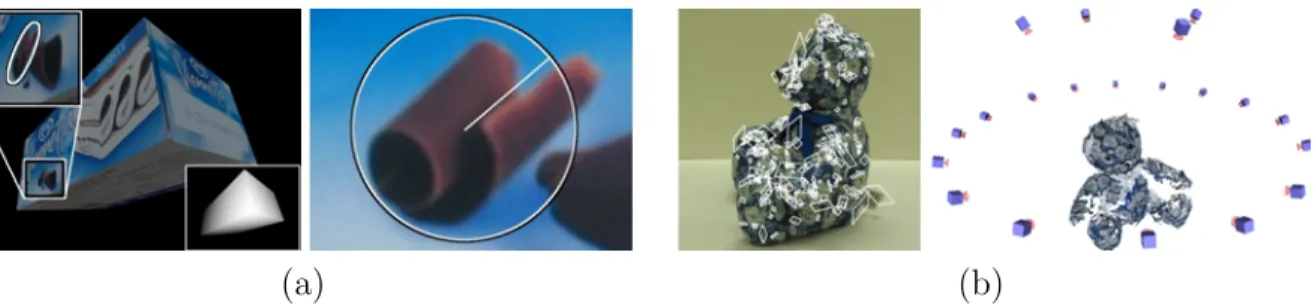
projective invariant normal view for the MSER features in the original images. The
local image texture is projected onto a sphere, and the 3D size of a feature is selected
according to standard deviation. Rothganger et al. (2006) match MSER features from
multiple images, and use sparse 3D reconstruction and projective constraints to generate
(a) (b)
Figure 2.8: 3D Geometry used to generate projective normalized view of features. (a) Koeser and Koch (2007) use a dense depth map. The left image shows one MSER in the image and the depth map; The right image shows the normal view of the feature. (b) Rothganger et al. (2006) use sparse geometry and projective constraint. The left image shows an image with MSER regions, and the right image shows the final 3D features. (best viewed in color)
The straightforward idea here is to recover 3D features that are perpendicular to
local surface normals and have some characteristic 3D sizes. Both Koeser and Koch
(2007) and Rothganger et al. (2006) use MSER as initial keypoint detector and find
3D features based on it. Koeser and Koch (2007) use standard deviation to determine
feature size and it is not accurate under illumination changes. Rothganger et al. (2006)
try to find a normalized patch that is consistent with matched features from different
cameras, which is not only complicated but also sensitive to errors in the initial detection.
The disadvantage is that the normalized views are based on the initial regions, which
have limited localization accuracy under large viewpoint changes. This thesis will take
a step forward to drop the dependency on the initial feature detection to improve the
invariance and accuracy of geometry-based features.
An alternative approach that shares a similar spirit is to re-project an image with
a set of possible transformations and combine their normalized features to get more
projective invariant features. Morel and Yu (2009) apply a set of affine transformations
to globally normalize the image based on camera intrinsics, and then detect SIFT in
each normalized frame. This method is able to successfully match images where standard
SIFT fails due to large viewpoint changes. Although the additional frames provide more
space of possible transformations also depends on the choice of the parameters.
2.4
Invariance Based on Repetition
High level information such as repetition and symmetry captures the geometric
rela-tionship between different parts of an image. As shown in Figure 2.9(a), the repetition
captures the 3D information in the slightly different appearance of each element. Similar
to region-based features, the repeating elements of repetition define a set of high-level
regions. Therefore, repetition-based invariance can combine the power of both 3D
ge-ometry and region. This thesis sees repetition detection as a special feature detector
and this section discusses some existing repetition detection methods.
Repetition and symmetry are useful in real applications because: 1) They are
per-vasive not only in urban scenes but also in nature; 2) Many repetitive structures and
symmetric structures correspond to interesting high-level semantics. One of the common
drawbacks of the detectors in previous sections is that their features do not correspond
to any semantic meaningful structures. The existence of repetition and symmetry
al-lows us to find high-level regions that possibly have a richer semantic meaning (e.g.
windows, doors). Finding such regions potentially allows many applications such as fast
scene recognition.
As a starting point, this thesis only considers urban scenes because urban applications
are more interesting. In addition, the repetitions in urban scenes are also regular and
they can be processed efficiently. The strong evidences of vanishing points in urban
scenes allow image rectification and simplify the detection.
2.4.1
Repetition Detection
The general symmetry concept includes translational symmetry, reflective symmetry,
a structure and its symmetric counterpart can be modeled by translation, reflection,
rotation, and their combinations respectively. This thesis will normally refer to
trans-lational symmetry as repetition and reflective symmetry simply as symmetry if not
specified otherwise.
In urban scenes, there are clearly two dominant repetition scenarios: the cases that
have repetition in only one direction and the cases that have repetition in a 2D grid.
Liu and Collins (1998) classified the possible combinations of symmetries for the two
scenarios into 7frieze groups and 17wallpaper groupsrespectively. In this thesis, only a subset of these symmetry groups will be considered, due to the fact that urban structures
often do not have reflective symmetry along vertical direction or rotational symmetry.
Hence this thesis considers only translational symmetry in horizontal/vertical direction,
and reflective symmetry along the horizontal direction.
Given the importance of repetition in urban scenes, several repetition and symmetry
detection methods have been developed. Repetition can be analyzed at three different
levels: local interest points, dense per-pixel, and model-based structures, which leads
the three different types of detection methods as follows:
Sparse Detection. This type of methods infer possible repetition based on the match-ing of local features within a smatch-ingle image, and extract groups of repeated features by
growing from random samples of repeated features [Leung and Malik (1996); Schindler
et al. (2008); Schaffalitzky and Zisserman (1999); Liu et al. (2004b); Wenzel et al. (2008);
Park et al. (2008, 2009)]. In particular, Liu et al. (2004b) and Park et al. (2008, 2009)
model the geometry of repetition as a near regular texture (NRT) model, an
affine-transformed regular grid that allows small shifts at each node as well as some grid
deformations.
These methods do not require rectified images for a 2D repetition grid, because
the sampled four features correspond to the hypothesis of a vanishing point pair for
(a) (b) (c)
Figure 2.9: Three different types of method for detecting repetition. (a) Sparse detection example [Park et al. (2009)], (b) Dense detection example [Liu et al. (2004a)]. (c) Model-based detection example from [M¨uller et al. (2007)]. (best viewed in color)
images because vanishing points cannot be proposed in the same way.
Sparse detection is also not able to define optimal regions of repeating elements,
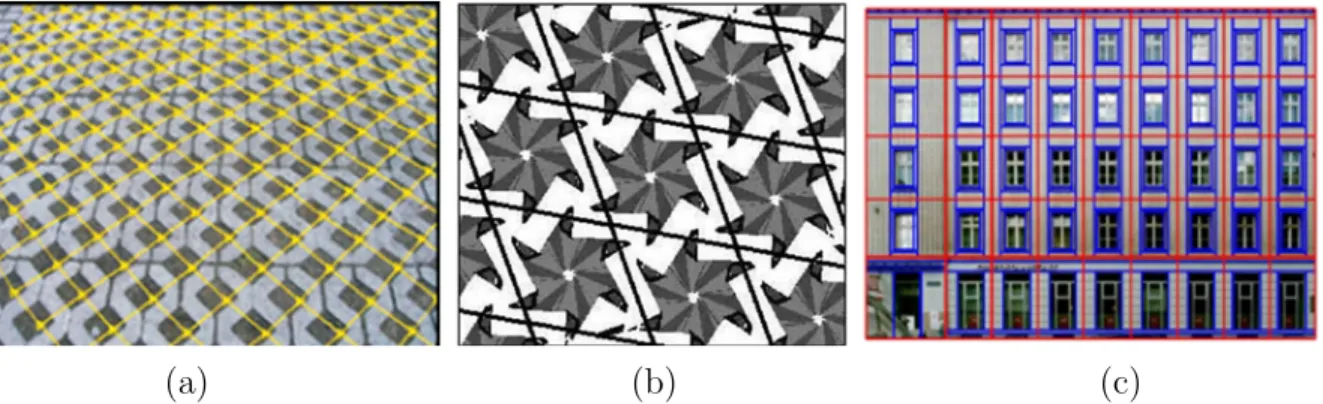
because the local feature can be at any location of a repeating element. For example in
Figure 2.9(a), the optimal grid should go thought the center of the squares, but the local
features forming the grid are not. For large repeating elements (e.g. Figure 2.10), this
category of methods generates multiple lattices when using different sets of local features
in the images, while they are not able to combine them for optimal region positions.
Dense Detection. Dense analysis of repetition finds dense repetitive regions by analyz-ing all image pixels (limited in affine space). Liu et al. (2004a) determine the boundary
of repeating elements by maximizing the local symmetries of repeating elements,
in-cluding reflective, rotational, and translational symmetry. A correlation-based scoring
is used to evaluate the global symmetry. The center of repeating elements are extracted
at the position that show maximum reflective symmetry or rotational symmetry [Liu
et al. (2004a)]. Figure 2.9(b) shows an result of this method.
Since this method defines the boundaries with a 2D affine grid, it may not be reliable
for finding the boundaries along vertical direction in urban scenes, because reflective
symmetry along vertical direction and rotation symmetry often does not exist. For
(a) (b)
Figure 2.10: Example of common repetition patterns that cannot be handled by ex-isting methods. Both images have repetition along only one direction. (a) Multiple elements whose vertical boundaries need to be found. (b) Depth change of 3D repetitive structures. (Best viewed in color)
direction. It does work for the skyscraper images like Figure 2.11 [Schindler et al.
(2008)], which has a dense grid of small windows that are rotationally symmetric. This
method also assumes any good matching as part of the repetition, which has ambiguity
between real repetition and homogeneous region.
Another limitation of this type of method for real urban scenes is due to its model of
strict regular grid and the use of correlation. Finding peaks through correlation can be
sensitive to depth change and noises. Real urban repetition often have 3D depth changes
from indentation or columns (e.g. Figure 2.10(b)). Therefore a more robust matching
function should be used. This thesis will use a scale-adaptive SIFT-based matching to
achieve robustness to those local details as well as noise. Sparse detection from local
features does not have this problem because it does not evaluate dense matching.
Model-based Detection. Model-based repetition detection makes additional assump-tions about the shape of the repeating elements and searches for those specific structures
in rectified images. Korah and Rasmussen (2007, 2008) assume the repeating elements
to be rectangular and uses a Markov Chain Monte Carlo method to extracts them based
M¨uller et al. (2007) use a grammar database that defines various rectangular shapes.
They use dense mutual information evaluation to obtain repetition intervals, and find
different shapes of structures based on edge segments. Their assumptions are quite
strong and often not completely valid in urban scenes, for example, curved structures
are common.
The limitations of the above repetition detection are rooted in their strong
tions. In order to handle more general repetitions, it is important to keep the
assump-tions as loose as possible. Specifically, this thesis will only employ an assumption of
weak reflective symmetry on the shape of the repeating elements, and the proposed
de-tection algorithm is able to handle a wider range of repetition scenarios including large
repeating elements that repeat along only one direction.
2.4.2
Repetition-based Features
Although repetition detection has been explored extensively, few work has used
repeti-tion in recognirepeti-tion or matching. One reason, I believe, is that real world repetirepeti-tion is
complicated, and different methods use different assumptions and work only in special
cases. Only by using as few assumptions as possible and solving more general cases, can
repetition-based features be truly useful.
Like all other features, to define repetition-based, the boundaries for repeating
el-ements must be selected with strong characteristic properties, for example, at local
maximum of some function. Otherwise, the boundaries from different images will be
different, and the features will not match. Existing techniques have various limitations.
Sparse detection is not able to define region for 1D repetition, and not able to give
optimal unique lattice for 2D repetition. Model-based methods have the advantage of
finding correct boundaries but requiring the modeling of various structures, thus they
are not too general. Dense-detection works for the cases that have reflective symmetry
(a) (b)
Figure 2.11: (a) Example of detected repetition lattices by Schindler et al. (2008) (b) Examples of repletion-based motif feature. (best viewed in color)
Based on the model of Liu et al. (2004a), Schindler et al. (2008) normalize all
rect-angles in its detected 2D repetition grid to square, learn a median representation called
motif for each repetition grid, and match them to register images to database. The detection works in this scenario because the windows of skyscrapers are small and
ro-tational symmetric. However the same method does work for 1D repetition like
Fig-ure 2.10(a).
To overcome the limitations of current methods, this thesis proposes a new method to
determine the boundaries based repetition along only one direction. Similar to the idea of
Liu et al. (2004a), the boundaries along horizontal direction are obtained by maximizing
reflective symmetry. For the boundary detection along the direction without repetition,
a novel repetition quality function is introduced to evaluate repetition for each repetition
interval with a suppression of integer multiples of repetition.
An interesting issue in repetition-based feature is whether to use a single description
for a group of repeating elements or use a separate descriptor for each element. Schindler
et al. (2008) compute a combined representation descriptor based on median tiles to
capture the common appearance. Another scenario this thesis will explore is to compute
a descriptor for each repeating element in a repetition region. The local irregularities
each element.
2.5
Evaluation
Given multiple images of a same scene taken with different viewing conditions, a good
invariant feature detector should produce a high percentage of repeatedly detected
fea-tures for its practical application in wide-baseline matching or recognition. Repeatability
is affected by the robustness of the feature selection criterion as well as the accuracy of
feature localization. First, the same features corresponding a common structure should
be robustness re-detected under different viewing conditions. Second they should be
as-signed to correct spatial extents that are consistent with the geometric transformations,
so that invariant feature description can be retrieved.
Many work uses a repeatability score to evaluate the performance of feature
de-tectors [Schmid et al. (2000); Mikolajczyk et al. (2005)]. Given a pair of images, the
repeatability score is defined as the ratio between the number of correct correspondences
and the smaller of number of regions in the common area of the image pairs. The
correct-ness of feature correspondence is defined according the overlapping of the spatial extent
by using a known homography transformation to relate the image pair. Mikolajczyk et al. (2005) give a thorough evaluation many affine invariant features w.r.t. viewpoint
changes, scale change, image blur, JPEG compression, lightening change. Similarly,
Kadir et al. (2004) use the ratio of number of correct region matches and the number of
expected region matches from a database.
repeatability = # correct correspondences
# features in common area (2.1)
Another evaluation method is by the correctness of direct feature matching.
Com-pared to the evaluation of repeatability, this evaluation is closer to real application
truth image warping. Again, the correctness of a feature match is determined by the
overlapping according to the known transformations. The precision and recall measure
for feature matching is defined as Equation 2.2. Typically, precision and recall are all
depending on parameters, and precisions increases and recall drops when stronger
pa-rameters are used in matching. Mikolajczyk and Schmid (2005) use 1-precision and recall
to evaluate different feature descriptors with different matching strategy and parameters.
The same method can also be used to evaluate feature detectors.
precision = # correct matches
# matches recall =
# correct matches
# correct correspondences (2.2)
Features can also be evaluated by their performance in other applications. For example,
image retrieval performance of features can indicate their goodness for recognition tasks.
In this thesis, I’ll also evaluate the performance of my proposed features by their
Chapter 3
Viewpoint-Invariant Patch (VIP) Feature
The perspective distortions under different viewpoints makes wide-baseline image
match-ing challengmatch-ing. Under the assumption of local planarity, the local transformations from
one image to the other are projective transformations decided by the camera parameters
and the 3D structures. Such a projective transformation can often be locally
approxi-mated by a similarity transformation or an affine transformation, but the simplified
fea-ture detection is essentially limited to relatively small viewpoint changes. This chapter
proposes a new Viewpoint Invariant Patch (VIP) feature by exploiting scene geometry
to handle the challenges posed by large viewpoint changes.
3.1
Large Scale Reconstruction
Large viewpoint changes are common problems in large scale reconstruction. Basically,
every pair of matched images gives some constraints to the 3D reconstruction, and it
is likely that certain key constraints rely on the matching of views taken from very
dif-ferent viewpoints. In recent years, there have been significant research efforts in fast
large-scale 3D scene reconstruction from video [Pollefeys et al. (2008)] and from
Inter-net photo collections [Agarwal et al. (2009); Frahm et al. (2010)], where the speedup
is achieved by exploiting parallelism of compute clusters or Graphics Processing Units
purely by structure from motion (SfM). Reconstruction from video sequences is a
dif-ferential technique which accumulates errors over time due to its difdif-ferential nature.
In urban modeling for example, a video’s path often crosses at intersections where the
viewing direction differs by about 90◦ (see Figure ??(a)), a single reconstruction often generates un-aligned double representations due to the errors. To avoid accumulated
errors, the reconstruction system must recognize previously reconstructed scene parts
and enforce correct alignment constraints to the reconstruction. In the case of Internet
photo collections, the reconstruction is often biased to popular viewpoints where most
of the photos are taken, and failures in matching different viewpoints may result in
disjointed models instead of a single complete model.
Large-scale reconstruction naturally will generate multiple 3D models for many
rea-sons: 1) The data might be too big for a single reconstruction task. 2) A single
recon-struction can be inaccurate for having too much accumulated errors. 3) It is unable to
match some images that have very different viewpoints or different viewing conditions.
Consequently, to tackle the large scale reconstruction problem, we need to not only find
matches from image subsets or video segments that are taken from different viewpoints,
but also to align the 3D reconstructions from different image subsets.
State-of-art invariant features can handle a certain range of viewpoint changes, and
relatively complete reconstruction can be achieved by feature matching, given enough
photos to cover the viewpoints in between the largely different viewpoints and to
pro-vide necessary links/constraints to connect different parts of a 3D scene. Many feature
detectors have been developed for robust wide-baseline matching in the last decades.
It is clear that improving the robustness of features to viewpoint changes will improve
the completeness of the 3D reconstruction. One of the most popular local invariant
feature is Lowe’s SIFT keypoints [Lowe (2004)], which is invariant to scale changes and
rotation. SIFT basically approximates the local projective transformation by
transformations [Mikolajczyk et al. (2005)]. Obviously, these approximations are limited
because the full projective transformation is more complicated. The feature introduced
in this thesis goes beyond affine invariance to robustness to projective transformations.
Large-scale reconstruction requires the alignment of 3D models from multiple
sub-reconstructions. Similarly to image matching, the 3D point matches can be hypothesized
from image feature matching. Li et al. (2008) use these feature matches to estimate 3D
similarity transformations between separate reconstructions and merge them to generate
larger reconstructions.
A related problem is the alignment of 3D laser scan models, which typically relies
more on the geometry than on the image content. The typical alignment algorithm is
Iterative Closest Point (ICP) [Zhang (1994)], which computes the alignment by
iter-atively minimizing the sum of distances between closest points. As an application in
SfM, Zhao et al. (2005) applies ICP to align 3D point clouds from SfM to 3D sensors
data and refine camera poses. The initial approximate scene alignment for ICP can also
be achieved by matching geometric features such as spin images [Johnson et al. (1999)].
Vanden Wyngaerd et al. (1999) proposed an invariant geometric feature by matching
bitangent curve pairs from images, and Vanden Wyngaerd and Van Gool (2002) then
extended the work to symmetric characteristics of surface patches. The matching of
these geometric features generates relative precise initialization for ICP. On the
con-trary to the aforementioned methods, King et al. (2005) employs SIFT keypoints in
original images to find the initial alignment for 3D laser scan models.
As a hybrid method to utilize both image and geometry, the proposed feature in this
chapter achieves improved viewpoint invariance. The detected features are described
based on image content for feature matching and associated with characteristic local 3D
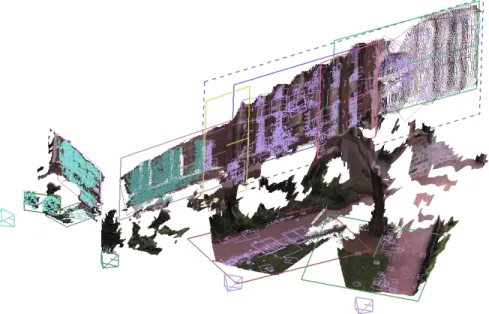
Figure 3.1: Two corresponding VIPs. The purple and green view frustums are original camera poses. Red view frustums are viewpoint normalized cameras. Lower left and right show patches in the original images while center patches are the ortho-textures for the feature rotationally aligned to the dominant gradient direction.
3.2
Viewpoint-Invariant Patch
Although image features have limited invariance to viewpoint changes, 3D reconstruction
can be achieved for images subsets that share similar viewpoints. The limitation of pure
image based features is due to the missing of 3D geometry and the approximation of the
underlying projective transformation. This thesis proposes a Viewpoint Invariant Patch
(VIP) feature to exploit the partial 3D reconstructions to guide feature detection for
improved invariance. As illustrated in Figure 3.1, orthogonal views of same 3D points on
different 3D models will be the same when scale and orientation are properly selected.
Sharing the similar spirit, Koeser and Koch (2007) obtain depth maps from depth
sensors and generate projectively invariant views for MSER features detected in the
original images. The local image texture is projected onto a sphere, and the 3D size of
a feature is selected according to standard deviation. Rothganger et al. (2006) match
MSER features from multiple images, and generate normalized views of features based
on sparse 3D reconstructions and projective constraints. In comparison, I apply more
determination of 3D feature shape during the detection stage avoids the error-prone
refitting of feature shapes.
VIPs are essentially projective invariant image features extracted from multiple
im-ages, a set of images whose dense geometry can be relatively easily reconstructed. Since
the detection is independent of the original camera viewpoint, VIPs can be used to
robustly and efficiently align 3D models of the same scene from video taken from
sig-nificantly different viewpoints. The remainder of this chapter will discuss the proposed
invariant feature technique and its applications in 3D matching and location recognition.
3.2.1
The VIP Detection
In VIP detection, the original images are undistorted to generate fronto views according
to local scene planes or on local planar approximations of the scene. Conceptually, for
every point on the surface we can estimate the local tangent plane’s normal and generate
a texture patch by orthogonal projection onto the plane. Within the local ortho-texture
patch, a keypoint is generated if the point corresponds to a local DoG Extremum in
scale space. The keypoint orientation in the tangent plane is then extracted from local
gradients and a SIFT descriptor is generated accordingly. Using the tangent plane avoids
the poor repeatability of interest point detection under projective transformations seen
in many popular feature detectors [Mikolajczyk et al. (2005)].
VIP detection is basically a process that factors out the original viewpoints. Similar
to the normalization of image patches according to scale and orientation performed in
SIFT and normalization according to ellipsoid in affine covariant feature detectors, VIP
detection can be seen as a Viewpoint Normalization. The VIP detection for each 3D
point can be divided into the following two steps:
1. Project the textured 3D modelinto a virtual orthographic camera with view-ing direction parallel to the local tangential plane’s normal. The resolution of the
Figure 3.2: Part of the VIPs detected on a 3D model. The two viewing frustums are the cameras of the original textures.
2. Extract the VIP descriptor from the orthographic patch projection. Invari-ance to scale changes is achieved by normalizing the patch according to local
ortho-texture scale. Feature selection is done by DoG local extrema suppression
like SIFT [Lowe (2004)]. VIP orientation in 3D is found based on the dominant
gradient direction in the ortho-texture patch.
Figure 3.1 demonstrates the effect of viewpoint normalization. The patches shown as
squares are the normalized image patches. The normalized image patches of a matched
pair are similar despite significantly different original images due to the largely different
viewing directions.
3.2.2
Dimensions of a VIP Feature
The geometric dimensions of VIPs are obtained by transforming the keypoints in
ortho-texture patches from their virtual camera coordinate systems to world coordinate
sys-tems of the 3D models. A VIP feature is fully described by (x, σ,n,d,s) where
• x is its 3D position, • σ is the patch size in 3D,
• d is texture’s dominant orientation as a vector in 3D, and
• s is the SIFT descriptor that describes the viewpoint-normalized patch.
Here I work with the dense models that are reconstructed from video sequences by
using SfM and multi-view stereo methods, but VIP detection is equally applicable to
textured 3D models obtained using LIDAR or other sensors. Given two reconstructed
models of a same scene, we can find their alignment, by matching the SIFT-descriptors
of as well as the geometric information of the VIPs.
3.2.3
Efficient VIP Detection
In general planar patch detection needs to be executed for every pixel of the image to
compute the ortho-textures. Each pixel (x, y) together with the camera centerCdefines
a ray, which is intersected with the local 3D scene geometry. The point of intersection
is the corresponding 3D point of the feature. From this point and its spatial neighbors
we can get an (approximate) tangential plane at the point, which for planar regions
coincides with the local plane. The extracted plane can then be used to select VIP
keypoints and compute their description with respect to this local tangent plane. This
method is generally valid for any scene.
VIP detection for a set of points that have same surface normal (either on a same
plane or on different planes) can be efficiently processed in a single pass. Considering
these VIPs, the image coordinate transformations between them are simply 2D scaling
and translation. If we project all these points onto a single plane and detect image
features in its orthogonal view, the original VIPs can be recovered by first transforming
from the plane, to their local coordinate frames, and then to the world coordinate system.
Figure 3.3 shows an example of detecting VIPs on dominant planes. The planes here
compensate for the noise in the reconstructed model, and improve VIP localization.
Figure 3.3: VIPs detected on dominant planes.
Figure 3.4: Original image (left) and its normalized patch (right) based on local plane fitting of local 3D structure. The approximated warping allows robust descriptor gener-ation at most locgener-ations, which are locally approximately planar. Indeed, it is not truly viewpoint invariant for structures where the surface normals are inconsistent with the plane (such as the indentations and staircases).
The accuracy of VIP detection is indeed limited by the quality of dense reconstruction
we can recover. First, 3D models typically have many errors especially for homogeneous
regions, but this can be partially handled by the proposed plane fitting. Second, even
perfect reconstructions do not have all the details that are seen from a different
view-point. Third, the ortho-rectification is based on approximated planar structures that
Figure 3.5: Wall images for repeatability evaluation. [Mikolajczyk et al. (2005)]
3.2.4
Evaluation of Repeatability
To measure the repeatability of VIP features, I conduct an experiment similar to the
evaluation done by Mikolajczyk et al. (2005). This experiment is done jointly with
Xiaowei Li and Brian Clipp.
We use the wall dataset shown from Mikolajczyk et al. (2005) for the evaluation
experiment. As shown in Figure 3.5, this dataset is a sequence of images of a brick wall
taken with increasing angles between the optical axis and the wall’s normal. Each of the
images of the wall has a known homography to the first image, which was taken with
image plane fronto-parallel to the wall. Using this homography we extract a region of
overlap between the first image and each other image. We extract features in this area of
overlap and evaluate two performance measures: the number of inlier correspondences
and the re-detection rate, for a number of feature detectors. The number of inliers is the
number of feature correspondences which fit the known homography. Re-detection rate
is the ratio of inlier correspondences found in these overlapping regions to the number
of features found in the fronto-parallel view. The number of inliers is shown in Figure
3.6 and the re-detection rate is shown in Figure 3.7.
Figure 3.6 demonstrates that VIP matching generates a significantly larger number
of inliers over the wide range of angles than the other detectors. The other detectors
we compare to are SIFT [Lowe (2004)], Harris-Affine [Mikolajczyk and Schmid (2004)],
Hessian-Affine [Mikolajczyk and Schmid (2004)],Intensity Based Region (IBR)
[Tuyte-laars and Van Gool (2004)], Edge Based Region (EBR) [Tuyte[Tuyte-laars and Van Gool
20 25 30 35 40 45 50 0 1000 2000 3000 4000 5000 6000 7000 angle (deg) num inliers VIP SIFT harris affine hessian affine IBR EBR MSER
Figure 3.6: Number of inliers under projective transformations
20 25 30 35 40 45 50
0.1 0.2 0.3 0.4 0.5 0.6 0.7 0.8 0.9 angle (deg) detection rate VIP SIFT harris affine hessian affine IBR EBR MSER
Figure 3.7: Re-detection rate of features under projective transformations
proposed VIP feature also has a significantly higher re-detection rate than the other
detectors as seen in Figure 3.7. This high re-detection rate demonstrates the power of
geometry-guided feature detection on ortho-rectified views. Even under large viewpoint
changes which often result in projective transformations between images that affine
transformations cannot accurately approximate, VIP performs well.
3.3
3D Model Matching with VIPs
The previous section addressed the VIP detection problem, and any 3D model can now
align two 3D models. In fact, VIP-based matching is not limited to 3D model alignment,
Section 3.6 will show how to utilize the 3D model matching as a basic function in loop
detection for large scale structure from motion and 3D model based location recognition.
Like other feature based matching, putative VIP matches can be obtained by
match-ing the feature descriptors, for example, by the nearest neighbor matchmatch-ing. After
ob-taining all the putative matches between two 3D scenes, it is then possible to find an
optimized scene transformation from the 3D transformation hypotheses given by VIP
correspondences. Since VIPs are viewpoint invariant, given a correct camera matrix and
3D structure, we can expect the similarity between correct matches to be more accurate
than a transformation derived from viewpoint dependent matching techniques.
The rich geometric dimensions of VIP feature allow recovery of the 3D similarity
transformation between two scenes from a single match. The ratio of the scales of two
VIPs expresses the relative scale between the 3D scenes; the normals and orientations
of the VIP pair determine the relative rotation. The translation between the scenes can
be obtained from relative feature positions after compensating the scaling and rotation.
The scaling and rotation needed to bring corresponding VIPs into alignment is uniform
for all the correct correspondences.
A hierarchical method is proposed in this section to estimate the 3D similarity
trans-formation between two scenes from putative VIP matches. Each single VIP
correspon-dence delivers a unique 3D similarity transformation, and so hypothesized matches can
be tested efficiently. Furthermore, the rotation and scaling components of the similarity
transformation are same for all inlier VIP matches and they can be tested separately
and efficiently with a voting scheme.
3.3.1
3D Similarity from a Single VIP Match
The scaling, rotation and translation of a 3D similarity transformation can be fully