Determining Consistency of Surrogate Decisions
and End-of-Life Care Received with Patient
Goals-of-Care Preferences
Mi-Kyung Song, PhD, RN, FAAN,1Sandra E. Ward, PhD, RN, FAAN,2Laura C. Hanson, MD, MPH,3 Maureen Metzger, PhD, RN,4 and SuHyun Kim, PhD, RN5
Abstract
Background:
Care consistent with preferences is the goal of advance care planning (ACP). However,
com-paring written preferences to actual end-of-life care may not capture consistency of care with preferences.
Objective:
We evaluated four additional types of consistency, using prospective data on written preferences and
active clinical decision making by patients and their surrogates.
Methods:
Secondary analysis of data was done from a trial of an ACP intervention for patient-surrogate dyads.
Forty-five patients died during the trial and comprised the sample for the analysis. Sources of data included
patients’ preferences in a written goals-of-care tool, medical record reviews, and two-week postbereavement
interviews with surrogates to complement medical record reviews.
Results:
Twenty-four patients (53.3%) received care consistent with written preferences and 11 (24.4%)
in-consistent with written preferences. The remaining 10 patients (22.2%) died suddenly with no opportunity for
treatment decision making. Eleven (24.4%) were able to participate in decision making with their surrogates; of
those, 9 (81.8%) received care consistent with their expressed preferences. Twenty-two patients were
inca-pacitated and thus the surrogate made treatment decisions alone; of those, 18 (81.8%) made decisions consistent
with the patient’s written preference.
Conclusions:
Simply comparing documented preferences for end-of-life care and medical records of care
delivered does not adequately reflect the process of ACP and treatment decision making at the end of life. To
understand consistency between preferences and end-of-life care, investigators need data on written and
real-time expressed preferences.
Introduction
A
dvance care planning(ACP) in which patients andsurrogates discuss and document preferences for treat-ment in future health states1,2has been recognized as a way to promote end-of-life care that is consistent with patients’ preferences.3,4 Several studies have examined whether an ACP intervention promotes consistency between a patient’s preferences and the treatments the patient actually receives near the end of life.5–8How such consistency was concep-tualized and determined varied across the studies; in general a patient’s early documented preferences were compared to medical record documentation of the end-of-life care the patient received (e.g., ICU admissions, CPR, mechanical ventilation, and location of death).
Unfortunately, this way of determining consistency be-tween preferences and end-of-life care reflects a limited as-pect of treatment decisions at the end of life and may fail to capture ACP as a process unfolding over several time points. Consider situations wherein the patient is able to make his or her own decisions up until the point of death. In such situa-tions, the patient’s decisions may differ from his or her pre-viously documented preferences. Also consider cases wherein the surrogate makes decisions that honor the pa-tient’s previously stated wishes, but the care team discounts the surrogate’s decision. In the former case, delivered care would be determined as having been inconsistent with the patient’s documented preferences, when in fact it was con-sistent with the patient’s most recently expressed preference. In the latter case, care would also be determined as being
1
Center for Nursing Excellence in Palliative Care, Nell Hodgson Woodruff School of Nursing, Emory University, Atlanta, Georgia.
2School of Nursing, University of Wisconsin-Madison, Madison, Wisconsin. 3
School of Medicine, University of North Carolina at Chapel Hill, Chapel Hill, North Carolina.
4
School of Nursing, University of Virginia, Charlottesville, Virginia.
5
School of Nursing, Kyungpook National University, Daegu, Korea. Accepted December 31, 2015.
ªMary Ann Liebert, Inc. DOI: 10.1089/jpm.2015.0349
inconsistent, but an important distinction would have been lost: whether the surrogate or the care team was dishonoring the patient’s preferences.
To add further complexity, while a patient’s election of a do-not-resuscitate (DNR) order allows for a relatively clear-cut consistency determination (with the medical record re-vealing that CPR was performed or not),8most end-of-life preferences are not so simple. End-of-life preferences are commonly stated in terms of goals of care or as an over-arching value in favor of either comfort care or aggressive treatments. Such preferences often leave a great deal of room for debate as to whether care was consistent with a patient’s wishes. Despite these complexities, there have been few discussions about how to define and measure consistency between patient preferences and treatment decisions at the end of life.
The purpose of this analysis was to examine several types of consistency by comparing surrogate treatment decisions and treatment actually received with patients’ previously expressed written preferences. We used data from 45 patients who died during a longitudinal trial of an ACP intervention and their surrogates.
Methods Study design
The present study is a secondary analysis of data from a larger trial that tested the efficacy of an ACP intervention on patient and surrogate preparation for end-of-life decision making and postbereavement outcomes for surrogates. Dur-ing the original study, patients and surrogates completed measures of preparedness outcomes at baseline and 2, 6, and 12 months later, and surrogates completed measures of be-reavement outcomes at baseline, 2 weeks, and 3 and 6 months after the patient’s death. Details of the study design have been described elsewhere.9 For the purpose of this descriptive analysis, the data from the intervention and control groups were combined.
Setting and participants
The original study included 210 dyads of patients from 20 free-standing outpatient dialysis centers in eight counties in North Carolina and their surrogates, who met the following inclusion criteria: age 18 years or older; self-identified Af-rican AmeAf-rican or white; on dialysis for at least six months prior to enrollment; Charlson Comorbidity Index (CCI)10 score‡6 or CCI score=5 and hospitalization in the last six months; English speaking; no hearing impairment;<3 errors on the Short Portable Mental Status Questionnaire11; and an English-speaking surrogate over age 18 who could partici-pate. Of the 210 patients, 45 died during the study and comprised the subgroup for this analysis.
Patient end-of-life preferences measured
Patients completed the goals-of-care tool12 as an out-come measure at baseline and 2, 6, and 12 months or until death. This tool included two scenarios describing medical conditions that commonly occur in dialysis patients. In the first, the patient developed a severe complication and could not speak for him or herself; the medical team be-lieved recovery unlikely and continuing life-sustaining
treatment, including dialysis, would no longer be benefi-cial. In the second scenario, the patient developed ad-vanced dementia. Each scenario had three response options: ‘‘The goals of care should focus on delaying my death, and thus I want to continue life-sustaining treat-ment’’; ‘‘The goals of care should focus on my comfort and peace, and thus I do not want life-sustaining treat-ment, including dialysis’’; and ‘‘I am not sure.’’ For the current analysis, the two responses in the last completed goals-of-care tool prior to death were combined to create an overarching goals-of-care preference:comfort care only
if the patient chose comfort care only for both scenarios, or not comfort care only if the patient chose treatment focused on delaying death for both scenarios or the re-sponses were mixed or included ‘‘unsure.’’
End-of-life care data
During the original study, patients’ medical records at the dialysis center and hospital were reviewed every two weeks until the patient’s death or study end. Data on primary acute medical conditions causing hospital admissions and treat-ments were collected. Upon the patient’s death, the surrogate was interviewed at two-week postbereavement to ask about the patient’s last month prior to death and the surrogate’s end-of-life experiences. These interviews complemented medical record reviews in cases where the medical record provided incomplete data (e.g., whether the surrogate was involved in treatment decision making). An Excel spreadsheet was cre-ated to display mortality data and treatment decisions chro-nologically.
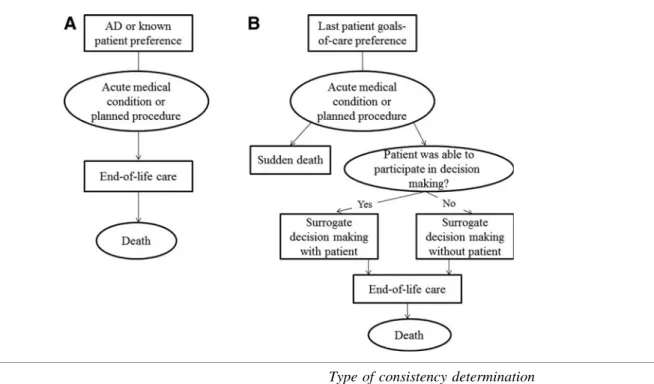
Types of consistency
patient preference might result in end-of-life care incon-sistent with the patient preference.
The three authors independently reviewed five randomly selected cases to determine the types of end-of-life decision making and consistency (consistent or inconsistent or un-certain due to lack of data). Any discrepancies among the authors were discussed for resolution and decision rules were developed. Three additional cases were reviewed by MS, SW, and LH to apply the decision rules. The decision rules were refined before being used by three authors (MS, MM, and SK) who independently determined the pathways and consistency for all 45 cases. Any discrepancies were resolved by group consensus. Descriptive statistics were used to summarize the study variables. Types of consistency were summarized using frequencies and percentages with 95% confidence intervals.
Results
Sample characteristics
African Americans comprised slightly over 50% of the subsample (n=24 dyads, 53.3%). Roughly half of the
pa-tients (n=21, 46.7%) and a majority of the surrogates (n=34, 75.6%) were women (see Table 1). All but one patient were on chronic hemodialysis prior to death.
End-of-life care
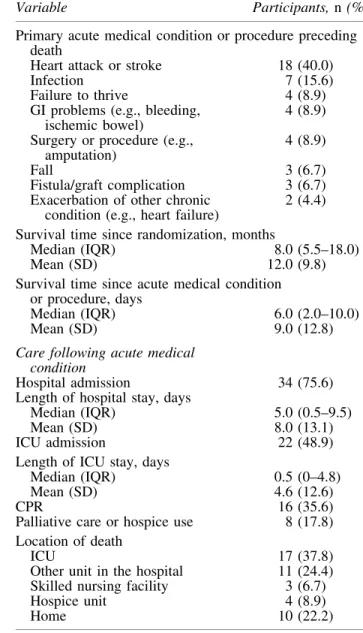
All 45 deaths occurred after an acute medical condition or a planned procedure (see Table 2). The most frequent acute condition was cardiovascular, such as heart attack or stroke. A median of six days elapsed from the acute condition or procedure to death. Thirty-four patients (75.6%) were admitted to the hospital for the acute con-dition. Half of all decedents received ICU care (n=22, 48.9%). Only a small percentage of the patients received palliative care or hospice care before death (n=8, 17.8%), and a majority (n=31, 68.9%) died in the hospital or in a skilled nursing facility.
Consistency between written preferences and end-of-life care
A majority of the patients’ overarching goals-of-care preference was comfort care only (n=30, 66.7%) (see
Type of consistency determination
A. Common determination 1. Consistency between the patient’s last written goals-of-care preference and end-of-life care the patient received
B. SPIRIT trial
Surrogate decision making with patient (as they actually face end of life)
2. Consistency between the patient’s decisions at the end of life and his/her last written goals-of-care preference
3. Consistency between the patient’s decisions at the end of life and the surrogate’s decisions
4. Consistency between the patient’s decisions at the end of life and end-of-life care the patient received
Surrogate decision making without patient 5. Consistency between the patient’s last written goals-of-care preference and the surrogate’s decisions
SPIRIT, Sharing the Patient’s Illness Representations to Increase Trust.
Table 3). The last completion of the goals-of-care tool oc-curred a median of three months prior to death. Using the first definition of consistency, end-of-life care was consistent with written preferences for 24 (53.3%) patients and inconsistent for 11 (24.4%). Ten patients (22.2%) died suddenly at home or in a nursing or dialysis facility, leaving no opportunity for treatment decision making, and thus consistency could not be determined.
Consistency using additional information on decision making
Of the 45 cases, 11 acutely ill patients (24.4%) were able to participate in their own medical decisions with their surro-gates, and 22 surrogates (48.9%) made treatment decisions without the patient due to the patient’s incapacitation. There were two cases (4.4%) for which a decision-making process could not be determined due to lack of data as to who made the decision.
Of the 11 patients who were able to participate in their own medical decisions with their surrogates, 7 patients (63.6%) made decisions consistent with their last written goals-of-care preference (consistency type 2), whereas 4 (36.4%) made decisions that differed from their written preferences.
Of these 11 patients, choices made by 9 surrogates (81.8%) were consistent with the patient’s expressed treatment choi-ces (consistency type 3), and 9 patients (81.8%) received actual end-of-life care consistent with choices expressed during acute illness (consistency type 4). Finally, of the 22 cases in which the surrogate made treatment decisions alone, surrogates’ decisions were consistent with the patient’s preference indicated in the last written goals-of-care tool (consistency type 5) in 18 cases (81.8%).
Discussion
We examined several ways to define consistency between patient preferences and treatment decisions at the end of life. The patient’s preference expressed in the goals-of-care tool and end-of-life care received were consistent for roughly half of the sample. Several additional consistency
Table 1. Baseline Characteristics of Patients and Surrogates
Characteristic
Participants,n (%)a Patient
(N=45)
Surrogate (N=45) Sociodemographics
Age, mean (SD), years 64.4 (12.6) 57.1 (13.7) Women 21 (46.7) 34 (75.6) Black, raceb 24 (53.5) 24 (53.5) Formal education completed,
mean (SD), years
12.9 (3.4) 13.6 (2.6) Protestant, religion 36 (80.0) 36 (80.0) Annual income
<$20,000 20 (44.4) 11 (24.4) $20,000 – $50,000 18 (40.0) 18 (40.0)
> $50,000 6 (13.3) 13 (28.9) Declined to answer 1 (2.2) 3 (6.7) Surrogate’s relationship
to patient
Spouse/partner - 18 (40.0) Parent - 13 (28.9) Sibling - 6 (13.3)
Child - 3 (6.7)
Friend - 3 (6.7)
Other - 2 (4.4)
Patient medical
Hemodialysis 44 (97.8) -Years on dialysis, mean (SD) 4.9 (4.4) -CCI, mean (SD) 8.8 (1.8) -Has an AD 16 (35.6) -DNR order at the clinic 8 (17.8)
-a
Due to rounding, percentages may not sum to 100.
b
Self-identified.
AD, advance directive; CCI, Charlson Comorbidity Index. DNR, do-not-resuscitate.
Table2. Care Near the End of Life(N=45)
Variable Participants,n(%)a
Primary acute medical condition or procedure preceding death
Heart attack or stroke 18 (40.0) Infection 7 (15.6) Failure to thrive 4 (8.9) GI problems (e.g., bleeding,
ischemic bowel)
4 (8.9) Surgery or procedure (e.g.,
amputation)
4 (8.9)
Fall 3 (6.7)
Fistula/graft complication 3 (6.7) Exacerbation of other chronic
condition (e.g., heart failure)
2 (4.4)
Survival time since randomization, months
Median (IQR) 8.0 (5.5–18.0) Mean (SD) 12.0 (9.8) Survival time since acute medical condition
or procedure, days
Median (IQR) 6.0 (2.0–10.0) Mean (SD) 9.0 (12.8)
Care following acute medical condition
Hospital admission 34 (75.6) Length of hospital stay, days
Median (IQR) 5.0 (0.5–9.5) Mean (SD) 8.0 (13.1) ICU admission 22 (48.9) Length of ICU stay, days
Median (IQR) 0.5 (0–4.8) Mean (SD) 4.6 (12.6)
CPR 16 (35.6)
Palliative care or hospice use 8 (17.8) Location of death
ICU 17 (37.8)
Other unit in the hospital 11 (24.4) Skilled nursing facility 3 (6.7) Hospice unit 4 (8.9)
Home 10 (22.2)
a
Due to rounding, percentages may not sum to 100.
determinations revealed that, in the cases wherein the pa-tient was able to participate in treatment decision making up until death, end-of-life care received was consistent with the patient’s decisions for a majority of the patients (81.8%). When surrogates made treatment decisions at the end of life without the patient because of the patient’s incapacitation, a majority (81.8%) were determined to be consistent. Thus, real-time decision making sometimes superseded written preferences, and insight into this process resulted in higher rates of consistency.
Emanuel and Scandrett13 have argued that the match (consistency) between a patient’s goals and the care he or she received should be the gold standard for quality of palliative care. For this important benchmark of palliative care, our study raises an important issue: only comparing a docu-mented patient preference with delivered care may be too limited to appropriately reflect the actual treatment decision-making process at the end of life. Previous efforts to assess consistency typically involved comparing the patient’s medical records of delivered end-of-life care with the pa-tient’s preferences that had been documented immediately after an ACP discussion or an AD that was completed at some point in the past. This approach assumes that documented preferences are the patient’s fixed decisions, when in fact there can be an important time interval between preference
statements and treatment. Real-time decisions likely incor-porate new information that patients do not have when completing ADs.
Therefore, we examined end-of-life care consistency from a perspective that goes beyond those efforts by examining patients’ preferences that were elicited most recently prior to death and later verbal preferences in comparison with sur-rogates’ decisions and end-of-life care the patient received. Consistency between the patient’s decisions and last written goals-of-care preference differs from the other types of consistency as it is a within-patient comparison. However, it was a meaningful determination because it revealed an im-portant minority of patients was able to participate in decision making up until the point of death, and some of those deci-sions differed from their previously expressed preferences. For these patients, delivered end-of-life care was inconsistent with their preferences indicated in the goals-of-care tool, while clearly reflecting an autonomous patient’s decisions at that time.
Differentiating types of consistency can be important for improving end-of-life care, because such differentiation may reveal specific problems that undermine quality of end-of-life care. For example, without a determination of the consistency between surrogate decisions and patient preference, it would be unclear whether an inconsistency of delivered end-of-life
Table3. Consistency between Patient’s Preferences and Treatment Decisions(N=45)
Variable Participants,n (%, 95% CI)a
Time between the last completed goals-of-care preference and death, month
Median (IQR) 3.0 (1.0–6.0)
Mean (SD) 5.2 (6.7)
Preference expressed in the last goals-of-care toolb
Comfort care only 30 (66.7, 52.9–80.5) Not comfort care only 15 (33.3, 19.5–47.1) Consistency type
1. Consistency between last written goals-of-care preference and end-of-life care received
Consistent 24 (53.3, 38.8–67.9)
Inconsistent 11 (24.4, 11.9–37.0)
Uncertain due to sudden death 10 (22.2, 10.1–34.3)
Surrogate decision making with patient (n=11)
2. Consistency between the patient’s decisions at the end of life and last written goals-of-care preference
Consistent 7 (63.6, 35.2–92.0)
Inconsistent 4 (36.4, 8.0–64.8)
3. Consistency between the patient’s decisions at the end of life and surrogate’s decisions
Consistent 9 (81.8, 59.0–100.0)
Inconsistent 2 (18.2, 0–41.0)
4. Consistency between the patient’s decisions at the end of life and end-of-life care received
Consistent 9 (81.8, 59.0–100.0)
Inconsistent 2 (18.2, 0–41.0)
Surrogate decision making without patient (n=22)
5. Consistency between the patient’s last written goals-of- care preference and the surrogate’s decisions
Consistent 18 (81.8, 65.7–97.9)
Inconsistent 4 (18.2, 2.1–34.3)
a
Due to rounding, percentages may not sum to 100.
b
Based on the last completed goals-of-care tool prior to death: comfort care only if the patient chose comfort care only for both scenarios; not comfort care only if the patient chose delaying death for both scenarios or the responses were mixed or included unsure.
care was due to the surrogate not fulfilling his or her role (possibly due to ineffective ACP) or rather to the care team’s failure to honor the surrogate’s decision. While delivered end-of-life care was consistent with the patient’s preference for only 53% of the patients, 82% of the surrogates made treatment decisions that were consistent with the patient’s preference or decisions.
Although sudden deaths are not uncommon among pa-tients with serious chronic illness, such as dialysis papa-tients, the role of sudden deaths in consistency determination has not been discussed previously. Slightly over 20% of the sample in our study and a similar percentage in a study by Detering et al.5died suddenly. These sudden deaths included cases, for example, of unwitnessed death at home, and car-diac arrest at a nursing facility or dialysis center leading to death before any treatment could be given other than CPR. If our study had been focused on CPR preference only, we might have been able to determine consistency for these cases. However, we were looking beyond CPR preferences. Therefore, instead of making consistency determinations with little to no information about treatment decisions, we decided to distinguish cases of sudden death from cases where there was sufficient information to make a consistency determination.
Judgment calls are unavoidable in consistency determi-nation, because what treatment should or should not be pro-vided for a patient who has chosen comfort care only can be highly situational.8For example, some patients who desire comfort care only may require hospital admission if comfort care cannot be provided in the patient’s current location. Also, code status is not predictive of a patient’s preferences for other kinds of treatments at the end of life; patients with a DNR order often want other aggressive treatments at the end of life.14This matter adds to the complexity in consistency determination especially for dialysis patients, because code status at the dialysis center is made separately from and can be different from one made at the hospital.
In our study, care received following an acute medical condition was very similar to end-of-life care observed in a national sample.15In the national sample, 76.0% experienced hospitalization and 48.9% received ICU care during the final month of life, and 44.8% died in a hospital.15Even though 66.7% of our sample chose comfort care only in the event of an irreversible life-threatening complication, such prefer-ences did not change the course after an acute medical con-dition for many patients. This might be associated with the fact that in the U.S. health care system, patients have little choice but to visit a hospital to manage an acute illness.3 Because numerous factors can affect end-of-life care sistency, it would be important that studies involving con-sistency determination make a concerted effort to minimize judgment calls and clearly describe the procedures employed for determination. Further, medical record reviews alone would be limited to reveal the complexity of treatment de-cision making at the end of life, and an additional source of information to complement medical record data would be necessary.
Our study findings are exploratory in nature because of the small sample and the small number of observations for in-dividual consistency types. Also, the original study was conducted in a single region of the Unted States. The path-ways after an acute illness and the four additional forms of
consistency determination in the study were based on what was observed in the sample, and thus may not be inclusive of all possible ways of defining consistency. Nonetheless, our analysis revealed several important aspects of end-of-life care consistency determination that may inform future research.
Acknowledgments
This study was funded by the National Institutes of Health, National Institute of Nursing R01NR011464 (PI, Song). The funding source had no role in the design and conduct of the study; the collection, management, analysis, and interpretation of the data; the preparation, review, or approval of the manuscript; or the decision to submit the manuscript for publication. No authors have conflict of in-terest to disclose.
References
1. Kolarik RC, Arnold RM, Fischer GS, Tulsky JA: Objec-tives for advance care planning. J Palliat Med 2002;5:697– 704.
2. Institute of Medicine:Dying in America: Improving Quality and Honoring Individual Preferences Near the End of Life.
Washington, DC: The National Academy of Sciences, 2014. www.iom.edu/*/media/Files/Report%20Files/2014/ EOL/Key%20Findings%20and%20Recommendations.pdf. (Last accessed December 1, 2015.)
3. Moses H, 3rd, Matheson DH, Dorsey ER, et al.: The anatomy of health care in the United States. JAMA 2013; 310:1947–1963.
4. Powell T: Advance care planning. N Engl J Med 2004; 350:1470–1471.
5. Detering KM, Hancock AD, Reade MC, Silvester W: The impact of advance care planning on end of life care in elderly patients: Randomised controlled trial. BMJ 2010; 340:c1345.
6. Kirchhoff KT, Hammes BJ, Kehl KA, et al.: Effect of a disease-specific advance care planning intervention on end-of-life care. J Am Geriatr Soc 2012;60:946–950.
7. Morrison RS, Chichin E, Carter J, et al.: The effect of a social work intervention to enhance advance care planning documentation in the nursing home. J Am Geriatr Soc 2005;53:290–294.
8. Hickman SE, Nelson CA, Moss AH, et al.: The consis-tency between treatments provided to nursing facility residents and orders on the physician orders for life-sustaining treatment form. J Am Geriatr Soc 2011;59: 2091–2099.
9. Song MK, Ward SE, Fine JP, et al.: Advance care planning and end-of-life decision making in dialysis: A randomized controlled trial targeting patients and their surrogates. Am J Kidney Dis 2015. [E-pub ahead of print.]
10. Charlson M, Szatrowski TP, Peterson J, Gold J: Validation of a combined comorbidity index. J Clin Epidemiol 1994; 47:1245–1251.
11. Pfeiffer E: A short portable mental status questionnaire for the assessment of organic brain deficit in elderly patients. J Am Geriatr Soc 1975;23:433–441.
13. Emanuel L, Scandrett KG: Decisions at the end of life: Have we come of age? BMC Med 2010;8:57.
14. Fromme EK, Zive D, Schmidt TA, et al.: POLST Registry do-not-resuscitate orders and other patient treatment pref-erences. JAMA 2012;307:34–35.
15. Wong SP, Kreuter W, O’Hare AM: Treatment intensity at the end of life in older adults receiving long-term dialysis. Arch Intern Med 2012;172:661–663.
Address correspondence to:
Mi-Kyung Song, PhD, RN, FAAN Center for Nursing Excellence in Palliative Care Nell Hodgson Woodruff School of Nursing Emory University 1520 Clifton Road NE Atlanta, GA 30322–4027