Knowledge Gaps Regarding Birth Control and Emergency Contraceptives Among College Educated Woman: An educational intervention
Emily M. Morgan
School of Nursing at The University of North Carolina at Chapel Hill Senior Honors Thesis
April 28, 2020
Approved:
Abstract
Contraceptive educational programs have shown a positive impact upon female’s contraceptive beliefs, attitudes and behaviors. Additional research established that college-aged women have the highest levels of method noncompliance when compared to an older female demographic. The following paper discusses an educational intervention that set out to provide birth control and emergency contraception information to college-educated females. A
post-survey was utilized to gather data regarding the distribution of knowledge deficits among different methods of birth control. The methods discussed were the arm implant, the shot,
intrauterine devices (IUD), oral pill, the ring, and emergency contraception. Forty-seven females took part in the study. Qualitative and quantitative data was collected and analyzed. It was found that the arm implant and the IUD showed the greatest increase in knowledge after the
presentation compared to before. Qualitative data provided that after the educational session eight women were now considering switching from oral contraceptives to birth control with less user error such as the IUD or arm implant. It was discussed that increasing educational programs that grant participants generalized knowledge about several types of birth control, with an emphasis upon methods that decrease user error, would be beneficial in preventing pregnancy in this demographic. Additionally it was hypothesized that college age females may be
noncompliant with oral birth control because they were not informed on the best practices for taking oral birth control. This is supported by the fact that 45.9% of participants recorded new information dealing with the understanding the best practices for the usage of oral birth control. It was recommended that increasing contraceptive educational programs with a focus on
Knowledge Gaps Regarding Birth Control and Emergency Contraceptives Among College Educated Woman: An educational intervention
The majority of college students view pregnancy as an unwanted consequence of sexual intercourse (Cabral et. al., 2018). However, despite this fear, Cabral et. al.(2018) found many college students possessed limited awareness of pregnancy risk and prevention. The United States adolescent pregnancy rate is the highest among industrialized nations (Yen, Parmar, Lin & Ammerman, 2015), suggesting a disparity between health goals and health behaviors within this population. This knowledge disparity persists despite the existence of educational programs aimed at pregnancy prevention and emergency contraceptive methods within college-aged women and men (Hickory & White, 2014). Specifically, adolescents, when compared against older demographics, they have the highest noncompliance with oral birth control, forgetting on average three pills per cycle, because they fail to pair their birth control with an established daily routine activity, such as brushing one's teeth (Chabbert-Buffet et. al., 2017). Additionally
compliance. College-age females’ contraceptive health behaviors and beliefs about safety and effectiveness were found modifiable through increased education programs (Heller et. al., 2019). Purpose
The following study created and implemented an educational program focused upon providing education on the method of action, proper usage, effectiveness, side effects and addressing common misconceptions of the following types of contraception; arm implant, the shot, intrauterine devices (IUD), oral pill, the ring, and emergency contraception. The
intervention was designed to provide contraceptive education with the aim to increase positive health behaviors and beliefs regarding contraception. The following study is an analysis of the outcomes of the educational session, with a retrospective examination upon the areas of
contraceptive knowledge in the need of more supplemental education. In summary, the outcomes of the study are twofold: provide education to college women to improve health behaviors and gather data on where previous educational disparities lie in order to create and provide improved contraceptive education in the future.
Procedure
educational program took place before a weekly member meeting in March of 2020. The
presentation included a PowerPoint highlighting the information, explained and elaborated upon by the primary presenter. All participation was voluntary, and participants could leave at any time. Participants were made aware they were taking part in a research study, that their responses would be included in the research, but no identifying information would be collected or
published. The presentation began after written consent was reviewed, collected and possible risks were explained. The presentation lasted a total of thirty minutes. At the end of the presentation, a post-survey was handed out to evaluate the outcomes of the intervention.
The presentation began with an overview of the fertile period and its effect upon getting pregnant and application to oral contraception, followed by an explanation of perfect use and typical use. An overview was given of the effectiveness of all the types of contraception, including an explanation of how human error impacts the effectiveness of each method. The following contraception methods were then discussed in detail: arm implant, the shot,
intrauterine devices (IUD), oral pill, the ring, and emergency contraception. For each method, the effectiveness, method of action, proper usage, common side effects, and misconceptions were addressed. For the emergency contraceptive section, additional resources were linked, such as Planned Parenthood’s “I Missed My Pill” quiz (Planned Parenthood). This quiz walks women through what to do if they have missed an oral contraceptive pill and if emergency contraception is needed. Additionally, it was stressed that it may be beneficial to talk to a pharmacist or a primary care provider before taking emergency contraception. Questions were answered
asked before the presentation had covered that method. The misconceptions were corrected both times to achieve a greater understanding of the evidence.
At the end of the presentation, a post-survey was handed out to all participants who completed a consent form.
The surveys were then completed and collected from the forty-seven participants. The collection of the surveys ended the presentation.
Results
Table 1 depicts a numerical comparison of to what degree the participant felt more knowledgeable with each method of birth control after the presentation compared to before. The rankings are a measure of growth, based upon each participant's knowledge before the
presentation started compared to after. For example, a score of zero for the arm implant indicates the participants felt just as knowledgeable after the presentation compared to before. A ranking of five indicates the participant felt they knew very little before the presentation, and felt much more knowledgeable and the information presented extremely helpful. A score of three, would indicate the participant had some knowledge beforehand, but still felt more informed after the presentation concluded. This scoring system was verbally explained to all participants before the survey was completed to ensure consistency in the style of voting.
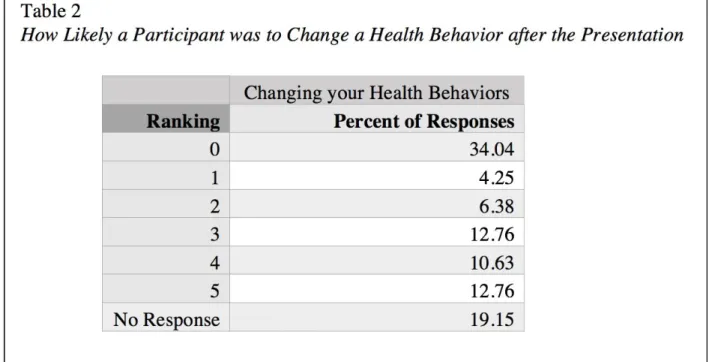
Table 3 organized the first set of qualitative data. Participants who indicated that they might make a behavioral change were organized into the positive health behavior change. Participants who ranked zero on Table 2 were categorized into no health behavioral change. The written responses associated with each numerical ranking were then coded into themes. The qualitative data were analyzed to identify common themes among participants' responses. They were then grouped into the two categories, Positive Health Behavior Change and No Health Behavioral Change, in order to establish a trend among the potential behavioral outcomes.
Participants who were categorized into no health behavioral change wrote that “[they were] not on birth control, but definitely [felt] more secure having this information”. Others wrote that “[she has] the bar and love[s] it” or that “already have an IUD and am happy with it”.
Eight of the participants categorized into positive health behavior change, found themselves now considering switching from an oral contraception to a LARC. One of them stated that she “after learning more about the IUD, [she] might consider switching from the pill in the future”. A different participant stated that she began to consider “talking to [her] Dr. about the possibility of switching to the arm implant and how it would effect [her].
The presentation impacted several participants' oral contraceptive health behaviors and attitudes. A participant responded that she was “unaware about the ways/times to remember to take [her] birth control … it is good to pair [...] birth control with a daily activity, such as brushing [her] teeth”. Another stated that she “[...] feels more confident about taking the pill everyday now and will tie [her] taking it to a daily activity”. An additional participant believed that she was now “more likely to take her pills on time”. After the educational session a
she would “definitely ask [her] physician more questions at [her] yearly physical”. One felt more comfortable with her contraceptive health practice, finding that she was “more aware of how [her] birth control [...] affects [her] body (oral 2-hormone pill) [she] know[s] to not be so paranoid or embarrassed about trusting [her] contraception and missing a pill”.
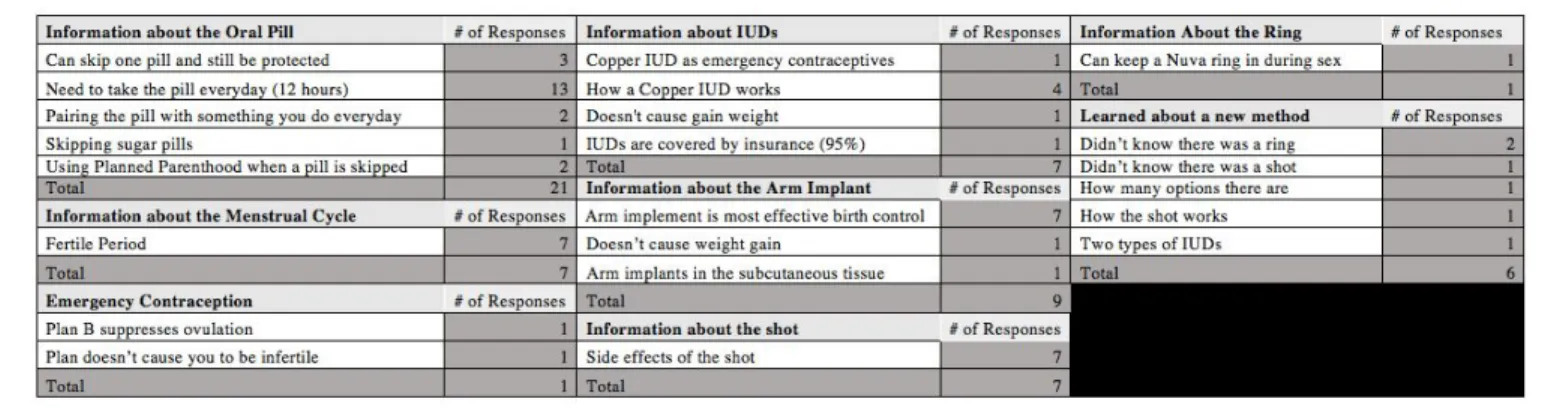
Table 4 organizes the last set of qualitative data in response to participants being asked to write one thing they learned from the presentation they did not know before. Similarly to Table 3, the responses were transcribed into themes based upon their responses. Nine different
categories of themes were developed based upon the qualitative data.
Several other participants cited learning about the fertile period for the first time. One participant wrote that she “thought you could get pregnant any day of the month”. Another wrote that she “had no idea … [about] the ovulation period”. Seven participants had similar statements regarding the fertile period.
Discussion
from switching birth control methods. An increase in knowledge and familiarity of IUDs and the arm implant was associated with an increase in participants now considering alternative methods then the oral pill. This trend is consistent with current literature. Shartzer et al. (2014) found that after a clinic provided comprehensive LARC education, they saw an increase in clients who initiated use of an IUD or implant.
Thirty-four percent of participants indicated that they did not intend to change their health behaviors following the presentation. Participants who indicated that their health
behaviors were unlikely to change and gave a reason why were the same participants who were happy with their current method of birth control, not sexually active, or not on birth control. It is hypothesized that their health behaviors were impermeable to change because they did not believe that the information applied to their current health behaviors. However their reproductive goals are likely to change in the future. A strong baseline education remains important regardless of current sexual practice.
compliance. It is hypothesized that college-age females may be noncompliant with oral birth control because they were not informed on the best practices for taking oral birth control. This is supported by the fact that 45.9% of participants recorded new information dealing with
understanding the best practices for the usage of oral birth control. It was cited that participants were unaware that paring their oral birth control with a daily routine activity would help
remember to take their pill. Participants found themselves to be more confident in remembering to take their pill everyday after the education section.
In addition to increased rates of oral birth control compliance, these results indicate that participants felt more positively regarding their contraception, found themselves to be more trusting of their birth control and less paranoid of getting pregnant. These findings are consistent with current research. Bader et al. (2014) identified that education had a positive impact upon females’ perception of contraception.
Chabbert-Buffet et. al. (2017) additionally found that noncompliance was higher among women who did not understand how their contraceptive method worked. Increasing
contraceptive education was found to increase a sense of autonomy and control among females, in regards to their contraceptive use in addition to their compliance (Bader et. al., 2014). This is supported by participants finding themselves to be more likely to engage with their provider during their well-woman exam.
that an increase in baseline understanding of the menstrual cycle could help females better understand how their contraceptive method works. DeMaria et. al.(2019) found that one’s perceptions and understanding of menstruation impacted a female’s contraception choice. Providers should increase menstruation education in order to help better align contraceptive methods to their patients' menstruation preferences (DeMaria et. al., 2019). Bader et. al. (2014) found an increase in participation in contraceptive method selection increased compliance. Recommendations
Based on the results of the study, and the current evidence it is recommended that there be an increase in education regarding the effectiveness, method of action, proper usage, common side effects, and misconceptions of all types of contraception. It is suggested that there be an emphasis on the usage and mechanism of action of methods that are impacted by user error, such as oral birth control. Furthermore education on LARCs should focus on safety, effectiveness, side effects and misconceptions. It is additionally beneficial for contraception education to establish a basic understanding of the menstrual cycle and its hormones. These recommendations are for educational programs for college-educated females, the population group of this study. additional research is needed to apply these recommendations to the general population. Limitations
small subset that the convenience sample was conducted. Additionally, participants volunteered to take part in the study, meaning they felt the education session was beneficial to their time. Those who felt contraceptive education was not beneficial to them are more likely to not volunteer. An additional limitation of the study was that no demographic data was collected. Further exploration regarings the ways age, race and ethnicity, sexual orientation and family income level impacted contraceptive knowledge needs to be explored. The lack of demographic information limits the application of the data set to the general population, as the ways in which the studied population is unique is missing from the data set.
Conclusion
increased contraception education is associated with increased user compliance(Bader et. al., 2014).
These findings were consistent with the current literature analysis of the impact of contraceptive education among females(Heller et. al., 2019). This study focused upon a small subset of the population, college-educated cis-gender females, asserting that even among higher education, there remains a contraceptive knowledge deficit. Increased education was found to positively impact health behaviors. It was found that not all females reported a potential positive change in health behaviors. These participants found the information to not apply to their sexual practices, or were already satisfied and educated on their method.
References
Bader, V., Kelly, P. J., Cheng, A.-L., & Witt, J. (2014). The Role of Previous Contraception
Education and Moral Judgment in Contraceptive Use. Journal of Midwifery & Womens
Health, 59(4), 447–451. doi: 10.1111/jmwh.12149
Chabbert-Buffet, N., Jamin, C., Lete, I., Lobo, P., Nappi, R. E., Pintiaux, A., … Fiala, C. (2017).
Missed pills: frequency, reasons, consequences and solutions. The European Journal of
Contraception & Reproductive Health Care, 22(3), 165–169. doi:
10.1080/13625187.2017.1295437
Demaria, A. L., Sundstrom, B., Meier, S., & Wiseley, A. (2019). The myth of menstruation: how
menstrual regulation and suppression impact contraceptive choice. BMC Womens Health,
19(1). doi: 10.1186/s12905-019-0827-x
Heller, C., Perreira, K. M., Shartzer, A., Johnston, E. M., & Courtot, B. (2019). Emergency
Contraception Use: The Influence of Awareness, Attitudes, and Beliefs Among
Non-Hispanic White, Non-Hispanic Black, and Hispanic Women in the United States.
Women's Health Issues, 29(2), 161–169. doi: 10.1016/j.whi.2019.01.003
Hickey, M. T., & White, J. (2015). Female college students experiences with and perceptions of
over-the-counter emergency contraception in the United States. Sexual & Reproductive
Healthcare, 6(1), 28–32. doi: 10.1016/j.srhc.2014.09.008
Planed Parenthood. (n.d.). I missed my pill. Retrieved April 9, 2020, from
Schwarz, E. B., Papic, M., Parisi, S. M., Baldauf, E., Rapkin, R., & Updike, G. (2014). Routine
counseling about intrauterine contraception for women seeking emergency contraception.
Contraception, 90(1), 66–71. doi: 10.1016/j.contraception.2014.02.007
Shartzer, A., Courtot, B., Benatar, S., & McMorrow, S. M. M. (2016). Knowledge Gaps and
Misinformation about Birth Control Methods Persist in 2016. Urban Institute .
Yen, S., Parmar, D. D., Lin, E. L., & Ammerman, S. (2015). Emergency Contraception Pill
Awareness and Knowledge in Uninsured Adolescents: High Rates of Misconceptions
Concerning Indications for Use, Side Effects, and Access. Journal of Pediatric and