PATTERNS OF ANTI-IMMIGRANT PROTESTS IN GERMANY, 2014-15
Andreas Jozwiak
A thesis submitted to the faculty at the University of North Carolina at Chapel Hill in partial fulfillment of the requirements for the degree of Masters of Arts in the department
of Political Science in the School of Arts and Sciences.
Chapel Hill 2016
ABSTRACT
Andreas Jozwiak: Patterns of Anti-Immigrant Protests in Germany (Under the direction of Dr. Rahsaan Maxwell)
TABLE OF CONTENTS
1 List of Figures . . . vi
2 List of Tables . . . vii
3 Patterns of Anti-Immigrant Protests in Germany, 2014-2015 . . . 1
LIST OF FIGURES
1 Dependent Variable . . . 15
2 Change in Unemployment 2001-2014 and Protests . . . 16
3 Unemployment and Protests . . . 17
4 Auslaender Population and Protests . . . 18
5 Education Levels and Protests . . . 19
6 Far Right Parties’ Vote Share and Protests . . . 20
7 Predicted Probabilities . . . 23
8 Interaction Terms . . . 26
LIST OF TABLES
1 Descriptive Statistics . . . 15
2 Bivariate Model Estimates . . . 21
3 Regression Results . . . 22
Patterns of Anti-Immigrant Protest in Germany, 2014-15
The emergence of protests in liberal democracies implies citizens’ deep dissatisfaction with a government’s actions or statements. These citizens feel as though the government is not responding to their concerns and they have no institutionalized means by which to address their concerns. Understanding why citizens protest is critical to our understanding of politics, because what happens on the streets affects what happens in the halls of power. In this paper, I examine the underlying structural conditions in politics, economics, and society that jointly determine protests across the more than 400 German counties in 2015. These protests were a response to the both the overwhelming numbers of Syrian and Middle Eastern migrants arriving in Germany and the government’s policy welcoming all refugees to the country. Germany is an important case because it is the largest European economy and democracy and a leader within the European Union. It was among the first countries to announce it would accept many hundreds of thousands of refugees, and the public’s reaction reflects broader anti-immigrant sentiment around the continent as well as the renewed popularity of right wing populist parties.
Jan 2015). The intensity of these protests is unprecedented in Germany, where earlier waves of anti-immigrant protests were able to attract at most a few thousand protestors.
This paper examines the mobilization of protests at the county (Kreis) level in Germany. In particular, I will focus on how county-level variation in economic and so-cial indicators and right-wing party strength affects the predicted probability and count of protests. I find support for my hypothesis that protests are more likely to occur in places experiencing economic distress. Those facing economic pressures, whether they be long term (due to deindustrialization and globalization) or short term (unemployment) are more likely to protest against refugees. They perhaps fear economic competition with refugees. Percep-tions of economic threat are intimately related to cultural threat; places with little experience with foreigners are more likely to feel threatened by the resettlement of culturally dissimilar refugees in their communities. Paradoxically, after controlling for income and population, higher levels of education at the county level were associated with more protests. This is due to higher than average levels of education in former Communist East Germany, and suggests education, commonly associated with cosmopolitan values, may not have the same effect there. Finally, the election of right-wing parties (such as the AfD and NPD) at the community level institutionalizes them within the political process. This, I suggest grants them both legitimacy and organizational capacities that have been used to facilitate protests.
Of course, social movements are cyclical; the 2014/2015 protest wave is not the first expression of immigrant sentiment in Germany. This wave follows several periods of anti-immigrant violence in the 90s. Groups like the NPD and Republikaner used similar rhetoric of cultural loss and national sovereignty, though different tactics, as those demonstrating today (Kurthen 1995, Koopmans 1993). However, both the scale of the functional pressure (resettling refugees) and protests (in the hundreds, with tens of thousands of participants) set it apart from previous waves and calls for new theorization of the process of mobilization.
to oppose or feel threatened by large numbers of migrants. I suggest that this has to do with economic decline (as opposed to threat), and the relative inexperience of many German communities with foreign born populations. In addition, there may be particularities of the East German case that contravene the literature’s findings on the effects of education. Next, I examine the impact of organizational presence and strength on protests. Following that, I present my empirical findings and conclude by suggesting further avenues for this research.
This paper brings together literatures on social movements to help explain the pro-cess and dynamic of mobilization. But because citizens are mobilizing around the issue of immigration, the scholarship on attitudes towards immigrants can shed light on the con-ditions that lead people to express negative attitudes. While negative attitudes are not a sufficient reason for protesting, they can be employed by social movement actors to mobilize a population. The Political Science literature on attitudes towards immigrants suggests a number of factors that lead to anti-immigrant sentiment, including ideology, education/skill level, perceived threat to the welfare state, nation, and labor market prospects (Karapin 1999, Borjas 1987, Scheve 2001, Helbing and Kriesi 2014, Hainmueller and Hopinks 2014). Hanimueller and Hopkins (2014) suggest economic self-interest plays a relatively small or indeterminate role on attitudes, but the scale of the functional pressures Germany is facing potentially challenge the mixed findings in the literature. Of course, economic and cultural reasons for opposing immigration are related, and I use several indicators of each type.
mobilization takes place.
Several of Daphi et al’s findings contradict previous empirical findings about the causes of mobilization and participation in previous right-wing activities in Germany. First, Koopmans (1996) finds that cases of violence against foreigners in Germany are mainly perpetrated by younger males who are socially and economically marginalized and members of neo-Nazi groups. By contrast, the protestors in Dresden were older (25-64) and had above average levels of education. Second, the scale of the protests is unprecedented; there were more than 200 in 2015 alone, and participation in some cases brought more than 25,000 citizens on the streets. This recent wave of protest clearly represents a departure from understandings of who participates, and thus this requires a context-specific theoretical framework that captures the diverse types of people who are protesting
While Geiges et al (2015) suggest recent protests are not a part of a process of social relegation leading to xenophobia, I argue this is, in fact, the case. The majority of the protestors interviewed at the Dresden protests were between 24 and 64, a generation who have largely lost out from the economic transformation of East Germany over the last 25 years. Reunification meant great structural changes to the East German economy; industries and manufacturing left the East and with their departure a large number of highly-skilled employees out of the work they had been trained to do. The loss of industrial jobs meant a loss of income and in the continental European cases (especially West Germany) the loss of generous employment protection schemes (Thelen 2013). The case of deindustrialization is most acutely felt in East Germany precisely because reunification brought about large economic as well as political/cultural shifts. But these economic processes are also occurring in West Germany. The effects are still being felt today and may even have been exacerbated by the 2008 economic crisis.
measure. This thesis suggests that those who feel most economically threatened by migrants (the unemployed, low-wage service sector employees, young people) will be the most likely to report negative attitudes (Park 1950, Scheve and Slaughter 2001). But education works in both an economic and cultural sense; more educated people more likely have cosmopolitan identities and understandings that reduce anti-immigrant sentiment (Hainmueller and Hiscox 2007, 2010). This is especially true in higher education, where understanding comes alongside larger and more diverse social networks (Betts 1988, Chandler and Tsai 2001).
This stands contrary to the finding that PEGIDA protestors had above average levels of education as compared to Germany as a whole (Daphi et al 2015). This may be a particularity of the East German case; the type of education received by former East Germans may have been of a different quality that did not promote cultural values like cosmopolitanism. Research on the effect of education specifically looks at Western education systems, and has perhaps not considered how different education under Communism was (Gang, Rivera-Batiz, and Yun 2002). Schooling in East Germany may have been more vocational and less rooted in a broader, liberal arts tradition. Education may still bring about increased social tolerance, but in this case the effect might be ’washed out’ by economic insecurity coupled with the cultural insecurity of reunification.
competition, though, and it is very likely that the feeling of general insecurity about one’s personal situation has both economic and cultural components.
However, the data on deindustrialization are limited. Time series data for dif-ferent indicators begin in 1995 and 2001, meaning that changes reflect not the process of deindustrialization, but the economic recovery that began to take place in East Germany after reunification. Whether long or short term, I still expect economic downturn to affect the probability of protest, because citizens feel a similar threat from potential for economic competition. Therefore, I use a measure of the current level of unemployment to measure the economic determinants of protests. Current unemployment reflects both the changes wrought by deindustrialization, because individuals may not have been able to transition to new jobs. In addition, looking at current unemployment reflects the pressures induced by the 2008 financial crisis.
The literature on attitudes towards immigration and right-wing parties stresses the importance of cultural fears and threats (Hainmueller and Hopkins 2014, Oesch 2008, Sides and Citrin 2007). Indeed, interviewed protestors expressed fears over the loss of German national identity and culture, poorer prospects for future generations, and terrorism. This suggests that motivations for protesting lie both in identities as well as (indirectly) through economic insecurities. These fears are not necessarily based in reason; the inherent contra-diction, though, is most correctly estimated the (very low) percentage of the local population who were of foreign decent. Intergroup contact theory suggests this is not so surprising; those who interact with immigrants or Auslaender more generally are less likely to feel threatened (Pettigrew 1998).
challenged by the immigration of millions of Turkish Gastarbeiter in the 1960s and 70s, whose permanent settlement and family reunification was an unintended outcomes (Esses et al 2006). Citizenship laws remained highly restricted to those with German lineage until 1990, when it became easier for Turks to gain citizenship. The approach to their integration was either segregationist or assimilationist, further deepening the exclusive notion of citizenship (Kurthen 1995). Tellingly, Germans do not typically use the term ‘immigrant,’ but refer to immigrants as ‘Auslaender’ or ‘Fremde’ (Foreigners) (Schnapper 2007). Nevertheless, Germans still do not see their country as one of immigration in the way that France or the United States does, and did not have an official immigration policy until 2005 (Esses et al 2006, Grassler 2005). Kurthen (1995) sees a fundamental dissonance between the liberal asylum policy and universal conception of human rights against the vlkisch definition of the nation.
I expect those with a narrower conception of identity to feel most threatened by immigrants. Closer identification with the ethnocentric notion of the nation, which can be particularly salient in Germany, leads individuals to feel more of an out-group threat. Esses et al. (2006) find empirical evidence that in Germany, the heightening of in-group salience led Germans to express more negative attitudes towards immigrants, as compared to participants from Canada, with a more broadly constructed national identity. Conversely, acceptance of a broader, European identity predicts more inclusiveness and therefore acceptance of outsiders (Hooghe and Marks 2004, Luedtke 2005, Schildkraut 2005). Variation in the exclusivity may be a function of politics, or the presence of a group that exists to mobilize and heighten the salience of group identities (Branscome, Ellemers, Spears and Doosje 1999).
that more contact with ethnic minorities in cities generates empathy that tends to reduce anti-immigrant sentiment (Pettigrew 1998, Schlueter and Scheepers 2010). Thus, the most pro-migrant protests and counter-demonstrations have occurred in the large, cosmopolitan cities. On the other hand, places with little experience with immigration will view immi-grants more frequently as threats, especially in light of the German government’s plan to distribute refugees across the country based on tax revenues and population. For some small communities, this potentially could mean the sudden arrival of hundreds of refugees that change the face of the community, especially in East Germany.
Next, I argue that far right political parties in power in part serve as the orga-nizational structures that have been used to organize protests. Parties do more than put candidates up for election; they require a level of organization at a local level to organize campaigns and communicate with voters. These interactions with citizens can be (and have been) retooled to mobilize protestors.
In social movement studies, cultural and economic threats are ‘grievances,’ which in and of themselves are not sufficient for mobilization (McCarthy and Zald 1976). Instead, they must be translated into actions where the political system is open to protests and organizations exist to mobilize citizens (Kurzman 1996). Political opportunity structures are the structural conditions in politics, economics, and society that signal to would be protestors that the environment is open to extrainstitutional challenges to politics (Tarrow 1994, 2006). Political opportunities vary at many levels of the polity; certain parts of Germany may experience more anti-immigrant protests for several structural reasons, such as the decline of traditional industries and the reunification of Germany.
opportu-nities are greater where society can identify with the protestors and vice versa (Braun and Koopmans 2013, Klandermans 2014). National political elites have mostly favored Chancel-lor Merkel’s decision to open the door to hundreds of thousands of Syrians, notwithstanding dissent from within her own party. State and local elites, however, may have differing opin-ions, as they are the ones responsible for resettling and accommodating refugees. At the subnational level there is also much greater heterogeneity of political parties and groups rep-resented, especially right wing groups. Political parties are ‘insiders’ to the political system; they are professionalized organizations with routine access to policy-making bodies.
Some of the literature suggests that professionalization of movement organizations leads them to engage in more regular forms of political action (Staggenborg 1988). On the other hand, Andrews (2001) argues that the most successful organizations and movements are those that can engage in both insider and outsider tactics. This is precisely the type of mixed strategies these groups are pursuing. The presence of strong right-wing parties indicates an organizational presence in a locale and one that is capable of organizing activists, disseminating information, and attempting to influence policy. The NPD, AfD and PEGIDA represent far-right sentiment in their regions, and they always form an opposition to the mainstream parties. Neither of the parties has ever been in a ruling coalition and had to deal with the reality of governing. As a result, they function more as challengers to the system and have focused their energies on grassroots mobilization that highlights their cause and makes them more visible than their small electoral success would suggest (Tilly 1978).
in making the right-wing’s voice heard, but does not translate into policy victories. While they have explicit policy goals, they may realize that their true power lies in their ability to influence government, elites, and the public via framing and organization (Maguire 1995). Furthermore, they can use their status inside government to create political opportunities for themselves. Koopmans (1996, 1999) find an empirical association between the strength of right-wing parties and violent actions against minority groups (see also Arzheimer and Carter 2006). I expect the same to be true for protests.
There are several organizations behind the recent wave of protests. First, many smaller protests were organized by the NPD, which is the reconstructed Nazi party. Out of all groups, it has the most radical ideology, and garners a modest share of the vote in many county governments. The NPD protests seem to be of a different stripe than the AfD/PEGIDA protests. They are smaller, occur with regularity in the same place, and are more confrontational. For example, the party organized several weekly protests in Berlin-Marzhan directly in front of an asylum shelter. The NPD protests are relatively uninteresting because they are smaller, mobilize from a base that is fairly consistent, and thus they are just ‘riding the wave’ of this protest cycle.
and the recent rise (and re-posititioning) of the AfD on the German political scene.
The AfD is a right-wing populist party. It began as a euro-skeptic party with a largely neoliberal ideology that grew out of popular dissatisfaction with Germany’s role in the Southern Eurozone economies after the financial crisis. However, internal fractures within the party came to a breaking point in late 2014/early 2015, and the more right-wing faction of the party, led by Frauke Petry, took over. Since then, the party has moved to take advantage of refugee crisis and made it a central part of their platform, and has organized many large demonstrations on the issue. The group is on the rise and is posturing itself to become Germany’s first true populist right party, much like the Sweden Democrats or Front National in France. It has done remarkably well in regional elections, capturing up to 15 percent of the vote in the most recent regional elections in 2016. They have done this by poaching voters from the mainstream parties, who have employed ‘blurring strategies’ on the refugee issue (Elias et al 2015).
The rise of the AfD comports nicely with Tarrow’s description of the cyclicality of protest movements. Social movements become a spark that feeds itself and, “set[s] a precedent that enables others to enter the social movement sector, expand the scope of contestation, and thus improve the opportunity structure for protest and eventually peaks when resources spent and coopted by political institutions (Kitschelt 1993:18)” The AfD was taken over by Petry at a time where it allowed the party to greatly expand its popularity and relevance in German politics. Furthermore, they were elected into office in 2014, before the beginning of the refugee crisis. Their subsequent platform shift has meant they are able to take advantage of their institutional status, but their populism has allowed them to continue utilize grassroots mobilization.
by its protestors, and explicitly prohibits these at its own protests. While there may be little formal coordination, there is probably large crossover in terms of participants. When Daphi et al. (2015) interviewed protestors at PEGIDA rallies, nearly all of them reported they would vote for the AfD if the next election were tomorrow. Therefore, I expect the electoral strength of the AfD and NPD to relate to the organizational capacity right wing organizations possess at a local level. This institutionalization in politics gives them legitimacy, but also the resources and networks necessary for the organization of protests.
My theory comes in three stages. First, grievances flow from the processes of deindustrialization that lead to economic and social displacement. In addition, places with low levels of immigration are more likely to be threatened by the potential arrival of refugees to their communities. These two concepts are related, But because protests do not simple arise from fears of cultural or economic threat, I examine the mobilizing structures at the county level. In this case, I proxy for the organizational capacity of groups to mobilize citizens by looking at the strength of right wing parties in the most recent regional elections.
This leads me to three hypotheses about the relationship between organizations, identity threats, and protests at the county level: H1: Counties that have experienced eco-nomic decline will be more likely to experience protests. H2: Counties with little experience
with immigration will experience higher numbers of protests. H3: The higher the share of
votes right wing parties receive at the county level, the better they will be able to organize
protests.
local organizations, and also from the social media pages of organizations like PEGIDA, NPD and AfD. Their data collection is the result of the combing of newspaper reports, pro-immigrant civil society reports of protests, and monitoring of Facebook pages of anti-immigrant groups in each region. While their data collection provides more extensive account of protests than might otherwise be reported by national media outlets, there are some issues with missing data. For all of 2014, there are some areas for which the number of protests is zero, which is highly implausible in some cases. Furthermore, there are some well known ‘hot-spots’ of highly publicized protests in some of the East German states which might lead to over reporting of protest events and underreporting of activity in states with fewer protests. Nevertheless, it is the most complete dataset of anti-immigrant protests in Germany, and my dataset includes nearly 300 observations of protests for 2015.
A central element of my theory revolves around the electoral strength, which I conceptualize as the organizational capacity of right wing groups at the county level. I will use a measure representing the percentage of the vote received by any one of the far-right parties on the German political scene in each state and county (NPD or AfD). However, Koopmans (1996) suggests that even mainstream right wing parties have the same effect of supporting protests. Thus, I will calculate for each Kreis the total vote percentage received by all right-of-center parties in the last regional elections. I calculate election results for the most recent county-level elections. While in a few cases the most recent election was in 2011, the vast majority of elections occurred in March-May of 2014. The AfD was voted into office on a platform that at the time was not explicitly anti-immigrant. At the time, it was focused on Germanys role in the Eurozone crisis. This is critical to my study, because it speaks to the way in which the partys organization was retooled for organize protests after they were already in power, lessening the concern that the causality flows from protests to electoral victories for these parties.
leveraging fine-grained population data available for each county. These data report the number and percentage of Auslnder in each county (and state). Finally, I also predict that areas with planned asylum homes will experience protests directed against the planned resettlement of refugees. These data are not currently available, but they are a good measure of a direct (as opposed to latent) threat to identities that I will include in future versions of this paper.
I theorize that the structural changes to the economy have an effect on the ways in which natives perceive immigrants. In line with this, I test my hypothesis with unem-ployment data. Ideally, the variable would be a change measured over a long time span, but data in this time series begins in 2001, and thus captures economic recovery rather, espe-cially in the East, rather than decline that resulted from the fall of Communism. Instead, I use unemployment data from 2013. This is imperfect, but it could also capture some of the lingering effects of the economic crisis of 2008 that affected European economies.
I also test several interactions between my independent variables, because it is highly likely that the effect of some is conditional on another. I will test the interaction of the presence of foreign-born peoples in a county and the electoral strength of right wing parties. The presence of grievances, or the threats to culture and identities, in this case, are not enough to spark protest. Grievances are omnipresent and do not always result in social movement activity. Therefore, looking at the organizational structures that mobilize indi-viduals, in conjunction with the level of grievances, should provide insight into the patterns of protest activity. Gaikwad and Nellis (2016), for example, find an interactive (rather than linear additive) effect between the presence of ethnic minorities and labor market competi-tion in predicting attitudes towards immigrants. I have a similar expectacompeti-tion with regard to the interaction between the percent of foreigners and unemployment levels.
and particularly in cities. I include a measure of the logged population of the county. In addition, I include a measure of GDP per capita as a measure of economic performance. These data come from the German Statistical Agency. Finally, I include a dummy for areas of the former East Germany, as these areas have disproportionately had more protests and right-wing activity.
Table 1: Descriptive Statistics
Minimum Median Mean Maximum NAs
Number of Protests 0 0 0.66 34
Percent Vote Share Far Right 0.00 0.00 2.20 16.30
Chng in Manufacturing Emp. -3.04 -0.07 -0.13 0.84 12
Population 34200.00 146800.00 198800.00 3292000.00 1
Percent Auslaender 0.01 0.05 0.06 0.29 1
Log of GDP per capita 2.66 3.36 3.42 4.98 2
Unemployment -11.98 -0.20 -1.25 4.90 3
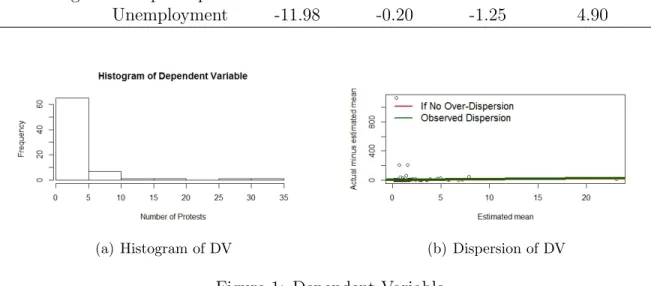
(a) Histogram of DV (b) Dispersion of DV
Figure 1: Dependent Variable
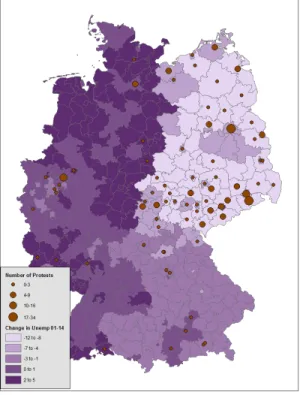
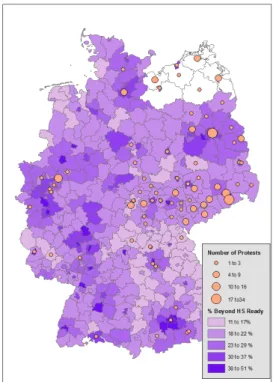
Figures 2 through 6 depict the spatial distribution of my independent variables of interest alongside my dependent variable, the number of protests that occurred at the county level over the period 2014-15. The majority of protests occurred in the old East, but there are a significant number of protests in the industrial areas of the West. Unsurprisingly, the number of protests was highest in large cities. Figure two depicts the association between deindustrialization, as measured by the change in unemployment (as a percent of the working age population) between 2001 and 2014 (2001 is the earliest year in the data). There is a stark contrast between the former GDR and West German counties. However, the data (because it first starts in 2001) produce an image of economic change that actually shows increased unemployment in the West. On the other hand, it demonstrates the beginning of an economic recovery of the former GDR, with unemployment rates decreasing up to twelve percent from 2001 to 2014.
Figure 2: Change in Unemployment 2001-2014 and Protests
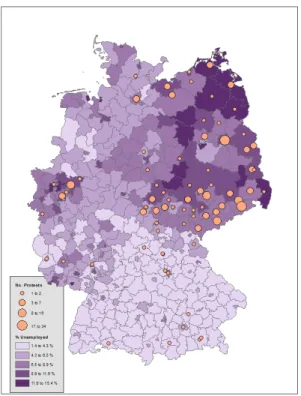
struggling economically. The counties in the East have much higher levels of unemployment as compared to those in the West. However, it also shows that the industrial counties in the Ruhrgebiet in the West are also experiencing higher levels of unemployment. This figure shows there is some spatial association between higher unemployment at the county level and increased protest activity.
Figure 3: Unemployment and Protests
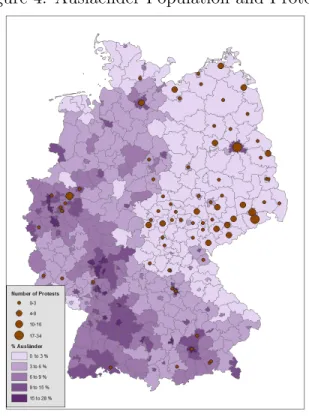
foreign populations, lending some support to the hypothesis that a lack of contact with other peoples does not promote tolerance. However, places in the West with the most protests are those with large foreign born populations. It is unclear how the effects of economic decline and intergroup contact counteract each other in the organization of protests.
Figure 4: Auslaender Population and Protests
Figure 5: Education Levels and Protests
mostly highly educated individuals.
in upcoming regional and local elections.
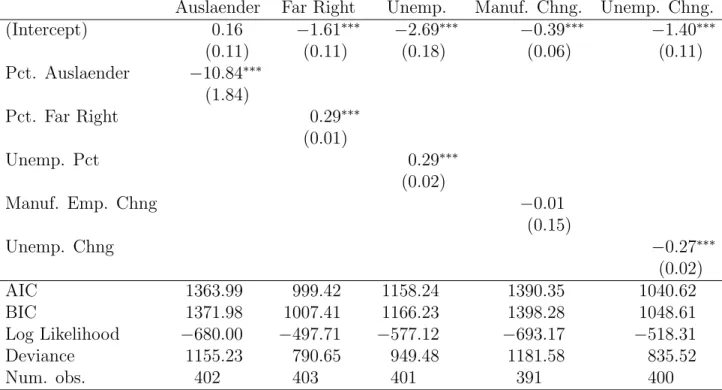
Auslaender Far Right Unemp. Manuf. Chng. Unemp. Chng.
(Intercept) 0.16 −1.61∗∗∗ −2.69∗∗∗ −0.39∗∗∗ −1.40∗∗∗
(0.11) (0.11) (0.18) (0.06) (0.11)
Pct. Auslaender −10.84∗∗∗ (1.84)
Pct. Far Right 0.29∗∗∗
(0.01)
Unemp. Pct 0.29∗∗∗
(0.02)
Manuf. Emp. Chng −0.01
(0.15)
Unemp. Chng −0.27∗∗∗
(0.02)
AIC 1363.99 999.42 1158.24 1390.35 1040.62
BIC 1371.98 1007.41 1166.23 1398.28 1048.61
Log Likelihood −680.00 −497.71 −577.12 −693.17 −518.31
Deviance 1155.23 790.65 949.48 1181.58 835.52
Num. obs. 402 403 401 391 400
∗∗∗p <0.001,∗∗p <0.01,∗p <0.05
Table 2: Bivariate Model Estimates
of unemployment at the county level.
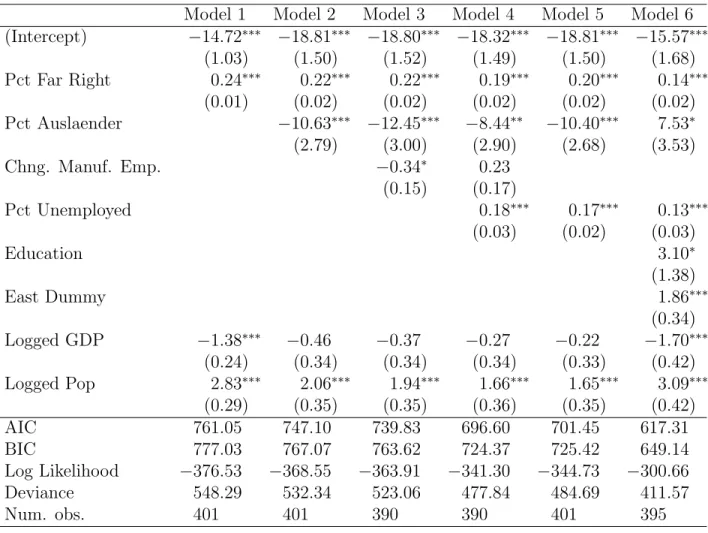
Table 3: Regression Results
Model 1 Model 2 Model 3 Model 4 Model 5 Model 6 (Intercept) −14.72∗∗∗ −18.81∗∗∗ −18.80∗∗∗ −18.32∗∗∗ −18.81∗∗∗ −15.57∗∗∗
(1.03) (1.50) (1.52) (1.49) (1.50) (1.68) Pct Far Right 0.24∗∗∗ 0.22∗∗∗ 0.22∗∗∗ 0.19∗∗∗ 0.20∗∗∗ 0.14∗∗∗
(0.01) (0.02) (0.02) (0.02) (0.02) (0.02) Pct Auslaender −10.63∗∗∗ −12.45∗∗∗ −8.44∗∗ −10.40∗∗∗ 7.53∗ (2.79) (3.00) (2.90) (2.68) (3.53)
Chng. Manuf. Emp. −0.34∗ 0.23
(0.15) (0.17)
Pct Unemployed 0.18∗∗∗ 0.17∗∗∗ 0.13∗∗∗
(0.03) (0.02) (0.03)
Education 3.10∗
(1.38)
East Dummy 1.86∗∗∗
(0.34)
Logged GDP −1.38∗∗∗ −0.46 −0.37 −0.27 −0.22 −1.70∗∗∗
(0.24) (0.34) (0.34) (0.34) (0.33) (0.42) Logged Pop 2.83∗∗∗ 2.06∗∗∗ 1.94∗∗∗ 1.66∗∗∗ 1.65∗∗∗ 3.09∗∗∗
(0.29) (0.35) (0.35) (0.36) (0.35) (0.42)
AIC 761.05 747.10 739.83 696.60 701.45 617.31
BIC 777.03 767.07 763.62 724.37 725.42 649.14
Log Likelihood −376.53 −368.55 −363.91 −341.30 −344.73 −300.66
Deviance 548.29 532.34 523.06 477.84 484.69 411.57
Num. obs. 401 401 390 390 401 395
∗∗∗p <0.001,∗∗p <0.01,∗p <0.05
(a) Far Right Parties (b) Unemployment
(c) Pct Auslaender
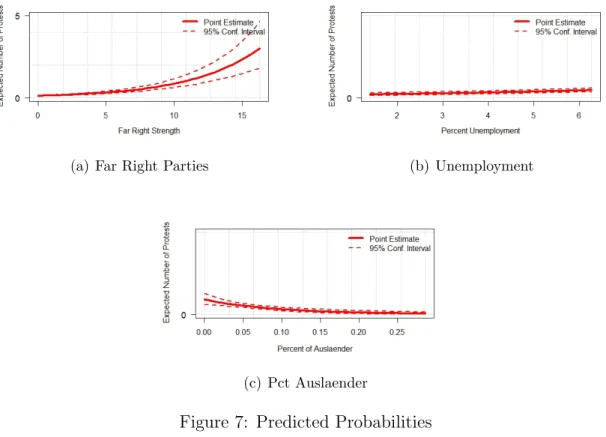
Figure 7: Predicted Probabilities
of time that includes the transition from socialist economies would yield significant results. The same is true for the change in unemployment; the data here only goes back to 2001. Again, East Germany experienced the largest decreases in unemployment since 2001, again demonstrating the gradual recovery of the local economies.
or foreigner populations. These people have less cosmopolitan identities and are thus more likely to feel threatened by their arrival into the community.
In each model, increases in the percent of the vote share in county elections for far right parties is consistently statistically significantly related to higher number of protest instances in a county. The same is true for the percent of Auslaender in the county, except for one case. Intergroup contact theory as well as considerable research on cosmopolitan and European identities suggests that experience with other groups increases familiarity and decreases perceptions of threats out-groups present. In the case where the Auslaender variable falls out of statistical significance, it is perhaps due to multicollinearity in the data between the percent of foreigners and economic variables, as immigrants tend to migrate to places with economic opportunities. Decreases in long term manufacturing employment are statistically significantly related to decreases in the predicted number of protests at the county level. The long term measure of change in unemployment is, as in the bivariate regressions statistically significant but signed in the wrong direction. This is a feature of the data spanning from 2001 to 2014, when the East began to recover economically. In model 5 I substitute the long term measures of deindustrialization with the current level of unemployment in each county. This measure is statistically significantly related to protest activity (see also Figure 2) in that higher levels of local unemployment are associated with higher numbers of protests. In each case, the controls are signed in the right direction, even if they are not statistically significant.
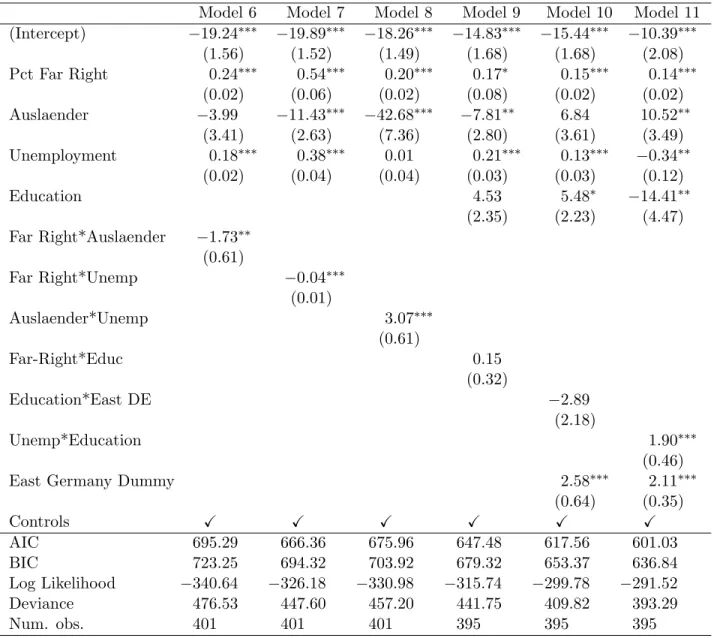
Model 6 Model 7 Model 8 Model 9 Model 10 Model 11 (Intercept) −19.24∗∗∗ −19.89∗∗∗ −18.26∗∗∗ −14.83∗∗∗ −15.44∗∗∗ −10.39∗∗∗
(1.56) (1.52) (1.49) (1.68) (1.68) (2.08) Pct Far Right 0.24∗∗∗ 0.54∗∗∗ 0.20∗∗∗ 0.17∗ 0.15∗∗∗ 0.14∗∗∗
(0.02) (0.06) (0.02) (0.08) (0.02) (0.02) Auslaender −3.99 −11.43∗∗∗ −42.68∗∗∗ −7.81∗∗ 6.84 10.52∗∗
(3.41) (2.63) (7.36) (2.80) (3.61) (3.49) Unemployment 0.18∗∗∗ 0.38∗∗∗ 0.01 0.21∗∗∗ 0.13∗∗∗ −0.34∗∗
(0.02) (0.04) (0.04) (0.03) (0.03) (0.12) Education 4.53 5.48∗ −14.41∗∗
(2.35) (2.23) (4.47) Far Right*Auslaender −1.73∗∗
(0.61)
Far Right*Unemp −0.04∗∗∗ (0.01)
Auslaender*Unemp 3.07∗∗∗ (0.61)
Far-Right*Educ 0.15
(0.32)
Education*East DE −2.89 (2.18)
Unemp*Education 1.90∗∗∗
(0.46) East Germany Dummy 2.58∗∗∗ 2.11∗∗∗
(0.64) (0.35)
Controls X X X X X X
AIC 695.29 666.36 675.96 647.48 617.56 601.03 BIC 723.25 694.32 703.92 679.32 653.37 636.84 Log Likelihood −340.64 −326.18 −330.98 −315.74 −299.78 −291.52 Deviance 476.53 447.60 457.20 441.75 409.82 393.29 Num. obs. 401 401 401 395 395 395
∗∗∗p <0.001,∗∗p <0.01,∗p <0.05
(a) Far Right * Auslaender (b) Far Right * Unemployment
(c) Unemployment * Auslaender (d) Far Right * Education
(e) East Germany * Education (f) Education * Unemployment
Figure 8: Interaction Terms
likely to experience protests regardless of the share of votes going to right wing parties. Subfigure C (from Model 8) shows that as one moves across the range of the percent of foreigners in the county, the coefficient for unemployment increases. In substantive terms, this means that the effect of unemployment is lower when there is a small foreign population, but higher in counties with large foreign populations.
I also estimated models using interaction terms that included my education variable. Subfigures D and E (from Models 9 and 10, respectively) show very little change, and the confidence intervals are too large for meaningful interpretation. However, Subfigure F (Model 11) presents perhaps the most interesting finding. As one moves along the range of education from lowest to highest, the coefficient of unemployment becomes larger. This means that in counties where the population is relatively better educated, the effect of unemployment is larger than in places with lower levels of education. This provides some support for the idea that the effects of education on tolerance are undermined by relatively worse economic circumstances.
It is possible that the causal chain leads in the other direction; protests may in-crease the visibility and spread the message of right wing parties such that they get elected to office in the next cycle. However, the timing of elections in Germany makes this an un-likely scenario. While the elections I have coded in my dataset span from 2011-2016, the overwhelming majority of elections in each state took place in March to May of 2014. This is before the refugee crisis got underway in the summer and fall of 2014, and before protest activity flared up. Furthermore, the newcomer in the political arena that experienced the largest increases in vote share this year was the AfD. At the time of elections, the AfD was still a neoliberal party that was focused on Germanys role in the Eurozone debt crisis. It was only afterwards, in early 2015, when Bernd Lucke left the party (and Frauke Petry, the current leader, took office) as a result of its increasingly xenophobic positions and rhetoric.
activity. Having seats in office at a very local level implies a level of organizational capacity for the party. The takeover of the AfD by the right wing has meant that at a local level, it has been able to shift its energies and resources and retool the organization to capitalize on the anti-immigrant political moment. This has allowed it to use its resources to organize protests. While PEGIDA has also organized protests in some of the same places as the AfD, they are likely drawing on the same population. Since the AfDs shift, it is also possible that the same protest leaders are involved in both organizations.
Figure 9: Hotspot Clustering Analysis
around Berlin and in a belt from the Czech/Polish border through Thuringa. Interestingly, there is no cluster around the (much smaller) protests that have occurred along the Baltic Coast and NPD bastions in Schwerin and Rostock.
This paper tests the spatial distribution of protests in Germany in 2015 that are the result of the migration of hundreds of thousands of refugees from Syria and the Lev-ant to Western European countries. I test several economic and social variables that have been theorized in previous work to be related to protest activity and anti-immigrant sen-timent. I use statistics at the county level to measure the process of deindustrialization and economic restructuring that has left parts of the former industrial West and socialist East economically depressed. This economic challenge may lead people to fear the arrival of refugees that theoretically, but probably not directly, will further challenge their tenuous position in society. Furthermore, these economically backwards areas in the East are those with the fewest number of Auslnder, meaning they have little experience with other groups. This means they are perhaps more insular and carry less cosmopolitan identities. This is in spite of higher than average levels of education in the former east, challenging theories that education brings about cultural and ideational changes that reduce a feeling of threat.
REFERENCES
Andrews, K. T. (1997). “The impacts of social movements on the political process: The civil rights movement and black electoral politics in Mississippi.” American Sociological Review, 800-819.
Andrews, K. T. (2001). “Social movements and policy implementation: The Mis-sissippi civil rights movement and the war on poverty, 1965 to 1971.” American Sociological Review, 71-95.
Andrews, K. T., and Seguin, C. (2015). “Group Threat and Policy Change: The Spatial Dynamics of Prohibition Politics, 189019191.” American Journal of Sociology, 121(2), 475-510.
Andrews, Kenneth and Michael Biggs. 2006. “The dynamics of protest diffusion: Movement organizations, social networks and news media in the 1960 sit-ins.” American Sociological Review 5:752-777.
Arzheimer, K., & Carter, E. (2006). “Political opportunity structures and right-wing extremist party success.” European Journal of Political Research, 45(3), 419-443.
Belanger, S., & Pinard, M. (1991). “Ethnic movements and the competition model: some missing links.” American Sociological Review, 446-457.
Biggs, Michael and Steven Knauss. 2012. “Explaining Membership in the British National Party: A Multilevel Analysis of Contact and Threat.” European Sociological Review
28: 633-646.
Borjas, G. J. (1987). Self-selection and the earnings of immigrants (No. w2248). National Bureau of Economic Research.
Braun, Robert and Ruud Koopmans. 2010. “The Diffusion of Ethnic Violence in Germany: The Role of Social Similarity.” European Sociological Review 26: 111-123.
Braun, Robert and Ruud Koopmans. 2013. “Watch the Crowd: Bystander Re-sponses, Trickle-Down Politics, and Xenophobic Mobilization.” Comparative Political Stud-ies 20: 1-28.
Daphi, Priska, et al. 2015. “Protestforschung am Limit: Eine Soziologische Annae-herung an Pegida.” WZB.
Elias, A., Szcsik, E., & Zuber, C. I. (2015). “Position, selective emphasis and framing How parties deal with a second dimension in competition.” Party Politics, 21(6), 839-850.
Esses, V. M., Wagner, U., Wolf, C., Preiser, M., & Wilbur, C. J. (2006). “Percep-tions of national identity and attitudes toward immigrants and immigration in Canada and Germany.” International journal of intercultural relations, 30(6), 653-669.
FAZ. 2013. “Schon so viele Angriffe wie 2014.” Published July 23, 2015. http://www.faz.net/aktuell/politik/inland/zahl-der-attacken-auf-asylbewerberheime-gestiegen-13716760.html
Gaikwad, Nikhar and Gareth Nellis. 2016. “The Majority-Minority Divide in Attitudes Towards Immigration: Evidence from Mumbai.” Forthcoming, American Journal of Political Science.
Geiges, Lars et al. 2015. PEGIDA: Die schmutzige Seite der Zivilgesellschaft? Transcript Verlag.
Gilens, Martin. 1999. Why Americans Hate Welfare: Race, Media and the Politics of Antipoverty Policy. Chicago: University of Chicago Press.
Hainmueller, J., & Hiscox, M. J. (2006). “Learning to love globalization: Education and individual attitudes toward international trade.” International Organization, 469-498.
Hainmueller, J., & Hiscox, M. J. (2007). “Educated preferences: Explaining atti-tudes toward immigration in Europe.” International Organization, 61(02), 399-442.
Hainmueller, J., & Hiscox, M. J. (2010). “Attitudes toward highly skilled and low-skilled immigration: Evidence from a survey experiment.” American Political Science Review, 104(01), 61-84.
Hainmueller, Jens et al. 2015. “Do concerns about labor market competition shape attitudes towards immigration? New evidence.” Journal of International Economics
97: 193-207.
Helbing, M. and H. Kriesi. 2014. “Why Citizens Prefer High- Over Low-Skilled Immigrants. Labor Market Competition, Welfare State, and Deservingness.” European Sociological Review.
Higgins, Andrew. 2015. “German Village of 102 Braces for 750 Asylum Seekers.” New York Times, 31 October 2015.
Hooghe, Liesbet, and Gary Marks. “Does identity or economic rationality drive public opinion on European integration?.” Political Science and Politics 37.03 (2004): 415-420.
Karapin, Roger. 1999. The Politics of Immigration Control in Britain and Ger-many. Comparative Politics 423-444.
Kitschelt, Herbet. 1993. “Social Movements, political Parties, and Democratic Theory.” The Annals of the American Academy 528.
Klandermans, P. G. (2014). “Identity politics and politicized identities: Identity processes and the dynamics of protest.” Political Psychology, 35(1), 1-22.
Koopmans, R. (1996). “Explaining the rise of racist and extreme right violence in Western Europe: Grievances or opportunities?.” European Journal of Political Research, 30(2), 185-216.
Koopmans, R., & Statham, P. (1999). “Ethnic and Civic Conceptions of Nation-hood and the Diferetial Success of the Extreme Right in Germany and Italy.” How social movements matter, 10, 225.
Koopmans, Ruud and Susan Olzak. 2004. “Discursive Opportunitiees and the Evolution of Right-Wing Violence in Germany.” AJS 110: 198-230.
Koopmans, Ruud. 1993. “The Dynamics of Protest Waves: West Germany, 1965 to 1989.” ASR 58: 637-658.
Koopmans, Ruud. 1997. “Dynamics of Repression and Mobilization: The German Extreme Right in the 1990s.” Mobilization 2: 149-164.
Kurthen, H. (1995). “Germany at the crossroads: national identity and the chal-lenges of immigration.” International Migration Review, 914-938.
Kurzman, C. (1996). “Structural opportunity and perceived opportunity in social-movement theory: the Iranian revolution of 1979.” American Sociological Review, 153-170.
Luedtke, Adam. 2005. “European Integration, Public Opinion and Immigration Policy.” European Union Politics 6: 83-112.
Maguire, D. (1995). “Opposition movements and opposition parties: equal partners or dependent relations in the struggle for power and reform?.” The Politics of Social Protest, 199-228.
Manow, P. and E. Seils. 2000. “Adjusting Badly: The German Welfare State, Structural Change, and the Open Economy.” In F.W. Scharpf and VA Schmidt, Eds. Welfare and Work in the Open Economy, Vol. II. Oxford: Oxford UP.
McAdam, D., Tarrow, S., & Tilly, C. (2003). Dynamics of contention. Social Movement Studies, 2(1), 99-102.
Oesch, D. (2008). “Explaining Workers’ Support for Right-Wing Populist Parties in Western Europe: Evidence from Austria, Belgium, France, Norway, and Switzerland.”
Olzak, S., Shanahan, S., & McEneaney, E. H. (1996). “Poverty, segregation, and race riots: 1960 to 1993.” American Sociological Review, 590-613.
Pettigrew, T. F. (1998). “Intergroup contact theory.” Annual review of psychol-ogy,49(1), 65-85.
Rupp, Leila and Verta Taylor. 1990. Survival in the Doldrums. Columbus, OH: Ohio State University Press.
Scheve, Kenneth and Matthew Slaughter. 2001. “Labor market competition and individual preferences over immigration policy.” Review of Economics and Statistics 83: 133-145.
Schildkraut, Deborah. 2005. Press One for English: Language Policy, Public Opin-ion and American Identity. Princeton, NJ: Princeton UP.
Schlueter, E., & Scheepers, P. (2010). “The relationship between outgroup size and anti-outgroup attitudes: A theoretical synthesis and empirical test of group threat-and intergroup contact theory.” Social Science Research, 39(2), 285-295.
Sides, J., & Citrin, J. (2007). “European opinion about immigration: The role of identities, interests and information.” British Journal of Political Science,37(03), 477-504.
Staggenborg, S. (1988). “The consequences of professionalization and formalization in the pro-choice movement.” American Sociological Review, 585-605.
“25000 protestieren in Dresden gegen Ueberfremdung.” 2015. Sueddeutsche Zeitung, 12 January.
Tarrow, S., & Tollefson, J. (1994). Power in movement: Social movements, collec-tive action and politics (pp. 41-61). Cambridge: Cambridge University Press.
Tarrow, Sidney. 2006. Power in Movement: collective action, social movements and politics Cambridge: Cambridge UP.
Thelen, Kathleen. 2013. Varieties of Liberalization and the new politics of social solidarity. Cambridge: Cambridge UP.