ISSN 2042-2695
CEP Discussion Paper No 1471
March 2017
Global Banking: Risk Taking and Competition
Ester Faia
Abstract
Direct involvement of global banks in local retail activities can reduce risk-taking by promoting local competition. We develop this argument through a model in which multinational banks operate simultaneously in different countries with direct involvement in imperfectly competitive local deposit and loan markets. The model generates predictions that are consistent with the foregoing argument as long as the expansionary impact of competition on multinational banks’ aggregate profits through larger scale is strong enough to offset its parallel contractionary impact through lower loan-deposit return margin (a result valid with both perfectly and imperfectly correlated loans’ risk). When this is the case, banking globalization also moderates the credit crunch following a deterioration in the investment climate. Compared with multinational banking, the beneficial effect of cross-border lending on risk-taking is weaker.
Keywords: global bank, oligopoly, oligopsony, endogenous risk taking, expectation of rents extraction, appetite for leverage
JEL codes: G21; G32; L13
This paper was produced as part of the Centre’s Trade Programme. The Centre for Economic Performance is financed by the Economic and Social Research Council.
Acknowledgements
We gratefully acknowledge financial support from the EU-FP7 grant MACFINROBODS-SSH-2013-612796. The paper is also recipient of the Ba¢ -Bocconi prize. We thank Javier Suarez for very useful comments. We also thank for comments participants at the CEPR conference in Financial Economics 2016, Banque de France-MACFINROBODS Workshop and seminars at Bundesbank, London Business School, the University of Amsterdam and the University of Milan.
Ester Faia, Goethe University, Frankfurt. Gianmarco Ottaviano, London School of Economics, Centre for Economic Performance, London School of Economics, University of Bologna and CEPR.
Published by
Centre for Economic Performance
London School of Economics and Political Science Houghton Street
London WC2A 2AE
All rights reserved. No part of this publication may be reproduced, stored in a retrieval system or transmitted in any form or by any means without the prior permission in writing of the publisher nor be issued to the public or circulated in any form other than that in which it is published.
Requests for permission to reproduce any article or part of the Working Paper should be sent to the editor at the above address.
Global Banking: Risk Taking and Competition
Ester Faia
Goethe University Frankfurt and CEPR Gianmarco Ottaviano
London School of Economics, University of Bologna, CEP and CEPR First draft: October 2014. This draft: March 2017.
Abstract
Direct involvement of global banks in local retail activities can reduce risk-taking by pro-moting local competition. We develop this argument through a model in which multinational banks operate simultaneously in di¤erent countries with direct involvement in imperfectly com-petitive local deposit and loan markets. The model generates predictions that are consistent with the foregoing argument as long as the expansionary impact of competition on multinational banks’aggregate pro…ts through larger scale is strong enough to o¤set its parallel contractionary impact through lower loan-deposit return margin (a result valid with both perfectly and imper-fectly correlated loans’risk). When this is the case, banking globalization also moderates the credit crunch following a deterioration in the investment climate. Compared with multinational banking, the bene…cial e¤ect of cross-border lending on risk-taking is weaker.
JEL: G21, G32, L13.
Keywords: global bank, oligopoly, oligopsony, endogenous risk taking, expectation of rents extraction, appetite for leverage.
Correspondence to: Ester Faia, Goethe University Frankfurt, Theodor-W. Adorno Platz 3, 60323 Frankfurt am Main, Germany; e-mail: [email protected]. Gianmarco Ottaviano: London School of Economics and Politi-cal Science, Department of Economics, Houghton Street, London WC2A 2AE, U.K.; e-mail: [email protected]. We gratefully acknowledge …nancial support from the EU-FP7 grant MACFINROBODS-SSH-2013-612796. The pa-per is also recipient of the Ba¢ -Bocconi prize. We thank Javier Suarez for very useful comments. We also thank for comments participants at the CEPR conference in Financial Economics 2016, Banque de France-MACFINROBODS Workshop and seminars at Bundesbank, London Business School, the University of Amsterdam and the University of Milan.
1
Introduction
In a well known contribution in 2005 Rajan [29] highlighted the potential increase in risk contagion emerging from …nance and banking globalization. This view, visionary at the time, seemed to be con…rmed when in 2008 the failure of one big globalized bank, Lehmann Brothers, had large cascading e¤ects on the entire banking system. While venturing into foreign markets might foster banks’opportunities to improve risk-sharing and to increase pro…ts’margins, globalization might have unintended consequences in terms of risk-taking. A recent IMF Financial Stability Report [24] as well as several other studies (reviewed in the next section) provide a more nuanced view. Empirical evidence shows that, prior to the 2007 …nancial crisis, global risk had increased since much of the …nancial globalization had taken place through cross-border activity with little involvement of global banks into local retail activity. On the contrary, after 2007 there has been a shift in the business model of global banks, which currently tend to operate more through subsidiaries (and occasionally through branches). Banks’direct involvement in the local retail activity implies that local competition can exert a higher discipline role. Evidence shows that this type of foreign banks’ entry (so called ‘bricks and mortar’) may indeed reduce risk-taking.
While the complex and multifaceted nature of banking globalization is high in the agenda of academics and policy makers working on crisis prevention, the literature still lacks a theoretical framework to examine those issues in a uni…ed way. The aim of this paper is to make a …rst step in that direction. In particular, we propose a model of multinational banking in which imperfectly competitive banks operate simultaneously in di¤erent national markets being directly involved in local retail activities both on the deposits’and the loans’sides. Key elements are an endogenous risk-taking and an endogenous dynamic entry decision. Our main goal is to study the impact of multinational banking on risk-taking through its e¤ects on local competition in the deposit and loan markets. In doing so we also examine how entry barriers a¤ect endogenous entry and risk-taking, which gives insights into the role of international agreements such as those on pass-porting rights within the European Union. We develop our analysis in deterministic and stochastic environments with systematic and idiosyncratic shocks as well as perfectly and imperfectly correlated loan fail-ures. We show that multinational banking can reduce risk-taking by promoting local competition.
This happens as long as the expansionary impact of competition on multinational banks’aggregate pro…ts through larger scale is strong enough to o¤set its parallel contractionary impact through lower lending-to-deposit rate spread. This result holds with both perfectly and imperfectly corre-lated loans’failures. When multinational banking reduces risk-taking, its also moderates the credit crunch that follows a deterioration in the investment climate. We also show that, compared with multinational banking, the bene…cial e¤ect of cross-border lending on risk-taking is weaker.
Our benchmark model features a banking industry with endogenous entry and endogenous risk taking in which home and foreign multinational banks co-exist in segmented national markets. In examining the interactions among competition, risk taking and globalization, we model glob-alization as a fall or a removal of the additional costs of banks’ foreign operations leading to an increase in their relative market share in foreign markets. Lower costs of foreign operation can be interpreted as the result of signing an agreement such as those on EU pass-porting rights. In each national market banks raise funds through deposits and use them to …nance …rms’projects through loans. Banks are thus directly involved in local loans’ monitoring activity and compete for local funds. Firms acquire bank loans to invest in risky investment projects, with higher investment returns being associated with higher failure probability. Given the return on loans, …rms choose both the amount of loans and the projects’ risk-return pro…les. Due to moral hazard originating from limited liability, when confronted with higher loan rates …rms’incentives toward risk-shifting are higher. This endogenously increases risk-taking as …rms invest more in tail risk. Banks act as Cournot oligopolist in the loan market and as Cournot oligopsonist in the deposit market. Entry decisions in each national market are endogenous as banks compare the sum of future discounted pro…ts with entry costs. Banks face additional costs when operating in a foreign market due to less e¢ cient monitoring. This assumption is introduced to capture the idea that banks’monitoring abil-ities in foreign jurisdictions are typically impaired. As a result high monitoring costs are associated with a smaller market share for foreign banks. However, as those costs fall due to globalization, banks’market shares in foreign markets increase thereby fostering competition for domestic banks. In general tougher competition has an ambiguous impact on risk-taking. Ambiguity arises from the presence of two opposite e¤ects associated with banks being simultaneously oligopsonist in the market for short-term funding and oligopolist in the loan market. On the one hand, tougher
competition in the deposit market increases the return on deposits. Banks have to o¤er higher deposit rates to attract funds. In isolation this …rst e¤ect would trigger an increase in loan rates, which in turn would increase risk-taking due to …rms’limited liability. On the other hand, tougher competition in the loan market decreases the return on loans. Banks have to o¤er lower loan rates to attract …rms. In isolation this second e¤ect would mitigate …rms’risk-taking. Hence, in general, whether banks’ internationalization reduces or increases risk-taking through tougher competition depends upon the balance in the extent of competition in the deposit and the loans’market. Under generally accepted functional forms,1 the second e¤ect tends to prevail so that the predictions of the
model are consistent with the …ndings by the IMF [24] report, namely that banking globalization with direct involvement in retail activities reduces risk-taking.2 We show that, in the deterministic equilibrium of the benchmark model with no shocks, an increase in banking globalization (measured by a fall in monitoring costs) increases loan supply and decreases …rms’risk-shifting incentives, thus reducing risk-taking. This result is con…rmed in a stochastic equilibrium of the benchmark model in which …rms are hit by aggregate shocks happening before banks make their loan portfolio decisions. For comparison, we also explore the deterministic equilibrium of a variant of the benchmark model in which banks cannot raise deposits abroad and thus operate as cross-border lenders. We show that also competition through cross-border lending reduces risk-taking, though to a smaller extent than multinational banking. Finally, we introduce partially correlated projects’ failures modelled as in Vasicek [31]. With general functional forms for downward-sloping loan demand and upward-sloping deposit supply, we show that the return on loans falls with the intensity of competition as long as the aggregate pro…t of the banking sector increases. This happens when the scale enhancing e¤ect of competition on aggregate deposits dominates its downward pressure on banks’pro…t margins.
The rest of the paper is organized as follows. Section 2 compares our paper with the existing literature. Section 3 describes the benchmark model of multinational banking. Section 4 solves the
1We follow Boyd and De Nicolo [4] and Martinez-Miera and Repullo [26] in assuming linear functional forms
for the demand of loans, the supply of deposits and the relation between projects’ returns and risk, an assumption compatible with decreasing hazard rates.
2
Further evidence on the fact that banks’expansion through bricks and mortar business model reduces risk is given in Goetz, Laeven and Levine [20] and Levine, Lin and Xie [25] for the US and by Faia, Ottaviano and Sanchez-Arjona [18], who construct a novel dataset for European GSIBs.
model and analyzes its predictions analytically and numerically in the deterministic and stochastic environments. Section 5 and 6 extend the benchmark model to compare multinational banking with cross-border lending and to allow for imperfectly correlated projects’failures. Section 7 concludes.
2
Related Literature
Our paper is primarily connected to the banking literature that studies the role of competition for risk-taking. This literature focuses on Cournot-Nash competition in closed economy. Allen and Gale [1] analyze competition among banks that can choose the level of assets’risk and show that more competition leads to more risk-taking. Their model hinges on competition in the deposit market. Banks seeking to attract deposits in a tougher competitive setting are forced to o¤er higher deposit rates. This forces banks to search for yield in assets, thus encouraging risk-taking. Furthermore, Allen and Gale [2] use a general equilibrium model of …nancial intermediation to show that instability in competitive banking systems is constrained e¢ cient, thereby concluding that there is no trade o¤ between risk and e¢ ciency. Di¤erently, Boyd and De Nicolo [4] highlight a di¤erent channel through which more competition in the loan market reduces loan rates, thus inducing …rms to select projects with lower returns but also lower risk. Through this channel, competition may improve the average quality of the loans’applicants and reduce adverse selection (see also Stiglitz and Weiss [30]). In the same vein, Martinez-Miera and Repullo [26] revisit the insights of Boyd and De Nicolo [4] when the correlation of projects’failures is imperfect as in Vasicek [31] rather than perfect as in the original paper. They note that lower loan rates reduce banks’ pro…t margins from non-defaulting loans, which generates a U-shaped relation between competition and banks’ aggregate failure rate (systemic risk). In all these papers changes in competition are only exogenous, while we also consider endogenous entry and how this interacts with endogenous risk-taking. Also in none of the above paper the bank has the choice between domestic and foreign markets, something which in our case creates ‘dumping’incentives as in Brander and Krugman [5]: in the presence of monitoring costs that hamper foreign operations banks are willing to accept a smaller lending-to-deposit rate spread in their foreign than in their domestic markets.
Our paper speaks to the emerging empirical literature on the role of global banks in the recent crisis. For instance, Cetorelli and Goldberg [9] and [10] study liquidity management by
global banks during the Great Recession and focus on the interaction with the monetary policy transmission mechanism. They show that banks manage liquidity optimally on a global scale by shifting it where it is most needed. They focus on banks that are already global and do not investigate the factors that might induce banks to enter foreign markets.3
More generally, our model also helps rationalize a number of results obtained by the empirical literature studying global banking. First and foremost, many papers …nd that negative shocks like the crisis tend to reduce cross-border lending, but not the presence of foreign banks (see, e.g., the survey by Claessens and van Horen [11] and Claessens and van Horen [12]). That is why, even after 2007, banks’globalization has remained a widespread phenomenon with far reaching consequences for risk and …nancial stability. This literature also explores the link between bank globalization on the one hand and credit condition or …nancial stability on the other. Evidence shows that the presence of foreign banks helps reduce the cost of credit and risk-taking and thus facilitate …nancial stability, the more so the lower the entry barriers and the higher the information e¢ ciency of the destination markets.4 Lower entry barriers increase competition. If the loan competition channel prevails, banks’risk-taking falls. Further evidence exists on the fact that expansion through ‘bricks and mortar’activity might reduce risk-taking. For instance, in the case of US banks Goetz, Laeven and Levine [20] and Levine, Lin and Xie [25] …nd that geographic expansion (within the US) reduces banks’risk-taking due to a diversi…cation channel. In the case of European GSIBs, Faia, Ottaviano and Sanchez-Arjona [18] test the impact of banks’foreign expansion on both individual bank risk (measured through CDS prices and/or loan loss provisions over assets) and systemic risk (measured with metrics of marginal capital short-fall and/or CoVaR) comparing the roles of the competition, the diversi…cation and the regulation channels. They …nd that foreign expansion (though ‘bricks and mortar’) reduces all risk metrics. Our paper provides a theoretical underpinning to these empirical …ndings as well as to the observed asymmetric reactions of cross-border lenders and multinational banks to negative shocks in the destination market, with the former typically retreating more than the latter.5
Finally, very few papers analyze the theoretical underpinnings of global banking. Bruno and
3See also the papers in Buch and Goldberg [8] for a recent overview. 4
See Claessens et al. [14], Berger et al. [3], Giannetti and Ongena [19].
5
Shin [6] build a model of the international banking system where global banks raise short term funds (‘deposits’) at worldwide level, but interact with local banks for loans production. Di¤er-ently from us they focus on banks’leverage cycle. Niepman [28] proposes a perfectly competitive model of banking across borders, in which the pattern of foreign bank asset and liability hold-ings emerges endogenously because of international di¤erences in relative factor endowments and banking e¢ ciency. Competition and risk-shifting are not part of the analysis. De Blas and Russ [15] investigate whether foreign participation in the banking sector increases real output. Using a general equilibrium model of heterogeneous, Bertrand competitive lenders and a simple search process, they show that lending-to-deposit rate spreads can increase with FDI whereas the lend-ing rates remain largely unchanged or even fall. They also contrast the competitive e¤ects from cross-border bank takeovers with those of cross-border lending. Di¤erently from us, they do not emphasize risk-shifting in the presence of limited liability.6
3
A Model of Multinational Banking
Consider a banking sector that operates in two symmetric national markets, calledHandF. Banks raise deposits from households and extend loans for investment projects. They are headquartered in only one of the two markets but can operate in both, choosing the risk-return pro…le that maximizes local pro…ts. However, when they operate in the market they are not headquartered in, banks face an additional monitoring cost on loans > 0. We use Nt;Ha and Nt;Fa to denote the numbers of active banks that at any timetare headquartered inH and F respectively, andNta=Nt;Ha +Nt;Fa
to denote the resulting total number of active banks. These numbers are determined by endogenous entry at …xed cost >0, which subsumes a bank entry cost b >0 and a subsidiary setup cost d>0for each market the bank operates in ( = b+ 2 d). The model will therefore feature both endogenous entry and endogenous risk-taking. As the two markets are symmetric, for conciseness of exposition we will focus on the description of marketH with analogous expressions holding for marketF.
6
3.1 Banks’Entry and Exit
In each periodtthe number of active banks is determined endogenously by entry and exit as follows. Entry requires establishing a headquarter in one of the two national markets and a subsidiary in each market at the overall …xed cost > 0. A constant discount factor 2 (0;1) captures the exogenous per period opportunity cost associated with …nancing in an un-modelled international capital market. The fact that is constant means that the two national banking markets we focus on are ‘small’with respect to the international capital market and thus …nancing conditions in the latter are not a¤ected by banks decisions in the former. Banks become active as soon as they enter. Exit does not incur any additional cost. It can be voluntary when it is a bank that decides to leave, or involuntary as long as each period banks face an exogenous death rate%2(0;1).
Accordingly, active banks consist of incumbents that survived from the previous period and new entrants. If we use Nt 1;H and Nt;He to denote the numbers of incumbent and entrant banks headquartered in H in periodt, we have that the corresponding number of active banks is:
Nt;Ha =Nt 1;H+Nt;He =
Nt;H
1 % (1)
Note that, due to exogenous death, the number of incumbents in any period is only a share
1 % of the number of active banks in the previous period.
In deciding whether to enter or not, banks compare the …xed entry cost with the total present expected value of future per-period pro…ts. Let z;HH and z;HF be the per-period pro…ts that a bank headquartered in H earns in periodz from operations in markets H and F. Then, if we use
Vt;H to denote the value of being active at timetfor a bank headquartered inH, we can write the total sum of its future discounted pro…ts recursively as:
Vt;H = t;HH+ t;HF + (1 %)EtfVt+1;Hg: (2)
As entry happens instantaneously, the model will feature no transitional dynamics. Free entry therefore implies that in any instanttthe value of being active will be equal to the overall entry cost:
Vt;H= . We will consider two cases, a stochastic environment and a deterministic environment in which banks’pro…ts per period are constant and equal to the annuity value of that cost:
which shows that the larger are the …xed entry cost , the opportunity cost of …nancing entry and the death rate%, the larger pro…ts have to be in order to justify entry. Analogous results hold for banks headquartered in countryF.
3.2 Banks, Firms and Depositors
Banks act as intermediaries between depositors and investors (‘…rms’), acting as oligopsonist vis-à-vis the former and as oligopolist vis-vis-à-vis the latter. In both cases they behave as Cournot-Nash competitors. For simplicity, we assume that: (i) …rms do not have internal funds and banks are their only source of funds; (ii) banks can only …nance …rms using own deposits; (iii) depositors can only use their funds for deposits. Moreover, we assume that both home and foreign banks can …nance home …rms using local deposits only. This assumption re‡ects well the reality of the bricks and mortar business model, in which liquidity cannot be moved easily across branches/subsidiaries. Banks optimize in each destination markets separately. Markets will be linked only through the banks’ free entry condition. Note that strategic interactions and …rms’ and banks’ optimization takes place within a period, hence in what follows we will leave the time index implicit.
While banks and …rms are risk neutral, depositors are risk averse households with concave utility function of their consumption. Deposits are insured by banks at a ‡at rate deposit insurance premium >0. This implies that in marketHthe total supply of depositsDHT as well as the return on deposits rDH do not depend on the riskiness of banks’ portfolios: depositors only care about the expected return of deposits, as they will not bear banks’ asset losses due to the insurance. Notice that the presence of the insurance, by expanding the bank’s limited liability region, also contributes to the banks’risk-taking incentives. We will return on this point later again. Thus, the (inverse) supply of deposits can be characterized as a return function of DT
H only. This function
rHD =rD DHT is assumed to satisfy rD(0) 0 and to be twice di¤erentiable with rD0 DHT >0
andrD00 DHT 0. UsingDHH andDF H to denote the deposits raised by home and foreign banks respectively, we haveDTH =DHH+DF H.
Notice that households could potentially invest in …rms’projects by themselves. In this case, however, they would receive a risky return. By investing in insured banks’ deposits, they receive instead a …xed return, which better suits their risk averse preferences. Hence, the main role of banks
in the model is that of risk insurance providers. Risk neutral banks collect deposits, invest them in risky assets by diversifying and provide a …xed returns to risk averse depositors. Importantly the deposit insurance plays the role of bank capital in our model: the insurance fee is proportional to assets and the insurance fund is the …rst in the pecking order of loss absorbing assets.
In each national market …rms have access to a set of constant-return risky technologies (‘projects’) with …xed output normalized to 1. For market H, projects are indexed rIH yielding
arIH with probabilityp(rHI; a) forrIH 2[0; rI]and 0 otherwise, whereais an aggregate shock. We assume that this shock is common across markets in order to insulate our analysis of the e¤ects of global banking on risk-taking channeled through competition from those channeled through risk diversi…cation. Probabilityp(rHI; a) satis…esp(0; a) = 1,p(rI; a) = 0,p1(rIH; a)<0,p11(rIH; a) 0 for allrIH 2[0; rI]so that p(rHI; a)arIH is strictly concave inrIH. It also satis…esp2(rIH; a)>0 and
p12(rHI ; a) 0. Accordingly, for given a, the probability of success decreases more than propor-tionately as projects’ returns increase, while it (weakly) increases as a increases. Moreover, the positive impact of larger aon rIH is (weakly) stronger for larger rHI so that higher return projects with lower probability of success bene…t (weakly) more than proportionately from favourable ag-gregate shocks. The choice of projects by …rms is unobservable to banks, which can only observe (at no cost) whether projects have been successful (rI
H > 0) or not (rIH = 0). As …rms are risk neutral, in each national market the total demand of loans LT
H = LHH +LF H (with LHH and
LF H denoting the supply of loans from home and foreign banks respectively) as well as their return
rHL do not depend on the riskiness of …rms’ projects. The (inverse) demand of loans can then be characterized as a return function of LTH only. This function rLH =rL LTH is assumed to satisfy
rL(0)>0and to be twice di¤erentiable with rL0 LTH <0,rL00 LTH 0and rL(0)> rD(0). Finally, as banks can only …nance loans through deposits and …rms can only …nance projects through bank loans, the total amounts of …rms’investmentsIHT, banks’loansLTH and depositsDHT
have to be the same: IHT = LTH = DHT; where the total amount of investments …nanced by home and foreign banks isIT
3.3 Firms’Decisions
The …rms’ decisions can actually be characterized in two stages. In the …rst stage …rms choose the risk-return pro…le of their investment. This leads to the endogenous risk characterizing the economy. Given the investment decisions in a second stage …rms decide on their loans’demand.
3.3.1 Firms’Risk and Investment Decisions
We introduce moral hazard by assuming that …rms have limited liability in that they repay their loans only if their projects are successful. Those elements imply that …rms have an incentive to risk-shifting, the more so the higher is the cost of credit. We follow in this respect the tradition of Stiglitz and Weiss [30] or Jensen and Meckling [22]. This implies that, given risk neutrality, a …rm (in the H market) choosesrIH in order to maximize expected per period pro…ts:
p(rHI; a)(arIH rHL); (4)
as failure happens with probability 1 p(rI
H; a) but does not require any loan repayment.7 Note that, given the monotonic relation between p(rI
H; a) and rHI , choosing rHI is equivalent to choosing p(rIH; a). In this respect, …rms choose the ‘risk-return pro…le’ of investments for given return on loans rHL (and given a).
The …rst order condition for a …rm maximizing (4) is:
p(rHI; a)a+p1(rHI; a)(arIH rHL) = 0; (5)
which shows that …rms trade o¤ higher return (p(rIH; a)a > 0) and lower success probability (p1(rHI ; a)(arHI rHL) <0). Making the dependence of rLH on LTH explicit allows us to rewrite (5) as:
p(rIH; a)a p1(rHI ; a)
+arHI =rL LTH ; (6)
which expresses the return on investment rHI (and thus also risk 1 p(rHI; a)) as an implicit function of aggregate loans LTH with exogenous parameter a. In particular, (6) shows that, by
7
We could alternatively assume that …rms earn a …xed amount (1 c) with probability 1 p(rIH; aH). This,
however, would not change the main incentives faced by …rms and banks. Indeed, in case of failure …rms would be unable to repay the loans, banks would repossess the amount left(1 p(rIH; aH))(1 c)and …rms would receive zero.
The proceeds earned by banks would then enter banks’pro…ts and their …rst order conditions would be simply scaled up by(1 p(rIH; aH))(1 c).
a¤ecting LTH, banks indirectly command the return-risk pro…le chosen by …rms. Speci…cally, given the functional properties ofrL LTH andp(rIH; a), a contraction in bank credit (smallerLTH) induces …rms to select a more ‘aggressive’investment pro…le characterized by higher return and higher risk (i.e., larger rHI and larger p(rIH; a)).8 Larger a has the same qualitative e¤ects on …rms’ choice due to its disproportionate boost to high-return high-risk projects.9 Hence, by disproportionately boosting the probability on the upper tail of the projects’ returns distribution, larger a increases …rms’‘exuberance’. The choice of …rms in the F market is equivalent.
3.3.2 Firms’Loans Decisions
Given the risk-return decisions on investment …rms formulate their optimal loan demand. Firms get funds and invest only in one country. We assume that there is continuum of entrepreneurs whose outside option h follows a distribution G(h): Each entrepreneur will fund investment with outside funding to the extent that their expected optimal pro…t is larger than their outside option. In this context the total demand for loans is equal to the total mass of entrepreneurs that invest:
LTH =G(hH) =G(p(rIH; a)(arHI rLH)): (7)
Additional details on how to derive this result can be found in Appendix A, where we also show that the loan demand implicitly de…ned by (7) satis…esrL0(LT
H)<0and rL00(LTH) 0:Intuitively, as the mass of borrowing …rms rises, the surplus of the marginal …rm falls. In turn, this …rm will be willing to pay lower rates.
3.4 Banks’Decisions on Deposits and Loans
As banks can only …nance local loans by own local deposits, in marketH the loans Lr;HH (Lr;F H) of any home (foreign) bank r have to exactly match its deposits Dr;HH (Dr;F H). This implies
Lr;HH = Dr;HH (Lr;F H =Dr;F H) with DHH = PNr=1H Dr;HH (DF H = PNr=1H DF H) so that Lr;HH orDr;HH (Lr;F H orDr;F H) can be equivalently chosen as a home (foreign) bank’s choice variable. In what follows, we will choose Lr;HH (Lr;F H). Then, Cournot-Nash behavior requires each home (foreign) bank r to take into account its individual impacts through LTH on both the return on
8
The crucial restriction here isp11(rHI; aH)<0. 9The crucial restriction here isp
depositsrD LTH =rD DTH and the return on loans rL LTH when choosing its amount of loans
Lr;HH (Lr;F H).
Each period starts with a certain number of incumbent banks operating in both markets. The timing of ensuing events for marketHis as follows. First, the aggregate shockais realized. Second, based on the number of incumbents and the realization ofa, new banks may decide to enter bringing the total number of active banks toNa=N=(1 %)withNHa =NH=(1 %)andNFa =NF=(1 %) (see the law of motion (1)). Third, active banks simultaneously choose the amounts of loansLr;HH (Lr;F H) in market H separately from marketF (due to their segmentation). Aggregation of these simultaneous individual decisions up to LT
H determines loans and deposits returns rLH and rDH. Fourth, based onrHL and the realization ofa, …rms design their risk-return pro…les by choosingrHI
or equivalently p(rHI; a). Fifth, uncertainty over projects’ outcomes is resolved. Successful …rms repay their loans and, whatever happens, depositors receive return rHD thanks to full insurance. Finally, exogenous exit takes place at rate %. Surviving banks become the incumbents at the beginning of the next period.
Given this timing, the backward solution of the model requires us …rst to characterize the Cournot-Nash equilibrium of loan extension (deposit collection) for given numbers of active banks and then to endogenize those numbers through the entry condition (3).
3.4.1 Banks’Optimization Problem
Due to market segmentation, banks maximize pro…ts independently in the to markets. In the case of marketH, a bankr headquartered in H choosesLr;HH to maximize
r;HH =p(rHI; a) rL LTH Lr;HH rD(DTH)Dr;HH Dr;HH ;
whereas a banksheadquartered in F chooses Ls;F H to maximize:
s;F H =p(rHI; a) rL LTH Ls;F H rD(DHT)Ds;F H Ds;F F Ls;F H ;
subject to the constraint that local loans must match deposits loans:
as well as to the …rms’…rst order condition (6), which implicitly de…nes the return of investment chosen by …rms as a function of the loan rate: rHI = rI rL DHT . In doing so, …rms are aware that their individual decisions a¤ect aggregate loans (deposits):
LTH = X r Lr;HH+ X s Ls;F H DHT = X r Dr;HH+ X s Ds;F H withLTH =DTH.
The …rst order condition for domestic bank r (for the domestic market) is:
d r;HH
dLr;HH
= p(rHI; a) rL LTH rD(LTH) + (8)
+p(rIH; a) rL0 LTH rD0(LTH) Lr;HH+
+p1(rHI; a)rI0 rL LTH rL0 LTH rL LTH rD(LTH) Lr;HH = 0
After the …rst equality, the …rst term is the ‘scale e¤ect’. It is positive and represents the marginal gain from increasing one unit of bank scale (as measured by the total amount of loans and deposits). The second term is the ‘competition e¤ect’. It is negative and captures the impacts of larger bank scale on deposit return (rD0 LTH > 0) and loan return (rL0 LTH < 0). More deposits and loans lead to a rise in the rate on deposits and a fall in the rate on loans. The third and last term is the ‘risk-taking e¤ect’. It is positive and captures the e¤ects of competition on the risk-return investment pro…le of …rms. More loans decrease the loan rate and this in turn induces …rms to select pro…les associated with lower return and higher probability of success.
The pro…t maximizing choice of loans by foreign banks(for the domestic market) satis…es an analogous …rst order condition:
d s;F H
dLs;F H
= p(rHI; a) rL LTH rD(LTH) + (9)
+p(rHI; a) rL0 LTH rD0(LTH) Lr;F H +
+p1(rHI; a)rI0 rL LTH rL0 LTH rL LTH rD(LTH) Ls;F H = 0
which di¤ers from (8) only for the presence of the additional monitoring cost . Analogous conditions hold for marketF.
3.4.2 Cournot-Nash Equilibrium
We focus on a symmetric outcome in which in each market all home banks achieve the same scale
Lr;HH =Ls;F F =` and all foreign banks achieve the same scaleLs;F H=Lr;HF =` . In this case, in each market total loans (and deposits) are:
LT = N
1 %(`+` ): (10)
For givenN, in each market the Cournot-Nash equilibrium (in any period t) is characterized by the solution of the following system of two equations in the two unknown scales` and ` :
p(rI; a) rL LT rD(LT) + (11) +p(rI; a) rL0 LT rD0(LT) `+ +p1(rI; a)rI0 rL LT rL0 LT rL LT rD(LT) `= 0 and p(rI; a) rL LT rD(LT) + (12) +p(rI; a) rL0 LT rD0(LT) ` + +p1(rI; a)rI0 rL LT rL0 LT rL LT rD(LT) ` = 0
where, exploiting symmetry between markets, we have dropped the market index from all variables.
3.4.3 Free Entry Equilibrium
With explicit time dependence, the values of `t and `t that solve system (11)-(12) determine the maximized values of domestic pro…ts t and foreign pro…ts t. These are the same for all banks ( t;HH = t;F F = t and t;HF = t;F H = t) and are functions of the number of active banks
Nta. In turn, the equilibrium number of active …rms is pinned down by the free entry condition described in Section 3.1, which with symmetry becomes:
in the determinist environment and:
Vt= t+ t + (1 %)EtfVt+1g= (14)
in the stochastic environment. Finally, the equilibrium values of`t,`t and Nta determine the equilibrium deposit return rDt , loan return rtL, and risk-return pro…le (rtI; p(rtI; at)). Given the number of incumbents, they also determine the equilibrium number of entrants by (1). The fact that the equilibrium of the two national markets can be characterized by such a parsimonious set of equations is obviously due to the assumption that the two markets are symmetric.
4
Qualitative and Quantitative Implications of the Model
We want to understand how competition and risk taking change when the parameters of the model change. In particular, we want to analyze the equilibrium behavior of our model in the two environments described in Section 3.1: a deterministic environment without aggregate shocks (at=
1) and a stochastic environment in which aggregate shocks make at follow a Markov stationary process. We will …rst characterize some analytical results for the more tractable deterministic case, and then resort to numerical simulations for a broader investigation of both the deterministic and stochastic environments. In doing so, we will work with speci…c functional forms satisfying the assumptions on rL DT ,rD(DT) and p(rI; a) laid out in the previous section.
4.1 Parametrization
To investigate the equilibrium behavior of the model (both analytically and numerically), it is useful to specify simple functional forms that comply with the properties detailed in Section 3.2. In the wake of Boyd and De Nicolo [4], we assume that the demand of loans and the supply of deposits take the following forms:
rL LT
t = at 1LTt with 1>0;
rD(DTt) = DtT with >0: (15)
We also assume that investment projects succeed with probability:
p(rIt; at) =
at 1 rIt forrI 2[0;1= ]
Hence, for given returns, larger at increases the demand of loans by (15), the productivity of projects by (4) as well as their success probability by (16). Accordingly, we will refer to larger (smaller)at as better (worse) ‘investment climate’. Di¤erently, larger decreases loan demand as well as projects’success probability without a¤ecting their productivity.
4.2 Deterministic Equilibrium without Monitoring Costs
We characterize the deterministic equilibrium in two steps. In this section we provide an analytical assessment for the simpler case in which = 0. In the next section we assess the role of banking globalization (as captured by an reduction of ) through numerical simulations.
As withat = 1 all variables are constant, we drop the time subscript. We can then use (15) and (16) with a= 1 and DT =DT to rewrite …rms’…rst order condition (6) as:
rI = 1 1
2 L
T; (17)
with associated success probability:
p= 1
2 L
T: (18)
These expressions show that more loans (and thus more deposits) make …rms choose invest-ments with lower return and higher probability of success (i.e. with more cautious risk-return pro…le). As for banks’…rst order conditions, (11) and (12) can be rewritten respectively as
LT 1 ( 1+ )LT + 1 2 ( 1+ )LT `= 0 (19)
and
LT 1 ( 1+ )LT + 1 2 ( 1+ )LT ` = 0; (20)
where we again focus on the symmetric Cournot-Nash equilibrium in which in both national markets all home banks choose the same amount of loans`ssand all foreign banks choose the same amount of loans `ss. Henceforth, we will use subscript ss to denote the values of all variables in the deterministic equilibrium. Note that conditions (19) and (20) imply that in such equilibrium, foreign banks facing the additional monitoring cost > 0 end up being smaller than their home competitors. Indeed, for any given LT, if the (19) holds for ` = `
` = `ss < `ss. Moreover, larger is associated with smaller `ss relative to `ss, with`ss going to zero for large enough . To summarize, when foreign banks face an additional monitoring cost, they are smaller than their home competitors. The more so, the higher the monitoring cost. When the monitoring cost is high enough, foreign banks do not operate in the home market.
Having discussed the role of > 0, in order to further understand the role of the other parameters of the model, it is useful to focus on the special case in which foreign banks face no additional monitoring cost ( = 0). In this case, (19) and (20) are identical and can be solved for:
LssT (NssT) =NssTdss(NssT) = 1 1+ NT ss 1 %+ 1 NT ss 1 %+ 2 (21)
with NssT(1 %) denoting the total number of active banks and Nss=(1 %) = NssT(1 %)=2 denoting the common number of home and foreign banks. Expression (21) shows that, as the number of active banks NssT(1 %) increases, total loans LTss(NssT) also increase. Expressions (17) and (18) then imply that, when more banks are active, …rms target projects with lower return
rssI (NssT) = 1= 1LTss(NssT)=2 and higher success probability pss = 1LssT(NssT)=2. This is the net outcome of two opposing forces. On the one hand, increasing the number of banks strengthens banks’competition for deposit funds, weakening their oligopsony power in the deposits market and thus raising the return on deposits as well as the total amount of deposits. For a given spread of the loan rate over the deposit rate rL rD, a larger number of active banks would increase the deposit raterD, therefore inducing …rms to take more risk as rL would also increase. On the other hand, a larger number of active banks also strengthens competition in loans provision, weakening their oligopoly power in the loan market and thus reducing the return on loans rL for any given deposit rate rD. With the assumptions embedded in the chosen functional forms, the downward pressure on the loan rate dominates the upward pressure on the deposit rate, which induces …rms to reduce return and risk. Hence, more competition due to a larger number of home and foreign banks makes …rms target investments with lower return and lower probability of failure.
however, that this number is endogenously determined by (13): ss(NssT) = 1 1 3 ( 1+ )2 NT ss 1 %+ 1 2 NT ss 1 % NT ss 1 %+ 2 3 = [1 (1 %)] : (22)
Implicit derivation of (22) shows that stronger demand of loans by …rms and higher success rate of their investments (as captured by lower ) cause a rise in the number of active banks given dNssT=d < 0. This is accompanied by a higher number of entrants as in equilibrium (1) implies Ne;ssT =%NssT=(1 %). By (21), largerNssT leads to a rise in both total and per-bank loans:
dLT
ss=d < 0 and d`ss=d < 0. Then, by (15), falling and rising LTss lead (on net) to higher rates on deposits and loans: drDss=d <0 anddrssL=d <0. Finally, by (17) and (18), falling and rising LTss also determine (on net) a rise in …rms’ success rate and in their return on investment:
dpss=d <0 and drssI =d <0. Hence, stronger demand of loans by …rms and higher success rate of their investments lead to an expansion of the banking sector along both the extensive margin (number of active banks) and the intensive margin (deposits and loans per bank). Returns to deposits, loans and investment all rise. Firms target less risky projects.
The e¤ects of lower insurance premium are similar, though less complex as they are channeled only through smaller NssT and LTss (as appears only in (21) and (22)). Those of lower entry cost
are also similar but even more straightforward as they are channeled only through NT ss (as appears only in (22)).
4.3 Deterministic Equilibrium with Monitoring Costs
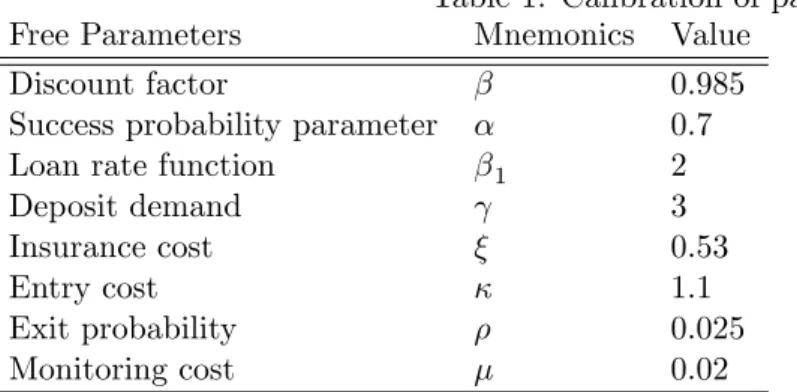
When banks face additional monitoring costs for their foreign operations, we have to resort to numerical investigation as analytical results are hard to obtain for >0. In particular, we compute the deterministic equilibrium through Newton-Raphson iterations of the model system of equations. Parameter calibration is summarized in Table 1 below. Notice that we have chosen parameter values for the loan and deposit demand such that the second is less elastic than the …rst. The discount factor is set so as to generate a 4% annual risk-free rate. The banks’ exit probability is set so as to generate an annual exit rate of 4%consistently with data from the FDIC for the 2000s (see also Hayashi, Grace Li and Wang [21]). The insurance costs are compatible with quarterly Initial
Table 1: Calibration of parameters. Free Parameters Mnemonics Value
Discount factor 0.985
Success probability parameter 0.7
Loan rate function 1 2
Deposit demand 3
Insurance cost 0.53
Entry cost 1.1
Exit probability 0.025
Monitoring cost 0.02
Basel Assessment rates (for Category I of risk) as of 2011. Monitoring costs are set according to the quarterly loan loss provisions of banks in the U.S. and Europe.10
Our ‘endogenous risk’refers to the overall default probability 1 p(rI; a). If projects are per-fectly correlated across …rms, this probability corresponds also to the aggregate default risk, hence to endogenous systemic risk. More generally, however, when projects are imperfectly correlated across …rms, systemic risk is not necessarily equivalent to1 p(rI; a). Martinez-Meira and Repullo [26] show how the aggregate endogenous risk metric shall change when idiosyncratic project failures are driven by a latent factor à la Vasicek [31] and projects are imperfectly correlated. In Section 5.2 we will show that changing the risk metric can quantitatively a¤ect the responses of the risk variables, but does not change the agents’ optimization behavior and the incentives behind the model mechanics. For this reason, in this section we focus on the simpler limiting case of perfectly correlated projects as our baseline.
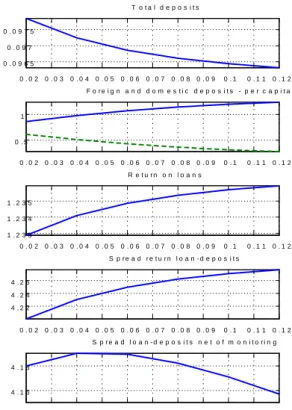
Figure 1 describes how ‘banking globalization’ (lower ) a¤ects all the endogenous variables in the model. In the panels of this …gure the di¤erent variables are reported on the vertical axis while increases rightward along the horizontal axis. Hence, the e¤ects of banking globalization can be read moving leftward. The …gure show that, as already argued, falling is accompanied by an increase in the market share of foreign banks: deposits and loans per capita increase for foreign banks and fall for domestic banks (second panel in the right column). Intensi…ed competition leads to an increase in the total amount of deposits and loans, a decrease in the return on loans and an increase in the return on deposits. As the spread between loan and deposit rates shrinks, the
1 0
number of banks falls causing a consolidation of the banking market. As for …rms, lower loan rates make them more cautious, targeting projects with lower return and higher probability of success. Despite more caution the spread between the returns on investment and loans increases, whereas the spread between the returns on loans and deposits decreases. Finally, note that for all values of the spread between loan and deposit rates is smaller for foreign than home banks once the the monitoring cost is netted out. This reveals that banks practice ‘dumping’in the sense of Brander and Krugman [5]: they are willing to accept a lower spread for their foreign operations than for their domestic ones and thus do not pass on the full additional costs of foreign operations to their customers. This happens as banks perceive higher elasticities of loans demand and deposits supply in their foreign market given that their market share is smaller there, and explains why costly cross-hauling of identical banking services by banks headquartered in di¤erent national markets arises in equilibrium despite monitoring costs. The partial absorption of monitoring costs by foreign banks becomes less pronounced as falls driving the perceived elasticities of loans demand and deposits supply in their foreign market closer to the ones in their home market.
4.4 Stochastic Equilibrium with Monitoring Costs
We now investigate how the banking sector reacts when the investment climate is subjected to shocks modelled through a Markov stationary process. The obvious di¤erence with respect to the deterministic equilibrium will be that in a stochastic environment expectations will play a role. Speci…cally, we choose an autoregressive process for shocks and look at the impulse responses of endogenous risk (…rm default probability), bank entry, deposits/loans of domestic and foreign banks, and the return on loans. We study how these responses change depending on the monitoring cost ( ), the deposit insurance premium ( ), the entry cost ( ) and the demand of loans ( ).
4.4.1 Quantitative Implementation
We study the dynamics of the model and the channels at work through stochastic simulations, which take into account expectations about the future banks’ value function. In the presence of random shocks to the investment climate, return to investment (17) becomes:
rIt = 1 1
2at
0 . 0 2 0 . 0 3 0 . 0 4 0 . 0 5 0 . 0 6 0 . 0 7 0 . 0 8 0 . 0 9 0 . 1 0 . 1 1 0 . 1 2 0 . 0 6 7 6 0 . 0 6 7 8 0 . 0 6 8 0 . 0 6 8 2 0 . 0 6 8 4 S u c c e s s p r o b a b i l i t y 0 . 0 2 0 . 0 3 0 . 0 4 0 . 0 5 0 . 0 6 0 . 0 7 0 . 0 8 0 . 0 9 0 . 1 0 . 1 1 0 . 1 2 0 . 0 9 6 5 0 . 0 9 7 0 . 0 9 7 5 T o t a l d e p o s i t s 0 . 0 2 0 . 0 3 0 . 0 4 0 . 0 5 0 . 0 6 0 . 0 7 0 . 0 8 0 . 0 9 0 . 1 0 . 1 1 0 . 1 2 0 . 1 2 4 0 . 1 2 6 0 . 1 2 8 T o t a l n u m b e r o f b a n k s 0 . 0 2 0 . 0 3 0 . 0 4 0 . 0 5 0 . 0 6 0 . 0 7 0 . 0 8 0 . 0 9 0 . 1 0 . 1 1 0 . 1 2 0 . 5 1 F o r e i g n a n d d o m e s t i c d e p o s i t s - p e r c a p i t a 0 . 0 2 0 . 0 3 0 . 0 4 0 . 0 5 0 . 0 6 0 . 0 7 0 . 0 8 0 . 0 9 0 . 1 0 . 1 1 0 . 1 2 1 . 3 3 1 1 . 3 3 1 5 1 . 3 3 2 R e t u r n o n i n v e s t m e n t 0 . 0 2 0 . 0 3 0 . 0 4 0 . 0 5 0 . 0 6 0 . 0 7 0 . 0 8 0 . 0 9 0 . 1 0 . 1 1 0 . 1 2 1 . 2 3 3 1 . 2 3 4 1 . 2 3 5 R e t u r n o n l o a n s 0 . 0 2 0 . 0 3 0 . 0 4 0 . 0 5 0 . 0 6 0 . 0 7 0 . 0 8 0 . 0 9 0 . 1 0 . 1 1 0 . 1 2 0 . 2 9 0 . 2 9 2 R e t u r n o n d e p o s i t s 0 . 0 2 0 . 0 3 0 . 0 4 0 . 0 5 0 . 0 6 0 . 0 7 0 . 0 8 0 . 0 9 0 . 1 0 . 1 1 0 . 1 2 4 . 2 2 4 . 2 4 4 . 2 6 S p r e a d r e t u r n l o a n - d e p o s i t s 0 . 0 2 0 . 0 3 0 . 0 4 0 . 0 5 0 . 0 6 0 . 0 7 0 . 0 8 0 . 0 9 0 . 1 0 . 1 1 0 . 1 2 1 . 0 7 8 1 . 0 7 8 5 1 . 0 7 9 S p r e a d r e t u r n i n v e s t m e n t - d e p o s i t s 0 . 0 2 0 . 0 3 0 . 0 4 0 . 0 5 0 . 0 6 0 . 0 7 0 . 0 8 0 . 0 9 0 . 1 0 . 1 1 0 . 1 2 4 . 1 6 4 . 1 8 S p r e a d l o a n - d e p o s i t s n e t o f m o n i t o r i n g
with associated success probability:
pt= 1
2 L
T
t: (24)
As in the deterministic equilibrium, these expressions show that, for givenat, more loans (and thus more deposits) make …rms choose investments with lower return atrIt and higher probability of success (i.e. a more cautious risk-return pro…le). On the other hand, for givenLTt, an improvement in the investment climate (larger at) makes …rm invest in projects with unchanged probability of success but higher return atrtI.
As (23) implies:
rIt0 rtL LtT rtL0 LTt = 1
2at
; (25)
the banks’…rst order conditions (19) and (20) become respectively:
LTt hat ( 1+ )LTt i + hat 2 ( 1+ )LTt i `t= 0 (26) and LTt hat ( 1+ )LTt i+hat 2 ( 1+ )LTt i`t = 0; (27)
where we again focus on the symmetric Cournot-Nash equilibrium in which all home banks choose the same amount of loans`t and all foreign banks choose the same amount of deposits`t.
The complete system of equations consists of: the banks’free entry condition (14); the banks’ …rst order conditions (19) and (20); the de…nition of total loans (10); the expression of banks’ operating pro…ts t+ t = 21LTt hat ( 1+ )LTt i`t+ 1 2 L T t hat ( 1+ )LTt i`t:
This is a system of …ve equations that can be solved numerically in the …ve unknowns, `t,`t,
LTt,Nt and t+ t. Equation (1) can then be used to …nd the corresponding number of entrants
Ne
t.
4.4.2 Simulation Results
To assess how the banking sector reacts to changes in the investment climate, we present impulse responses of selected variables to a 1% aggregate productivity shock (at). We perform stochastic
simulations using higher order Taylor expansions of our model around the deterministic equilib-rium.11 Productivity shocks are modelled as AR(1) processes taking the form ofeat =eate"t, where
is shock persistence and"tis an i.i.d. shock. Following most of the dynamic macro literature, is calibrated to a value of0:98. The rest of the parameters is calibrated as in the previous section. In each of the …gures below we examine the impulse responses for di¤erent values of crucial parame-ters. We do so for two reasons. First, globalization may take place for di¤erent motives. Certainly a reduction of monitoring cost (smaller ) directly favors the entry of foreign banks. However, the entry of foreign banks can also be fostered by stronger loan demand (smaller ), lower entry barriers (smaller ) and lower insurance premium (smaller ). Examining how the response of the banking sector changes for di¤erent value of those parameters will allow us to understand how the various channels at work in our model operate.
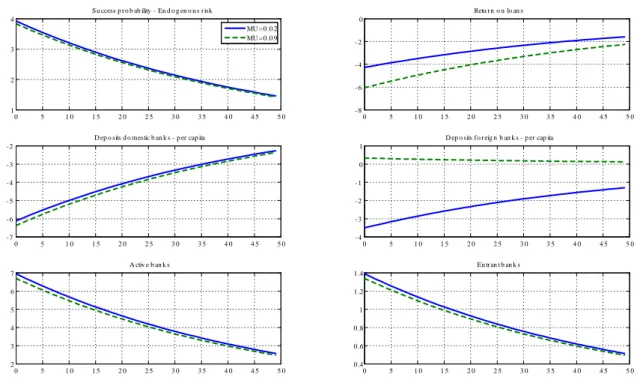
Figure 2 shows the impulse responses of selected variables to the 1% productivity shock for di¤erent values of the monitoring cost .
We start by examining the qualitative response of each variables for high and low values of . An increase in productivity boosts project returns, hence fosters the entry of both domestic and foreign banks. Both active banks and new entrants increase in number. As the market becomes more competitive, per bank deposits and each bank’s market share fall (second panel to the left). Overall credit, however, increases due to the increased number of active banks. This brings about a fall in the loan returns. In turn, the fall in loan returns reduces risk-shifting incentives for …rms, which then move to select projects with lower returns and higher success probability. The latter indeed increases on impact (…rst panel). Hence endogenous risk (default probability) falls. A higher value of has a double e¤ect. On the one side, by increasing dumping, it induces banks to apply a higher discount on loans’rates (second panel to the right). This renders competition in the loan market more aggressive. On the other side, higher monitoring costs reduce foreign pro…ts and foreign banks’entry (which is endogenous in our case). Monitoring costs are per period operating costs that a¤ect the banks’ intensive margin, namely the amount of deposits to be held in each market. Through this they reduce the sensitivity of the risk pro…le to the loan rate. There are less active banks and this reduces slightly the …rms’ risk-shifting incentives. This second e¤ect tends
1 1
0 5 1 0 1 5 2 0 2 5 3 0 3 5 4 0 4 5 5 0 1
2 3 4
S u ccess p r o b ab ility - En d o g en o u s r isk
MU =0 .0 2 MU =0 .0 9 0 5 1 0 1 5 2 0 2 5 3 0 3 5 4 0 4 5 5 0 - 8 - 6 - 4 - 2 0 Retu r n o n lo an s 0 5 1 0 1 5 2 0 2 5 3 0 3 5 4 0 4 5 5 0 - 7 - 6 - 5 - 4 - 3 - 2
D ep o sits d o mestic b an k s - p er cap ita
0 5 1 0 1 5 2 0 2 5 3 0 3 5 4 0 4 5 5 0 - 4 - 3 - 2 - 1 0 1
D ep o sits f o r eig n b an k s - p er cap ita
0 5 1 0 1 5 2 0 2 5 3 0 3 5 4 0 4 5 5 0 2 3 4 5 6 7 A ctiv e b an k s 0 5 1 0 1 5 2 0 2 5 3 0 3 5 4 0 4 5 5 0 0 .4 0 .6 0 .8 1 1 .2 1 .4 En tr an t b an k s
Figure 2: Impulse responses of selected variables to a positive productivity shock for di¤erent values of ( = 0:53).
0 5 1 0 1 5 2 0 2 5 3 0 3 5 4 0 4 5 5 0 1 2 3 4 5
S u ccess p r o b ab ility - En d o g en o u s r isk
csi=0 .5 csi=0 .9 0 5 1 0 1 5 2 0 2 5 3 0 3 5 4 0 4 5 5 0 - 3 0 - 2 0 - 1 0 0 Retu r n o n lo an s 0 5 1 0 1 5 2 0 2 5 3 0 3 5 4 0 4 5 5 0 - 1 0 - 8 - 6 - 4 - 2
D ep o sits d o mestic b an k s - p er cap ita
0 5 1 0 1 5 2 0 2 5 3 0 3 5 4 0 4 5 5 0 - 4 - 2 0 2 4
D ep o sits f o r eig n b an k s - p er cap ita
0 5 1 0 1 5 2 0 2 5 3 0 3 5 4 0 4 5 5 0 2 4 6 8 1 0 1 2 A ctiv e b an k s 0 5 1 0 1 5 2 0 2 5 3 0 3 5 4 0 4 5 5 0 0 .5 1 1 .5 2 2 .5 En tr an t b an k s
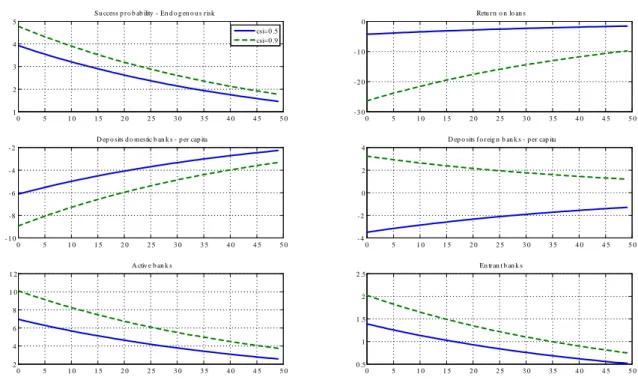
Figure 3: Impulse responses of selected variables to a positive productivity shock for di¤erent values of :
to partly counteract the …rst, so that we observe a smaller increase in the success probability and a smaller increase in the number of new entrants. At last, monitoring costs a¤ect banks’choice on the relative operating scale between the domestic and the foreign markets. Higher monitoring costs induce banks to decrease not only the relative scale of their foreign operations, but also, though to a smaller extent, the absolute scale of their overall operations.
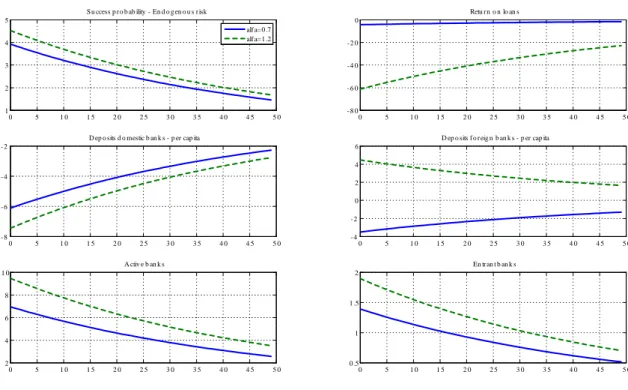
Figure 3 examines the response to the1%positive productivity shock for high and low values of the insurance premium :
As before, the increase in expected revenues (today and in the future) induces more banks to enter, reduces their market share (deposits per capita) and increases overall loan supply, which in turn reduces loan rates and risk (the success probability increases on impact, see …rst panel). Responses are di¤erent for di¤erent values of the insurance premium. By providing loss coverage, insurance induces higher banks’ risk-taking. As the insurance is the …rst loss absorber in the
0 5 1 0 1 5 2 0 2 5 3 0 3 5 4 0 4 5 5 0 1 2 3 4 5
Su ccess p r o b ab ility - En d o g en o u s r isk
alf a=0 .7 alf a=1 .2 0 5 1 0 1 5 2 0 2 5 3 0 3 5 4 0 4 5 5 0 - 8 0 - 6 0 - 4 0 - 2 0 0 Retu rn o n lo an s 0 5 1 0 1 5 2 0 2 5 3 0 3 5 4 0 4 5 5 0 - 8 - 6 - 4 - 2
D ep o sits d o mestic b an k s - p er cap ita
0 5 1 0 1 5 2 0 2 5 3 0 3 5 4 0 4 5 5 0 - 4 - 2 0 2 4 6
D ep o sits f o r eig n b an k s - p er cap ita
0 5 1 0 1 5 2 0 2 5 3 0 3 5 4 0 4 5 5 0 2 4 6 8 1 0 A ctiv e b an k s 0 5 1 0 1 5 2 0 2 5 3 0 3 5 4 0 4 5 5 0 0 .5 1 1 .5 2 En tr an t b an k s
Figure 4: Impulse responses of selected variables to a positive productivity shock for di¤erent values of :
pecking order, its role is mainly that of dispensing banks from bearing any operating loss (beyond the protection guaranteed by the limited liability). The impulse responses show that for higher values of the increase in success (the fall in endogenous risk) is larger. This is due to the fact that the bank has an incentive to follow a more cautious behavior as a higher insurance premium makes the bank share a larger part of the losses from loan default.
Figure 4 shows the response to the positive productivity shock for high and low values of . The responses of the selected variables are to be interpreted as before. Regarding the role of , recall that larger values of this parameter decrease loan demand as well as projects’success probability for given at. Hence, larger reduces investors’hubris leading to less appetite for risk and less banks’entry.
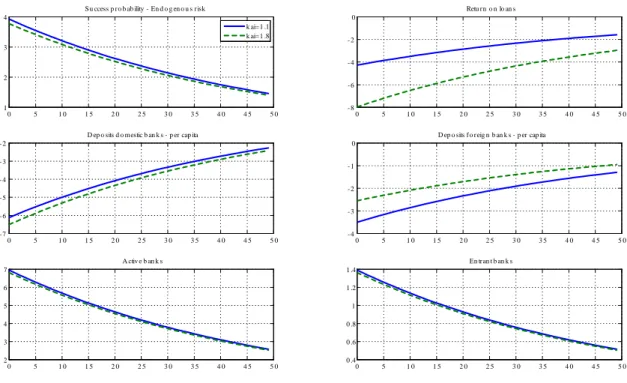
Figure 5 shows the response for di¤erent values of the …xed entry cost .
0 5 1 0 1 5 2 0 2 5 3 0 3 5 4 0 4 5 5 0 1
2 3 4
S u ccess p r o b ab ility - En d o g en o u s r isk
k ai=1 .1 k ai=1 .8 0 5 1 0 1 5 2 0 2 5 3 0 3 5 4 0 4 5 5 0 - 8 - 6 - 4 - 2 0 Retu r n o n lo an s 0 5 1 0 1 5 2 0 2 5 3 0 3 5 4 0 4 5 5 0 - 7 - 6 - 5 - 4 - 3 - 2
D ep o sits d o mestic b an k s - p er cap ita
0 5 1 0 1 5 2 0 2 5 3 0 3 5 4 0 4 5 5 0 - 4 - 3 - 2 - 1 0
D ep o sits f o reig n b an k s - p er cap ita
0 5 1 0 1 5 2 0 2 5 3 0 3 5 4 0 4 5 5 0 2 3 4 5 6 7 A ctiv e b an k s 0 5 1 0 1 5 2 0 2 5 3 0 3 5 4 0 4 5 5 0 0 .4 0 .6 0 .8 1 1 .2 1 .4 En tr an t b an k s
Figure 5: Impulse responses of selected variables to a positive productivity shock for di¤erent values of .
their future sum of discounted pro…ts equate the entry cost. By solving recursively equation (2) we can express this condition as:
=Et ( 1 X z=t ( (1 %))z t p(rIt; at) rLt LtT rDt (LTt) (`t+`t `t) ) (28)
The option value of opening a new branch or subsidiary is given by the discounted sum of future banks’rents. The higher is the entry barrier, the higher are the rents which the bank shall extract to satisfy condition (28). Rents’extraction is re‡ected in the fact that the bank decreases the loan rate (and extracts higher market shares) by a larger extent when is higher. In other words, banks’ predatory incentives are higher when the initial sunk cost is higher.
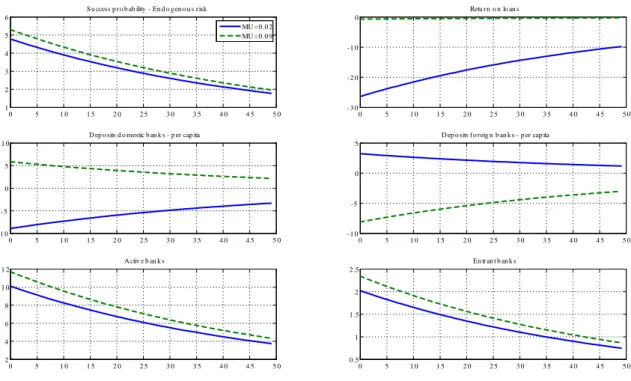
At last, it is interesting to notice that the e¤ects of the monitoring costs di¤er for di¤erent values of the insurance premium. Figure 6 shows the impulse responses for di¤erent values of and a value of larger than in Figure 2. It is interesting to note that in this case an increase in monitoring reduces risk (increases success probability). High insurance costs coupled with high monitoring costs induce foreign banks to reduce their scale. This frees up deposit demand for domestic banks, which on the contrary acquire market share. Overall, the adjustment is ampli…ed by the higher premium. The stronger increase in total loans induces a larger reduction in the loan rate and a larger increase in success probability.
We can summarize all the channels operating in our model as follows. First, an improvement in investment climate, by fostering entry and competition in loan markets reduces risk-shifting incentives and induces banks to select better portfolios (see also Boyd and De Nicolo [4]). Due to this e¤ect, foreign expansion induces a fall in risk. Second, entry in the foreign market fosters banks’predatory incentives or ‘dumping’(see Brander and Krugman [5] for a similar e¤ect in the trade literature). This e¤ect taken in isolation would reduce banks’margins for the non-defaulting loans (see Martinez-Miera and Repullo [26]) and jeopardize banks’portfolio sustainability; it would hence increase banks’risk. However, in our model entry is endogenous, this implies that shifts in the loan curves also change the relative market shares of all banks. By reducing loan rates, foreign entrants also increase market shares. Overall, this dampens the fall in per period banks’margins for non-defaulting loans. The increase in market shares raises the value of a bank that continues to do business in the future (i.e. its ‘charter value’; see Vives [32]), and this reduces also its overall risk.
0 5 1 0 1 5 2 0 2 5 3 0 3 5 4 0 4 5 5 0 1 2 3 4 5 6
Su ccess p r o b ab ility - En d o g en o u s r isk
MU =0 .0 2 MU =0 .0 9 0 5 1 0 1 5 2 0 2 5 3 0 3 5 4 0 4 5 5 0 - 3 0 - 2 0 - 1 0 0 Retu rn o n lo an s 0 5 1 0 1 5 2 0 2 5 3 0 3 5 4 0 4 5 5 0 - 1 0 - 5 0 5 1 0
D ep o sits d o mestic b an k s - p er cap ita
0 5 1 0 1 5 2 0 2 5 3 0 3 5 4 0 4 5 5 0 - 1 0
- 5 0 5
D ep o sits f o r eig n b an k s - p er cap ita
0 5 1 0 1 5 2 0 2 5 3 0 3 5 4 0 4 5 5 0 2 4 6 8 1 0 1 2 A ctiv e b an k s 0 5 1 0 1 5 2 0 2 5 3 0 3 5 4 0 4 5 5 0 0 .5 1 1 .5 2 2 .5 En tr an t b an k s
Figure 6: Impulse responses of selected variables to a positive productivity shock for di¤erent values of ( = 0:9).
5
Cross-Border Lending and Systemic Risk
To conclude our analysis, we compare our results on the relation between multinational banking and risk with perfectly correlated …rm projects’outcomes with those generated by two alternative setups. In the …rst, we substitute multinational banks with cross-border lenders that extend loans in both markets but can only raise deposits in the market in which they are headquartered. In the second, we revert to multinational banks but introduce systemic risk through imperfectly correlated projects’outcomes.
5.1 A Model of Cross-Border Lending
Internationalization for banks can take place in di¤erent forms. So far we have explored the possi-bility of multinational banking, which materializes through the opening of branches or subsidiaries in a foreign country that raise deposits and extend loans locally. An alternative to this business model is cross-border lending whereby banks foreign operations are restricted to loan provision. The di¤erence between these business models might be relevant in terms of risk-taking behavior. Indeed, a recent IMF Financial Stability Report [24] shows that, prior to the …nancial crisis of 2007, global risk had increased since much of the …nancial globalization took place through cross-border activity with little involvement of global banks into local retail activity. The same report shows, however, that after the crisis there has been a shift in the business model of global banks, which currently tend to operate more through subsidiaries (occasionally through branches) and this shift has been associated with a fall in banks’ risk. Our benchmark model shows, consistently with evidence in the IMF report, expansion by multinationals can actually reduce risk-taking. It is, therefore, worth examining whether expansion through cross-border activity can instead lead to di¤erent conclusions.
We assume that, di¤erently from multinational banks, cross-border lenders have a lighter foreign presence. This can be captured by a lower setup cost for foreign operations, which we normalize to zero. Accordingly, the overall …xed cost of a cross-border lender is d, where and dare the overall …xed cost and the subsidiary setup cost of a multinational bank respectively.
A cross-border lenderrheadquartered in marketHraises depositsDr;H in its domestic market and allocates them to domestic loans Lr;HH and foreign loans Lr;HF. We use Dr;HH and Dr;F H to denote the complementary amounts of deposits allocated to loans in H and F respectively, so that we have Dr;HH =Lr;HH, Dr;F H =Lr;F H and Dr;H =Dr;HH+Dr;HF =Lr;HH+Lr;HF. The lender then chooses Lr;HH and Lr;HF so as to maximize expected pro…t:
H = p(rHI; aH) rHL LHT Lr;HH rDH(DTH)Lr;HH Lr;HH
+p(rIF; aF) rLF LTF Lr;HF rDH(DTH)Lr;HF Lr;HF Lr;HF d :
The …rst order condition for pro…t maximization is:
@ H
@Lr;HH
= p1(rHI; aH)rHI0 rLH rLH0 LTH rHL LTH Lr;HH rHD(DHT)Lr;HH Lr;HH (29)
+p(rIH; aH) rHL0 LTH Lr;HH+rLH LTH rHD0(DTH)Lr;HH rDH(DTH)
p(rIF; aF)rHD0(DTH)Lr;HF = 0
Note that, as higher Lr;HH increases interest payments also for deposits used for Lr;F H, the lender’s …rst order condition can not be separated between markets as it was the case with multi-national banks. This generates a novel trade-o¤. On the one hand, asrD
H(DHT)increases withDTH, being forced to tap a single market for deposits drives the deposit return up, which by itself would increase the loan rate. On the other hand, the lack of foreign competition for domestic deposits puts downward pressure on the deposit return, which by itself would decrease the loan rate. Hence, for the same number of banks, it is not obvious whether one should expect cross-border lending to lead to more or less risk taking than multinational banking.
For simplicity, we focus on the symmetric deterministic equilibrium with = 0 and a = 1. In this case, symmetry implies that in equilibrium the total amount of loans o¤ered by home and foreign banks in a market equals the total amount of deposits raised in the same market (LT =DT). This is due to the fact that home and foreign banks supply the same amounts of deposits rather than to the fact that banks can …nance loans only with local deposits as in the case of multinational banks. Using our functional forms (15) and (16), the …rst order condition (29) becomes
Hence, after imposing LT = Na`, we can solve for the total amount of loans extended by cross-border lenders in each market:
LTcbl=Na`= 1 1+ (Na+ 1) 12 (Na+ 2) + Na+ 1+ ; (30)
which shows that, also in the case of cross-border lending, a larger number of active banks raises the total amount of loans, thus reducing risk-taking. Expression (30) can be compared with its analogue (21) in the case of multinational banks:
LTmnb =Na`=
1 1+
Na+ 1
Na+ 2:
Three comments are in order. First, for a given number of active banks Na, cross-border lenders raise a smaller total amount of deposits and thus supply a smaller total amount of loans (LT
cbl < LTmnb). Second, for a given initial number of active banks Na, the increase in competition
caused by the same increase in the number of active banks leads to a smaller increase in deposits and loans with cross-border lenders than with multinational banks (dLTcbl=dNa < dLTmnb=dNa). Hence, for given Na, multinational banking generates less risk taking than cross-border lending (pcbl >
pmnb) and more competition reduces risk by a larger extent (dpcbl=dNa < dpmnb=dNa). Third, when instead the number of active banks is endogenously determined by free entry, multinational banking still generates less risk than cross-border lending provided that the additional …xed cost of setting up a foreign subsidiary is not too large. Too see this, note that, for givenNa and net of the corresponding overall entry cost, the maximized pro…t of a cross-border lender evaluates to:
cbl= 1 1 3 ( + 1)2 (2Na+ 1)2 5 +3 1 + 1 + 2N a 8Na 3 +2 1 + 1 + 2N a 3 [1 (1 %)] d ;
while, by (22), the pro…t of a multinational bank evaluates to:
mnb = 1
1 3
( 1+ )2
(Na+ 1)2
Na(Na+ 2)3 [1 (1 %)] :
Both cbl and mnb are decreasing in Na and go to zero as Na goes to in…nity. However, it can be shown that the multinational bank’s pro…t gross of the overall entry cost is larger than the cross-border lender’s for any value ofNa. It then follows that for d= 0 the multinational banking