Bologna
SCUOLA DI SCIENZE
Corso di Laurea Magistrale in Informatica
Blockchain-based
end-to-end encryption
for Matrix instant messaging
Relatore:
Chiar.mo Prof.
Stefano Ferretti
Correlatore:
Chiar.mo
Mirko Zichichi
Presentata da:
Julian Sparber
I Sessione: 15/07/2020
Anno Accademico 2019/2020
will help me in the future to write a thesis, a blogpost, an email
or any written text. Thanks to them I was able to overcome the
challenges that my dyslexia posed and get this far in my
academic career.
Privacy and security in online communication is an important topic to-day, especially in the context of instant messaging. A lot of progress has been made in recent years to ensure that conversations are secure against attacks by third parties, but privacy from the service provider itself remains difficult. There are a number of solutions offering end-to-end encryption, but most of them rely on a centralized server, proprietary clients, or both. In order to have fully secure instant messaging conversations, a decentralized and end-to-end encrypted communication protocol is needed. This means there is no single point of control, and each message is encryped directly on the user’s device such that only the recipient can decrypt it.
This work proposes an end-to-end encryption system for the Matrix protocol based on blockchain technology. Matrix is a decentralized protocol and net-work for real-time communication that is currently mostly used for instant messaging. This protocol was selected because of its versatility and extensi-bility.
Using the Secret Store feature in OpenEthereum, the proposed system en-crypts data using keys stored on the Ethereum blockchain. Access control to the keys is also handled by the Secret Store via a smart contract. The pro-posed encryption system has multiple advantages over alternative schemes: The underlying blockchain technology reduces the risk of data loss because of its decentralized and distributed nature. Thanks to the use of smart con-tracts this system also allows for the creation of an advanced access control system to decryption keys.
In order to test and analyze the proposed design, a reference implementation was created in the form of a library. This library can be used for future research, but also as a building block for different applications to easily im-plement end-to-end encryption based on blockchain technology.
Privacy e sicurezza sono tematiche sempre più importanti nelle comuni-cazioni online. Questa tesi si concentra sulla sicurezza della messaggistica is-tantanea. Un importante strumento per sostenere una conversazione digitale confidenziale è la cifratura end-to-end, che permette di cifrare un messaggio direttamente sul dispositivo dell’utente e di decriptarlo solo sul dispositivo del destinatario. In questo modo se ne nasconde il contenuto a ogni altra entità, incluso il fornitore di servizi Internet e l’azienda che offre il servizio di comunicazione.
In questo lavoro è proposto un nuovo sistema per la cifratura end-to-end utilizzando Ethereum, una piattaforma basata su blockchain per eseguire, in maniera distribuita, operazioni computazionali. Più nello specifico Eth-ereum è una tecnologia che permette di eseguire codice attraverso gli smart contract. Il sistema proposto di cifratura end-to-end usa il Secret Store, una funzionalità integrata nel client Ethereum chiamato OpenEthereum(Parity). Questo strumento permette di generare le chiavi crittografiche necessarie per il funzionamento del sistema, in più le immagazzina in maniera decentraliz-zata e distribuita e ne regola l’accesso attraverso uno smart contract.
Matrix è un sistema per la comunicazione in tempo reale, oggi principalmente usato per la messaggistica istantanea. È un sistema decentralizzato, creato appositamente per essere esteso con nuove funzionalità e pertanto è stato scelto come protocollo di trasporto per questo progetto. Matrix ha già un sistema di cifratura end-to-end, ma il nuovo sistema proposto ha un numero significativo di vantaggi.
Uno di questi vantaggi è la separazione tra il processo di cifratura e il trasporto del messaggio, che permette di riutilizzare lo stesso processo di cifratura per un protocollo diverso da Matrix. Inoltre, grazie all’astrazione del sistema, sarebbe facile integrare i frutti di questo lavoro in un qualsiasi software per implementare la funzionalità di cifratura end-to-end.
Ethereum, Secret Store e Matrix sono tutti sistemi decentralizzati e per questo nessuna parte del sistema proposto deve fare affidamento a una sin-gola entità per svolgere le varie funzionalità richieste. Il sistema proposto non ha necessità di backup grazie alla tecnologia blockchain e finché l’utente mantiene i permessi d’accesso corretti, impostati via smart contract, non esiste alcuna possibilità di perdere l’accesso ai messaggi inviati. In più, sem-pre tramite gli smart contract, è possibile creare un sistema avanzato per il controllo di accesso alle chiavi di decriptazione, che può essere utilizzato per aggiungere nuovi utenti a una conversazione oppure per ritirare l’accesso al suo contenuto in un qualsiasi momento.
In questa tesi è proposto un sistema funzionante di cifratura end-to-end basato sulle garanzie di sicurezza di Ethereum e di blockchain, per testare il quale è stata scritta una libreria specifica che potrebbe essere riutilizzata, grazie al suo design, per altri protocolli di comunicazione. In conclusione, questa tesi stabilisce una base per la futura ricerca su sistemi di cifratura end-to-end basati su blockchain.
Digital communication is becoming ever more important in today’s mod-ern society. We are increasingly relying on it for many critical parts of our everyday lives. Since digital communication is now a basic need, we need ways to secure and protect the interaction and the system itself. It’s not enough to encrypt its content, but we also need resilience against system failures and attacks. Furthermore, it’s important not to only rely on the trustworthiness of a third party to guarantee the integrity and the privacy of the system. A good start is to rely as much as possible on open source software, so that it can be audited and improved by anyone with the skills to do so.
This work focuses mainly on instant messaging, or IM for short. The most basic feature of an instant messenger is real time text communication, but nowadays most people expect much more advanced features such as image and file sharing, voice messages, and video chat.
Over the past decade the public’s concern about their online privacy has grown significantly, and as a result people want better privacy and secu-rity online. Though secusecu-rity has generally improved as a result, not enough progress has been made to better protect user’s privacy.
Most of the messaging systems used every day by the general public are centralized services, with one single point of control and hence also a single point of failure. The most popular services all require the user to trust their system, without any real possibilities to review or validate what the provider is actually doing with their data. Most services offer some kind of encryption
to protect user data, but only a few provide encryption which inhibits access to the conversation content by the provider themselves. These systems may protect the user against outside eavesdropping or other types of attacks, but not so much against eavesdropping from inside the system. Therefore, the user must trust the service provider blindly.
The basic encryption protocols many services have put in place are generally built on top of solid cryptographic foundations that considerably improve the status quo, but often their systems are proprietary and thus the user is still required to fully trust the company and hope that the encryption was implemented competently. So far, most companies addressed only the basic protection, but have yet to mitigate the privacy issue. As a result, users are still left with no power and not much protection.
This is where Matrix comes into play. Matrix is a decentralized communi-cation protocol, designed to not require any centralized server. Therefore it does not have a single point of failure and, more importantly, a single point of control. Its main use case today is instant messaging, but it was created to accommodate any type of real-time communication[1]. The entire system is open-source, which means that its source code can be reviewed by anybody and it is developed by a globally distributed community, composed of many different companies and individuals. Matrix also has comprehensive public documentation, which helps the development and allows users to understand and work on the system.
Any user can run their own server, or join an existing one, through which they can join the Matrix network. It is possible to run a completely separate network, which can join the main network at a later point, or stay isolated forever. Obviously not everybody has the technical know-how or interest to set up and run their own server. There are already many existing servers, many of them free of charge, on which a user can create an account and participate in communications on the Matrix network. This adds up to the same problem as described previously, but it’s slightly better because the user’s data is stored only on their server or the server the people they
com-municate with are on. Still, a server involved in a conversation can read the messages sent between different users. The only way to circumvent this issue is end-to-end encryption. This means that a user encrypts their messages on their own device and only the recipients, selected by the sender, can decrypt them and read the messages content. Matrix implements an end-to-end en-cryption system to encrypt the entire communication[2].
The scope of this work is to create an alternative end-to-end encryption sys-tem which replaces the default end-to-end encryption syssys-tem used by Matrix. The proposed system is built on top of the blockchain-based distributed com-puting platform Ethereum, specifically on OpenEthereums’s Secret Store. OpenEthereum (previously known as Parity) is an advanced Ethereum client, that implements a feature called Secret Store[3]. The Secret Store is a core technology which allows to generating keys for encryption and decryption, it provides distributed key storage, and has a key retrieval system which uses smart contracts for permission control[4].
The new end-to-end encryption system proposed in this work has the advan-tage that it fully separates the encryption of a message from its transport, because a message is encrypted without any dependency on the protocol that is used to send it. The Secret Store was selected, among other things, because it provides an abstraction over the underlying cryptographic primitives. In addition, it permits the creation of an advanced control system to access the encryption keys, and hence the conversation. This is especially interesting when a user can revoke the access to the content of a conversation. Thanks to the blockchain all the cryptographic keys are stored securely over a dis-tributed network of nodes, which protects them from attackers and data loss. As long as the user maintains the correct access permissions via a smart con-tract loss of the message content is highly unlikely.
This document describes a functioning end-to-end encryption system that can be used to secure the communication among different parties. In or-der to enable this, a library was created which can be used as a foundation to add end-to-end encryption not only to the Matrix protocol, but also to
other transport protocols. The library is published under the GNU Gen-eral Public License (GPL-3.0-or-later) and the source code can be found at https://github.com/jsparber/e2e-secretstore.
The first section of this document is dedicated to the explanation of fun-damental concepts and to give background knowledge. The second part contains the proposed design, and a description of the reference implemen-tation and evaluation of the system. The implemenimplemen-tation was written to experiment, text and analyze the proposed design. This thesis is structured in the following chapters:
• Cryptography. This section gives a general overview about Cryptogra-phy and its importance. It explains the most important cryptographic schemes related to this work. All systems reported in this chapter are the foundation of the entire project, and they allow it to function as intended.
• Blockchain. This part gives some background on blockchain technology, including underlying principles, and the data structures it is buildt upon. It also explains how the technology is used in cryptocurrencies, such as Bitcoin and Ethereum.
• Ethereum. This chapter will talk about Ethereum more specifically. Ethereum is not just a cryptocurrency based on blockchain technology, but rather a distributed computing platform. This part also explains smart contracts, the core Ethereum feature used in this work.
• Matrix. A distributed real-time communication protocol. This part gives an overview of Matrix, describing the overall structure of the protocol, as well as core features and advantages. For completeness, the standard encryption method used in Matrix is also briefly explained. • Proposed designs. This chapter describes the proposed design for the
Ma-trix. This section also describes problems of the system and discusses possible solutions.
• Reference implementation. To test the proposed design this work in-cludes a reference implementation. This chapter talks about the tools and software used for the implementation and gives background knowl-edge, not included in other parts of this document. It explains the over-all structure and outlines the most important decisions taken during the creation of the software.
• Analysis and evaluation. This section contains experiments to test the performance of the created end-to-end encryption system.
Abstract i Sommario iii Introduction v 1 Cryptography 1 1.1 Symmetric-key cryptography . . . 4 1.2 Public-key cryptography . . . 5
1.2.1 The RSA cryptosystem . . . 7
1.2.2 Elliptic Curve Cryptosystem . . . 7
1.3 Threshold Cryptosystems . . . 11
1.3.1 Secret Sharing . . . 11
1.3.2 Shamir’s Secret Sharing . . . 15
1.4 End-to-end encryption . . . 17
1.4.1 The Double Ratchet Algorithm . . . 19
1.5 Hash function . . . 20
2 Blockchain 23 2.1 Centralized, decentralized and distributed systems . . . 26
2.2 Merkle tree . . . 28
2.3 Blocks . . . 30
2.3.1 Consensus mechanisms . . . 31
2.4 Smart contracts . . . 37 xi
3 Ethereum 39
3.1 Network stack . . . 40
3.2 Currency . . . 41
3.3 Smart Contracts . . . 42
3.3.1 Ethereum virtual machine (EVM) . . . 42
3.3.2 Solidity . . . 43 3.4 Ethereum clients . . . 44 3.4.1 OpenEthereum (Parity) . . . 44 3.4.2 Secret Store . . . 45 4 Matrix 49 4.1 Architecture . . . 50
4.1.1 Users and Identity . . . 52
4.1.2 Events . . . 52 4.1.3 Rooms . . . 53 4.1.4 Devices . . . 54 4.2 End-to-end encryption . . . 54 5 Proposed design 59 5.1 Ethereum . . . 60 5.1.1 Permissioning contract . . . 61 5.2 Matrix . . . 66 5.3 Identity verification . . . 69 6 Reference Implementation 73 6.1 Technical background . . . 74 6.1.1 Rust . . . 74
6.1.2 JavaScript Object Notation . . . 75
6.1.3 JSON-RPC . . . 76
6.1.4 Fractal . . . 76
6.2 Crypto Module . . . 77
6.2.2 Encryption . . . 78
6.2.3 Decryption . . . 80
6.2.4 Permissioning contract . . . 81
6.2.5 Client integration . . . 82
7 Analysis and evaluation 85 7.1 Varying length of messages . . . 87
7.2 Varying threshold . . . 89
7.3 Access time to smart contract . . . 90
7.4 Gas usage . . . 91
Conclusion 95
1.1 The frequency of each letter in the English language[5] . . . . 3
1.2 Private encryption scheme . . . 4
1.3 Public encryption scheme . . . 6
1.4 Elliptic curvey2 =x3−3x+ 5 . . . . 8
1.5 Example of Point Addition[7] . . . 9
1.6 Example of Point Doubling[7] . . . 10
1.7 Safe deposit box. A (2,2)-threshold scheme . . . 12
2.1 An example of a block and created chains in a blockchain. . . 24
2.2 A centralized system . . . 26
2.3 A decentralized system . . . 27
2.4 A distributed system . . . 28
2.5 Merkle tree . . . 29
2.6 A sequence of blocks in a blockchain . . . 30
2.7 Byzantine Generals problem . . . 32
2.8 Proof of Work vs Proof of Stake [27] . . . 33
2.9 Energy consumption of the bitcoin network by country[28] . . 34
2.10 Proof of Work vs Proof of Stake. Network dominance.[27] . . 35
2.11 Electing witnesses in a Delegated Proof-of-Stake network[31] . 37 3.1 Simplified network stack of Ethereum[21] . . . 40
3.2 OpenEthereum’s logo (Parity’s logo)[3]. . . 45
3.3 A Secret Store setup composed of three nodes. . . 46 xv
4.1 Matrix network with 3 homeservers . . . 51
5.1 Abstract process of sending a message between two users: Al-ice and Bob. . . 60
5.2 Interaction with the permissioning contract. . . 61
5.3 Layout of memory used in the permissioning contract. . . 62
6.1 Overview of different modules in the reference application. . . 73
6.2 Overview of the internal structure of the reference implemen-tation. . . 77
6.3 Flow of function calls to encrypt a document . . . 79
6.4 Flow of function calls to decrypt a document . . . 81
6.5 Modified interface of Fractal. . . 82
7.1 Test network setup . . . 86
7.2 Time of encryption and decryption for messages with different length. . . 87
7.3 Time of encryption for messages with different length, split into encryption time and time to set the access permissions via smart contract. . . 88
7.4 Time of encryption and decryption using different thresholds. 89 7.5 Time of encryption using different thresholds, split into en-cryption time and time to set the access permissions via smart contract. . . 90
7.6 Time to set access permission with increasing number of al-lowed users, and the time to check permission via smart contract. 91 7.7 Gas used for setting access permission with increasing number of allowed users. . . 92
1.1 Faulty Secret Sharing: pieces of each individual . . . 13 1.2 Faulty Secret Sharing: knowledge about the secret based on
the number of shares[8] . . . 13 1.3 Comparison of message digest produced by different hash
func-tion for the same input string: ”lorumipsum” . . . 22 3.1 The Ether denominations[37] . . . 41
Cryptography
In this chapter a general introduction to cryptography is given and it describes important cryptography schemes and primitives related to the pro-posed encryption system.
Historically cryptography, often referred to as classical cryptography, was considered to be an art form that tries to creatively create procedures and processes to transform understandable information into a gibberish message, so that no one who doesn’t know the algorithm used to transform the infor-mation can still understand it. Before the 1980s, cryptography was essen-tially the process of creating algorithms, that satisfy the objective, mostly in an innovative and inventive manner[5]. Cryptography wasn’t based on any scientific foundation and had no general definition to define what could be considered as a good and secure system. Today’s cryptography on the other hand is built on solid mathematical constructs and it defines specific criteria to analyze the system and to determine its security.
Classical cryptography was only about encrypting information, the process of making a data unreadable for everyone except for the party who is de-sired to read it, intuitively, the receiver requires some information on how to obtain the original content. Encrypting is the process of translating a so called cleartext, the understandable message, into an unreadable message called ciphertext. The operation of converting the ciphertext back from its
unreadable state into a readable message is called decryption.
Back then, cryptography was used only by the military and governments[5]. But the modern systems, created by today’s cryptographers, are used by millions of people every day, and it’s the foundation of every secure digital activity.
Cryptography doesn’t study anymore only how to encrypt and decrypt information, but it includes a much wider area of interest. Applications include identity verification, data integrity, digital currencies and much more. A core principle of modern cryptography on which all cryptographic schemes should be built on is:
Kerckhoffs’s principle. The cipher method must not be required to be secret, and it must be able to fall into the hands of the enemy without inconvenience[5].
This principle says that an encryption scheme must be public and that security by obscurity is bad practice to provide a secure system. The secrecy guarantee needs to rely only on the secrecy of a key but not on the secrecy of the protocol itself.
One of the best and oldest known encryption schemes is the Caesars ci-pher. The scheme takes a sentence and rotates each character of the input string by a certain number of positions in the alphabet. Caesar always ro-tated by three positions, but to respect Kerckhoffs’s principle let’s assume that the key is variable.
Let’s take the sentence ”This is a top-secret sentence” as an example. When rotating each character by three positions in the alphabet the ciphertext ”Xlmw mw e xst wigvix wirxirgi” is obtained. The resulting string looks pretty random at first glance and it’s not possible to read the message. To return to the cleartext it’s just the simple task of rotating each character back by three positions in the alphabet. Although the ciphertext looks like gibberish it actually gives quite some information about the original text. To analyze the security of the cipher, it’s necessary to first define what the cipher
tries to accomplice and what security means in this context of this algorithm. Informally, the objective is that a ciphertext obtained by encrypting a mes-sage via Caesars cipher can’t be decoded by anybody who doesn’t know how the cipher works. A scheme is secure in this context if it satisfies the previ-ous stated objective. It’s relatively easy to see that Caesar’s cipher doesn’t
Figure 1.1: The frequency of each letter in the English language[5]
satisfy the objective. The scheme is relatively easy to break via statistical analysis attack. It’s possible to use knowledge about the English language to easily find the key. The figure 1.1 shows the frequency of each letter in the English alphabet. Since the letter ”e” is the most frequent letter in the English alphabet it’s possible to link it to the most frequently used letter in the ciphertext, thus obtain the used key. Even without any knowledge about the frequency of the letters, it would be simple to gain access to the key by trying all 26 possible keys. This type of attack is called brute forcing. In this case a brute forcing attack can be done in less than a second via a computer, but also doing it by hand would be relatively quick.
1.1 Symmetric-key cryptography
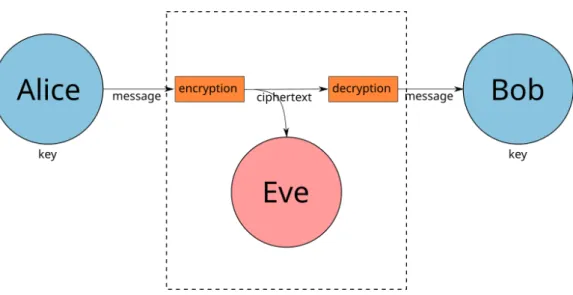
Symmetric-key encryption, or sometimes called private-key encryption or also just encryption, is used to encrypt data via an encryption scheme that allows data to be encrypted and decrypted generally with the same key. It is often used to protect an information that is later retrieved by the same person for example disk encryption where it isn’t required to share a key with anybody. If the data is intended to be shared with somebody else the key needs to be shared over a secure channel. Figure 1.2 shows a typical setup of a communication between two parties, Alice and Bob. Both have the same key in memory and hence they can access the message. An attacker, Eve, who is eavesdropping on the conversation between Alice and Bob can’t read the message because they don’t have access to the key used by Alice to en-crypt the message.
Figure 1.2: Private encryption scheme: Alice sends an encrypted message to Bob. Both parties use the same encryption key. Eve is some third party who only sees the ciphertext, they know the algorithm used for encryption and decryption but do not have access to the key and hence not to the message.
• Stream cipher. This type of cipher encrypts each input bit individually by adding a bit from a key stream to the plaintext bit[6]. An example for this type of cipher is the Vigenère Cipher or also called substitution cipher, which works on the same principles as the Caesar’s cipher, substituting letters but in a more secure way.
• Block cipher. Block ciphers on the other hand take a chunk, a block of the plaintext bits, and encrypted it with the key. This implies that the encryption of any plaintext bit depends on every other plaintext bit in the same block[6]. Advanced encryption standard (AES) uses for example a block length of 128 bits.
1.2 Public-key cryptography
Public-key cryptography is quite different from symmetric-key cryptogra-phy explained in the previous section. It’s based on mathematical primitives which allow to generate two different keys. The first key, called public-key, is used to encrypt and the second key is used to decrypt data or a message. The public-key can be published without any restriction, also to an attacker. A widespread knowledge of the public-key can improve the overall security. This implies that no secure channel is needed to distribute any shared-secret, because there is none. The private-key is the secret part of the system and must be kept secure and shouldn’t be shared with anybody.
Public-key ciphers are often used directly to allow different parties to com-municate securely, but they can also be used to establish a secure communi-cation channel so that a secret key can be shared, which has the advantage that it enables the possibility to use symmetric-key encryption that operate generally faster than this type of encryption.
Public-key cryptography isn’t limited just to encrypting data, it is a pri-mary ingredient to assure confidentiality, authenticity and non-repudiation in modern cryptography. It is used for many applications including identity validation, document signing and user authentication.
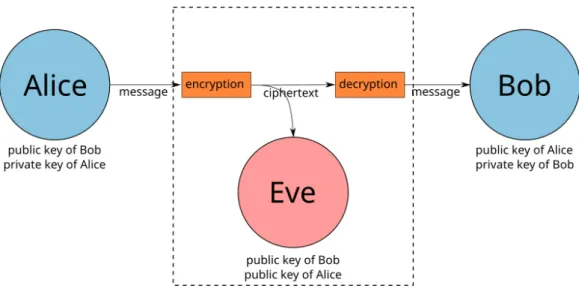
Figure 1.3 shows an example of a secure message exchange between Alice and Bob. Alice and Bob exchange their public key via some key exchange protocol, obviously they don’t communicate the private part. Then Alice encrypts a message for Bob using Bob’s public-key and sends it to them. Bob decrypts the obtained message via their private-key. An attacker Eve eavesdrops on the communication channel and obtains the public-key of Alice and Bob as well as the ciphertext. Eve can’t decrypt the sent message be-cause they would need the private-key it was encrypted for, but the attacker could encrypt their own message for Bob using the public-key they know. This system makes the content completely unreadable to an adversary, but it doesn’t guarantee the authenticity of the sender. Public-key cryptography can be used to solve this problem as well.
Figure 1.3: Public encryption scheme: Alice sends an encrypted message to Bob. The parties have already exchanged their public keys. Alice encrypts a message for Bob and sends it. Eve is some third party who obtains the ciphertext of the message and the public keys of Alice and Bob. Eve knows the algorithm used for encryption and decryption but since they don’t have access to the private key, they can’t decrypt the intercepted ciphertext. The attacker could encrypt their own message for Bob and send it.
1.2.1 The RSA cryptosystem
RSA is the one of the first cryptosystems realized to use the full potential of public-key cryptography. The name RSA comes from the initials of the creators Ronald Rivest, Adi Shamir and Leonard Adleman[6]. The system was created in 1977 and is today one of the most used cryptosystems. The main use cases for RSA are[6]:
• Data encryption. RSA is generally used only for small data sizes be-cause it’s much slower than symmetric-key encryption, for example it’s used for key transportation.
• Digital signatures. Systems which allow a recipient of a digital message or document to verify the authenticity of the data.
RSA is built on the mathematical problem of integer factorization. It is computationally easy to multiply two prime numbers, and it could also be done by hand on paper. But it is extremely hard to factorize the result and find the two prime numbers. This type of function is called one-way function because it’s easy to calculate in one direction but it’s extremely hard to reverse.
1.2.2 Elliptic Curve Cryptosystem
Elliptic curve cryptosystems (ECC) are the newest type of systems to create a public-key cryptosystem. Even though this approach exists since the 1980’s, it’s just lately that it got much more attention and interest. It offers significant advantages to other public-key cryptosystems. Elliptic Curve Cryptography provides the same level of security as RSA but with much shorter key length, which can significantly improve efficiency and re-duce network traffic overhead.
RSA is constructed based on the difficulty of factoring prime numbers, on the other side elliptic curve cryptography is based on the difficulty of solving the
elliptic curve discrete logarithm problem[7]. The elliptic curve discrete loga-rithm problem is basically the problem of determining the number of steps needed to move from one point on a elliptic curve to a different point[7]. Even if the the equation for the curve and the start point is known, it’s impossible to determine the number of hopes that were made between the start point and another point on the same curve[7].
Elliptic Curve Discrete Logarithm Problem. Given two points P and Q where Q is a multiple of P. Find k such that Q=kP.
The security of ECC is built on top of the difficulty of solving the above problem[7].
To better understand the ”hopping” on a curve let’s look at some
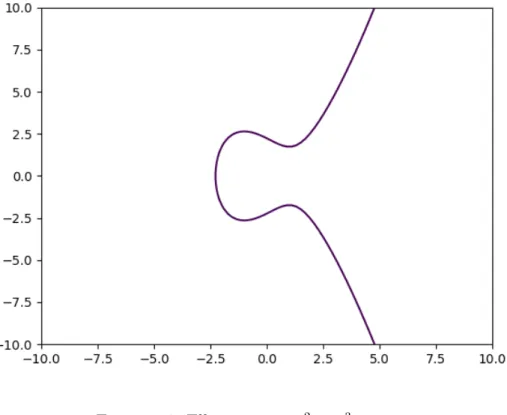
char-Figure 1.4: Elliptic curve y2 =x3−3x+ 5
plane algebraic curve in the form of y2 = x3 +ax+b, where x and y are
the standard variables used like in any other algebraic function to represent points on a Cartesian coordinate plane. The coefficient valuesaand b trans-form the elliptic curve and define its specific appearance. An elliptic curve is symmetric in respect to the x-axis, and any non-vertical line intersects the curve in at most 3 points[7].
Figure 1.4 shows an elliptic curve on a Cartesian coordinate plane with the coefficient values a=−3and b= 5.
Elliptic curve cryptography uses essentially two operations for hopping be-tween points on an elliptic curve in order to find values used for encryption[7]:
Figure 1.5: Example of Point Addition[7]
• Point Addition. This is an operation that allows to derive a new point starting from another point on an elliptic curve. Given two points P
andQ, a third point is created by drawing a line that goes through the pointsP and Q, as shown in figure 1.5. This results in a newly formed point at the intersection between the line and the elliptic curve, that is called−R [7]. Since an elliptic curve is symmetric to the x-axis, this also creates a point R, also shown in figure 1.5. By finding the point
This progress then can be repeated by drawing a line crossing P and
R which creates another point on the curve and finally by drawing a vertical line at this point a new point is found that is the sum between
P and R[7].
• Point Doubling. This is another operation used in ECC. It works sim-ilar to Point Addition but instead of adding two points, the point P is added to itself[7]. Instead of drawing a line crossing two points, a tan-gent line to the pointP is drawn, as shown in figure 1.6. This line then intersects the elliptic curve at some point −R. Finally a vertical line through the point −R is created and the intersection with the elliptic curve gives the point R, hence 2P =R [7].
Figure 1.6: Example of Point Doubling[7]
In addition to Point Addition and Point Doubling, ECC also uses the concept of finite field[7]. It isn’t possible to include every possible point found on an elliptic curve, therefore, the set of valid points is limited by a point calledp. The point p represents the key size and by increasing it’s value the security of the system can be increased[7].
1.3 Threshold Cryptosystems
A Threshold cryptosystem is a system that allows to encrypt an infor-mation with a public key. The private key is then distributed among all the participating entities, and no entity should be able to access the decryption key and therefore be able to obtain the original information (or any part of it) without the agreement of at least a predefined number of parties. In a system that hasnparties and uses t as a threshold, the minimum number of parties that have to give consent, is called (t, n)-threshold. In a similar way it’s also possible to create a signature scheme which requires multiple parties to sign a document. Many different public-key encryption schemes can be used to create a threshold cryptosystem.
1.3.1 Secret Sharing
Informally, secret sharing is any process that allows to split a secret into shares and to distribute the shares among a group of individuals called shareholders[8]. Such a system requires also that no single individual can retrieve the information without at least some number of other shares, this means that each share doesn’t expose any information about the shared se-cret.
Generally the objective is to create (t, n)-threshold scheme, where a secret S
is divided intonshares and given to nshareholders, so that the knowledge of at least t shares is needed to make the secret S easily retrievable, but fewer than t shares expose no information at all about S.
Secret sharing is useful for managing and securing cryptographic keys. It is simple to protect data by encrypting it, but for protecting encryption keys different systems are required. Secret sharing schemes try to address this issue. They are systems that are more resilient to data loss and more secure against security breaches because they distribute the secret over multiple individuals[9]. This implies that also its control is shared among more enti-ties, hence making it more difficult for attackers to obtain the shared secret
because they need to obtain many different pieces from different parties.
Figure 1.7: Safe deposit box. A(2,2)-threshold scheme
An example of secret sharing is a safe deposit box in a bank. Normally they use two separate keys and both keys are needed to open the deposit box. One key is given to the client and the other one is kept by the bank manager. This way none of the two parties can access the content by themselves, thus both are required to open the box. This example creates a (2,2)-threshold scheme, since it requires the two shares of both individuals to access the secret, in this case the deposit box.
Example of insecure secret sharing
Let the following system be a (4,4)-threshold scheme. The secret is S = ”somesecuresecret”. The secretSis split in four equal parts and distributed to the four individuals as shown in table 1.1.
This system is faulty because each individual already knows one-fourth of the secret S. But a secure secret sharing scheme requires that no party can gain any knowledge about the secret without overcoming the threshold, in this case all four individuals are required.
The table 1.2 shows how much knowledge is gained based on the number of shares obtained. The third column shows the number of possible values an attacker would need to guess to retrieve the secret S. The objective in
S some secu rese cret
s1 some
s2 secu
s3 rese
s4 cret
Table 1.1: Faulty Secret Sharing: pieces of each individual shares missing letters possible values
0 16 2616
1 12 2612
2 8 268
3 4 264
4 0 260
Table 1.2: Faulty Secret Sharing: knowledge about the secret based on the number of shares[8]
a secret sharing scheme is that even when t−1 shares are known it’s still impossible to know anything about the secret itself. In this example the desired outcome would be that with t−1shares the possible values are still
2616, but already with only two shares the number of unknown values is cut in half.
Trivial secret sharing
There are three types of secret sharing:
(t, n)-threshold scheme with t = 1 In the most trivial system of secret sharing, the secret can be shared directly among all parties, since every individual can access the secret without any consent from other parties.
(t, n)-threshold scheme with t = n There are many different schemes which allow to share a secret among n individuals where every share is
re-quired to retrieve the secret. Two examples of this type of systems are[8]: • The secret is encoded as an integerS. Let’s give to each participant i,
out of the n participants, a random number ri, excluding one
partici-pantk. Let’s give to the shareholderk, who has not received any share so far, the number calculated by this formula(S−r1−r2−...−rn−1).
To obtain the secret S it’s simply a matter of summing up the shares of all shareholders.
• The secret is encoded as a byteS. Each shareholderi, excluding share-holderk, obtains a random byte bi. The shareholder k receives the
re-sulting byte of(S⊕r1⊕r2⊕...⊕ri), where the ⊕is the bitwise XOR.
To retrieve the secret S a bitwise XOR of all shares is calculated.
(t, n)-threshold scheme with 1 < t < n This type of secret sharing is more complex than the other two, since the objective is to create a system that is secure but it doesn’t require all shares to retrieve the secret. Also, this kind of system can’t release any information at all about the secret without reaching the number of shareholders to overcome the threshold, otherwise it wouldn’t be secure.
Consider a secret of a company that is shared among the members of the board of directors. The business doesn’t want that one individual has full power over the company’s secret, but it would also be unwise to require all shareholders to access the secret, because some of them could be unable to access (for example if they die) and therefore it would be impossible to access the secret ever again. A possible solution would be a (n
2, n)-threshold scheme
where a majority is required to gain access to the secret.
It is possible to create this kind of scheme based on a (t, t)-threshold, like one of the above examples. The (t, t)-threshold scheme is usedntimes thent
shares are distributed to each individual[8]. Since each individual is required to store multiple shares this solution isn’t space efficient and there are better solutions for this problem.
The parameters t and n
The choices of the thresholdt does heavily depend on the application as well as the number of individualsn. A secret sharing scheme is appropriate to be used in a situation where a group of mutually suspicious individuals with conflicting interests are required to cooperate[8]. This setting still needs a sufficient large majority to be able to perform an action or access the secret, but on the other hand it also requires to have a sufficient large minority that could block an action or deny access to the secret. The choice over different thresholds comes with a couple of trade-offs. By increasing the thresholdtfor a given number n of individuals it reduces the availability of the secret, the access to the shared information, but on the other side it also increases the secrecy of the shared information. The secrecy can be defined by the number of shareholders that an attacker is required to convince or compromise to give up their shares to gain access to the secret. The integrity of the scheme is set by the number of parties an attacker needs to corrupt at least to modify or change the secret, it’s calculated by n−t+ 1. Therefore, the selection of the threshold must be adjusted for different use cases as well as for different situations.
1.3.2 Shamir’s Secret Sharing
Shamir’s Secret Sharing is an efficient way to share a secret and imple-ments a (k,n)-threshold scheme. The objective is to split some data S into
n pieces S1, ...Sn so that it satisfies the following requirements[9]:
• the knowledge of any k or moreSi slices turns S easily computable.
• the knowledge of any k−1 or fewer Si slices leaves S completely
un-determined, which means that all possible values for a secret have the same probability to be the real dataS.
would also be possible to use any other collection of functions that allows an easy evaluation and interpolation.
Theorem 1 (Interpolation). Given k distinct points x1, ..., xk and the
cor-responding values y1, ..., yk, there exists a unique polynomial q(x) of de-gree k − 1 such that q(xi) = yi and consequently interpolates the data
(x1, y1), ...,(xk, yk)[9][10].
A random k − 1 degree polynomial is created in the form of q(x) =
a0 +a1x+ ...+ak−1xk−1 where a0 is set to S encoded as an integer, so
a0 = S. Without losing generality it’s possible to assume that every data
S can be represented as a number. To obtain a share for each shareholder
S1 =q(1), ..., Si =q(i), ..., Sn =q(n) is calculated.
Provided any subset of size k of the valuesSi and their identifying indices i
it’s possible to find the coefficients ofq(x)by interpolation, hence gain access to the secret S by calculating S = q(0). The knowledge of less than k−1
share, at the contrary, doesn’t give enough information to calculateS. Shamir’s Secret Sharing scheme uses modular arithmetic instead of real arith-metic to make the calculation more precise. The system uses a set of integers modulo a prime number p, that is bigger than the integerS and n, this cre-ates a field where interpolation is possible. Then the coefficients a1, ..., ak−1
in q(x) are randomly selected from a uniform distribution over the integers in the set [0, p) as well as the values S1, ...Sn are retrieved modulop.
Assuming that an attacker gains access to k −1 shares, for every possible value S′ in [0, p) they could create one unique polynomial q′(x) of degree
k−1 such that q′(0) =S′ and q′(i) = Si for the available k−1 arguments.
By design allppossible polynomials have the same probability and therefore the opponent can’t deduce any information about the real secret[9].
There are efficient algorithms which interpolate a polynomial through n
points with complexity ofO(nlog2n)[11], but even with less efficient quadratic algorithms it would be acceptable fast to interpolate and to create a usable key management system[9]. In addition to its computational efficiency this type of system is also space efficient since no key is bigger in size then the
data S. Shares can’t be arbitrarily short, the prime number p needs to be bigger thann+ 1because the set[0, p)needs to contain at leastn+ 1distinct values to calculate q(x).
The following list summarizes some of the key features of the Secret Sharing scheme created by Shamir[9]:
• The size of each share doesn’t exceed the size of the original data, by splitting the data into smaller pieces the size of the shares could be reduced.
• As long ask is fixed the scheme allows easily to add and remove shares dynamically. To remove a share the shareholder is required to com-pletely give up the knowledge of the share.
• It’s possible to generate a new set of shares Si without changing the
original secret S. This can be done by creating a new polynomial
q(x), which can significantly increase the security because an attacker
would have to gain access to enough shares from the same generation to overcome the threshold in order to retrieve the secretS.
• A scheme created in this way has the ability to create a hierarchical structure by using tuples of shares where individuals with a higher power receive more shares and this way have more control over the secret. Imagine a board of directors of a company. The president gets three shares, the vice-president obtains two shares and other stake-holders get one share. By creating a(3, n)-threshold scheme the secret can be accessed by any three executives, by two executives when the vice-president is present, or the president by themselves.
1.4 End-to-end encryption
In online communication, end-to-end encryption is used to make sure that the conversation between two users can only be read by them[12]. Users can
be humans, but the same principles can be applied to machine communica-tion as well.
Generally, a public-key cryptosystem is put in place to share the keys between the parties and may also be used to encrypt the content. Some systems use a private-key cryptosystem to improve performance and use an asynchronous system to share the encryption keys which then are used by both entities. Communication systems which do not implement end-to-end encryption can be vulnerable to eavesdroppers. End-to-end encryption doesn’t protect only against outside attackers but makes it also impossible for anybody who doesn’t have access to the decryption keys to read the content. This re-duced significantly the required trust the user must give to the provider of the communication system because they have no way to access the content of the conversation. Of course, the keys need to be stored in a secure way and can’t be shared with third parties, which would impact significantly the security of the system. Many services that claim to fully encrypt messages send by users often use closed source implementations that are not possible to independently inspect and validate. Even worse they often store cryp-tographic keys on their server[12]. This puts the keys not only out of the hand of the user, but it also leaves the provider in full control over the keys, so anyone who compromised the security of the company would obtain the content of a conversation. Obviously if anybody would gain access to the keys used for the communication that entity could eavesdrop on the traffic. Furthermore, a well implemented e2e encryption system does obfuscate also the data from the internet service provider as well as from any server which forwards the communication to the receiving user.
Additionally, an end-to-end encryption system needs to provide a method to verify that the user receiving authorization (or the decryption keys) to read the message is actually the correct user. If there is no way to identify a user an attacker could still listen to the conversation by putting themselves in the middle of the traffic. The attacker would work as a relay who has two interaction points, one that talks to the real sender and another one that
forwards the messages to the real destination. The attacker would simply present themselves to be the receiver to the real sender and to be the sender to the receiver of the message. This form of intrusion is called man-in-the-middle attack.
End-to-end encryption still leaves the user unprotected from attacks that target directly the user’s computer, eventually the invader could capture the message before it wasn’t encrypted or when it was already decrypted. It could also be possible that an attacker steals the cryptographic keys from the user’s machine and this way get access to the conversation.
1.4.1 The Double Ratchet Algorithm
The Double Ratchet Algorithm is a key management algorithm that to-gether with other cryptographic protocols is used to provide end-to-end en-cryption for instant messaging. It was initially created for Signal, a fully encrypted instant messenger, by Trevor Perrin and Moxie Marlinspike in 2013[13]. Nowadays it’s used by many different platforms like WhatsApp[14], Wire[15], Matrix[16] and many more.
The algorithm is called double ratchet because it combines a cryptographic ratchet based on the Diffie–Hellman key exchange and a ratchet based on a key derivation function (KDF) for example a hash function. Diffie–Hellman key exchange is a secure protocol for exchanging cryptography keys over a public communication channel.
The Double Ratchet Algorithm uses, after the initial key exchange, short-lived session keys which are constantly renewed. The algorithm is said to be self-healing because in certain situations the protocol inhibits an attacker who has gained access to session keys from reading the cleartext of the conversa-tion after one message has passed the attacker without them compromising the message[17].
1.5 Hash function
A hash function is a one way function, a function that is easy to cal-culate in one direction but it’s basically impossible or infeasible to invert, which maps a string with an arbitrary length to a string, often called hash or digest, of fixed length. This type of functions have many use cases and applications because they allow to convert a string from any length into a hash with fixed length where the output doesn’t release any information about the input string. Hash functions are a cryptographic primitive used for digital signature, message authentication codes and for other forms of au-thentication. One of the most important features of a hash function is that they return always the same digit for the same input string, this property is used to proove the authenticity of data. It is often used in combination with public-key schemes which provide confidentiality of the message.
A simple and often used application of a hash function is to give a user the possibility to verify the integrity of a file or software downloaded from the Internet. The user calculates a hash value of the downloaded file on their own, and then they compare the generated value with the value obtained from the provider of the file.
To satisfy basic security requirements any cryptographic secure hash func-tion needs to have the following properties:
• Determinism. Provided the same input string to a hash function, it is required that the same output hash is generated.
• Quick computation. The calculation of a hash, starting from any input string, needs to be fast.
• Collision resistance. It is required that it is highly unlikely that two different input strings generate the same hash as output. In other words, it needs to be difficult to find two messages which have the same digest.
• Non invertibility. A digest can’t expose in any circumstances any in-formation about the original message which was used to generate the digest.
• Avalanche effect. Every change, also only of one character, of the input needs to create a completely different digest.
Over the past year cryptographers have created a number of different hash functions, some of them have already known weaknesses and others seem secure enough for now and nobody could find an attack to compromise their security. A few of the most used hash functions which are standardized are:
• MD5. It was developed in 1992 by Ronald Rivest. The MD5 algorithm is designed to be calculated quickly and it returns a 128-bit message digest. This algorithm is obsolete nowadays since it’s relatively easy to find hash collisions and therefore it shouldn’t be used anymore, at least not for security relevant applications.
• SHA-1 (Secure Hash Algorithm 1) SHA-1 was created by the NSA and standardized by the National Institute of Standards and Technology (NIST) in 1993. Shortly after it was redrawn and in 1995 the now used version was published. This algorithm produces a 160 bits long digest. In 2017 it was shown by Google with the so called SHAttered attack that it it’s possible to find two colliding messages that create the same digest, with a method which is significantly faster than a brute forcing a SHA-1 collision with a birthday attack[18].
• SHA-2 (Secure Hash Algorithm 2). SHA-2 was also created by the NSA. It has a similar internal structure to SHA-1. SHA-2 is divided into two distinct hash functions: SHA-256 and SHA-512. There exists a few other variants which are derived from the two mentioned functions. The number in the name represents the bit size of the output, e.g SHA-256 creates a SHA-256 bit message digest.
• SHA-3 (Secure Hash Algorithm 3). SHA-3 was standardized and pub-lished by NIST in 2015. The SHA-3 is part of a broader cryptografic hash function family called Keccak. All functions in this family use a sponge construction, different from the Merkle–Damgård construc-tion used by SHA-2, SHA-1 and MD5. And therefore, this family is resistant to the length extension attacks. Ethereum uses a slightly different version of SHA-3, called Keccak-256, which can create some confusion because the SHA-3 is sometimes used interchangeably with Keccak-256[19].
hash function message digest length M5 946c a9b0 fcc3 5f84 678a dc2d f85e 43e8 128 bit SHA-1 5e6c 2c9f 1116 ab3a 36bc e9c8 44ab 34b7 df3a a747 160 bit SHA2-256 34d7 9f3c 1113 ad6d 6550 ccdb b750 3670 9a22 9107
55ec 2f4a d09e c551 d49c 3cdf 256 bit
SHA2-512
636e c24d b100 9600 480e 6902 da98 c9d3 b7a1 f7ef 754f 9368 0d37 5504 5b4c e272 77a5 051c b60d 3e1b 5941 6978 cb10 5c7f d33b 3783 6487 d07f a590 23ae e32a ec91
512 bit
SHA3-512
267a 7f7b 73ee cdef 8ef2 04a5 53be 51c5 6c5b a5ab 4388 993d ba5c 6d3f 7ea5 e68e 047f 2902 bb85 831f f619 2020 9e96 bc0a d8c7 14bb ca3a 50d7 39f8 6ccc fa6b abf8
512 bit
Keccak-256 0326 0d84 f984 f392 6310 92b4 89a1 13f9 2424 e08d
8afe 1fa4 b159 f759 b452 b309 256bit Table 1.3: Comparison of message digest produced by different hash function for the same input string: ”lorumipsum”
Blockchain
The blockchain has many different definitions, depending on who you ask the question you can receive a different answer because there is so much in-terest from different areas in blockchain technology. The blockchain emerged together with its first implementation Bitcoin. Bitcoin was created in 2008 by an unknown person or group named Satoshi Nakamoto[20]. The main purpose of Bitcoin is to create a decentralized digital currency. While Bit-coin is a cryptocurrency, the underlying blockchain technology was used to create a wide range of different systems. This chapter will focus mostly on use cases beyond its application in finances, since that isn’t the scope of this thesis.
A blockchain is essentially a data structure that allows to store data in a non-structured manner. The information is distributed over a network of nodes. Records which store the user’s data are called transactions. A transaction is inserted into a logical group for organization named block[21].
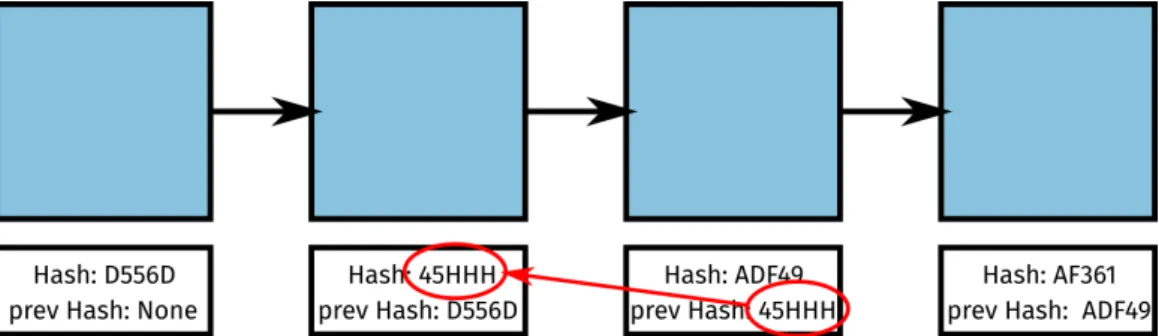
The name blockchain comes from how it operates: each block is linked to the previously created block, so in this way a single linked list or chain is created. Each block therefore requires a pointer to the previous block. Normally the pointer is a cryptographic hash of the former block. Each block can also contain more metadata, like the timestamp, but the full structure of a block depends on the specific design of the system.
The distributed nature of a blockchain also requires a distributed process to produce new blocks. Different blockchains have different ways to create them, and manage the flow of blocks’ validation differently. Some of the specific methods are discussed later in this chapter. Each newly produced block is attached to the end of the chain by incorporating the hash of the previous block. This obviously can produce two blocks at the same time be-cause usually there is no centralized authority, and when this happens a fork in the chain is introduced. The creator of a new block, typically, attaches it to the longest chain they know.
(a) A possible block structure in a blockchain
(b) A chain in a blockchain, the green block is the origin which doesn’t have any parent. The main chain is shown in darker blue, and the blocks in light blue are shorter chains, that have split off from the main one.
Figure 2.1: An example of a block and created chains in a blockchain.
• Immutability. Data added to the blockchain can’t be changed. Even though it could be done with a huge amount of computing power, it is considered nearly impossible to modify data, therefore the blockchain is considered immutable[21].
• Transparency. Most blockchain implementations are open source, which allows contributions by anyone and it makes the system publicly au-ditable. Any transaction stored in a block is public and can be re-viewed by every entity using the blockchain. This obviously reduces confidentiality and privacy, but many applications need to audit the flow of transactions in order to avoid the problem of double spending and other related problems.
• Distributed consensus. Blockchains use different mechanisms to reach an agreement among different nodes on how to create new blocks. Those methods are called distributed consensus. There are many differ-ent possible methods to create an agreemdiffer-ent between nodes. Therefore, no single node has control and makes decision, but multiple parties are required to agree to give the consensus.
• Security. The blockchain technology is built on the top of a proven cryptographic primitive, like for example hash functions, to ensure the integrity of the data. The immutable nature of the data allows everyone to verify the information, as well as it’s nearly impossible to manipulate the stored data.
• Smart contracts. Smart contracts are essentially code run on top of the blockchain. Not every blockchain implements smart contracts, but because of its versatility it’s a much-desired feature[21].
2.1 Centralized, decentralized and distributed
systems
There are three major topologies regarding how networks can be struc-tured. This chapter will explain the main properties and the differences between them.
First let’s define what a network is in the context of this work. A network is a system with several nodes that are in some way connected and can com-municate. Each node is one unit interacting with other nodes in the system. A node can be for example a physical device.
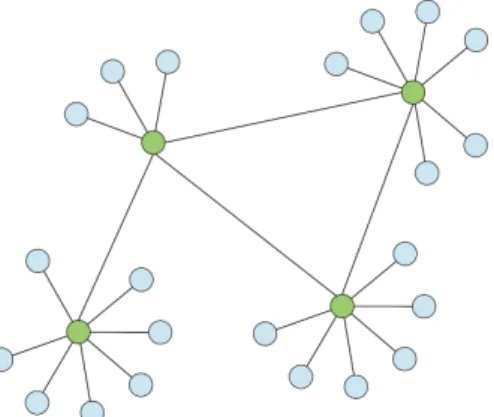
• Centralized system. Each node communicates exclusively with the cen-tral node, in figure 2.2 the green node is the cencen-tral point. It’s the simplest structure, because it doesn’t require any complex system for consent, or to resolve inconsistencies of the system’s states. This type is the most used system because of its simplicity.
Figure 2.2: A centralized system. Each circle is a node, while the green circle is the central server node. Every client node interacts only with the central node.
A centralized system is often referred to as a client-server system. Nor-mally the server provides a service, for example it can offer a webpage.
Each node, other than the server, is a client and it doesn’t interact with anybody other than the server. It’s still possible to allow commu-nication among multiple nodes but the traffic must always be relayed by the central node. Generally, all the data are stored on the central server, and users update the system’s memory or state via requests to the server.
Centralized systems give a great control over the data flow, as well as over the entire systems, since it has by design a central authority. The centralization also comes with downsides, the architecture is much more prone to system failures and it comes with many privacy issues. • Decentralized system. This type of system is quite different from a
centralized system. A decentralized system has multiple central points, shown as green circles in figure 2.3. This topology requires a more com-plicated process to keep the system consistent, since no single point has the full power over the network. Also, it needs sophisticated processes for consent and to establish an agreement between different nodes.
Figure 2.3: A decentralized system. There are multiple central nodes, shown as green circles. The blue circles are the client nodes.
The decentralized ownership and control is an advantage and it im-proves the resilience of the system as well as it makes it more difficult for an attacker to take over the entire network. Therefore, by design,
decentralized systems resist much better to system failures and attacks. Also, they increase the privacy of their users because no single entity is in power to read all the traffic on the network, at least not from a single point.
• Distributed System. A system is called distributed when a collection of independent nodes, generally computers, act autonomously to complete a task[22]. Normally a distributed system is intended to appear as a single unit to the user. To accomplish this, it uses complex methods to manage the system and to distribute tasks.
Figure 2.4: A distributed system
Ethereum and Matrix, used in this work, are both decentralized systems by design. They were built to remove the central entity and to give the owner-ship of the network to the people running and using the network. Ethereum, or in general blockchains, are distributed networks and this is explained in more detail in the section about smart contracts.
2.2
Merkle tree
Hash digits are used to provide integrity checks for transactions stored in a block. To make the calculation of hash digits and to allow fast verification of transactions, a blockchain uses a particular data structure called Merkle
tree. The Merkle tree was named after Ralph Merkle who patented it in 1979[23]. It’s a binary tree where every leaf node is labeled with the hash of the transaction data and all non-leaf nodes are labeled with the hash of the label of its immediate children. This layout allows to determine if a leaf node is part of a hash tree by calculating a few hashes proportional to the logarithm of the number of nodes in the tree[24]. In a blockchain it’s vital to verify the validity of a block or transaction, therefore the Merkle tree is used. Figure 2.5 shows a Merkle tree with four leaf nodes and the label of each node.
Figure 2.5: Merkle tree. A binary tree with four leaves and a depth of four. Highlighted in yellow are the labels of each node where L1, L2, L3, L4 are the hash of the transaction stored in the block. Each non-leaf node is labeled with the hash of the concatenation of the labels of its direct children[25].
2.3 Blocks
A node listens for new transactions and adds them to the list of transac-tions to be inserted in a new block. Every node in the system can generate new blocks. A blockchain is a distributed system and consequently there isn’t any central authority to control when a block is created and who can create it. Evidently, it’s not possible to just randomly create new blocks without the agreement of other nodes. Therefore, a blockchain puts in place different methods for creating new blocks. This process allows autonomous nodes to agree on something in a distributed manner. In other words, there are different consensus mechanisms to select a new block. Some of the con-sensus mechanisms are reported later in this chapter.
A newly created block contains the cryptographic hash of the previous block
Figure 2.6: A sequence of blocks building a chain. Each block has a reference of the previous block via the cryptographic hash. The block on the far left has no previous block, hence it’s the first block ever created.
(shown in figure 2.6), as well as the transactions the node decided to include into the block, hence the transaction needs to exist before the new block is started to be created. By appending new blocks to the chain, a single linked list is formed, where the hash is the link. Because the system is distributed, more than one block can be produced at the same time by different nodes. When this happens the chain is forked, that means that it is divided into two chains. In this way a tree-like structure, shown in figure 2.1, is formed. Other nodes then usually continue attaching new blocks to the longest chain.
Naturally blocks of shorter chains are dropped at some point and the trans-actions stored in those blocks are lost if not included in other blocks.
If the system becomes out-of-sync it could also be possible that some nodes continue generating blocks for a different chain, and at some later point they overwrite the previous predominant chain. By quickly generating new blocks it’s possible to obtain the same effect and in this way manipulate data stored in the blockchain. This from of attack is mitigated by slowing down the block creation as well as making block generation as expensive as possible (computational and economically) via the consensus mechanisms.
2.3.1 Consensus mechanisms
The problem that a consensus mechanism tries to solve was formalized long before the emerging of the first blockchain. And it was researched in the context of distributed computing. To better visualize the issue a thought experiment was created: The Byzantine Generals problem [26]. The prob-lem consists of a group of army generals who command different parts of the Byzantine army. The generals need to agree on whether to attack a city or to retreat, since in order to conquer the city and to win the war the full power of the Byzantine army is needed. The only method the commanders can use to communicate is a messenger. Unfortunately, some of the generals can be traitors and send intentional misleading messages to other generals[21].
Let’s consider for an example three generals, shown in figure 2.7. Each general is in control of one third of the Byzantine army. The generals are divided into a Commander and two Lieutenant, they all are equal and have the same power, but the Commander sends the first message. In figure 2.7a the ”Lieutenant 2” has a malicious intent, therefore they invert the message they get from the ”Commander”. In this way the ”Lieutenant 1” doesn’t know if they should attack the city or retreat. In figure 2.7b the commander themself is the traitor and communicates two different messages to the other two generals and thus ”Lieutenant 2” sends a different message
(a) The Lieutenant 2, in red, is a traitor.
(b) The Commander, in red, is a traitor.
Figure 2.7: Byzantine Generals problem. The Commander sends the first message to the Lieutenants and then Lieutenant 2 forwards the message to the other Lieutenant.
to the ”Lieutenant 1”. Again ”Lieutenant 1” is confused because they get two contradicting messages.
In this thought experiment it’s only possible to gain an agreement between the generals if more than one third of the generals are trustworthy, therefore in the above example one traitor is enough to disrupt the entire system. Thanks to modern cryptography it’s possible to build systems that perform much better. Protocols that sign messages can obtain a consent even when more than one third of the participants are traitors.
The Byzantine General Problem can be seen as an analogy to a distributed system like the blockchain. Each general is a node and the messenger are a communication channel between the nodes.
A consensus mechanism is a protocol executed by every node, or most nodes, in the network to create an agreement on some decision. Blockchains can use different consensus mechanisms to create new blocks. The most dominated processes are Proof of Work and Proof of Stake.
Figure 2.8: Proof of Work vs Proof of Stake [27]
Proof of Work
Proof of Work relies on the proof that enough computational resources were used to obtain the proposed value. This type of consensus mechanism is used in many cryptocurrencies and it’s the most used mechanism for the validation of a block. In a blockchain network, different nodes compete to solve a mathematical puzzle.
This process is called mining and the actors doing the heavy computation are called miners. The first miner to solve the mathematical problem distributes their block to the rest of the network and hence they confirm all transac-tions present in the new block. The miner who created the block receives a compensation generally in two different forms, via transaction fees paid by the initiator of the transaction, and depending on the blockchain, also some currency. In Bitcoin for example they receive a specific amount of bitcoins, and this amount is constantly reduced based on the number of blocks gener-ated overall. Therefore, at some point in the future miners will only receive the transaction fees. The difficulty of the puzzle is adjusted to the overall performance of the network to stabilize the time passing between each newly created block. This consensus mechanism has a couple of downsides. If an attacker owns more the 50% of the computing power of the system, they can insert a malicious block[27]. Once a block is found by a miner all other
miner’s effort to solve the puzzle is lost. Therefore, miners often combine their computing power into mining pools to try to solve the problem to-gether faster than others. This can significantly reduce the decentralization of the network.
Since solving a puzzle is computationally very expensive, the calculation
Figure 2.9: Energy consumption of the bitcoin network by country[28] requires huge amounts of electricity to run the infrastructure. The bitcoin network consumes 77.78 TWh in one year, which is as much electricity as the entire country of Chile uses in one year[28]. A single transaction consumes more electricity than an average household in the US in about 23.45 days[28]. If the network would be a country it would place itself as the 38th biggest energy consumer in the world.
Proof of Stake
Because of the high energy consumption of Proof of Work researchers invested a lot of time to create a different consensus mechanism that doesn’t
Figure 2.10
![Figure 1.1: The frequency of each letter in the English language[5]](https://thumb-us.123doks.com/thumbv2/123dok_us/422975.2548580/23.892.156.737.389.700/figure-frequency-letter-english-language.webp)

![Figure 1.6: Example of Point Doubling[7]](https://thumb-us.123doks.com/thumbv2/123dok_us/422975.2548580/30.892.263.592.553.847/figure-example-of-point-doubling.webp)