THE RELATIONSHIP BETWEEN eCRM IMPLEMENTATION AND
E-LOYALTY AT DIFFERENT ADOPTION STAGES OF TRANSACTION
CYCLE: A CONCEPTUAL FRAMEWORK AND HYPOTHESIS
Talhat Alhaiou, Information System Evaluation and Integration Network Group (ISEing)
Brunel Business School, Brunel University, UK. [email protected]
Zahir Irani, Information Systems Evaluation, and Integration Network Group (ISEing)
Business School, Brunel University, UK. [email protected]
Maged Ali, Information System Evaluation, and Integration Network Group (ISEing)
Brunel Business School, Brunel University, UK. [email protected]
Abstract
The purpose of this paper is to propose a model for the relationship between eCRM and E-loyalty by conceptualizing that e-loyalty is influenced by e-satisfaction, e-trust, and multi-dimensional aspects of eCRM. In order to capture the full picture for this relationship, we attempt to cover the complete purchase experience by focusing on transaction cycle (Pre-Purchase, A-Purchase, and Post-Purchase).different Components of eCRM have differing effects on e-loyalty. This study strengthens the literature by adding different components of eCRM as a possible critical antecedent in the model of e-loyalty development and attempts to build a stronger holistic model by including eCRM features. Keywords: eCRM, Transaction Cycle, E-satisfaction, E-trust, E-loyalty
1 INTRODUCTION
The shift from a product-focused business strategy to a customer-focused one has been a major transformation agent in companies recently. Many companies have invested heavily in technologies enabling a customer-focused relationship marketing strategy. Nowadays, customers are more demanding more knowledgeable, and require more attention. Increasingly, firms are shifting their focus to the customer, thus the rising importance of customer relationship management (CRM). Customer relationship management (CRM) is a comprehensive business and marketing strategy that integrate technology, process, and all business activities around the customer (Anton, 1996; Anton & Hoeck, 2002). With the rapid growth of electronic business and rise of Internet-based services, the internet has provided a platform to deliver CRM functions on the Web; hence, a new concept is born: eCRM (Electronic customer relationship management). eCRM emerges from the Internet and web technology to facilitate the implementation of CRM; it focuses on Internet- or web-based interaction between companies and their customers. Rosenbaum & Huang (2002) argue that the main driver for eCRM adoption seems to be a commonly shared belief that it improves customer loyalty and retention through the enhancement of customer satisfaction, as customer satisfaction is one of the more immediate objectives of eCRM. Researchers and practitioners alike are claiming positive effects of
eCRM on customer Satisfaction, survey conducted by InfoWorld suggests that 77 % of eCRM projects fail to meet company goals (Apicella, 2001), Feinberg & Kadam (2002) survey suggests that eCRM failure may be due to the implementation of features that executives believe affect customer satisfaction, but in reality do not have any effect at all. As organizations become increasingly customer focused and driven by customer demands, the need to meet customers’ expectations and retain their loyalty becomes more critical. Loyalty is not only based on the measures of consumer behaviour, but the positive attitude towards the company and the probability to recommend the product/service usage (the willingness to provide a favourable word of mouth (WOM)) are also the manifestation of this concept (Zieithaml et al., 1996).
The purpose of this study is to develop and validate a comprehensive model, which describes the relation between eCRM factors and E-loyalty at different adoption stages of transaction cycle (Pre-purchase, At-purchase and Post-purchase). The structure of this paper is divided into three sections. In section one the researcher has presented the introduction, in section two a discussion on eCRM factors and E-loyalty is presented. Last in section three, the research finalises with the conclusions and future research.
2 LITERATURE REVIEW AND HYPOTHESIS DEVELOPMENT
In this paper attention will be given mainly to online B2C transactions. This study begins by establishing a conceptual framework through a review of related literature. There are five topics of conceptualization considered in this section: Pre-purchase/eCRM factors, At-purchase/eCRM factors and Post-purchase/eCRM factors, customer e-satisfaction and e-loyalty. The conceptual framework development is thus founded on each reviewed literature theme.
2.1 eCRM features
Electronic customer relationship management (eCRM) is the latest technique companies are using to increase and enhance their marketing skills and capabilities. Integrating both technological and marketing elements, eCRM covers all aspects of the customer’s online experience throughout the entire transaction cycle (Pre-purchase, At-purchase and Post-purchase). Jutla et al (2001) describe eCRM as the customer relationship care component of e-business. Greenberg (2000) suggests that eCRM is CRM online. According to Romano and Fjermestad (2001), eCRM is concerned with attracting and keeping economically valuable customers and eliminating less profitable ones. Rosen (2001) suggests that eCRM is about people, processes, and technology, by Romano and Fjermestad (2003) there are five major non-mutually-exclusives eCRM research areas: eCRM markets; eCRM business models; eCRM knowledge management; eCRM technology and eCRM human factors, and each major area is composed of minor ones. In the context of e-commerce, Sterne (1996) proposes a framework to characterize online customer experience, consisting of three stages: pre-sale, sale, and after-sale interactions. Lu (2003) uses this framework to study the effects of ecommerce functionality on satisfaction, demonstrating that eCRM features contribute differently to the satisfaction associated with each transaction stage. Following the same line, Feinberg et al. (2002) map the eCRM features of retail websites into the pre-sale, sale, and post-sale stages in investigating the relationship between eCRM and satisfaction. The usage of the transaction cycle framework to classify satisfaction is also supported by Khalifa and Shen (2005), who investigate the relative contribution of pre-sale, sale, and post-sale satisfaction to the formation of overall satisfaction.
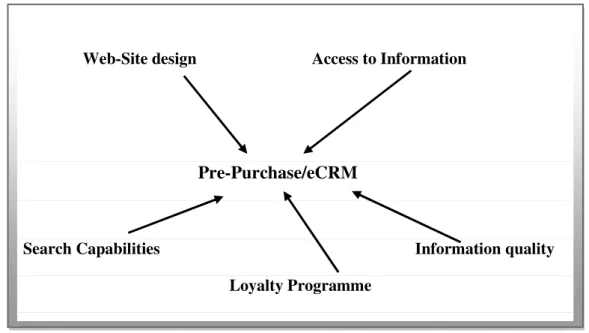
The purchase decision-making process involves problem recognition, information search, alternative evaluation, product choice, and actual purchasing behaviour, and can be divided into pre-purchase, At-purchase, and post-purchase stages (Solomon, 2004). The idea about pre-purchase satisfaction appears to be generally well supported in the literature, which views Pre-purchase satisfaction as a logical antecedent to purchase, since without the positive feelings towards buying some products for the first time, probably no purchase would be made. Therefore, anticipation can give rise to pre-purchase feelings that can drive pre-purchase behaviour. Following comprehensive literature such as Khalifa and Shen (2005), Cheung and Lee (2005), Pre-Purchase/eCRM features can be divided into five elements: (a) Web-Site Presentation that refers of pictures, images, and information well presented on the website; (b) Access to Information which indicates How it is easy for a customer to find information about the products, prices and services,(c) Search capabilities which allow customer to specify multiple criteria for quickly retrieving the desired information; (d) information quality which refer to the accuracy , the content and the update of the information on the website ;and (e) loyalty programme . Figure 1 below presents the construct of Pre-purchase/eCRM features.
Figure 1. Pre-purchase/eCRM constructs (Developed by the Author)
Oliver (1981) argues that the level of satisfaction in the pre-purchase stage will have an impact on consumers’ subsequent buying behaviours and satisfaction toward product utilization. Further, Gardial et al (1994) suggests that Consumers’ thoughts and evaluative criteria in the pre-purchase stage differ from those in the post-purchase stage. Woodruff et al (1982) have suggested that consumers can anticipate the satisfaction that they will receive from a planned purchase and that both satisfaction beliefs (i.e. cognitive evaluations) and feelings (i.e. emotions) can be expected.
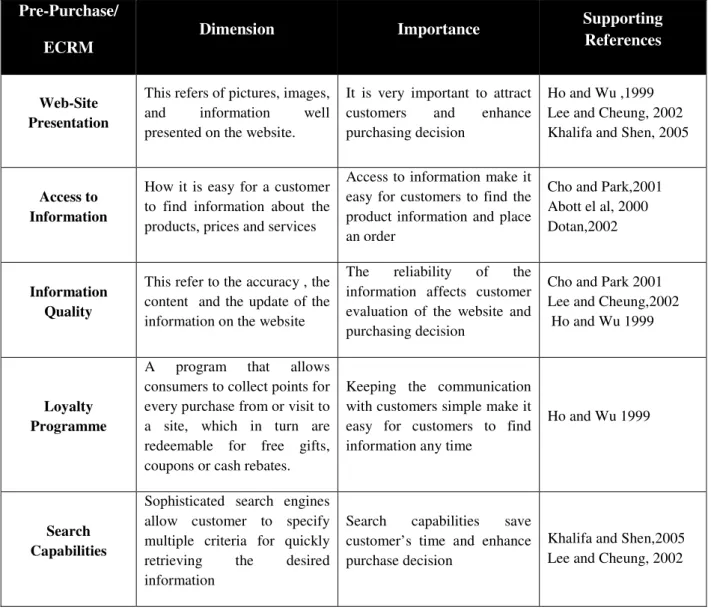
The above discussion, which is translated into Figure 1, is important because a satisfied pre-purchase process may lead to positive purchase intention and post-purchase satisfaction. Table 1 below presents the description of Pre-Purchase / eCRM features.
Web-Site design Access to Information
Pre-Purchase/eCRM
Search Capabilities Information quality
Loyalty Programme
Pre-Purchase/ ECRM
Dimension Importance Supporting
References
Web-Site Presentation
This refers of pictures, images,
and information well
presented on the website.
It is very important to attract
customers and enhance
purchasing decision
Ho and Wu ,1999 Lee and Cheung, 2002 Khalifa and Shen, 2005
Access to Information
How it is easy for a customer to find information about the products, prices and services
Access to information make it easy for customers to find the product information and place an order
Cho and Park,2001 Abott el al, 2000 Dotan,2002
Information Quality
This refer to the accuracy , the content and the update of the information on the website
The reliability of the information affects customer evaluation of the website and purchasing decision
Cho and Park 2001 Lee and Cheung,2002 Ho and Wu 1999
Loyalty Programme
A program that allows
consumers to collect points for every purchase from or visit to a site, which in turn are redeemable for free gifts, coupons or cash rebates.
Keeping the communication with customers simple make it easy for customers to find information any time
Ho and Wu 1999
Search Capabilities
Sophisticated search engines allow customer to specify multiple criteria for quickly
retrieving the desired
information
Search capabilities save customer’s time and enhance purchase decision
Khalifa and Shen,2005 Lee and Cheung, 2002
Table 1. Dimensions of the Pre-purchase /eCRM
In line with the previous argument and for the purpose of this paper the author states the following hypothesis:
H1: Site Design will have a positive effect on E-Satisfaction
H2: Search Capabilities will have a positive effect on E-Satisfaction
H3: Loyalty Programme will have a positive effect on E-Satisfaction
2.1.2 At-purchase /eCRM Constructs
Pacheco (1989) suggests that an effective customer satisfaction system provides management with early warning signals, which enable the avoidance of loss of market share. Following comprehensive literature such as Kailua and Liu (2007), Cheung and Lee (2005), At-Purchase/eCRM features can be divided into five elements: Payment methods, privacy, and security, promotions, ordering tracing and dynamic pricing. Figure 2 below presents the construct of At-purchase/eCRM features.
Figure 2. At-purchase/eCRM constructs (Developed by the)
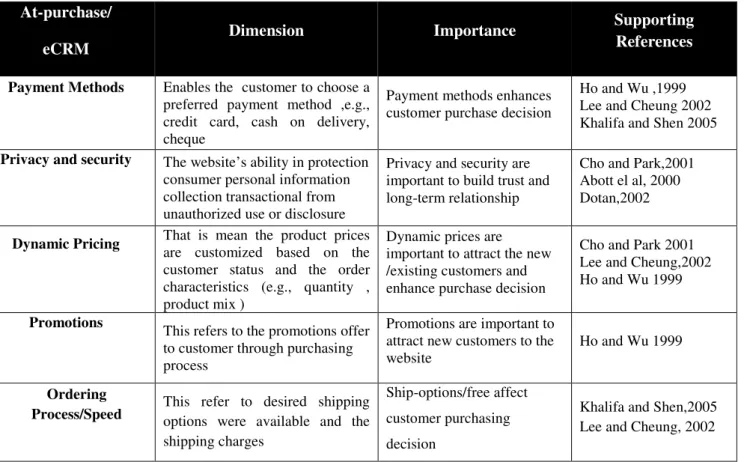
Table 2 below presents the description of At-Purchase/eCRM features (Payment Methods, Privacy and security, Dynamic Pricing, Promotions, and Ordering Process/Speed).
Table 2: Dimensions of At-purchase/ eCRM At-purchase/
eCRM
Dimension Importance Supporting
References
Payment Methods Enables the customer to choose a preferred payment method ,e.g., credit card, cash on delivery, cheque
Payment methods enhances customer purchase decision
Ho and Wu ,1999 Lee and Cheung 2002 Khalifa and Shen 2005
Privacy and security The website’s ability in protection consumer personal information collection transactional from unauthorized use or disclosure
Privacy and security are important to build trust and long-term relationship
Cho and Park,2001 Abott el al, 2000 Dotan,2002
Dynamic Pricing That is mean the product prices are customized based on the customer status and the order characteristics (e.g., quantity , product mix )
Dynamic prices are important to attract the new /existing customers and enhance purchase decision
Cho and Park 2001 Lee and Cheung,2002 Ho and Wu 1999
Promotions
This refers to the promotions offer to customer through purchasing process
Promotions are important to attract new customers to the website
Ho and Wu 1999
Ordering
Process/Speed This refer to desired shipping options were available and the shipping charges
Ship-options/free affect customer purchasing decision
Khalifa and Shen,2005 Lee and Cheung, 2002
Payment Methods Privacy and security
At-Purchase/eCRM
Dynamic Pricing Promotions Ordering Process/Speed
In line with the previous argument and for the purpose of this paper the author states the following hypothesis:
H4: Security/Privacy will have a positive effect on E-Satisfaction
H5: Payment Methods will have a positive effect on E-Satisfaction
2.1.3. Post-purchase/eCRM Construct
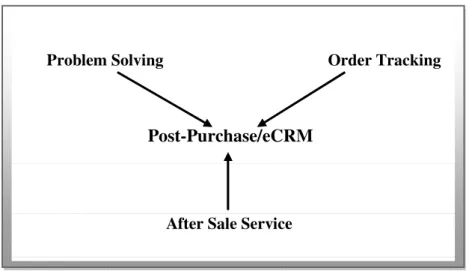
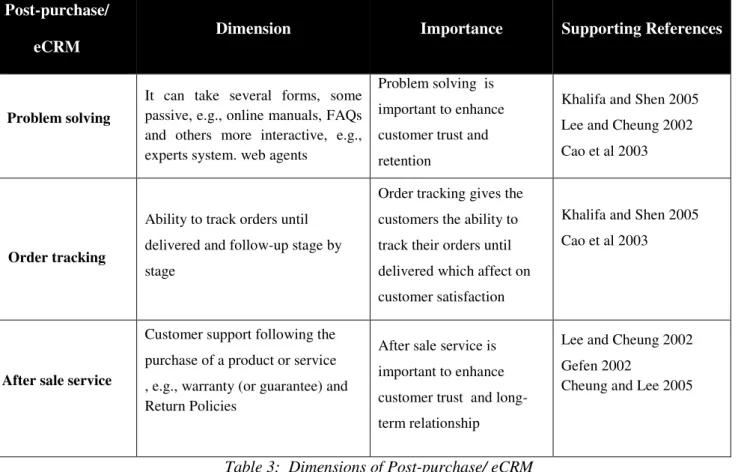
Gardia et al (1994) suggests that Consumers’ thoughts and evaluative criteria in the pre-purchase stage differ from those in the post-purchase stage. Bearden & Teel (1983) and Oliver & Swan (1989) argue that Customer satisfaction is mainly described as a post-purchase experience. Following comprehensive literature such as Khalifa and Liu (2005), Cheung and Lee (2005), Post-Purchase/eCRM features can be divided into three elements: Problem solving, order tracking and after sale service. Figure 3 below presents the construct of Post-purchase/eCRM features.
Figure 3.Post-puchase/eCRM constructs (Developed by the Author)
Table 3 below presents the description of Post-Purchase/eCRM Features (Problem Solving, Order Tracking, and after sale Service)
Problem Solving Order Tracking
Post-Purchase/eCRM
Post-purchase/ eCRM
Dimension Importance Supporting References
Problem solving
It can take several forms, some passive, e.g., online manuals, FAQs and others more interactive, e.g., experts system. web agents
Problem solving is important to enhance customer trust and retention
Khalifa and Shen 2005 Lee and Cheung 2002 Cao et al 2003
Order tracking
Ability to track orders until delivered and follow-up stage by stage
Order tracking gives the customers the ability to track their orders until delivered which affect on customer satisfaction
Khalifa and Shen 2005 Cao et al 2003
After sale service
Customer support following the purchase of a product or service , e.g., warranty (or guarantee) and Return Policies
After sale service is important to enhance customer trust and long-term relationship
Lee and Cheung 2002 Gefen 2002
Cheung and Lee 2005
Table 3: Dimensions of Post-purchase/ eCRM
In line with the previous argument and for the purpose of this paper the author states the following hypothesis:
H6: Order Tracking will have a positive effect on E-Satisfaction
H7: On- time Delivery will have a positive effect on E-Satisfaction
H8: Customer Service will have a positive effect on E-Satisfaction
2.2 E-trust and e-satisfaction as antecedents of e-loyalty
E-loyalty is widely defined as customer’s favourable attitude and commitment towards the online retailer that results in repeat purchase behaviour (Srinivasan et al., 2002). As a result, e-loyal customers bring increased profitability to the online retailer through long-time customer commitment and reduced costs of acquiring new customers (Reichheld et al., 2000). E-loyal customers are not the ones seeking the lowest prices, but the ones willing to pay premium prices. They also tend to refer new customers to the online retailer, providing rich potential sources of profit (Reichheld et al., 2000). Further, E-loyal customers purchase more than newly acquired customers and can be served with reduced operating costs (van Riel et al., 2001). Therefore, even though the cost of establishing online loyalty is larger than that of traditional brick-and-mortar retailers, profit growth accelerates at an even faster rate once the relationship has been built (Reichheld and Schefter, 2000). These previous findings point to the need for understanding how e-loyalty is developed.
In explaining the establishment of e-loyalty, both e-satisfaction and e-trust are found to play a central role. For example, studies discovered that e-satisfaction and e-trust influence e-loyalty either
individually, such as e-satisfaction → e-loyalty (Anderson and Srinivasan, 2003), and e-trust → e-loyalty (Sirdeshmukh et al., 2002), or in a sequential order, such as E-trust→ e-satisfaction → e-loyalty (Gummerus et al.,2004). Trust has been conceptualized as ‘‘customer confidence in the quality and reliability of the service offered’’ (Gabarino and Johnson, 1999) and has been presented as a central attribute in relationship initiation, formation and maintenance in a variety of exchange contexts (Sirdeshmukh et al., 2002). Previous studies suggest that trust has significant impact on the establishment of loyalty in both offline (Chaudhuri and Holbrook, 2001; Singh and Sirdeshmukh, 2000) and online (Park and Kim, 2003; Pitta et al., 2006). In the link with the previous argument, we state the following hypothesis:
H9: E-trust has a positive effect on e-loyalty.
In addition, we expect- trust to not only have a direct impact on e-loyalty but also to have an indirect influence through e-satisfaction. Trust is a critical antecedent of building relation- ships between buyer and seller (Sirdeshmukh et al., 2002; Verhoef et al.,2002). In any buyer–seller relationship, consumers’ trust evaluations before a specific exchange result is found to have a direct influence on their post purchase satisfaction (Singh and Sirdeshmukh, 2000). This relationship is deemed to hold true in online retailing contexts where trust maybe a fundamental component for initiating the transaction. Customers perceive a higher level of risk with online retailers than traditional retailers in terms of delivery, payment, information disclosure, etc. Thus, online customers may prefer to transact with online retailers they can trust (Singh and Sirdeshmukh, 2000). In previous studies, trust is empirically found to be a strong predictor of satisfaction in online settings (Gummerus et al., 2004; Harris and Goode, 2004). In line with the previous arguments, we propose that: H10: E-trust has a positive effect on e-satisfaction.
In addition, the relationship between e-satisfaction and e-loyalty has been found to be significant in several studies (Anderson and Srinivasan, 2003; Park and Kim, 2003; Rodgers et al., 2005). Thus, we propose: H11: E-satisfaction has a positive effect on e-loyalty
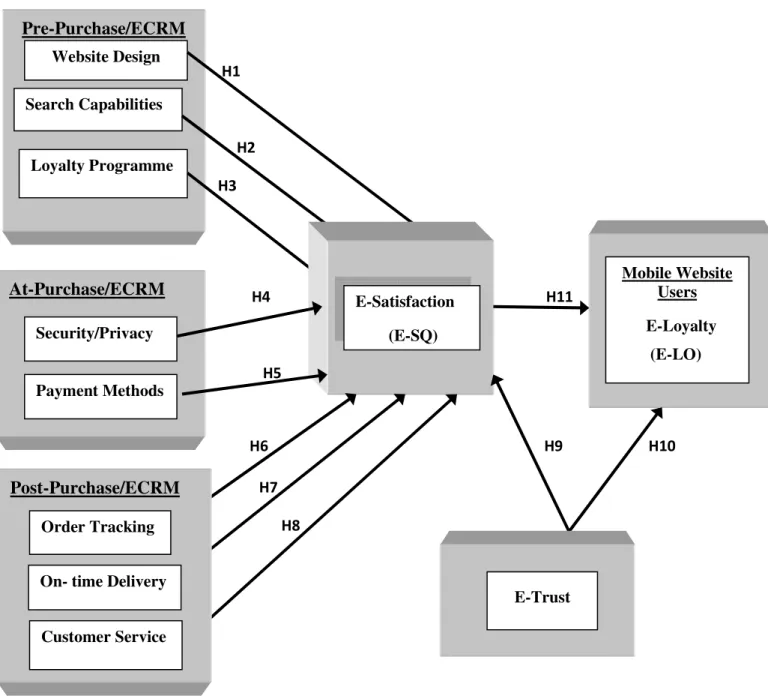
Based on the literature review, this paper identified eleven variables that relevant to the objective of this study. The independent variables (IV) for this study include Pre-Purchase/eCRM, At-Purchase/eCRM, Post Purchase/eCRM, and E-Trust, while the use e-satisfaction and e-loyalty are listed as the dependent variables (DV). . This paper proposes that Pre-Purchase/eCRM is constructed from three independent variables: Web-Site Design, Search Capabilities, and Loyalty Programme. On the other hand, Payment Methods, and Privacy/security are proposed as the independent variables of At-Purchase/eCRM, while Post-Purchase/eCRM is constructed from three independent variables: Order tracking, on time delivery and after sale service. These variables build up a Conceptual framework that is inline with the objectives of this paper. Figure 1 bellow illustrates a schematic diagram that represents the Conceptual framework of this study.
H1 H2 H3 H4 H11 H5 H6 H9 H10 H7 H8
Figure 4. A Conceptual Model and hypothesis
3. CONCLUSIONS
eCRM emerges from the Internet and web technology to facilitate the implementation of CRM; it focuses on Internet- or web-based interaction between companies and their customers. (Rosenbaum & Huang 2002) argue that the main driver for eCRM adoption seems to be a commonly shared belief that it improves customer loyalty and retention through the enhancement of customer satisfaction, as customer satisfaction is one of the more immediate objectives of eCRM. E-loyalty brings high rate of customer retention and reduced Cost for recruiting new customers that leads to long-term
Pre-Purchase/ECRM Website Design Search Capabilities Loyalty Programme Mobile Website Users E-Loyalty (E-LO) At-Purchase/ECRM Security/Privacy E-Satisfaction (E-SQ) Payment Methods Post-Purchase/ECRM Order Tracking
On- time Delivery
E-Trust Customer Service
profitability to the online retailer (Reichheld et al., 2000). The purpose of this paper is to develop a comprehensive model, which describes the relationship between eCRM factors and E-loyalty at different adoption stages of transaction cycle (Pre-Purchase, At-Purchase and Post-Purchase). The framework builds upon the view of eCRM and E-loyalty presented within the paper. Based on the literature review, this paper identified eleven variables that relevant to the objective of this study. The independent variables (IV) for this study include Pre-Purchase/eCRM, At-Purchase/eCRM, Post Purchase/eCRM, and E-Trust, while the use e-satisfaction and e-loyalty are listed as the dependent variables (DV). This paper proposes that Pre-Purchase/eCRM is constructed from three independent variables: Web-Site Design, Search Capabilities, and Loyalty Programme. On the other hand, Payment Methods, and Privacy/security are proposed as the independent variables of At-Purchase/eCRM, while Post-Purchase/eCRM is constructed from three independent variables: Order tracking, on time delivery and after sale service. These variables build up a Conceptual framework that is inline with the objectives of this paper. In future research, this model will be explored by conducting quantitative study.
REFERENCES
Anton, J. 1996. Customer relationship management, Prentice Hall, New York.
Anton, J., Hoeck, M. 2002. e-business customer service, the Anton Press, Santa, Monica, CA.
Abbott, M., Chiang, K.P., Hwang, Y.S., Paquin, J., and Zwick, D. 2000. "The Process of Online Store Loyalty Formation," Advance in Consumer Research, (27) 145-150.
Apicella, M. 2001. "Solid CRM is difficult, but not impossible", InfoWorld, pp.55-6.
Anderson, R.E., Srinivasan, S.C.E-s. 2003. "satisfaction and e-loyalty: a contingency framework",
Psychology and Marketing, 20 (2): 123-38.
Bearden, William O., and Teel, Jesse E. 1983. Selected Determinants of Consumer Satisfaction and Complaint Reports. Journal of Marketing Research: 21–28.
Cho, N., and Park, S., 2001. "Development of Electronic Commerce User-Consumer Satisfaction Index (ECUSI) for Internet Shopping," Industrial Management & Data Systems, 101(8) 400-405. Cheung, C, M., Lee, M, K. 2006. Understanding Consumer Trust in Internet Shopping: A
Multidisciplinary Approach, Journal of the American Society for Information Science and Technology, 57(4):479–492
Chaudhuri, A., Holbrook, M.B., 2001. The chain of effects from brand trust and brand affect to brand performance the role of brand loyalty. Journal of Marketing 65 (2): 81–93.
Cheung, M.K., C. Lee, K.O., M .2005. Consumer satisfaction with internet shopping: a research framework and propositions for future research. Proceedings of 7th International IEEE Conference on E-Commerce Technology 2005
Feinberg, R., Kadam, R., Hokama, L., Kim, I. 2002. "The state of electronic customer relationship management in retailing", International Journal of Retail & Distribution Management,
Greenberg Paul. 2000. CRM at the speed of time---Capturing and Keeping Customers in Internet Real Time. Osborne/McGraw-Hill
Gummerus, J., Liljander, V., Pura, M., van Riel, A., 2004. Customer loyalty to content-based websites: the case of an online health-care service. Journal of Service Marketing 18 (2/3): 175–
Gefen, D. "Customer Loyalty in E-Commerce," 2002. Journal of the Association for Information Systems (3) 27-51.
Gabarino, E., Johnson, M.S., 1999. The different roles of satisfaction, trust and commitment in consumer relationship. Journal of Marketing 63 (2): 70–87.
Gardial, S.F. D., Clemons, D.S., Woodruff, R.B., Schumann, D.W, and Burns, M.J. 1994. "Comparing Consumers' Recall of Pre-purchase and Post-purchase Evaluation Experiences."
Journal of Consumer Research 20 (March): 548-560.
Harris, L., Goode, M., 2004. The four levels of loyalty and the pivotal role of trust: a study of online service dynamics. Journal of Retailing 80, 139–158.
Ho, C.-F., and Wu, W.H. (1999)"Antecedents of customer satisfaction on the Internet: an empirical study of online shopping”, Proceedings of the 32nd Annual Hawaii International Conference on Systems Sciences, IEEE Computer. Soc, Los Alamitos, CA, Maui, HI, USA, p.9.
Jutla, D., Craig, J & Bodorik. 2001. Enabling and Measuring Electronic Customer Relationship Management Readiness, Proceedings of the 34th Hawaii International Conference on System Sciences.
Khalifa, M., and Shen, N. 2005. Effect of electronic customer relationship management on customer satisfaction: a temporal model, proceeding of the 38th Hawaii international conference on system sciences
Khalifa, M., and Liu, V. 2007. Online consumer retention: contingent effects of online shopping habit and online shopping experience, European Journal of Information Systems, 16 (6): 780-792
Khalifa, M., Liu, V. 2003. Determinants of satisfaction at different adoption stages of Internet-based service. Journal of AIS, 4(5): 206-232.
Khalifa, M., Liu, V.2003. Satisfaction with internet-based services: the role of
expectations and desires. International Journal of Electronic Commerce, 7(2): 31-50.
Lu, J. 2003 a model for evaluating e-commerce based on cost/benefit and customer satisfaction. Information Systems Frontiers, 5(3): 265-277
Oliver, R.L., and J.E. Swan. 1989. Consumer perceptions of interpersonal equity and satisfaction in transactions: a field survey approach. Journal of Marketing 53(2): 21–35.
Oliver, R.L., Linda, G. 1981. "Effect of satisfaction and its antecedents on consumer preference and intention,” Advances in Consumer Research, Vol. 8 pp.88-93.
Pacheco, P.L. 1989. "Satisfaction guaranteed: a marketing research approach to measuring customer satisfaction and identifying competitive opportunities", Journal of Business and Industrial Marketing, Vol. 4 pp.1-17.
Park, C-H., Kim, Y-G., 2003. Identifying key factors affecting consumer purchase behaviour in an online shopping context. International Journal of Retail and Distribution Management 30 (1):16– 29.
Pitta, D., Franzak, F., Fowler, D., 2006. A strategic approach to building online customer loyalty.
Journal of Consumer Marketing 23 (7): 421–429.
Reichheld, F.F., Schefter, P. 2000. "E-loyalty: Your secret weapon on the web”, Harvard Business Review, p 105-113.
Sirdeshmukh, D., Singh, J., Sabol, B. 2002. "Consumer trust, value, and loyalty in relational exchanges,” Journal of Marketing, 66 (1): 15-37.
Rodgers, W., Negash, S., Suk, K., 2005. The moderating effect of on-line experience on the antecedents and consequences of on-line satisfaction. Psychology & Marketing, 22 (4): 313–331.
Reichheld, F.F., Schefter, P., 2000. E-loyalty your secret weapon on the Web. Harvard Business Review, 78 (4): 105–113.
Reichheld, F.F., Markey, R.G., Hopton, C., 2000. E-customer loyalty-applying the traditional rules of business for online success. European Business Journal, 12 (4): 173–180.
Romano, N.C., Fjermestad, J. 2003. Electronic Commerce Customer Relationship Management: A Research Agenda. Information Technology and Management, 4 (2-3): 233-258.
Rosenbaum, H., Huang, B.Y. 2002. A framework for web-based ecommerce customer relationship management: Research in progress. Proceedings of the 8th AMCIS Conference.
Romano, N.C., Fjermestad, J. 2001. Customer relationship management research: An assessment of research. International Journal of Electronic Commerce, 6, 59-111.
Rosen, K. 2001. "Five myths of CRM,” Computerworld, available at: www.computerworld.com/softwaretopics/crm/story/0,10801,60972,00.html (accessed 31/05/2007).
Srinivasan, S.S., Anderson, R., Ponnavolu, K., 2002. Customer loyalty in e- commerce: an exploration of its antecedents and consequences. Journal of Retailing, 78 (1): 41–50.
Singh, J., Sirdeshmukh, D., 2000. Agency and trust mechanisms in consumer satisfaction and loyalty judgments. Journal of the Academy of Marketing Science, 28 (1): 150–167.
Solomon, M, R. 2004. Consumer Behaviour, Prentice Hall,
Sterne, J., Customer service on the Internet. 1996. New York: John Wiley and Sons.
van Riel, A.C.R., Liljander, V., Jurriens, P., 2001.Exploring consumer evaluations of e-services: a portal site. International Journal of Service Industry Management, 12(4): 359–377
Verhoef, P.C., Francis, P.H., Hoekstra, J.C., 2002. The effect of relational constructs on customer referrals and number of services purchased from multiservice provider: does age of relationship matter? Journal of the Academy of Marketing Science, 30 (3): 202–216.
Woodruff, R.B., Cadotte, E.R., Jenkins, R.L. 1982. "Charting a path for CS/D research", in Day, R.L., Hunt, H.K. (Eds), International Fare in Consumer Satisfaction and Complaining Behaviour, School of Business, Indiana University, Bloomington, pp.118-23.
Zeithaml, V.A., Berry, L.L., Parasuraman, A., 1996. The behavioural consequences of service quality.