Chapter 9
Early stages of evolution and the main
sequence phase
In this and the following chapters, an account will be given of the evolution of stars as it follows from full-scale, detailed numerical calculations. Because the stellar evolution equations are highly non-linear, they have complicated solutions that cannot always be anticipated on the basis of fundamental principles. We must accept the fact that simple, intuitive explanations cannot always be given for the results that emerge from numerical computations. As a consequence, the account of stellar evolution that follows will be more descriptive and less analytical than previous chapters.
This chapter deals with early phases in the evolution of stars, as they evolve towards and during the main-sequence phase. We start with a very brief (and incomplete) overview of the formation of stars.
9.1
Star formation and pre-main sequence evolution
The process of star formation constitutes one of the main problems of modern astrophysics. Com-pared to our understanding of what happens after stars have formed out of the interstellar medium – that is, stellar evolution – star formation is a very ill-understood problem. No predictive theory of star formation exists, or in other words: given certain initial conditions, e.g. the density and temper-ature distributions inside an interstellar cloud, it is as yet not possible to predict with certainty, for example, the star formation efficiency (which fraction of the gas is turned into stars) and the resulting initial mass function (the spectrum and relative probability of stellar masses that are formed). We rely mostly on observations to answer these important questions.
This uncertainty might seem to pose a serious problem for studying stellar evolution: if we do not know how stars are formed, how can we hope to understand their evolution? The reason that stellar evolution is a much more quantitative and predictive branch of astrophysics than star formation was already alluded to in Chapter 7. Once a recently formed star settles into hydrostatic and thermal equilibrium on the main sequence, its structure is determined by the four structure equations and only depends on the initial composition. Therefore all the uncertain details of the formation process are wiped out by the time its nuclear evolution begins.
In the context of this course we can thus be very brief about star formation itself, as it has very little effect on the properties of stars themselves (at least as far as we are concerned with individual stars – it does of course have an important effect on stellar populations).
Observations indicate that stars are formed out of molecular clouds, typically giant molecular clouds with masses of order 105M⊙. These clouds have typical dimensions of∼10 parsec, temperatures of
10−100 K and densities of 10−300 molecules/cm3 (where the lowest temperatures pertain to the densest parts of the cloud). A certain fraction, about 1 %, of the cloud material is in the form of dust which makes the clouds very opaque to visual wavelengths. The clouds are in pressure equilibrium (hydrostatic equilibrium) with the surrounding interstellar medium. Roughly, we can distinguish six stages in the star formation process.
Interstellar cloud collapse Star formation starts when a perturbation, e.g. due to a shock wave
orig-inated by a nearby supernova explosion or a collision with another cloud, disturbs the pressure equilibrium and causes (part of) the cloud to collapse under its self-gravity. The condition for pressure equilibrium to be stable against such perturbations is that the mass involved should be less than a critical mass, the Jeans mass, which is given by
MJ≈4×10⁴M⊙ T 100 K !3/2 n cm−3 !−1/2 (9.1) where n is the molecular density by number (see e.g. MaederSec. 18.2.1 for a derivation). For typical values of T and n in molecular clouds MJ∼103−104M⊙. Cloud fragments with a mass exceeding the Jeans mass cannot maintain hydrostatic equilibrium and will undergo essentially free-fall collapse. Although the collapse is dynamical, the timescaleτdyn ∝ ρ−1/2 (eq. 2.18) is of the order of millions of years because of the low densities involved. The cloud is transparent to far-infrared radiation and thus cools efficiently, so that the early stages of the collapse are isothermal.
Cloud fragmentation As the density of the collapsing cloud increases, its Jeans mass decreases by
eq. (9.1). The stability criterion within the cloud may now also be violated, so that the cloud starts to fragment into smaller pieces, each of which continues to collapse. The fragmentation process probably continues until the mass of the smallest fragments (dictated by the decreasing Jeans mass) is less than 0.1 M⊙.
Formation of a protostellar core The increasing density of the collapsing cloud fragment
eventu-ally makes the gas opaque to infrared photons. As a result, radiation is trapped within the central part of the cloud, leading to heating and an increase in gas pressure. As a result the cloud core comes into hydrostatic equilibrium and the dynamical collapse is slowed to a quasi-static contraction. At this stage we may start to speak of a protostar.
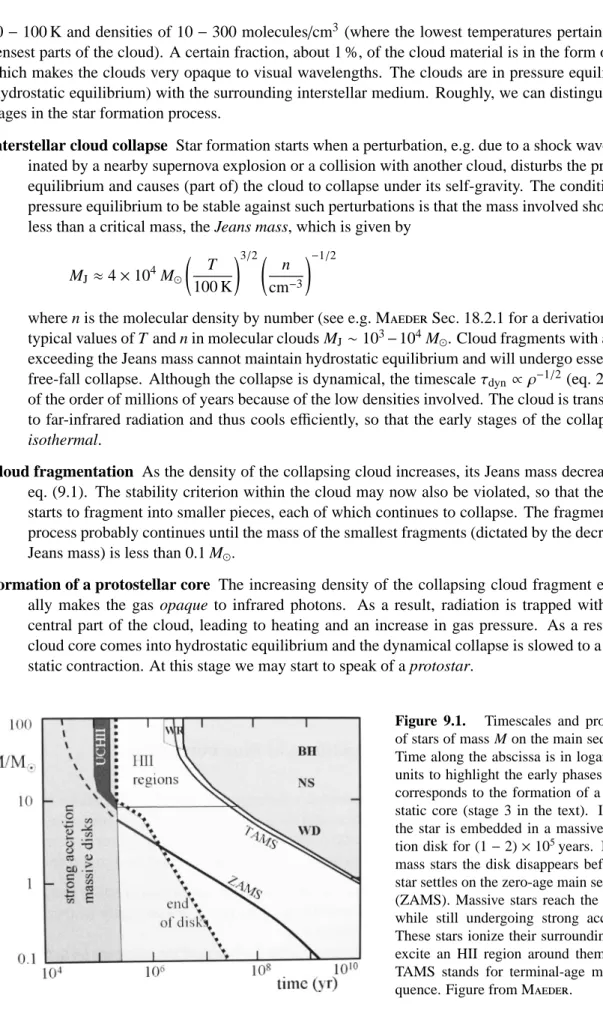
Figure 9.1. Timescales and properties of stars of mass M on the main sequence. Time along the abscissa is in logarithmic units to highlight the early phases, t = 0 corresponds to the formation of a hydro-static core (stage 3 in the text). Initially the star is embedded in a massive accre-tion disk for (1−2)×105years. In low-mass stars the disk disappears before the star settles on the zero-age main sequence (ZAMS). Massive stars reach the ZAMS while still undergoing strong accretion. These stars ionize their surroundings and excite an HII region around themselves. TAMS stands for terminal-age main se-quence. Figure from Maeder.
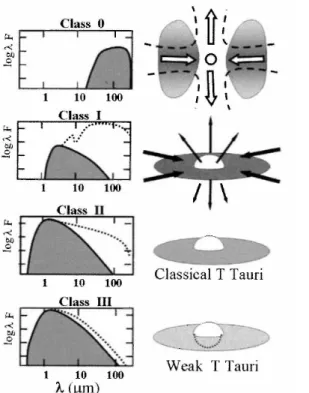
Figure 9.2. Schematic illustration of four stages in the evolution of protostars and their circumstellar disks. On the left, the stellar flux is depicted (shaded area) and the contribution from the disk (dotted line). On the right the corresponding geometry of the ob-ject is shown.
Class 0 objects are very young protostars (<∼104yrs)
with almost spherical accretion at a high rate, emit-ting in the far-IR and sub-mm range. Class I pro-tostars correspond to an advanced stage of accretion (age∼105yrs), where the star is still embedded in a
massive accretion disk, while jets or bipolar outflows are also observed. In class II the protostar has become visible as a classical T Tauri star on the pre-main se-quence (age∼ 106yrs), while the accretion disk is
still optically thick giving rise to a large IR excess. Class III stars are already close to the main sequence (age∼107yrs), with an optically thin accretion disk and weak emission lines. Figure from Maeder.
Accretion The surrounding gas keeps falling onto the protostellar core, so that the next phase is
dominated by accretion. Since the contracting clouds contain a substantial amount of angular momentum, the infalling gas forms an accretion disk around the protostar. These accretion disks are a ubiquitous feature of the star formation process and are observed around most very young stars, mostly at infrared and sub-millimeter wavelengths (see Fig. 9.2).
The accretion of gas generates gravitational energy, part of which goes into further heating of the core and part of which is radiated away, providing the luminosity of the protostar, so that
L∼ Lacc= GM ˙M
2R (9.2)
where M and R are the mass and radius of the core and ˙M is the mass accretion rate. The factor 1
2originates from the fact that half of the potential energy is dissipated in the accretion disk. Meanwhile he core heats up almost adiabatically since the accretion timescaleτacc = M/M is˙ much smaller than the thermal timescaleτKH.
Dissociation and ionization The gas initially consists of molecular hydrogen and behaves like an
ideal gas, such that γad > 43 and the protostellar core is dynamically stable. When the core temperature reaches∼ 2000 K molecular hydrogen starts to dissociate, which is analogous to ionization and leads to a strong increase of the specific heat and a decrease of γad below the critical value of 43 (Sect. 3.5). Hydrostatic equilibrium is no longer possible and a renewed phase of dynamical collapse follows, during which the gravitational energy release is absorbed by the dissociating molecules without a significant rise in temperature. When H2is completely dissociated into atomic hydrogen HE is restored and the temperature rises again. Somewhat later, further dynamical collapse phases follow when first H and then He are ionized at∼104K. When ionization of the protostar is complete it settles back into hydrostatic equilibrium at a much reduced radius (see below).
Pre-main sequence phase Finally, the accretion slows down and eventually stops and the protostar
is revealed as a pre-main sequence star. Its luminosity is now provided by gravitational con-traction and, according to the virial theorem, its internal temperature rises as T ∝ M2/3ρ1/3 (Chapter 8). The surface cools and a temperature gradient builds up, transporting heat out-wards. Further evolution takes place on the thermal timescaleτKH.
A rough estimate of the radius Rpof a protostar after the dynamical collapse phase can be obtained by assuming that all the energy released during the collapse was absorbed in dissociation of molecular hydrogen (requiringχH2 =4.48 eV per H2molecule) and ionization of hydrogen (χH=13.6 eV) and helium (χHe=79 eV). Because the final radius will be much smaller than the initial one, we can take the collapse to start from infinity. After the collapse the protostar is in hydrostatic equilibrium and must satisfy the virial theorem, Etot= 12Egr. Taking Egras given by eq. (2.28), we can write
α 2 GM2 Rp ≈ M mu X 2χH2 +XχH+ Y 4χHe ! ≡ M mu χ. (9.3)
Taking X = 0.72 and Y = 1− X, we have χ = 16.9 eV per baryon. For a polytrope of index n,
α= 3/(5−n) (eq. 4.19). We will shortly see that the protostar is completely convective and thus we can take n= 32 andα= 67, such that
Rp ≈ α 2 GMmu χ ≈ 50 R⊙ M M⊙ ! . (9.4)
The average internal temperature can also be estimated from the virial theorem (eq. 2.29), ¯ T ≈ α 3 µ R GM Rp = 2 3 µ kχ ≈ 8×10 4K, (9.5)
which is independent of the mass of the protostar. At these low temperatures the opacity is very high, rendering radiative transport inefficient and making the protostar convective throughout. The properties of such fully convective stars must be examined more closely.
9.1.1 Fully convective stars: the Hayashi line
We have seen in Sect. 7.2.3 that as the effective temperature of a star decreases the convective envelope gets deeper, occupying a larger and larger part of the mass. If Teff is small enough stars can therefore
become completely convective. In that case, as we derived in Sect. 5.5.2, energy transport is very effi -cient throughout the interior of the star, and a tiny superadiabaticity∇ − ∇adis sufficient to transport a very large energy flux. The structure of such a star can be said to be adiabatic, meaning that the tem-perature stratification (the variation of temtem-perature with depth) as measured by∇=d log T/d log P is equal to∇ad. Since an almost arbitrarily high energy flux can be carried by such a temperature gradi-ent, the luminosity of a fully convective star is practically independent of its structure – unlike for a star in radiative equilibrium, for which the luminosity is strongly linked to the temperature gradient.
It turns out that:
Fully convective stars of a given mass occupy an almost vertical line in the H-R diagram (i.e. with Teff ≈ constant). This line is known as the Hayashi line. The region to the right of the Hayashi
line in the HRD (i.e. at lower effective temperatures) is a forbidden region for stars in hydrostatic equilibrium. On the other hand, stars to the left of the Hayashi line (at higher Teff) cannot be fully
convective but must have some portion of their interior in radiative equilibrium.
Since these results are important, not only for pre-main sequence stars but also for later phases of evolution, we will do a simplified derivation of the properties of the Hayashi line in order to make the above-mentioned results plausible.
Simple derivation of the Hayashi line
For any luminosity L, the interior structure is given by∇=∇ad. For an ideal gas we have a constant ∇ad = 0.4, if we ignore the variation of∇adin partial ionization zones. We also ignore the non-zero superadiabaticity of ∇ in the sub-photospheric layers (Sect. 5.5.2). The temperature stratification throughout the interior can then be described by a power law T ∝ P0.4. Using the ideal gas law, P∝ρT , we can eliminate T from both expressions and write
P=Kρ5/3,
which describes a polytrope of index n= 32. Indeed, for an ideal gas the adiabatic exponentγad = 53. The constant K for a polytropic stellar model of index n is related to the mass M and radius R by eq. (4.15). For our fully convective star with n= 32we have N3/2=0.42422 (Table 4.1) and therefore
K=0.42422 GM1/3R. (9.6)
Since the luminosity of a fully convective star is not determined by its interior structure, it must follow from the conditions (in particular the opacity) in the thin radiative layer from which photons escape, the photosphere. We approximate the photosphere by a spherical surface of negligible thick-ness, where we assume the photospheric boundary conditions (7.9) to hold. Writing the pressure, density and opacity in the photosphere (at r =R) as PR,ρRandκRand the photospheric temperature
as Teff, we can write the boundary conditions as
κRPR= 2 3 GM R2 , (9.7) L=4πR2σTe4ff, (9.8)
and we assume a power-law dependence ofκonρand T so that
κR =κ0ρRaTebff. (9.9)
The equation of state in the photospheric layer is PR=
R
µρRTeff. (9.10)
The interior, polytropic structure must match the conditions in the photosphere so that (using eq. 9.6)
PR=0.42422 GM1/3RρR5/3. (9.11)
For a given mass M, eqs. (9.7-9.11) constitute five equations for six unknowns, PR,ρR,κR, Teff, L and
R. The solution thus always contains one free parameter, that is, the solution is a relation between two quantities, say L and Teff. This relation describes the Hayashi line for a fully convective star of
mass M.
Since we have assumed power-law expressions in all the above equations, the set of equations can be solved straightforwardly (involving some tedious algebra) to give a power-law relation between L and Teff after eliminating all other unknowns. The solution can be written as
log Teff =A log L+B log M+C (9.12)
where the constants A and B depend on the exponents a and b in the assumed expression for the opacity (9.9), A= 3 2a− 1 2 9a+2b+3 and B= a+3 9a+2b+3. (9.13)
ZAMS 4 2 1 0.5 0.25 3.5 4.0 4.5 −2 0 2 4 6 log Teff (K) log L (L sun ) log Teff (K) log L (L sun ) log Teff (K) log L (L sun ) log Teff (K) log L (L sun ) log Teff (K) log L (L sun )
Figure 9.3. The position of the Hayashi lines in the H-R diagram for masses M =0.25, 0.5, 1.0, 2.0 and 4.0 M⊙ as indicated. The lines are analytic fits to detailed models computed for composition X =
0.7,Z =0.02. The zero-age main sequence (ZAMS) for the same composition is shown as a dashed line, for comparison.
Note that the Hayashi lines do not have a constant slope, as expected from the simple analysis, but have a convex shape where the constant A (eq. 9.12) changes sign and becomes negative for high lumi-nosities. The main reason is our neglect of ionization zones (where ∇ad < 0.4) and the non-zero
supera-diabaticity in the outer layers, both of which have a larger effect in more extended stars.
Therefore the shape of the Hayashi line in the HRD is determined by how the opacity in the photo-sphere depends onρand T . Since fully convective stars have very cool photospheres, the opacity is mainly given by H−absorption (Sect. 5.3) which increases strongly with temperature. According to eq. (5.34), a≈0.5 and b≈9 (i.e.κ∝T9!) in the the relevant range of density and temperature, which gives A≈0.01 and B≈0.14. Therefore (see Fig. 9.3)
• for a certain mass the Hayashi line is a very steep, almost vertical line in the HRD,
• the position of the Hayashi line depends on the mass, being located at higher Teff for higher
mass.
We can intuitively understand the steepness of the Hayashi line from the strong increase of H− opacity with temperature. Suppose such a fully convective star would increase its radius slightly while attempting to keep L constant. Then the temperature in the photosphere would decrease and the photosphere would become much more transparent. Hence energy can escape much more easily from the interior, in other words: the luminosity will in fact increase strongly with a slight decrease in photospheric temperature.
The forbidden region in the H-R diagram
Consider models in the neighbourhood of the Hayashi line in the H-R diagram for a star of mass M. These models cannot have∇=∇adthroughout, because otherwise they would be on the Hayashi line. Defining ¯∇as the average value of d log T/d log P over the entire star, models on either side of the Hayashi line (at lower or higher Teff) have either ¯∇>∇ador ¯∇<∇ad. It turns out (after more tedious analysis of the above equations and their dependence on polytropic index n) that models with ¯∇<∇ad lie at higher Teffthan the Hayashi line (to its left in the HRD) while models with ¯∇>∇adlie at lower Teff(to the right in the HRD).
Now consider the significance of ¯∇ , ∇ad. If on average ¯∇ < ∇ad then some part of the star must have ∇ < ∇ad, that is, a portion of the star must be radiative. Since models in the vicinity of the Hayashi line still have cool outer layers with high opacity, the radiative part must lie in the deep interior. Therefore stars located (somewhat) to the left of the Hayashi line have radiative cores surrounded by convective envelopes (if they are far to the left, they can of course be completely radiative).
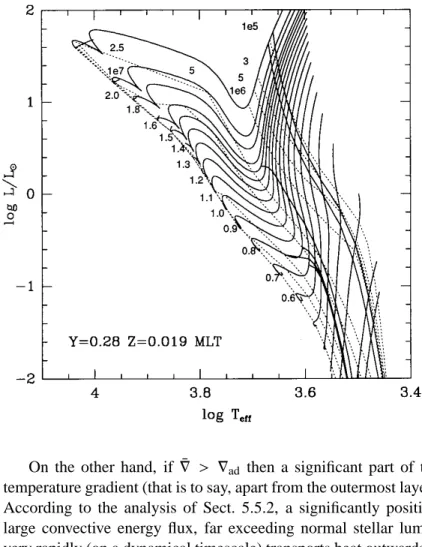
Figure 9.4. Pre-main-sequence evolution tracks for 0.3 − 2.5 M⊙, according to the calculations of D’Antona & Mazzitelli (1994). The dotted lines are isochrones, connect-ing points on the tracks with the same age (between t = 105yrs
and 107yrs, as indicated). Also
indicated as solid lines that cross the tracks are the approximate loca-tions of deuterium burning (between the upper two lines, near the t ∼
105yr isochrone) and lithium burn-ing (crossburn-ing the tracks at lower lu-minosity, at t>106yr).
On the other hand, if ¯∇ > ∇ad then a significant part of the star must have a superadiabatic temperature gradient (that is to say, apart from the outermost layers which are always superadiabatic). According to the analysis of Sect. 5.5.2, a significantly positive ∇ − ∇ad will give rise to a very large convective energy flux, far exceeding normal stellar luminosities. Such a large energy flux very rapidly (on a dynamical timescale) transports heat outwards, thereby decreasing the temperature gradient in the superadiabatic region until∇= ∇ad again. This restructuring of the star will quickly bring it back to the Hayashi line. Therefore the region to the right of the Hayashi line, with Teff <
Teff,HL, is a forbidden region for any star in hydrostatic equilibrium. 9.1.2 Pre-main-sequence contraction
As a newly formed star emerges from the dynamical collapse phase it settles on the Hayashi line appropriate for its mass, with a radius roughly given by eq. (9.4). From this moment on we speak of the pre-main sequence phase of evolution. The pre-main sequence (PMS) star radiates at a luminosity determined by its radius on the Hayashi line. Since it is still too cool for nuclear burning, the energy source for its luminosity is gravitational contraction. As dictated by the virial theorem, this leads to an increase of its internal temperature. As long as the opacity remains high and the PMS star remains fully convective, it contracts along its Hayashi line and thus its luminosity decreases. Since fully convective stars are accurately described by n = 1.5 polytropes, this phase of contraction is indeed homologous to a very high degree! Thus the central temperature increases as Tc∝ρ1c/3∝1/R.
As the internal temperature rises the opacity (and thus∇rad) decreases, until at some point∇rad < ∇ad in the central parts of the star and a radiative core develops. The PMS star then moves to the left in the H-R diagram, evolving away from the Hayashi line towards higher Teff (see Fig. 9.4). As
it keeps on contracting the extent of its convective envelope decreases and its radiative core grows in mass. (This phase of contraction is no longer homologous, because the density distribution must adapt itself to the radiative structure.) The luminosity no longer decreases but increases somewhat.
Once the star is mainly radiative further contraction is again close to homologous. The luminosity is now related to the temperature gradient and mostly determined by the mass of the protostar (see Sect. 7.4.2). This explains why PMS stars of larger mass turn away from the Hayashi line at a higher luminosity than low-mass stars, and why their luminosity remains roughly constant afterward.
Contraction continues, as dictated by the virial theorem, until the central temperature becomes high enough for nuclear fusion reactions. Once the energy generated by hydrogen fusion compensates for the energy loss at the surface, the star stops contracting and settles on the zero-age main sequence (ZAMS) if its mass is above the hydrogen burning limit of 0.08 M⊙(see Chapter 8). Since the nuclear energy source is much more concentrated towards the centre than the gravitational energy released by overall contraction, the transition from contraction to hydrogen burning again requires a (non-homologous) rearrangement of the internal structure.
Before thermal equilibrium on the ZAMS is reached, however, several nuclear reactions have already set in. In particular, a small quantity of deuterium is present in the interstellar gas out of which stars form, with a mass fraction∼ 10−5. Deuterium is a very fragile nucleus that reacts easily with normal hydrogen (2H+1H → 3He+γ, the second reaction in the pp chain). This reaction destroys all deuterium present in the star when T ≈ 1.0×10⁶K, while the protostar is still on the Hayashi line. The energy produced (5.5 MeV per reaction) is large enough to halt the contraction of the PMS star for a few times 105yr. (A similar but much smaller effect happens somewhat later at higher T when the initially present lithium, with mass fraction<∼10−8, is depleted). Furthermore, the 12C(p, γ)13N reaction is already activated at a temperature below that of the full CNO-cycle, due to the relatively large initial12C abundance compared to the equilibrium CNO abundances. Thus almost all12C is converted into14N before the ZAMS is reached. The energy produced in this way also halts the contraction temporarily and gives rise to the wiggles in the evolution tracks just above the ZAMS location in Fig, 9.4. Note that this occurs even in low-mass stars,<∼1 M⊙, even though the pp chain takes over the energy production on the main sequence in these stars once CN equilibrium is achieved (see Sect. 9.2).
Finally, the time taken for a protostar to reach the ZAMS depends on its mass. This time is basically the Kelvin-Helmholtz contraction timescale (eq. 2.36). Since contraction is slowest when both R and L are small, the pre-main sequence lifetime is dominated by the final stages of contraction, when the star is already close to the ZAMS. We can therefore estimate the PMS lifetime by putting ZAMS values into eq. (2.36) which yieldsτPMS ≈107(M/M⊙)−2.5yr. Thus massive protostars reach the ZAMS much earlier than lower-mass stars (and the term ‘zero-age’ main sequence is somewhat misleading in this context, although it hardly makes a difference to the total lifetime of a star). Indeed in young star clusters (e.g. the Pleiades) only the massive stars have reached the main sequence while low-mass stars still lie above and to the right of it.
9.2
The zero-age main sequence
Stars on the zero-age main sequence are (nearly) homogeneous in composition and are in complete (hydrostatic and thermal) equilibrium. Detailed models of ZAMS stars can be computed by solv-ing the four differential equations for stellar structure numerically. It is instructive to compare the properties of such models to the simple main-sequence homology relations derived in Sect. 7.4.
From the homology relations we expect a homogeneous, radiative star in hydrostatic and thermal equilibrium with constant opacity and an ideal-gas equation of state to follow a mass-luminosity and mass-radius relation (7.32 and 7.36),
L∝µ4M3, R∝µνν+−43 M
ν−1
−1 0 1 2 −2 0 2 4 6 log (M / Msun) log (L / L sun ) −1 0 1 2 −1.0 −0.5 0.0 0.5 1.0 1.5 log (M / Msun) log (R / R sun )
Figure 9.5. ZAMS mass-luminosity (left) and mass-radius (right) relations from detailed structure models with X =0.7,Z = 0.02 (solid lines) and from homology relations scaled to solar values (dashed lines). For the radius homology relation, a valueν=18 appropriate for the CNO cycle was assumed (giving R∝M0.81);
this does not apply to M < 1 M⊙so the lower part should be disregarded. Symbols indicate components of double-lined eclipsing binaries with accurately measured M, R and L, most of which are MS stars.
These relations are shown as dashed lines in Fig. 9.5, where they are compared to observed stars with accurately measured M, L and R (see Chapter 1) and to detailed ZAMS models. The mass-radius homology relation depends on the temperature sensitivity (ν) of the energy generation rate, and is thus expected to be different for stars in which the pp chain dominates (ν≈ 4, R ∝ M0.43) and stars dominated by the CNO cycle (ν≈18, R∝µ0.67M0.81, as was assumed in Fig. 9.5).
Homology predicts the qualitative behaviour rather well, that is, a steep L-M relation and a much shallower R-M relation. However, it is not quantitatively accurate and it cannot account for the changes in slope (d log L/d log M and d log R/d log M) of the relations. This was not to be expected, given the simplifying assumptions made in deriving the homology relations. The slope of the L-M relation is shallower than the homology value of 3 for masses below 1 L-M⊙, because such stars have large convective envelopes (as illustrated in Sect. 5.5; see also Sect. 9.2.2 below). The slope is significantly steeper than 3 for masses between 1 and 10 M⊙: in these stars the main opacity source is free-free and bound-free absorption, which increases outward rather than being constant through the star. In very massive stars, radiation pressure is important which results in flattening the L-M relation. The reasons for the changes in d log R/d log M are similar. Note that for low masses we should have used the homology relation for the pp chain (for reasons explained in Sect. 9.2.1 below), which has a smaller slope – the opposite of what is seen in the detailed ZAMS models. The occurrence of convective regions (see Sect. 9.2.2) is the main reason for this non-homologous behaviour.
The detailed ZAMS models do reproduce the observed stellar luminosities quite well. The models trace the lower boundary of observed luminosities, consistent with the expected increase of L with time during the main sequence phase (see Sect. 9.3). The same can be said for the radii (right panel of Fig. 9.5), although the scatter in observed radii appears much larger. Partly this is due to the much finer scale of the ordinate in this diagram compared to the luminosity plot. The fact that most of the observed stellar radii are larger than the detailed ZAMS models is explained by expansion during (and after) the main sequence (see Sect. 9.3).
0.1 0.2 0.5 1 2 5 10 20 50 100 3.5 4.0 4.5 −2 0 2 4 6 Z = 0.02 Z = 0.001 log Teff (K) log (L / L sun )
Figure 9.6. The location of the zero-age main sequence in the Hertzsprung-Russell diagram for homogeneous, detailed stellar models with X =
0.7,Z = 0.02 (blue solid line) and with X =
0.757,Z = 0.001 (red dashed line). Plus symbols indicate models for specific masses (in units of M⊙). ZAMS models for metal-poor stars are hotter and have smaller radii. Relatively low-mass stars at low metallicity are also more luminous than their metal-rich counterparts.
The location of the detailed ZAMS models in the H-R diagram is shown in Fig. 9.6. The solid (blue) line depicts models for quasi-solar composition, which were also used in Fig. 9.5. The increase of effective temperature with stellar mass (and luminosity) reflects the steep mass-luminosity relation and the much shallower mass-radius relation – more luminous stars with similar radii must be hotter, by eq. (1.1). The slope of the ZAMS in the HRD is not constant, reflecting non-homologous changes in structure as the stellar mass increases.
The effect of composition on the location of the ZAMS is illustrated by the dashed (red) line, which is computed for a metal-poor mixture characteristic of Population II stars. Metal-poor main sequence stars are hotter and have smaller radii. Furthermore, relatively low-mass stars are also more luminous than their metal-rich counterparts. One reason for these differences is a lower bound-free opacity at lower Z (eq. 5.33), which affects relatively low-mass stars (up to about 5 M⊙). On the other hand, higher-mass stars are dominated by electron-scattering opacity, which is independent of metallicity. These stars are smaller and hotter for a different reason (see Sect. 9.2.1).
9.2.1 Central conditions
We can estimate how the central temperature and central density scale with mass and composition for a ZAMS star from the homology relations for homogeneous, radiative stars in thermal equilibrium (Sec. 7.4.2, see eqs. 7.37 and 7.38 and Table 7.1). From these relations we may expect the central temperature to increase with mass, the mass dependence being larger for the pp chain (Tc ∝ M0.57)
than for the CNO cycle (Tc ∝ M0.21). Since the CNO cycle dominates at high T , we can expect
low-mass stars to power themselves by the pp chain and high-mass stars by the CNO cycle. This is confirmed by detailed ZAMS models, as shown in Fig. 9.7. For solar composition, the transition occurs at T ≈ 1.7×10⁷K, corresponding to M ≈ 1.3 M⊙. Similarly, from the homology relations, the central density is expected to decrease strongly with mass in stars dominated by the CNO cycle (ρc ∝ M−1.4), but much less so in pp-dominated low-mass stars (ρc ∝ M−0.3). Also this is borne out
by the detailed models in Fig. 9.7; in fact the central density increases slightly with mass between 0.4 and 1.5 M⊙. The abrupt change in slope at 0.4 M⊙is related to the fact that stars with M <∼ 0.4 M⊙ are completely convective. For these lowest-mass stars one of the main assumptions made in the homology relations (radiative equilibrium) breaks down.
0.1 0.2 0.5 1 2 5 10 20 50 100 CNO pp CNO pp 0 1 2 6.5 7.0 7.5 Z = 0.02 Z = 0.001 log ρc (g / cm3) log T c
(K) Figure 9.7. Central temperature versus central
den-sity for detailed ZAMS models with X =0.7,Z =
0.02 (blue solid line) and with X=0.757,Z=0.001 (red dashed line). Plus symbols indicate models for specific masses (in units of M⊙). The dotted lines in-dicate the approximate temperature border between energy production dominated by the CNO cycle and the pp chain. This gives rise to a change in slope of the Tc,ρcrelation.
The energy generation rate of the CNO cycle depends on the total CNO abundance. At lower metallicity, the transition between pp chain and CNO cycle therefore occurs at a higher temperature. As a consequence, the mass at which the transition occurs is also larger. Furthermore, high-mass stars powered by the CNO cycle need a higher central temperature to provide the same total nuclear power. Indeed, comparing metal-rich and metal-poor stars in Figs. 9.6 and 9.7, the luminosity of two stars with the same mass is similar, but their central temperature is higher. As a consequence of the virial theorem (eq. 2.29 or 7.28), their radius must be correspondingly smaller.
9.2.2 Convective regions
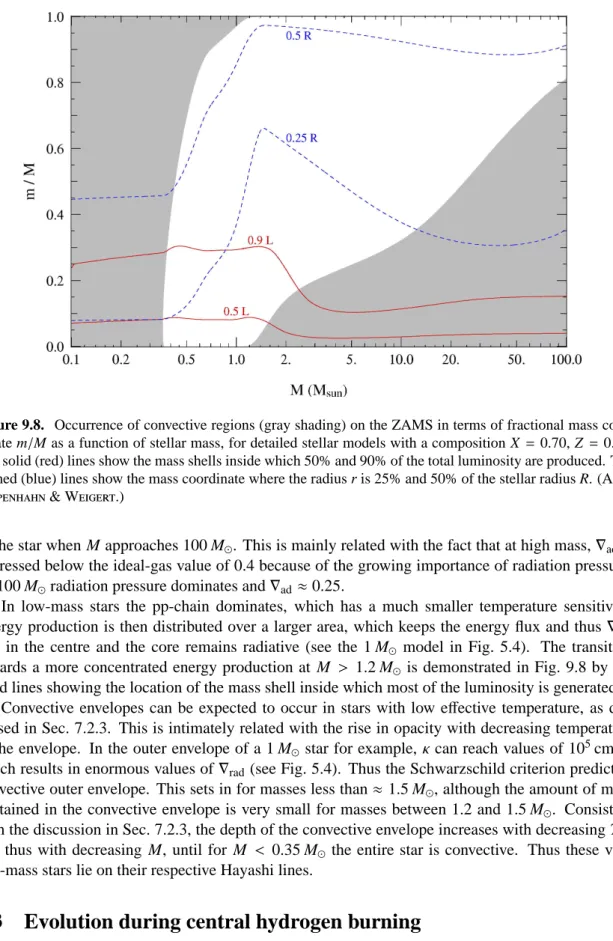
An overview of the occurrence of convective regions on the ZAMS as a function of stellar mass is shown in Fig. 9.8. For any given mass M, a vertical line in this diagram shows which conditions are encountered as a function of depth, characterized by the fractional mass coordinate m/M. Gray shading indicates whether a particular mass shell is convective (gray) or radiative (white). We can thus distinguish three types of ZAMS star:
• completely convective, for M<0.35 M⊙,
• radiative core+convective envelope, for 0.35 M⊙< M<1.2 M⊙, • convective core+radiative envelope, for M>1.2 M⊙.
This behaviour can be understood from the Schwarzschild criterion for convection, which tells us that convection occurs when ∇rad > ∇ad (eq. 5.50). As discussed in Sec. 5.5.1, a large value of ∇rad is found when the opacityκis large, or when the energy flux to be transported (in particular the value of l/m) is large, or both. Starting with the latter condition, this is the case when a lot of energy is produced in a core of relatively small mass, i.e. when the energy generation rate ǫnuc is strongly peaked towards the centre. This is certainly the case when the CNO-cycle dominates the energy production, since it is very temperature sensitive (ν ≈ 18) which means that ǫnuc rapidly drops as the temperature decreases from the centre outwards. It results in a steep increase of∇rad towards the centre and thus to a convective core. This is illustrated for a 4 M⊙ZAMS star in Fig. 5.4. The size of the convective core increases with stellar mass (Fig. 9.8), and it can encompass up to 80% of the mass
Figure 9.8. Occurrence of convective regions (gray shading) on the ZAMS in terms of fractional mass
coor-dinate m/M as a function of stellar mass, for detailed stellar models with a composition X=0.70, Z =0.02. The solid (red) lines show the mass shells inside which 50% and 90% of the total luminosity are produced. The dashed (blue) lines show the mass coordinate where the radius r is 25% and 50% of the stellar radius R. (After Kippenhahn& Weigert.)
of the star when M approaches 100 M⊙. This is mainly related with the fact that at high mass,∇ad is depressed below the ideal-gas value of 0.4 because of the growing importance of radiation pressure. At 100 M⊙radiation pressure dominates and∇ad ≈0.25.
In low-mass stars the pp-chain dominates, which has a much smaller temperature sensitivity. Energy production is then distributed over a larger area, which keeps the energy flux and thus ∇rad low in the centre and the core remains radiative (see the 1 M⊙ model in Fig. 5.4). The transition towards a more concentrated energy production at M > 1.2 M⊙is demonstrated in Fig. 9.8 by the solid lines showing the location of the mass shell inside which most of the luminosity is generated.
Convective envelopes can be expected to occur in stars with low effective temperature, as dis-cussed in Sec. 7.2.3. This is intimately related with the rise in opacity with decreasing temperature in the envelope. In the outer envelope of a 1 M⊙star for example, κ can reach values of 105cm2/g which results in enormous values of ∇rad (see Fig. 5.4). Thus the Schwarzschild criterion predicts a convective outer envelope. This sets in for masses less than≈ 1.5 M⊙, although the amount of mass contained in the convective envelope is very small for masses between 1.2 and 1.5 M⊙. Consistent with the discussion in Sec. 7.2.3, the depth of the convective envelope increases with decreasing Teff
and thus with decreasing M, until for M < 0.35 M⊙ the entire star is convective. Thus these very low-mass stars lie on their respective Hayashi lines.
9.3
Evolution during central hydrogen burning
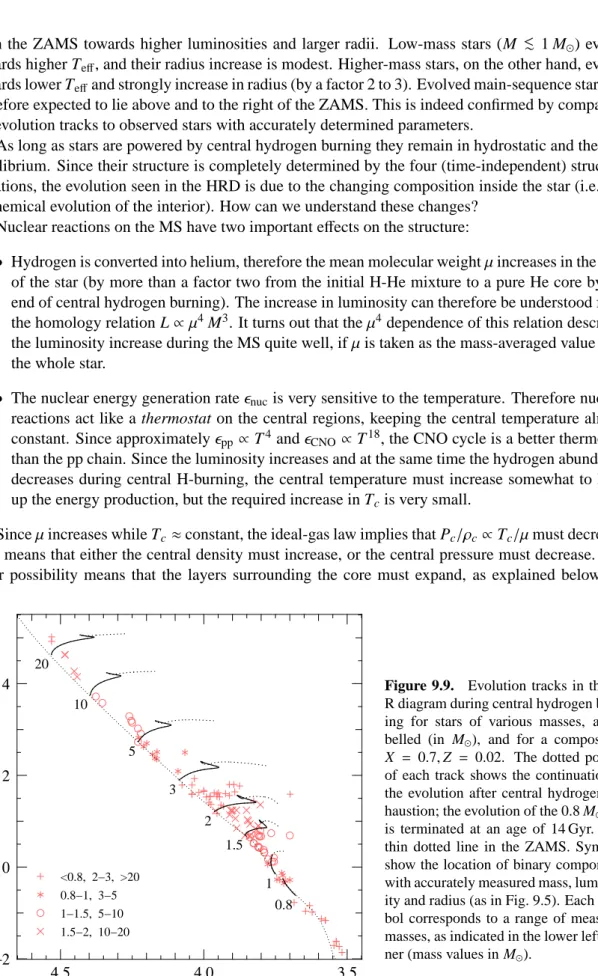
Fig. 9.9 shows the location of the ZAMS in the H-R diagram and various evolution tracks for different masses at Population I composition, covering the central hydrogen burning phase. Stars evolve away
from the ZAMS towards higher luminosities and larger radii. Low-mass stars (M ∼< 1 M⊙) evolve towards higher Teff, and their radius increase is modest. Higher-mass stars, on the other hand, evolve
towards lower Teffand strongly increase in radius (by a factor 2 to 3). Evolved main-sequence stars are
therefore expected to lie above and to the right of the ZAMS. This is indeed confirmed by comparing the evolution tracks to observed stars with accurately determined parameters.
As long as stars are powered by central hydrogen burning they remain in hydrostatic and thermal equilibrium. Since their structure is completely determined by the four (time-independent) structure equations, the evolution seen in the HRD is due to the changing composition inside the star (i.e. due to chemical evolution of the interior). How can we understand these changes?
Nuclear reactions on the MS have two important effects on the structure:
• Hydrogen is converted into helium, therefore the mean molecular weightµincreases in the core of the star (by more than a factor two from the initial H-He mixture to a pure He core by the end of central hydrogen burning). The increase in luminosity can therefore be understood from the homology relation L∝µ4M3. It turns out that theµ4dependence of this relation describes the luminosity increase during the MS quite well, ifµis taken as the mass-averaged value over the whole star.
• The nuclear energy generation rateǫnucis very sensitive to the temperature. Therefore nuclear reactions act like a thermostat on the central regions, keeping the central temperature almost constant. Since approximatelyǫpp∝ T4andǫCNO ∝ T18, the CNO cycle is a better thermostat than the pp chain. Since the luminosity increases and at the same time the hydrogen abundance decreases during central H-burning, the central temperature must increase somewhat to keep up the energy production, but the required increase in Tcis very small.
Sinceµincreases while Tc ≈constant, the ideal-gas law implies that Pc/ρc∝Tc/µmust decrease.
This means that either the central density must increase, or the central pressure must decrease. The latter possibility means that the layers surrounding the core must expand, as explained below. In
<0.8, 2−3, >20 0.8−1, 3−5 1−1.5, 5−10 1.5−2, 10−20 0.8 1 1.5 2 3 5 10 20 3.5 4.0 4.5 −2 0 2 4 log Teff (K) log (L / L sun )
Figure 9.9. Evolution tracks in the H-R diagram during central hydrogen burn-ing for stars of various masses, as la-belled (in M⊙), and for a composition X = 0.7,Z = 0.02. The dotted portion of each track shows the continuation of the evolution after central hydrogen ex-haustion; the evolution of the 0.8 M⊙star is terminated at an age of 14 Gyr. The thin dotted line in the ZAMS. Symbols show the location of binary components with accurately measured mass, luminos-ity and radius (as in Fig. 9.5). Each sym-bol corresponds to a range of measured masses, as indicated in the lower left cor-ner (mass values in M⊙).
either case, the density contrast between the core and the envelope increases, so that evolution during central H-burning causes non-homologous changes to the structure.
9.3.1 Evolution of stars powered by the CNO cycle
We can understand why rather massive stars (M>∼1.3 M⊙) expand during the MS by considering the pressure that the outer layers exert on the core:
Penv= Z M
mc
Gm
4πr4 dm (9.14)
Expansion of the envelope (increase in r of all mass shells) means a decrease in the envelope pressure on the core. This decrease in pressure is needed because of the sensitive thermostatic action of the CNO cycle,ǫCNO ∝ ρT18, which allows only very small increases in Tc andρc. Sinceµc increases
as H being is burned into He, the ideal-gas law dictates that Pc must decrease. This is only possible
if Penvdecreases, i.e. the outer layers must expand to keep the star in HE (ρenv ↓and R↑). This self-regulating envelope expansion mechanism is the only way for the star to adapt itself to the composition changes in the core while maintaining both HE and TE.
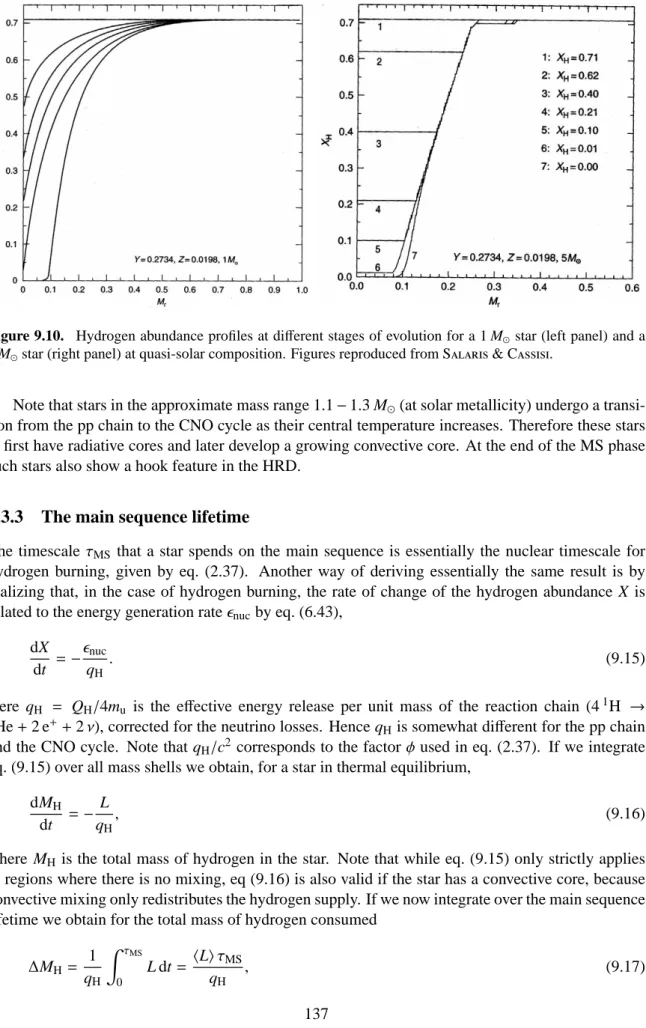
Another important consequence of the temperature sensitivity the CNO cycle is the large concen-tration ofǫnuctowards the centre. This gives rise to a large central∇rad ∝l/m and hence to convective cores, which are mixed homogeneously (X(m)=constant within the convective core mass Mcc). This increases the amount of fuel available and therefore the lifetime of central hydrogen burning (see Fig. 9.10). In general Mcc decreases during the evolution, which is a consequence of the fact that ∇rad ∝ κ and sinceκ ∝ 1+X for the main opacity sources (see Sect. 5.3) the opacity in the core decreases as the He abundance goes up.
Towards the end of the main sequence phase, as Xcbecomes very small, the thermostatic action of
the CNO reactions diminishes and Tc has to increase substantially to keep up the energy production.
When hydrogen is finally exhausted, this occurs within the whole convective core of mass Mccand
ǫnuc decreases. The star now loses more energy at its surface than is produced in the centre, it gets out of thermal equilibrium and it will undergo an overall contraction. This occurs at the red point of the evolution tracks in Fig. 9.9, after which Teff increases. At the blue point of the hook feature in the
HRD, the core has contracted and heated up sufficiently that at the edge of the former convective core the temperature is high enough for the CNO cycle to ignite again in a shell around the helium core. This is the start of the hydrogen-shell burning phase which will be discussed in Chapter 10.
9.3.2 Evolution of stars powered by the pp chain
In stars with M<∼1.3 M⊙the central temperature is too low for the CNO cycle and the main energy-producing reactions are those of the pp chain. The lower temperature sensitivity ǫpp ∝ ρT4 means that Tcandρcincrease more than was the case for the CNO cycle. Therefore the outer layers need to
expand less in order to maintain hydrostatic equilibrium in the core. As a result, the radius increase in low-mass stars is modest and they evolve almost parallel to the ZAMS in the H-R diagram (see Fig. 9.9).
Furthermore, the lower T -sensitivity of the pp chains means that low-mass stars have radiative cores. The rate of change of the hydrogen abundance in each shell is then proportional to the overall reaction rate of the pp chain (by eq. 6.41), and is therefore highest in the centre. Therefore a hydrogen abundance gradient builds up gradually, with X(m) increasing outwards (see Fig. 9.10). As a result, hydrogen is depleted gradually in the core and there is a smooth transition to hydrogen-shell burning. The evolution tracks for low-mass stars therefore do not show a hook feature.
Figure 9.10. Hydrogen abundance profiles at different stages of evolution for a 1 M⊙star (left panel) and a 5 M⊙star (right panel) at quasi-solar composition. Figures reproduced from Salaris& Cassisi.
Note that stars in the approximate mass range 1.1−1.3 M⊙(at solar metallicity) undergo a transi-tion from the pp chain to the CNO cycle as their central temperature increases. Therefore these stars at first have radiative cores and later develop a growing convective core. At the end of the MS phase such stars also show a hook feature in the HRD.
9.3.3 The main sequence lifetime
The timescale τMS that a star spends on the main sequence is essentially the nuclear timescale for hydrogen burning, given by eq. (2.37). Another way of deriving essentially the same result is by realizing that, in the case of hydrogen burning, the rate of change of the hydrogen abundance X is related to the energy generation rateǫnucby eq. (6.43),
dX dt =−
ǫnuc qH
. (9.15)
Here qH = QH/4mu is the effective energy release per unit mass of the reaction chain (41H → 4He+2 e++2ν), corrected for the neutrino losses. Hence q
His somewhat different for the pp chain and the CNO cycle. Note that qH/c2 corresponds to the factorφused in eq. (2.37). If we integrate eq. (9.15) over all mass shells we obtain, for a star in thermal equilibrium,
dMH dt =−
L qH
, (9.16)
where MHis the total mass of hydrogen in the star. Note that while eq. (9.15) only strictly applies to regions where there is no mixing, eq (9.16) is also valid if the star has a convective core, because convective mixing only redistributes the hydrogen supply. If we now integrate over the main sequence lifetime we obtain for the total mass of hydrogen consumed
∆MH= 1 qH Z τMS 0 L dt= hLiτMS qH , (9.17)
wherehLiis the time average of the luminosity over the main-sequence lifetime. We can write∆MH= fnucM by analogy with eq. (2.37), and write fnucas the product of the initial hydrogen mass fraction X0and an effective core mass fraction qcinside which all hydrogen is consumed, so that
τMS =X0qH qcM
hLi . (9.18)
We have seen that the luminosity of main-sequence stars increases strongly with mass. Since the variation of L during the MS phase is modest, we can assume the same relation betweenhLiand M as for the ZAMS. The other factors appearing in eq. (9.18) do not or only weakly depend on the mass of the star (see below) and can in a first approximation be taken as constant. For a mass-luminosity relationhLi ∝Mη– whereηdepends on the mass range under consideration withη≈3.8 on average – we thus obtainτMS ∝M1−η. HenceτMSdecreases strongly towards larger masses.
This general trend has important consequences for the observed H-R diagrams of star clusters. All stars in a cluster can be assumed to have formed at approximately the same time and therefore now have the same age τcl. Cluster stars with a mass above a certain limit Mtohave main-sequence lifetimesτMS < τcland have therefore already left the main sequence, while those with M < Mto are still on the main sequence. The main sequence of a cluster has an upper end (the ‘turn-offpoint’) at a luminosity and effective temperature corresponding to Mto, the so-called turn-offmass, determined by the conditionτMS(Mto)=τcl. The turn-offmass and luminosity decrease with cluster age (e.g. see Fig. 1.2). This the basis for the age determination of star clusters.
The actual main-sequence lifetime depend on a number of other factors. The effective energy release per gram qHdepends on which reactions are involved in energy production and therefore has a slight mass dependence. More importantly, the exact value of qc is determined by the hydrogen profile left at the end of the main sequence. This is somewhat mass-dependent, especially for massive stars in which the relative size of the convective core tends to increase with mass (Fig. 9.8). A larger convective core mass means a larger fuel reservoir and a longer lifetime. Our poor understanding of convection and mixing in stars unfortunately introduces considerable uncertainty in the size of this reservoir and therefore both in the main-sequence lifetime of a star of a particular mass and in its further evolution.
9.3.4 Complications: convective overshooting and semi-convection
As discussed in Sect. 5.5.4, the size of a convective region inside a star is expected to be larger than predicted by the Schwarzschild (or Ledoux) criterion because of convective overshooting. However, the extent dov of the overshooting region is not known reliably from theory. In stellar evolution calculations this is usually parameterized in terms of the local pressure scale height, dov=αovHP. In
addition, other physical effects such as stellar rotation may contribute to mixing material beyond the formal convective core boundary. Detailed stellar evolution models in which the effects of convective overshooting are taken into account generally provide a better match to observations. For this reason, overshooting (or perhaps a variety of enhanced mixing processes) is thought to have a significant effect in stars with sizable convective cores on the main sequence.
Overshooting has several important consequences for the evolution of a star:
1. a longer main-sequence lifetime, because of the larger hydrogen reservoir available;
2. a larger increase in luminosity and radius during the main sequence, because of the larger region inside whichµincreases which enhances the effects on L and R discussed earlier in this section; 3. the hydrogen-exhausted core mass is larger at the end of the main sequence, which in turn leads to (a) larger luminosities during all evolution phases after the main sequence (e.g. see Fig. 10.2 in the next chapter) and, as a result, (b) shorter lifetimes of these post-main sequence phases.
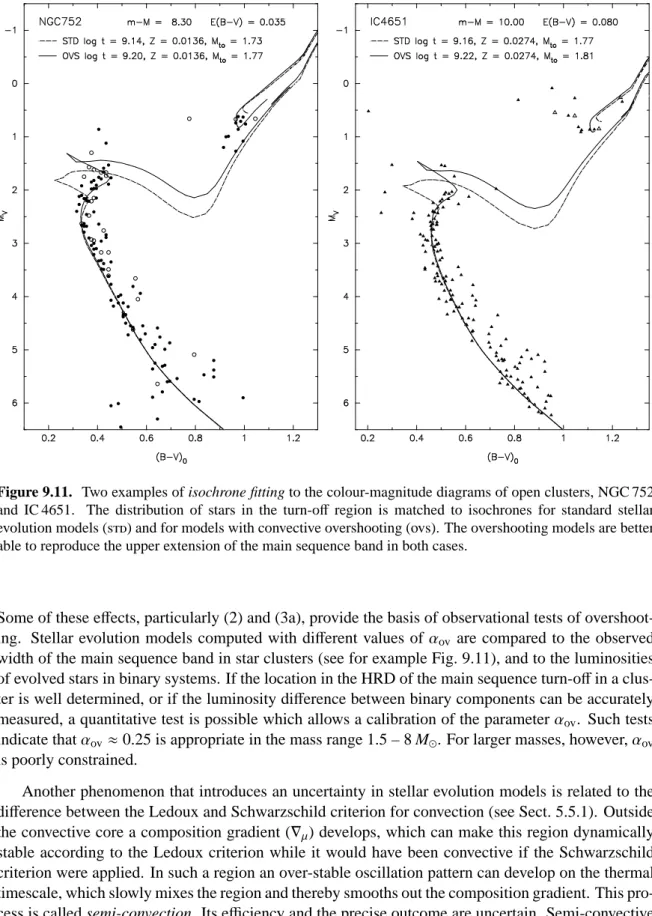
Figure 9.11. Two examples of isochrone fitting to the colour-magnitude diagrams of open clusters, NGC 752
and IC 4651. The distribution of stars in the turn-off region is matched to isochrones for standard stellar evolution models (std) and for models with convective overshooting (ovs). The overshooting models are better able to reproduce the upper extension of the main sequence band in both cases.
Some of these effects, particularly (2) and (3a), provide the basis of observational tests of overshoot-ing. Stellar evolution models computed with different values of αov are compared to the observed width of the main sequence band in star clusters (see for example Fig. 9.11), and to the luminosities of evolved stars in binary systems. If the location in the HRD of the main sequence turn-offin a clus-ter is well declus-termined, or if the luminosity difference between binary components can be accurately measured, a quantitative test is possible which allows a calibration of the parameterαov. Such tests indicate thatαov≈0.25 is appropriate in the mass range 1.5 – 8 M⊙. For larger masses, however,αov is poorly constrained.
Another phenomenon that introduces an uncertainty in stellar evolution models is related to the difference between the Ledoux and Schwarzschild criterion for convection (see Sect. 5.5.1). Outside the convective core a composition gradient (∇µ) develops, which can make this region dynamically stable according to the Ledoux criterion while it would have been convective if the Schwarzschild criterion were applied. In such a region an over-stable oscillation pattern can develop on the thermal timescale, which slowly mixes the region and thereby smooths out the composition gradient. This pro-cess is called semi-convection. Its efficiency and the precise outcome are uncertain. Semi-convective situations are encountered during various phases of evolution, most importantly during central hy-drogen burning in stars with M > 10 M⊙and during helium burning in low- and intermediate-mass stars.
Suggestions for further reading
The process of star formation and pre-main sequence evolution is treated in much more detail in Chapters 18–20 of Maeder, while the properties and evolution on the main sequence are treated in Chapter 25. See also Kippenhahn& WeigertChapters 22 and 26–30.
Exercises
9.1 Kippenhahn diagram of the ZAMS
Figure 9.8 indicates which regions in zero-age main sequence stars are convective as a function of the mass of the star.
(a) Why are the lowest-mass stars fully convective? Why does the mass of the convective envelope decrease with M and disappear for M>∼1.3 M⊙?
(b) What changes occur in the central energy production around M =1.3 M⊙, and why? How is this related to the convection criterion? So why do stars with M≈1.3 M⊙have convective cores while lower-mass stars do not?
(c) Why is it plausible that the mass of the convective core increases with M?
9.2 Conceptual questions
(a) What is the Hayashi line? Why is it a line, in other words: why is there a whole range of possible luminosities for a star of a certain mass on the HL?
(b) Why do no stars exist with a temperature cooler than that of the HL? What happens if a star would cross over to the cool side of the HL?
(c) Why is there a mass-luminosity relation for ZAMS stars? (In other words, why is there a unique luminosity for a star of a certain mass?)
(d) What determines the shape of the ZAMS is the HR diagram?
9.3 Central temperature versus mass
Use the homology relations for the luminosity and temperature of a star to derive how the central tem-perature in a star scales with mass, and find the dependence of Tcon M for the pp-chain and for the
CNO-cycle. To make the result quantitative, use the fact that in the Sun with Tc ≈1.3×10⁷K the
pp-chain dominates, and that the CNO-cycle dominates for masses M >∼1.3 M⊙. (Why does the pp-chain dominate at low mass and the CNO-cycle at high mass?)
9.4 Mass-luminosity relation
Find the relation between L and M and the slope of the main sequence, assuming an opacity lawκ =
κ0ρT−7/2(the Kramers opacity law) and that the energy generation rate per unit massǫnuc∝ρTν, where ν=4.
Chapter 10
Post-main sequence evolution through
helium burning
After the main-sequence phase, stars are left with a hydrogen-exhausted core surrounded by a still hydrogen-rich envelope. To describe the evolution after the main sequence, it is useful to make a division based on the mass:
low-mass stars are those that develop a degenerate helium core after the main sequence, leading to
a relatively long-lived red giant branch phase. The ignition of He is unstable and occurs in a so-called helium flash. This occurs for masses between 0.8 M⊙and≈ 2 M⊙(this upper limit is sometimes denoted as MHeF).
intermediate-mass stars develop a helium core that remains non-degenerate, and they ignite helium
in a stable manner. After the central He burning phase they form a carbon-oxygen core that becomes degenerate. Intermediate-mass stars have masses between MHeF and Mup ≈ 8 M⊙. Both low-mass and intermediate-mass stars shed their envelopes by a strong stellar wind at the end of their evolution and their remnants are CO white dwarfs.
massive stars have masses larger than Mup ≈ 8 M⊙ and ignite carbon in a non-degenerate core. Except for a small mass range (≈8−11 M⊙) these stars also ignite heavier elements in the core until an Fe core is formed which collapses.
In this chapter the evolution between the end of the main sequence and the development of a carbon-oxygen core is discussed. We concentrate on low-mass and intermediate-mass stars, but the principles are equally valid for massive stars. The evolution of massive stars in the H-R diagram is, however, also strongly affected by mass loss and we defer a more detailed discussion of massive stars until Chapter 12.
10.1
The Sch¨onberg-Chandrasekhar limit
During central hydrogen burning on the main sequence, we have seen that stars are in thermal equi-librium (τnuc ≫ τKH) with the surface luminosity balanced by the nuclear power generated in the centre. After the main sequence a hydrogen-exhausted core is formed inside which nuclear energy production has ceased. This inert helium core is surrounded by a hydrogen-burning shell and a H-rich envelope. For such an inert core to be in thermal equilibrium requires a zero net energy flow, l(m) = R
mǫnucdm = 0 and hence dT/dr ∝ l = 0. This implies that the core must be isothermal to
A star composed of ideal gas at constant temperature corresponds to a polytrope withγ = 1, i.e. with n→ ∞. Such a polytrope would have infinite radius (Chapter 4) or, if its radius were finite, would have infinitely high central density, both of which are unphysical. In other words, completely isother-mal stars made of ideal gas cannot exist. The reason is that the pressure gradient needed to support such a star against its own gravity is produced only by the density gradient, dP/dr= (RT/µ) dρ/dr, with no help from a temperature gradient. Thus hydrostatic equilibrium in an isothermal star would require a very large density gradient.
It turns out, however, that if only the core of the star is isothermal, and the mass Mcof this isother-mal core is only a sisother-mall fraction of the total mass of the star, then a stable configuration is possible. If the core mass exceeds this limit, then the pressure within the isothermal core cannot sustain the weight of the overlying envelope. This was first discovered by Sch¨onberg and Chandrasekhar in 1942, who computed the maximum core mass fraction qc =Mc/M to be
Mc M <qSC=0.37 µenv µc !2 ≈0.10 (10.1)
whereµc andµenvare the mean molecular weight in the core and in the envelope respectively. This limit is known as the Sch¨onberg-Chandrasekhar limit. The typical value qSC ≈ 0.10 is appropriate for a helium core withµc = 1.3 and a H-rich envelope. (A simple, qualitative derivation of eq. 10.1 can be found in MaederSection 25.5.1.)
1 Msun 2 Msun 3 Msun 5 Msun 7 Msun 10 Msun 3.5 4.0 4.5 0 2 4 log Teff (K) log L (L sun ) 1 2 3 5 7 10 0 2 4 6 8 7.0 7.5 8.0 8.5 9.0 log ρc (g / cm3) log T c (K)
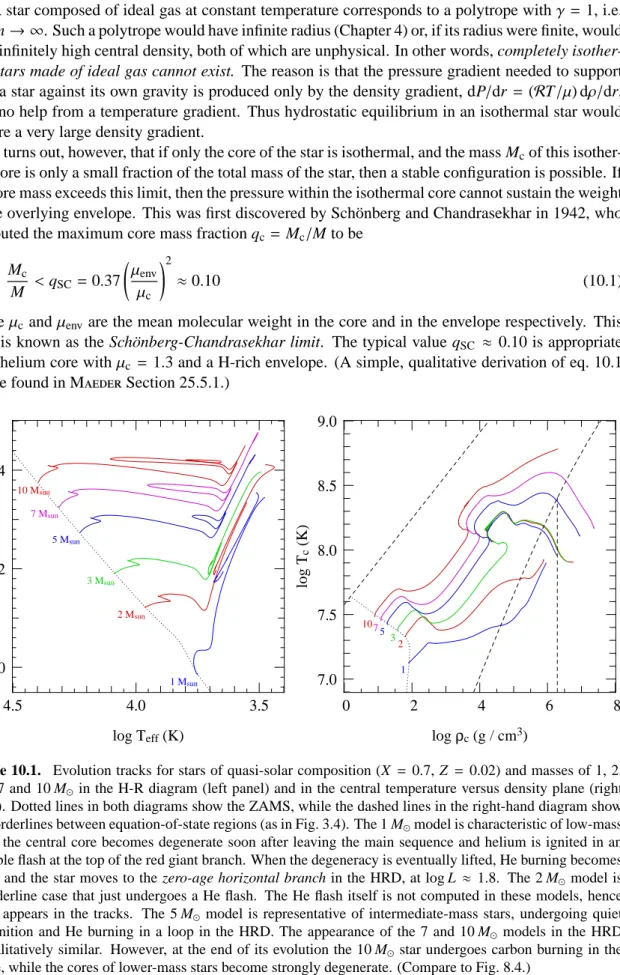
Figure 10.1. Evolution tracks for stars of quasi-solar composition (X = 0.7, Z =0.02) and masses of 1, 2, 3, 5, 7 and 10 M⊙in the H-R diagram (left panel) and in the central temperature versus density plane (right panel). Dotted lines in both diagrams show the ZAMS, while the dashed lines in the right-hand diagram show the borderlines between equation-of-state regions (as in Fig. 3.4). The 1 M⊙model is characteristic of low-mass stars: the central core becomes degenerate soon after leaving the main sequence and helium is ignited in an unstable flash at the top of the red giant branch. When the degeneracy is eventually lifted, He burning becomes stable and the star moves to the zero-age horizontal branch in the HRD, at log L ≈1.8. The 2 M⊙model is a borderline case that just undergoes a He flash. The He flash itself is not computed in these models, hence a gap appears in the tracks. The 5 M⊙ model is representative of intermediate-mass stars, undergoing quiet He ignition and He burning in a loop in the HRD. The appearance of the 7 and 10 M⊙ models in the HRD is qualitatively similar. However, at the end of its evolution the 10 M⊙star undergoes carbon burning in the centre, while the cores of lower-mass stars become strongly degenerate. (Compare to Fig. 8.4.)
Stars that leave the main sequence with a helium core mass below the Sch¨onberg-Chandrasekhar limit can therefore remain in complete equilibrium (HE and TE) during hydrogen-shell burning. This is the case for stars with masses up to about 8 M⊙, if convective overshooting is neglected. Over-shooting increases the core mass at the end of central H-burning, and therefore the upper mass limit for stars remaining in TE after the main sequence decreases to about 2 M⊙in calculations that include moderate overshooting.
When the mass of the H-exhausted core exceeds the Sch¨onberg-Chandrasekhar limit – either im-mediately after the main sequence in relatively massive stars, or in lower-mass stars after a period of H-shell burning during which the helium core mass increases steadily – thermal equilibrium is no longer possible. The helium core then contracts and builds up a temperature gradient. This tempera-ture gradient adds to the pressure gradient that is needed to balance gravity and keep the star in HE. However, the temperature gradient also causes an outward heat flow from the core, such that it keeps contracting and heating up in the process (by virtue of the virial theorem). This contraction occurs on the thermal (Kelvin-Helmholtz) timescale in a quasi-static way, always maintaining a state very close to HE.
Low-mass stars (M<∼2 M⊙) have another way of maintaining both HE and TE during hydrogen-shell burning. In such stars the helium core is relatively dense and cool and electron degeneracy can become important in the core after the main sequence. Degeneracy pressure is independent of temperature and can support the weight of the envelope even in a relatively massive core, as long as the degenerate core mass does not exceed the Chandrasekhar mass.1 In that case the Sch¨onberg-Chandrasekhar limit no longer applies. Inside such degenerate helium cores efficient energy transport by electron conduction (Sec. 5.2.4) can keep the core almost isothermal.
Effects of core contraction: the ‘mirror principle’
The following principle appears to be generally valid, and provides a way of interpreting the results of detailed numerical calculations:
Whenever a star has an active shell-burning source, the burning shell acts as a mirror between the core and the envelope:
core contraction ⇒ envelope expansion core expansion ⇒ envelope contraction
This ‘mirror principle’ can be understood by the following argument. To maintain thermal equi-librium, the burning shell must remain at approximately constant temperature due to the thermostatic action of nuclear burning. Contraction of the burning shell would entail heating, so the burning shell must also remain at roughly constant radius. As the core contracts,ρshellmust therefore decrease and hence also the pressure in the burning shell must decrease. Therefore the pressure Penvof the overly-ing envelope must decrease, so the layers above the shell must expand (an example of this behaviour can be seen in Fig. 10.4, to be discussed in the next section).
10.2
The hydrogen-shell burning phase
In this section we discuss in some detail the evolution of stars during hydrogen-shell burning, until the onset of helium burning. Based on the above section, qualitative differences are to be expected between low-mass stars (M <∼ 2 M⊙) on the one hand and intermediate- and high-mass stars (M >∼
A B C D E F G H J 3.6 3.8 4.0 4.2 2.5 3.0 3.5 4.0 log Teff(K) log (L / L sun ) 5 Msun (Z = 0.02) std ovs 3.6 3.8 4.0 4.2 2.5 3.0 3.5 4.0 4.5 log Teff (K) log (L / L sun ) 5 Msun (Z = 0.02)
Figure 10.2. Evolution track in the Hertzsprung-Russell diagram of a 5 M⊙star of initial composition X = 0.7, Z = 0.02. See text for details. The evolution track in the left panel was computed without convective overshooting. The right panel shows a comparison between this track and the evolution of the same star computed with moderate overshooting (αov = lov/HP ≈ 0.25; dashed line), illustrating some of the effects
discussed in Sec. 9.3.4.
2 M⊙) on the other hand. Therefore we discuss these two cases separately, starting with the evolution of higher-mass stars because it is relatively simple compared to low-mass stars. We use two detailed stellar evolution sequences, for stars of 5 M⊙ and 1 M⊙ respectively, as examples for the general evolutionary behaviour of stars in these two mass ranges.
10.2.1 Hydrogen-shell burning in intermediate-mass and massive stars
Fig. 10.2 shows the evolution track of a 5 M⊙ star of quasi-solar composition (X = 0.7,Z = 0.02) in the H-R diagram, and Fig. 10.3 shows some of the interior details of the evolution of this star as a function of time from the end of central hydrogen burning. Point B in both figures corresponds to the start of the overall contraction phase near the end of the main sequence (when the central H mass fraction Xc ≈0.03) and point C corresponds to the exhaustion of hydrogen in the centre and the
disappearance of the convective core. The hatched regions in the ‘Kippenhahn diagram’ (lower panel of Fig. 10.3) show the rapid transition at point C from hydrogen burning in the centre to hydrogen burning in a shell.
The H-exhausted core initially has a mass of about 0.4 M⊙which is below the Sch¨onberg-Chandra-sekhar limit, so the star initially remains in TE and the first portion of the hydrogen-shell burning phase (C–D) is relatively slow, lasting about 2×10⁶yr. The temperature and density gradients be-tween core and envelope are still shallow, so that the burning shell initially occupies a rather large region in mass. This phase is therefore referred to as thick shell burning. The helium core gradually grows in mass until it exceeds the S-C limit and the contraction of the core speeds up. The envelope expands at the same time, exemplifying the ‘mirror principle’ discussed above. This becomes more clear in Fig. 10.4 which shows the radial variations of several mass shells inside the star. After point C the layers below the burning shell contract while the layers above expand, at an accelerating rate towards the end of phase C–D. As a result the temperature and density gradients between core and
LH LHe Lgr − Lgr B C D E F G H 80 90 100 110 2 4 log (L / L sun ) H He C N O 80 90 100 110 0.0 0.5 1.0 Xc
Figure 10.3. Internal evolution of a 5 M⊙star of initial composition X =0.7, Z=0.02. The pan-els show various internal quantities as a function of time, from top to bottom:
(a) Contributions to the luminosity from hydro-gen burning (red line), helium burning (blue) and gravitational energy release (orange; dashed parts show net absorption of gravitational en-ergy). The black line is the surface luminosity. (b) Central mass fractions of various elements (1H,4He,12C,14N and16O) as indicated. (c) Internal structure as a function of mass coor-dinate m, known as a ‘Kippenhahn diagram’. A vertical line through the graph corresponds to a model at a particular time. Gray areas are con-vective, lighter-gray areas are semi-convective. The red hatched regions show areas of nuclear energy generation, where ǫnuc > 10 L/M (dark
red) and ǫnuc > 2 L/M (light red). The letters
B. . . J indicate the corresponding points in the evolution track in the H-R diagram, plotted in Fig. 10.2. See text for details.
envelope increase, and the burning shell occupies less and less mass (Fig. 10.3c). The latter portion of hydrogen-shell burning is therefore referred to as thin shell burning. Most of the time between C and D is spent in the thick shell burning phase at relatively small radii and log Teff > 4.05. The phase of
expansion from log Teff ≈4.05 to point D at log Teff ≈3.7 occurs on the Kelvin-Helmholtz timescale
and takes only a few times 105yrs. A substantial fraction of the energy generated by shell burning is absorbed by the expanding envelope (dashed yellow line in Fig. 10.3a), resulting in a decrease of the surface luminosity between C and D.
The rapid evolution on a thermal timescale across the H-R diagram from the end of the main sequence to Teff ≈5000 K is characteristic of all intermediate-mass stars. The probability of detecting
stars during this short-lived phase is very small, resulting in a gap in the distribution of stars in the H-R diagram known as the Hertzsprung gap.
As point D is approached the envelope temperature decreases and the opacity in the envelope rises, impeding radiative energy transport. The envelope grows increasingly unstable to convection, starting from the surface, until at D a large fraction of the envelope mass has become convective. During
Figure 10.4. Radial variation of various mass shells (solid lines) in the 5 M⊙(Z =0.02) star of Fig. 10.3, during the early post-main sequence evolution. Each line is labelled with its mass co-ordinate m in units of M⊙; the top-most curve indicates the total radius R. Gray areas indicate convection and red cross-hatched areas have in-tense nuclear burning (ǫnuc > 10 L/M). Letters
B. . . E correspond to those in Fig. 10.3.
phase D–E the star is a red giant with a deep convective envelope. The star is then located close to the Hayashi line in the H-R diagram, and while it continues to expand in response to core contraction, the luminosity increases as the effective temperature remains at the approximately constant value corresponding to the Hayashi line. The expansion of the star between D and E still occurs on the thermal timescale, so the H-shell burning phase of intermediate-mass stars on the red-giant branch is very short-lived.
At its deepest extent at point E, the base of the convective envelope is located at mass coordinate m = 0.9 M⊙ which is below the maximum extent of the former convective core during central H-burning (about 1.25 M⊙ at the start of the main sequence). Hence material that was formerly inside the convective core, and has therefore been processed by hydrogen burning and the CNO-cycle, is mixed throughout the envelope and appears at the surface. This process is called dredge-up and occurs about halfway between D and E in Fig. 10.2. Dredge-up on the red giant branch also occurs in low-mass stars and we defer its discussion to Sec. 10.2.3.
The helium cores of intermediate-mass stars remain non-degenerate during the entire H-shell burning phase C–E, as can be seen in Fig. 10.1. These stars develop helium cores with masses larger than 0.3 M⊙, the minimum mass for helium fusion discussed in Ch. 8. In the 5 M⊙star at point E the helium core mass is 0.6 M⊙when a central temperature of 108K is reached and helium is ignited in the core. The ignition of helium halts further core contraction and envelope expansion and therefore corresponds to a local maximum in luminosity and radius. Evolution through helium burning will be discussed in Sec. 10.3.1.
10.2.2 Hydrogen-shell burning in low-mass stars
Compared to intermediate-mass stars, low-mass stars (with M ∼< 2 M⊙) have small or no convective cores during central hydrogen burning, and when they leave the main sequence their cores are rel-atively dense and already close to becoming degenerate (see Fig. 10.1). In stars with M <∼ 1.1 M⊙ the transition from central to shell hydrogen burning is gradual and initially Mc/M< 0.1 so the star can remain in thermal equilibrium with an isothermal helium core. By the time the helium core has grown to≈0.1M, its density is large enough that electron degeneracy dominates the pressure and the