Algorithms for Hyper-Parameter Optimization
James Bergstra, R. Bardenet, Yoshua Bengio, Bal´
azs K´
egl
To cite this version:
James Bergstra, R. Bardenet, Yoshua Bengio, Bal´
azs K´
egl. Algorithms for Hyper-Parameter
Optimization. J. Shawe-Taylor, R.S. Zemel, P. Bartlett, F. Pereira, K.Q. Weinberger. 25th
Annual Conference on Neural Information Processing Systems (NIPS 2011), Dec 2011, Granada,
Spain.
Neural Information Processing Systems Foundation, 24, 2011, Advances in Neural
Information Processing Systems.
<
hal-00642998
>
HAL Id: hal-00642998
https://hal.inria.fr/hal-00642998
Submitted on 20 Nov 2011
HAL
is a multi-disciplinary open access
archive for the deposit and dissemination of
sci-entific research documents, whether they are
pub-lished or not.
The documents may come from
teaching and research institutions in France or
abroad, or from public or private research centers.
L’archive ouverte pluridisciplinaire
HAL, est
destin´
ee au d´
epˆ
ot et `
a la diffusion de documents
scientifiques de niveau recherche, publi´
es ou non,
´
emanant des ´
etablissements d’enseignement et de
recherche fran¸cais ou ´
etrangers, des laboratoires
publics ou priv´
es.
Algorithms for Hyper-Parameter Optimization
James Bergstra
The Rowland Institute Harvard University
R´emi Bardenet
Laboratoire de Recherche en Informatique Universit´e Paris-Sud
Yoshua Bengio
D´ept. d’Informatique et Recherche Op´erationelle Universit´e de Montr´eal
Bal´azs K´egl
Linear Accelerator Laboratory Universit´e Paris-Sud, CNRS [email protected]
Abstract
Several recent advances to the state of the art in image classification benchmarks have come from better configurations of existing techniques rather than novel ap-proaches to feature learning. Traditionally, hyper-parameter optimization has been the job of humans because they can be very efficient in regimes where only a few trials are possible. Presently, computer clusters and GPU processors make it pos-sible to run more trials and we show that algorithmic approaches can find better results. We present hyper-parameter optimization results on tasks of training neu-ral networks and deep belief networks (DBNs). We optimize hyper-parameters using random search and two new greedy sequential methods based on the ex-pected improvement criterion. Random search has been shown to be sufficiently efficient for learning neural networks for several datasets, but we show it is unreli-able for training DBNs. The sequential algorithms are applied to the most difficult DBN learning problems from [1] and find significantly better results than the best previously reported. This work contributes novel techniques for making response
surface modelsP(y|x)in which many elements of hyper-parameter assignment
(x) are known to be irrelevant given particular values of other elements.
1
Introduction
Models such as Deep Belief Networks (DBNs) [2], stacked denoising autoencoders [3], convo-lutional networks [4], as well as classifiers based on sophisticated feature extraction techniques have from ten to perhaps fifty hyper-parameters, depending on how the experimenter chooses to parametrize the model, and how many hyper-parameters the experimenter chooses to fix at a rea-sonable default. The difficulty of tuning these models makes published results difficult to reproduce and extend, and makes even the original investigation of such methods more of an art than a science. Recent results such as [5], [6], and [7] demonstrate that the challenge of hyper-parameter opti-mization in large and multilayer models is a direct impediment to scientific progress. These works have advanced state of the art performance on image classification problems by more concerted hyper-parameter optimization in simple algorithms, rather than by innovative modeling or machine learning strategies. It would be wrong to conclude from a result such as [5] that feature learning is useless. Instead, hyper-parameter optimization should be regarded as a formal outer loop in the
learning process. A learning algorithm, asa functional from data to classifier(taking classification
problems as an example), includes a budgeting choice of how many CPU cycles are to be spent on parameter exploration, and how many CPU cycles are to be spent evaluating each hyper-parameter choice (i.e. by tuning the regular hyper-parameters). The results of [5] and [7] suggest that with current generation hardware such as large computer clusters and GPUs, the optimal
alloca-tion of CPU cycles includes more hyper-parameter exploraalloca-tion than has been typical in the machine learning literature.
Hyper-parameter optimization is the problem of optimizing a loss function over a graph-structured configuration space. In this work we restrict ourselves to tree-structured configuration spaces. Con-figuration spaces are tree-structured in the sense that some leaf variables (e.g. the number of hidden units in the 2nd layer of a DBN) are only well-defined when node variables (e.g. a discrete choice of how many layers to use) take particular values. Not only must a hyper-parameter optimization algo-rithm optimize over variables which are discrete, ordinal, and continuous, but it must simultaneously choose which variables to optimize.
In this work we define a configuration space by a generative process for drawing valid samples. Random search is the algorithm of drawing hyper-parameter assignments from that process and evaluating them. Optimization algorithms work by identifying hyper-parameter assignments that could have been drawn, and that appear promising on the basis of the loss function’s value at other points. This paper makes two contributions: 1) Random search is competitive with the manual optimization of DBNs in [1], and 2) Automatic sequential optimization outperforms both manual and random search.
Section 2 covers sequential model-based optimization, and the expected improvement criterion. Sec-tion 3 introduces a Gaussian Process based hyper-parameter optimizaSec-tion algorithm. SecSec-tion 4 in-troduces a second approach based on adaptive Parzen windows. Section 5 describes the problem of DBN hyper-parameter optimization, and shows the efficiency of random search. Section 6 shows the efficiency of sequential optimization on the two hardest datasets according to random search. The paper concludes with discussion of results and concluding remarks in Section 7 and Section 8.
2
Sequential Model-based Global Optimization
Sequential Model-Based Global Optimization (SMBO) algorithms have been used in many applica-tions where evaluation of the fitness function is expensive [8, 9]. In an application where the true
fitness functionf :X →Ris costly to evaluate, model-based algorithms approximatef with a
sur-rogate that is cheaper to evaluate. Typically the inner loop in an SMBO algorithm is the numerical
optimization of this surrogate, or some transformation of the surrogate. The pointx∗
that maximizes
the surrogate (or its transformation) becomes the proposal for where the true functionf should be
evaluated. This active-learning-like algorithm template is summarized in Figure 1. SMBO
algo-rithms differ in what criterion they optimize to obtainx∗
given a model (or surrogate) off, and in
they modelf via observation historyH.
SMBO f, M0, T, S 1 H ← ∅, 2 Fort←1to T, 3 x∗ ← argminx S(x, Mt−1), 4 Evaluatef(x∗ ), ⊲Expensive step 5 H ← H ∪(x∗ , f(x∗ )),
6 Fit a new modelMttoH.
7 returnH
Figure 1: The pseudo-code of generic Sequential Model-Based Optimization.
The algorithms in this work optimize the criterion of Expected Improvement (EI) [10]. Other cri-teria have been suggested, such as Probability of Improvement and Expected Improvement [10], minimizing the Conditional Entropy of the Minimizer [11], and the bandit-based criterion described in [12]. We chose to use the EI criterion in our work because it is intuitive, and has been shown to work well in a variety of settings. We leave the systematic exploration of improvement criteria for
future work. Expected improvement is the expectation under some modelM off :X →RN that
f(x)will exceed (negatively) some thresholdy∗
: EIy∗(x) := Z ∞ −∞ max(y∗ −y,0)pM(y|x)dy. (1)
The contribution of this work is two novel strategies for approximatingf by modelingH: a hier-archical Gaussian Process and a tree-structured Parzen estimator. These are described in Section 3 and Section 4 respectively.
3
The Gaussian Process Approach (GP)
Gaussian Processes have long been recognized as a good method for modeling loss functions in model-based optimization literature [13]. Gaussian Processes (GPs, [14]) are priors over functions
that areclosed under sampling, which means that if the prior distribution offis believed to be a GP
with mean0and kernelk, the conditional distribution off knowing a sampleH= (xi, f(xi))ni=1
of its values is also a GP, whose mean and covariance function are analytically derivable. GPs with generic mean functions can in principle be used, but it is simpler and sufficient for our purposes to only consider zero mean processes. We do this by centering the function values in the consid-ered data sets. Modelling e.g. linear trends in the GP mean leads to undesirable extrapolation in unexplored regions during SMBO [15].
The above mentioned closedness property, along with the fact that GPs provide an assessment of prediction uncertainty incorporating the effect of data scarcity, make the GP an elegant candidate
for both finding candidatex∗
(Figure 1, step 3) and fitting a modelMt(Figure 1, step 6). The runtime
of each iteration of the GP approach scales cubically in|H|and linearly in the number of variables
being optimized, however the expense of the function evaluationsf(x∗
)typically dominate even
this cubic cost.
3.1 Optimizing EI in the GP
We modelfwith a GP and sety∗
to the best value found after observingH:y∗
= min{f(xi),1≤
i ≤n}. The modelpM in (1) is then the posterior GP knowingH. The EI function in (1)
encap-sulates a compromise between regions where the mean function is close to or better thany∗
and under-explored regions where the uncertainty is high.
EI functions are usually optimized with an exhaustive grid search over the input space, or a Latin Hypercube search in higher dimensions. However, some information on the landscape of the EI cri-terion can be derived from simple computations [16]: 1) it is always non-negative and zero at training
points fromD, 2) it inherits the smoothness of the kernelk, which is in practice often at least once
differentiable, and noticeably, 3) the EI criterion is likely to be highly multi-modal, especially as the number of training points increases. The authors of [16] used the preceding remarks on the landscape of EI to design an evolutionary algorithm with mixture search, specifically aimed at opti-mizing EI, that is shown to outperform exhaustive search for a given budget in EI evaluations. We borrow here their approach and go one step further. We keep the Estimation of Distribution (EDA, [17]) approach on the discrete part of our input space (categorical and discrete hyper-parameters), where we sample candidate points according to binomial distributions, while we use the Covariance Matrix Adaptation - Evolution Strategy (CMA-ES, [18]) for the remaining part of our input space (continuous hyper-parameters). CMA-ES is a state-of-the-art gradient-free evolutionary algorithm for optimization on continuous domains, which has been shown to outperform the Gaussian search EDA. Notice that such a gradient-free approach allows non-differentiable kernels for the GP regres-sion. We do not take on the use of mixtures in [16], but rather restart the local searches several times, starting from promising places. The use of tesselations suggested by [16] is prohibitive here, as our task often means working in more than 10 dimensions, thus we start each local search at the center of mass of a simplex with vertices randomly picked among the training points.
Finally, we remark that all hyper-parameters are not relevant for each point. For example, a DBN with only one hidden layer does not have parameters associated to a second or third layer. Thus it is not enough to place one GP over the entire space of hyper-parameters. We chose to group the hyper-parameters by common use in a tree-like fashion and place different independent GPs over each group. As an example, for DBNs, this means placing one GP over common hyper-parameters,
including categorical parameters that indicate what are theconditional groups to consider, three
GPs on the parameters corresponding to each of the three layers, and a few 1-dimensional GPs over individual conditional hyper-parameters, like ZCA energy (see Table 1 for DBN parameters).
4
Tree-structured Parzen Estimator Approach (TPE)
Anticipating that our hyper-parameter optimization tasks will mean high dimensions and small fit-ness evaluation budgets, we now turn to another modeling strategy and EI optimization scheme for
the SMBO algorithm. Whereas the Gaussian-process based approach modeledp(y|x)directly, this
strategy modelsp(x|y)andp(y).
Recall from the introduction that the configuration spaceX is described by a graph-structured
gen-erative process (e.g. first choose a number of DBN layers, then choose the parameters for each).
The tree-structured Parzen estimator (TPE) modelsp(x|y)by transforming that generative process,
replacing the distributions of the configuration prior with non-parametric densities. In the exper-imental section, we will see that the configuation space is described using uniform, log-uniform, quantized log-uniform, and categorical variables. In these cases, the TPE algorithm makes the
following replacements: uniform → truncated Gaussian mixture, log-uniform→ exponentiated
truncated Gaussian mixture, categorical→re-weighted categorical. Using different observations
{x(1), ..., x(k)}in the non-parametric densities, these substitutions represent a learning algorithm
that can produce a variety of densities over the configuration spaceX. The TPE definesp(x|y)
using two such densities:
p(x|y) =
ℓ(x) ify < y∗
g(x) ify≥y∗
, (2)
whereℓ(x)is the density formed by using the observations {x(i)} such that corresponding loss
f(x(i)) was less than y∗
and g(x) is the density formed by using the remaining observations.
Whereas the GP-based approach favoured quite an aggressivey∗
(typically less than the best
ob-served loss), the TPE algorithm depends on ay∗
that is larger than the best observedf(x)so that
some points can be used to formℓ(x). The TPE algorithm choosesy∗
to be some quantileγof the
observedyvalues, so thatp(y < y∗
) =γ, but no specific model forp(y)is necessary. By
maintain-ing sorted lists of observed variables inH, the runtime of each iteration of the TPE algorithm can
scale linearly in|H|and linearly in the number of variables (dimensions) being optimized.
4.1 Optimizing EI in the TPE algorithm
The parametrization of p(x, y) as p(y)p(x|y) in the TPE algorithm was chosen to facilitate the
optimization of EI. EIy∗(x) = Z y∗ −∞ (y∗ −y)p(y|x)dy= Z y∗ −∞ (y∗ −y)p(x|y)p(y) p(x) dy (3) By construction,γ=p(y < y∗ )andp(x) =R Rp(x|y)p(y)dy=γℓ(x) + (1−γ)g(x).Therefore Z y∗ −∞ (y∗ −y)p(x|y)p(y)dy = ℓ(x) Z y∗ −∞ (y∗ −y)p(y)dy=γy∗ ℓ(x)−ℓ(x) Z y∗ −∞ p(y)dy, so that finallyEIy∗(x) = γy∗ ℓ(x)−ℓ(x)Ry ∗ −∞p(y)dy γℓ(x)+(1−γ)g(x) ∝ γ+g(x)ℓ(x)(1−γ) −1
.This last expression
shows that to maximize improvement we would like points x with high probability under ℓ(x)
and low probability underg(x). The tree-structured form ofℓandg makes it easy to draw many
candidates according toℓand evaluate them according tog(x)/ℓ(x). On each iteration, the algorithm
returns the candidatex∗
with the greatest EI.
4.2 Details of the Parzen Estimator
The models ℓ(x) andg(x)are hierarchical processes involving discrete-valued and
continuous-valued variables. The Adaptive Parzen Estimator yields a model over X by placing density in
the vicinity ofK observationsB = {x(1), ..., x(K)} ⊂ H. Each continuous hyper-parameter was
specified by a uniform prior over some interval(a, b), or a Gaussian, or a log-uniform distribution.
The TPE substitutes an equally-weighted mixture of that prior with Gaussians centered at each of
thex(i)∈ B. The standard deviation of each Gaussian was set to the greater of the distances to the
left and right neighbor, but clipped to remain in a reasonable range. In the case of the uniform, the
pointsaandbwere considered to be potential neighbors. For discrete variables, supposing the prior
was a vector ofN probabilitiespi, the posterior vector elements were proportional toN pi+Ci
whereCi counts the occurrences of choiceiinB. The log-uniform hyper-parameters were treated
Table 1: Distribution over DBN hyper-parameters for random sampling. Options separated by “or”
such as pre-processing (and including the random seed) are weighted equally. SymbolU means
uniform,N means Gaussian-distributed, andlogUmeans uniformly distributed in the log-domain.
CD (also known as CD-1) stands for contrastive divergence, the algorithm used to initialize the layer parameters of the DBN.
Whole model Per-layer
Parameter Prior Parameter Prior
pre-processing raw or ZCA n. hidden units logU(128,4096)
ZCA energy U(.5,1) W init U(−a, a)orN(0, a2)
random seed 5 choices a algo A or B (see text)
classifier learn rate logU(0.001,10) algo A coef U(.2,2)
classifier anneal start logU(100,104) CD epochs logU(1,104)
classifierℓ2-penalty 0 orlogU(10−7,10−4) CD learn rate logU(10−4,1)
n. layers 1 to 3 CD anneal start logU(10,104)
batch size 20 or 100 CD sample data yes or no
5
Random Search for Hyper-Parameter Optimization in DBNs
One simple, but recent step toward formalizing hyper-parameter optimization is the use of random search [5]. [19] showed that random search was much more efficient than grid search for optimizing the parameters of one-layer neural network classifiers. In this section, we evaluate random search for DBN optimization, compared with the sequential grid-assisted manual search carried out in [1]. We chose the prior listed in Table 1 to define the search space over DBN configurations. The details of the datasets, the DBN model, and the greedy layer-wise training procedure based on CD are provided in [1]. This prior corresponds to the search space of [1] except for the following differences: (a) we allowed for ZCA pre-processing [20], (b) we allowed for each layer to have a different size, (c) we allowed for each layer to have its own training parameters for CD, (d) we allowed for the possibility of treating the continuous-valued data as either as Bernoulli means (more theoretically correct) or Bernoulli samples (more typical) in the CD algorithm, and (e) we did not discretize the possible values of real-valued hyper-parameters. These changes expand the hyper-parameter search problem, while maintaining the original hyper-parameter search space as a subset of the expanded search space.
The results of this preliminary random search are in Figure 2. Perhaps surprisingly, the result of manual search can be reliably matched with 32 random trials for several datasets. The efficiency of random search in this setting is explored further in [21]. Where random search results match human performance, it is not clear from Figure 2 whether the reason is that it searched the original space as efficiently, or that it searched a larger space where good performance is easier to find. But the objection that random search is somehow cheating by searching a larger space is backward – the search space outlined in Table 1 is a natural description of the hyper-parameter optimization problem, and the restrictions to that space by [1] were presumably made to simplify the search problem and make it tractable for grid-search assisted manual search. Critically, both methods train DBNs on the same datasets.
The results in Figure 2 indicate that hyper-parameter optimization is harder for some datasets. For
example, in the case of the “MNIST rotated background images” dataset (MRBI), random sampling
appears to converge to a maximum relatively quickly (best models among experiments of 32 trials show little variance in performance), but this plateau is lower than what was found by manual search.
In another dataset (convex), the random sampling procedure exceeds the performance of manual
search, but is slow to converge to any sort of plateau. There is considerable variance in generalization when the best of 32 models is selected. This slow convergence indicates that better performance is probably available, but we need to search the configuration space more efficiently to find it. The remainder of this paper explores sequential optimization strategies for hyper-parameter optimization
for these two datasets:convexandMRBI.
6
Sequential Search for Hyper-Parameter Optimization in DBNs
We validated our GP approach of Section 3.1 by comparing with random sampling on the Boston Housing dataset, a regression task with 506 points made of 13 scaled input variables and a scalar
1 2 4 8 16 32 64 128
experiment size (# trials)
0.0 0.2 0.4 0.6 0.8 1.0 ac cu ra cy mnist basic 1 2 4 8 16 32 64 128
experiment size (# trials)
0.0 0.1 0.2 0.3 0.4 0.5 0.6 0.7 0.8 0.9 ac cu ra cy
mnist background images
1 2 4 8 16 32 64 128
experiment size (# trials)
0.0 0.1 0.2 0.3 0.4 0.5 0.6 ac cu ra cy
mnist rotated background images
1 2 4 8 16 32 64 128
experiment size (# trials)
0.45 0.50 0.55 0.60 0.65 0.70 0.75 0.80 0.85 ac cu ra cy convex 1 2 4 8 16 32 64 128
experiment size (# trials)
0.4 0.5 0.6 0.7 0.8 0.9 1.0 ac cu ra cy rectangles 1 2 4 8 16 32 64 128
experiment size (# trials)
0.45 0.50 0.55 0.60 0.65 0.70 0.75 0.80 ac cu ra cy rectangles images
Figure 2: Deep Belief Network (DBN) performance according to random search. Random search is used to explore up to 32 hyper-parameters (see Table 1). Results found using a grid-search-assisted manual search over a similar domain with an average 41 trials are
given in green (1-layer DBN) and red (3-layer DBN). Each box-plot (forN = 1,2,4, ...)
shows the distribution of test set performance when the best model amongNrandom trials
is selected. The datasets “convex” and “mnist rotated background images” are used for more thorough hyper-parameter optimization.
regressed output. We trained a Multi-Layer Perceptron (MLP) with 10 hyper-parameters, including
learning rate,ℓ1 andℓ2penalties, size of hidden layer, number of iterations, whether a PCA
pre-processing was to be applied, whose energy was the only conditional hyper-parameter [22]. Our results are depicted in Figure 3. The first 30 iterations were made using random sampling, while
from the30thon, we differentiated the random samples from the GP approach trained on the updated
history. The experiment was repeated 20 times. Although the number of points is particularly small compared to the dimensionality, the surrogate modelling approach finds noticeably better points than random, which supports the application of SMBO approaches to more ambitious tasks and datasets. Applying the GP to the problem of optimizing DBN performance, we allowed 3 random restarts to
the CMA+ES algorithm per proposalx∗
, and up to 500 iterations of conjugate gradient method in fitting the length scales of the GP. The squared exponential kernel [14] was used for every node. The CMA-ES part of GPs dealt with boundaries using a penalty method, the binomial sampling part
dealt with it by nature. The GP algorithm was initialized with 30 randomly sampled points inH.
After 200 trials, the prediction of a pointx∗
using this GP took around 150 seconds.
For the TPE-based algorithm, we choseγ= 0.15and picked the best among 100 candidates drawn
fromℓ(x)on each iteration as the proposalx∗
. After 200 trials, the prediction of a pointx∗
using this TPE algorithm took around 10 seconds. TPE was allowed to grow past the initial bounds used with for random sampling in the course of optimization, whereas the GP and random search were restricted to stay within the initial bounds throughout the course of optimization. The TPE algorithm was also initialized with the same 30 randomly sampled points as were used to seed the GP.
6.1 Parallelizing Sequential Search
Both the GP and TPE approaches were actually run asynchronously in order to make use of multiple compute nodes and to avoid wasting time waiting for trial evaluations to complete. For the GP
ap-proach, the so-calledconstant liarapproach was used: each time a candidate pointx∗
was proposed,
a fake fitness evaluation equal to the mean of they’s within the training setDwas assigned
tem-porarily, until the evaluation completed and reported the actual lossf(x∗
). For the TPE approach,
we simply ignored recently proposed points and relied on the stochasticity of draws fromℓ(x)to
provide different candidates from one iteration to the next. The consequence of parallelization is
that each proposalx∗
is based on less feedback. This makes search less efficient, though faster in terms of wall time.
0 10 20 30 40 50 14 16 18 20 22 24 26 Time Bes t value so far
Figure 3: After time 30, GP optimizing the MLP hyper-parameters on the Boston Housing regression task. Best minimum found so far every 5 iterations, against time. Red = GP, Blue = Random. Shaded areas = one-sigma error bars.
convex MRBI
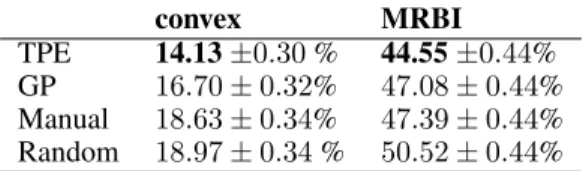
TPE 14.13±0.30% 44.55±0.44%
GP 16.70±0.32% 47.08±0.44%
Manual 18.63±0.34% 47.39±0.44%
Random 18.97±0.34% 50.52±0.44%
Table 2: The test set classification error of the best model found by each search rithm on each problem. Each search algo-rithm was allowed up to 200 trials. The
man-ual searches used 82 trials forconvexand 27
trialsMRBI.
Runtime per trial was limited to 1 hour of GPU computation regardless of whether execution was on a GTX 285, 470, 480, or 580. The difference in speed between the slowest and fastest machine was roughly two-fold in theory, but the actual efficiency of computation depended also on the load of the machine and the configuration of the problem (the relative speed of the different cards is different in different hyper-parameter configurations). With the parallel evaluation of up to five proposals from the GP and TPE algorithms, each experiment took about 24 hours of wall time using five GPUs.
7
Discussion
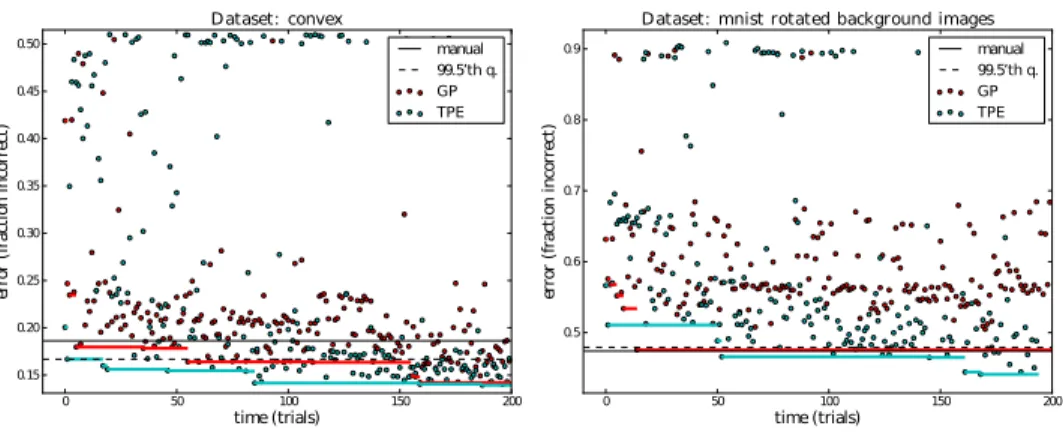
The trajectories (H) constructed by each algorithm up to 200 steps are illustrated in Figure 4, and
compared with random search and the manual search carried out in [1]. The generalization scores
of the best models found using these algorithms and others are listed in Table 2. On theconvex
dataset (2-way classification), both algorithms converged to a validation score of 13% error. In generalization, TPE’s best model had 14.1% error and GP’s best had 16.7%. TPE’s best was sig-nificantly better than both manual search (19%) and random search with 200 trials (17%). On the
MRBIdataset (10-way classification), random search was the worst performer (50% error), the GP
approach and manual search approximately tied (47% error), while the TPE algorithm found a new best result (44% error). The models found by the TPE algorithm in particular are better than pre-viously found ones on both datasets. The GP and TPE algorithms were slightly less efficient than manual search: GP and EI identified performance on par with manual search within 80 trials, the
manual search of [1] used 82 trials forconvexand 27 trials forMRBI.
There are several possible reasons for why the TPE approach outperformed the GP approach in
these two datasets. Perhaps the inverse factorization ofp(x|y)is more accurate than thep(y|x)in
the Gaussian process. Perhaps, conversely, the exploration induced by the TPE’s lack of accuracy turned out to be a good heuristic for search. Perhaps the hyper-parameters of the GP approach itself were not set to correctly trade off exploitation and exploration in the DBN configuration space. More empirical work is required to test these hypotheses. Critically though, all four SMBO runs matched or exceeded both random search and a careful human-guided search, which are currently the state of the art methods for hyper-parameter optimization.
The GP and TPE algorithms work well in both of these settings, but there are certainly settings in which these algorithms, and in fact SMBO algorithm in general, would not be expected to do
well. Sequential optimization algorithms work by leveraging structure in observed(x, y)pairs. It is
possible for SMBO to be arbitrarily bad with a bad choice ofp(y|x). It is also possible to be slower
than random sampling at finding a global optimum with a apparently good p(y|x), if it extracts
structure inHthat leads only to a local optimum.
8
Conclusion
This paper has introduced two sequential hyper-parameter optimization algorithms, and shown them to meet or exceed human performance and the performance of a brute-force random search in two difficult hyper-parameter optimization tasks involving DBNs. We have relaxed standard constraints (e.g. equal layer sizes at all layers) on the search space, and fall back on a more natural hyper-parameter space of 32 variables (including both discrete and continuous variables) in which many
0 50 100 150 200 time (trials) 0.15 0.20 0.25 0.30 0.35 0.40 0.45 0.50 er ro r( fra ct io n in co rr ec t) Dataset: convex manual 99.5’th q. GP TPE 0 50 100 150 200 time (trials) 0.5 0.6 0.7 0.8 0.9 er ro r( fra ct io n in co rr ec t)
Dataset: mnist rotated background images manual 99.5’th q. GP TPE
Figure 4: Efficiency of Gaussian Process-based (GP) and graphical model-based (TPE) se-quential optimization algorithms on the task of optimizing the validation set performance
of a DBN of up to three layers on theconvextask (left) and theMRBItask (right). The
dots are the elements of the trajectoryHproduced by each SMBO algorithm. The solid
coloured lines are the validation set accuracy of the best trial found before each point in time. Both the TPE and GP algorithms make significant advances from their random ini-tial conditions, and substanini-tially outperform the manual and random search methods. A
95% confidence interval about the best validation means on theconvextask extends 0.018
above and below each point, and on theMRBItask extends 0.021 above and below each
point. The solid black line is the test set accuracy obtained by domain experts using a combination of grid search and manual search [1]. The dashed line is the 99.5% quan-tile of validation performance found among trials sampled from our prior distribution (see Table 1), estimated from 457 and 361 random trials on the two datasets respectively.
variables are sometimes irrelevant, depending on the value of other parameters (e.g. the number of layers). In this 32-dimensional search problem, the TPE algorithm presented here has uncovered new best results on both of these datasets that are significantly better than what DBNs were previously believed to achieve. Moreover, the GP and TPE algorithms are practical: the optimization for each dataset was done in just 24 hours using five GPU processors. Although our results are only for DBNs, our methods are quite general, and extend naturally to any hyper-parameter optimization problem in which the hyper-parameters are drawn from a measurable set.
We hope that our work may spur researchers in the machine learning community to treat the hyper-parameter optimization strategy as an interesting and important component of all learning
algo-rithms. The question of “How well does a DBN do on theconvextask?” is not a fully specified,
empirically answerable question – different approaches to hyper-parameter optimization will give different answers. Algorithmic approaches to hyper-parameter optimization make machine learning results easier to disseminate, reproduce, and transfer to other domains. The specific algorithms we have presented here are also capable, at least in some cases, of finding better results than were pre-viously known. Finally, powerful hyper-parameter optimization algorithms broaden the horizon of models that can realistically be studied; researchers need not restrict themselves to systems of a few variables that can readily be tuned by hand.
The TPE algorithm presented in this work, as well as parallel evaluation infrastructure, is available as BSD-licensed free open-source software, which has been designed not only to reproduce the results in this work, but also to facilitate the application of these and similar algorithms to other
hyper-parameter optimization problems.1
Acknowledgements
This work was supported by the National Science and Engineering Research Council of Canada, Compute Canada, and by the ANR-2010-COSI-002 grant of the French National Research Agency. GPU implementations of the DBN model were provided by Theano [23].
1
References
[1] H. Larochelle, D. Erhan, A. Courville, J. Bergstra, and Y. Bengio. An empirical evaluation of deep architectures on problems with many factors of variation. InICML 2007, pages 473–480, 2007. [2] G. E. Hinton, S. Osindero, and Y. Teh. A fast learning algorithm for deep belief nets.Neural Computation,
18:1527–1554, 2006.
[3] P. Vincent, H. Larochelle, I. Lajoie, Y. Bengio, and P. A. Manzagol. Stacked denoising autoencoders: Learning useful representations in a deep network with a local denoising criterion. Machine Learning Research, 11:3371–3408, 2010.
[4] Y. LeCun, L. Bottou, Y. Bengio, and P. Haffner. Gradient-based learning applied to document recognition. Proceedings of the IEEE, 86(11):2278–2324, November 1998.
[5] Nicolas Pinto, David Doukhan, James J. DiCarlo, and David D. Cox. A high-throughput screening ap-proach to discovering good forms of biologically inspired visual representation. PLoS Comput Biol, 5(11):e1000579, 11 2009.
[6] A. Coates, H. Lee, and A. Ng. An analysis of single-layer networks in unsupervised feature learning. NIPS Deep Learning and Unsupervised Feature Learning Workshop, 2010.
[7] A. Coates and A. Y. Ng. The importance of encoding versus training with sparse coding and vector quantization. InProceedings of the Twenty-eighth International Conference on Machine Learning (ICML-11), 2010.
[8] F. Hutter.Automated Configuration of Algorithms for Solving Hard Computational Problems. PhD thesis, University of British Columbia, 2009.
[9] F. Hutter, H. Hoos, and K. Leyton-Brown. Sequential model-based optimization for general algorithm configuration. InLION-5, 2011. Extended version as UBC Tech report TR-2010-10.
[10] D.R. Jones. A taxonomy of global optimization methods based on response surfaces. Journal of Global Optimization, 21:345–383, 2001.
[11] J. Villemonteix, E. Vazquez, and E. Walter. An informational approach to the global optimization of expensive-to-evaluate functions.Journal of Global Optimization, 2006.
[12] N. Srinivas, A. Krause, S. Kakade, and M. Seeger. Gaussian process optimization in the bandit setting: No regret and experimental design. InICML, 2010.
[13] J. Mockus, V. Tiesis, and A. Zilinskas. The application of Bayesian methods for seeking the extremum. In L.C.W. Dixon and G.P. Szego, editors,Towards Global Optimization, volume 2, pages 117–129. North Holland, New York, 1978.
[14] C.E. Rasmussen and C. Williams.Gaussian Processes for Machine Learning.
[15] D. Ginsbourger, D. Dupuy, A. Badea, L. Carraro, and O. Roustant. A note on the choice and the estimation of kriging models for the analysis of deterministic computer experiments. 25:115–131, 2009.
[16] R. Bardenet and B. K´egl. Surrogating the surrogate: accelerating Gaussian Process optimization with mixtures. InICML, 2010.
[17] P. Larra˜naga and J. Lozano, editors.Estimation of Distribution Algorithms: A New Tool for Evolutionary Computation. Springer, 2001.
[18] N. Hansen. The CMA evolution strategy: a comparing review. In J.A. Lozano, P. Larranaga, I. Inza, and E. Bengoetxea, editors,Towards a new evolutionary computation. Advances on estimation of distribution algorithms, pages 75–102. Springer, 2006.
[19] J. Bergstra and Y. Bengio. Random search for hyper-parameter optimization. The Learning Workshop (Snowbird), 2011.
[20] A. Hyv¨arinen and E. Oja. Independent component analysis: Algorithms and applications. Neural Net-works, 13(4–5):411–430, 2000.
[21] J. Bergstra and Y. Bengio. Random search for hyper-parameter optimization. JMLR, 2012. Accepted. [22] C. Bishop. Neural networks for pattern recognition. 1995.
[23] J. Bergstra, O. Breuleux, F. Bastien, P. Lamblin, R. Pascanu, G. Desjardins, J. Turian, and Y. Bengio. Theano: a CPU and GPU math expression compiler. InProceedings of the Python for Scientific Comput-ing Conference (SciPy), June 2010.