Data Sharing between Different Databases
Florian e
ckkrAmmer1– Rainer f
elDBAcher2– Tobias e
ckkrAmmer21FH Technikum Wien 2University of Vienna
{florian.eckkrammer; tobias.eckkrammer}@technikum-wien.at [email protected]
Abstract
In spite of the benefits of globalization research, the integration of the potential of archaeological platforms spanning over multiple projects and excavations is rarely employed due to self-imposed limits. Scientists must be convinced of the advantages of shared approaches to store, describe and maintain data obtained from excavations, findings in particular, publications and interdisciplinary information. The user (data owner) is still in full control of the data exchange process and can decide which data to share with other selected users. Hints should be given as to what kind of finds and contexts have been found. The more members and more different disciplines join, the broader the network and the greater the opportunity for cross disciplinary research. A complete linkage makes direct communication with others or the combing of excavation reports obsolete. The answers to questions queried concerning examinations would be covered by means of metadata.
Keywords
Data exchange, database, data mapping, CIDOC CRM, data accessibility, data availability, archaeological excavations, description lists, peer to peer data exchange, datasharing
1. Introduction
Archaeologists have one crucial problem – they are currently not able to search all the existing information
about the topic they are working on at the moment.
Conversely, they are not able broadcast their new
findings and results of research to other colleagues.
As a result they are condemned to search a bunch
of new publications for novelties every month. If
important information for their studies is published
in a range of books they do not search (either they do not know it or cannot access it) they will most likely miss it or will discover it with a great delay.
The ongoing globalization affects all areas of
science. This results in cumulative networking and in a broad information and knowledge exchange. The exchange does not only take place in one field of knowledge; it is more like an exchange over several domains. The other domains can be used to provide
alternative perspectives or to contribute some tech
nical methods. The results will allow a greater
breadth of understanding than a monolithic ap proach
based on the techniques, methods and knowledge of one field. These steps have already been done by archaeologists. This could be seen in (just to name a few exsamples) the employment of 3D laser scanner
on excavations, digital storage and recording of
blueprints (CAD systems) and the identification via
dendrochronology as well as the usage of different
databases.
As long as these criteria are not achieved, it will
not be possible to avail the benefits of globalization in the field of archaeology.
It is not the intention of the article to tackle all these problems nor would it be possible. All the
problems and approaches to solution described in this article refer to the data management and
documentation of archaeological excavations. To
express the intention of the authors in an abstract
way, it could be said that the objective is to create
a holistic method for capturing, managing and releasing the data of excavations under consideration
of the knowledge of other projects as well as the exchange between them. To get to this point it is necessary to make the data exchangeable and available to others. In succession it would be possible to cumulate the data over a large scale of projects for semantic agents. These agents could search the data pool. To reveal the ancient macrocosm, the self-imposed limits must be forgotten in order to look at new horizons, as even distant regions influence each other due to trade, expansion and resulting conflicts.
Therefore it is possible to identify new coherences and
But in the actual situation research is still kept rudimentary and fragmentary. The tools currently used do not provide the functionality. At the beginning of the article the most common techniques
for storing data in archaeological excavations will be
listed and discussed. Afterwards six critical problems will be isolated and the approaches visualized.
2. Different methods of documentation in excavations
Based on an analysis carried out by F. Eckkrammer
et al. (2007) of different excavations organized by different countries such as Austria, Germany, Denmark, Sweden, Canada and the UK, the methods
of documentation could be categorized as follows: – Non-computer-based documentation
– Documentation with text processing SW
– Documentation with spreadsheet SW
– Documentation with database SW
– Server centered database
In this probe the criterion for the groups was the
system used for saving the data. The documentation
was done based on the following areas: – Textual Documentation
– Drawings & measuring data
– Photos1
– Integration of ancillary sciences
This results in the following six core problems related to the attributes of exchangeability and ease of access:
– Different database systems
– Different data structure
– Different description lists
– Different language
– Different accessibility
– Lack of knowledge about relevant DB’s
3. Description of main problems
3.1. Different database systems and data structure
Currently different database (DB) systems are used. The number of database platforms used is equal to the number of vendors of such systems. The data of many projects are stored in word processing or spreadsheet software. But processing data stored in
such systems is – similar to handwritten information – very challenging and additional transformations are necessary in order to integrate them into the later
described workflow.
The different data structure results not from the
choice of the DB system or other technical conditions but from the stored findings and data. If for example
a database predominantly contains pottery, the lists
for categorization of the pottery would be worked out in a very detailed way. On the other hand the
–––––––––––––––––––––––––––––––––––––––
1 Just to name some possibilities: onset of aerial photo, photo interpretation, and stereo-photography.
description of metal or wood pieces would not be so
detailed.
3.2. Different description lists
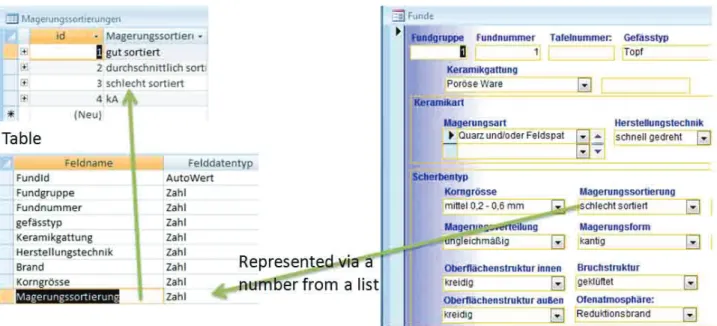
As a consequence of different data structures, each project uses its own lists to describe the records. A
list stores all the data which could be selected from
– for example a dropdown field or selection boxes. Such lists are often used to describe attributes like
record type, sherd type, material, hardness and
others. Fig. 1. shows the lists system.
The design and content of these lists depends – analogous to the data structure – on the different
record types. The lists assure that the data is structured within an application. Based on such lists it is easy to run queries, save time during data collection and to avoid literal errors. But this (desirable) structuring
will be obsolete if the content is provided to other
projects because each project uses its own set of lists. Consequently, such lists are not useable for cross project data exchange unless further transformations are applied.
3.3. Different language
The aspired cross linking between projects raises the issue of different languages. The majority of records are stored in the mother tongue of the project group. This impedes automatic queries and reporting.
3.4. Different accessibility
Depending on the technical solution and the system architecture, the accessibility of the systems differs. Some applications run on local computers and therefore cannot be accessed by others. If other persons need access, the records have to be copied. If one side makes some changes (e.g. a project member) they do not affect the source. Thus, collaboration is very difficult (F. Eckkrammer et al. 2007). A big
threat to such single user solutions could be data loss, for example caused by a hardware defect, a virus or
burglary.
Some advanced systems are already connected
to the internet and are accessible no matter where
the user is located. Such software designs allow collaborative work within the project team. However,
few systems contain interfaces for data exchange to external applications or possibilities to abstract data
or to tag them with security constraints.
The widely used system architecture of isolated applications builds the basic problem addressed by
this paper.
3.5. Lack of knowledge about relevant DB’s
Many groups of researchers are working in similar fields and deal with similar archaeological questions.
Therefore they are in need for the same information
(=data). Because of these isolated systems,
archae-ologists have to deal with the problem that only
a small group can access or even knows about this particular information.
A discussion of several approaches to solution
follows the listing of the core problems. As pointed out in this chapter, the problems intertwine. The approaches are listed so as to make increasing cross linking and interoperability possible.
4. Description of approaches
4.1. Different database systems and data-structure
To solve this issue two different methods were tested:
1) Standardisation 2) Data mapping
Ad 1)
The efforts to create a set of standard attributes cross cutting periods and cultures result in a very large and
inflexible set of attributes. An additional drawback was that this new format only addresses new projects and does not provide a solution for existing ones. Consequently the intention of standardization was subordinated to the second approach.
Ad 2)
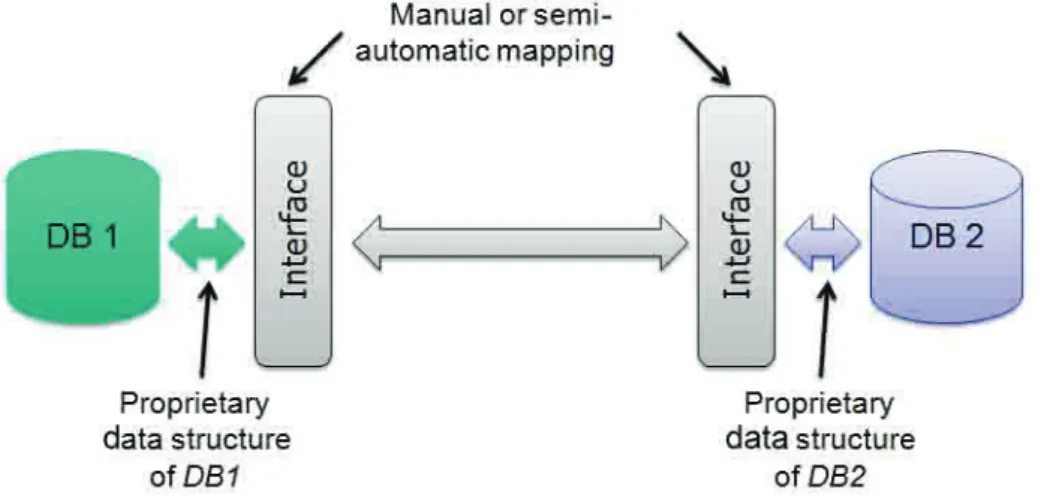
During the mapping process databases are wrapped by an interface. The interface defines a mapping from the local attributes to the attributes of the interface. The interface uses a standard like the CIDOC CRM model (ISO 21127 standard). This process is called mapping. Several tools for mapping data to the CIDOC CRM model are already available. Additionally the
interface has layers where security, data sharing and
user settings can be taken into account.
Fig. 2. shows the concept of data sharing/ exchange between two different databases via two
from one interface to the other
in a standardized format. The
receiving system (which has also mapped the attributes to the interface) receives the data
and maps it back to the local/ own format. Also linking of data
between databases as well as
change notifications would be supported.
However, the mentioned
approach did not address the discovery of relevant
database systems.
Therefore the concept would be extended with a
set of metadata. Those metadata describe the content
of the database/system in a structured way so that it
could be processed automatically.
The metadata contain, among other entries, data
like: – LanguageCode – Connection strings – Custodian – Licence Types – Sitenames – Site Location – Categories
To distribute the metadata, two methods are supported:
– Centralized metadata Server
– Distributed /peer-to-peer concept
For the first option each database submits the metadata to a centralized server. This server can handle search requests and provide the information to the clients.
The second approach
works like a peer-to-peer system. Each database
collects the metadata collection from the
requesting database and stores it locally. After requested by another these
two systems exchange
all metadata as well. The
concept is shown in the
Fig. 3.
The next step should provide a solution for the
usage of different lists to describe properties of a
record as well as the usage of different languages. To
solve this issue an approach from the eHealth sector
was adapted for the archaeologists.
The lists will be identified via OID numbers which are worldwide unique identification numbers. Each institution or person can get such numbers. This OID and some other attributes could be used to describe the lists in a unique and assignable way. The identification string could be fragmented so that a wide range of sub-groups would be possible.
The following attributes are used to describe a list: – codeSystem – codeSystemName – code – displayName – codeSystemVersion
This information would be added to the records
during the exporting or sharing process. Other
databases could easily identify the used description
lists.
Fig. 2. Data exchange via the interface.
The example shown below describes a shape/the
usage of a finding:
– codeSystem: 1.3.6.1.4.1.32.12176.1
– codeSystemName: pottery descrip tion List of Celtic Museum Hallein (Dürrnberg)
– codeSystemVersion: V1.0.10
– code: 207
– displayName bowl
Thereby the codeSystem describes the list which
is used to describe the finding by the OID number.
The codeSystemName describes the list in a
human readable manner (the name of the list). The
usage of a codeSystemVersion allows updating the
list. The code attribute describes the selected entry
(row) of the list by a unique number (unique number inside the list). And the displayName describes the
selected list entry in a human readable manner. Due to the usage of a centralized registry the
lists could be translated (semi)automatically by
the server. Hence the multi-language issue is also addressed. Of course not all description attributes
are entered via lists, but the translation of the lists is
at least a beginning. So cross language data exchange would be possible. The metadata entries could also be translated automatically if centrally stored.
5. Conclusion
In this paper we have described approaches to some core problems which have to be solved in order
to facilitate the cross linking of currently isolated databases which would make project crossing queries and automated searching possible. In a nutshell the objective is to create a holistic way for capturing,
managing and releasing data of excavations under
consideration of the knowledge of other projects as well as the exchange between them. We have
demonstrated the advantage of the approaches and of
the cross linking by several examples. The benefit of
providing consistently structured data over different
projects and the fact that this approach is meant
to use available databases without editing existing
databases itself highlights the genuine property of
this approach.
6. Perspective
Recognizing the larger pattern in the development of human culture it appears more important to establish
connections between single excavations, projects, or museums. That is the way to evince distribution of
goods2 and not just pointing to certain contacts due
to imports. To name an example for clarification, questions for a tomb could be:
– Where is it located? – How is it arranged?
– Which period can be observed?
Another topic could be comparisons of intangible culture as language and signs3 leading to a better understanding of archetypes or coincidental parallels
between objects.
Different viewing angles are possible: On the one hand it is essential to couple all questions as chronological or regional parallels concerning objects or structures. On the other hand – meant in literal
sense – an observation of an excavation site can be made either from above (beginning with the position
of the site down until the object) or from the side,
allowing the interpretation of stratigraphy, offering
a multi-layered and complex sequence of dynamics due to innumerable events.4
Thanks to technical development, a lot is possible nowadays. But a difficult step is convincing members to exchange the data with others. The more members (of more different disciplines) join, the better the global research.
Descriptions of finds are still far away from being homogenous. Nevertheless all of them could be
embedded or integrated for a more elaborated and
detailed typology. There are still some uncertainties. For example the problem, how finds from different
regions and epochs can be described in a standardized
way. Simplifying the handling of a large amount of finds during the creation of typologies/definitions
and/or catalogues is important, also as criterion
–––––––––––––––––––––––––––––––––––––––
2 That knowledge also allows interpretations regarding transfers of intangible assets as knowledge, ideas and religion. 3 There are already first steps working on sign formation and lexical ontologies in a cross-cultural perspective.
4 Each point of view – be it objects or structures – consists of data, photographs, drawings with measurement, or integrated
geo-data and can be examined separately. Through cross-references it is possible to associate a find to a region, a culture, an excavation, or whatever is necessary for the research. Interactive maps (as satellite photos, morphological plans, etc.) with either an entire overview or within a chronological frame, can be linked to each other.
for scientists whose pursuit is generally outside of
certain considerations. This is important to bring more transparency and to make scientists able to
communicate and discuss with others beyond their
specialization.
The opportunities of being interlinked throughout
the world are not yet used in some sciences on a scale
as they should be.
References
Droysen, Johann Gustav (19939). Historik, Vor lesungen über Enzyclopädie und Methodologie der Geschichte.München.
Eckkrammer, Florian, Tobias Eckkrammer and Rainer Feldbacher (2008). Possibilities to
exchange, map, and administer finds from
different archaeological projects within databases. Kulturelles Erbe und neue Technologien. Workshop 12 – Archäologie und Computer. Wien.
Leclant, Jean (ed.) (1996). Archeologia. Percorsi Virtuali nelle Civilta´ Scomparse. Milano: Mondadori.