U
NIVERSITY OF
Y
ORK
C
OMPUTER
S
CIENCE
D
OCTOR OFP
HILOSOPHYReservoir Computing in
Materio
Author:
Matthew Nicholas D
ALESupervisors:
Prof. Susan S
TEPNEYDr. Martin T
REFZERAbstract
Reservoir Computing first emerged as an efficient mechanism for training recurrent neural networks and later evolved into a general theoretical model for dynamical systems.
By applying only a simple training mechanism many physical systems have become ex-ploitable unconventional computers. However, at present, many of these systems require
careful selection and tuning by hand to produce usable or optimal reservoir computers. In this thesis we show the first steps to applying the reservoir model as a simple
com-putational layer to extract exploitable information from complex material substrates. We argue that many physical substrates, even systems that in their natural state might not
form usable or “good” reservoirs, can be configured into working reservoirs given some stimulation. To achieve this we apply techniques from evolutionin materiowhereby con-figuration is through evolved input-output signal mappings and targeted stimuli.
In preliminary experiments the combined model and configuration method is applied
to carbon nanotube/polymer composites. The results show substrates can be configured and trained as reservoir computers of varying quality. It is shown that applying the
reser-voir model adds greater functionality and programmability to physical substrates, without sacrificing performance. Next, the weaknesses of the technique are addressed, with the
creation of new high input-output hardware system and an alternative multi-substrate framework. Lastly, a substantial effort is put into characterising the quality of a sub-strate for reservoir computing, i.e its ability to realise many reservoirs. From this, a meth-odological framework is devised. Using the framework, radically different computing
substrates are compared and assessed, something previously not possible. As a result, a new understanding of the relationships between substrate, tasks and properties is possible,
Contents
1 Introduction 1
1.1 Unconventional Computing . . . 2
1.2 Configuring Matter to Compute . . . 4
1.3 Research Hypothesis and Thesis Overview . . . 6
2 Context 8 2.1 Material Computation . . . 8
2.1.1 The effects of criticality on complexity . . . 9
2.1.2 Configuration and structure . . . 10
2.1.3 Analogue computers . . . 11
2.2 Evolutionin materio . . . 13
2.2.1 Computation in Liquid Crystal . . . 15
2.2.2 NASCENCE project: Carbon nanotube substrates . . . 16
2.2.3 Summary . . . 18
2.3 Reservoir Computing . . . 18
2.3.1 Echo State Network . . . 20
2.3.2 Liquid State Machine . . . 21
2.3.3 Neuroscience . . . 22
2.3.4 Reservoirs and kernels . . . 23
2.3.5 Reservoirs and criticality . . . 24
2.3.6 Training reservoirs . . . 26
Off-line training . . . 26
On-line training . . . 29
2.3.8 Reservoir Computing with Unconventional Substrates . . . 31
2.3.9 Summary . . . 33
3 Evolving Reservoir Computers 35 3.1 Carbon Nanotube Reservoir Computing . . . 35
3.1.1 Carbon nanotube-polymer composite . . . 35
3.2 Hardware Setup . . . 37
3.3 Training and Evolution . . . 38
3.3.1 Evolutionary Algorithm and Representation . . . 39
3.3.2 Training cycle . . . 39
3.4 Benchmark Tasks . . . 42
3.4.1 NARMA task . . . 42
3.4.2 Wave generator task . . . 43
3.5 Results . . . 43
3.5.1 Control Substrates . . . 43
3.5.2 Nanotube Density and Stability . . . 45
3.5.3 Memory Capacity . . . 45
3.5.4 Harmonic Generation . . . 46
3.5.5 Comparison to other Substrates . . . 47
3.6 Summary . . . 49
4 Analysis of the Reservoir Computingin materio 51 4.1 Comparisons to Random Search . . . 52
4.2 Input Mechanisms . . . 52
4.3 Time-scaling . . . 54
4.4 Training Process and Encoding . . . 55
4.4.1 Benchmark: Santa Fe Time-Series Prediction . . . 56
4.5 Results . . . 57
4.5.1 Random Search . . . 57
4.5.2 Input-Weighting and Time-Scaling . . . 58
4.5.3 Repeatable Performance . . . 59
CONTENTS
4.5.5 Potential Limitations . . . 62
4.6 Summary . . . 63
5 Exploiting Low-level Evolution and High-level Abstraction 64 5.1 Training . . . 65
5.1.1 Benchmark: Fishers’ Iris Classification . . . 66
5.2 Results . . . 67
5.2.1 Direct vs. Abstraction . . . 67
5.3 Reservoirsin materiovs. in silico . . . 69
5.3.1 Interpreting Reservoir Characteristics . . . 71
5.3.2 Identifying Substrate Patterns . . . 73
5.3.3 Breaking Temporal Dependencies . . . 74
5.4 Summary . . . 75
6 An Extended Hardware Platform 77 6.1 Input-Output Complexity Problem . . . 77
6.2 Extended Hardware Platform . . . 78
6.2.1 Signal Routing . . . 79
6.2.2 Micro-electrode Arrays . . . 81
6.2.3 Fabrication Process of Nanotube Composites . . . 82
6.2.4 Substrate Housing . . . 83
6.3 Measurements and Stability . . . 84
6.4 Genetic Representation . . . 85
6.5 Isolating the Substrate . . . 87
6.6 Multi-Substrate Housing . . . 89
6.7 Summary . . . 90
7 Hierarchical and Modular Reservoir Computers 91 7.1 Limitations of Reservoirs . . . 91
7.2 Hierarchical Reservoir Computers . . . 93
7.2.1 Reservoir of Reservoirs . . . 93
7.4 Optimisation: Microbial GA . . . 97
7.4.1 Mutation and Recombination . . . 98
7.5 Benchmarks . . . 100
7.6 Results . . . 101
7.6.1 Neuroevolution – A Single ESN . . . 101
7.6.2 Neuroevolution – Hierarchical ESNs . . . 101
7.7 Task Generalisation . . . 103
7.8 Future Work with RoRs . . . 107
7.9 Summary . . . 107
8 Characterising SubstrateQualityfor Reservoir Computing 110 8.1 How Do We Measure Quality? . . . 111
8.2 The SQuARC Framework . . . 112
8.2.1 Definition . . . 113
8.2.2 Exploration & Mapping . . . 114
8.2.3 Evaluation . . . 114
8.2.4 Learning and Application . . . 115
8.3 Task-Independent Properties . . . 116
8.3.1 Chaos and Criticality . . . 117
8.3.2 Kernel Quality and Generalisation Rank . . . 118
8.3.3 Memory Capacity . . . 119
8.3.4 Class separation . . . 119
8.3.5 Information Theory . . . 121
8.4 Behaviour Exploration . . . 123
8.4.1 Objective-Based Evolutionary Algorithms . . . 123
8.4.2 Novelty Search . . . 124
8.4.3 Novelty Search Implementation . . . 126
8.5 Applied to Echo State Networks . . . 129
8.5.1 Measuring Quality . . . 129
8.5.2 Experimental Parameters . . . 130
CONTENTS
8.5.4 Discovering Parameter Patterns . . . 134
Weight matrix scaling . . . 134
Input scaling . . . 135
Sparsity/connectivity of the weight matrix . . . 137
Density of the input weight matrix . . . 138
Leak rate . . . 139
Conclusion . . . 139
8.6 Representation and Predicting Performance . . . 140
8.6.1 Prediction Tasks . . . 140
8.6.2 Experimental Set-up . . . 141
8.6.3 Prediction Results . . . 142
8.7 Completing the Framework . . . 144
8.7.1 Experimental Parameters . . . 145
8.7.2 Quality of Physical Substrate . . . 146
8.7.3 Prediction transfer . . . 149
8.8 Summary . . . 152
9 Conclusion and Future Work 155 9.1 Outcomes of Thesis . . . 155
9.1.1 Thesis Chapter Summary . . . 156
9.2 Future Work . . . 164
9.2.1 The RoR Architecture . . . 165
9.2.2 Heterotic Computing . . . 166
9.2.3 Reservoir Computingin materioFramework . . . 166
9.2.4 The SQuARC framework . . . 167
9.2.5 Framework-in-the-loop Hardware Design . . . 168
A Hardware Platform Designs 170 A.1 Routing Board Ideas . . . 171
A.2 Routing Board Designs . . . 172
A.3 Electrode Masks . . . 180
A.5 Multi-Substrate Housing and LED Designs . . . 187
B SQuARC: Supplementary ESN Plots 188
C Dynamic Archive or All Behaviours? 198
D Multi-Thread SQuARC Framework 201
List of Tables
3.1 Wave Generator results for an input 1 kHz sine wave. Test Error is given for 10 runs. . . 47
3.2 Best wave generator results compared to best Atomic Switch Network [183]. Test Error (Mean Squared Error) given for best configuration on
best material (PBMA 0.53%). . . 48
4.1 The minimum, mean and standard deviation of the test error (NRMSE) for both search methods across 10 runs. . . 57
4.2 Comparison table of other reservoir computing systems, with our system highlighted. . . 61
5.1 RCiM compared to EiM. Average (mean) accuracies (in percentages) are shown for training and test data. For RCiM, standard deviation (std) is
provided. . . 68 5.2 Wilcoxon/Mann-Whitney (U) and Vargha-DelaneyAeffect sizes, between
different density materials and the control. . . 69 5.3 Wilcoxon/Mann-Whitney (U) and Vargha-DelaneyAeffect sizes, between
PBMA 1% material and simulated reservoirs. . . 70
6.1 EncodingGfor Reservoir and Substrate Configuration. . . 86
7.1 Hyperparameters for Microbial GA. . . 99 7.2 NARMA performance of LI-ESN(M-GA) compared to random LI-ESNs
and other reservoir techniques. Standard deviationσand minimum errors
7.3 Results of evolved architectures for the NARMA-10 and NARMA-30
tasks. Mean NMSE and standard deviation are given for multiple ar-chitecture sizes, with the lowest highlighted. The LI-ESN outperforms
List of Figures
2.1 Configurable Analogue Processor (CAP): material is reconfigured to solve some computational task through applied input signals [134] . . . 15
2.2 Micro-electrode array used in the NASCENCE project to contain, stimu-late and record activity in a carbon nanotube-based substrate. Computer
controlled evolution is used to select active electrodes and mode (i.e. re-cord or stimulate) . . . 16
2.3 Example three-layer recurrent neural network. . . 20 2.4 Echo State Network taken from [117] . . . 21
2.5 Applying the reservoir model we argue that any material, and subsequent configuration, can represent reservoirs of varying quality. Pre-training
through configuration is therefore used to find and discover functional/useful reservoirs within all possible material states. We also argue that there is a
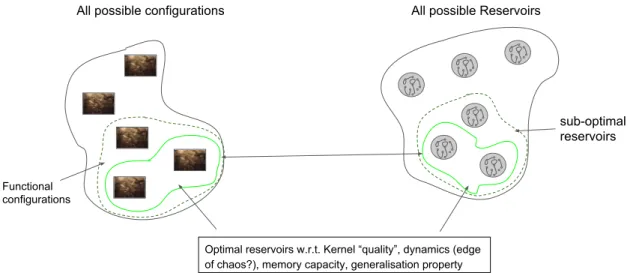
region that optimal reservoirs exist where convenient informational meas-ures (“metrics”) perform best. . . 33
3.1 Substrates under test. Top left, SWCNT/PBMA mixture with a concen-tration of 1% SWCNT by weight. Top right, SWCNT/PBMA 0.53%.
Bottom left, gold resistor array. Bottom right, SWCNT/PMMA 0.1% . . . 36 3.2 Hardware Interface. PC stimulates material via routing matrix. . . 38
3.3 Physical reservoir representation using electrodes. Each assigned readout electrode (ROn) forms the reservoir state. The configuration voltages (Vn) location and value are decided by evolution. TheWoutmatrix is calculated and applied in the digital domain. . . 40
3.4 Reservoir work flow through time: combined evolution and regression
training procedure. Generational loop highlights the switch assignment process and training/validation process. The final evaluation process of
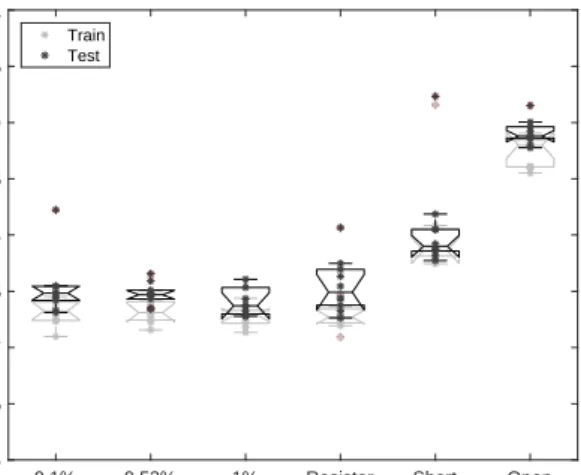
the found solution is expanded. . . 40 3.5 NARMA-5 plot of train and test error of 10 runs across all materials
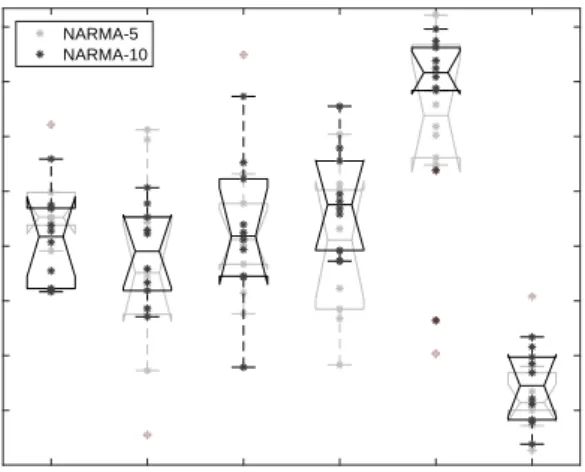
(lower error is better fitness). . . 44 3.6 NARMA-10 plot of train and test error of 10 runs across each material. . . 44
3.7 Memory Capacity of all test subjects post-evolutionary configuration, across 10 runs. . . 46
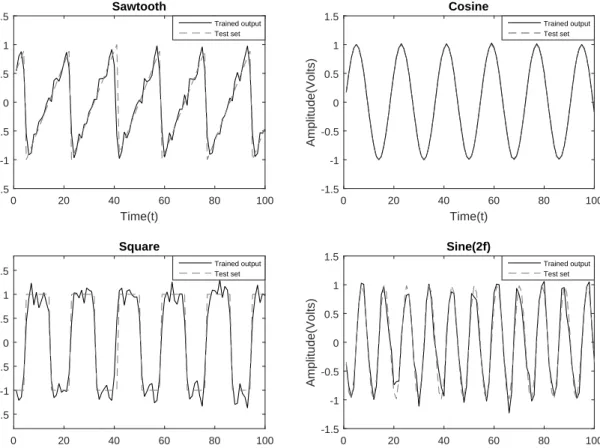
3.8 Trained reservoir output (PBMA 0.53%) plotted against the desired out-put for each waveform. All waveforms are trained and outout-putted
simul-taneously. . . 48 3.9 Power Spectral Density of readout states on the wave generator task for
the PBMA 0.53% material. The main plot shows an increase in harmonic behaviour when the material is “configured”. The subplot shows the
un-modified material given an input 1 kHz sine-wave. . . 49
4.1 Example input mechanisms; a) configuration through static voltages, and
b) using multiple weighted inputs to various locations on the array. For the input-weighting scheme, each input ui(n) is multiplied by a weight stored in the genotype. . . 53 4.2 Example Genotype. Any gene within the first 16 genes, ≥13 represents
a configuration or weighted input. Genes 17 to 20 represent the static voltage input or input signal gain depending on the input mechanism in use. 55
4.3 Errors using controls, input-weighting and time-scaling: (A) control sig-nals with no time-scaling; (B) control sigsig-nals and time-scaling; (C)
input-weighting with no time-scaling; (D) input-input-weighting and time-scaling. . . 58 4.4 Evolutionary runs of each material with both time-scaling and input-scaling
applied. Variation in error, both here and in Table 4.1, suggests the search space complex and dependent on nanotube density. . . 59
LIST OF FIGURES
4.5 A graph of the percentage change in error from the original evolved test set NRMSE of 0.195 over different time periods. This is shown for the best reservoir found with the SWCNT/PBMA 1% material using both
time-scaling and input-weighting. . . 60
5.1 Example input-output mapping for Iris task. . . 67
5.2 Evolved accuracies of each material for the Iris task; training accuracy (blue, left) and test accuracy (red, right). . . 67
5.3 Experimental results of three simulated reservoirs and the 1% PBMA ma-terial; training accuracy (blue, left) and test accuracy (red, right). . . 70
5.4 Parameters and Iris performances of three evolved Echo State Network sizes. . . 72
5.5 Visualisation of common evolved electrode patterns. . . 74
6.1 Hardware Reservoir System. Micro-electrode housing, routing switch
board and CNT/polymer deposited onto PCB electrode array. . . 78 6.2 Pictures of both routing boards. . . 80
6.3 Micro-electrode array designs. a) example from NASCENCE project. b) new 64-electrode design. . . 81
6.4 Housing for PCB; connecting substrate to routing board to PC. . . 83 6.5 Two LED designs printed on PCBs. . . 87
6.6 Multiplexed analogue-to-digital converter (ADC) from National Instru-ments documentation on “ghosting”. . . 88
6.7 Multi-substrate Housing. . . 89
7.1 Reservoir-of-Reservoirs (RoR) architecture: a) only one sub-reservoir is
supplied with the input u, b) all sub-reservoirs have access to the input
u. Each sub-reservoir has independent parameters, such as biases bi and leak rateαi. All statesxiare used for readout training. . . 94
7.2 Hierarchical architectures: a) Ensemble of independent sub-reservoirs,
b) Pipeline of sub-reservoirs with input u only at first sub-reservoir, c) Pipeline with inputusupplied to every sub-reservoir. All have independ-ent bias terms bi and use neuron states xn (after leak filter) for readout training. . . 96
7.3 Task performance for each architecture. For all architectures (except M-GA), 100 nodes is equal to 2 sub-reservoirs of 50 nodes, 200 nodes = 2×100 nodes, and 400 nodes=4×100 nodes. The single network (M-GA) produces the lowest errors, followed closely by RoR-IA. . . 104
7.4 Results of evolved networks retrained to laser and H´enon map tasks. . . . 106 7.5 Weight matrices plots of an evolved 200 node RoR-IA network. Matrices
W1,1andW2,2 represent the internal connectivity/weights of the two 100 node sub-reservoirs. MatricesW1,2 andW2,1 show connectivity between
the two sub-reservoirs. . . 108
8.1 Framework levels and building blocks. . . 112
8.2 Example of a 3-Dimensional Behaviour Space. Here each abstract be-haviour is relative to the three chosen property measures. Given enough
time to explore the space, the substrate’s dynamical/behavioural limita-tions become apparent. . . 113
8.3 Separation Ratio Graph [63]. Graphical representation of the phase trans-ition between chaos and order. Systems in the target zone possess both a
good separation property and ideal dynamic behaviour to produce optimal reservoirs. . . 120
8.4 Adapted microbial GA with novelty search. . . 127 8.5 Average coverage (over 10 runs) of behaviour space against number of
generations. Error bars show minimum and maximum coverage. . . 131 8.6 Plot of all behaviours found through novelty search (Red, Top row) and
all behaviours found through random search (Black, Bottom row). . . 132 8.7 A comparison of all experiments shown in fig. 8.5 when plotted as the
LIST OF FIGURES
8.8 W scaling: 100 node ESNs. . . 135
8.9 Input Scaling: 50 node ESN. . . 136
8.10 W connectivity: 25 and 200 node ESNs (novelty search only). . . 137
8.11 Input connectivity: 25 and 200 node ESNs (novelty search only). . . 138
8.12 Mean performance of 20 FFNNs trained and tested on each database (dif-ferent sized ESN), per task . . . 143
8.13 Carbon nanotube composite behaviour space (Red) superimposed on ESN behaviour space (Black) . . . 146
8.14 Comparison of behaviour space covered; carbon nanotubes (Red) and ESNs (Black). . . 147
8.15 Physical substrate: novelty search (red) versus random search (black). . . 148
8.16 The novelty rate (r=θ/generation) of the physical substrate and com-pared with 25 node ESN. . . 149
8.17 FFNN prediction errors of all trained and tested ESNs, and tested on phys-ical substrate. . . 150
8.18 The average difference∆between prediction errors for ESNs trained/tested using same size and physical substrate, across the four tasks: T1 = NARMA-10, T2 = NARMA-30, T3= Laser, T4= Non-linear channel equalisation.). 151 8.19 Framework summary. a) Reference substrate mapped providing a refer-ence quality and learned relationships to predict performance. b) Test substrate is assessed for quality. No task assessment is necessary and learning phase is skipped. Performance of test substrate is predicted us-ing learned relationships from reference. . . 153
B.1 Random Search: Spectral radius relationship to behaviour space. . . 189
B.2 Random Search: Input Scaling relationship to behaviour space. . . 190
B.3 Random Search: Leak rate relationship to behaviour space. . . 191
B.4 Random Search:W connectivity relationship to behaviour space. . . 192
B.5 Novelty Search: Spectral radius relationship to behaviour space. . . 193
B.6 Novelty Search: Input Scaling relationship to behaviour space. . . 194
B.8 Novelty Search:W connectivity relationship to behaviour space. . . 196
B.9 Novelty Search: input connectivity relationship to behaviour space. . . . 197
C.1 All behaviours in the archive versus a dynamic sized archive: behaviour space coverage against number of generations. . . 199
C.2 All behaviours found with “full” archive (Red, Top row) and all beha-viours found with dynamic archive (Black, Bottom row). . . 200
D.1 Total coverage against generations: Parallel versus normal implementa-tion. . . 202
D.2 a) All behaviours found with parallel implementation (Red, Top row) and all behaviours found with normal implementation (Black, Bottom row). b) Behaviours of parallel when set to equal database size. . . 203
D.3 Comparison of behaviour distributions: Parallel versus Normal, with same database size. . . 204
E.1 Bagged Trees: Features=3, Threshold=1. . . 207
E.2 Bagged Trees: Features=3, Threshold=0.8. . . 208
E.3 Bagged Trees: Features=11, Threshold=1. . . 209
E.4 Bagged Trees: Features=11, Threshold=0.8. . . 210
E.5 FFNN: Features=3, Threshold=1. . . 211
E.6 FFNN: Features=3, Threshold=0.8. . . 212
E.7 FFNN: Features=11, Threshold=1. . . 213
E.8 FFNN: Features=11, Threshold=0.8. . . 214
E.9 Multi-Task FFNNs. . . 215
Dedication
First, I want to thank my supervisors Susan, Martin and Julian. Their feedback and encouragement has been resolute throughout my time as a PhD student. The time and
commitment they gave to me and continue to give to their students is inspirational. I want to thank my family for being there throughout my unconventional route to
academia and nudging me at those few critical moments when I needed it most.
Lastly, I want to thank my fianc´e who joined me on this journey. She saw the gradual
descent into madness, with late nights and weekends spent watching “evolution TV”, and the infamous “just five more minutes” turning into several hours. Without her patience,
Funding for this research was given through a Defence Science and Technology Labor-atory (DSTL) PhD studentship.
Declaration
I declare that this thesis is a presentation of original work and I am the sole author. A large portion of the presented work has been published in co-authored papers, however
all work presented is original. This work has not previously been presented for an award at this, or any other, University. All sources are acknowledged as References.
Publications
Dale, M., 2015, October. Unconventional Reservoir Computers: Exploiting Mater-ials to Perform Computation. In Eighth York Doctoral Symposium on Computer
Science & Electronics (p. 69).
Dale, M., Miller, J.F., Stepney, S. and Trefzer, M.A., 2016, July. Evolving
car-bon nanotube reservoir computers. In International Conference on Unconventional Computation and Natural Computation (pp. 49-61). Springer, Cham.
Dale, M., Miller, J.F., Stepney, S. and Trefzer, M.A., 2016, Reservoir Computing: Evolution in materio’s Missing Link. In Ninth York Doctoral Symposium on
Com-puter Science & Electronics (p. 57).
Dale, M., Stepney, S., Miller, J.F. and Trefzer, M., 2016, December. Reservoir
computing in materio: An evaluation of configuration through evolution. In Com-putational Intelligence (SSCI), 2016 IEEE Symposium Series on (pp. 1-8). IEEE.
Dale, M., Stepney, S., Miller, J.F. and Trefzer, M., 2017, May. Reservoir computing in materio: A computational framework for in materio computing. In Neural
Dale, M., Miller, J.F. and Stepney, S., 2017. Reservoir computing as a model for
in-materio computing. In Advances in Unconventional Computing (pp. 533-571). Springer, Cham.
Dale, M., 2018, Neuroevolution of Hierarchical Reservoir Computers. In Proceed-ings of the Genetic and Evolutionary Computation Conference 2018 (GECCO ’18).
ACM.
Konkoli, Z., Nichele, S., Dale, M., and Stepney, S., 2018, Reservoir computing
with computational matter. In Computational Matter (pp. 269-293). Springer.
Dale, M., Miller, J.F., Stepney, S. and Trefzer, M.A., 2018 (submitted) A
Substrate-Independent Framework to Characterise Reservoir Computers. Proceedings of the Royal Society A.
Chapter 1
Introduction
Biological organisms vastly outperform classical/conventional computing paradigms in many respects, from possessing inherent fault-tolerance to constructing highly parallel
machines. Much of this is achieved by exploiting physicality and by sharing and distrib-uting computational effort throughout the spatial system. As such, they exploit physical
interactions through feedback with the real world, utilising features such as their own morphology.
Many of these systems comprise relatively simple elements that emerge and coalesce into more complex, but robust, structural layers across different scales. Such grounding
properties (and many more) have enabled these complex systems to thrive and evolve, adapting and co-evolving in real-time with their local ecosystem.
In modern science, many attempt to mimic the computational properties and beha-viours of biological systems on conventional machines. It is argued here that such
at-tempts can themselves be flawed. Many of these experiments attempt to imitate the per-formance of an embodied system in a non-embodied abstraction, in a process that requires
some transformation to a symbolic representation. In essence, such transformations might detract from many of the physical aspects that make these natural systems so powerful.
The limitations of conventional computing paradigms are well defined; and we are rapidly approaching the limitations of current CMOS technology [115]. For technology
to move forward, many of these limitations need to be solved, whether that be using the same classical paradigms or using alternative ones. For example, conventional computing
math-ematical definitions. However, to solve more complex tasks may require some intractable
properties that cannot be formally defined.
The conventional von Neumann computing architecture, based on the stored-program
computer concept, although expertly refined over decades, poses some fundamental ineffi-ciencies. For example, classical computers require the transformation between high-level
languages to low-level machine code, a process that requires layers of conversion through a compiler stack, making it computationally costly, slow, and highly susceptible to faults
and errors.
These systems typically succumb to many issues in speed, from both an inability
to deal with concurrent computations and the bottleneck created by the transfer of data between separate memory and processing entities. Because of these architectural
weak-nesses, other intertwined issues arise, such as an increase in power consumption, system size, and top-down design complexity.
1.1
Unconventional Computing
Unconventional computing tries to address some of the above limitations by attempt-ing to provide alternative architectures and systems that typically exploit the underlyattempt-ing
physics and many-scale interactions of the real world. Many forms of unconventional
systems have been explored in recent years.
For example, quantum computing is one such system, where two-state quantum bits,
typically described by electron or photon spin/polarisation, can be exploited to perform large numbers of parallel computations (i.e. 2no. of qubits). This is achieved through the
principles of superposition, enabling a qubit to be in both states simultaneously (see [175] for a review).
Another example is reaction-diffusion computing [4], which performs computation through local chemical reactions and diffusion. By using chemical processes, the
sys-tem can execute highly parallel computations, performed by the complex interactions of propagated waves of information caused by local disturbances. The result of such
com-putations are stored, or encoded as the concentration profiles of the chemical reagents. Physarum polycephalum (slime mould) is currently under investigation as an excitable,
CHAPTER 1. INTRODUCTION
reaction-diffusion medium that could form the basis of a programmable amorphous
bio-logical computer. The Physarum chip, a result of the PhyChip project [5], is described as consisting of networked protoplasmic tubes coated with conductive substances to create a
living non-linear system. Experiments to-date with Physarum have already demonstrated an ability to approximate logic gates and derive combinational logic circuits [201].
Even earlier examples of unconventional systems can be found back in the mid twenti-eth century cybernetics movement in Pask’s experiments with electrochemical assemblages
in ferrous sulphate solutions [30, 154]. Pask attempted to evolve functional dendrite-like structures by passing current directly through immersed electrodes. To determine
the growth of these structures one would simply define which electrodes to pass current between, with the resulting linkage conductance representing synaptic weights. In his
experiments, Pask used manual selection to “evolve” linkages sensitive to perturbations caused by sound, or magnetic fields, to create a self-assembling “ear” that could be trained
to discriminate between different frequencies.
Interdisciplinary research into unconventional computing has shown that many diverse
dynamical systems can be exploited to perform computational tasks [3, 1, 2]. Exploiting computation directly at the substrate-level offers potential advantages over classical
com-puting architectures, such as exploiting physical and material constraints that could offer solutions “for free”, or at least computationally cheaper [178].
Extracting computation from these systems and physicallyprogrammingthem, how-ever, can be very challenging. Sometimes this is further exacerbated by a desire for
min-imal abstraction, i.e., exploiting emergent physical phenomena directly, and wanting a level of programmability that enables the system to perform a variety of tasks.
Hybrid digital-analogue computers have the potential to fulfil these needs, where the digital system is trained to extract computation performed implicitly from an analogue
substrate. Mills’ Kirchhoff-Lukasiewicz Machines (KLM) [136], based on Rubel’s com-putational model of analogue computation (the extended analogue computer [159]), are a
prime example.
For analogue computers the program and architecture may be indistinguishable or
inseparable, i.e., to program the machine requires a change in the machine architec-ture. However, by placing additional layers within the machine’s architecture the amount
of change required is reducible, for example, by adding a standardised reconfigurable
“middle” layer.
In Mills’ KLM device, a middle layer is implemented using Lukasiewicz logic arrays
that perform piecewise linear functions on measured values from the material. To control the logic arrays a vector of bits referred to as the “overlay” [136] is used. This overlay,
representing the semantic “program”, is used to describe the reconfigurable layer that exploits the implicit material function. The computational functions being utilised are
therefore a result of the material’s configuration, typically achieved through the selection of inputs, outputs and control functions/signals.
Mills describes this as a paradigm ofanalogy, [137] where the computing device is not explicitly told to perform an operation and provide a readable output, but rather trained to
exploit an implicit function that results from the material’s configuration.
1.2
Configuring Matter to Compute
Conventional, classic computers are designed to be substrate-independent, where a
symbolic “machine” is highly constrained into physical hardware.
Material/substrate-based computers are conceptual machines in which some
compu-tational process, or physical mechanism, maybe extracted from a behaviourally “rich”
dynamical system. In essence, information processing can be exploited from what the substrate does naturally, for example, how the system reacts and dynamically adapts to
some input stimulus [178]. Informally speaking, this can be viewed as “kicking” the dy-namical system and observing its behaviour to some given stimulus, where the method
of perturbation and observation may vary in type: electrical, mechanical, optical, etc. From this, we speculate as to whether some exploitable process, orcomputation, can be extracted and whether the system can be trained to consistently exploit this process.
Exploiting computation directly from materials offers many potential advantages over
classical systems. As a paradigm, it potentially offers vast amounts of computational power by capitalising on the massive parallelism and natural constraints of these rich
systems.
CHAPTER 1. INTRODUCTION
layer – has been applied to computational composites consisting of randomly dispersed
carbon nanotubes. These semi-conducting substrates are shown to exhibit interesting computational properties across a variety of tasks using computer-evolved configurations
[19]. Applying evolved control signals, the unknown electrical properties of these com-posites are perturbed and trained to produce physical solutions to computational tasks.
Training these composites is done through the evolutionary selection of input-output mappings and evolvable control stimuli, using a technique referred to as evolutionin ma-terio(EiM) [134]. The training method searches for material configurations that display interesting computational features related to a given task, in a vast space of configurations
that is constrained only by physical laws.
To date, research based on the evolutionin materioconcept has showed much prom-ise [19], however, many of the same issues identified earlier in exploratory work has yet to be resolved.
For example, the “analogy” programming method works well, but a middle layer providing some level of abstraction is still missing. This lack of abstraction leads to
scaling problems in both hardware connectivity and task complexity. This limits its use-fulness and applicability, and potentially reduces its adoption by the wider computing
community.
Another fundamental issue is the non-trivial task of analysing what is being exploited,
intrinsically, externally, and in terms of general computational and dynamical properties of the substrate. This is closely linked with how to determine if a substrate is suitably
“rich” to solve computational tasks; and, if the substrate is suitable, what spectrum of tasks are appropriate.
At a basic level, a generic methodology for substrate characterisation is missing. At the moment, too much is expected from the evolution process: we cannot just give the
algorithm Lead and expect it to turn it into Gold. The minimal criteria for evolution
in materio to excel should be assessed on a substrate-by-substrate basis. Therefore, the substrate should be characterised prior to the evolutionary process and its potential de-termined.
1.3
Research Hypothesis and Thesis Overview
The research hypothesis is that a computational framework calledReservoir Comput-ing(RC) can provide solutions to many of the present issues with evolution in materio
(EiM), from providing a layer of abstraction to quantifying computational processes
be-ing exploited in the substrate. A full description of reservoir computbe-ing and how to apply it is given in Chapter 2.
Throughout the thesis, techniques from both EiM and RC are utilised, and where each falters the other is used to provide a solution. Reservoir Computing is not a given in the
thesis, but is itself explored, and its definition expanded.
To test the hypothesis, several unconventional computing devices (based on carbon
nanotube composites) are evolvedin materioand trainedin silico, creating a new hybrid computing framework, referred to here asReservoir Computing in materio(RCiM).
First, the new hybrid computing framework is evaluated directly on machine learning tasks common to RC (Chapter 3). Then it is analysed in greater detail on different tasks
(Chapter 4). Next, RCiM’s combined low-level exploitation and abstraction is evaluated and compared to direct EiM (Chapter 5).
In order to take full advantage of the RCiM approach, a new extended hardware plat-form has been built. Details of its design, limitations and practical considerations when
in-use are outlined in Chapter 6.
In Chapter 7, some limitations of reservoir computers are addressed. Here, ways to
im-prove and extend the RC/RCiM framework are demonstrated with hierarchical reservoir structures, providing greater potential to tackle harder tasks, and perform better across
multiple tasks.
Finally, in Chapter 8, a generic framework is defined to characterise any substrate for
RC/RCiM, filling a significant gap both in evolutionin materioand reservoir computing with physical systems. The new framework provides not only a way to judge the richness,
or “quality” of a substrate but allows us: i) to better understand the computational pro-cesses being exploited; and ii) to determine and predict tasks appropriate for the substrate,
in some cases without being assessed on tasks directly.
CHAPTER 1. INTRODUCTION
material computation as never before. With the combination of computer-controlled
evol-ution and reservoir computing theory and abstraction leading to: greater performances and flexibility than previous work in evolution in materio; a new evolvable architecture to extend both the RC and RCiM framework to tackle tasks with greater complexity; and lastly, a generic framework to measure and characterise the quality of any substrate for
reservoir computing. As a result, a significant step forward has been made in the design and understanding of physical reservoir computers.
Context
2.1
Material Computation
Material computation is defined here as a computational process that occurs in a suf-ficiently complex dynamical system realised in the form of a physical material substrate.
This definition relies on the idea that matter contains physical information and that systems of collective matter can dynamically modulate and redistribute information to
change state, therefore, implied here, to perform some form of computation. A simple ex-ample of this would be the physical process in which the state or phase of matter changes
in relation to energy, which could (loosely) in some sense be viewed as a computational mechanism.
Stepney et al. [180] provide a more contextual definition of material computation as: “computation directly by physical and chemical processes of a complex substrate,
with little or no abstraction to a virtual machine”. From this definition we can categorise material computation as an analogue process that utilises physical constructs, the
tan-gible medium itself, and meta-processing to do computation. This “physicality” may be defined and observed as the structural topology, characteristic behaviours and information
processing associated with the many-scale interactions occurring in that system.
Material computation is still in its developmental or conceptual stage, with early
ex-periments supporting, or working in tandem with, current digital technology to form hy-brid, and potentially very powerful, machines. A configurable substrate can be used to
CHAPTER 2. CONTEXT
As such, the material can endow the system with many of the properties and advantages
of analogue systems, such as speed and concurrency, in a device where memory and pro-cessing are not separable. To achieve this, engineers attempt to exploit processes and
behavioural phenomena that naturally occur, properties that are governed directly by the underlying physics and chemistry of the substrate.
Exploiting computation directly from materials offers many potential advantages over classical systems where the computation performed does not depend so much on the
de-tails of the materials used. As a paradigm, substrate computing potentially offers vast amounts of computational power by capitalising on the massive parallelism and natural
constraints of these rich systems. Such properties are suggested to have the potential to provide solutions “for free”, or at least computationally cheaper, and provide a rich
explorable state space, aligning computation to particular trajectories [178].
Much of the current interest in material computation is to abstract a model (or models)
of computation from what the substrate does naturally. It has been proposed that the first step to producing a potential unified theory of material computation, i.e., a theory that
better understands what computation is and how it occurs in materials, should take place in “primitive” (un-evolved) substrates, where the general principles are in plain sight [178].
After this, material computation could emerge with some supportive reasoning to a better understanding of computation in biological substrates.
2.1.1
The effects of criticality on complexity
It has been hypothesised that there is a critical state in which a system can exhibit maximal computational power, and therefore where maximal complexity can be acquired,
labelled a region near (or at) the edge of chaos [103]. This concept may have a direct relationship to material computation, whereby a material can exhibit “richness” [134],
and therefore be exploitable, by operating close to or within this region.
Thisedge of chaosrepresents the transitional border between ordered dynamics, where perturbations to the system quickly fade and the system settles, and chaotic behaviour, where perturbations significantly affect long-term stability and the system becomes
un-predictable. This critical landscape can be observed by looking at the system’s trajectory in the phase space by monitoring the convergence towards or away from a steady state,
and thus highlighting a system’s sensitivity to initial conditions. Both behaviours are
thought to be necessary to gain maximal complexity, using some ordered behaviour to maintain memory, and some chaotic behaviour to enable processing.
Langton [103] observed the effects and advantages of systems working in this trans-itional region, using cellular automata. At a critical point, Langton observed that a cellular
automaton could optimally perform computations, imitating complex life-like behaviour. Earlier, Packard [152] observed another unique property: that genetic algorithms tend to
evolve populations in these critical regions, suggesting that adaptability was therefore op-timised close to the edge of chaos. Similar conclusions are proposed and demonstrated
in neural networks, where vast computational power and capability in this region is de-scribed through network connectivity. Bertschinger and Natschl¨ager [15] demonstrate
these relationships in input-driven networks, by accurately determining the position of the critical line with respect to structural parameters.
It has also been suggested that living neural networks support the “criticality hypo-thesis”. Beggs [13] discusses this notion by looking at how the power-law distribution
of neuronal avalanche sizes (a cascade of bursts of activity) suggests operation near a critical point. Beggs further explains that the implications of these avalanche size
distri-butions implies that information transmission, information storage, computational power and stability could all simultaneously optimise at the edge of chaos.
2.1.2
Configuration and structure
Conventional programs and algorithms represent idealised mathematical objects, ir-respective of their underlying hardware. In a physical system, say a biological system,
computation is embodied, and behaviour may not be completely captured by a closed mathematical model. As such, trying to program these embodied systems requires
dif-ferent techniques. The programming and manipulation of materials requires (to some extent) a complex understanding of the properties and interactions within that system.
We therefore require either some convoluted top-down “programming” approach in the traditional sense, or an alternative mechanism, e.g. through training, learning or evolution.
Whichever method is applied, this “program” would alter the details of system in a con-trolled manner, for example, using controlling fields that affect structure and dynamics.
CHAPTER 2. CONTEXT
Structure plays a pivotal role in the complexity, behaviour and programmability of
a material. The structure may ultimately define the computation and potentially adhere exclusively to the task. In a practical sense, a material would ideally require some form of
self-assembly, or self-organisation, to create bottom-up structures on the molecular scale. Traditional top-down design is not only impractical where exact arrangements are not
possible, but also typically implies some form of uniformity, which may be detrimental when large varying dynamics are wanted.
The manipulation of silicon in traditional technology represents “what we do not want” in our exploitable substrates, i.e., a material that is given intentional limits to
re-duce the likelihood of “unwanted” interactions, a property argued here as detrimental to a device that requires rich exploitable behaviour.
2.1.3
Analogue computers
Material computation is principally a form of analogue computation where no sym-bolic representation is created and the physics of the continuous system affect
comput-ability. Known variations of analogue computers date back as far as the second century BCE, where mechanical analogue computers were used for astronomical purposes [129].
Most analogue computers, then and now, are typically devoted to one task, e.g., the an-cient Greek Antikythera mechanism used for astronomical calculations, and the Torpedo
Data Computer used for torpedo fire-control on a World War Two submarine.
General-purpose, oruniversalmachines (although universality in computation is hotly debated [6, 7]), are desirable in both analogue and digital domains, i.e., one machine that can implement all others. Universal machines are useful in highlighting the limits of
domain-specific computation. For example, what is not computable on a universal ma-chine is not computable on any other computer in that domain. The seeds of universal
analogue computers arose in the nineteenth century from Lord Kelvin’s differential ana-lyser, which was later built by Bush to solve differential equations [24, 129].
Shannon devised a mathematical theory of Bush’s mechanical computer, which led to a formalisation of the general purpose analogue computer (GPAC) [168]. The computer
was designed to solve initial-value problems for ordinary differential equations (ODEs). Once the invention of the operational amplifier arrived, mechanical analogue computers
were quickly replaced by faster and more cost-effective electronic versions. These
com-puters operated on continuous variables using a range of linear and non-linear elements such as adders, multipliers, integrators and function generators.
Over time, electronic analogue computers became largely overshadowed by their di-gital counterparts. After a few decades of incredible gains in didi-gital computers and
re-duced interest, education and understanding of the advantages of analogue computation, it diminished somewhat as a viable field to investigate. However, analogue computing
never completely disappeared; in many cases it just took on a different form. For example, hybrid systems became popular in critical real-time applications as they still vastly
out-performed digital systems, e.g., in areas such as the US intercontinental ballistic missile program in the 1950s [129].
In the 1990s another general-purpose mathematical model was proposed by Rubel, known as the Extended Analogue Computer (EAC) [159]. Rubel’s conceptual computer
(the EAC) tackles the limitations of Shannon’s GPAC by extending it beyond ODE prob-lems, allowing it to compute differential algebraic functions of any finite number of real
variables (not just time). Principally, an EAC integrates a GPAC and a partial differential equation (PDE) solver. Mills went on to create a practical EAC, despite Rubel’s
reser-vations on its electronic tangibility, and named it the Kirchhoff-Lukasiewicz Machine (KLM) [128]. Using a form of multi-valued logic, known as Luckasiewicz logic, Mills
could overcome the perceived difficulties by approximating GPACs and therefore solve ODEs in the KLM system (see [136]).
KLMs are composed of three computational components: i) the partial differential equation solver, implemented as conductive sheets; ii) the reconfigurable Lukasiewicz
logic arrays (LLA), representing piecewise linear function generators; and iii) wire junc-tions that perform addition and subtraction using Kirchhoff’s current laws [136]. The
machine is configured, or “programmed” in some sense similar to a digital computer where a vector of bits (the overlay) reconfigures all components.
Configuration of a KLM is typically a manual process, although the use of genetic algorithms (GAs) to create overlays is briefly mentioned in [136, 137]. In earlier work,
Mills’ research students evolved overlays that produced “encouraging” results. Later, Harding successfully evolved configurations to symbolic equations, “bridging the
se-CHAPTER 2. CONTEXT
mantic gap between symbolic mathematical functions and the EAC architecture” [137].
This feat was achieved by evolving a function of the voltage at a location (x,y) on the conductive foam sheet.
2.2
Evolution
in materio
Evolution in materio(EiM) is a term coined by Miller & Downing [134] to refer to the means by which a physical system, a complex material, could be manipulated by
computer controlled evolution (CCE) to perform useful computation.
The idea of using unconstrained artificial evolution as a search method in physical
media is deeply rooted in the field of Evolvable Hardware (EH) [68, 71]. Most evolved configurations in EH lead to digital products or components later embedded into
phys-ical artefacts. Examples include: evolving simulated models and optimisation programs; designing a physical system that can be manufactured after evolution, like antennas [116],
robots [111, 160] or chemical systems made of oil droplets [70].
Natural evolution is a fullyembodied (intrinsic) process where physical systems die, reproduce/self-replicate, co-evolve with the environment and other organisms, becoming many physical instantiations and tweaked copies of the thing being evolved. Artificial
evolution represents varying layers of embodiment. Eibenet al[53] propose three forms, with most evolvable systems coming under the first two: digital and physical instantiations as a product of evolution in simulation. The third is fully embodied evolution, where
evolution is occurring within the product being created.
Miller argues that evolutionin materiosits between full embodiment and the realised evolved EH solutions described above [135]. In this form, physical artefacts are con-figured (or conceptually created) during the process and assessed/controlled by simulated
Darwinian evolution. This can also be seen in some EH systems, but, typically such sys-tems are limited to constrained silicon hardware, e.g., electronic circuits evolved on Field
Programmable Gate Arrays (FPGAs) [79].
EiM relies on a hybrid analogue/digital architecture where the evolutionary process
(run on a digital computer) controls the writing/reading of physical signals to/from an analogue material. The directed search tries to exploit the dynamics of the material by
evaluating the performance of individual test configurations. Physical realisations are
therefore embodied in the search process but evaluated externally. A system that oper-ates in this manner is theoretically very powerful, allowing the manipulation of physical
properties which are hitherto unknown.
An early example of EiM can be found in Thompson’s work with FPGAs [187].
Thompson evolved a frequency discriminator by allowing evolution to reconfigure cir-cuit elements on the FPGA. He discovered that evolution had exploited subtle electrical
variations in the underlying material to form a solution. This was made evident when evolved configurations no longer solved the problem when moved around the FPGA and
when areas not directly connected were nevertheless found to contribute to the overall operation. Thompson’s seminal work led to an explosion of interest in intrinsic
evolu-tion [71, 135].
An advantage – but which should also be viewed with caution – of the EiM
methodo-logy is that the training process does not require a full understanding of the computational mechanisms that it exploits, treating the material as an encapsulated black-box. These systems are also open systems, where energy can be lost to and gained from the envir-onment. Therefore, some exploited mechanisms may be non-trivial to analyse, requiring
analysis at a holistic level across multiple scales, e.g. substrate-level, system-level, and environmental.
The training procedure widely used in EiM takes the form of evolving a set of sig-nals and their connection locations on an electrode array interfacing the computational
material. Evolution is not the only possible training procedure: there are many ways to manipulate and interact with a physical system. Other training algorithms linked to EiM
include particle swarm optimisation [198] and global and local search [69]. The general aim of all of these is to find, or optimise, an input-output mapping that carries out a desired
computational mapping. The rationale is that physical systems contain enormous com-plexity, and that evolution may exhibit the most efficient method to discover and exploit
CHAPTER 2. CONTEXT
Figure 2.1: Configurable Analogue Processor (CAP): material is reconfigured to solve
some computational task through applied input signals [134]
2.2.1
Computation in Liquid Crystal
Miller & Downing [134] discuss several interesting materials that could possess the
desired characteristics needed for both computation and evolution. These include: liquid crystal, conducting and electro-active polymers, voltage controlled colloids, nanoparticle
suspensions, and irradiated or damaged semiconductors [134]. To exploit these mater-ials, a configurable analogue processor (CAP) (see Fig. 2.1) was proposed to alter the
material’s function through configuration parameters (discrete signals).
Harding & Miller [73] adopted liquid crystal as a material and constructed a bespoke
platform around it to test the concept, and solve multiple computational problems. Liquid Crystal (LC) has a number of advantages for readily applying EiM. LC contains several
key features including: has wide availability, is addressable using digital voltages, exhibits emergent behaviour, has a unique mesomorphic structure between ordered and disordered,
and can relax to an initial base state.
Harding & Miller’s platform houses a liquid crystal display (LCD) and an array of
dynamically selectable input/output connections to both the LCD and external measure-ment devices. Over the course of their investigations, the LC system was applied to three
separate tasks: tone discrimination [73], creating logic gates [75], and a real-time robot controller [74].
They demonstrated liquid crystal as an efficient evolvable material where relatively small numbers of generations could produce effective solutions. They also found that a
Figure 2.2: Micro-electrode array used in the NASCENCE project to contain, stimulate and record activity in a carbon nanotube-based substrate. Computer controlled evolution
is used to select active electrodes and mode (i.e. record or stimulate)
rich substrate of liquid crystal supplied many more exploitable properties compared to conventional silicon hardware such as Thompson’s FPGA. This increased the diversity of solutions, thus increasing its evolvability.
This embryonic work demonstrated the advantages of emergent design by configur-ing intractable characteristic properties with no knowledge of their existence. But, the
experiments also raised other fundamental questions on applying the evolution in ma-teriotechnique, for example, the length of time needed to “program” materials, what is actually doing the computation, and how reproducible are solutions when environmental conditions change. Many of these questions and more are discussed in [135].
2.2.2
NASCENCE project: Carbon nanotube substrates
As part of the European FP7-ICT research project NASCENCE1 (NAnoSCale En-gineering for Novel Computation using Evolution) further materials were considered, along with a new bespoke hardware platform [18]. The hardware platform, known as
the Mecobo board [122], forms another hybrid hardware architecture to integrate digital computers with experimental materials. The system interfaces with materials placed on
micro-electrode arrays (MEA) (Fig. 2.2) using a similar premise to Harding & Miller’s liquid crystal system, the CAP.
CHAPTER 2. CONTEXT
The primary substrate used in the NASCENCE project consisted of Single-Walled
Carbon Nanotubes (SWCNT) mixed with either a polymer or liquid crystal. The poly-mer/LC mixtures disperse the nanotubes into random static networks, forming varying
connection topologies and conductive pathways, possibly forming something akin to a random electrical circuit. Carbon nanotubes are used as they can exhibit either metallic or
semi-conducting behaviour and contain other unique properties (e.g. ballistic conduction, thermal conductivity, self-assembly via van der Waals forces), whilst the mixing material
is believed to create isolating regions, forming an insulator between elements and creating network structure.
Another substrate consisting of randomly-dispersed gold nanoparticles was also in-vestigated, showing very promising non-linear characteristics, but required cryogenic
temperatures of less than a few Kelvin to function [17].
Many investigations within the project demonstrated the capabilities of SWCNT/
polymer mixtures, in particular poly-methyl-methacrylate (PMMA) and poly-butyl-meth-acrylate (PBMA), as a potentially rich, evolvable and computationally generic substrate.
Computational tasks addressed include: solving classification and optimisation problems such as frequency classification [139]; classifying various data instances [35, 141];
solv-ing small numbers of cities instances of the travellsolv-ing salesman problem (TSP) [34]; and applied to the (NP-hard) bin packing problem [140]. These early results demonstrate the
potential of the methodology, but, in some respects it still lacks competitive results and still exhibits some of the issues raised in Harding & Miller’s work with LC [135].
PBMA composites show greater stability than PMMA composites. The electrical per-colation threshold of PBMA is claimed to occur around a SWCNT concentration of 1%
(w.r.t. polymer weight), forming a useful mixture of short and long-conductive pathways. Adding further nanotubes to the mixture is claimed to provide a negligible computational
advantage as a suitable network appears to already exist. However, higher concentrations do demonstrate more non-linear current–voltage (I–V) behaviour in comparison. At less
than 1%, the nanotube networks become fairly sparse, and are claimed to have reduced computational performance (and potentially more linear properties) [130]. The PMMA
polymer was investigated towards the beginning of the NASCENCE project (see [100]) and is reported to have a percolation threshold between 0.17 and 0.70% in the
literat-ure [130]. However, a direct comparison is difficult to make between the two polymers as
they come under different polymer groups, i.e. contain different chain lengths.
More recent investigations into SWCNT/liquid crystal mixtures have shown
prom-ise [131, 198], for example, the non-linear I–V behaviour appears to be more prominent. It has also been demonstrated that conductivity and orientation can be changed by an
in-plane electric field. But LC has been shown to experience a longer configuration time, in terms of LC molecule and SWCNT alignment, due to LC molecules being smaller
than SWCNT ribbons, and associated relaxation times. Other issues include: long-term stability and reconfigurability, and the exact role of the liquid crystal in nanotube
align-ment [199].
2.2.3
Summary
In general, evolution in materiois still in its infancy. New engineering technologies, adaptations in the search method (or fitness criteria), changes in hardware (number of electrodes, different pitch sizes, etc.) and new materials could all have a significant effect
on the field. The key components to the success of current EiM substrates lay in improve-ments to the fabrication of materials and the interfacing system used for stimulation and
observation.
So far, early work has highlighted only one of many means of “programming” a
ma-terial via evolution (i.e., through discrete voltage inputs). Other controlling fields and mechanisms (magnetic, thermal, optical, etc.), or even a combination, could be utilised to
manipulate and configure different materials, further increasing the distinction between configuration and input signals. Many potential systems that possess such controlling
mechanisms have emerged recently (see section 2.3.8), but none have yet adopted the evolutionin materioconcept.
2.3
Reservoir Computing
Reservoir Computing is the unification of three individually conceived methods for creating and training artificial recurrent neural networks (RNN): Echo State Networks
CHAPTER 2. CONTEXT
(BPDC) on-line learning rule [176].
A typical RNN model consists of a system of three layers: an input layer, a hidden layer (the core network), and an output layer (see Fig. 2.3). The hidden layer contains
processing elements (neurons) that are interconnected through weighted synapses (con-nection weights). The input and output layers are connected to the hidden layer, again
through weighted synapses. Variations on the types of connectivity, e.g. feedback from the output to hidden layer or input layer to output layer, depends on the task and method.
When driven by an input, neurons activate, propagating information through the net-work to other neurons through varying connection strengths. The presence of recurrent
connections can produce self-sustained activations, preserving a dynamic memory in the network’s internal state.
Networks such as this have been shown to be theoretically very powerful and can be both Turing equivalent [97] and good universal approximators of dynamical systems [60].
However, making the most of RNNs comes at a price, as they suffer from many training difficulties, such as the computational expense of updating large networks, bifurcation
points, and sometimes falling into inescapable local optima when using gradient-descent. Reservoir Computing offers an alternative training technique. It reduces the
compu-tational cost and removes the problem of degenerative gradient information that leads to poor convergence in RNNs. But, the reservoir computing framework also goes beyond
traditional neural networks. Its training simplicity, black-box nature, and exploitation of widespread dynamical characteristics allow it to encompass many more dynamical
sys-tems than just RNNs.
There are many “flavours” of reservoir, originating from two separate research fields
of machine learning and computational neuroscience. The first focusses on training dy-namical systems for temporal learning tasks using artificial recurrent neural networks.
The second aims at realistically modelling the computational properties of neural micro-circuits. A brief summary of the two main branches of RC are given below. For more
Figure 2.3: Example three-layer recurrent neural network.
2.3.1
Echo State Network
TheEcho State Network(ESN) is a discrete-time neural network constructed from a sparse, random collection of analogue neurons. The typical neuron model employed uses
the sum of its weighted inputs, applied to a sigmoid function (generally a hyperbolic-tangent), to give the neuron statex(n)at timen. The state activationsx(n)of these neurons are termed as echo states [86], i.e. echoes of the input history. To propagate and hold this history the network requires theecho state property, or more generally speaking, a fading memory. The property itself is provided by the characteristic dynamics of the system.
An example ESN is given in Fig. 2.4. This consists of a random, static recurrent
network of neurons. The inputu(n)is fed to the reservoir networkW via the input layer weight matrixWin. An extra inputWbias (labelled “1” in the figure) is provided to bias the activation functions.
Each node/neuron in the hidden layer network (the reservoir) possesses a one-to-one
weighted connection to all nodes via the internal weight matrixW; only a few weights are non-zero, making the network sparse. When driven by the input, input states, network
states and echoes of each are captured in the reservoir network and observed as states
x(n).
The output layer represented by the weight matrixWout is trained using the reservoir statesx(n)and target signalytarget(n)to minimise the errorE betweeny(n)andytarget(n). For ESNs, different scaling parameters, and in particular the spectral radius ρ(.),
CHAPTER 2. CONTEXT
Figure 2.4: Echo State Network taken from [117]
alter and control the amount of memory and non-linearity present in the system. Theρ(.)
parameter is used to scale the weight matrix W so that the largest absolute eigenvalue generally satisfies ρ(W)<1. Within this region the echo state property is said to be
assured. However, this is not always necessary [119].
A variant of the ESN model is the leaky-integrator neuron model, using a neuron that
possesses some form of memory of previous activations. These neurons contain a leaking rate, or decay parameterα, which can control the speed of the reservoirs update dynamics.
The state update equation for leaky-integrator neurons is expressed as:
x(n) = (1−α)x(n−1) +αf(Winu(n) +W x(n−1)), (2.1)
where f is the function of the neuron, typically atanhsigmoid function.
As Jaeger [86] describes, each leaky-integrator neuron acts like a digital low-pass
filter enabling a discrete network to approximate the dynamics of a continuous network (variations and uses can be seen in [86, 117, 119]). Dynamical systems have a natural
time-scale; understanding the time-scale on which the input is changing compared to the time-scale of the system dynamics can be difficult. The leaky parameter α helps control
and mediate any differences in input time-scales.
2.3.2
Liquid State Machine
The Liquid State Machine (LSM) model arose as a method for defining the com-putational properties and power of neural microcircuits, “an alternative to Turing and
attractor-based models in dynamical systems” [126]. The LSM model represents a
com-petitive model for describing computations in biological networks of neurons. The LSM attempts to model cortical micro-columns in the neocortex, structured in cortical layers
of randomly created spiking neurons based on a spatial embedding.
Networks based on LSM use continuous streams of data (spike trains) to achieve
real-time computations. Maass [126] argues that classical models cannot handle real-real-time data streams based on spike trains. Unlike ESNs, LSMs are generally more adaptive
sys-tems, supporting additional advanced readout features such as parallel perceptrons [127], although, in many cases, a linear readout is preferred.
Investigations using Liquid State Machines has highlighted the potential for more abstract applications, for example, pattern recognition using a physical medium (water)
[55], and imitating LSMs inE. Coli[94].
2.3.3
Neuroscience
The conjecture that a simple linear classifier can extract complex computation from
distributed neuronal activity is clearly pertinent to physical processes that occur within the brain. The brain encompasses a mass of highly complex architectures with specialised
regions undergoing different tasks. Ultimately, one might perhaps ask: is RC a suitable metaphor for brain-like computing, or is it just another way of utilising neural networks
and making them more trainable? Furthermore, if we think about regions of the brain acting as reservoirs from an evolutionary standpoint, how do these specialised parts evolve
if they are not simply learned?
It has been shown that regions such as the primary visual and auditory cortex can
operate in a similar fashion to a reservoir when an additional readout is applied. Nikoli´c
et al[148] use the primary visual cortex of a cat to test whether a simple linear classier can extract information related to visual stimuli. Under anaesthesia, probes are placed into multiple architectural levels within the cortex to simultaneously record different neuronal
activity. The visual stimuli used come in the form of different alphabetical letters to induce spike train activity.
It was discovered that: the system’s memory for the past stimulation is not neces-sarily erased by the presentation of a new stimulus, but it is instead possible to extract
CHAPTER 2. CONTEXT
information about multiple stimuli simultaneously. This implies that multiple sources of
information, including that of previous states (i.e. memory) are superimposed upon the network. This reportedly allows XOR classification on the input through linear classifier
extraction, directly showing that this region by itself is performing non-linear computa-tion.
Klampfl et al. [98] show similar behaviour within the primary auditory cortex in re-sponse to tone sequences. Similar mechanisms have also been identified as a possible
process used by mammalian brains in speech recognition [50].
2.3.4
Reservoirs and kernels
A reservoir can be interpreted as possessing kernel-like properties. A kernelacts as a pre-processor, embedding input data into a vector space known as a feature space. It is understood in many statistical machine learning methods that combining this feature space with a simple linear discriminant algorithm can enable the learning of complex
non-linear functions.
In kernel methods this is achieved by projecting the input space u(n) into a high-dimensional (possibly infinite-high-dimensional) feature spacex(n)withoutpaying the price of its explicit computation, referred to as thekernel trick[162]. A kernel can therefore be ex-pressed as the expansion functionx(u(n)). However, there are two significant differences between reservoirs and kernels: reservoirs do explicitly compute the input
transforma-tion, i.e. do not possess the kernel trick; and kernels are typically ill-equipped to handle temporal signals. To tackle temporal tasks the learned functionx(.)requires some form of memory of previous inputs. Reservoirs solve this by utilising the network’s recurrent to-pology, which creates memory by retaining previous state activations. The final expansion
function of the reservoir can therefore be represented asx(n) =x(x(n−1),u(n)).
Reservoirs use this pre-processing technique to map temporal features of the input into
a spatially defined feature map (the network). The desired features can then be extracted, or combined, in a linear fashion to create the outputy(n):
y(n) =Woutx[u(n)] (2.2)
where Wout ∈RNy×Nx, and N
respectively.
This enables reservoirs to tackle many temporal and dynamic real-world tasks not possible using simple non-temporal kernels. Eqn. (2.2) also implies the system contains a
clear separation between the reservoir and the linear readout, separating the training pro-cedure from the hidden layer, i.e. onlyWout is trained. As such, the kernel representation offers a much faster and better converging mechanism compared to other RNN models, as it does not suffer from vanishing gradients. This representation also classes reservoirs
as powerful adaptive filters. For more information on kernels see [170].
![Figure 2.4: Echo State Network taken from [117]](https://thumb-us.123doks.com/thumbv2/123dok_us/794033.2600389/43.892.223.651.138.371/figure-echo-state-network-taken-from.webp)