Essays on the Role of Network Structure in Operational
Performance
a dissertation
submitted to the faculty of the graduate school
of the university of minnesota
by
Kedong Chen
in partial fulfillment of the requirements
for the degree of
doctor of philosophy
Kevin Linderman, Adviser
William Li, Co-Adviser
Acknowledgements
The completion of my dissertation would not have been possible without the support and nurturing of my advisers. I would like to express my deepest appreciation to my adviser Dr. Kevin W. Linderman, for his unparalleled support, tireless mentoring, and unwavering guidance throughout my doctoral studies. Dr. Linderman has been inspiring my research in the field of supply chain and operations management. His scholarly diligence and meticulous attitude has had a profound impact on me. I am blessed to have Dr. Linderman as my adviser. I would also like to extend my deepest gratitude to my co-adviser Dr. William Li, for his relentless support and incessant encouragement in my research work. I am extremely grateful for Dr. Li’s tremendous efforts to establish my research collaboration with Zhejiang Cainiao Supply Chain Management Co., Ltd. Dr. Li has also offered invaluable suggestions and guidance in my pursuit of the M.S. degree in Statistics and the Ph.D. degree in Business Administration. It is my greatest fortune to have Dr. Li as my co-adviser.
I would also like to extend my sincere thanks to my external committee member Dr. Ankur Mani, for his invaluable insight into the modeling of supply chain network, his time, his constructive and ingenious suggestions, and his belief in my work and abilities. Dr. Mani’s suggestions and comments have considerably improved my dis-sertation. I would also like to extend my gratitude to my committee chair Dr. Ximin Natalie Huang, for her valuable advice and contributions to my dissertation and my job searching.
In addition, I would like to acknowledge the supports and assistance from my collaborators and friends, many of whom have invaluable contributions towards the dissertation. Specially, I would like to thank Dr. Hung-Chung Su, who has had
tremendous tangible contributions towards the first essay of my dissertation. With-out Dr. Su’s help in theorizing and conceptualizing warehouse network’s operations, Essay 1 would not have been possible. I would also like to specially thank Dr. Yuhong Li, whose help in the agent-based simulation in Essay 3 cannot be over-estimated. I also very much appreciate the strong support of Dr. Lijun Zhu from Zhejiang Cainiao Supply Chain Management Co., Ltd. Finally, I would like to thank all the other fac-ulty members and Ph.D. students in the Department of Supply Chain and Operations for many useful discussions, which have helped me better my dissertation in many ways.
Dedication
To my parents Yanping Chen and Ying Zhou
To my beloved Kai Yang
Research on supply chain networks is an important emerging field. A network per-spective is essential because a supply chain is more of a network of organizations involved in various stages of manufacturing and product distribution, than indepen-dent firms or simple linear chains. In today’s volatile world of interdependence and connectivity among firms and facilities, supply chain management must go beyond single organizations and embrace a holistic view of entire networks. Managers who fail to take into account firms’ or facilities’ relationships with respect to the rest of the network may produce biased performance evaluations and ineffective improvement strategies.
In my dissertation, I investigate the effect of network structure on firms’ opera-tional performance. The dissertation consists of three inter-related essays. The first essay explores how a warehouse’s inventory efficiency is affected by its structural posi-tion in the network. The second essay prescribes optimal strategies to invest resilience resources in the supply chain network against supply shocks. The third essay clar-ifies the learning behavior of a supply network that improves resilience through its suppliers’ disruptions. The dissertation takes a multi-method approach by utilizing data analytics, stochastic optimization, agent-based simulation, multi-level analysis, etc. The dissertation is motivated by and grounded in real supply chains. The net-work data and the operational context are related to world-renowned manufacturing and/or logistics companies. This dissertation is informed by business practice and difficulties. Its prescriptions and implications will, in turn, inform organizations.
Contents
List of Tables ix
List of Figures xi
1 Introduction 1
1.1 Problem Statement . . . 1
1.2 Related Literature Streams . . . 4
1.2.1 Common Stream – Network Perspective . . . 4
1.2.2 Background Literature for Individual Essays . . . 5
1.3 Design of the Dissertation Research . . . 8
1.3.1 Research Design of Essay 1 (Chapter 2) . . . 8
1.3.2 Research Design of Essay 2 (Chapter 3) . . . 9
1.3.3 Research Design of Essay 3 (Chapter 4) . . . 10
2 Structural Embeddedness and Warehouse Inventory Efficiency: A Network Perspective 12 2.1 Introduction . . . 12
2.2 Literature Review . . . 16
2.2.1 Structural Embeddedness . . . 16
2.2.2 Product Variety and Demand Variability . . . 17
2.3 Hypothesis Development . . . 18
2.4 Research Methods . . . 22
2.4.1 Context of Warehouse Network . . . 22
2.4.2 Data, Variables, and Measurements . . . 23
2.5 Model, Analysis and Results . . . 28
2.5.1 Two-Stage Least-Square Fixed-Effects Model . . . 28
2.5.2 Empirical Tests on Instruments . . . 29
2.5.3 Multicollinearity, Heteroskedasticity, Auto-correlation . . . 30
2.5.4 Results . . . 31
2.5.5 Robustness Check . . . 33
2.6 Discussion . . . 36
2.6.1 Theoretical Implications . . . 36
2.6.2 Managerial Implications . . . 38
2.7 Conclusion and Future Research . . . 39
3 Where to Improve Resilience in the Supply Chain Network under Stochastic Disruptions? 41 3.1 Introduction . . . 41
3.2 Literature Review on Supply Chain Network Resilience . . . 45
3.3 Model Formulation . . . 47
3.3.1 Supply Chain Network . . . 48
3.3.2 Disruption and Resilience Investment . . . 50
3.3.3 Max-Flow and Routing Mechanism . . . 51
3.4 Optimal Resilience Investment Strategies . . . 56
3.4.1 Routing Flexibility . . . 58
3.4.2 Rare Disruptions . . . 60
3.4.3 Frequent Disruptions . . . 62
Contents vii
3.5 Data-Driven Prescription on Resilience Investment . . . 70
3.5.1 Context and the Distribution Network . . . 70
3.5.2 Analysis and Results . . . 71
3.5.3 Extended Prescription for Special Network Configuration . . . 79
3.6 Implications and Discussion . . . 80
4 Supply Network Resilience Learning: A Data-Driven Exploratory Study 83 4.1 Introduction . . . 83
4.2 Literature Review on Network Resilience and Learning . . . 87
4.3 Agent-Based Computational Model . . . 89
4.4 Supply Network Resilience at Infinite Time . . . 93
4.4.1 Limiting Distribution of Node States . . . 94
4.4.2 Expectation of Infinite-Time PDP . . . 96
4.5 Agent-Based Simulation and Experimental Design . . . 98
4.5.1 Simulation and Network Setup . . . 98
4.5.2 Experimental Design and Parameters . . . 100
4.6 Data Analytics and Data-Driven Prescription . . . 103
4.6.1 Visualization of Supply Network Resilience . . . 103
4.6.2 Data and Empirical Model . . . 105
4.6.3 Analysis, Results, and Data-Driven Prescriptions . . . 107
4.7 Implications, Discussion, and Conclusion . . . 115
5 Concluding Remarks 119 5.1 Contributions and Implications . . . 119
5.2 Future Research Direction . . . 121
A Essay 2 Appendices 138
A.1 Robustness Check on Derived Networks . . . 138
B Essay 3 Appendices 143 B.1 Proof . . . 143
B.2 Additional Visualization . . . 145
B.3 Robustness Check: Simulation Length of 500 . . . 146
List of Tables
1.1 Summary of the dissertation essays . . . 3
2.1 Summary Statistics of the Variables . . . 31
2.2 Correlation Matrix of the Continuous Variables . . . 31
2.3 Fixed-Effects 2SLS Estimation with Arellano-Robust Inference . . . . 33
2.4 Robustness Check: Variable Measure (R1-R3) and Data Sampling (R4-R6) . . . 35
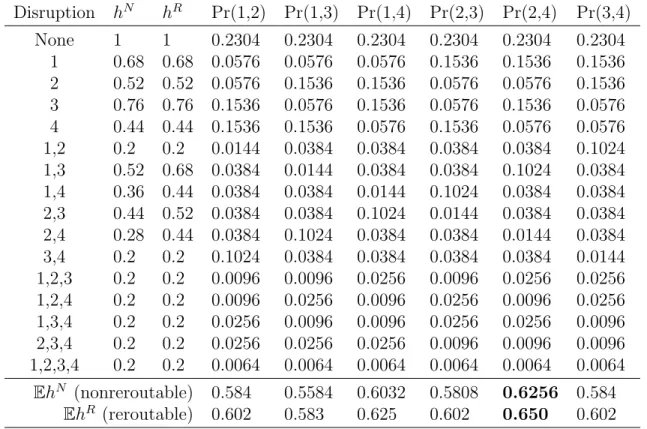
3.1 Max-flow for nonreroutable flow under disruptions (l = 0.2) . . . 52
3.2 Max-flow for reroutable flow under disruptions (l = 0.2) . . . 54
3.3 Notation in the model . . . 55
3.4 Resilience investment under K = 2 and expected max-flows . . . 56
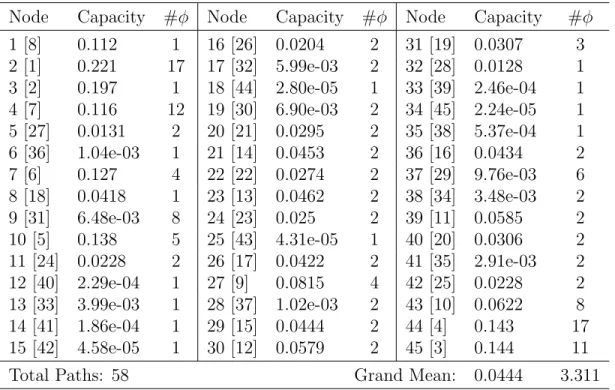
3.5 Node capacity with rank (in brackets) and # paths through node for DN . . . 72
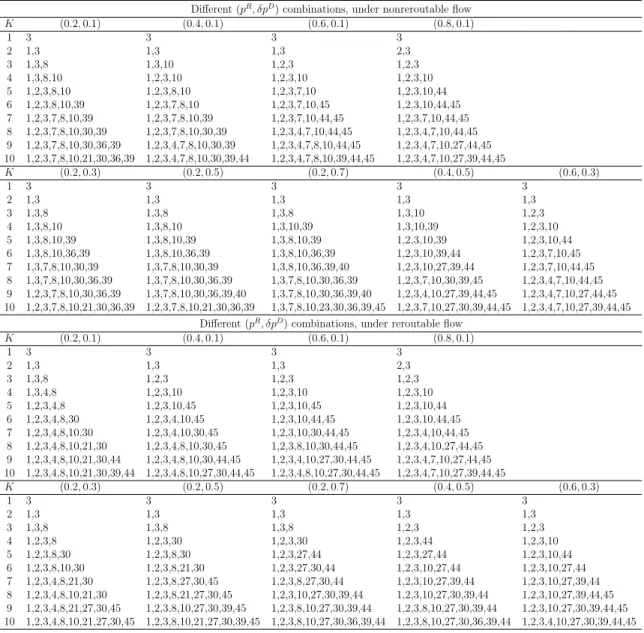
3.6 Optimal investment for DN as K increases from 1 to 10 . . . 74
3.7 Ordered logistic regression results for DN . . . 78
4.1 Notation in the model and analysis . . . 93
4.2 Settings for Experiments I and II . . . 102
4.3 Experiment I (same supplier learning rates) results . . . 110
4.4 Experiment II (some suppliers learn faster) results . . . 113
A.1 Node capacity with rank (in brackets) and # paths through node for
AN2 . . . 139
A.2 Optimal investing structure for AN1 . . . 140
A.3 Ordered logistic regression results for AN2 . . . 141
A.4 Optimal investment for AN2 as K increases from 1 to 10 . . . 142
B.1 Robustness check on Experiment I (same supplier learning rates) – simulation length 500 . . . 148
B.2 Robustness check on Experiment II (some suppliers learn faster) – simulation length 500 . . . 149
List of Figures
1.1 Examples of upstream and downstream supply chain networks . . . . 2
1.2 Overarching framework of the dissertation . . . 3
2.1 A sample warehouse network of electric appliances in week 29 . . . . 23
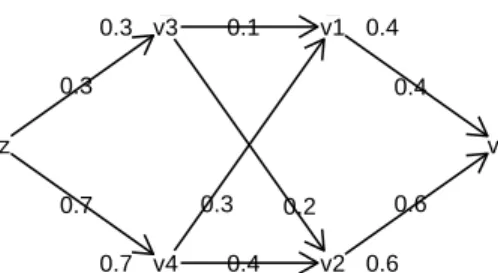
2.2 Interaction plots between direct ties and environmental uncertainty . 34 3.1 An example of the supply chain network with node and edge capacities 49 3.2 Disruptions on v2 and v3 and nonreroutable flows through edges . . 52
3.3 Disruptions on v2 and v3 and reroutable flows through nodes . . . 54
3.4 The final distribution network (DN) in the tree layout . . . 72
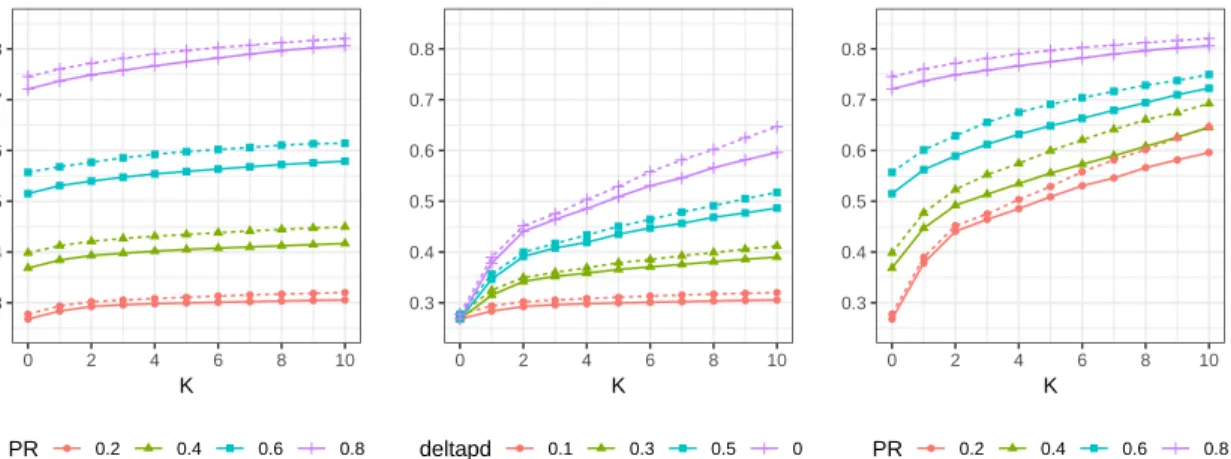
3.5 Max expected max-flow fixing absolute benefit (left),pR(middle), and investment goal (right) . . . 73
4.1 A stochastic process for nodei at time t . . . 91
4.2 Supply networks of Honda (left) and Toyota (right) . . . 100
4.3 Two random networks generated from Honda’s network . . . 100
4.4 Mean PDP curves for Honda’s supply network in Experiment I . . . . 104
4.5 Mean PDP curves for Honda’s supply network in Experiment II . . . 105
4.6 Interaction effects between risk and supplier learning in Experiment I 108 4.7 Interaction effects between centrality, risk, and supplier learning in Experiment II . . . 111 4.8 Data-driven strategies that improve supply network resilience learning 116
A.1 Two derived networks based on the distribution network . . . 139 B.1 Interaction effects between risk and supplier learning in Experiment I
(simulation length 500) . . . 147 B.2 Interaction effects between centrality, risk, and supplier learning in
Experiment II (simulation length 500) . . . 147 B.3 Interaction effects between centrality, risk, and supplier learning inpost
Chapter 1
Introduction
1.1
Problem Statement
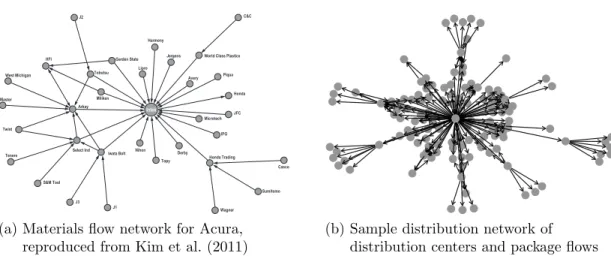
In today’s world, we are already beyond the point where “supply chain” denotes a linear set of linkages between firms. Rather, firms are faced with a network of col-laborators, competitors, suppliers, customers, logistic facilities, and intricate inter-organizational relationships. Supply chains now evolve to include a higher level of interdependence and connectivity between more organizations. Business entities are more closely intertwined, and their supply chains essentially become supply chain networks. Figure 1.1 displays (a) Acura’s supply network and (b) the distribution network of a world leading logistics management company, as the examples of up-stream and downup-stream supply chain networks, respectively.
Research on supply chain networks is emerging. Incorporating the network per-spective into supply chain management is gaining increasing recognition. Traditional “linear management” may fail to achieve desired performance improvement due to not considering the effect of network structure on firms’ operational performance. For instance, in managing a logistic network, managers who fail to take into account one facility’s relationship to the rest of the distribution network may produce biased performance evaluations and ineffective improvement strategies. In fact, many
1 2 3 4 5 6 7 8 9 10 11 12 13 14 15 16 17 18 19 20 21 22 23 24 25 26 27 28 29 30 31 32 33 34 35 36 37 38 39 40 41 42 43 44 45 46 47 1 2 3 4 5 6 7 8 9 10 11 12 13 14 15 16 17 18 19 20 21 22 23 24 25 26 27 28 29 30 31 32 33 34 35 36 37 38 39 40 41 42 43 44 45 46 47
P
meTrICs for neTwork PerformanCe
Certain topologies of a network are either vulnerable or tolerant depending on the perturbations (e.g., specific or non-specific failure). Zhao et al.36 proposed several metrics
to evaluate complex network responses when experiencing disturbances:
1. Supply Availability Rate is a measure of the aggregate performance of the complex network and is measured as the percentage of demand nodes that have access to supply nodes.
2. Connectivity as measured by the largest functional sub-network (LFSN) to consider the case of partitioning into several isolated sub-networks. The largest connected component (LCC) as a measure of network performance is suitable when all of the nodes are homogeneous.
3. Average Supply-Path Length is given by the average of the minimum supply-path lengths between all pairs of supply and demand nodes in the LFSN. This is a measure of the network accessibility, which can be used to examine cost and time efficiency. Higher accessibility means that supplies are closer to consumers, and they can receive them at lower cost or in lesser time.
J2 HFI West Michigan Master Twist Tenere S&M Tool J3 J1 Iwata Bolt Select Ind Arkay Miliken Tobutsu Garden State Lipro Harmony
Jergens World Class Plastics C&C Piqua Avery Honda JFC Microtech IPG Derby Topy Nihon Honda Trading Wagner Sumitomo Casco
Figure 19.3 an example of a supply-chain network for the flow of materials in automobile manufacturing
Source: Reproduced from Kim et al. 2011, Journal of Operations Management: Structural investigation of supply networks: a social network analysis approach, Elsevier
Lindgreen.indb 337 5/14/2013 11:34:33 AM
Intek
(a) Materials flow network for Acura, reproduced from Kim et al. (2011)
● ● ● ● ● ●● ● ● ●● ● ● ● ● ● ●●● ● ● ● ●● ● ●● ●● ●● ●● ●● ● ● ● ●● ● ● ● ● ● ● ● ●● ● ● ● ● ● ● ● ● ● ●●● ● ● ● ● ● ● ● ● ● ● ● ● ●● ● ● ● ● ● ● ● ● ● ● ● ● ● ● ● ● ● ● ● ● ● ● ● ● ●● ● ● ● ● ● ● ● ● ● ● ● ● ● ● ●●● ● ● ● ● ● ● ● ●● (b) Sample distribution network of
distribution centers and package flows
Figure 1.1: Examples of upstream and downstream supply chain networks
nies, such as Honda, Toyota, BMW, Intel, and Siemens, have realized the importance of “network management” and devoted significant resources to the development of supply network and inter-organizational relationships (Handfield et al., 2010; Liker and Choi, 2004).
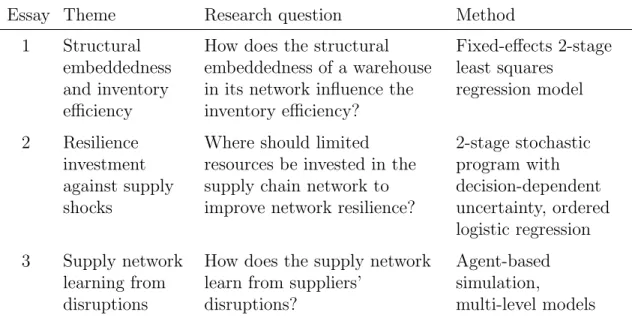
This dissertation investigates the role of network structure in the operational performance of both residing organizations and the focal firm. Figure 1.2 presents the overarching framework of the dissertation, where Essay 1 examines how network structure affects individual node’s (a warehouse’s) performance, Essay 2 proposes op-timal resilience investment strategies under supply shocks, through identifying critical nodes in the network, and Essay 3 clarifies the cross-level relationship between node learning and network learning from disruptions. Table 1.1 provides a summary of the three dissertation essays.
1.1. Problem Statement 3 Individual Node (Essay 1) Network Learning (Essay 3) Supply Shock (Essay 2)
Network
Structure
Figure 1.2: Overarching framework of the dissertation
Table 1.1: Summary of the dissertation essays Essay Theme Research question Method
1 Structural embeddedness and inventory efficiency
How does the structural embeddedness of a warehouse in its network influence the inventory efficiency? Fixed-effects 2-stage least squares regression model 2 Resilience investment against supply shocks
Where should limited resources be invested in the supply chain network to improve network resilience?
2-stage stochastic program with decision-dependent uncertainty, ordered logistic regression 3 Supply network learning from disruptions
How does the supply network learn from suppliers’
disruptions?
Agent-based simulation,
1.2
Related Literature Streams
1.2.1
Common Stream – Network Perspective
The three essays build on the same underlying rationale in the network perspective. That is, a network can exert influence, grant opportunities, and create challenges for specific nodes in the network (Borgatti and Li, 2009). A residing organization can experience such structural effect because, when “chain” relationships evolve into a network, the organization’s (operational) performance is affected not only by the interplay between its partners and itself, but also more by the interactions among those partners (Choi et al., 2001). Realizing the structural effect in the complicated business world, researchers begin to adopt the network perspective to understand the mechanisms and propose more effective suggestions in the supply chain management. Starting from basic network elements, Choi and Wu (2009a) proposed the “triad” as the “fundamental building block of a network”. Choi and Wu (2009b) exhausted all possible configurations of the buyer-supplier-supplier triad, and explored conditions where buyer-supplier and supplier-supplier relationships emerge, persist, or break down. A series of their related work on triads (e.g., Wu and Choi, 2005; Wu et al., 2010) sheds light on the benefits of examining the network structure in managing even simple business relationships.
As a broader network than triad is investigated, researchers incorporate ideas and concepts from social network analysis, which emphasizes that a company’s economic actions are embedded in a network and that their outcomes are substantially influ-enced by the ongoing pattern of a relationship (Granovetter, 2005; Gulati, 1998). Borgatti and Li (2009) related network concepts specifically to the supply chain con-text, and suggested that a more systematic adoption of the network perspective would be instrumental in exploring behavioral mechanisms of entire supply networks. Choi et al. (2001) went a step further and understood the supply network as a complex
1.2. Related Literature Streams 5 adaptive system, which precisely characterizes the supply network through internal mechanisms, environment, and co-evolution.
In general, the network concepts and measures lay the foundation of this disserta-tion. Each essay integrates other specific literature streams with network and supply chain management to rationalize the hypotheses and better answer the research ques-tions. The next sub-section describes those related literature streams.
1.2.2
Background Literature for Individual Essays
Background Literature for Essay 1
Essay 1 focuses onstructural embeddednessthat has never been explored in the context of a warehouse network. Structural embeddedness was originally defined as “the impersonal configuration of linkages between people or units” (Nahapiet and Ghoshal, 1998, p. 244). To characterize a warehouse’s structural embeddedness, Essay 1 adapts the definition and follows Moran (2005) to distinguish between direct and indirect ties in a warehouse’s ego network. To understand the underlying mechanism of how structural embeddedness affects a warehouse’s performance, Essay 1 incorporates the literature of information processing.
Structural embeddedness can affect the amount of information an organization must manage, since ties are “conduits through which resources and information flow” (Borgatti and Foster, 2003, p. 1002). The amount of information is “the volume or quantity of data about organizational activities that is gathered and interpreted by organization participants” (Daft and Macintosh, 1981, p. 210). On the one hand, as the amount of information going through an organization increases, the resources required to effectively process the information also increase. On the other, if al-ters in an ego network have the flexibility to exchange informational requests among themselves, the focal node can only deal with the needs that cannot be fulfilled by the
alters rather than coordinate individually with every alter, which implies a lower total amount of information and reduced information processing needs for the focal node. In general, the integration of information processing with network structure appro-priately illustrates the effect of structural embeddedness on a warehouse’s inventory efficiency management.
Background Literature for Essay 2
Essay 2 is closely related to the literature of supply chain disruption and resilience management, where scholars have proposed various frameworks and strategies to improve resilience (e.g., Chopra and Sodhi, 2014; Christopher and Peck, 2004; Klein-dorfer and Saad, 2005; Sheffi and Rice Jr, 2005; Simchi-Levi et al., 2014, 2015; Tang, 2006). However, much of the emerging literature on supply chain resilience focuses on how to reduce disruption and improve resilience. Little is known about where to improve resilience in a supply chain network. For instance, Pettit et al. (2013) iden-tified several capabilities that firms need to develop to improve resilience, and argued that a firm’s capabilities should align with their disruption vulnerabilities. Snyder and Daskin (2007) found that the design and structure of a supply chain network influences resilience. The average path length (Nair and Vidal, 2011) and structural properties (e.g., clustering coefficient, scale-free and small-world characteristics) (Al-bert et al., 2000; Basole and Bellamy, 2014; Kim et al., 2015) can significantly influence risk mitigation. Firms should make optimal sourcing decisions based on their posi-tions in the network (Ang et al., 2016; Bimpikis et al., 2017, 2018) and as a response to their suppliers’ investments (Bakshi and Mohan, 2015).
Nonetheless, little research, if any, has focused on where to invest in resilience in the context of supply chain network. Some studies outside of the supply chain management area have investigated the where question. For instance, the network interdiction problem examines which vulnerable nodes to protect to maximize the
1.2. Related Literature Streams 7 flow through a network under attacks (e.g., Cormican et al., 1998). This literature stream is critical to managing the infrastructure network such as the highway system (e.g., Peeta et al., 2010). Different from the existing literature, Essay 2 contributes data-driven prescriptions to managing random unintentional disruptions within the context of a supply chain network. It corresponds well with the acknowledgment that improving supply chain resilience should go beyond the focal company’s facilities and understand the entire supply chain network (Kim et al., 2015).
Background Literature for Essay 3
Essay 3 examines supply network resilience from a learning perspective. While or-ganizational learning has been extensively studied, the learning behavior of a supply network, in other words, how the network resilience improves due to supplier learn-ing from disruptions, has been largely overlooked. Essay 3 bridges the node-level and network-level learning based on two classic organizational learning curves (Lapr´e et al., 2011), namely the power curve (e.g., Argote and Epple, 1990; Darr et al., 1995; Dutton and Thomas, 1984; Yelle, 1979) and the exponential curve (e.g., Lapr´e et al., 2000; Levy, 1965). Scholars have used the power curve to study risk mitigation in airline companies (Haunschild and Sullivan, 2002), US railroads (Baum and Dahlin, 2007), coal mining organizations (Madsen, 2009). The exponential curve has also been applied to other metrics, such as the success rate, the recovery rate, and the production rate (Levy, 1965; Madsen and Desai, 2010; Norrman and Jansson, 2004). Previous studies in the learning literature have examined multi-level effects, e.g., the effects of population-level (network-level) factors on firm-level performance. For example, Bellamy et al. (2014) studied the influence of supply network structure on firm innovation. Madsen and Desai (2018) investigated the impact of population-level actors on firm failure prevention. However, the learning effect on the network-level performance metrics has not been examined. In practice, firms invest in their
suppliers with an overarching aim of improving supply network resilience (Liker and Choi, 2004). Investing in network-level learning may well explain the sustained success of firms like Cisco and Toyota in the face of increasing levels of supplier risks.
1.3
Design of the Dissertation Research
This section introduces the design and results of the three dissertation essays. Brief overarching summary of each essay is given at the beginning of the following sub-sections.
1.3.1
Research Design of Essay 1 (Chapter 2)
Essay 1, “Structural Embeddedness and Warehouse Inventory Efficiency: A Network Perspective”, is developed against the background of emerging omni-channel and e-commerce, where more firms are rethinking and expanding their warehouse networks to better fulfill demand and win over customers. While the managing company sets common requirement of fill rate for the warehouses, inventory efficiency measured as inventory turnover becomes a distinguishing performance metric for each warehouse. Due to that a warehouse’s operations may be impacted by other warehouses’ actions (i.e., the network structural effect), a warehouse’s ability to maintain a high inven-tory efficiency may depend, in part, on its position in the network. Failing to account for the warehouse’s network position can lead to misguided performance evaluation. Essay 1 thus draws on the concept ofstructural embeddedness and contributes to un-derstanding how the direct and indirect ties that constitute structural embeddedness affect warehouse inventory efficiency, which is largely overlooked in the literature.
Essay 1 adopts the fixed-effects 2-stage least squares regression model and exam-ines a proprietary dataset provided by a world leading logistics management com-pany. The empirical analysis controls the warehouse company’s inventory policy and
1.3. Design of the Dissertation Research 9 sales that may confound the results (Gaur et al., 2005). The analysis uses inventory turnover as a measure of inventory efficiency (Lee, 2004), the dependent variable. The independent variables include a warehouse’s structural embeddedness, the de-mand variability and product variety facing the warehouse, and control variables including transshipment and demand. Specifically for structural embeddedness, di-rect ties are operationalized as the total number of an ego’s incoming and outgoing ties (i.e. degree centrality) while indirect ties are operationalized as the proportional density following past studies (Lokam, 2003; Moran, 2005; Pudl´ak and R¨odl, 1994), which is the ratio between the actual number and all possible ties among alters.
Study results reveal that a warehouse’s inventory efficiency significantly depends on its structural embeddedness in the network. Direct ties reduce while indirect ties improve warehouse inventory efficiency, as more direct ties increase the burden of managing information for the ego warehouse, while more indirect ties lessen the information processing burden. Structural embeddedness can significantly interact with product variety and demand variability. The extent of direct ties weakens the negative effect of product variety, while strengthens the negative effect of demand variability on inventory efficiency. In sum, Essay 1 finds that a warehouse’s inventory efficiency is a combinative result of its number of direct connections with neighboring warehouses, the variety of products stored within it, and the demand variability faced by the warehouse.
1.3.2
Research Design of Essay 2 (Chapter 3)
Essay 2, “Where to Improve Resilience in the Supply Chain Network under Stochastic Disruptions?”, is concerned with today’s volatile world full of risks and disruptions such as natural disasters, cyber attacks, epidemics, and political upheavals. These risks and disruptions lead to supply shocks that reduce facilities’ capacities and de-crease the final output of the overall supply chain network. Facing such supply shocks,
supply chain managers are highly motivated to invest in resilience resources to miti-gate disruptions affecting supply chain actors. However, resource limitations compel managers to identify “critical” facilities whose resilience investment mostly enhances the entire network’s output.
Through analyzing the NP-hard 2-stage stochastic program with decision-dependent uncertainty, Essay 2 finds that the optimal investment decision depends on the prob-ability of a disruption and on whether the material flow in the supply chain network can be rerouted. Under rare or frequent disruptions, it is optimal to adopt a node-investment or path-node-investment strategy, respectively. For mid-level disruptions, the greedy algorithm exhibits comparative performance to the optimal decision of invest-ing on nodes. Through numerical analysis on real distribution networks, Essay 2 generates data-driven prescriptions that are applicable to directed acyclic networks and under various disruption conditions. The commonly acknowledged notion of “node criticality” (Craighead et al., 2007) should be understood in the context of the overall network structure, including in particular paths. Supply chain managers can benefit from the proposed algorithm, the path perspective, and the contingency found in Essay 2 – they can sense the weight (importance) of the actors and paths (e.g., shipping routes or product lines) and shift the investment focus accordingly.
1.3.3
Research Design of Essay 3 (Chapter 4)
Essay 3, “Supply Network Resilience Learning: A Data-Driven Exploratory Study”, examines how suppliers’ learning from disruptions affects the overall supply network’s learning to improve resilience. When suppliers experience a disruption, they seek to learnfrom the event and reduce the risk of future events (Fiksel et al., 2015). Supply network resilience learning occurs when the supply network becomes more resilient due to individualsupplier learningfrom disruptions. Although organizational learning has been extensively studied, supply network learning and its relationship to supplier
1.3. Design of the Dissertation Research 11 learning remains unexplored. Essay 3 contributes to clarifying how individual supplier learning translates into supply network learning to better improve network resilience. Supplier learning at the node level follows the classic power curve and exponential curve to reduce the probability of disruption and increase the probability of recov-ery, respectively. Through an agent-based simulation model, where suppliers act as agents within an ego network (i.e., the supply base) of a focal firm, Essay 3 examines the curve of network resilience improvement under various disruption probabilities and risk propagation rates. The data analytics uses Honda’s and Toyota’s supply networks and shows that suppliers’ learning-to-prevent improves supply network re-silience learning more when suppliers face a lower diffusion rate of a disruption, while learning-to-recover enhances network learning more when the risk of disruption is lower. Essay 3 further shows that more centrally located suppliers influence network learning more, but this depends on the disruption and diffusion of operational risks across the network. Results from Essay 3 suggest practical strategies aimed to make the most of limited resources and facilitate supply network learning to improve the network resilience.
Structural Embeddedness and
Warehouse Inventory Efficiency: A
Network Perspective
2.1
Introduction
Retailers are expanding their warehouse networks as part of their strategies to better respond to customers’ demands. For instance, Target and Amazon have been build-ing warehouses in the U.S. to satisfy the growbuild-ing demands from both traditional and e-commerce channels (Stampler, 2019). Similarly, Cainiao Network Inc., the logistics arm of Alibaba, has also been rapidly expanding their distribution network across China, to better meet customer demands (Chou, 2018). As a result, overall ware-house networks become more complex with an increasing number of wareware-houses and connections between warehouses. For a retailer to maintain a certain service level across warehouses, the efficiency of inventory performance becomes a critical metric to those individual warehouses (Ecklund, 2010). The extent of inventory efficiency relies on individual warehouse’s managerial efforts. However, we have limited un-derstanding of how network structural characteristics could influence an individual warehouse’s inventory efficiency performance.
2.1. Introduction 13 Embedded in a warehouse network, a warehouse typically faces a dual challenge of managing warehouse inventories efficiently with certain customer service level tar-get. Anecdotal evidences support the notion that warehouse managers interact with neighboring warehouses for inventory and logistics decisions. In a field study by one of the authors with a globally leading supply chain management company, we observe that, managers in the neighboring warehouses exchange and process inventory and logistics information and make relevant decisions accordingly to manage warehouse inventory. In a sense, coordination in the form of information processing and shar-ing between neighborshar-ing warehouses plays an important role in affectshar-ing warehouse inventory efficiency. Zhou and Wan (2017b) found similar mechanisms in their study of a sourcing network, in which individual warehouses coordinate inventory and lo-gistics decisions with each other. Since coordination between neighboring warehouses is necessary for managing inventory, an individual warehouse’s ego-network structure essentially represents the inventory coordination network. However, past literature is silent about the role that network structure plays in managing warehouse inventory efficiency.
We posit that a focal warehouse’s structural embeddedness in the warehouse net-work can exert a prominent impact on the warehouse’s inventory efficiency. Structural embeddedness, in the context of a warehouse network, is defined as the configuration of ties between warehouses (Nahapiet and Ghoshal, 1998). Structural embeddedness has received extensive attention in economics and social science (e.g., Nahapiet and Ghoshal, 1998; Uzzi, 1996; Moran, 2005) – it influences exchanges between entities and further affects entities’ behaviors and performances (Granovetter, 1985). Following Moran (2005), we assess a warehouse’s structural embeddedness as the warehouse’s extent of direct ties with neighboring warehouses and indirect ties among the neigh-boring warehouses.
environ-mental uncertainties could affect warehouse inventory efficiency significantly (e.g., Fisher et al., 1994; Gaur et al., 2005; Smith and Agrawal, 2000; Zipkin, 2000). We learn from the field study that, echoing the previous literature, two kinds of envi-ronmental uncertainties can greatly reduce warehouse inventory efficiency: demand variability and product variety. Demand variability refers to the extent of product demand volatility that each warehouse must fulfill. Product variety relates to the dispersion of the variety of products assigned to each warehouse. These two types of uncertainties reflect the trend that customer demand is difficult to predict; cus-tomers prefer a large set of choices (Fisher et al., 1994; Smith and Agrawal, 2000) and firms are increasing their product offerings to increase sales (Smith and Agrawal, 2000). Both demand variability and product variety also exist ubiquitously in other companies (e.g., Zhou and Wan, 2017b) and pose a significant challenge to warehouse inventory management.
Knowing that individual warehouses are embedded in a warehouse network, facing differing extent of product variety and demand variability and striving for inventory efficiency, we ask the following research question: What is the role of warehouse struc-tural embeddedness, product variety, and demand variability in determining warehouse inventory efficiency? While there are abundant studies and findings on product vari-ety, demand uncertainty, and inventory management separately (Baker et al. (2017) illustrates related topics thoroughly), very few, if any, have empirically examined warehouse inventory efficiency from a network perspective considering the effects of uncertainties.
We examine the effect of structural embeddedness and its interactions with prod-uct variety and demand variability through a proprietary dataset provided by the globally leading supply chain management company (hereafter “Company A”). We specifically consider and address the network endogeneity issue (Carpenter et al., 2012) through a two-stage least-square fixed-effects model with lagged network-related
2.1. Introduction 15 variables as instrumental variables. Study results reveal a negative effect of direct ties and a positive effect of indirect ties on a warehouse’s inventory efficiency. More im-portantly, we find that the extent of direct ties weakens the negative effect of product variety, while strengthens the negative effect of demand variability on inventory ef-ficiency. In sum, we find that a warehouse’s inventory efficiency is a combinative result of its number of direct connections with neighboring warehouses, the variety of products stored within it, and the demand variability faced by the warehouse.
We contribute to the operations management literature in the following two as-pects. First, we examine the warehouse inventory efficiency from a network perspec-tive. Through warehouse-level panel data, we identify a significant effect of structural embeddedness on warehouse inventory efficiency. Prior studies on inventory perfor-mance focus either on firm-level manufacturing practices such as lean and JIT (e.g., Demeter and Matyusz, 2011; Rabinovich et al., 2003), or firm-level factors such as gross margin (e.g., Gaur et al., 2005) – they generally do not consider the effects of network structure. We apply network analysis in a logistics and operational context and extend the network perspective into the field of operations management. Second, we examine interactions between a warehouse’s direct ties and the uncertainties faced by a warehouse. These findings provide a better understanding of the role of struc-tural embeddedness, product variety, and demand variability on warehouse inventory efficiency.
Our findings also provide managerial implications regarding both assessment and improvement of warehouse inventory efficiency. In terms of assessment, our results show that warehouse inventory efficiency is determined, in part, by a warehouse’s embedded network structure. As firms often rely on auditing (Ackerman, 1990) and benchmarking (Staudt et al., 2015) to compare warehouse inventory performance, our study shows that firms should benchmark individual warehouse efficiency against that of structurally equivalent counterparts. As to performance implications, we help
managers better understand the role of a warehouse’s network position in managing uncertainties.
The rest of Essay 1 is organized as follows. We review the relevant literature in Section 2.2. Section 2.3 develops the hypotheses. In Section 2.4, we describe the context of warehouse network, the dataset, the variables and measures. Section 2.5 describes the models and results. Section 2.6 discusses the theoretical implications from the analysis, along with the managerial implications. We conclude Essay 1 with future research suggestions in Section 2.7.
2.2
Literature Review
2.2.1
Structural Embeddedness
Nahapiet and Ghoshal (1998, p.244) defined structural embeddedness as “the imper-sonal config- uration of linkages between people or units”, which, in the context of a warehouse network, would be the configuration of ties between networked ware-houses. We assess a warehouse’s structural embeddedness based on its ego network (Borgatti and Li, 2009). An ego network consists of (1) a focal node (the ego), (2) the set of nodes directly connected to the ego (the alters), and (3) all ties among the ego and alters. Correspondingly, a warehouse’s ego network consists of the immediate neighboring warehouses as alters and all the connections among the ego and alters. In a network of warehouses, each warehouse can be the ego. We follow Moran (2005) and characterize structural embeddedness of a warehouse in its ego network in the following two dimensions: (1) direct ties: ties between the ego and alters, and (2) indirect ties: ties among the alters.
Previous literature supports the notion that structural embeddedness can signif-icantly affect an entity’s business performance. In the management settings, Moran
2.2. Literature Review 17 (2005) discovered the importance of structural embeddedness for more routine, execution-oriented tasks (e.g., managerial sales performance). Lin et al. (2009), in the context of government-sponsored R&D consortia, supported significant impacts of structural embeddedness on technology transfer performance. In the supply network context, Choi and Kim (2008) demonstrated the benefits of adopting the structural embed-dedness perspective when firms make strategic sourcing decisions. Similarly, Kim (2014) found a positive effect of understanding suppliers’ structural embeddedness on a buyer’s operational performance. Lawson et al. (2008) also found that structural embeddedness facilitates a buyer’s performance improvement. Focusing on distribu-tion networks in China, Dong et al. (2015) showed a distributer’s network posidistribu-tion affects its opportunism towards supplier through survey data. A recent study by Kao et al. (2017) demonstrated the effects of different network measures on firm-level pro-ductivity. Nonetheless, few studies to date have connected structural embeddedness and inventory performance of a warehouse.
2.2.2
Product Variety and Demand Variability
In this section, we review the commonly adopted notion of product variety, i.e., the variety of product SKUs, in the marketing and operations literature (see Ho and Tang (1998) and Ramdas (2003) for a thorough review). Product variety is mostly regarded as a strategy and decision to improve sales or revenues (e.g., Baumol and Ide, 1956; Berry and Cooper, 1999; Smith and Agrawal, 2000). As customers demand more variety of products nowadays (Fisher et al., 1994), firms are increasingly adopting a high variety strategy to increase sales (Smith and Agrawal, 2000).
The operations management literature has pointed out that increase in product variety is associated with a decrease in inventory turnover (Zipkin, 2000). Increas-ing product variety reduces demand forecast accuracy, hence leadIncreas-ing to mismatches between product supply and demand, and ultimately reduced inventory performance
(Fisher and Ittner, 1999; Ton and Raman, 2010; Wan et al., 2012). Wan et al. (2012) found negative but diminishing impacts on product fill rate (as an operational per-formance measure) as product variety increases, due to increased similarities among products that contribute to demand prediction accuracy. Specifically, for warehouse operations and transshipment, product variety can increase distribution costs as ware-houses have to deliver each variety in smaller batches and keep extra inventory to ac-count for unexpected customer demand across a variety of products (Zhou and Wan, 2017a).
Demand variability is the main reason for carrying inventory (Nahmias, 2008). Demand variability can reduce inventory performance, mainly through the safety stock requirement (Zipkin, 2000). Rumyantsev and Netessine (2007) showed that high demand uncertainty leads to high inventory levels for U.S. public firms using a panel dataset from 1992-2002. Further, demand variability has been viewed as the main contributor of the bullwhip effect, which creates difficulty in inventory man-agement across the supply chain and reduces inventory efficiency (Cachon, 1999; Lee et al., 1997b). A recent empirical study by Han¸cerlio˘gulları et al. (2016), using the inaccuracy of quarterly sales forecasts as a measure of demand variability, found that demand variability is negatively correlated with firm-level inventory turnover. In the context of a warehouse network, a focal warehouse’s demand variability creates uncer-tainty when the focal warehouse tries to balance the demand and supply (inventory) through sending and receiving products to and from other warehouses.
2.3
Hypothesis Development
A warehouse’s structural embeddedness could affect the amount of information it must manage, since network ties are “conduits through which resources and informa-tion flow” (Borgatti and Foster, 2003, p.1002). The amount of informainforma-tion is “the
2.3. Hypothesis Development 19 volume or quantity of data about organizational activities that is gathered and inter-preted by organization participants” (Daft and Macintosh, 1981, p.210). In a network of warehouses, each warehouse needs to exchange operational information (e.g., prod-uct, schedule, inventory information) with neighboring warehouses and make logistics decisions (e.g., shipping products, adjusting inventory levels). A warehouse also needs to respond to neighbors’ informational requests regarding specific products, inquiries, or shipments. For a warehouse to manage informational exchanges or requests and to coordinate effectively, considerable internal resources such as employees’ time and ef-forts are required. As the amount of information going through a warehouse increases, the required “burden” to effectively process the information also increases.
Considering an ego network, having more direct ties implies that the ego warehouse is connected to more alter warehouses and hence would experience a higher extent of information exchanges and processing due to the sheer number of the alters. A warehouse with more direct ties has lower inventory efficiency because (1) more direct ties lead to more information processing needs and workload, which creates more opportunities of decision errors regarding demand forecast or inventory management (Levinthal, 1997), and (2) the ego warehouse’s accommodation of requests from alters could disrupt the existing operations and increase transaction costs (e.g., changing the product mix, searching for a shipment, answering the inquiries) (Choi and Krause, 2006). Therefore, we posit that more direct ties could negatively affect the focal warehouse’s inventory efficiency:
Hypothesis 1 Ceteris paribus, warehouse inventory efficiency decreases with the
extent of direct ties.
As another dimension of structural embeddedness, the extent of indirect ties re-flects the interconnectedness in a warehouse’s ego network (Podolny and Baron, 1997)
– a higher extent of indirect ties indicates more connections among the alters. Given a specific number of alters, a higher level of indirect ties implies that the alters could exchange and process information among themselves. They could address requests and fulfill each other’s orders without involving or disrupting the ego warehouse. In contrast, an ego warehouse with low level of indirect ties may have to respond to every request from the alters (e.g., gathering information, shipping products, making necessary inventory adjustments).
In a sense, with high extent of indirect ties, the ego warehouse can view the connected alters as an entirety and only deal with the needs that cannot be fulfilled by the connected alters rather than coordinate individually with each alter, which implies a lower amount of information processing burden on the ego warehouse. Therefore, the interconnectedness among the alters could benefit the ego warehouse’s inventory management, through reducing its workload and errors and causing fewer disruptions to its operations. We thus propose:
Hypothesis 2 Ceteris paribus, warehouse inventory efficiency increases with the
ex-tent of indirect ties.
We posit that a focal warehouse’s extent of direct ties interacts with its product variety. High product variety implies large numbers of different product SKUs and a diverse SKU dispersion that the focal warehouse can allocate to alters to fulfill customer demands. Viewing from an inventory flow perspective (Schmenner and Swink, 1998), having more neighboring warehouses (i.e., more direct ties) essentially enables an ego warehouse with high product variety to ship its products to more outlets, which helps manage the efficiency of the inventory flow for the ego warehouse (Schmenner, 2001; Schmenner and Swink, 1998). In other words, as warehouses have limited capacities in reality, the focal warehouse with only a few direct ties has a lower
2.3. Hypothesis Development 21 capability in managing high product variety than a warehouse with more direct ties. A high extent of direct ties prevents the focal warehouse with high product variety to become an inventory bottleneck. Therefore, we propose the following hypothesis:
Hypothesis 3 Ceteris paribus, the extent of direct ties weakens the negative effect
of product variety on warehouse inventory efficiency.
Past research in operations management has shown that high demand variability increases difficulty in forecasting and inventory management (Gaur et al., 2007). A warehouse facing high demand variability would face challenges in adjusting inventory to match supply and demand, which leads to high inventory level and low inventory turnover (Han¸cerlio˘gulları et al., 2016).
We argue that the extent of direct ties also interacts with demand variability. For a focal warehouse with many direct ties, high demand variability increases the informa-tion processing and coordinainforma-tion needs between the ego and neighboring warehouses. The coordination needs increase in a nonlinear fashion when an ego warehouse has to coordinate the inventory logistics with an increasing number of neighboring ware-houses and an increasing extent of uncertainty (Ladyman et al., 2013). For example, a number of alters could send several requests to the ego warehouse regarding certain products, under high demand variability. The ego would be hesitating or uncertain (acting on the conservative side by holding more inventories) in managing inventory to fulfill alters’ demands, which likely reduces inventory efficiency.
Further, under high demand variability, the possibility of decision errors (sending more or less than needed products to neighboring warehouses) also increases, which also reduces inventory efficiency; the focal warehouse may make a wrong decision and ship a product to its neighboring warehouses that is later needed by the focal warehouse. With increasing extent of direct ties and demand variability, managing
inventory efficiency becomes an even more difficult task for the focal warehouse. On the contrary, with fewer direct ties and lower demand variability, the focal warehouse can better predict the demand of its own inventory and manage fewer coordination requests from the neighboring warehouses, which helps increase inventory efficiency. Hence, based on the above reasoning, we hypothesize the following:
Hypothesis 4 Ceteris paribus, the extent of direct ties strengthens the negative
effect of demand variability on warehouse inventory efficiency.
2.4
Research Methods
2.4.1
Context of Warehouse Network
We examine the warehouse network and operations in Company A, a globally leading supply chain management company. Company A provides both service (e.g., cloud-based warehouse management system) and facilities (e.g., warehouses) to worldwide online business-to-consumer (B2C) merchants. Merchants can store, sort, and pack-age products in Company A’s warehouses and collaborate with Company A on ser-vices such as sales planning, demand forecasting, inventory replenishment, and order delivery. Company A’s warehouses store and sort different kinds of products (e.g., television, grocery) and vary in sizes and personnel, but share the same infrastruc-ture, i.e., warehouse management system. Individual warehouses have the discretion to make logistics decisions and arrange inventory transshipment in the warehouse network to balance the yet-to-be realized demand and supply.
We focus on the warehouses of electric appliances as they provide a good re-search context. Focusing on a single product type reduces the confounding effects of factors like product categories and characteristics. We are able to track the
ware-2.4. Research Methods 23
Figure 2.1: A sample warehouse network of electric appliances in week 29
house network within 80 weeks in 2017-2018 (no specific months or dates revealed due to confidentiality). Figure 2.1 displays a sample warehouse network snapshot in week 29. Nodes are warehouses and arrows represent the material flows, which can vary frequently across time. The double arrow represents a mutual flow, indicating bi-directional product flows. Three isolated sub-networks do not have exchanging relationships with other network components in week 29.
2.4.2
Data, Variables, and Measurements
Company A records daily inventory activities of every warehouse. The raw data from the database is at the SKU-supplier-warehouse-day level. We screen out data entries related to electric appliances and aggregate SKUs and suppliers to the warehouse level. The unit of analysis is each warehouse. The aggregation also makes practical sense because once inventory gets into the warehouses, it is managed indifferently regardless of its suppliers. The aggregation can also smooth out random variations among SKUs and suppliers that are unable to be tracked in the original dataset. We further aggregate the daily data into weekly to obtain variables of variability and
smooth out daily noises. The final dataset is a panel dataset containing 6,046 entries at the warehouse-week level with 179 warehouses and 80 weeks.
Warehouse Inventory Efficiency.
We use a commonly used metric – inventory turnover – to measure warehouse in-ventory efficiency (Lee, 2004; Mapes, 2015). Inin-ventory turnover reflects the degree of economic benefits for a warehouse. It is calculated as the total demand quantity over the average inventory in a week. We use the quantity value instead of sales due to the confidential price and cost information. We estimate inventory turnover in the following manner: (1) Calculate each SKU’s inventory turnover in a week, and (2) average across all SKUs to obtain the measure. The focus on the electric appliances also helps reduce the product turnover differences.
Structural Embeddedness.
A warehouse’s structural embeddedness is characterized as direct and indirect ties (Moran, 2005). Direct ties are operationalized as the total number of an ego’s coming and outgoing ties (i.e., degree centrality). Each tie represents a link for in-formational exchanges between the connected warehouses. We consider tie direction because different directions imply different information processing and coordination tasks between warehouses. Indirect ties are operationalized as the proportional den-sity, which is the ratio of the number of ties among alters to the squared number of alters. Aligning with Moran (2005)’s suggestion, the extent of indirect ties need to be scaled to avoid the confounding effect from direct ties (a simple count of indirect ties is highly correlated with or affected by the number of direct ties).
2.4. Research Methods 25
Transshipment.
Transshipment is measured as the total count of transshipment through the ego in the week to and from neighboring warehouses. A warehouse’s transshipment can directly affect inventory turnover since it represents the extent of physical product flow in and out of a warehouse. A warehouse with high transshipment essentially implies a high inventory turnover rate, i.e., products flow through the warehouse frequently. We include transshipment to control the physical product flow while structural embeddedness captures the information processing between warehouses for inventory-related decisions.
Network Endogeneity and Instrumental Variables.
The notion that locations of warehouses are not randomly chosen is well established in the empirical literature. For example, Holmes (2011) explicitly discussed the en-dogeneity issue. Houde et al. (2017) also provided similar evidence and used an instrumental variable (IV) approach to deal with the endogeneity issue. The choice of warehouse locations, hence positions, may depend on proximity to potential cus-tomers, competition in the service area, customer characteristics in the service area, etc. Extant literature has indicated that not accounting for endogeneity is a major issue in prior research on networks (Carpenter et al., 2012). To address endogene-ity of network-related variables, following previous literature (e.g., Zhou and Wan, 2017b), we use lagged variables (lag by one period) as instrumental variables for transshipment, direct ties and indirect ties.
Lagged variables meet both requirements for instruments – relevance (i.e., iden-tifiability) and exogeneity (i.e., the exclusion restriction). Lagged transshipment, direct and indirect ties are strongly correlated with current transshipment, direct and indirect ties, respectively, and satisfy the identifiability due to the equal
num-ber to endogenous variables. In terms of the exclusion restriction, lagged warehouse network-related variables (in the last period) do not directly affect the current pe-riod’s warehouse inventory turnover. Moreover, inventory turnover is a performance metric that is evaluated ex post and is measured by periods (rather than real-time).
Product Variety.
We use Shannon’s entropy index (Shannon and Weaver, 1949) to measure product variety in a warehouse following past studies (e.g., Straathof, 2007), which captures both the variety of SKUs and the dispersion of SKU variety. Product variety is measured as −Ps
i=1pilnpi −
s−1
2n , where pi is the daily proportion of SKUi across
all SKUs, s is the daily number of SKUs in the warehouse, and n is the warehouse’s daily total inventory level. Prior studies have argued that the entropy index can be used to describe the extent of variety available in an environment (Starr, 1980; Gupta and Roth, 2007) and captures the uncertainty associated with products allocated in a warehouse (Smunt and Ghose, 2016). To compute the measure of product variety, we take the following steps: (1) Calculate each warehouse’s daily Shannon’s entropy, and (2) average the daily measures over a week to obtain the weekly warehouse’s product variety.
Demand Variability.
Demand variability represents the demand-side uncertainty originating from cus-tomers and sales markets, which is beyond the individual warehouse’s control. De-mand variability can also be regarded as exogenous to an individual warehouse since logistics decisions cannot reversely affect the variability in customer demand. Demand variability can significantly impact inventory turnover (Gaur et al., 2005). To exclude transshipments out of demand variability, we focus on the demand related only to end-consumers and sales markets – demand from other warehouses is not considered.
2.4. Research Methods 27 Demand variability is calculated as the coefficient of variation of a warehouse’s daily demand across SKUs, within a week.
Other Control Variables.
We include two control variables that may affect warehouse inventory turnover. One is a warehouse’s weekly demand that could affect its inventory turnover. Weekly demand is calculated as the sum of a warehouse’s daily demand within a week. The other control variable is the sales demand of a warehouse’s coverage (i.e., cities), which can also impact a warehouse’s inventory efficiency. We create warehouse and time (week) dummies to control for unobserved individual and time heterogeneity, corresponding to the fixed-effects model described in Section 2.5.1.
Data Transformation for Confidentiality.
Per Company A’s request, we report summary statistics (Table 2.1) and correlation matrix (Table 2.2) on the standardized data of all variables, to protect sensitive information. For empirical analysis, we first logarithmize (or take a square root if the variable contains 0) and then standardize each independent variable. Using standardized independent variables in the model will not affect the consistency and validity of results. Using standardized variables can mitigate multicollinearity due to the interaction terms. For the dependent variable, we logarithmize the original values to reduce data skewness.
2.5
Model, Analysis and Results
2.5.1
Two-Stage Least-Square Fixed-Effects Model
We adopt two-stage least-square two-ways fixed-effects model (2SLS-FE) in the anal-ysis. We choose fixed effects over random effects to account for unobserved individual warehouse heterogeneity and potential time effects. Empirically, the Hausman test supports our choice of the two-ways fixed-effects model (Chisq = 212.32∗∗∗). Further, the widely adopted 2SLS method is integrated with the fixed-effects model to account for the network endogeneity in the panel data. We show the first and second-stage equations of main effects for an illustrative purpose, whereas in the analysis we esti-mate coefficients simultaneously using R packageplm(Croissant and Millo, 2018), as running two separate regressions for two stages leads to biased standard errors for β
in the second-stage regression (Stock and Watson, 2011).
Equation (2.1) is the first-stage equation for direct ties. A similar equation can be constructed for transshipment and indirect ties.
Dir Tieit =γiDT +φ DT t +δ
DT
1 Lag Dir Tieit+δ2DTLag Indir Tieit
+δDT3 Lag Transit+θ1DTProd Varit+θDT2 Dmd Varit
+θ3DTWh Dmdit+θ4DTCover Dmdit+ηDTit
(2.1)
where the superscript DT stands for direct ties; Lag Dir Tieit, Lag Indir Tieit, and Lag Transit denote the lagged direct and indirect ties and the transshipment for warehouse i at time t, respectively; γ, φ, δ, θ are the parameters for the model; and
ηDT
2.5. Model, Analysis and Results 29 The second-stage equation is:
Inv Turnit =αi+τt+β1Dir Tieit+β2Inir Tieit+β3Transit+ξ1Prod Varit
+ξ2Dmd Varit+ξ3Wh Dmdit+ξ4Cover Dmdit
+πDTηˆitDT +πITηˆITit +πT RηˆitT R+εit
(2.2)
Whereαiandτtrepresents the unobserved individual and time heterogeneity; Dir Tieit,
Indir Tieit, and Transit represent direct and indirect ties and transshipment,
respec-tively; ˆηDTit , ˆηitIT, and ˆηT Rit are the estimated residuals from the first-stage equations; and εit is the random error.
The 2SLS-FE model considering the interactions between direct ties and two vari-abilities can be established accordingly – we use the interactions between lagged variables and product or demand variability as instruments for the corresponding terms. The overall analysis is performed in a hierarchical manner. Specifically, we first enter the control variables (Models (1) in Table 2.3). The next model includes the main effects of direct and indirect ties to show the effect of structural embedded-ness (Models (2) in Table 2.3). Finally, the analysis includes the interaction terms (Models (3) and (4) in Table 2.3).
2.5.2
Empirical Tests on Instruments
Section 2.4.2 rationalizes the instruments from a theoretical perspective. We empir-ically test on the instruments here. The (Wu-)Hausman test for the panel model prefers the fixed effects model, as mentioned before. Due to that we have an equal number between instruments and endogenous regressors, the Sargan test of overiden-tification is not necessary.
We present the weak instrument test. Multiple instruments may render the tra-ditional weak instrument test biased (Sanderson and Windmeijer, 2016). We follow
previous research and adopt the Cragg-Donald F-statistic (Cragg and Donald, 1993) that employs canonical correlations in the process. The Cragg-Donald F-statistic is 68.01∗∗∗, indicating all instruments are valid and strong.
2.5.3
Multicollinearity, Heteroskedasticity, Auto-correlation
We have performed additional tests on common model assumptions. We standardize the independent variables for the sake of including the interaction terms and perform the variance inflation factors (VIF) analysis. The VIFs for all variables in the analysis (including the interaction terms) are below 4, which is lower than the critical value of 10 (Kutner et al., 2005), indicating that multicollinearity is not a concern.
The studentized Breusch-Pagan test indicates (Breusch and Pagan, 1980) indicates heteroskedasticity (BP = 504.32∗∗∗, df = 10), while the Breusch-Godfrey/Wooldridge test for serial correlation (Breusch, 1978; Godfrey, 1978) indicates serial correlation (Chisq = 977.35∗∗∗). The existence of heteroskedasticity and autocorrelation may cause inconsistent standard errors of the coefficients, reducing the explanatory power (Arellano, 2003). Hence, we use the robust covariance matrix to obtain consistent standard errors.
Robust covariance matrix estimators in the style of Arellano (1987) is used be-cause it allows a fully general structure with respect to heteroskedasticity and serial correlation. The Arellano matrix is based on nonparametric heteroskedasticity au-tocorrelation (HAC) covariance matrix estimators, essentially the averages of HAC estimates across individuals in the cross-section (Vogelsang, 2012). We obtain the coefficient estimates and perform Wald tests of the estimated coefficients against the heteroskedasticity-consistent Arellano covariance matrix. Corrected standard errors are robust to arbitrary autocorrelation and heteroskedasticity.
2.5. Model, Analysis and Results 31
2.5.4
Results
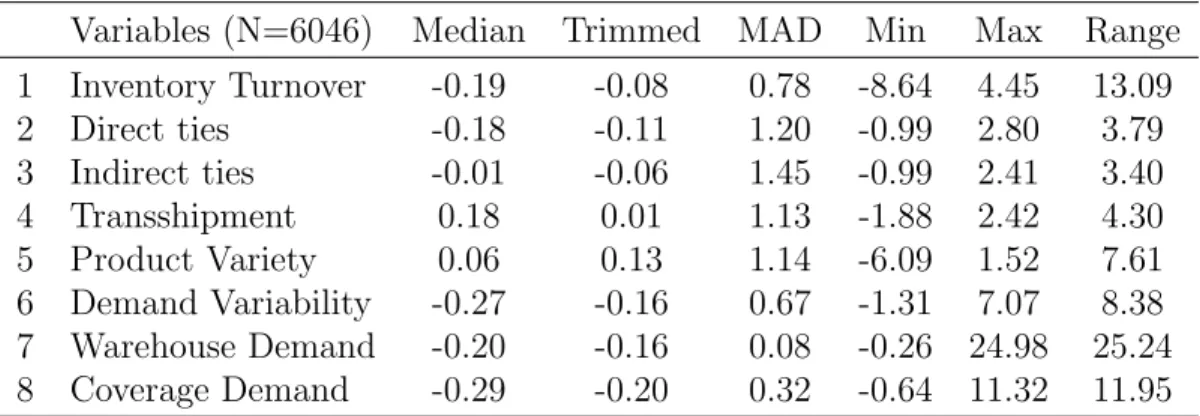
Table 2.1 displays the summary statistics of the study variables. Table 2.2 shows the corresponding correlation matrix. From Table 2.2, inventory turnover is strongly correlated with both direct ties and indirect ties, indicating possible structural ef-fects. The inventory turnover is also correlated with exogenous controls, justifying the inclusion of the control variables.
Table 2.1: Summary Statistics of the Variables
Variables (N=6046) Median Trimmed MAD Min Max Range 1 Inventory Turnover -0.19 -0.08 0.78 -8.64 4.45 13.09 2 Direct ties -0.18 -0.11 1.20 -0.99 2.80 3.79 3 Indirect ties -0.01 -0.06 1.45 -0.99 2.41 3.40 4 Transshipment 0.18 0.01 1.13 -1.88 2.42 4.30 5 Product Variety 0.06 0.13 1.14 -6.09 1.52 7.61 6 Demand Variability -0.27 -0.16 0.67 -1.31 7.07 8.38 7 Warehouse Demand -0.20 -0.16 0.08 -0.26 24.98 25.24 8 Coverage Demand -0.29 -0.20 0.32 -0.64 11.32 11.95 Note: All variables are standardized (mean = 0 and sd = 1) for confidentiality.
Table 2.2: Correlation Matrix of the Continuous Variables
Inv turn Dir tie Indir tie Trans Prod var Dmd var Wh dmd Inv turn Dir tie -0.35∗∗∗ Indir tie -0.44∗∗∗ 0.75∗∗∗ Trans -0.02 0.50∗∗∗ 0.29∗∗∗ Prod var -0.49∗∗∗ 0.62∗∗∗ 0.61∗∗∗ 0.64∗∗∗ Dmd var 0.15∗∗∗ -0.19∗∗∗ -0.17∗∗∗ -0.23∗∗∗ -0.29∗∗∗ Wh dmd -0.01 -0.02 -0.08∗∗∗ 0.20∗∗∗ 0.19∗∗∗ -0.07∗∗∗ Cover dmd 0.12∗∗∗ 0.11∗∗∗ -0.21∗∗∗ 0.18∗∗∗ 0.04∗∗∗ -0.11∗∗∗ 0.50∗∗∗ Note: Pearson’s paired test. †p <0.1, ∗p <0.05, ∗∗p <0.01,∗∗∗p <0.001 (two-tailed).
Table 2.3 shows the results of the 2SLS-FE estimation with the Arellano-robust inference. Notice that the residual sum of squares (RSS) is no longer constrained
to be smaller than the total sum of squares (SST) for the 2SLS estimation (Sribney et al., 2018). Hence,R2 and F statistic are pseudo and may not be interpretable.
We first examine the association between control variables and warehouse inven-tory efficiency (Models (1) in Table 2.3). Both product variety and demand variability significantly reduce inventory turnover, indicating their effects on reducing warehouse inventory efficiency. Transshipment significantly increases inventory turnover, as ex-pected. Other control variables are also significant, justifying the inclusion of con-trol variables. Specifically, warehouse demand is positively associated with inventory turnover, which comforts to the notion that higher demand usually leads to quicker turnover (Gaur et al., 2005).
Next, we examine the effects of direct and indirect ties. Model 2 shows a negative effect of direct ties (coeff. = −0.244∗∗∗) and a positive effect of indirect ties on inventory turnover (coeff. = 0.143∗), controlling for transshipment. The results show that increasing direct ties reduces warehouse inventory efficiency, supporting Hypothesis 1. Controlling the effect of direct ties, the increase in indirect ties is associated with higher warehouse inventory efficiency, which supports Hypothesis 2.
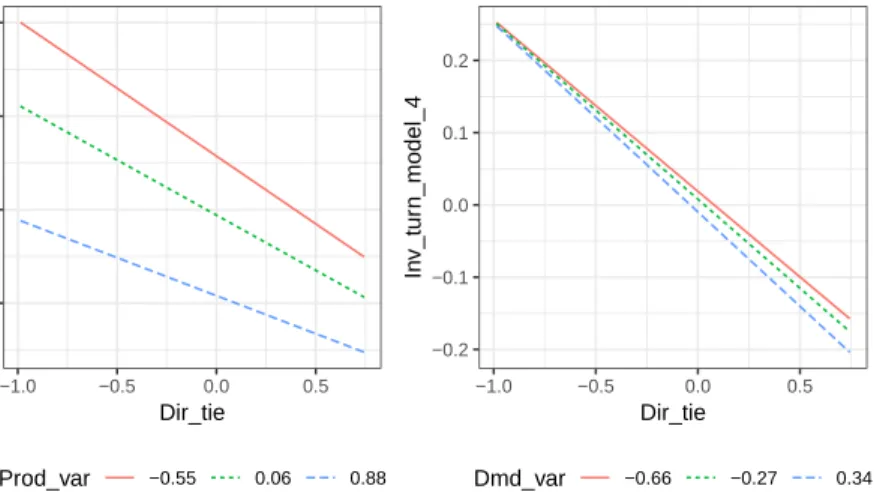
Models (3) and (4) in Table 2.3 show the interactions between direct ties and prod-uct and demand variabilities. We separate interaction terms into different models to further minimize multicollinearity. The interaction terms are significant. Specifically, high direct ties weaken the effect of product variety (coeff. = 0.111∗ in Model (3)), which supports Hypothesis 3. High direct ties strengthen the effect of demand vari-ability (coeff. = −0.024∗∗ in Model (4)), which supports Hypothesis 4. To better understand the interaction effects, Figure 2.2 displays the interaction plots between direct ties, product variety, and demand variability. The choice of product variety and demand variability values correspond to their 25%, 50%, and 75% quantiles. We discuss implications from the interaction effects in more details in Section 2.6.