Doppler Shift Estimation and Jamming Detection for Cellular Networks
Javad Afshar Jahanshahi, Seyed Ali GhorashiCognitive Telecommunications Research Group, Department of Electrical Engineering, Faculty of Electrical and Computer Engineering, Shahid Beheshti University G.C., Evin 1983963113, Tehran,
IRAN.
Abstract:The estimation of mobile terminal speed at base station in cellular networks helps BTS in many aspects including channel estimation, adaptive reception, anti-jamming and handover operations. In this paper, we introduce a new algorithm to estimate the channel Doppler shift seen by BTS, using the measured received signals at base station. We have improved an LCR based Doppler shift estimation algorithm by using only inherent information which are available in common receivers without any excessive hardware. An improved scheme for jamming detection based on the proposed Doppler shift estimation is proposed, as well. The performance of the proposed algorithm in a TETRA network is modeled and the simulation has shown acceptable results in a wide range of velocities and jammers.
Key words: TETRA (Terrestrial Trunked Radio), Doppler shift, jamming detection INTRODUCTION
The speed of a mobile terminal in wireless communication networks is an important piece of information that can improve system performance in many ways. Knowing the speed of the mobile terminal enables the receiver to perform more efficient channel estimation. Similarly, in adaptive transmission, it helps the transmitter to adjust a suitable modulation/coding scheme according to the channel condition. In addition, based on the speed information of the mobile terminals, handover time can be determined more accurately. Speed information can also be used in anti-jamming techniques, when the receiver tries to differentiate between signal attenuations caused by jamming and channel effects (Sampath, A. and J. Holtzman, 1993). Meanwhile, speed estimation by additional sensors like gyroscopes or accelerometers, and systems like GPS (Global Positioning System), increases the complexity and overall costs of the user terminals, and furthermore, reduces the handset battery life time. Therefore, several techniques have been proposed in literature for mobile terminal speed estimation based on channel Doppler shift measurement, and some of them have been implemented in existing mobile communication systems. Covariance estimation schemes estimate Doppler frequency shift by computing covariance value between training received samples (Baddour. K.E. and N.C. Beaulieu, 2005; Anim-Appiah, K.D., 1999; Holtzmann, J.M. and A. Sampath, 1995; Tepedelenlioglu, C., 2001; Austin, M.D. and G.L. St¨uber, 1994). Other schemes for Doppler frequency shift estimation have used spectral analysis and variance (Mottier, D., D. Castelain, 1999), estimation of channel envelope and angle (Tepedelenliogl, C., G.B. Giannak, 2001), statistical information of channel phase variations (Hua Jingyu, 2004), Eigen based spectral estimation (Austin, M.D., 1994), spectrum estimation method based on channel power spectrum density (Jingyu, H. Han, 2004), multi vector test by using maximum likelihood approaches (Krasny, L., 2001), wavelet analysis by tracking changes in the temporal scale (Narashimhan, R. and D.C. Cox, 1999) and channel auto-correlation (Yi Sha, Na Yao, Xiaojing Xu, 2008).
In (Cho, M.G., D. Hong, 2004), authors proposed an LCR based algorithm that estimates terminal’s speed over each speed estimation window, and consequent windows do not overlap each other. They also used a single threshold for signal power comparisons. However, the proposed algorithm in (Cho, M.G., D. Hong, 2004) cannot follow the mobile terminal’s variation in low SNR conditions. In this paper the Doppler shift estimation algorithm is improved by utilizing a speed estimation window that slides over bursts with overlaps and by introducing two different low and high thresholds for power level comparisons. These thresholds are
Corresponding Author:Javad Afshar Jahanshahi, Cognitive Telecommunications Research Group, Department of Electrical Engineering, Faculty of Electrical and Computer Engineering, Shahid Beheshti University G.C.,
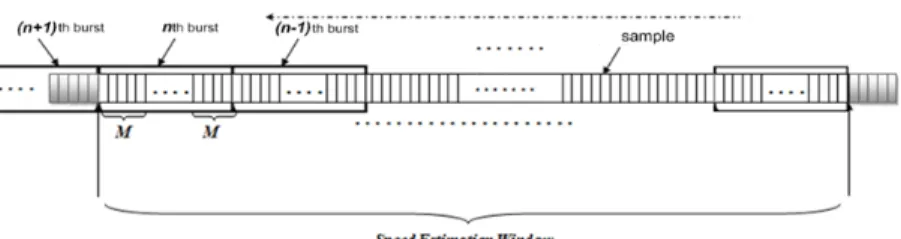
Fig. 1 shows the structure of received complex samples over one speed estimation window (i.e. 0.5 or 1 second). This window slides over samples of received signal. Each window divided into groups of samples where:
N
[
WL
]
(1)M
where is the rounding down operator,
[.]
WL is the number of samples within a speed estimation window and M is the segmentation factor. The segmentation factor will be updated for each received burst.Fig. 1: The structure of speed estimation window.
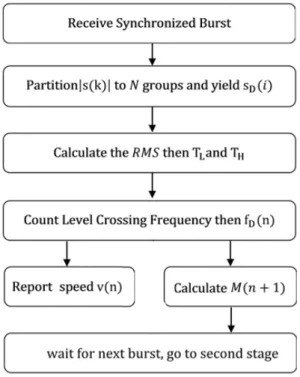
The flowchart of the proposed Doppler shift estimation algorithm is illustrated in Fig.2. At the first stage, the power of the received signal is calculated. This power is measured within a fixed size speed estimation window. Then, the power meter computes group powers S iD( ), i {1, 2, 3, ...,WL}
M (2) * 2 ( 1)* 1
1
( )
.
( )
( )
i M D z i MS i
s z
M n
¦
where is the power of samples over
S i
D( )
i the group. In the third stage, RMS meter computes the root mean square of group powers during speed estimation window as:(3) 2 1
1
.
( )
WL M D iRMS
WL
S i
M
¦
Fig. 2: Signal Flow of the Proposed Algorithm.
The calculated RMS is then used to determine low and high thresholds for level crossing calculations. Then, high and low level crossing thresholds and are calculated. These thresholds should be fractions
T
HT
L of the RMS value calculated in previous stage:(4)
.
.
1
H LT
y RMS
T
x RMS
o x y
In the fourth stage, level crossing counter counts level crossing frequency , which indicates how many
L
R times group powers cross thresholds and in positive slope.S i
D( )
T
HT
LIn Rician fading channel with 2-dimensional isotropic scattering, the Doppler shift is given by (Theodore Rappaport, 2001): (6) 2 ( 1). 0
.
. 2 (
1). (2 .
(
1) )
k k R D H LL e
f
k
I
k k
T
T
RMS
UU
S
U
U
where denotes the Doppler shift,
f
D k denotes the Rician fading factor, represents the modified zeroI
0 order Bessel function, and e is Euler’s number. The Doppler shift of each received burst is given by its angleFor example, when signaling is done with in a typical value for a TETRA system,
f
c396
MHz
100 km/h terminal speed results in maximum Doppler shift of . The estimated speed ismax
37
D
f
Hz
reported in the fifth stage. In the last stage, segmentation factor for the next incoming burst is updated as:
(9) max
[
]
*
s Df
M
scaling factor f
Where is again a rounding down operator, is sampling frequency, is maximum Doppler
[.]
f
smax
D
f
frequency and “scaling factor” which is dependent on the channel type. In rapidly changing channels, since the amplitude of the signal varies more rapidly during a burst, the limits of scaling factor cannot be set as high as what it is in static channels. A rapidly changing channel may appear in some situations, i.e. where the speed of the user terminal is high. The algorithm interrupts until it receives new bursts. Algorithm started again (go to stage two) by using this new value of M when a new burst arrives.
3. Jamming Detection:
In this section, the proposed jamming detection method which is based on the (Kurhila, M., M. Torvinen, 2006) is described.
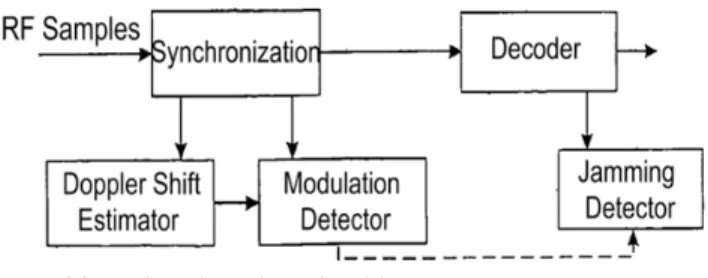
The peak and mean values of the correlation between RF received samples and training sequences (generated by the receiver) are measured in the synchronization block by match filter. The Doppler shift estimator block estimates the effective user velocity which will be used for weighting the mean values. Based on the estimated Doppler shift and synchronization values, the state of modulation is decided in modulation detection block. The relations and procedure between these mentioned blocks are shown in Fig. 4.
Fig. 3: The overall procedure of jamming detection algorithm
The rest of the jammer detection algorithm is the same as (Kurhila, M., M. Torvinen, 2006) and the overall of the jammer detection procedure is shown in figure 4 and in Appendix.The difference between our improved algorithm and Kurhila et.al (Kurhila, M., M. Torvinen, 2006) method is in the Doppler shift estimation process. Using our proposed Doppler shift estimation makes the modulation detection process more accurate.
Fig. 4: Modulation detection algorithm 4. Simulation Results and Analysis:
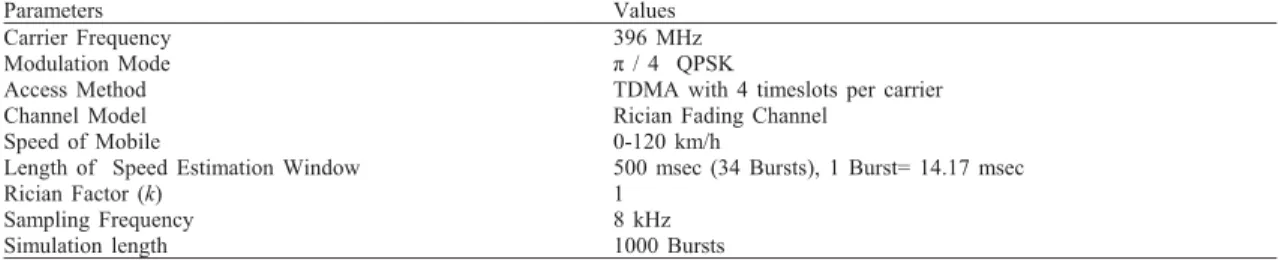
In order to evaluate the performance of the proposed algorithm for estimating the user speed by BTS, simulations are performed according to conditions reported in Table 1. In the simulation, we used the simulated MS generated data in a TETRA system and passed them through a Rician fading channel. The initial value for M is set 40.
Table 1: Simulation Parameters
Parameters Values Carrier Frequency 396 MHz Modulation Mode / 4 QPSK
Access Method TDMA with 4 timeslots per carrier Channel Model Rician Fading Channel
Speed of Mobile 0-120 km/h
Length of Speed Estimation Window 500 msec (34 Bursts), 1 Burst= 14.17 msec Rician Factor (k) 1
Sampling Frequency 8 kHz Simulation length 1000 Bursts
For the simulation results, is defined to indicate the normalized relative estimation error:
(9) max max max
ˆ
D D Df
f
f
K
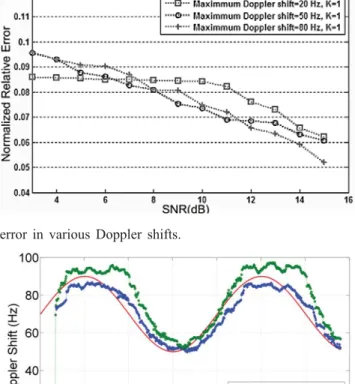
where, is estimated Maximum Doppler shift. Fig. 5 illustrates the performance of the proposed
max
ˆ
Df
algorithm in three different maximum Doppler shifts versus SNR. It shows that how the performance of Doppler shift estimation algorithm improves when SNR increases.
In Fig. 6, the accuracy of the proposed algorithm in tracking the speed of users, is shown. After receiving 34 burst (34 burst = 0.5 sec), the proposed algorithm starts and initial estimation of user’s speed is performed. Then, a speed is estimated for each coming burst. It can be seen that the proposed algorithm outperforms the reference algorithm (Cho, M.G., D. Hong, 2004) in following the mobile terminal’s variation in low SNR conditions.
Fig. 7 shows the performance of two jamming detection methods by (Kurhila, M., M. Torvinen, 2006) and our improved jamming detection algorithm in a fixed Signal to Jammer (SJR=8 dB) over the TETRA network. Note that, in these simulation results, a simple type of jammer detection algorithm of Kurhila et.al (Kurhila, M., M. Torvinen, 2006) is considered and just the used Doppler shift estimation method is different. In this simulation it is expected that 52% of information should be corrupted. This feature is shown by the constant red line.
Fig. 5: Normalized relative error in various Doppler shifts.
Fig. 6: Comparisons between Proposed Method and Hong Method
Fig. 7: Percentage of corrupted bursts due to jammer, the constant curve is expected corruption percentage and the other curves are the algorithms’ estimation. SJR=8 dB, Lower Limit=9, Upper Limit=12, Doppler Shift=20 Hz. RSSI=-60dBm.
We can see from the curves that the performance of the improved jamming detection method is better than Kurhila et.al method (Kurhila, M., M. Torvinen, 2006) especially in low SNRs. As shown in Fig. 7, the proposed method results is closer to the expected corruption percentage 52% than Kurhila et.al algorithm (Kurhila, M., M. Torvinen, 2006) result, and it converges to the constant curve more rapidly.
5. Conclusion:
In this paper, a level crossing based algorithm for Doppler shift estimation is improved and used to enhance the performance of Jammer detection. It is shown that the performance of the improved algorithm in moderate SNRs (i.e., SNR=5 dB) for TETRA users is acceptable. The application of the proposed algorithm is modeled and simulation results have shown a good performance in a wide range of velocities and jammers.
ACKNOWLEDGMENT
The authors would like to thank Depelmaan Pardaz Ltd. for partially supporting of this research. Appendix
The Flowchart of the jamming detection algorithm’s details is shown in Fig. 8 which is proposed in the (Kurhila, M., M. Torvinen, 2006).
Appendix: Fig. 8: The jamming Detection Algorithm in details (Kurhila, M., M. Torvinen, 2006) REFERENCES
Austin, M.D., Gordon. L. Stuber, 1994. Eigen-based Doppler estimation for differentially coherent CPM, IEEE Trans on Vehicular Technology, pp: 781-785.
Anim-Appiah, K.D., 1999. On Generalized Covariance-Based Velocity Estimation, IEEE Transactions on Vehicular Technology, 48(5): 1546-1557.
Austin, M.D. and G.L. St¨uber, 1994. Velocity Adaptive Handoff Algorithms for Microcellular Systems, IEEE Transactions on Vehicular Technology, 43(3): 549-560.
Baddour. K.E. and N.C. Beaulieu, 2005. Robust Doppler Spread Estimation in Nonisotropic Fading Channels, IEEE Transactions on Wireless Communications, 4(6): 2677-2682.
Cho, M.G., D. Hong, 2004. Velocity Estimation Apparatus and Method Using Level Crossing Rate, US patent 0235479 A1.
Hua Jingyu, You Xiaohu, Sheng Bin, et al. 2004. A scheme for the Doppler shift estimation despite the power control in mobile communication systems, IEEE Vehicular Technology Conference. Spring, pp: 284-288.
Tepedelenlioglu, C., A. Abdi, G.B. Giannakis and M. Kaveh, 2001. Estimation of Doppler spread and signal strength in mobile communications with applications to handoff and adaptive transmission, John Wiley & Sons, Ltd.
Tepedelenliogl, C., G.B. Giannak, 2001. Estimation of Doppler Spread and Signal Strength in Mobile Communications with Application to handoff and adaptive transmission, Wireless Communications and Mobile Computing, 1(2): 221-242.
Theodore Rappaport, 2001. Wireless Communications: Principles and Practice, 2nd Edition, Prentice Hall. Yi Sha, Na Yao, Xiaojing Xu, 2008. Improvement and Performance Analysis of A Scheme for the Maximum Doppler Frequency Estimation, IEEE-WiCome Conference.