Filter Bank Multicarrier Modulation Scheme
for 5G Cellular Communication Systems
under Various Fading Channels
P.Naga Rani1, Dr. Ch. Santhi Rani2
P.G. Student, Department of Electronics and Communication Engineering, DMS SVH College of Engineering,
Machilipatnam, Andhra Pradesh, India1
Prof & Head, Department of Electronics and Communication Engineering, DMS SVH College of Engineering,
Machilipatnam, Andhra Pradesh, India2
ABSTRACT: The fifth generation mobile communication will be deployed in many countries by 2020 which aims to
furnish a real wireless world free from present obstacles in communication system which is a great motivating factor for all the researchers, academicians and engineers. The new technologies are being investigated that provide high speed, capacity, spectral efficiency, energy efficiency, pseudo outdoor communication, etc. that solves the existing problems in mobile communication system. This paper aims to highlight the aspects of Multicarrier modulation scheme which is popular with Fifth Generation (5G) with Filter Bank Multi Carrier (FBMC) modulation scheme. OFDM is an incredible Multiple Access Modulation strategy adopted in Fourth Generation (4G) communication system even though it is not exempt of defects. OFDM suffers from the difficulty of Side band leakage. To overcome this, FBMC modulation scheme is used. This paper gives an overview of dominant metrics like Power Spectral Density (PSD), Bit Error Rate (BER) of forthcoming Cellular Communication System’s modulation scheme. The simulation results of FBMC under perfect channel assumption gives BER values of 0.010213, 0.009945 for K=3, 4 respectively at a Signal to Noise Ratio (SNR) of 5dB. It is also observed that the effect of Rayleigh and Rician channels in FBMC give BER values of 0.49988, 0.5081 and 0.15615, 0.12549 for K=3, 4 respectively. From the simulation results it is observed that, FBMC outperforms the most popularity gained by 4G modulation technique.
KEYWORDS: 5G; FBMC; Multi Carrier; OFDM; BER; Fading channel.
I. INTRODUCTION
The Efficient utilization of bandwidth is a crucial parameter for the development of any communication system. In addition to the never ending requirements, i.e. higher peak data rate, more capacity, better cost efficiency provokes new challenges to be addressed. High reliability, very long battery lifetimes and very low response times call for Another “G”. All these things come into reality in the form of 5G. A wide research is being carried out by researches on 5G and 5G holds the promise of high social and economic valued applications, leading to a ‘hyper-connected society’ in which mobile will play an ever more important role in people’s lives. OFDM, as a multi-carrier modulation technique, has been extensively acquired by 4G communication systems, such as LTE. Although it is efficient, it suffers from large PAPR values and also high out of band leakage which leads to high battery consumption. A Multi Carrier technique used in 5G is Filter Bank Multi-Carrier (FBMC) technique. It is a well known multicarrier technique in which data symbols are simultaneously transmitted over multiple frequency subcarriers.
A. STRUCTURE OF ASSESSMENT
This paper is organized as follows. Section I gives a brief introduction, Section II describes System Model which represents Transmitter and Receiver Sections. After that Simulation Results are given in Section III. Section IV deals with Conclusion. Finally, Section V presents References.
B. LITERATURE SURVEY
In perfect Channel State Information (CSI), FBMC gives higher energy efficiency than OFDM. The opposite occurs if imperfect CSI is assumed. To solve this problematic situation Miquel Payaro, Antonoi Pascual-Iserte, Montse Najar[1] proposed a novel beam forming receiver for FBMC, then better BER results occurs over OFDM.
In Long Term Evaluation systems like Dynamic Spectrum Access (DSA) and Cognitive Radio (CR), OFDM is a popular Multi-Carrier method but suffers from few drawbacks. To overcome these drawbacks Bidyalaxmi Devi, Nongmaithem Lalleima, Sonika Singh [2] suggest FBMC. OFDM and FBMC are Multi-Carrier techniques. Bidyalaxmi Devi Tensubam, Sonika Singh [3] said that if both these techniques have same frequency pattern then a high degree of compatibility can be obtained
II. SYSTEM MODEL
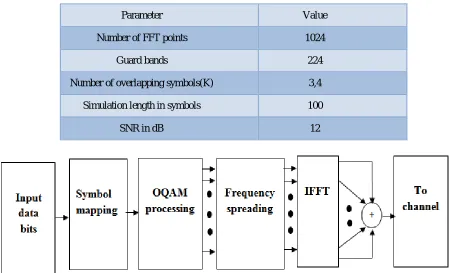
FBMC is a 5G technique for increase spectral usage by filtering the each subcarrier. The overlapping factor K is characterized the PHYDAS [4] filters. Where, K is the number of multicarrier symbols that overlap in a time domain. The order of prototype filter can be chosen as 2*K-1 where K = 3, 4 and length of prototype filter in a time domain is L=KN [5]. The simulation parameters are shown in Table 1 and FBMC Transmitter section is shown in Fig.1.
Table 1: Simulation parameters of FBMC
Parameter Value
Number of FFT points 1024
Guard bands 224
Number of overlapping symbols(K) 3,4
Simulation length in symbols 100
SNR in dB 12
The present implementation of FBMC uses frequency spreading. A well known dominant problem in multiparty channels is Inter Symbol Interference (ISI). Orthogonality is the basic principle involved in OFDM to reduce ISI. In FBMC total available band is divided into a number of subcarriers. Unlike OFDM, subcarriers do not meet the orthogonality principle. Therefore, ISI becomes a trouble shoot. To overcome this trouble, FBMC keeps unchanged symbol duration. Filtering is added at transmitter and receiver side followed by IFFT/FFT operations to cope with adjacent multicarrier symbols overlapping in a time domain. The length of IFFT is N*K in which the delay of overlapped symbols is N/2, here N represents a number of subcarriers. The synthesis analysis of filter bank structure is formed by prototype filtering along with IFFT/FFT operation. Here significant ISI suppression is possible by a prototype filter design. In order to guarantee, ISI-free operating additional coefficients are introduced in the frequency domain between FFT coefficients. This additional coefficient number is known as overlapping factor which is represented by k of the filter. Prototype Filter impulse response can be expressed as in eq. (1).
( ) = 1 + 2 cos(2 )
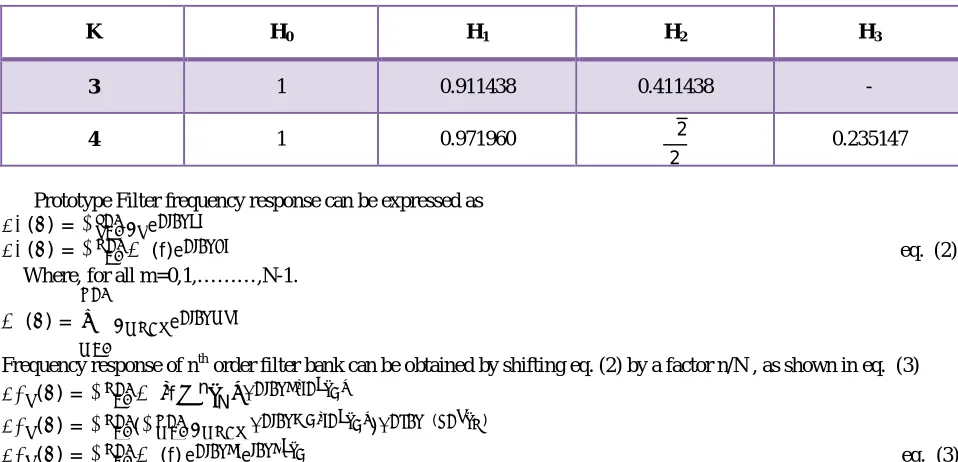
eq. (1) Where Hm are coefficients which are listed in Table 2.
Table 2: List of coefficients Hm for Overlapping Factor values 3 and 4
K H0 H1 H2 H3
3 1 0.911438 0.411438 -
4 1 0.971960 √2
2 0.235147
Prototype Filter frequency response can be expressed as
( ) =∑ ℎ e
( ) =∑ (f)e eq. (2) Where, for all m=0,1,………,N-1.
( ) = ℎ e
Frequency response of nth order filter bank can be obtained by shifting eq. (2) by a factor n/N , as shown in eq. (3)
( ) =∑ f−n N
( ) =∑ (∑ ℎ ) ( )
( ) =∑ (f) e e eq. (3)
Fig.2 Block diagram of FBMC Receiver
Figure 2 shows the FBMC receiver block diagram. The data received from channel undergoes FFT operation. Data symbols are obtained from pre processing of OQAM followed by frequency dispreading. The original data bits are recovered from the data symbols by performing symbol remapping. BER is measured in the absence of channel for the chosen configuration.
III. SIMULATION RESULTS
The simulations are carried out using MATLAB. It is a multi-paradigm supporting language tool. In this section, the performance of one of the 5G waveforms (FBMC) is examined. The effective spectrum utilization plays an important role to get the popularity of any cellular system. Fig.3 and Fig.4 depict the PSD values for FBMC and OFDM. On comparing PSD plots of FBMC and OFDM, we showed that FBMC has efficient spectrum utilization than OFDM.
Fig.3.Power Spectral Density of FBMC at Overlapped Symbols = 4 Fig.4. Power Spectral Density of OFDM
Fig.5. FBMC BER curve for K=3, 4.
The performance of FBMC in the presence of channel includes 2 cases. Case 1 and case 2 are related to Rayleigh fading channel, Rician fading channel. Both the cases are observed for BER at K=3, 4. Fig.6 and Fig.7 shows FBMC BER curve for K=3, 4 with Rician channel, Rayleigh Channel respectively.
Fig.8 With and without channel FBMC BER curve for K=3, 4
Fig.8 shows BER performance of FBMC without, with Rician and Rayleigh channels. Studying these plots without channel gives better result than with channel and in case of with channel, Rician channel gives better performance than Rayleigh channel.
IV. CONCLUSION
The supreme parameter of a cellular communication system to function is the spectrum. So, effective spectrum utilization plays a crucial role in the success of any new cellular system. One of the candidate solutions for 5G is FBMC because it has less out-of-band leakage compared to OFDM. The simulation results are carried out for FBMC system in the absence of channel. It is observed that the BER values for chosen configuration at a SNR of 5dB are 0.010213, 0.009945 for K=3, 4 respectively. The performance of the system under Rayleigh and Rician fading channels is also considered in this work. Under Rayleigh fading channel BER of 0.49988, 0.5081 and for Rician fading channel BER of 0.15615, 0.12549 are observed for overlapping factor k=3,4 at SNR of 5dB. From the simulation results, it is observed that FBMC gives high spectral efficiency compared to OFDM.
REFERENCES
1. Miquel Payaro, Antonoi Pascual-Iserte, Montse Najar “Performance Comparison between FBMC and OFDM in MIMO Systems under
Channel Uncertainity” IEEE European Wireless Conference, 2010, pp. 1023-1030
2. Bidyalaxmi Devi, Nongmaithem Lalleima, Sonika Singh, “Comparative Analysis of FBMC and OFDM Multicarrier Techniques for Wireless Communication Networks”, International journal of Computer applications, vol. 100, No 19, Aug 2014.
3. Bidyalaxmi Devi Tensubam, Sonika Singh “A Review on FBMC: An Efficient Multicarrier Modulation System”, International Journal of Computer Applications, Vol 98, No 17, July 2014.
4. “FBMC physical layer : a primer’, PHYDYAS EU FP7 Project 2010.
5. Ari Viholainen, Tero Ihalainen, Tobias Hidalgo Stitz, Markku Renfors and Maurice Bellanger “Prototype Filter Design for Filter Bank MultiCarrier Transmission”, 17th European Signal Processing Conference (EUSIPCO), Aug 24-28, 2009, pp. 1359-1363.
6. Yahia Medjahdi, Michel Terre, Didier Le Ruyet, Daniel Roviras “Asynchronous OFDM/FBMC Interference Analysis in Selective Channel”, IEEE 21st International Symposium on Personal Indooe and Mobile Radio Communications, 2010,pp 538-542.
7. Theodore S. Rappaport, Shu Sun, Rimma Mayzus, Ha g Zhao, Yaniv Azar, Kevin Wang, George N. Wong, Jocelyn K. Schulz, Mathew Samimi, Felix Gutierrez, “Millimeter Wave Mobile Communications for 5G Cellular: it will Work!”, IEEE Access, Vol (1), 2013, pp. 335-349. 8. P. Naga Rani, Dr. Ch. Santhi Rani "UFMC:The 5G Modulation Technique", 2016 IEEE International Conference on Computational
Intelligence and Computing Research (ICCIC), Dec 15-17, 2016.
BIOGRAPHY
P.Naga Rani is pursuing M.Tech in Electronics and Communication Engineering from D.M.S.S.V.H College of
Engineering, Machilipatnam, Andhra Pradesh, India. Her B.Tech degree was received from the same College in the year 2015. She published a paper titled UFMC:The 5G Modulation Technique in IEEE international Conference on Computational Intelligence and Computing Research held from 15th-17th December, 2016 at Agni College of Technology, Chennai, India. Her area of interest is Wireless Communications.
Dr. Ch. Santhi Rani received her B.Tech degree from Nagarjuna University, Andhra Pradesh, India, M.Tech degree